10 Mistakes the CEO/Founder of ZoomInfo Made on His Journey to IPO (and Beyond)
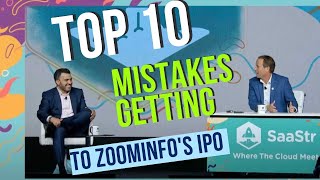
Transcript of a conversation (Jason M. Lemkin interviewing Henry, CEO of ZoomInfo) focused on ZoomInfo’s journey from bootstrap to IPO, company metrics (profitability, margins, ARR, customers), go-to-market strategy, hiring/talent lessons, and a framed list of "10 mistakes" Henry made while scaling to a billion in ARR. The piece mixes concrete facts (margins, growth rates, dates of fundraising milestones) with tactical leadership and GTM lessons.
Chapters
The way you advertise your round if you're in our space, is you say, we raised it to disrupt Zoom Info. We had a product and a team that could take us to the next level. There's no platform out there that's brought together the breadth, the depth and the accuracy of business information the way that we have. None of it is possible without the great employees that we've hired along the way. I think when we went public, it was a major validating moment for everybody. What it cemented for me is if you get a bunch of people together and you get them to believe that they can basically accomplish anything, kind of turns out they can't. It's gonna be hard. That is the game. There's no way who you are today is who you need to be a year from now. I want to build this company into an iconic software company. That's what we're driving to.
So thanks, everybody, for streaming in after lunch. Having fun on day two. Good time. How many of you guys use Zoom Info now? Or any of our products or have before? Quick show of hands.
Thank you. I appreciate that.
Thank you. So we are lucky. We are lucky. We're lucky that Henry happens to be here in Barcelona, which is great, and was able to drive by. I think we're especially fortunate.
To have.
The CEO of ZoomInfo here today, because as iconic a company it already is, it's very apropos for the time we're in today. Right. And we'll talk about it in the minute. If you guys don't know, I think you were the first IPO after Covid hit, right?
Yes.
Yeah, the first weird one where there's just you on Zoom ringing the bell all by. Was it.
Is that image my wife pretending to hit a button.
Pretending to hit a button.
Right.
Like peak lockdown, which is crazy in and of itself.
Right? Yes.
And then we're going to talk. We're going to talk. Henry was kind enough. We did one of these during Peak Covid during a digital event. Go watch it. It was Great. It was 10 mistakes on the way to 400 billion. We thought we're here together. Henry wanted to update it with new learnings about getting to a billion in ARR and almost $20 billion market cap.
But.
Oh, maybe. Let me click to the next slide. But what we'll talk about some of the metrics, but what's not on this is the operating margins of this company.
Yeah.
The operating margin. And some of you guys may not even know what an operating margin is yet, but Zoom Info has been. There are profitable companies and then there are companies that by their very nature generate massive cash like we thought software should. And Zoom Info, the operating margin is like 39% approaching 40.
39%, yes.
So almost for the billion in revenue, Zoom Info is going to generate almost 400 million of operating operating income and plus or minus that for free cash flow. It's insane, right? And this is not self serve. This is a sales driven motion. I don't know that there's any company that has a motion like this that has margins like that, is there?
I don't know of a company that has margins like this in software, period.
I think Zoom might be close, right?
Yeah, yeah. We don't have a self service motion. We go direct to customers. So those of you who raise your hand at some point interacted with the sales rep at ZoomInfo, we grew. Now we're also growing the top line. We grew the top line 50 plus. 50% last quarter we did that with 40% operating margins. Yeah. In a world where historically nobody cared about operating margins. And when we went public, one of the big conversations we were having with investors is like, why are you profitable? Should you be profitable? And for the next year there was this constant push about, well, what if we take margins down and increase growth? And should we take margins down more than that and increase growth? And we did, actually, before we went public, it was more like 44, 45% margins. And we've taken that down to just sub 40 to grow the top line. But today it is a much different world. And that happened, you know, almost overnight. It shifted from take your margins down and grow your top line to make sure you maintain those margins. Those margins are really, really important. Yeah.
So, yeah. And so in what you were telling me before, just to tease that a little bit, as you're going to ipo, people didn't even understand why you needed.
To be that profitable.
It didn't even make sense to investors. Right.
In the go go days it was actually a negative.
A negative.
Right.
You must not, you must be too conservative, Henry. You're not, you're not investing properly.
Right. You don't believe that the TAM is as big as it actually is. Yeah. Or you don't believe the company is as good as it is because if you, you did, you would take that money out of margins and you put it back into growth. Yeah.
So there's. And I want to just chat on it on a couple more points and then we'll dig into the 10 mistakes to a billion in ARR. But first of all, just for the folks to process it, it's almost a narrative violation versus Twitter, right? And you can either be bootstrapped and grow slowly and maybe later grow, right? Or, or you, you invest everything, right, because you have to fuel growth. But to be able to do this with the sales driven motion, people will tell you it's not possible. But this is like any great company is an outlier, right? They're all, they're all, they're all. The public ones are outliers. GitLab's an outlier. Zoom info. They're all Hashicorp. But it clearly can be done. It don't have people tell you that it cannot be done. It can be done. And just to break it down. But for the. What are the. From a mechanical SaaS mechanics perspective, what lets you do that with the sales driven motion?
It's the go. The go to market efficiency that we drive at the front end drives the ability to do that at scale. So if you go fill out a form on the ZoomInfo website today, somebody will call you within 90 seconds. The person who's calling you has been algorithmically chosen as the SDR who's most likely to convert your type of company and your level of buyer into an opportunity. A demo for an account executive. When you get assigned an account executive, the SDR gets a ranked list of the account executive that's most likely to convert that opportunity to a closed one business. And then all of our account executives are ranked in four different tiers. And based on what tier you're in, you get a higher quality of leads. And if you're in tier one, you get the best leads. If you're in tier two and you outperform your tier two peers by 20, 20%, you can move up to tier one. If you underperform, you move down to tier three. And the leads are distributed based on the quality of the account executive. So it's a lot of science that goes into the way that we generate the leads, we route the leads and then we close new business. And that drives a 10xLTV to CAC a sub 30 day sales cycle. Often deals are closed same day. And these are not like you know, two or $3,000 deals. These are 20, 30, 40, $50,000 lands.
And I should know this, but on the marketing side is because there's no viral. I mean maybe there's a little bit of viral element to the product, but it ain't much. It ain't. It ain't much, is it Word of mouth. Like because you're marketing at that CAC and a sales driven, the marketing cost has to be almost zero. Like the math doesn't work unless you can't spend a year of customer just on marketing. It has to be minuscule. Right. It's got to be weeks or month or two.
Yeah. So it is. It is short. And the. It's a lot of word of mouth, it's a lot of SEM, a lot of SEO. Yeah. And then. And so that's driving the top of the funnel for us. And that. Yeah, that's where we're investing SEM, SEO.
But that's the bulk. That's the majority. Right, that's the majority. And did you hack it? Did you have some magical growth hacker you found on Angel List or Craigslist? Or was it just brute for force of just doing it year after year?
SEO SDM magic force and iteration constantly.
Okay, it's interesting. All right. We can spend the whole time on that because there's a bit of a counter narrative in that. But. But pretty cool. But let's go through this before we do. For folks, I do think. And then I want to let Henry do most of the rest of the talking. I do think Zoom Info is a very interesting company because it's one of the ones that more of us have used as a product than Noah as a company. You know, we're all still newly public. So many. But almost $1 billion in error. 25,000 customers. So sorry, the average ACP, I should do it in my head. But 20. About 20 to 30K.
Yeah.
On average. But going more enterprise, 11% international, which we might not talk about today, but you know, data does take a little bit longer. But now it's the fastest growing segment, right? 80% or something.
Yeah. The international business is growing plus 80% at over $100 billion revenue run rate.
And for quite a while bootstrapped. Right. And I want to get into this, but when did you de bootstrap?
So we founded the business. I put $25,000 on my credit card. My co founder put $25,000 on his credit card. We grew it profitably without any outside funding until 2014. 2014, we're about a $30 million run rate and we're running kind of 50% margins.
Yeah. So 30 million. You debuted 30 million, right? Yeah. And what was. Was that looking back now that bootstrap is back in fashion. It went out for a while. Was that the right time when they like the Atlassian founders said they waited way Too long, right? I mean, I think they, well, maybe they're at 40 million or 100 million. I can't remember this. Pretty, pretty significant difference. But would you have waited longer? Was it the right time? Would you have gone earlier, knowing what you know now?
You know, it's hard to sit here and be a, you know, about $1 billion run rate company and say like, it was wrong.
Clearly you weren't wrong.
It was, I think at the time was it was a good time to take outside funding, take outside venture.
And did you, did you, did it accelerate, I should know this, but did it accelerate the business or just create liquidity?
You could see like the business did this when we took outside funding.
Got it. All right, I want to chat more about that, but I think we have some of that embedded. I know we're doing a little context switching, but I just, it's such an, it's one of my favorite companies, but it's maybe the most interesting SaaS company to study today in this market. There's a Sasser post on it. Research it, learn about it, because you're gonna learn more. Most of you will Learn more from ZoomInfo than almost any other SaaS company you can read about. So become an expert. But bootstrapping to 30 million, getting to a billion in ARR. But number one, not being honest about your talent. I could guess what this means, but this is mistake number one.
Yeah, so this one is basically in the areas of your business where you have metrics that tell you how good people are doing, it's really easy to be vigilant about talent. So in sales, you see one or two people lagging. You know, you need to spend more time with them or at some point move them out of the business everywhere. And for me, I did sales. I carried a bag the first six years of Zoom info. So I also knew how sales worked. And I could just see like, okay, that person's not going to work out. Let's bring somebody else in. In the other areas of the business where I wasn't an expert, product development, engineering, marketing, I had inklings that the people in those departments weren't working. But I wasn't nearly as vigilant about talent as I was on the sales side. And so the advice here is what I should have done at those, in those moments was go have informational interviews with great product development heads, great engineering heads, great marketing heads, and try to compare the talent that I was meeting through those interviews to the talent that I had in house and then acted faster and so you can convince yourself, I don't really understand engineering. And they told me it's hard. So it's probably really hard. And you have a voice in your head that tells you, like, why would that be difficult? I don't understand why that's complicated. And you should listen to that voice and go do these informational interviews to validate it. And then move fast on talent in the early stages, as fast as you can, where you've got find those.
It's hard to hire a great one if you've never met a great one.
Yep, absolutely.
Pretty much impossible, right?
Yeah. And I see it in our business today. Somebody comes in and they start hiring people and I'm like, wait a second, maybe you don't know what great looks like, because it doesn't look like that to me. And so, yeah, you really want to see what great looks like so you can go try and find it.
Now, we've all made some of those mistakes, and I think, remember that. And I think, I think entrepreneurs, I've learned, are much better at this recently, which is hunting 30 great VPs of product, VPs of marketing and interviewing. But if that's not you, if you're not a hunter, go do it.
Yeah, there are more.
The good news is today there are more great VPs out there than ever before. Right. I mean, Zoom Infos directors will become VPs. You hope they all stay. But it will spawn 20 or 30 VPs of sales and they will. Some of them will talk to you. Right. There's more veterans.
Yeah.
So it's not impossible to find 20 or 30 that will talk to you and then find one great one. And then to Henry's point, if then you meet your candidate and something in your back, your mind says they're not great. They're not. There is no chance they're great.
Yeah, it doesn't matter.
Especially if everyone else likes them.
That voice never gets more quiet, gets louder.
Now, interesting question as what I've learned is that often that error repeats itself at the next stage. Then maybe you get to 30 million like we talked about, and you need a new level of management and you don't know what that level of management work. Did you solve it after the first set of management or did the error repeat itself?
Yeah, no, that's a great question. I think around 200 million of ARR, you started being confident that you knew what great looked like. And then when you were out interviewing, you knew what you were looking for and what wasn't going to work.
200 million in error. You had it figured out.
Yeah, it took us a while.
All right, well, I think that ANSWERS the question 2. There could be a lot in here thinking my CFO is. It is. Should I emphasize the my or our or my accountant?
Our. No, not my. Our. Our.
Our accountant. I can see that going a couple different ways.
No, not never. Never. My rich, Can I run the Porsche through the business?
Henry, we raised outside capital. I don't know if that's okay any longer.
That was never us. But for this mistake, until we took outside capital, the CFO was somebody who just did the books, paid the taxes. That was his job. As long as that was happening, we were great. Ran accounts payable, accounts receivable. And when we took outside funding, they said, look, that's not what a CFO is supposed to do. Your CFO should be your business partner. It should be the person who helps you understand the rhythm of the. The business, who can create early warning signals in the business to tell you when things are going well, when things are going poorly, can tell you where you should focus, where you should take away your focus and double down. And so I didn't think of a CFO like that at all. I just thought of him as a glorified accountant. When we got a new CFO in a real cfo, that CFO was able to really articulate the rhythm of the business. He gave dashboards to the department head so they understood what was going on early. He helped us double down on areas that made sense, where we were, like, shy. He would say, look at this part of the business. Look how well it's going. You're barely focusing on it. Let's double our investment here and we'll continue to reap the rewards. And so really, thinking about your CFO as a business partner, not purely an accountant, is a valuable lesson.
And I've seen. I've actually seen the quality of heads of finance deteriorate the last few years.
Oh, interesting.
I think there may be two root causes. One, startups are growing faster than ever. So however they did in the beginning, they just. They stick with it longer. Right? And some of it may just be more competition for limited number of resources. But to tie that together, like, how much can you stretch for the cfo? Is a VP of finance good enough? Like, where's that line? Because not everyone can be the person that took seven companies public. Like, how much do you stretch for the cfo? Totally.
I think you can see stretch here, especially if you get somebody who has like an FP and a Type background of financial planning and analysis background or somebody who worked in private equity and was like an analyst or a VP and is looking for a change. Those, those, those people have tremendous horsepower and they understand the operating side of the business. You can team them up with an accountant who can do all the nuts and bolts and then that business partner is going to be able to learn the accounting and also just drive the business forward too. Yeah.
And how much. And that's at the next point. But how much can your CFO really help you model out the future of your business the next year or two? How much can that. Can they own all of it. Are they too input sensitive? Like how much can they own?
I think a lot of it. A lot. All of it. Basically. I mean as long as you're a good cfo, has a really strong relationship with the business and so they're constantly meeting the product heads, the business unit heads, your sales head, your marketing head. And so they have a feel for the business that's similar to your feel. And so they're not going to get tricked into thinking like well marketing is going to quadruple leads next year because they say they're going tricks and so they're wise about that.
Yeah. My biggest flag on this hire when it's a stretch stretch is if they produce the model they think you want.
Yeah, totally.
Everyone's happy. Marketing's happy. Sales is everyone's happy. And then, and then you just pick at it also requires is like flat growth. The next six months in the back half the year will grow 10x and then it works.
Right. This should be the most sober person in the room.
You would hope.
Yeah.
All right. 3. Not appreciating go to market. We just talked a lot about SEO and SEM and others. But may that be it as a strategic advantage. What does this mean?
This one's interesting. We, we made go to market really efficient. It's the most efficient go to market. It's the most efficient Go to market Org in software, I think. And we didn't appreciate that as a strategic advantage. You start thinking of strategic advantages. You, you end up oftentimes focused on the product. The reality of the situation is we're building businesses here and businesses have so much to do with. Have a lot more to do with go to market and all of the other parts of a business than just product. Product is incredibly important. You have to get it right. But if you myopically focus on product and let the rest of the business not be a strategic, strategic advantage for you it hurts the whole business. I see this in M and A all the time now. We'll go out and do M and A, and what I'll see is two companies that are at parity from a product perspective. Both have the same features, same functionality, and one is just running a circle around the other one. And inevitably it's because the other one just didn't build a great go to market engine. Their go to market was inefficient. It wasn't very good. It was scattered and broken. And so those are great acquisitions for us because we can look at those and go, okay, that's fantastic. It's a great product. A bad go to market engine. We can come in and apply all of our learnings, all of our go to market engine to this underperforming company and instantly grow them. This happened with Chorus. We made an acquisition of a conversation intelligence product called chorus. Chorus AI. It was growing 100%.
You got up there, you've got parity, Right. And a good team, right? Yeah, good team. But lost the go to market.
Absolutely lost the go to market. Yeah. And it was growing 100% year over year. When we acquired acquired it within six months, it was growing 300% year over year, and now it's growing 200% year over year. And so you can view a company that has great parity, great product, and it could be under delivering because there's no focus on go to market. Our jobs as founders and CEOs is to make sure that there's an even distribution of our focus and not focusing on go to market as a big miss.
So I want to come back to this strategic advantage point you made because I think it's even more important than it looks. But the chorus one, super interesting because, yes, clearly ZoomInfo has one of the strongest go to market. I mean, the numbers, you can't argue it. Right? But Chorus is a different product.
Yeah, yeah.
Similar buyers for sure, but it's not the same. Different questions, different objections, different competitive landscape.
Yeah.
Why does it, why does it work?
Why?
Why were you able to so quickly? Because it's not simple. It is. It is different. Different. Different sheets, different everything. Why did it really work for the new product?
Same buyer.
Same buyer.
Same buyer and simple product. And so when we do M and A, one of the things we think about is how quickly can I enable all of the sales team to be able to sell this? And our sales team are avid users of conversation intelligence. They understand the value, they know how to talk about it. It's Not a technical sale. We don't have to bring an SE in to have a conversation. Conversation about conversation intelligence. So I can get everybody on the team instantly enabled to take that out to market. And so that's a special one. We bought a company called Ringlead that's way more technical, sells only to the enterprise. And so it's much more complicated to get that type of acceleration. But where you have a product that sells to the same buyer, goes up and down SMB to enterprise and is easily enabled. That's where you can get a big, big lip.
I think maybe. So I think that the learning there, look, you went. There's many ways to go. Multi product acquisition isn't the only one. But when it's the same buyer and similar motion, you have the highest chance of success.
Right.
And so many people get tempted to take their technology and move it into a different vertical or a different buyer because it, on a PowerPoint it looks very logical.
Right.
Why don't we just do this to engineers or to product people? But mostly we see success selling more to buyers that love us.
Right? Yes, absolutely.
So this one, just to wrap this one up. But I think this is a really insightful point that I missed a bit as an entrepreneur, which is that if you have a strong go to market team, it's a weapon.
Yes.
And sometimes we think, oh great, we're efficient. Oh great. And we don't recognize how special that is. Right. If you have a great go to market team and that probably your competitors don't and probably your, and you can, you gotta triple down. You can't ignore it.
Yep. If you have, if you're, if you.
If you don't have to worry about sales, worry, invest more there.
Yeah, yeah, yeah, absolutely. I think the other thing here is if you're efficient at go to market, guess what, you've got more dollars to put back into the product and the other parts of the business. Yeah.
Okay, four, let's talk about this for all the rest of the time. But not kidding. There's so many interesting. This is even bigger than the point. Look, it's not getting your product and engineering team on sales calls.
Yeah.
And everyone please listen, listen in the back to this one. But what's the learning here?
So first, what happens on a sales call is pretty magical. Like if you've built the product and you've engineered the product, getting on that sales call where you have a customer or prospect and you've got to ask them for money, the most honest feedback ever comes in that Moment. And for someone who's building a product, who's designing a product, who's engineering the product, to not be front and center when that's happening is just a huge loss. Like every. I built product at ZoomInfo, at DiscoverOrg, the first company for the first six, seven years. And I had a tight connection to the customers because I was also selling. And so I could hear their feedback when I showed them a new feature. Feature. I could hear their feedback when they would talk to me about what competitors had that we didn't have. I could hear their feedback when I asked them for money for the product and they said, well, you know, I'm getting it a little bit of this value over here, over there. And your product people will tell you, like a lot of times they'll tell you, no, the engineering and product people will be, ah, too busy. Well, fine, if you want me to do it, it's gonna push back the roadmap. As long as you're okay with that answer.
Yeah, you get that in the beginning. In the beginning. In the beginning. Yeah.
And I think it's just so valuable for a product person to be sitting there and listening to the feedback directly from the customer. I actually think we use conversation intelligence for a big part of this. So we record the calls and then I mandate that our product people listen to a certain number of calls every week. That's a shortcut. But there still is nothing as valuable as the product person being in the same seat sitting there with the salespeople when you're inevitably going to get punched in the teeth by a prospect.
And is everyone on the product engineering time, do they do need to do one a month or is there still a goal or a KPI so on.
For us on chorus, Every week we record, we record all of our sales calls, all of our customer calls, and then they're required in each platform to listen to five calls each and then write up the summary of those.
Write it up. But you're writing it up and it happens, right?
And then I asked them like, tell me on the product roadmap what we're doing that started from a call listen where you heard a customer say, hey, this is a problem. And now show me where those things have shown up on the product.
You got to do the write up related to this. There's a topic I'm lately super passionate about is I've realized it's getting worse and worse too. How expert does the sales team need to be in the product?
Yeah, it's a great question. The Answer is, it depends on your stage. So early on in the evolution of our company, when you were creating a kind of creating a category and people hadn't heard of the product and you're the only one in the space and competition was really fierce and it was kind of more of a duopoly at the time. They have to know a lot about the product. They have to know how to navigate the product. They also have to be usually one really bright. We did a really bad job of hiring salespeople. We'd hired six and then one would be remaining. We'd hire one, five, three months later, two would be remaining. We ended up giving essentially a cognitive test in the early days. And it turned out we gave it to our best sales reps. They scored way high on it. And so then we went and we went back and we gave it to everybody who was a prospective salesperson. The ones who scored high came in. They did a really great job. When the company got bigger, that was just a bottleneck to hiring. And it turned out as the company got bigger and more people understood what the product was more, the buyers in the market understood things. The product was more featureful that you didn't really need like the super high IQ person anymore. And that was just hurting our ability to scale the sales team. And so it is. The smaller you are, the newer the category is, the more they really need to understand.
And if you just had to. That's a great insight. If you had to guess when, when was that switch over in terms of ARR or stage?
It probably happened around 100 million. Okay, well, that's.
I was going to suggest you're going to say 20. Take this away at 100 million. You can go away from the super smart sales rep that's kind of a product person.
Yeah.
That's really passionate. And then you can just do nuts and bolts. Sell that. That's late. That's late.
Yeah. Maybe it's 80 million. Yeah.
But that's pretty late. I've just. What I've found is that during the great boom, bars were lowered. Everyone says they raised the bar, but everyone lowered the bar. They lowered the bar in engineering. And. And we hired sales folks. Not only were they lower, but sometimes we took folks from companies that were too big that had a huge brand behind them. And then I watched them come in and know nothing about the product. They need an SE and an engineer to sell a fairly straightforward product.
And there's a zero.
It's like a version. You have to come up with some version of Henry's cognitive test, your own version and have this, this, this thespian, this savant, this product, but they don't. Maybe you have to give up a little bit as a closer. Maybe right at the margin. Would you give up a little bit?
Would you give up a little bit?
Would you take someone that in the early days that deeply knew your product?
Yes.
But was a pretty good closer. Would you give up a little bit of the closer? That's the mistake we make, right? Yeah. So after a hundred though, you can, you can do nuts and bolts, maybe you can get enablement a little bit early. But that's, that's actually my big. A big learning for me to hear you say that. Now this one, I don't know exactly what it means. Number five, not real. Maybe you mean the CO's voice. Not realizing your voice is important.
Yeah. So this one we probably do quickly. When we first brought institutional dollars into the business. Yeah. We had our second board meeting and, and on our way down to dinner after the board meeting, I leaned over to one of my board members and I went, well, first of all, this was the first time professional people showed up in our company. Right. Like we were just kind of doing stuff. And then now all these people with Harvard MBAs and Penn undergrads and they went to Princeton, now they're reading our financials and asking us questions. And my first reaction to that was, oh, they're really smart people. Like, just tell me what to do and I'll go do it in the business. And I said that to one of our board members. I said, hey, look, you guys just tell me what you want me to do, I'll go do that. And he went, no, that's not how this works. Like, we don't know the day to day operating of your company. We don't know the insides and outs of the company. We're going to give you advice that's kind of general based on things that we've seen. Your obligation is to listen to it and then decide what you're gonna do with it. But it's not for us to tell you something that you then go do. That's not the right structure. And I think like when we talked Jason last time, you said you can kind of get into this feeling that they start treating you like their older son. And so they're like, oh, hey buddy, like go do this thing. And they're not actually telling you these things to do or you should not take it that way. Your voice about what's actually happening in the company and how you can actually execute against that advice is really important. So oftentimes I find myself saying like that's really good advice. The product team is in no place to be able to execute against that right now. Maybe six months from now, maybe a year from now when we do this and do that and line these things up. But right now, great, great advice. Not something I'm gonna go do right away. It just doesn't make sense in our current context. Construct. And so being honest and giving that feedback back to your board instead of feeling like you're just an order taker is really important.
Yeah. I think the rough. It took me a while to appreciate but I think your board gives you some of your best advice and some of your worst advice.
Absolutely.
And about without knowing it in about equal measure. And you got it. It's your job to realize you have to decide.
Right.
And the bad advice isn't wrong, but it's wrong for you. And if you, if you, if you overreact to it, it can be the time.
Right? Yep.
Yeah, we used to talk about that. Every startup had a feature that was just for an investor.
Yeah, there was one.
We had a notes tab and it's like oh, I want to write notes on my document. We built it. 0.0.00% usage. But. But it took a day. Right.
But.
But take too much of that bad advice. Especially these days when like SaaS is on fire but the private markets and VCs aren't. You're going to get crazy advice all over the place and it's got you, you, your voice matters.
Yeah. Absolutely. It.
Okay. Six.
I love this one.
I think almost all of us learn. This is almost all that matters later. Right. But not knowing how that you have to develop people probably especially your best people.
This is your job.
Yeah.
Like this is your job. You're not going to go get every superstar out there to come work for your little company, your startup. It's just they're not available. My head of new business sale sales before he came to ZoomInfo was Caddy. He was a caddie on a golf course. My chief revenue officer was a professional poker player who was a 2.5 GPA in A. You know, in not a great school. My. Our current chief operating officer was our director of sales operations just six years ago. And what you realize is it is your job to. To develop these people into champions, into world class leaders. That's our job because you're not going to go out and get the best people from salesforce or bill.com or wherever you're going to get people who are not those people who have an aspiration for the future of being those people, the same way we all do in our startup. And you've got to develop those people along with you. That is like, that is the most important thing that you can do. And I think I hired somebody from a big company once. He came in and he started running our SDR team. It was right after an acquisition and there was one guy on the SDR team who he was having trouble with and he sent me a message and he was like, oh, I hate to tell you this, but this guy's not working out. I don't know what to do. It's like, have you told him? No, I haven't really relayed that feedback. Feedback directly. Are you working with him to improve him? No, I'm not really doing that yet. Well, listen, we build champions at this company and you're not even trying to build a champion at this company. You're just throwing your arms up. It's like we have to develop the people around us. When we get somebody in the door, it's our job to make them into champions. And everybody has to go in with that mentality.
Let me ask you two follow up questions. One is, what do you do when they're good but they plateau?
What do you do when they're good and they plateau? That's interesting. You tell them, you go, listen, you used to be really great and now you're not so great anymore. And like, let's talk about what's changed that's caused this plateau. Some people burn out and they need to move to a different area in the business. And so we do that often. And then the question really becomes one of opportunity cost. So, and let's just use the sales example because it's easy. But when you think about it in terms of opportunity cost, if I take a lead and I give it to that plateaued person versus I take a lead and I give it to one of my up and comers, am I losing money by keeping that person on the books? And when it starts looking like for every additional lead that I give the plateauer, I'm hurting the overall business because one of my up and comers would take that lead and convert it better and focus on it more, then it's easy to make the decision that you need to move on. But I think the number one thing, and people are terrible at this, but the number one thing is you've got to give that feedback. You've got to give them an opportunity to hear where they're falling down and lay out expectations for them. If you haven't done that yet, then you're really not in a place to do anything.
Even to the mediocre.
You give feedback even to the mediocre.
Yeah, that one I'm still learning. I don't find that it's effective to.
Yeah, that's interesting. I just think it's. We're obligated to give that feedback whether it lands or not. We are obligated to give it.
All right, one, follow up on this. A different type of plateauing. When you have a director or a VP and they're great, but they're great up to a million dollars a month in bookings or 2 million, they're not. They plateaued in a different way. Like they just don't have the skills. They have the right skills to manage sales at 30, but not 60 or 90, but they can still do the job at the 30. Do you bring in more of them? Do you let them go? How do you top them? How do you. How do you retain the folks that are great, but they have reached their. Just their, their, their, their limit?
You bring in. So I. We often bring in somebody above that person, somebody who's seen that next stage. The key about this is, and we've done it all across our business, the key about this is you have to get somebody who actually better than that person to go above them. Because if you mess up that hire, then it's a real mess. So if you go like when we hired our first chro, I went to our existing head of HR who had grown up at the company, and I said, look, if you trust me, I'm gonna get someone that you're gonna learn a lot from over the next few years, who's seen it before that you're gonna be able to grow with. And I'm not gonna going to get bamboozled into the next hire. I'm going to do a good job of getting the next person and you'll be able to grow and learn from them. And, you know, that usually works. If you get the right person, then it really works because they come in and then right away the person who you topped went like, okay, I got it. Yeah, I don't. I didn't know those things. So we. We top them.
No, that's a good point. I think that's the. That's the. We think we don't make the mistake. But they have to be clearly better than the person Being clearly better than. And the person being taught may not. They usually get it at least in a couple weeks.
Yes. Not always.
Maybe they're, they sort of get in the interview process, but they'll get it quickly. And if you, if you fudge, they just have the experience, but they're, they're a peer or worse. It's, it never, they never really work.
They all leave.
All the talent leaves. Right? Absolutely.
All right.
7. Not adding great people first before optimization. This isn't how startups work.
Yeah.
It's a Hire the bodies.
Yeah.
And then you do the enablement later.
Yeah. So what we did was we optimized everything. And so like in all of the manager functions in sales and customer success, they were automated. Follow up emails were automated. Everything was like very automated. So your span of control was huge. You'd have one manager to like 19 people or something. That's unusual. You built so much automation. When we acquired this, we acquired a business called ZoomInfo, then changed our name. When we acquired ZoomInfo, they had a different approach. They hired great managers who inspired and coached and trained their people. They had no optimization, no automation, and they were growing faster. And so one of the learnings is where you have something that's going really well. That's a good opportunity to add more people to that and it doesn't have to be perfectly optimized. You can get to optimization later, but hire the great people into the org. That's working really well. And then think about optimization.
I guess I missed it. Don't pre optimize.
Don't pre optimize.
Yeah, it doesn't get too much.
If that's going really well, you don't.
Have to pre optimize. All right.
8.
Not understanding questions about your decision. Questions from whom?
From everyone. Anyone?
Anyone.
Oftentimes I would like have. And this happens more often, less often with me today, more often with the people underneath me. But they'll go present something to our CFO and they'll leave the meeting and go like, oh, Cameron's not supportive of this. I'll go, well, why, why is Cameron not supportive? This sounds like something Cameron is totally supportive of. Well, he asked me this and he asked me that and he asked me this and he asked me that. It's like, okay, that sounds like Cameron trying to understand how you came to this decision. Yeah. Not Cameron telling you he doesn't support the decision. And people can get all wrapped around this. And so it's just really important to understand that when you're, when people are questioning you, questioning decisions that you're making. It's not them questioning the decision or you specifically. They're just trying to understand how you got there. And so hearing those questions and going, okay, I understand why they're asked. They want to know what my decision making process was, what the inputs were, how I made that decision. That's very different than this is a dumb idea. And they hear, oftentimes this is a dumb idea. They don't hear like, hey, bring me along.
Is there any management leadership trick you have to get the right amount of questions? Like none isn't good and too many is overwhelming.
Right. I don't have a good hack.
No trick for that one. But people ask you questions.
People ask me questions all the time. And like I understand today, like they haven't. I have more information about the company, about our investors, about our customers, about marketing, about product than anybody else on the team. I just have more information coming in than anybody. And so when I make a decision, it is my obligation to bring people along and share the inputs to that decision. Decision so that they all can get behind it.
Yeah, I think that's, that's, that's my big takeaway. Make sure you get enough questions. Because they're the vehicle to bring people along. Right. They are, they have, they have a value far beyond themselves that bring people along. And, and as CEO, sometimes we make more too many decisions without bringing people along because they're clearly the right decision.
Yeah.
And it's going to backfire on you 20 of the time, right? Yeah, you got it. You got to just like grooming your team or growing your team, you gotta, you gotta put in the time of the question.
It's way easier to get alignment when you're answering these questions.
I actually think, I don't know, I actually think in the earliest days, this is the most valuable part of an e staff meeting or a staff meeting is to get. It doesn't matter. Everyone presents but the cross questions. It's a format that forces people once a week to ask these questions.
Yeah. And then for people to articulate how they got there. Yeah. Okay.
Nine not. Okay. This, this should be pretty tactical.
Yeah.
This is not having the right accounts. We probably all have the wrong account structure.
Yeah. What do we do? What do we learn at any moment in time? You have the wrong account structure. I think the key thing here is, number one segment, your customers don't treat them all the same. That's like basic. I'm sure, like one of Jason's very first posts said that.
But people wait these days.
Yeah, that's interesting.
They wait longer than you might think.
A certain amount of customers before segmentation makes sense. But once you get there, segmentation makes sense. No question about it. It might be by industry, it might be by size. Whatever it is, you should be thinking about segmenting your customer base. Now the learning here is you're never really done. You're always resegmenting. I'll give you an example. We segmented by size and growth potential. And so if you are an enterprise company with high growth potential, we segmented you together. You had an account manager who managed a bunch of enterprise accounts. Well, it turned out in a group of 15 enterprise accounts you often had 12 that were spending 500,000 to a million dollars or more with you and then you had three that were spending $50,000 a year. High potential to grow $50,000 customers. Guess who was getting no attention by the account manager. All of those sub 50k large enterprise accounts that got landed small. And so we went okay, that's bad in you saw it all the way across the business. So we pulled those 50,000 and below accounts from the enterprise and we created a different segmentation just for those. And immediately you saw results.
What'd you name them out of just from a learning. What'd you call them if they weren't enterprise?
I think we called them sub 50k enterprise.
But a dedicated. But this happens to all of us. Right. Once you segment, the small guys in each segment get ignored by sales and customer success. So you pull them out, maybe even doubling your segments and you put a team and your job is to grow 50k to 100k or whatever the number is. Yeah.
Yep. Cool.
Well, any other learning on the account structure?
No, that's it. It's always changing.
Yeah. And when did you. I literally got an email. Well, this is maybe six months ago, but from a CEO. A company where the. The CEO is an incredible sales leader. Like with decades of experiencing at over 100 million. We're just segmenting our customer base now.
Yeah. Interesting.
And that's, that's not. I mean I don't know that many 100 but I talked to more and more founders and sometimes they just want to share everything or they don't want to break what's working. But I think we're later to segmenting. Do you remember when you started doing it diligently?
Diligently, yeah. Probably around. Actually it's a good question. Probably around 80 million. Probably waited longer. Yeah.
So now you're thinking all these Are early days at a billion in revenue. I think eight is late, I think, because I think. I think by the time you have 100 customers, you can segment them. Can you even 100. You'll see patterns. 100, yes. And if you don't start segmenting. That was way late, by the way.
Too late.
Yeah. Right?
Yeah.
I mean, you did okay, but way too late. All right, the last one on this one. Not practicing difficult conversations. I might be getting worse than this one. Okay, what does this one mean?
Yeah, so this one is. Look, all of us have to have difficult conversations with our peers, with our staff. They're never very fun. But I think what my team started thinking was, well, once. Or the people at Zoom Info started thinking, well, once you're the CEO, these are just super easy. You just, like, roll out in the morning and you go have a bunch of difficult conversations with your team. That is not the case. I practice these. So before I have most of my difficult conversations, I have said those words out loud. I have practiced and thought through how my direct report is going to react to it. I'm thinking about, like, what I would say based on that reaction, and I'm actually practicing how I give the feedback. And it's really important. Important like the times where I just go into a conversation. No. Practice and try to give feedback versus the times where I actually practice it out loud and give the feedback. The result is, you know, on completely different extremes.
Do you literally do the mirror thing that some people do?
I don't stand in front of a mirror. Great people do that.
Sometimes you walk into the restroom and you'll see it even once in a while.
I just say it out loud somewhere. I say it out loud to myself, and then I can hear how sometimes it sounds stupid. Right? Like, my first inclination was very bad. And so it gives me an opportunity to iterate against it. And then those conversations become much easier. These are very important to practice.
And how often do you do this? Per month or per week? Do you?
I probably do this per week, two or three times because I think this.
Is a good learning for me, for all of us. I think as we scale, maybe we do less of this intuitively because we know so much, we think we can just shoot from the hip on these difficult conversations.
Yeah, you can.
But if at a billion and error, it's gotten more and more valuable, I'm gonna. I'm gonna take that away myself. Well, let me just see. I think we're out of time or might have gone over. We are out of time. Otherwise, I take some questions. But, Henry, thank you so much for this. This was great.
Thank sa.










