175% Growth, 120 Countries, Agents as Buyers: Stripe's CRO of AI on The New AI GTM Playbook
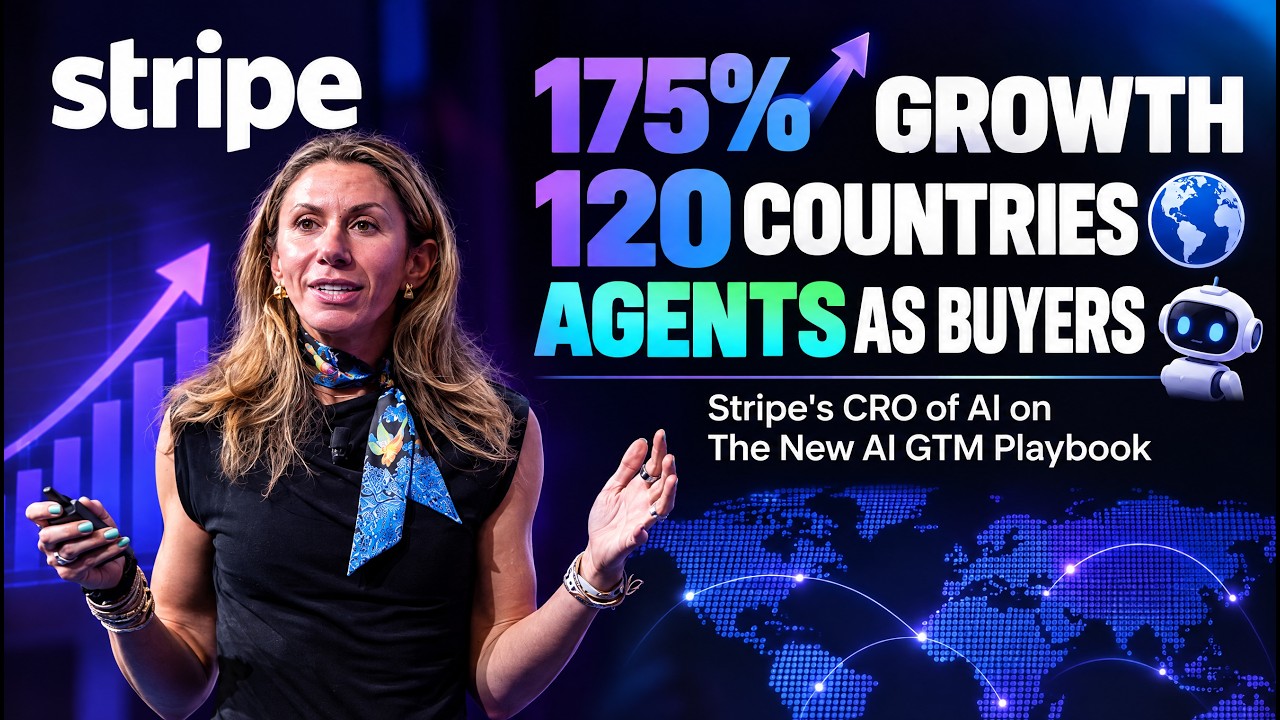
Stripe's AI leader Maya shares patterns from 175% YoY growth across AI companies: faster product iteration with coding agents, global launches in year one, usage-based pricing, and treating AI agents as buyers. She breaks down how Lovable, Cursor, and Anthropic scaled to billion-dollar run-rates in months.
Chapters
I'm Maya.
What I'm gonna talk to you about now is how differently I would run a company today if I was starting one, and what we're seeing in our data from all the AI companies. So at Stripe, we work with the fastest growing AI companies in the world, which means we have a front row seat to what's working, what's not, and what the best companies in the world are doing to navigate this agentic era. And The headline is that the playbook for how to run a company is changing faster than any of us can wrap our heads around. So there's really 4 patterns we're seeing across these companies. Number 1, the top AI companies just build so much faster, and I think we're all feeling that. 2, they sell globally by default. 3, Pricing is evolving faster than, again, any of us can wrap our heads around. And 4, they're adapting their go-to-market motions super fast. So, building enterprise sales used to be this decade-long journey. Now it happens in year 1. So, we're going to dig into each of these and talk a little bit about what we're seeing from the companies working with Stripe. All right. So, so we'll start with the numbers. We saw the top AI companies in the world grow by 120% in 2025, and then in '26 by 175%. That's nearly tripling in a single year. So what we're seeing is growth is accelerating, not slowing down. And the top ones are even more mind-blowing. So I think you're gonna hear from a few of these companies today. Lovable reported $100 million in revenue. In 8 months, and then 8 months later, they got to $400 million. Cursor hit a billion-dollar run rate in under 2 years, and then 3 months later, they got to $2 billion. And Anthropic went from a billion to a $30 billion run rate in just 2 years. It's wild.
You're listening to the official SaaStr AI podcast, brought to you by— Hey everybody, starting a business can get expensive fast. Website here, email somewhere else, business phone with another provider. Northwest Registered Agent gives you a complete business identity in one place with free tools, resources, and built-in privacy from day one. Get more at northwestregisteredagent.com/saastree. That's northwestregisteredagent.com/saastree. S-A-A-S-T-R-F-R-E-E. Hey everyone, if you're listening to the agents, then you need to be at Saastr AI Annual. We'll be back next May in 2027. The world's largest B2B and AI event, May 11th and 12th in the San Francisco Bay Area. Look, most conferences and content these days are about what's possible. As you know from the Agents, we're all about what's happening now, the latest and greatest, and that's what we do even more so at SaaStry Annual. See the actual work where we bring together 10,000 founders, revenue leaders, and VCs, plus 200 of the very best speakers showing you the playbooks of what's already running in production behind the scenes, deep dive demos, and so much more. Plus over 5,000 scheduled one-on-one meetings so you can actually meet the people doing all this, not just hear from them. If you're a founder, a revenue leader, or you're the one who has to make this all work with agents, this is where you wanna be. You already know this from listening to The Agents. That's SaaStr AI Annual 2027. Go to saastrannual.com and use our code The Agents for a special discount on your tickets. See you there.
And it's not just B2B. So our Link data shows that the consumer adoption of AI has doubled from under 6 million consumers to 14 million in just one year. And they're all spending more too. So the top Link buyers are now spending $371 on AI. That's up from $140 just a year ago. Just to put that into perspective, That's more than the average American spends on internet, streaming, and phone service combined, which means people aren't treating AI like a streaming service they might cancel. This is a critical utility for how they live their lives. All right, so we've got 175% year-on-year revenue growth, adoption doubling, billion-dollar run rates in months. What's behind all of it? We'll dig into the 4 patterns, starting with speed. So when I first started Urban Escapes, getting to a prototype took months. Okay, and I'm not kidding here, but building a shopping cart was so hard that our first checkout, when you hit buy, told customers to mail a check to my apartment in Brooklyn. And people did it. Now, just like you no longer need months of engineering to accept a payment, you don't need months of engineering to ship software. This chart shows when that really clicked. So as late as 2024, iOS app releases were declining, and then agentic coding tools hit, and then they went up 24% month on month. And you see Delaware incorporations actually follow the same exact pattern. So you look at that huge spike when the tools went mainstream. Now, a lot of people are talking about, you know, non-technical founders vibe coding companies, but here's something really surprising. As startup creation has grown, the share of technical founders has actually gone up by 7 points. In just one year. So a technical founder can now, with AI tools, do in days what used to take teams months. These aren't just side projects. These are real businesses. In fact, since we started embedding payments into developer platforms like Replit or Vercel, we've seen each monthly cohort go from idea to first charge faster and faster. And what you see is it now takes builders less than 6 weeks to get their first paying customer. And I can promise you, none of them are asking people to send checks to their house. So we're gonna make this very practical. What does this mean for you? Now, many of you are already doing these things, but for those that aren't, here's the playbook that's emerging. First, obsess over developer productivity. Collapsing build times is a competitive advantage. The companies that are moving fastest treat it as a top priority. Second, build, sell, and iterate at the same time. That old linear playbook where you could build the product and then go sell it, it just doesn't work anymore. The best teams are doing all 3 in parallel. And third, when posed with the build versus buy question, the best teams are building and buying. So they're focusing their resources on what makes them differentiated and then buying the infrastructure and building blocks to help them that they don't have to build. Okay, getting to market fast. is one thing, but where you sell matters just as much. So with Urban Escapes, expansion was city by city, New York first, then Philly, Boston, DC. And SaaS had the same logic. So you'd explore selling in other markets, but the focus was really on nailing your home market until you had true product-market fit at scale. And then You'd go find a GM in Dublin or London, and then you were international. That playbook just does not work anymore, and the data confirms it. So a few years ago, the fastest growing SaaS companies would reach 25 countries in year one and 50 by year three. AI companies in 2025, 42 countries in year one. And get this, 120 countries by year 3. That means Kazakhstan is now showing up on the list for many AI companies. Now that was not on my bingo card. And it's not about selling to just one person in these countries. There's real revenue coming from them. Gamma is a really good example. They reported $100 million in revenue. In their first year, and although they're based in San Francisco, the majority of their revenue comes from outside the U.S. That's not the exception anymore; that's the rule. Across top AI companies, we see 48% of revenue comes from outside their home market. That is nearly half of every dollar. Three years ago. That number was only 33%. So, what that says to me is global revenue is not a bonus or just, you know, the extra. It's actually just the baseline. Now, let's take a look at which markets are spending the most on AI tools on Stripe. Not surprisingly, we're seeing strong spend in markets with high GDP, like the US, Japan, and Germany. And then there are some countries emerging as hotspots, like South Korea, Brazil, and India. The demand is there. So, the question is, how do you actually capture it? By meeting your customers where they are. That means offering local currencies and local payment methods. All right, get this. Localized pricing drives 18% higher cross-border revenue. And when you have at least one local payment method added, we see more than 7% uplift. Now, with these stats, it's kind of crazy to not be doing this. So here's a good check for yourself. Put yourself in the shoes of a customer in Brazil. Can they pay in Hey Ice with Pix? If your answer is not, of course, you're certainly leaving money on the table. All right, the playbook for this one: 3 ways to pressure test your global readiness. So first, localize prices. Make sure you have local payment methods in key markets. 2, automate your tax collection, because no one wants to get in trouble with this. And 3, track revenue and conversion by country and obsess over optimizing it. Pricing, my favorite topic. Who thinks about pricing? Who's nailed it? Yeah, the old models just are not working anymore because AI has upended Everything we know. All right, so at Urban Escapes, pricing was very straightforward. Skydiving, $300. Rafting, $100. Same experience, same price, done. And the SaaS corollary is similar with seats, right? Same price for everyone. But as we all know, AI pricing is way more complicated. Value is elastic. So while everyone might use the same AI tool, The value they get and the experience they're having is vastly different. Let's take 2 users. So one is an engineer who sets up before bed a bunch of agents and wakes up in the morning with code ready to review. And the other is my mom, who last week told me very proudly that she just replaced Safari with ChatGPT on her phone. One is creating tremendous output and the other has an upgraded search experience. The value and the costs of these 2 experiences are really, really different. And so the pricing has to be different as well. Now, this change in value isn't new. Every major technology shift has repriced software. For on-prem, you paid once for all the code written up until the moment that it was installed. And so a one-time fee really made sense. And then cloud changed everything, right? Because software became continuous and auto-updating. So recurring subscriptions made sense. With AI, The value is elastic. And so we have to, again, people get different value from the software and the cost is very elastic as well. And so we just have to think about it differently. All right, so now is when you want the playbook for how to price with AI, right? Good news, bad news. The bad news is we're still in early innings and the full gold standard has not been stamped yet. But the good news is that some patterns are emerging. So let's look at Replit, developer tools company that's been around for almost a decade. When agentic coding took off, they pivoted their product, rethought their pricing, and hockey-sticked their growth. So they started with flat subscriptions, and then they layered in credits as AI became core to their product. Subscriptions for predictability, usage for value capture. And the result? They're now targeting a billion-dollar run rate. And they're not alone. Usage-based pricing is fundamental to how AI delivers value. So 2 in 3 companies on the Forbes AI 50 have some form of usage-based pricing. This was less than 50% last summer. And a majority of those are running this hybrid model. So subscriptions to anchor the relationship layered with credits that scale with value and usage. All right, knowing you need to be usage-based is one thing, but getting it right is really different. There's 3 steps to add to our playbook here. First, price in your customer's language. Developers think in tokens, enterprises In seats, but they're increasingly getting comfortable with consumption. So you can do the hybrid. Basically, you want to match your pricing with how your customers experience value. 2, show your customers what they're consuming before they get the bill. Who has ever opened up their electric bill and said, well, that is exactly what I was expecting? No, it's always a surprise, and that is not a great experience. So you want to do the same for your— or you wanna avoid that experience with your end customers. Real-time visibility is not a nice-to-have, it's a critical part of your product experience and how you prevent churn. So practically, this means finding ways to tell your customers how much they're using while they're using it. And then third, sell credits, not cost. Have your customers exchange money for credits once, so they're thinking about value, not dollars and cents every time they use your product. Okay, and now we're up to our last pattern. Companies are adapting their go-to-market motions much faster. All right, at Urban Escapes, we started with consumers first, and then we built the enterprise business. Because believe it or not, the Googles and Facebooks of the world loved taking their customers on adventures. Now, that's been the norm, right? You start product-led, startups find organically, and then you layer in enterprise sales years later, once you've proven product-market fit at scale. I mean, Stripe followed the same arc. I was our first head of enterprise product, and that was just 3 years ago. Every AI founder I talk to now is hiring a CRO. Building out an enterprise motion is not a 3 years from now problem anymore. Take Cursor, AI code editor. They launched in '23 self-serve, then they layered in sales-led to land their enterprise contracts. They now have an incredibly impressive enterprise business That would have taken other companies decades to build. They launched it in 23. But that's not the only shift. No, because that would be too easy. Entirely new motions are emerging too. So for one, channel sales have now become a huge part of the AI go-to-market motion. A lot of people are buying OpenAI and Anthropic through their cloud providers. And now the AI companies are doing the same thing and building their own marketplaces so others can do the same. So you really have to think about channel sales as a critical channel for your product. And then the billion or probably trillion dollar question that's on everyone's mind is how do we all sell to our new buyer, the agent? We've spent decades Optimizing pricing around human psychology, anchoring on good, better, best, $9.99 instead of $10. Agents do not care about any of that. I think that this chart is one of the clearest examples of agent as buyers. So, in 2025, agent traffic to Stripe Docs 10x'd in a single year. The purple line is humans. And the pink line is agents, and they're converging. By the end of this year, agents will read more Stripe docs than humans. Now, here's where a lot of companies underestimate the work. Go-to-market is the tip of the iceberg. Everything underneath has to move with it as well. Adding a new go-to-market motion touches everything in your company. Your product looks different for each motion because the onboarding flow is different. Pricing will have different nuances. You have commits for enterprise, sticker pricing for product, and then your org has to be built for it too. We all know an enterprise sale is very different than how you do customer support for the long tail. It's not just a go-to-market change. We're really talking about your whole business model having to shift. Now, most companies will build the revenue infrastructure the same way, one piece at a time, a billing tool here, a tax vendor there, and then you like add in payments when you need to. And when you're growing slowly, a Frankenstein stack is much more manageable. But when you're compressing a decade of go-to-market evolution into months, Every seam becomes a liability. So here's how I think about it. Your customers are channel agnostic. The same customer might find you self-serve, graduate to enterprise, and then have an agent turn on a new feature. They are certainly not thinking, I'm self-serve, I'm an agent, I'm enterprise. And so you can't think of them as a channel either. So that means your systems have to move with them. So here's the playbook. First, have a clear graduation process. Know when a self-serve customer becomes enterprise and how pricing changes with that. Second, build unified systems. That means one customer object, one product catalog, one data model, regardless of how they came in. And third, design for agent readiness. Where an agent can discover, evaluate, and activate your product without a human in the loop. All right, we've covered a lot, and one thing is for sure: the playbook is being rewritten in real time, from how you build and price to where you sell and go to market. And the question we all have to ask ourselves is. Are you driving the change or are you reacting to it? I'll leave you with this. I remember sitting around a campfire and a friend telling me to pursue Urban Escapes and that it was okay to quit my job. And I did. It took months to build a website, 2 and a half years to get to 4 cities. And a lot of sweat equity along the way. If I was doing it today, I could be done with all that before the fire was out. And that's what's changed. Not just the tools, but the entire starting line has moved. You can build in hours, you can sell in 42 countries on day one, and you can go from PLG to enterprise before you raise the Series A. The question is not whether the opportunity is real. You've seen the data. The question is whether you're moving fast enough to capture it. I think this is the most fun time ever to start a company, whether you're a startup or one of the fastest-growing AI companies or an enterprise trying to navigate. And our job at Stripe is to be there with you every step of the way. So, have fun building and know that Stripe will be there to help you as you scale.
Thank you.
Thank you very much.
You're listening to the official SaaStr AI podcast, brought to you by— Costs can add up quickly when you start a business, so stop paying for 5 different services. Northwest Registered Agent gives you a complete business identity in one place with free tools and resources to actually launch your business for real. Get more at northwestregisteredagent.com/saastrfree. That's northwestregisteredagent.com/saastrfree.










