20 AI Agents We're Running at SaaStr: How We Went from Behind in AI to Ahead
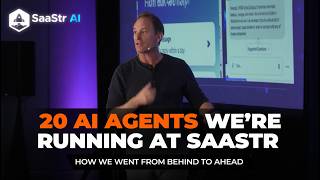
Jason M. Lemkin walks through 20 AI agents SaaStr built to move from lagging behind in AI to leading. The talk covers what each agent does and how they're deployed across the organization.
Chapters
Okay, so we can take it wherever you want to go. This doesn't have to be that formal. I'm only so smart, but I have built a SaaS company to a couple hundred million in revenue from zero. I've invested in some winners and some that are very different than Mangomint, some like Owner that a lot of you folks know that I'm on the board that in some ways have a lot of similarities. So that's interesting on business-to-business software. And then I would say at the start, At the start of this year, we were pretty behind on AI. We were pretty behind. Could talk the talk. I could read the tweets and, and, and talk about how great ChatGPT was, but I was behind. And we kind of went on a roll and we went from being pretty far behind in using AI ourselves on our little team to I think being at the cutting edge. We have 20 AI agents in production. Uh, we just today rolled out, and it'll be interesting, we can, I don't have enough data to talk to you about today. We just rolled out Salesforce's agent force. And if you listen to Marc Benioff, he talks about everybody using AgentForce. But hopefully we're not streaming. We might be the only company that is smaller like ours that is in production. We might be the first. It's early, which we'll chat about. So maybe we have 21 AI agents in production and you guys are going to be doing a lot of this. You've got Connect that's coming out. You have more products that are coming. You, you are— will be on a similar journey where I think when I invested in Mango Mint, AI was a discussion point. And I think next year it will be a deep part of what you do both internally and externally and for customers. So This is not the most profound stuff, but what I'll do is I'll quickly share what we're doing. And then maybe more interestingly, I'll share what we've learned having all these AIs in production. And we're not like you, but we have more AIs than humans now. It's kind of weird. There's not that many people that have more AIs than humans. But I'll walk you through quickly what we've learned. Here's us on the left. I had Claude make this. But this is how our agent journey, 0 to 20, I guess it's 21 with AgentForce. And the first one we started with, and this is pretty interesting, I'll share more with you. The first thing we started with was sometime around March of this year, I used a tool called Delphi. And Delphi, you can go to saster.com if you want on the bottom right. It's a general AI tool. That's trained on 20 million words of Saastr content. We've been doing— I've been writing blog posts since 2012 about scaling B2B companies. We've had like 1,000 speakers. We've done 10,000 people, 12 years of Saastr annual. And this is a particular AI that could easily ingest all of this and creates a digital version of me. So I did it as an experiment. A few other like leading folks that have a lot of content did it and I'm like, well, theirs are pretty good. And I thought, well, ours will be better, not because I'm better, but we have so much content and it's all on B2B and a lot of it's on scaling revenue. So I bought this tool called Delphi, Delphi AI. I turned it on and it immediately broke and the founder got mad at me. It immediately broke and it broke because no matter what, everyone's kind of full of it in AI. And he said, oh, we have customers much bigger than Saastr. We have folks that have ingested 2 billion words of content. I'm like, oh, we only have 20 million words of content. But the truth is we had more YouTubes, tweets, blog posts than anybody did. So it broke their ingestion engine. After 2 hours it went down. I mean, I'm kind of self-sufficient, so I tried again. It broke again. It broke again. Now it's much better now. Finally, the engineers had to help us to work because they were full of it, like a lot of folks are on it. But it did work. And then it was magical. It was magical. So what was interesting— I might not have another slide on this. What is interesting— there's me, digital Jason. So I kind of compared this. Here's an app we use, a really dated SaaS app we use for our SaaS University called Mighty Networks to help. It's free. It's like Saastr University. There's 20,000 people on it. Here's their support. We typically reply within a day. Hooray. Okay. We have 4 people on our Saastr team. We've already had 130,000 chats on the right. 130,000. So here's an example. I just pulled it up to make the slide. When is— and I misspelled it— when is Saastr Annual 2026? This isn't that hard. This is the date. 12th to 24th at San Mateo Foundry. It'll be even bigger than before in AI focus. Who are the top sponsors? Google, Rippling, Artisan, G2. This is pretty good, right? And this is all automated. This was all ingested. And so what was interesting when we did the first one is I built this tool so that founders and exec folks like you, anyone in this room, could come in and say, hey, I'm at Mangleman, I'm coming up on $20 million, it's, it's SMB SaaS for salons and spas, we're thinking about going upmarket this way, what should I do? And it would give you— Digital Jason would give you a pretty good answer. It wasn't designed for support. It wasn't designed to do inbound qualification, but when it was live, people started asking them these types of support questions. Where the hell is SaaS renewal? It's on the website. And they would come in and they would say, am I the right sponsor? Like, can I get the right leads at your event? And it was well enough trained that we ripped crappy old Intercom out pre-Finn, and this became everything. It did everything. Now, did it do it great? No. But here's the thing. We don't have 20 people on our support team like you did. We had nuns people. People on our support team. When you went to our fin, it would say we reply within a month. Okay. And so immediately it was better at everything than nothing. And it was an eye-opening moment for us. And so I uploaded our sales collateral and our sponsor prospectus and it could answer. And immediately when I had that aha moment to upload our sales collateral, I noticed it was better than anyone on our sales team at answering sales questions. Not better than Amelia that runs SaaS with me, but even better. I mean, our sales team is 3 people. It's pretty small. But we have one guy that's been with us that, that's for 5 years. He's probably closed $10 million or something. But it knew everything in the prospectus. You know, you're going to— I mean, these are pretty banal questions. I want to have a booth at SaaS Annual, a super gold booth. How thick can the carpet be? I mean, you think the sales rep knows this, but the AI does. It doesn't forget, right? And what do I get if I upgrade to this, or what do I do? And it would know everything. And then we noticed it it was trying to set up appointments on its own. And we're like, well, maybe we should connect that to a human. And so all this— this was our start. And going into May, we had one. This, this was it. And then we started adding to it. We're like, well, that went pretty well. Okay. And then what I— the lesson that will go through this whole presentation at the end, if you want to learn— if I had to distill all the learnings from 20 agents and you'll— and you will have to figure this out with your end customers too. One way or another, you have to train them. You have to train them up front and you have to constantly train them. And the amount of training will inevitably decline over time. But to get Digital Jason, which was the easiest because we had 20 million words of content, I had to get it up and going. I had to test it and then I had to see where it made mistakes. So every day I would spend an hour in the morning looking at the answers and they would get better and better. And even though it ingests this content, there was a way in this app where I could upload correct answers and it would get some things wrong. And mostly it would hallucinate things about the future. Like if we asked it when SASTRA 2027 was, which we don't know, it would make it up. Okay, that really sucked. Okay, it was funny for some things, but I had to find that the worst hallucination— but anything that was in the prospectus, it would know. It wouldn't get that stuff wrong, but it would make stuff up that wasn't known, right? Oh, Saastr Europa this year will be in Barcelona. Well, that's terrible because Marcel is going to London. Like, it would make up the wrong location. Okay, so every day for about a month, just me, and arguably wasn't good use of my time, I would spend an hour looking at this. Now it's about an hour a week. Okay. But other folks would say the tool is terrible. It doesn't— I tried Delphi, it didn't work for me. How much content did you ingest? What do you mean ingest? What do you mean put content in? How much time have you spent since you bought your digital clone? I just bought— I pay— I just pay $200. I don't— I didn't train it. What do you mean? I didn't get it. But one of the folks that was successful is Brian Halligan, chairman and founder of HubSpot. He's got a digital clone too. There's a digital Brian Halligan. You can go talk to him as long as you want. And he started before me. He's like, well, I trained it. I'm like, okay, what do you mean you trained it, Brian? I mean, you're chairman of a public company. And he didn't have 20 million words of content, but he spent a week just talking to it for 2 hours a day. That's how he trained it. Okay. And so in any event, to get any of these things working, you've got to train it. And I'm probably talking out of order or 20. Let me go ahead. But we have I'll talk about our whole stack, but we have 3 AI SDRs, now 4 with AgentForce, and an AI BDR called Qualified. We can talk about these vendors, but here's an interesting thing. It's interesting and a little scary. For both Artisan and Qualified, which have hundreds of customers probably for outbound and inbound, we're their number 1 user by performance. Number 1. And we're not far from the biggest. In fact, we're anomalously small, but we, but we have a lot of data and we train them. We train both of these for 30 days before we went live. And then literally every single day, Amelia is working on improving these. Even today, every single day improving them. And that's why they're, that's why they're great. 14,971 outbound emails. I might or might not have the data. It might be here, but you can see just we had the most meetings and most engagements. This is unqualified of anyone on their whole platforms, anyone on their platform. So if you learned nothing else about these AI agents, You'll, you'll talk to— you'll especially see it on LinkedIn. Oh, I bought this AI tool. Didn't work. I bought it. Just AI tools are terrible. How much time did you spend training them, Mr. CRO? What do you mean? How much? How much time did you— and how many weeks and how much time do you— did you personally look at it? How much time do you iterate with it every— I don't— none. Of course it didn't work. Of course it didn't work. And there's other reasons, like not to be nerdy, Basically a lot of AI and it benefited us. A lot of AI got a lot better in the beginning of this year. Too much information. But Claude, which is, you know, Anthropic, which is number 2 to ChatGPT, changed their model. They came out with these 4 models and everything got better. So like Qualified that we use to qualify inbound, it's kind of old and it used to be kind of terrible. Okay. It's actually— you can try it. Go to sasterannual.com, our event site, and you can talk to Qualified. You guys have looked at it. Marshall tried. It looks like any old chat. It doesn't look that great. It was probably developed 4 years ago. But once they added the latest AI in it plus training, magic happened. Magic happened. Vibe Coding blew up. No one could vibe code their own app last year. Then Cloudflare came out. Replit's a 10-year-old company, and it went from 1 million to 150 million already this year because the AI got better. So we're doing that plus training are these magical moments, and that's the journey we're on. And so if you work with these apps, they'll all get better. Internally, you guys, for your own tools, you'll figure it out. Externally, it's the biggest challenge for SMBs because if you like these tools, like, sorry to jump around, but these tools that we have, I mean, we don't really pay for all of them, but basically they're all like $50 grand to $100 grand. That's what they charge. And it comes with like a month of forward deploy engineering or training. Okay. So you'll buy, you'll buy, you'll buy Qualified. It'll be $60 grand or $100,000 a year to, to, to to help you qualify inbound. It works. And that— but that's 6 figures. And then, and then you've got— you've got to train an average spa. I don't think they have $100,000 or the time to train their AI. Right. So that is different. It's a challenge for you. But I will tell you, for what it's worth, I'm on the board of a company called Gorgeous, which is about $100 million, and their AI support for e-commerce and Shopify. So it's a different ecosystem to you, but it's a lot of similarities. Your app costs about the same as they do, very similar things. What they have though is they have all the data because they have all the merchant data, all the Shopify data, everything. So when they do support, it's really great. So their AI is really, really good. So it is possible. It's just the more SMB you are, the less humans there are to train this app, right? And so as you add more and more to Mango Mint, your job is harder than an Artisan or a Qualified or a Salesforce or someone because you can't put a team of humans on site or training them. But that's the opportunity too. It just means actually SMB AI has to be better than enterprise because you can't have humans filling these gaps for training. On the other hand, though, as I'll show you, you don't need as much training as you think. You just need consistent training, right? And I know I'm jumping around the deck, but maybe I'll get to it. But the other learning— so we launched the first one in March, this, this Delphi, and I ingested 20 million words of SaaS content. And it was great. And you could, you could see founders like, this is the best AI I've ever used. It was like, it was like talking to a better version of you, Jason, except it's slower and you don't get tired and you don't get a little angry or grouchy. It's like, great. And we have some founders and we had to turn it down who literally were on it all day long. They literally have it in a window and they talk about their whole day with Digital Jason. It's cool. And I went around thinking, hey, it's— I'm so great because we had 20 million words of content and I broke it. But I, you know, I did it and it automatically it ingests every tweet I do every day and every video we do. And if we put this video on our YouTube channel, it'll automatically ingest it and it'll know what we're talking about. And I thought the reason ours is better than Brian Halligan's is the 20 million words. And then the founder of Delphi came to SaaStr Annual this weekend and he used my Delphi, Lenny Rachinski's, Brian Halligan's, and Keith Rabois, who's— who all of whom have a lot of content. And we dug in and he did, I think, 2 million simulated conversations with all of us. 2 million. I think a million, 2 million. I just wrote it up. You can find it on saaStr.com. And a lot of learnings from it. But for me, the number one learning is it wasn't the 20 million words of content that made our better. It was having a number of really good recent pieces of content, a little bit in the long tail, and then constantly updating it made it better. I didn't need 20 million words of content to make it great. Maybe 20,000 would have been enough if it was exactly what I needed to do to get my salon up and running or to get more things. So a lot of folks poop on this like, well, we can't do what SaaS does. We don't have 12 years of content. I thought that too. I was wrong. Okay. You need a small set of really good content and then constantly make it better when it makes mistakes. That's all you have to do. Nobody does this. So I got that one really wrong. Another product where we're number one on, I got that piece really wrong. Maybe a few other things, then I can go into the learnings, then we can answer questions. So, and again, and another learning, why are we on the bleeding edge here? It's just to learn from. We're not like Mango Man. We had a, issue where folks— I mean, we're a tiny team, but folks would leave. And I just got— I just don't want to do recruiting anymore. I'm not— I'm not Marshall. I don't have that energy to constantly be out there recruiting. And we just got tired. And then we hired two folks who literally— one of them never even learned how to sell SaaStr, and another one was a DJ most of their time and only helped us a little bit when they had time. And I just couldn't go through this one more time in life. I mean, as the intro said, I've been a three-time founder and investor. I just couldn't deal with the mediocre any longer. And I said, listen, I don't need our AIs to be better than the best I've ever worked with. I just need AI to be better than the DJ that only worked for us 5 hours a week. That's all the bar was. And we trained it and it is better. It is better than that. It is not better than the best we've ever had. It is no— the, you know, it's not so much that I think AI can replace a great human. It can't. We know this. Can it replace someone that doesn't know your product, doesn't know how to spell Mango Mints, Doesn't know anything. Yeah, maybe think about the worst person you've ever worked with in any functional area. Sales. But can AI replace that? Yeah, it can. And so if you read this email, it's not even that great an email, but at least it knows what SaaS is and it's not full of typographical errors. And it has a couple interesting pieces of information about the prospect. It's not even that good, but it's better than someone phoning it in. That's the bar. And so there's all different ways to do that. But I could imagine at the end of the day, for your end customers, like as you're helping supplement back and front office at the product level, you don't have to replace the person that knows every— that's worked at the salon for 20 years and knows it cold. You might just try to be able to supplement the person that works there for 3 hours and quits or phones it in or isn't available or doesn't show up for work or is sick half the week. Right. All you have to do is replace that person. This is what I've learned for the AI to be profoundly valuable. All right. So that's what we've done. We've replaced humans with AI and we're willing to live with some limitations so that I don't have to deal with the DJ drama. It's, it's for real. Sorry. And then this DJ quit that made a lot of money here and quit to do, to go full-time DJing and do something else. So even paying people doesn't— so we have 3, we have one that does sponsorships. So anyway, we have 3 different ones. If this is interesting to folks, we had one and then we've broken it up into 3 different agents because they have different personas and different goals. One does for us a bigger deal, a $50K to $100K deal to get a big booth at our events that you need to know a lot of data about them. You need to know if they've sponsored before. You need to know where they worked before because CMOs have a lot of— CMOs are the buyers and every year 50% of them work somewhere else. So if you didn't know they went from Dialpad to Google Cloud to Replit, your data better know that because you may think it's a cold email, but it'd be a lot better if you knew that Jason used to work at Salesforce and now is at Lovable. Like it's going to be much better. So that needed its own low volume, hyper-personalized. Then we had one for ticket sales because we sell 10,000 tickets a year, but it still had to be smart enough to know if you've been to an event before. It's a very different pitch. Hey, we haven't seen you. Thanks for coming in 2019. You know, things are a little different since that little bug went around the world. Like, it's a different come see us versus a raw— or we need to know, are you in our database because you read our newsletter, but maybe you want to come in real person. So we need a certain amount of personalization and that had a lift. And then we needed a super VIP one when we go out to like CMOs and CEOs to see if they want to come for speakers. Because I'll get to it briefly, we used to have a speaker agency that we paid about $300,000 a year mainly to do outbound and inbound for speakers. And it was great for a while, and then toward the end of last year they got tired of it and they wanted to charge us twice as much and not really do any of the work except sit in the green room at the events. Okay, so they wanted $600,000, $700,000 a year, and they actually didn't want to read the inbounds because it was too much work, and they didn't want to really do the outreach because it got harder. So we let them go. First we just had our Delphi general agent do it, and then I built one to replace it, and then we added one to do outbound. So we've replaced— like, we used to have an A-tier resource. When it became a C-tier resource, we had nothing. We're like, well, we'll just AI it. I would have rather have them when they were great, but when they decided They didn't want to do the work anymore, which is life. We did it. So that worked. The outbound thing worked because we had no one doing outbound after the DJs and the guy that lived in the van full time. So that was an easy lift because it just had to be. It just had. And I was just arguing with the DJ. I'm like, could you please— like, I know the CEO and like, he's a super fan for SaaS for 10 years. Can you send him one email? He already told me in a DM he'll sponsor, but maybe I just couldn't, I couldn't take it anymore. So the AI could do better. So then there's this app called Qualified, but there's a lot of folks like this that was originally designed to qualify them and we were reluctant to try it because pre the AI changes that in early in the year, I just didn't think the app worked very good. I'd seen it in 2024. I thought it was good for marketers that maybe didn't know what they were talking about, right? To check, check, check the box higher. But finally we tried it and it was like, like somehow it got really good with, with this qualified. Cloud 4, and now it's pretty great. We've done 194,000 sessions when we did this. And Daniel and I were talking about this. It's not magical, OK? But what this does is you come to one of our sites for our events, and it can figure out who you are. Some of it's not even that clever. Be an event sponsor. This is not the cleverest thing. It looks like stuff. But it has all of our data integrated. And so if you came from Google Cloud, and Google Cloud's been a sponsor for 10 years, but they haven't renewed yet, it will know that. And it will reach out to you, and it will talk to you about it. I want you to come back and we'll tell you what's changed and that we have a Vibe Cafe and that it's better to connect with founders. And it will instantly set you up with an appointment when you're ready with someone on our huge sales team. Now, could you do all that stuff before with, you know, a HubSpot link and a Chili Piper and a Chili Pepper? Yeah, but it's just a mess right now. It talks to you, it qualifies you without you feeling qualified, which is always an icky, icky feeling. It's not— I'm talking to some 20-year-old SDR that decides whether it's worth their time for me to talk to an AE, which is one of the worst experiences in SaaS sales. It just wants to know who I am. Have I been before? Do you know who Saastr is? What's your budget? What are your goals? You know, if your budget's $1,000 and you need a million leads, it just tells you no, like, don't do it. Like, if you've got budget and you want to reach like B2B professionals, let me have you talk to Amelia or David or Brian, right? And that just removes so much friction, right? And again, This works really well. And we're the number one performing user of Qualified across 100 customers, 101 artisan. It doesn't have to be amazing. It just has to be pretty good at knowing those things, knowing our data and linking it together where there was no human doing this before. Right. The bar is not that high. So that's the next one we've done. We talked about the fact I didn't even think this digital clone would do support. This is a fun thing about AI. If you train it, sometimes you don't know what it's, what it's going to do, right? Very versatile. And then we've done a few other things. I don't want to spend too much time on this. I'll wrap it up and I'll go to the learnings. But it's just learn. Like, we're also one of the top users of this tool called Gamma. Have anyone ever heard of it? They went from like nothing to 50 million. It's really a consumer tool to make cool looking stuff. We use it for B2B, but we got tired of like people handing out our prospectus that was like 2 years old. Like they would send their prospectus to be for SaaS for 2024. Like we would delete the links, but they would have downloaded it. They'd send the wrong— I mean, we know this problem. And so we kind of fixed that. And they were like, but, but now Amelia has to like create a custom deck for everybody because the sales team couldn't do it. So we just had now Gamma just automatically pulls all that data from our marketing automation tool and creates a custom deck for every single prospect. Custom. Here's the right thing for you. Hey, if you're, if you're DigitalOcean and you're like Google Cloud, here's how many leads Google got. So here's how many you should expect. It'll show the peers, it'll show why they should be there, how to do it customized to them, what their ICP, who's going to be there. It doesn't look as pretty now that our designer doesn't do it, but it just takes a couple of minutes. So pretty cool thing that we do. And then it's— it gets passed around far more than our other decks did. This one I want to talk about. We all kind of copied Kyle. I was skeptical of using like momentum and attention because we had such a small team. But man, it's great. I've told the story before. We had someone that quit the day we rolled it out. Ultimately, if you want to know the life lesson, we had one person— wasn't the DJ or the guy living in the van, but he was the guy who never— who would spell Saster with an E in the middle, S-A-S-T-E-R, in his collateral. And he would always send out two meeting requests, like with two different apps, one using ours and one using Mixmax. So the prospect would never know which one to link. So you get the story, right? I always be like, Kenny, what are you working on today at our all hands? Like doing a lot of outbound. Good. 2 months, 3 months. Don't really see any pipeline, but good. And then we rolled out Momentum and then the gig was up because we could now see what everybody was doing. And he quit that afternoon. He just, he just quit. He didn't even tell anybody. He just, he just disappeared. But it has, it has been great to have this trend because the net learning from all of this is just the pace of everything's faster with AI, right? Because people don't want to wait 2 days for the meeting and they don't want to wait for this. And there's no— if AI can find the data and surface the data, it should be acted on almost instantly. And then a few more. We had this agency that wanted to go from 250 to 600 but didn't actually want to review the content because we get 2,000, 3,000 speakers that want to speak at our event. And so it's not that fun to read all of them, right? Especially because the real tough one is the really— even the terrible ones take time. And then the ones in the middle, like the maybes, you're like, you reach out to them and then there's like 28 emails after and it's just too much. And so they just stop reading them. So I just went into Replit. I built my own reviewer that now just grades them in real time. So now it does it all automatically. They put in the data, I push it to, to the Anthropic API and it just grades it and tells them instantly what their score is and gives them the brush off if it's not good enough. So this is not the learning from this and this, this saves us so much time, right? Because now thousands are read and they're told their score. You got a 54. Now it's nicer to them than what it tells us. It's terrible to them. It's like it always says, probably not right for this event, but we'll let them know. Okay. But this is what— interesting. It's a micro app. Like, who else will use this but us? But we could use it a lot. So AI lets you do some of these things. It's a micro— it's almost an agent for us. So valuable, right? I wake up each morning, it'll say, we got one that's a 54. Here's a 20. Here's a 79. Take a look. Here's why. It's just amazing. So we'll see more and more of using like little bits of AI. And sorry to ramble, but the other interesting thing about it, it's so good. It's so good. It doesn't need that much data. I told them, here's what a great presentation is like. Here's Marshall last year talking about 10 learnings from SMBs. It wasn't a commercial. We have a criteria for circuit speakers. So look up on the internet how many— if Michelle's been to 100 events on the same topic, kindly tell her no. Has she not spoken before? Is it on point? Is she mainly promoting her own services? Is she a service provider or a leader? Like, you can figure out all this stuff and then compare it to all of our other SaaS speakers for 10 years and rank it. That's not that hard with AI. So as you get smarter, you can think, what are some amazing things we could do if we just inject a little AI? You don't need that much data to to make this awesome. Not that much data to make it awesome. And then maybe I want to get to learning, so I'll just breeze through the last one. Then I got on a tear, I built some others. I built this calculator to value startups. It was $200,000 when I wrote this. We've already crossed $400,000 valuations. And then we added reviewing pitch decks. We've already done 1,000-something in a week, so pretty cool stuff. But my learning, if you're curious, on the last point, and I want to get to some of the learnings, like, and we were talking about a little before, there's like so much stuff you might want to build with AI, but if you can buy it, just buy it. Like, don't buy— don't build anything because it does take a lot of time. Okay, let me flip through to a few other things that are not obvious. And I think we hit some of this because I went through it, but I want to make sure I'll at least get this. Then we can open up to questions on anything you want. Doesn't even have to be on this, but this is the Captain Obvious one. But again, I think for app— for stuff you build, especially for your customers and onboarding, it's going to be harder. Is it's just daily management and review. This is the— again, I already said it, so I'm only gonna say it 3 or 4 more times before I end the presentation, but this is the key. And you will talk— you will hear on the internet agents managing agents, and you will hear about grading and all this stuff. It really doesn't work today, not in a B2B application. You've got to constantly be training them. We don't— a lot of agents, you're not really gonna see hallucinations like you used to see in the early days, but you will see mistakes. And Mistakes are just a different version of hallucination. You've got to constantly be trained. There is no set and forget. And figuring out how to do this at scale is kind of the biggest, the biggest challenge. The other learning we had, it's a version of the before, but this is the other mistake so many people make. Onboarding an AI agent is about the amount of work as onboarding a human. I mean, if you hire someone to Manglement and you don't train them at all in sales, You don't give them access to anything engineering. You do, you tell them nothing about how the project works and you just say good luck. I mean, sometimes it works, but it sure is better if there's a hint of training, isn't it? I mean, maybe, maybe, maybe we're still too small to do any training. I hope, I hope these people get at least a little bit of help before they start, right? So it's the same thing with the AI, roughly. You've gotta put in that amount of time. Like if you think about, if you want to think about it, an AI agent, it's, it is maybe even ironic, it's not a human, but you might have to spend the same amount of time in the first 30 days that you would invest in a human to have a successful outcome. Otherwise it's gonna fail. This one is, I kind of hit it, but this is the most obvious one, and this is, it's a challenge for a lot of apps, but this data question, right? It's not all about volume, but the more you know about your customers and users, the far better the AI can be. It doesn't need 20 years of data like I thought, but 3 or 4 points of data is so so valuable to give the AI to run on. That's what we've learned. And again, that's why we're number one on these platforms. Um, okay, number 4, this is one hopefully we're getting past the debate on, but a lot of folks still challenge this. We have all the data for it. It's so interesting. Buyers don't care if it's an AI. They don't care. A lot of us have had, again, we're, we're kind of thinking about ChatGPT in 2023 or some terrible support bot they used, okay, the other day. Listen, there's plenty of terrible support bots, even by leading AI companies. But when you have a well-trained AI like we do, people don't mind. It's a joy to not have to wait for Jason to call me back tomorrow, to not have to work on a human's term. It is a joy if the AI is good. It's fine that I know it's Jason Bot. If Jason already says to me, hey, I know you came to Saastr last year, it's really exciting. I'm— Manglement seems to be on a roll. Can we get you to come back here last year? Do you really care if that's an AI? It turns out you don't, especially if it does something for you, if it adds value and it's fast and rapid. So people don't mind, right? And let me know if you're an agent. We found— and it's fun because when we do these 16,000 emails, we would, you know, a lot of them are not to salons. They are to tech leaders and founders. And they would know it was an AI. They say, this is a great AI. They don't mind. So don't fear it being an AI. In fact, disclose it. And yes, have some scar tissue about that crappy bot you used when you were trying to reschedule your American Airlines flight or whatever. We've all lived it. AI doesn't have to be like this in 2025. It doesn't. It can be, it can be empowering for your end users. And don't hide. Don't try to pretend that it's not an AI. Force yourself to make it great and they will love it. They will love it. Because again, a well-trained AI can know more than most humans. It really can know more than most humans can. Okay, Captain Obvious. This is the biggest— this is small, but it is interesting for like our little teams. It is exhausting that the AI is always on. It is exhausting. So the first thing that we, we still do and we certainly had to do as we scale it, like 7 a.m. with the coffee was going through all the output because if the AI is setting up meetings and appointments and doing all these things, you've got to be on it. And you do have to sleep. Like the AI agent doesn't have to sleep. We have to sleep, right? So I would say as a small team, we work more from 7 to 8 a.m. than we ever did before these agents. Because they've queued up so much work during the night. You, you, you got to do it. It's a different cadence, it's a different pace. And, you know, the most obvious one is when you have like an AI BDR, you can't wait a day to get back to that prospect because the prospect's having an immediate conversation with the website. They expect the human to be almost immediate. And so that it just— our day is just stacked before it even starts. And it's a little tiring and a little stressful. And it's just— it is just different. So how to figure this out is still— we're trying to figure out a criage system. We try to figure out office hours, but I don't really have all the answers. Yeah, here he is, the CEO of— what did I say in the hat? CEO— they never sleep. What's that? Yeah, yeah. I kind of like my images that I make in Reeve Art. He's just— he can't take it anymore, can he? He's not quitting, but— He's pretty tired. He thought 7:00 AM was the time where he just did office chitchat. Now he's gotta like spend an hour reviewing the AI agents. You know, this is interesting. And hopefully for your customers, you can, you know, you will insulate them from that. But when you get so much information, when there's so much communication, it is so much to process. It's so much more to process than it is from a human, which is just gonna surface you know, you meet with your team once a day, they're going to surface a couple of things. Your AI is going to surface everything, everything the minute you log in. Right. This one I think I hit. But this— I think I had Amelia put this. The first one was how many chats that our general AI did when we launched, 139,156. That's a lot. I mean, we were just talking with your head of support about how many you guys do. This is on that scale, right? With, with, with an AI, it might be more than you do in a month. You have a pretty good app. This was pretty interesting. Our AI at this point sent 1497 messages and 560 or 570 were identified as leads. It's pretty good. Okay, this is just— okay, another interesting point. There's a lot of meta interesting points is There are costs. There are costs. And so we, we, I've never fired anyone in my entire career except for inappropriate behavior. I let people just leave or figure it out. I should get better at it. You may find this hard to believe listening to me, but I'm conflict averse. So I let people go. I mean, I let them go when they're ready. I thank them even if they don't deserve it always. Enjoy the DJing. Send me the demo tapes. Uh, but, um, but as folks left since the beginning of the year, we replaced them with an AI. As much to learn as anything else. Let's try. Let's try to do— when our content team wanted half a million dollars a year just to sit in the green room, let's try to replace them with an AI. When the DJ leave, we weren't sure it would work, but we thought we should try. And it's interesting. We know some of these, they are nice enough to comp us because we get them a lot of leads. But the nominal cost is we're about half a million dollars into these. Vendors. About $500,000 a year. It's not nothing. It's not nothing. Um, most of them cost— some of the cheaper ones are $200 to $300 a month, the gammas and the general support. But the other ones are all like $4,000 or $5,000 a month. That adds up, right? As you replace— it's not nothing. Is it cheaper than a human? Sure. Right? As this $8,000 to $12,000 versus $2,000 to $4,000. But it's something. Um, and the soft costs are significant, right? Of monitoring them. What's interesting that isn't in this slide is most of our agents now plug into Salesforce. This is something to think about at a meta-level for Mingleman. So we only— now that we have all these agents rather than humans, we only need 3 seats of Salesforce. So how much do we pay for Salesforce? I don't know, Salesforce keeps going up, but $10,000 a year for those seats? $10,000? But the agent companies are getting $500,000 $50 of value. 50x. 50x. So my challenge to everyone, Daniel, I talked about, think about how you can get— what's your 500x at Mango Man, right? It's, it's, it's, it's, it's— the answers aren't really obvious, but these apps that I talked about are, for us, for— and it's different for large enterprises— are, are in any event creating and extracting far more value than Salesforce. That's— it's an existential threat, I think, to Not to Manglement, but to a lot of CRMs and others, because it's not that we're getting rid of our CRM, but when the agents do all the work and they're much more valuable, think about that ratio. It's crazy. $500,000 versus $5,000 or $10,000. That's a lot of value distortion. It's a lot of value distortion. That's the main one. I'm not sure how I put this quote up, but when I did an interview with Marc Benioff on 20VC a couple weeks ago, maybe a month ago, and he said they had 1,000 leads their human SDRs So that was the first thing that he had there, Agent Four Shoes. So I'm not sure exactly where I came— well, I'm not sure what the point I was trying to make, but, um, an interesting one. But that— but, but, but, oh, the point is like, just— but it is work to follow up with those 1,000. Anyhow, this ratio thing, so like, I, you know, I'm just— maybe it's not my role, but, you know, MangoMint's a pretty cheap product in the grand scheme of things. It's a good deal. It's not inexpensive, like, I mean, it's not $10 a month, and, and, and your customers are very cost-sensitive. Their small businesses, but getting that massive ratio by saving them over time massive amounts of labor, massive amounts of ROI. When you unlock that, you might unlock a megamix even 10 times bigger than it is today. And these artisans and qualifieds, they didn't intend to do that. They didn't know that they would be worth that much. I mean, Salesforce is $42 billion in revenue, so it's pretty big. But this is kind of a scary ratio if you get it right, that we're spending 10 to 20 times more on AI agents around Salesforce than for Salesforce itself. I didn't know that. And then the last two are fun, and then we can do any questions if we have time. You know, here's our office on the left with the agents. These desks are empty. Do you need any? Anyone need a 32-inch monitor? We've got quite a few. We've got 3 video games there no one's playing. It's a little lonely. The culture is different. The team, the daily stand-ups at 1:30 are a little different. The agents don't say much at the standup. They don't say much. Now they do their own check-ins in the morning. They tell us how the day went. They push it into Slack, but they don't say much. They have no need to come to the Omni. They don't do any bonding or any fall exercises. I mean, I'm used to it now, but it was a weird transition. It was a weird transition. And, and listen, dealing with people, people are tough. We're humans, right? There's conflict, there's issues. People yell, they get upset, they They have a— they tend to have opinions, especially more open companies like Mega Man. And that does burn me out sometimes, but I do miss it. I do. I do miss it. Not enough. Not enough to bring the DJ back or the content people that don't want to do any content. But it's a weird— it's a weird world. It is quiet. And what an office looks like when you have 10 agents. So I don't think this is really happening. We're pretty extreme, but I think the learning is in the future, just realize it is going to be a different world culturally. And if we come to this in 2 years, this room will be bigger. Okay. But it might not be as much bigger as it would have been in 2019 going to 2021. And you will interact with your AIs differently externally and internally. It will be a different world and embrace it. It is fun. It is more productive. But it is just because we're seeing an extreme version. Everyone's going to see some. I don't think anyone in tech is going to have no employees. And even these AI-native folks that have very few employees in the beginning, they catch up. Okay. Then they build out sales teams and they go more enterprise and then they, then they decide they need support. Okay. So they catch up, but it's not ever going to be quite the same. So, so, so it's just a learning. And then the last one, this one I got to think about more. I don't know that I love the copilot term, but we're using it. But this is the interesting thing. When we started seeing founders sit all day on our digital Jason, like all— like we had, we had to turn it back to like 2 hours a day. It's not that it costs that much, it just would create like little micro issues because it would ask— if you're on it like 2 to 3 hours a day, you'd start asking weird things our agent doesn't know the answer to. So it would create a lot of little, little micro issues. But, but when they're talking, when they, when the agents talk, when they're talking to them all the time, or when they're really answering all their sales and support questions, and they trust them. They are becoming team members and it's getting like better. Like we're constantly getting better. So I don't have all the answers, but people do talk with digital Amelia and digital Jason again and again and again. So I used to hate this term AI agents because I don't even know what it means. And there's a lot of nerdy people talking about it just to get our hands around it. But they are becoming part of our team internally and externally. People know them. So it's a different world. And this part I'm, I'm still grokking with on the early days. So I think those are my 10 top learnings. I don't know if it's helpful or not. We can talk about anything that people want with our remaining time. But thanks, everybody. Should we wrap or do questions? What do we want to do?
Is this thing on? Can you guys hear me?
Okay, great.
So, Jason, first of all, thank you so much for coming here. I know you are a bit of a celebrity. You're super high in demand. So first of all, it means a lot that you come here.
Look, for $50 grand, I'll speak anywhere. Really. I mean, you think my bar is high, but once you, once you get the nut. Yeah, but that's net, not to the agency. Like, I need the $50 grand, right?
Copy that. Got it. I know we have a bunch of folks in the room who are actually using Replit and Lovable and all the tools to build tools already. I know Lucy over there. You built the whole tool yourself in Lovable and you don't have a technical background. I know we have somebody in finance who is using Cursor to build like a custom integration. Connor, where are you? Connor is back there. So you figured that out. I know we use Replit for a bunch of stuff as well. But I also know that there's a lot of folks in the room who are very interested in like, you know, figuring out like, how can I use all these like app coders and app builders to help their own job? And so you are somebody who also didn't have necessarily like a programming background, but you're like super deep in Replit now and all the tools. I was wondering if you could just like for folks who are wanting to use them and don't necessarily know like, you know, what the right way to approach it is, just share some of the learnings that you've been through, like, you know, some of the ways that people should be thinking about this. Should everybody in here know how to use Replit and love it?
It's an interesting question. Yeah. So let me, let me break it up into two pieces. This vibe coding, if you're, if you're deep into tech, you've probably heard of that. If you haven't, it may sound like a really stupid term, vibe coding, but the basic idea that you can talk to an AI and one way or another it will create the code for you. And there's really two types of vibe coding. There's vibe coding for developers, for engineers, and there's vibe coding for non-engineers, prosumer. And for the engineer thing, like the ship, the train's left the station. I mean, OpenAI just launched yesterday this, this ability to connect different apps together. And they said that 80% of it OpenAI itself wrote. The, the AI wrote 80% of the code. The humans wrote 20%. Okay. So there's a lot to unpack there. But I want to put this whole thing aside. For developers, it's just a tool. It's not like a developer that gets either 20% of their code's written by AI or 80%. It's not like they get to just play foosball the rest of the day. Day. Okay, you're either doing— you're either writing more code, or you're getting that, that, that manglement connect out faster, or you're just doing more. Like, it's not as big a deal as the media. Everyone's like, Mark Benioff, oh, 30% of our codes at Salesforce is written by AI. Who cares? It's just a faster way to code. Um, very, very few top-tier engineering teams, like, have no human involvement in code. So really, it's just a tool. It's just a tool. It's a much better— it's disruptive. It's very cool to have the see the thing write the code for you. But all it means is if humans don't have to write as much routine code or figure out little corner cases or can get some help here and there, it still doesn't mean they're not programming at the end of the day. So even though it's a huge deal and this is a multi-billion dollar market and nothing, I don't think it's that interesting to folks. I really— it's just, it's already changed. Just a tool. It's very cool. Now this prosumer side, I didn't get it until a couple months ago. And now on this Replit platform, They lie like the rest. I might be the number one power user with 9 apps in production. They said I'm in the top 10%. No way. Because when I look at the other ones, they're like calorie counters and recipe makers and like giraffe photo apps. I got 500,000 users of my apps. I'm pretty sure I'm in the top 10. And I actually think if folks want to learn AI, everyone should use one of these apps. I didn't think that till Daniel asked about it. Replit or Lovable, or actually Wix has one now called Base44. You just go to Wix and they all basically look the same. They all have a prompt that looks vaguely like ChatGPT. Hopefully everyone's used ChatGPT at least once. It's 800 million users. And just like if you want to learn something you haven't done it, just, it will tell you in an hour I can build you an app. I can build you Mango Mint in an hour. So if you want to have it build you Mango Mint or Mango Mints for mints or, you know, tattoos only just for that segment. Like, just do it, just try it and you will learn a lot. And what will happen is if you ask it to build and you can even be more specific to like a rep or you can say, I want to build a SaaS product for salons. I want it to be AI first. I want it to be like Mango Mint and do everything Mango Mint does but better. Okay, this is something— this is interesting. This is something at the beginning of the year you couldn't do. Now it's being done thousands, thousands of times a day. Try it in the prompt. It's— you can actually use the base versions for free. You can't, you can't go forever for free. And it will be very interesting. You'll all get different outputs, a little bit outputs, and basically it will build something that looks very rudimentary, but kind of a little like the Mangleman homepage or the app. Now, the buttons won't work, the appointments won't be— the phone thing, like you'll, you'll, you'll press the phone icon and nothing will happen. Okay. And you will learn a lot. You will learn what could be built in minutes now or an hour that could not be done a year ago. And you will also learn its limitations. You will learn more than you think. I literally would encourage everyone in this room to go to one of these products, Replit, Lovable, or Wix's version, Base44, and just come up if you want, come up with a jewelry store or whatever you want. But it would be fun to have it build a Mango Mint clone. You'll all build different ones. If I were a founder, I might make it your homework assignment. You could share notes on Monday. What, what was your Mango Mint clone? It will, it will make you feel more comfortable that this AI can't magically destroy Mango Mint overnight. It will also show you, though, that like everything's getting better and the bar's going up and the Mango Mint of 2021 probably is not going to be sellable in 2026. Okay. There's already reasons today it's not sellable. But look at all the cool stuff, the phone and the integrated, like that's going to be table stakes in 60 days. And like you could go out and destroy Mango Mint as your competitor in 60 days. Like, And AI is going to drive it up. So I do think maybe this is one— I think it would be a really fun exercise to go build Mangle Mint in any of these apps. You can use it for free, or if it costs a couple of bucks, I'll comp the team up to $20 per person. Just bill it to me and let's have a contest. What Mangle Mints do you build? And you will just play with it and, and you can iterate it and you can say, oh, well, the phone dialer doesn't work and it'll try to get a phone dialer to work and then it'll, it'll ring to some weird place or like it'll half work as you go. And you'll be like, I want to set up SMS text messaging to my customers and say, great, and it'll do it in 60 seconds and you won't know where the texts go. But, but it'll do more than you think and less, but less than you realize a competitive threat. So, but it's— you will— you may learn more doing that than, than talking to ChatGPT for 10 hours because it is kind of magical and it's limited. Yeah. Yeah. Anybody else? Any question?
I got up with any other questions.
Hi, I'm Adam. I'm on the data team here at Mango Mints. I'm curious, what does like business intelligence and reporting look like for you internally now? Are you still looking at dashboards? Do you just get like an AI summary every morning that tells you what you need to know? Or like, how has this changed your reporting internally?
Well, I could tell you what me personally, I'll tell you what I think my meta-learning is, is that, you know, everyone deserves highly personalized real-time analytics of anything they want. Anything. Like, there's no excuse. There's no excuse to have to go to a data team. There's no excuse to be stuck with pre-rendered reports. There's, there's literally just no excuse with AI. Everyone should be able to get what they want. The data is there. Analytics is tough, right? I mean, but, but there's no excuse to have to wait for a Looker report. It's just— there's just no excuse. And like, I can't pull it up here on the screen. If you go to Saastr.ai, we have an AIBC section and there's an analytics section. And we've now done these 500,000 valuations and 1,000 decks. It automatically dynamically pulls all the analytics across all of this for you. It's pretty good. And I didn't have a data science team or any accounts. I just built it. So however you get it done, I don't think there's an excuse anymore for every app, every use to have the analytics that it needs, right? And highly personalized to each individual. It's pretty disruptive, I think. And maybe, maybe people don't totally get it, but there's just the data is there. And listen, then the beauty to a lot of analytics is depends what you want out of analytics. A lot of times it needs to be— it needs to have like 5 nines perfection, right? But for a lot of business stuff, it just needs to be most like 95% correct is fine. Like AI is so good at taking massive amounts of data and pulling into pretty darn good reports, isn't it? So I think every customer, whatever analytics they want, everyone deserves what exactly they should have customized for business. I honestly don't think it's that hard.
Thank you. Yeah, I've been playing around with Snowflake Intelligence and like making agents in there and it's fun. It's cool.
Yeah. Yeah.
Thank you.
But why can't every Mingle Mint customer have the analytics they want? Like, exactly. Like, just talk to it. I mean, I know it's not the tip. And like a lot of Mango customers might not even think about it as analytics, but whatever they want, they should be able to get. Hey, I just want to know. Here's exactly what I want. I want enablement for my team. I want to know who comes in. I want to know how many, how many appointments are rescheduled, who's the most. And they should just be able to talk to it in English and get beautiful graphs and stuff pushed to them however they want, every day, every hour, in whatever format they want, right? However they want to get it. It should just happen on their phone and the mobile app. Like, because AI can do that. It's a little thing. It's not much work for Anthropic or OpenAI. Or OpenAI, is it? It's like it's a couple tokens. Yeah. Yeah. Well, I mean, Anthropic's particularly good at this stuff. Yeah.
Hi, I'm Alessandra. A little bit of a follow-up question on that one. So you spoke to the fact that AI is only as good as it is trained, and you're never going to beat on training, and it can only always improve. And at least for now, still gonna—
at least today—
act up a little bit sometimes. Yes, at least for now. How do you decide when you're at a point where it is good enough? Because, you know, speaking about data, and everybody deserves to have access to it if they want it, um, how do we— how would you determine the point where it's good enough to expose that to customers?
Well, it's a great question. Let me step back. Maybe one point I wish I'd been to the presentation on the good enough. I actually think a lot of the agents we use are not very good. They're just well trained. Like, I think— I don't— I think— I know— I just want to make that point. A lot of the software, like, you know, it's the same old chat, it's the same old thing, it's just well trained. And I actually think you can take a limited piece of software or a mediocre piece of software and train it is much better than the coolest thing that just came out last week. It's better to have a well-trained mediocre agent. How do you know it's good enough? I don't know. I mean, certainly whether it's nerdy stuff like evals or other things, people are trying to figure out this question, right? I think all I can tell you personally, what I've learned and, and maybe folks like Gorgeous that Daniel let us know that have you know, 10,000 SMBs using the AI for support would have other answers that I, I'm not experienced enough to know right now. Unfortunately, a lot of it is you gotta just do sampling. You gotta sample an hour a day. And so when we launched that general agent that did 150 chats, I would read 20 or 30 of them every day. Me, I mean, I'm not that important, but I have a lot to do. I would still carve out an hour a day to read 20 or 30. And then, and then it was live, but I didn't promote it until I saw that the number of issues had fallen to a trivial amount. There are, there are use cases where that won't work and AI is going to make mistakes. It is stressful. But if you launch something and you spend and you sample, read 1%, 5%, 10%, and then improve it and iterate it, I found you get results pretty quickly that way. I mean, it may not, may not be satisfying, but I think that's right. And I also think everyone, for at least for a lot of B2B use cases, folks that think you can do it all with agents managing agents and evals where you don't have to touch it and it's all automated. I haven't seen it. I've had to see basically human QA sampling, and then, and then maybe, maybe the first week it's 40 hours of work, and then the next week it's 20, and then 10, and then, and then 1. And it's never nuns, right? It's never nuns. But you just have to decide when it's good enough, because at least as humans you have enough experience, you'll know when it's good enough. You have to define what's good enough, not what's perfect, and then just push it into production when it's good enough. Thank you.
Hi. Hi, I'm Brendan. I'm head of DevOps here at Megamint. I had a question about the training that you're doing. Are you doing like fine-tuning of models or are you just like doing prompt engineering or are you just updating the ingested data?
Yeah, I mean, listen, that could mean a lot of different things depending on how technical you are and what you're doing, right? Sorry, sometimes I get a little tired in the afternoon. The question is how do we train it? Is that the question, or tune it?
Yeah, yeah, yeah.
I don't tune any weights or models or anything. The only training I'm doing is literally, well, it depends, but literally when we see mistakes, we feed the correct answers into the ingestion engine in whatever app it is. It's usually just a, frankly, it's usually a text box, right? Or it's usually as simple as, depends on the application, it's usually as simple, The training often is as simple as— I mean, you can do it voice, right? You could do it other ways. But I think for me, text is easy. Just literally re-answer the question, right? No, Mango Mint Connect is not out yet, but it is coming out next week. Is that what I heard in the earlier session?
You get—
tell that to the agent. It gets it right the next time. That's all I mean. And yes, do some of these underlying platforms rag a lot of data and then push it and push it? Sure. But who— I don't care. Like it is interesting how all that works and it's changing and whether they're vectorizing or ragging it. But I mean, I'm sort of interested, but I think the apps abstract it away that I don't even care, right? However, they're, they're, they're ragging it or vectorizing it and then handing it off to the API for whatever OpenAI, Anthropic, or Gemini. I just— the key is that each day I'm just in plain English, I'm iterating with it.
Hey Jason, over here.
Hi.
Justin, VP of Marketing.
No one right under the lights could talk? If the people more like at the edges or in the middle, that would be helpful, but go ahead, sorry.
I'll just pass up the question.
No, no, no.
Now I'm curious, you create a lot of video content, yes?
We create a lot of video content, yeah.
So I'm curious, You've talked a lot about AI JSON today. I'm curious where your head's at with video right now and creating content through AI video JSON or your version of what's interesting there.
Yeah, I mean, listen, I don't claim to be an expert in a lot of things. I don't know the answers personally. I don't, I don't, I don't know that video is like the, is, is, is the right use case for high value content. Now the digital JSON is great because it, here you really are getting advantage. You can take 20, 20 million words of content, thousands of sessions, not just me, all, all the CEOs that you want, the CEO of ServiceTitan that came to Saastr and the CEO of Atlassian or whatever you want, or Datadog or whatever. And it can synthesize all of the learnings to help you with your business. That's super powerful, I think. And it's okay that it's AI because you know that digital— there's no way human Jason could do that. I mean, I could get— I kind of remember what Olivia from Datadog said, but mostly forget. Um, I don't see that turning that into an avatar with mis-synced audio and video is like that compelling. I don't think— at least I haven't found a way for that to be compelling. Um, if I— this is very niche— if I look at our data, I don't think we're great at video, but we have a lot of volume. Going to your point, I would say our video is B, but we have a lot of volume. Look, the bar has, as you know, the bar has gone way up on video, right? There's so much, I mean, when we started Saster, when we did the first Saster in 2015, no one had ever heard of, heard from Aaron Levy from Vox. He'd never spoken before, Jeff Lawson from Twilio, or Michael Caine and Brooks Bennett last year, no one had ever heard them talk. Now they're on 50 podcasts a week, right? So, and they're really good, and these podcasts are professionally produced with lots of money and producers and videographers. Just one example of the bar has gone up. So I think for me, what I've seen and in companies I've invested in, it's super high quality non-AI video that's performing really well, like super high now, incredibly well-produced. It's got all the tricks and the right colors and the size heads and the thumbnails, but super high value human stuff. It's working. And I don't see any— it could be there. I don't see any role for AI-produced video. I see none. In fact, I see it potentially being the same horrible death spiral of AI-produced LinkedIn and Twitter content, which I think has zero value. I think that's just— I mean, if it worked, I don't care. I just don't think it has any value anymore, right? So same problem with video, maybe worse. Cool. Yeah, thank you.
Sorry, I'm under the light. Okay. But I'm on Jing, I work in product. One question I have is is as we continue to adopt AI in a lot of our workflows, where do you feel like human input would be the most important? I know you had mentioned human QA, but is there anywhere else where kind of these human skills would be more useful to complement the AI skills?
Sorry, in what— in which— in general, or is there a specific functional area?
In the context of Mingle Mint.
No, I know, but sales, marketing, product engineering, or support, or Just anywhere?
Anywhere. I think I don't want to limit it to one team because I think everyone here would have— would help— sorry, would be helped by any, I guess, insights you would have.
Well, maybe you can rephrase the question if I got it wrong. I would think about it this way. What in your functional area isn't getting done or people don't want to do? Like, that's the lowest hanging fruit. Go see if you can find a tool to do that. What is just not getting done? You can't— we're human beings. We don't want to do everything, and every organization has, has different DNA and different cultures. And so we don't have anyone that wants to do outbound. You have, you have an outbound team. We just don't have any humans that want to do it. So for us, that bar is like super low, right? Or what, you know, so I think in every you could like, again, I just, I don't see any place on planet Earth for AI to replace A-tier people. I just don't see any role. A-tier people, it's just like code. Like they'll get better and better. Like if I can use cloud code to ship 50% more code, I'll just ship 50% more code. Like the best people will just get— everyone's seen the best folks and everything get better and better with AI. So I would focus on where just no one wants to do it and see if a tool can do it. I mean, literally, that company Mighty Networks, where it's a day to get back to you. I mean, I would do the AIs there. It's just not okay to take a day to get back to someone paying you as a paying customer today. It's just, it's just not. There's just no excuse for it, right? But clearly it's not— customer support is not their passion. This company, it's just not their passion. It is your passion. You guys do a great job of it.
Thank you.
Cool.
All right.
Are we at time? Okay. Well, if you have other questions, just go to Digital Jason. He's got a lot of time, never gets tired. Saastr.com. Thanks everybody. All right.
Another round of applause for Jason M. Lemkin. Alright, well, that was very informative. I want to build some agents myself. I want to build a Vander agent for sure. No, jokes aside, we're done with our sessions for today, so we are going to do a company photo. I think we're staying right here in this room, so, you know, stretch your legs for a minute or two and then we'll be right back to take the company photo. I think it's going to be in this area. So thanks, y'all.










