“3 Tips To Building Your Ideal Marketing Team” with HiBob’s CMO Sarah Reynolds
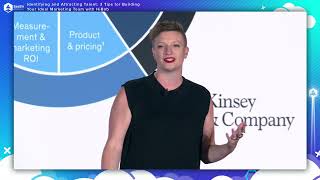
Sarah Reynolds, CMO at HiBob, shares three steps for building a marketing team: define what your team needs based on company stage, write job descriptions that attract diverse talent and consider apprenticeships, and work with HR to build your employer brand so people want to stay.
Chapters
Hey folks, as the voiceover told you, I'm Sarah Reynolds. I am chief Marketing officer at an HR tech company called hi Bob. My pronouns are they and them. And I'm here to talk to you about identifying and attracting talent. I'm going to share three tips for building your ideal marketing team. We're going to move through this super quickly. I only have 10 minutes, but I wanted to share kind of three key insights that have come from developing marketing teams throughout my career. The first of which I kind of want to take us back in a little bit of a time capsule. In 2017, Harvard Business Review published a really great article called while the CMOs never last. It's something that I share with every single person in my network who wants to become a marketing leader, whether you're a CMO or a VP or any kind of title. And it's all about how, in fact, like at the time CEOs that they polled for the article, 80% of them said they were dissatisfied with their CEO, CMO or their marketing team's performance. And the authors, they characterize this as a fundamental disconnect between what what people wanted a CMO to do and what they thought the job was supposed to do and the agency that they gave the CMO to actually do things in the organization. There just wasn't really clear definition about what a chief marketing officer does, what a marketing team is supposed to do, or what they're supposed to control. This is the fundamental of sort of our first tip, which is that you need to figure out what your marketing team does. If you want to build out a great marketing team, you need to understand that one size is not going to fit all when it comes to developing a marketing organization. And specifically, you need to assess for your company what exactly you need to be good at when it comes to marketing. Because fundamentally, the needs for each of the marketing disciplines are going to be different from company to company. You might be at a stage of growth where brand and the look and feel of your brand and the definition of your brand is really critical. You might be at a stage where building pipeline is really important. You need to figure out that demand generation motion. You might be at a stage where you know you've had some messaging but you're struggling to differentiate and product marketing is going to be critically important for you. You might be at a stage where you have some great folks who can execute in your organization, but you need great leadership or you need a cultural change to try and drive you forward. When you look at the top marketing skills that LinkedIn and others say are in demand. It's almost always soft skills. It's kind of interesting. It's like the things that fundamentally make marketers great. Leadership, strategy, communication. These things are always in demand. So it's not just that you want to hire for those great aspects in your talent pool. You really want to figure out, like, when it comes to the actual work that marketing is going to do beyond leadership and communication and strategy, what do you need to hire for? Who do you need to hire? What kind of experts do you need? It wouldn't be a SaaS conference if I didn't have a diagram from McKinsey up on a slide in front of you. All this diagram from McKinsey talks about the capabilities and enablers in a marketing organization and talks about all the different things that you could decide as a marketing team or as a executive team that you really need to be good at. For you, it's about matching the skills that you need in your marketing organization to the requirements of the business. And as the leader of that function or in partnership with other leaders in your organization, you are the folks who determine that. Just keep in mind that you should set that tone early because your CEO might have really different ideas about what a marketing organization does or should be good at than maybe even you do as a marketing leader. The next is about actually attracting the talent that you need. Okay, I've figured out, like, what do I need to be good at? Who do I need to go and hire? How do I actually go and do that? So this tip is secretly three tips for the price of one. The first is get really good at using all those great marketing and communication skills to write a really fantastic job description. Sounds simple. In reality, it's hard. Hard because what you want to do is you want to have a job description that really makes an impact. The job description is the advertisement. It's the selling post for what your role is, what the opportunity is at your company. And if you think about how competitive the talent pool is, especially for great marketers, you know you need to stand out and really make an impact. So find ways of differentiating yourself, find ways to market your role, showcase your opportunity, really hone in on what is your company culture? What is your unique brand promise? What do you have to offer to an applicant if you're trying to hire for like a director of product marketing? Why is your job different than every other director of product marketing job on LinkedIn or Indeed or all of these places that they are seeing content? And then finally think about how you're making your language include inclusive throughout. So, for example, in my recruiting practice, I do not put specific requirements for numbers of years of experience. It's because you don't really need someone who has five years of experience. You need someone who has experience doing a very specific thing that ties back to what you want to be good at. They could have done that for six months and absolutely knocked it out of the park. They could have done it for five years and been absolutely terrible. The number of years of experience, it prevents people from applying who might be part of a more diverse candidate pool that you want to attract. It turns people off, so I recommend that you remove it. Similar requirement for things like MBAs. I don't have an MBA and I'm still a CMO. Who'd have thought? I remove requirements for things like MBAs. I remove requirements for things like Bachelor's degrees. Some of the best, most interesting marketers I've ever worked with don't have any formal education. They come from non traditional backgrounds. It's a huge opportunity again for you to differentiate yourself and attract as many candidates as possible. If you think differently. Second thing to think about is the location. Don't just default to return to office. Don't just default to an HQ staffing position. Remote jobs According to LinkedIn, they make up less than 20% of the job postings on LinkedIn right now. They receive more than 50% of the applications. If you want top talent, you need to think about hybrid and remote work. You need to think about the talent and the opportunity that should exist everywhere for us, not necessarily back at the office. And then finally think about your funnel. As you can tell, I'm really big into making sure that you are increasing the diversity of your applicant pool. You are going after all of the great candidates who exist everywhere in the world, not just in a 1% type of population. You want to think about how am I actually going to move the needle when it comes to reaching those folks who maybe don't find me via LinkedIn or via a college recruiting fair. So think about programs like Train to Hire. Apprenticeships have been hot for a really long time for a reason, folks, and they are a great opportunity for you to get great talent in the door. Train them exactly to do the things that you need them to do, get them thinking in the way that you think, and ultimately grow them as part of your organization. You can do things like rotational programs if you have a small startup or you have lots of jobs to do and you want to give people the opportunity to try out many different roles in your organization. You can look to professional organizations who might have networks of people who are really good at exactly the things that you need in your organization. And then finally, consider executive recruiters. They're your friends, especially when you're trying to build a great marketing leadership team. They have access to candidates and they can sell your company to candidates who maybe would not have given you a second look on a more traditional recruiting platform like LinkedIn or indeed, last but not least, don't go it alone. Develop a great partnership with your HR function. Define your company culture and your values. Figure out what your employer brand stands for just as much as you're thinking about what your company brand stands for. And in this market that is so competitive and in this market that continues to favor job seekers, figure out what your clear and compelling employee value proposition is. Your evp. Your EVP can be everything from company culture to benefits, to job opportunities to internal mobility to the type of hybrid work that you embrace in your organization. It can be all of those things. It can be many, many more things than that, but it's a really great way again of differentiating yourself in a super crowded market. So key takeaways. Figure out what you want to be good at, then go be good at it. Then recruit for those people who help you be good at it. Hire talent that's going to fit both your marketing team needs, those things you want to be good at. And also is a culture fit for your organization. You want to ensure that great employee success. You want to ensure retention of employees long term with your organization. It's what's on going going to make you successful as you grow. So figure out how you're going to find the people who fit both of those needs. And then finally consider remote or hybrid roles that let talent work from anywhere and that allow you to reach the talent that exists everywhere around the beautiful, diverse, big wide world of ours. Because it's a huge opportunity for you to think differently than maybe somebody who's thinking just about in office work. Bob is here to help. Bob is an HR platform again that provides a great, like mobile, consistent experience for your employees around the globe. We're here today at booth 217 in the other hangar. We'd love to talk to you if you have additional questions for me about marketing best practices or if you have any ideas about how to form that great partnership with hr. Again, we're here to help. So thank you so much for your time, really appreciate it.










