4 Steps to Scaling to $250M, While Keeping Community at Your Center with Stack Overflow CEO
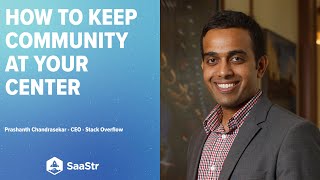
Stack Overflow's CEO outlines four pillars for scaling a B2B SaaS company to $250M: product-market fit, go-to-market strategy, competitive differentiation through community as a strategic moat, and evolving your team across growth stages. He stresses building with your community through shared identity and co-creation, measuring adoption early, and sequencing your GTM moves carefully.
Questions this video answers
October 2019.
About 120 million monthly users.
About 2.7 million questions in the prior year.
Over 50 million questions and answers overall.
The Messy Middle by Scott Belsky.
Chapters
Okay, I am going to hit start, so here we go. Great. Good luck. All right, well, thank you for the opportunity to share some of our thinking around scaling B2B SaaS companies with a special focus on community building. As you know, Stack Overflow is all about communities with a focus on developers and technologists. And we're in the midst of transforming ourselves and scaling into a very, very fast growing SaaS company. So I myself, my name is Prashant Chandrasekhar. I joined as a CEO of Stack Overflow back in October of 2019. So I've been about 10 months in seat and I joined after about a seven year stint as a senior leader at Rackspace where I led their cloud services business. And as you know, Rackspace recently, or likely Rackspace recently went public after about four years being in the private market. So a great story for them. So to kick things off, what I thought I would do is I would want to reference this great shot that I've used both at Stack Overflow with my teams, also at Rackspace. And it's a shot by Scott Belsky, who is the CPO of Adobe. Also my classmates and friend from business school from over 14, 15 years ago, he wrote this book called the Messy Middle. And what it really shows is there are tremendous number of ups and downs as we kind of go through the scale journey. And many of you that have sort of been in the midst of this or in the messy middle, so to speak, have experienced this. And so I think as long as my perspective, as long as the slope of this line is on a positive upward trajectory, you're in good shape. So it's critical that as CEOs and as leaders of SaaS companies, that it's important to take a step back and detach from what you're actually sort of in the thick of and really assess the general slope of your scaling story because, you know, it's very easy to get bogged down with, you know, either a downward trend, which is somewhat temporary, or even an upward trend that's somewhat temporary. So I thought I would boil this down to four key pillars in terms of how I think about scaling organizations up to that 250 million mark, and again, keeping community at the center. And I'll focus a lot on that topic given our vantage point of Stack Overflow. So the four pillars, there are some key questions that you have to ask as you go on the scale journey. The first one is somewhat obviously important, but also quite covered and people have talked about this quite a bit. You can talk about, talk About Peter Thiel's zero to one, you've got Eric Reese, you've got a whole bunch of folks that have talked about this, especially early on. So you know, I don't have to talk about it from a founder perspective, but fundamentally what you're trying to do here is you're trying to understand what are the ways in which you can ensure that your product is really sound, solving a big problem for customers before you scale. Right. And how do you expand ultimately once you figure that out, how do you expand the scope of your use cases over time to ultimately make your product even, even more pervasive across the board? Secondly, you've got go to market approach and expansion. So obviously there are many ways to go to market and ultimately we just need to understand what are the options, what are the most appropriate ones and how do you decide for your own organization and how do you ultimately then expand your go to market given there are so many different options and how do you again pick amongst the different choices that you have? The third pillar, competitive differentiation. So this is really where I will focus my comments on the community quite a bit. And I believe that's an underestimated area of competitive differentiation. But with so many companies and startups and all the incumbents of the world being disrupted by literally hundreds and thousands of companies that are being funded to effectively disaggregate or decouple certain parts of the value chain so they can actually add value in an even more efficient way. How do you stand out from the pack and grow despite all this competition? And then finally a topic that's not necessarily talked about as much, which I think is very relevant, is a stage specific team. So I think it's quite difficult in my experience that you go from 0 to 250 million of revenue with the same team, whether that's across product or other go to market functions and so on, there's a lot, there's these sort of, it's almost an evolution of not only sort of the customer as an organism, but you know, the people, you know that are really running the play and you just effectively need different types of skills along the way. So I will focus a lot of my time on number three and number four because you know, lots been written about number one and number two. So I just, you know, be a better focus of our time. So number one, product market fit for completeness and expansion. Just to kick things off, the key points here, you know, you really want to focus on the fit side, which is the first of two sides of this Example equation really delivering repeatable value very early on the customer journey. Right. So this is many of us that have sort of been involved with launching new products or businesses. There is always going to be this temptation especially when you're getting going big customers coming down and saying it's like I will pay you a lot of money to effectively do this and this and this and you know, this is a, you know, typically that could be a complete drain on your resources internally. Especially when you're trying to be a product led company. You're building for a lot of scale and you want to make sure that we talk a lot about the last mile of customization and really building configurable products as we like to say, within Stack Overflow versus just highly customized products. And so I learned this lesson very kind of the hard way early on in my career when we were launching capability around creating a sort of a service around DevOps as a concept. And the, the temptation again to take on larger customers that want to define a lot of your individual requirements really takes away from your ability to drive something at scale. The second point here is around really measuring leading indicators and this versus just waiting for the end of the year type renewal which is typically way too late in terms of figuring out if you really got product market fit. So you want to make sure that you're figuring out product adoption in product nudges. And there's so many tools these days that allow you to do that effectively. We use them at Stack Overflow like Intercom and Pendo and all these other tools and really customer success driving this adoption and really understanding in a very detailed fashion what is likely to happen towards the end of the end of the renewal period. And then on the expansion side you've got a couple of things to consider. One is the problem journey. When you think about the problem you're solving for customers, it's likely that there are plenty of adjacent problems to the left of the problem you're solving and to the right of the problem that you're solving. A good example of this is at Rackspace where I was doing the cloud services business. When companies came to us, mostly they came to us because they loved our managed services capability. We were a services company and that's very much sort of later down the phase of where customers were thinking about the cloud. You also have phases before that which are the architecture phase and you have effectively a design phase thinking about which possible, which possible cloud to choose between. AWS and Azure and Google. So all those different problem statements and even Problem statements after, like cost optimization, all those things are very important in the context of making sure that there are important considerations before and after. So you have to figure out ultimately where you want to focus and ultimately figure out, you know, in terms of your problem statement, can you move earlier on in that cycle or can you move after that cycle once you solve the immediate problem at hand? Secondly, we've got in terms of the second part of the expansion problem is use cases. So when you think about use cases for adjacent organizations, there's a lot to be said around figuring out where your immediate target group is all about. So when you think about if you're serving, let's say an engineering organization like we do in stack over for teams, which is typically the place where we typically serve customers, then it expands to things like DevOps, perhaps to site reliability engineering, to architecture teams, to product teams, perhaps to product marketing teams, customer success teams, and so on. Ultimately you have to probably very likely in fact make changes to your product over the as you sort of expand those use cases. But those are opportunities for expansion. Second pillar with go to market approach and expansion. So a big part here when you think about the key points, again with the two sides of the coin around the approach and the expansion. If I think about approach, the first part here is you have to ultimately decide as an organization whether you're product led, where you're sales led, or you're a marketing led organization. And this is important because ultimately you want to try and ensure that you've got alignment across your company. And this is, you know, it's easier said than done because there's a lot of considerations around where you are as an organization at the current moment, where you are in the context of where you're going. And there's a tremendous amount of maturity elements that need to be in place for you to be able to move in whatever direction you choose. And there are trade offs with all things and ultimately you have to decide do you really care about serving the ultimate end user or do you care about focusing on the CIO and CTO type sale or are you somewhere in between? But this is a very deliberate choice making this determination which aligns a lot of folks around your company. Secondly, when you think about freemium and free trials, this aspect is important because it's hard to be in enterprise B2B SaaS these days without the ability for users or customers to try before they buy. And so especially these days, developers and technologists do a lot of the decision making. They influence the ultimate decision in a Tremendous way. And they ultimately hold the power and influence and increasingly are making the recommendations on all sorts of critical decisions like cloud providers or internal asynchronous and synchronous collaboration software and so on. And this is especially true when you're thinking about a bottoms up product LED motion which is obviously becoming more and more common in the SaaS world. And then you've got a choice around direct and indirect sales and ultimately you can't do it all in my experience. So you have to figure out, you have to pick one primary motion, whether that's direct or indirect, and progress to the next one in a very systematic fashion. Ultimately indirect will get you the ability to scale very rapidly, but, but you can't do that unless you actually have a very solid foundation with your direct go to market motion. And then probably one of the most important things that again is somewhat overlooked, especially when folks are flush with cash and with the ability to fund businesses, is you have to make the unit economics work. And I believe that this needs to be an explicit priority for your company as it scales if you want to sort any sort of long term fundamental value creation and sort of return on invested capital. So this is super critical for it to kind of ultimately last for your company to be sustainable for the long run. On the flip side, expansion, there are probably three dimensions that you can think of. One is verticals and this is fairly obvious industry verticals. This could be financial services, could be healthcare and so on. At Stack over as an example, financial services is a big vertical for us in our team's SaaS production and we have there's an opportunity to effectively leverage a vertical go to market strategy. Think about solutions, packages, bundles, how you think about attach rates if you've got related products that are able to be sold together. So that's a very, very key area of focus that allow you to really sell bigger ACD type deals to your clients. Secondly, our segments, and this is again also fairly self explanatory when you think about small business, medium sized businesses, enterprises and vice versa. If you go the other way around, enterprise, mid market SB and you have to figure out what direction you want to move. At Rackspace originally we actually started out as an SMB focused company but we moved into the enterprise over the many years at Stack Overflow, especially our Team SaaS product, we actually started in the enterprise and then we have now actually expanded that into the mid market and also into the SV or small business world geographic areas. This is a tremendous opportunity, especially the world that we live in. And it's very dynamic and you have a tremendous amount of entrepreneurship and growth worldwide. So if your business is based in the us, how much of that foundation is applicable in the context of the international regions, whether it's EMEA or apac. And ultimately the value proposition is the same. You've got a good solid foundation. But of course there's going to be a level of effort with regards to local language support. There's currency, there's billing, there's local go to market teams. So there are definitely. It's not as easy as it sounds, but it is effectively a very deliberate expansion strategy. So those are the first two pillars. Let's now move to competitive differentiation. And so out of this I thought I'd cover both the common things that people think about here, plus also community. So let me start out with product. Product is probably easily the most thought out, the most leveraged way to differentiate your company when most B2B stars companies start these days. So this includes a range of different things, features and quality and reliability and price and distribution and so on. And all of that together ultimately allows you to really distinguish yourself. And there are so many companies and examples around folks that have done this. Even if you look outside the tech sector, think about reliability, when you think about Honda and Toyota, cars that you probably bought when you were in college because they were going to run for 200,000 miles and there was that they made an entire, they differentiated themselves amongst the pack using that strategy. Secondly, one that's also obviously quite prevalent is brand. And so when you think about brand, there are many ways to think about this. Values, heritage, packaging, convenience, customer support, quality, you name it, right? So there's all these traditional ways. Any marketer is looking forward to this. And also great examples here of companies that have built tremendous businesses. One example that comes to mind, let's take customer support is Zappos, the shoe retailer that's part of Amazon, built a tremendous business out of customer support at the heart of their brand building efforts. And so that's. So the second pillar is about brand. Now the third pillar is all around community. And I believe that this is one of the most underestimated ways in which people can actually differentiate their company and their strategy and how they actually think about building a long term sustainable business. And I believe there are also five key tenets to building a great community. And we know this example. We know this because obviously at Stack Overflow we breathe this every day. So the first part is all around shared identity. So in our case, it's all about developers and technologists who love helping their fellow developers and technologists. And so there's this kind of real camaraderie and real sense of sharing and really creating something that's gonna change the world. And developers just have that in their DNA. They love to help each other and that's why we get up in the morning. They're so excited about that mission. Secondly, you've got incentives and rewards for users and this is all around the gamification that gives the participants in the community a tremendous sense of accomplishment. In our case, they're helping obviously their fellow developers and technologists. They're showcasing their skill in the community on Python and Ruby and AWS and all sorts of other topics. And this incentive and reward system that's been built with the upvotes and the downvotes by our amazing founders many years ago has lasted over a decade. And this is a key, key tenant to being able to maintain the community. The third aspect is building with the community. And this is all about not building for the community, but building it in partnership with the so when we think about power users and we think about what we call the meta user base at Stack, you can't just build it from outside in, you have to build it from within. So our product and engineering community teams, led by Chief Product and Technology Officer Teresa Dietrich, are doing a really great job of partnering with the community and building it with them versus independently outside of them. Next we've got breaking down Silos which is all around making sure that associated communities are you break down silos so they can actually work together. We're in this process at the moment where we think about a lot of full Stack engineering topics. There's cloud, there's DevOps, there's AI, ML, data science, there's a whole host of other technology centric topics. How do you make sure that these communities are somewhat linked in a way that allows people to have a broader perspective and are being helped in a multiple dimensional way? And all of this creates these virtuous cycles between not only the, in our case the public community and all our paid SaaS products, but it really creates this ecosystem of communities and products, as we like to say, that generates this momentum and that's why we have the vast scale that we do at Stack Overflow. Another kind of final point I'd like to mention here is the order in which you actually do this is important. Most companies start with product, they move to create a great brand and then ultimately they maybe think about communities. In my opinion, again, people don't often think about communities as much, but there are examples like Stack Overflow or even many open source communities these days, or companies like, let's say MongoDB that went from building a phenomenal community to creating a great brand in that ecosystem and then ultimately created a product Stack Overflow. We're on this journey because we're now creating SaaS products. After we started with a great community, we built a great brand and now we've been really transforming into a SaaS company. And so this order, I would ask Yourself, as a SaaS company, are you first of all focused on all three? Where are you in this kind of evolution and ultimately which direction are you going in? And communities is becoming more and more relevant and people are being to recognize it. So we look at some external research. First Run Capital recently put this out, which is that 80% of founders reported that it was important to their business and about 30% or 28% said it was critical to that business. I suspect that in a world that's becoming increasingly remote, community will become even more prevalent as a source of competitive differentiation because you can only do so much with product and brand in such a highly virtual environment. All right, and if you even look outside the tech space, there are examples of this. You think about Peloton, I'm sure many of you are customers, especially given what we're going through at the moment. They have built a massive home fitness community and they've broken up this isolated exercising activity into a group and really a community activity, which is phenomenal. Similarly, upwork, massive community, freelancers and permancers. And they've used their site and app to ensure that everybody feels supported. As a result, they also built a really material community. And of course Stack Overflow, over the past 10 years, we have got over 120 million monthly users. And just last year we had about 2.7 million questions that were asked on our platform. And overall we have now over 50 million questions and answers. And so this gives you a sense of the scale and the virtuous cycles that you can actually create if you focus on the community. So in summary, obviously we love and we obsess about the community. We're blessed to work with developers and technologists to create these communities on our public platform and also internal communities through our Stack overflow for team's SaaS product. And ultimately, you know, the developer DNA of sharing and aligning to our mission statement of helping write the script of the future by serving developers and technologists really allows us to feel really excited in the morning to come to work and really be able to go after this. And so in summary, I'll say that when you think about communities, this third pillar of competitive differentiation, what comes to mind is actually something that Warren Buffett has been talking about for years and you know, he celebrated his 90th birthday recently as a very happy man. And he talks about moats and he talks about strategy moats and imagine this medieval castle and the body of water around it. And community is a strategy moat. It very much is. And ultimately it's a moat because it promotes stickiness. The many to many interactions between the community create virtuous cycles with organic scale. And then ultimately what you're trying to accomplish as a company is competitive differentiation and advantage which cannot be replicated. It's core to the strategy and that's ultimately the goal. Right. And so in our case, like I said, we have this community of 120 million users which serves as a tremendous moat for us in an ecosystem. And that moat surrounds our paid SaaS products, stack overflow for Teams, which is a private version of our public platform and also serves very much the same users with all the other products that we have. And then finally, the fourth pillar that I'll cover off here in a little bit of a faster fashion is a state specific team. So I truly believe this is not talked about enough and I do think that it makes a huge difference, especially when you're scaling from 0 to 250. So Jason Lemkin of Sasrix has talked about the various phases and the go to market approaches and so on. So I'm just going to use some broader definitions here, both in terms of what's early and I've split it up early, mid and late and let's assume for illustrative purposes is sort of in this first phase of call it 0, 20 or 25 million of revenue. And what you typically experience is on the product side. You know, you start out with a fairly small, tight knit group, founder led, a lot of blurry lines, no fancy titles, and a lot of them are really, you know, cross product engineering and architecture and functions like that typically. And you have a lot of focus on direct customer feedback and you're really, you need to get the heart of the customer problem because that's where you are trying to figure it out in terms of product market fit that we talked about earlier on ultimately solving this customer problem, which is hopefully a huge problem with your product and with a lot of deep customer empathy on the go to market side, what you're likely to start out with is more often than not an evangelist type sales leader. And this is typically somebody who's quite close to the product and the customer problem may even be not or he or she may not be a typical sales leader. You know, it may be somebody that's actually a lot more product centric and that's good. In this phase of the journey it's very important to be very, very tied to that and I would argue throughout your journey, but even more so important in this part of the journey. And then your team that you have, which is likely a combined sales and customer success team, is a ragtag group of folks that have not always had, not all of them come from typical sales background. Many of them are again very focused on this early phase and are excellent at it. And that's what you need at this phase. When you move on to this mid phase, which is in between, call it again 2025 to let's say 70 or 75 million. Again using broad definitions. When you think about the product side, you're going to need a much more full product team with specialization. And this is where you have product management and user research and product design and all the other functions that all of you are familiar with. And then on the go to market side you're going to move to a lot more of a builder VP of sales, somebody who has a lot of discipline, cadence, methodology, things like Bent which we used to use at Rackspace in the sales organization. We use Medpic at stack Overflow in our sales organization. And then there's a lot of specialization of the sales organization. Jason Lemkin talks a lot about this in terms of specialized sales. And then finally when you think about inbound marketing and inbound and outbound sales development, a lot of scaled efforts around demand generation engines with tools like Marketo and those sort of things. And then finally you have a separate customer success organization that obsesses about renewals and upgrades and so on. And so this is this mid phase. And then when you progress even further, you know, you have to take it up even one more notch, right in terms of the late stage of this game where you think, when you think of it from a product standpoint, you've got all those mid stage items that we just talked about. Even more an obsessive focus on voice of customer, customer advisory boards, roadmap reviews, you know, offering management which includes like an exploration and business cases and commitment pitches. A lot more diligence around, you know, when you actually do certain things, a lot more deliberate focus on Market differentiation versus market relevance. Especially when you're likely to have a lot more competition at this phase. So you have to because incumbents are going to notice your presence because you've actually scaled this stage in the game and resource allocation here becomes completely paramount. And Teresa, our chief product officer and I talk a lot about this at Stack and she also had a session around Focus at an earlier session earlier in Saster and so she this is the kind of this topic here is all about making sure that we maybe we pick our spots in terms of where we actually allocate resources and then finally go to market. When we think about the various capabilities you not only think about the build a vp but you moved on now to this forecast machine and predictability and somebody a VP of sales who can actually do that. Right. And so that is important. Then everything that I mentioned in the prior stage. But also on top of that a lot of enablement, a lot of operational rigorous around sales strategy, territory planning, deal desk, you name it. Much has been written about this topic so I won't sort of belabor the point. And then ultimately that allows you to effectively scale your go to market. So in terms of key takeaways, just to make sure it lands in terms of the four main pillars, number one product market fit and expansion number two go to market approach and expansion number three, competitive differentiation again three ways to do it, product brand and community again underestimated area of competitive differentiation and the order matters and then ultimately stage specific team. So if you focus on these four, I hope you know that that's useful to you and you know, you know we definitely use this frame at Stack Overflow on our teams and I've used it in my career throughout my time at Rackspace and while I moved over here and I think it relates, I think one of the primary things I hope you're leaving with is that community is a sort of really great core axis of competitive differentiation. And as we Progress in our SaaS scale journey we certainly believe that is for us and we hope it is going to be for your companies. If you'd like to learn more about how we help companies build communities whether they're externally on a public platform or internally with our stack over for teams SaaS product, please reach out to us on our this email that's been set up primarily just for this event. So it's Saster just AS event spelled sasterstackoverflow.com and I hope this was useful to everybody. So I will stop there and I will take any questions that Folks might have. All right, let me see. There's some questions coming in. All right, is there a specific, let's see, is there a specific platform you recommend for managing rewards and incentives? Great question, Andrea. I think the, obviously at Stack we use what we've built over the years and the algorithm and the kind of the logic there is all based on. There's a lot that goes into it. There's a lot of experimentation over the years. And this is the whole point I was mentioning around the meta community. So there are no, I don't believe there are any sort of off the shelf capabilities. That's why we're sort of in the world that we are in. We help create communities. And so there's an opportunity to leverage Stack overflow pretty much for all your kind of the rewards and incentive systems that are in place. Most of the other companies, if you think about, you know, other companies that have created sort of their own and mostly been internal mechanisms to showcase, you know, that's like employee, you know, in some cases people are gamifying how they think about, you know, expense management. If you. And some companies are showcasing, you know, how many, how employees have actually saved money for the company and showcasing that. So they've mostly built them on their own. But of course, if you think about technology communities, we believe you can leverage Stack over for that either in the public space or the private space. Next, let's see. In terms of. This is an interesting question. App development seems to have exploded since COVID Any data or learnings on why? Well, I think, you know, I think in general, if you look at the macro trends that are underway, you've got, you know, you heard digital transformation, it's a big buzzword. But I would say in general, the movement to the cloud is a fundamental move. It's been happening for over a decade actually, but it's actually still very early in the transformation of that for all the companies around the world. So estimates are that it's probably close to about a trillion dollars of IT spend or even more that will ultimately move to the cloud. And so that is a fundamental driver of saying ultimately when you do architect for the cloud, you have to do it in a very, very specific way. As we talk about internally, it's around, we have how do you make sure that there's not a single monolith and there's true flexibility when you're able to build cloud applications and so on. So a lot of that is fueling it. The move around DevOps is a huge aspect and making sure that there's real connectivity not only internally between your dev and ops teams and so on, but also with customers, which is ultimately the purpose, which is to make sure you're very close to your customers, to build things that they care about. And so all those underlying kind of forces, those two plus of course, remote work, as you point out, and companies realizing that this is not a kind of a temporary phenomenon, it's going to be around for a long time, the impact of COVID 19, that is all causing people to think very diligently about their digital transformation strategy. I think. I believe that's why those three forces, cloud DevOps and then of course remote work more broadly, is causing this kind of massive move to digitization. All right, let me think about a couple more questions here. There's one, there's a, there's one about Stack overflows community efforts. You know, where have they actually failed over time? So this is an interesting question and I think it's a good one. I think over the years I mentioned this power user base, the meta community. When we started as an organization in the community back in 2008, that was the core focus. It was all about working with that very specific power user community. Over the years, I think there was varying levels of focus on that topic and being able to be very deliberate about it and being able to follow through on thinking about what does the community actually care about and how do we make sure we deliver on those promises and given the resources that the company has, and also of course, having this kind of, this kind of goal of being a sustainable company over time. So that I think was tough. I think over the years for the company. What we've done more recently is said, let's actually think about this as a product. Our primary product is the public platform. So what we did is effectively treated that as a product by itself. So all the product principles, and again, our product organization has done a tremendous job on a community team, et cetera, of this is making sure that we think, you know, build a roadmap, be very deliberate about what the community actually wants and being able to deliver and showcase and really be able to, you know, follow through on our commitments and really take the input of the folks again in that power user base and also expand it to new users to make sure that, you know, it's inclusive and welcoming of all the folks around the world that want to enter software development, which is an increasingly large number. And so that whole balancing act, I think is, is, I think historically has been a tough one to navigate But I think we've got a great path going forward. I think we've made some really good strides with our team over the past past nine months. Another one. Can you give an example of how you would build a community in a traditionally conservative environment like a financial technology or services company? Great question. I mean, this is, you know, we believe that there are almost 60% plus of information that is shared and, you know, collaborated. You know, people used to collaborate is actually private information, which is the reason why we actually launched our Stack Overflow for Teams product. And this is actually, it's not surprising to us that financial services is actually the number one vertical for our Stack Overflow for Teams product. Because a lot of that information is proprietary, beyond, of course, the information that's public, which is all around fundamental concepts, around all the technology that you want to learn about, whether it's Python or Ruby or AWS and so on. But the point is that in financial services institutions, there's plenty that is proprietary that they now use capabilities like ours with our teams product to be able to share internally. So that's why we build internal communities with teams and we of course build external communities with our public platform. This is an excellent question by Sagar. What do you think the cost Runway of startup for startups is for starting from the community rather than starting from the product? Usually communities take a long, take long to actually become something profitable. Great question. And I think this is one where you have to decide ultimately, you know, what is the long game, what is like your. What is the company's objective in terms of what you're trying to solve and what the problem is. And if you think about companies like MongoDB, they were very deliberate about this. It was one of those things that ultimately started again with a very, very, very specific shared identity around the space that they operate in, which of course is not focused on traditional relational databases. And that focus, and with keeping profit and keeping the business side second, in many ways allowed them to effectively create a problem statement very rapidly because of the commonality of the community and the virtual cycles that I was explaining before that solved the problem in a very rapid way. Another example here would be OpenStack, which is more of a private cloud capability. And that also in many ways started because of the shared identity of wanting to be open source. In many ways, that's taking a different trajectory. But the point is that the ability to get some critical mass and for you to create a product or capability or share technology is very rapid in that sort of sense. And that allows you to effectively build this great fundamental ecosystem like I was mentioning with Stack Overflow and then you can progress to the other parts like MongoDB did or stack Overflow is doing at the moment. There's one question about why don't you piggyback or leverage GitHub's presence and communities more? So GitHub actually solves a very specific problem around code repository and of course phenomenal product. We're partners with GitHub. Our stack over for teams capability integrates with GitHub Enterprise. We actually serve many of the same customers in a very joint fashion, but we also integrate in the public community. So meaning you can actually sign up, you can log into Stack Overflow with your GitHub account, the public community side. So we've actually done some really great things. I connect with nat Friedman, the CEO of GitHub quite often and we are very aligned on where the world is going in terms of the impact of developers and technologists and the tremendous opportunity we have to really make an impact for the world. Right. For the next generation set of applications we have integrated, but they solve a different problem and we solve a different problem. I think they focus on code, repeat, repository and really making sure that that information is freely shared. And you know, how do they make sure that that is highly effective? And we focus on of course being like the knowledge base with regards to all sorts of problems. And you know, we've recently expanded to new form factors called longer form content called articles, beyond the Q and A format, especially in our teams product. And we'll be also thinking about that in the context of the. Okay, and let's see, I think there's one more. Couple more questions I can take here. Yeah, so this one's interesting. How do you remain authentic to a community and still build a large business on that community? What are the lines not to cross and keep it real and not break the community relationship? So phenomenal question, you know, this is one that we have actually thought about very deeply for a long time. And you know, our thought is that ultimately like what are you trying to do? You're trying to serve a very specific user. In our case, it's about serving developers and technologists. That's it. You know, we, those are the users that we want to serve. How do you do it? We first started out with a public community that was built with the community that's been serving, of course, that, that, that user base for over a decade. And then the question becomes, how do you continue to serve them? What else do they need so in the context of allowing them to find phenomenal jobs when they're looking for transitions in their careers, how do you make sure they're aware of and being connected with companies that are launching new features? For example, If AWS launches 1400 features, how do they actually engage with the community of AWS users and maybe even AWS directly through our platform? How do we enable them, those same users, developers, technologists, to be able to share private information if they're working for a financial services company, as an example, like I said, 60% is private. So the way in which we can solve this is to be focused on ultimately who we are serving. And it's all about developers and technologists. It doesn't matter. Ultimately, people have to decide if it is a paid product or unpaid. There's value, of course, that you create that ultimately hopefully deserves to be paid. And so we focus on creating value. And in some cases we believe some value should be just out there in the context of the public community, which is obviously created jointly with, with the community. And then there are capabilities even beyond kind of layer above that in many ways to enable those same users to benefit. And then of course, we have decided to charge for those. Of course, we want to make sure that, like I said earlier on this unit, economics and we are sustainable kind of company over time. It's important to do that ultimately to again serve the community, the same users. So you have to have that understanding and being very clear ultimately with your community, that's what you're doing. And I think we've done an increasingly better job over the past few quarters to make sure it's clear what we're actually trying to accomplish. All right, let's see. Yes, there's an interesting one around. There's an interesting one around. How do you build a community around a new product category when the pain is not obvious to most people? And that's an interesting one. I mean, Azen has asked that question. And ultimately, like I said, you want to solve a problem that's big, right? I think there are many ways. There has got to be some sort of critical mass people that actually there are enough people that actually care about a topic. And we've actually put some thought into this in the context of our stack overflow, Stack Exchange websites. And if you go to websites, you'll see that there's an area called literally Area 51. And that's the area you can actually go and propose new sites and new areas that you can create a community around and organically through a very Specific process that I won't get into here is how it gets effectively bubbled up in a way that says there's enthusiasm for this topic. So we've thought about this very problem that you're talking about is how do we know, should we just go create pre populate a bunch of communities that we believe are important in the world but you know, may or may not be shared. That perspective may or may not be shared by people around the world. That's the reason why you want to make sure that you're building with the community so that they are also working with you. And if there's interest and you're introducing the topic and there's actually common problems that people are trying to solve, that shared identity comes into the mix and you're able to create, you know, a common understanding and you're able to move forward from that. Okay, I think, Yeah, this is an interesting question from Vikram. How do you decide on, you know, whether you're a sales led organization or product led organization, a marketing led organization. And this is a phenomenal question. Like I said, you know, we, we talk a lot about this at Stack Overflow and you know, most SaaS companies and SaaS companies, there's a lot of data around this, you know recently about this, which is product led SaaS companies are typically outperforming traditional SaaS companies. And so there's an interesting dichotomy in that there are many different. It's not easy by the way, just to say your product led you off to the races. I think it's one of those things which people underestimate again the amount of work that actually goes into making sure that's highly successful. You got to be hyper focused on the user. You've got to think about the online experience, the self serve experience, the ability to really drive adoption, all those elements that people are aware of. And then sales led organizations, which is common in companies like many other enterprise companies in the past have been sales led, including services companies are also typically sales led. It's all about that is more, it sort of depends on the segment you're focused on. If you're focused a lot on serving a fewer number of customers that have more bespoke requirements then it's probably okay to be sales that. But if you're trying to build something at scale, it is more likely than not, you know, you're likely going to choose, you know, product led because that's where you get the virality and you get a lot of common fundamental usage of your product versus you know, serving a smaller number of customers, where you might have to justify a lot of customization, but again, they might write large checks and so on. But you have to decide what type of company you are. Are you a company that's trying to sell 100 customers or you're trying a company that's trying to serve millions of customers? So that's nothing wrong or right. It's just one of those things where you have to decide what your company strategy is about. This is an interesting question by Andrea. If most companies start to engage their customers in a community, will there be community fatigue in quotes at some point? How many communities will individuals want to be part of? Great question. I really believe that when you think about macro communities. Right. That you've often heard about theorists saying that ultimately in any category, there's probably a couple leaders. There's typically the top two are the kind of the most prevalent category leaders where people spend all their time. It's kind of like saying, think back to the social media days back in the early 2000s. There's all that kind of back and forth with the Facebooks and the Friendsters and all that. You can't be part of all these social networks and ultimately you're just going to be wasting a lot of time. So the question like, where do you get your biggest bang for your buck? Where's the biggest critical mass? Where's the biggest level of virtual cycles? And where do you get your job done? In many cases, in our case, we believe in the technologists and developer space, it's that powerful because Again, we have 120 million users and it's, I think it would not make a lot of sense for people to actually, you know, then go and, you know, focus on that, plus also a whole bunch of other technology communities. So we believe it actually is the one place for people to go to get all their answers. Okay, I think we're at almost at time, So let me just see if there are any other kind of outstanding questions. Yeah, this is an interesting one by Clinton. Can you share any experiences or lessons learned from when you moved to the mid to late stages of scaling and have outgrown your initial service, billing, management, sales support, assuming they cannot scale without you? Yes. You know, so both stories come to mind from Rackspace. Stories come to mind from, from Stack Overflow. And I'll use one from Stack Overflow, where when we think about Jason Lemkin talks a lot about this in terms of the funnel and Obviously things like MQLs and SQLs and so on, and there was our marketing leader, Khaled and his team were very deliberate about making sure that we were setting up the scale as we went on the SaaS journey. And there was a lot of focus on what are the systems that will help us to get from zero to wherever we ended up in 2018, 2019. And then ultimately now we are kind of progressing to this kind of journey ahead, becoming sort of a very large SaaS company. And the question is your process, your technology, the people, I covered the people earlier. Technology is a huge, huge element of that. But it all starts with, you know, it starts with people, then there's probably process and then technology, as you know, it's commonly known. And so we had him, his team and him focus a lot on making sure that we replaced the systems to make sure that we had a kind of a much more scale demand generation effort, a lot more visibility and attribution from a marketing standpoint of every single lead that's generated. What truly ultimately resulted in that lead was it because of this particular campaign that was kicked off and being able to track it all the way through. So every dollar that you drop at the top of the funnel, you're able to track all the way to the bottom. And so that level of specificity, which requires a tremendous amount of work and discipline and the right people and technology changes, you know, we changed out one demand gen system for another. And then ultimately, of course, process to make sure that everybody is trained and using it in a way that ultimately makes sense for us and then data is accurate is one example that I can portray here. All right, Okay. I think those are all the questions for the most part, in terms of, you know, the questions that have been asked and, you know, kind of in terms of being able to kind of, hopefully that's been helpful for folks across the board. So thank you again for all your time and your questions. They're amazing questions. And again, if you would like to learn more about how we can help you build your communities, whether it's in our public platform or within your company, please email sasterstackoverflow.com or you can also look me up on LinkedIn or Twitter. Chandrasekhar. It's my first initial, my first name and my entire last name. But thank you again for your attention and for your time.










