5 Tips for Showing the True Value of Your AI with Freshworks
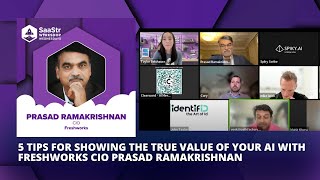
Prasad Ramakrishnan, CIO at Freshworks, shares five tips for proving AI's value: start with a problem you need to solve, not a solution looking for one. Focus on user experience gains like call deflection and personalization, use copilots to speed up workflows, and build analytics that show cause-and-effect so you can act faster on insights.
Chapters
Foreign.
Hello everyone. Welcome, welcome. We are back for workshop Wednesday. Hi everyone. As always, please let us know where you are tuning in from. We are thrilled today to be joined by Prasad Ramakrishnan from the freshworks. He is the Chief Information Officer there. Prasad's joining us us today from Cavallo Point, a beautiful place in the Bay Area. So we're so thrilled to have him. We'd also love to hear where you guys are from. So Prasad knows who he's talking to and where in the world everyone is. We are really excited for this session today as CIO Prasad is at the forefront of optimizing and innovating his team and his customers tech stack. So today he's going to be covering a really timely topic and sharing his five tips for showing the true value of your AI. We know it's obviously a really top of mind topic for everyone and really excited because Prasad's tactics are straightforward, really impactful and are things that you guys are going to be able to take to your teams after workshop Wednesday today. So we love a tactical session. As always, we aim to keep these sessions as interactive as possible. So please make sure that you're contributing to the chat, dropping your questions in there. I'll be coordinating with you if you're able to come off mute and ask your question live to Prasad when the time comes or I can help facilitate. But we also invite everyone to turn their cameras on so that Prasad also knows who he's talking to. So again Prasad, welcome and thanks so much for being here with us today.
Good morning Taylor. Good morning everyone. Wonderful being here. Thank you for organizing the session.
Yeah, of course. Like I said, excited to dive into this AI focused topic. Before we get kicked off, just a couple of quick fire questions. Starting off. How would you define what you do in your day to day role for the group today?
Yeah, I think I come up with different ways to look at the abbreviation. A CIO is normally called Chief Information Officer, but it's actually Chief Innovation Officer, Chief Integration Officer. I look at my role as a problem solver, Taylor, at the end of the day, right, the business has a problem and I'm a technology enabler to enable the business to digitize and digitalize their business so that they are, they're more productive. Right. So look at my role as more of a problem solver.
Love it, love it. And I know there are a lot of other problem solvers in this room who are excited to hear from you so and love the idea that, that I stands for a lot of different things. Wearing many hats. Prasad, we always like to ask everyone in the last 12 months, what's been the hardest thing that you've worked on?
See, I think two, two and a half years back when Covid hit us and we all had to get into a work from home mode. Right. That did a number on all of us. Right. We ended up having to accelerate some of our transformation initiatives. But now fast forward the clock to the beginning of the year. We now have a mode where we are in what I call as a hybrid workplace mode. So you have some people still working from home, some people working in the office. How do I make sure that the digital experience, the employee experience from both my internal and external constituents, how do I make it as seamless as possible? So because it's in a mode where everybody's in the office, I can focus on one thing or if everybody is remote, I can focus on a particular set of solutions. Now, how do I take care of a mixed mode of operation? Right. That's one of the, one of the hardest things to figure out from an employee experience perspective, given that that's top. And I'm sure all the people on the call will agree that that's top on their minds too.
Yeah, absolutely. As we all do these sessions virtually every week, we can definitely that. And then, Prasad, what project are you working on now that you're most excited about?
Yeah, so as with any business, we are, we are constantly transforming different parts of our business. Right. So right now I'm working on transforming our sales and marketing stack and looking forward to rolling out, rolling out that in the next eight to 12 weeks. So it's going to be a fun Christmas and Thanksgiving period for us and we are doing a bulk of our data migration and all of that. So that's what my team is working on.
Yeah, very exciting. And again, very much in line with what we are always talking about here at Workshop Wednesday and at Saster, so. Well, without further ado, I will pass it over to Prasad, everyone. We're so thrilled to have him and he's going to take it away with his tips for leveraging AI and then we'll get into Q and A here in just a few minutes. But Prasad, take it away.
Thank you, Taylor. And good morning to everyone that's joining remotely. I would love to be in a face to face session and meet people because it's always, I look at every opportunity to interact with people when I'm learning stuff. Right. So I encourage your comments, I encourage your questions and encourage your dialogue here because it's not a one way conversation here. I would love for you to also say things which I'm going to learn from as part of the session. So the topic I'm going to cover is 5 tips for showing the true value of AI. I know that Zoom allows you to do kind of a hand raise, just show of hands. How many of you have used the word AI more times this year than in the last many years? Has it shown up as a topic du jour for all of you? If you really look at it, you're not alone. Thanks to the announcement that came last year from Microsoft and the ChatGPT announcement that came earlier this year. It's not just IT practitioners or technology practitioners, but pretty much even people on the business side have started embracing and looking forward to what I can do for them. Right. As with any technology. Right. And I think one, one phrase I like to use is don't be a problem, a solution, looking for a problem. Right? It's always you want to start with the problem statement and then figure out what is the appropriate technology that you want to deploy to solve your problem. Right? And all of us have been through all the prior technology hype cycles. We have all been through the, the big data hype cycle. We have all been through the webification of your business, if you want to call it. If you didn't have a website, you are dead. If you remember the early 2000s, in the mid 2005, 2006, the whole big data wave where we went through a hype cycle where everybody said they are doing big data. Then we had the mobile revolution where everybody needed to have a mobile presence. But in the case of AI, it is actually slightly different. AI is not new. AI has been around for 30, 40 years. In fact, I was talking to somebody the other day and I may be dating myself here. I did programming in Lisp, an AI language back in my college days. So there have been AI technologies in use for many, many years and it's been part of a lot of the software that we use in our day to day life. But what's different now is we now have this aspect of generative AI where it is not just about using AI tools to analyze and automate things, but it's also creation of content. If you look at the way we are looking at AI, it's now enabling us to do a lot more. So I'm just going to talk about a few tips here and I would encourage your questions and we can get into a dialogue here.
Right.
One, I think if you look at, from a, from an overall value proposition perspective, every single company and every single IT practitioner, we want to make sure that we are enhancing the user experience. And here when I talk about user, I'm talking about, if you're talking about your internal employees, you want to make sure that your internal employees have the best possible experience as they're relating, as they're interacting with your IT department, or if it's the customer that you're talking about, we want to make sure that our customer, our paying customer, when they come to us for support, we want to enhance the user experience. In fact, the term experience as it relates to employee experience, user experience, customer experience, was not a mainstream term till five, six years back. We used to all focus on that. We used to always come up with ways by which we would take care of that. But the fact that it's, we used to focus on UI and then I think the last five to seven years we have started focusing on user experience where UX engineers have started becoming important. So let's look at how AI can help here, right? From an interaction perspective. The most obvious one is what we call a call deflection, where when somebody is asking for support, how frustrating is it for you to have to explain everything about yourself and all the issues that you're facing over and over again to multiple people, right? Imagine if you had an intelligent AI bot on the other side, right? Or a virtual agent on the other side which can understand what you're talking about and can do a round trip conversation for you. So for example, if you're saying, hey, I have a problem with my mobile phone, if it knows who you are and is able to now turn around and ask a question, say, hey, I know you have a Samsung phone, are you having a problem with this or that? Right? It's, that's the way humans typically provide service. So this is where AI can do the round trip conversation in terms of humanizing the interaction. A lot of the companies that we are, that I'm sure all of you are part of, we are global organizations where our customers don't just come from one locale or one region. We have customers coming from all over the world. And in some cases the people that are interacting with you may not necessarily speak English, right? Where you want to make sure that you are able to serve the needs of the customers and the employees who are in a different geographical location, right? Where you could, there is only so many translators we can hire, right? As a, as an, as an organization, when your revenue goes from a million dollars to say $100 million. You don't make your employee count as 100x what it was when you were million dollars. There is this linearity factor that we always look at, right? Where you always want to make sure how do I leverage technology to achieve scale where I'm still serving the needs of a broad, broad base of employees and customers. And here's where AI can play a huge role in automating and expanding your reach as it relates to kind of local language translations, right? And obviously getting the whole personalization of the user experience. When a user comes and talks to you, I don't know how many of you would remember 15, 20 years back, the only automation we used to have was everything was IVR. IVR was the in thing at that time. Press 1 for this, press 2 for this, press 3 to talk to a customer service agent and press 9, right? All of us would by default press 9 or press 0 to talk to a customer service agent, right? Because we want to go and talk to a human, right? So AI can actually try and humanize the experience from an end user perspective where as an organization you do not need to add that many more customer service support agents or sales agents. You could actually humanize the entire interaction by making sure that you deploy the creative ways of deploying AI to actually serve that need, right? So these are the three broad areas that I can think of from a user experience perspective. Let me go into the second aspect, right? And this is what I call the whole, the whole copilot type of experience, right? Imagine if you're bringing, if you're bringing a whole bunch of employees into your organization right? Now, when a person comes into your team, you actually have them buddy up with an existing member of the team to tell the new person, hey, this is how we respond to customer issues, or this is how we take care of supporting this particular issue, and so on. Right? Now imagine if you're scaling rapidly across the globe, sometimes you may not have the luxury of the person sitting next to you. And think about the last two, two and a half years where we have gone into this mixed mode of working, where there are people working at home and people working remotely. How do I make sure that I am now training and onboarding the new employees and making them productive. This is where almost having a copilot type of experience, where AI, the AI engine is actually acting as a copilot working along with, along with the sales engineer or with the support engineer. Example, if you're trying to compose an email to send to your prospect or to your, to the person who's about to make a decision on buying your product. Or as a support engineer, if you're trying to compose an email to an irate customer, a customer is very unhappy with the service that we have provided. How do you draft and write an email without having this notion, which I call as writer's block, right? All of us love to write, but sometimes you encounter this writer's block. Here's where I can come in, right? Where if it can generate a draft for you based on looking at the context of the ticket or the context of the sales deal, or the context of the marketing program that you're trying to run with the prospective customer, which then you as a human can take and then enhance and further personalize, you have actually now enabled your sales engineer or your support engineer or marketing engineer to become that much more productive, right? And this is a huge productivity gain. If you, if you want to. If as an organization you're rapidly scaling, but you don't want to linearly scale your, your employees, right? So this is the other aspect where AI can play a huge role, right? The third area is, is around optimizing your data platforms, right? See, I think the, thanks to the previous wave, which I talked about, the big data wave, right? The ability to bring data, large amounts of data. And again, the other phenomenon is the cost of processing as well as the cost of storage over the last 20 years has dramatically reduced, right? Previously we used to watch for every byte or megabyte or kilobyte of data that we used to store. Now who cares? Right now data is available aplenty, right? We now have excessive data, right? But it's about how do you make sense of all of the data that is coming from, from all of these sources? So this is where I can play a role, right? Rather than you writing code to now bring data from these multiple sources, these structured and unstructured sources, thanks to AI, you can actually now tell it, hey, can you write a python code, a piece of python code to now bring data from my customer master as well as my billing master to now bring into my, into my data lake? It would give you the starting point of the code with kind of starting points for you to now go and put your database connection output, the extra logic that you want to put here, what is it in a sense done? It has reduced the complexity for you for writing code because as much as writers have, writer's blog, even programmers sometimes, we have, in fact, one of the first programs that I would always write in my programming days was the hello World program. I go in there first thing in the morning, drink my coffee. I would write a hello World, hello World program. Because I know, okay, there's one program that I've written this morning that compiles without an issue, right? I don't know how many of you were doing that during your programming days. But see, at the end of the day, getting over the writer's block and reducing your cycle time to value from the point of view of bringing in the data and analyzing the data is where AI can play a huge role. The fourth is in terms of what we call as a cause and effect. I'm sure every one of us has a data platform where we bring data from multiple different sources and then we do insights from that, saying, hey, what's our average customer satisfaction? What is our average time to resolution? What is my deal lifecycle stage looking like? And take the CSAT for example, where you have it may possibly come back to you and say that, hey, out of 80% of our customers are very happy with us, 10% are neutral, and 10% are extremely unhappy with the type of service that we are providing. Now imagine what we would do as humans. We would be happy with the 80% that the 10% that are neutral. We will go into the actual qualitative comments to see why that is, but we would actually spend more time on the remaining 10% to say, why are the people unhappy? Because you always want to increase your csat. You want to increase your net promoter score from a support perspective. Now imagine this is where if AI can be deployed to actually now not just tell you that there is a problem, but if IT can also analyze and say, hey, out of Your entire population, 80% are happy with your support, 10% are extremely unhappy and they are unhappy for these following reasons. And if you do these one or two things, you can actually bump up your 80% positive CSAT to 85% here. This would normally have been done by a human, but this is where we can leverage AI to actually identify the patterns and identify the correlation between the data to actually now bring back insights into making you do more insight based data decisions, right? Where you are not going and fishing for information, you are not going and spending the time where the information is being served up to you. And then now the business leader or the IT leader who's using that, either from a sales or a support or an IT perspective, is using that to now actually make an informed decision, right? So this is where the, what I call the cycle time between the time data is consummated to the time the data is analyzed. If I can shorten that, then you can go and change how it's almost going back into time and changing what the actual event was, right? So here, if it's a customer retention problem, because you're saying that, hey, if I ship things from this particular warehouse, I'm getting a lot of returns. Imagine if you wait till the end of the month. We are now coming up on the holiday season. It may be too late for you to recover from a revenue perspective. But if you had that insight and using AI, where you look at the cost and the effect, you can actually go back and change and say, you know what, stop shipping from that warehouse. There is a major defect happening there. Let's change our warehouse to something else. So this is where AI can play a huge role. The other aspect is managing and summarizing email. See, all of us know that thanks to what ChatGPT and GPT4 is doing for us, right? A lot of the content, in fact, I was seeing a kind of a deep fake movie created through AI where Morgan Freeman is speaking and he looks exactly like Morgan. I'm sure Morgan may himself be surprised to see how real it looks. Right? You can actually have humans being created in the sense the, the videos that are being created are so lifelike. Right now. Right now, think about the internal business context. I'm not asking all of you to create a Morgan Freeman here, but I'm saying we could actually use AI to summarize some of the emails. Let's take a customer support example. Somebody calls you for support and your level one agent takes care of solving the problem, but is not able to solve the problem, which then goes to a level two agent and then goes to a, a deeper level from an escalation perspective, right? You want to make sure that you have the right people within your organization solving the customer's problem. Now, what happens in many organizations, the Level 1 or Level 2 agent is actually going to summarize the problem so that the next level of person reading it is not wasting time reading through like 500 chatters, right? So this is where AI can help summarize the context of, of a ticket. Or if you're talking about a sales situation, right? If you're actually now trying to send for exception approval to your sales leader saying, hey, I have a prospect who's interested in buying your product and is looking for say 30% discount as compared to the normal 10% discount, you want to provide the justification where if you have an engine enabling you to do that, you're actually going to reduce the amount of time that you're spending writing and summarizing. This is where AI can play a huge role in terms of simplifying your day to day life. Right. So what I've covered here is like four or five broad tips and areas in terms of how you can leverage AI. Right. One is leverage it to enhance user experience. Look at ways by which you do not have to linearly scale your employee growth based on the growth of your organization. How do you leverage AI to seamlessly onboard peoples and train all the new people that are coming onto your board, coming onto your company? Right. How do you optimize the data by leveraging the code creation capabilities of AI to now augment your overall data platform? How do you just not get insights but also get the cause and effect analysis right? If I do this, I will get this right, which is what a human normally does. And AI can help us here. And the last thing we talked about was how, how to manage and summarize emails. Right. So with this I'm going to stop sharing my screen so that I would love to have a dialogue about, about these topics here. Taylor, if you can help with the format of the Q and A, that will help.
Yeah, we're already getting some great questions. Prasad, thanks for that overview. Our first question is from Venk. Will Venk. I'll pass it over to you if you want to go off mute and ask your question live to Prasad.
I think you're on mute.
I think you're still on mute. Vink.
How does this work? Is that better?
Yeah, much better. Much better.
Bluetooth technology.
Yeah. When everything else fails, reboot. Right. That's what we do.
Thank you for this. I'm the chief Product Officer of a company called Path Factory. We do marketing AI and in fact you're one of our customers at freshworks and have while. And it's really interesting because we realize that there is so much opportunity. But here's the other interesting thing because I speak to a lot of CIOs more so I've spoken to probably more CIOs this financial quarter than I have CMOs, partially because all the transformation that you're advocating and it's amazing to see you being an evangelist for this involves a lot of, how do I want to call it? Reticence and some trust issues around the challenges of data security and privacy around these new AI models. So in order for us to, you know, I'd love to hear from your perspective, I mean, you're living and breathing this world, but half the challenge is anybody can put out AI these days. But it requires a rethinking and reformatting of all the trust guidelines that we've had for the past 10 years. So I'd love for your viewpoint and how do we partner on this together? How do you look through this and, and what do you think the advice is for folks like that who are selling to CIOs?
No, no, great point, Venk here. And if you really look at it, right, what do you call the legislation and the governance framework always lags behind technology innovation, right? We saw this with all the prior innovation that we have been seeing here, right? Think about it. When we used to be in an on premise mode, right, and we used to have complete control over our. All of the infrastructure, the servers, the network, the databases, the apps, everything would be within our campus. The next leap of faith happened when we moved to a Colo facility where, oh my God, I cannot touch and feel it because I cannot do enough heating and cooling. So now we started putting it in a Colo facility. The next huge leap was going towards SaaS, right? If you really look at what happened, right? So the same questions you're talking about, right? In terms of how do we as technology leaders safeguard our company assets and their company ip, right? And our customer information and our employee information. Because think about it, at the end of the day, then when customers come to us, they have put the trust in us. I like the word you use, venk, right? Where they put the trust in you, saying that you are now going to safeguard that customer's information, right? So I think there are two angles to what you're saying, right? If you're asking about legislation and other things, I think those are emerging, right? It's in fact, Congress is talking about it, right? But at the end of the day, from a practical. What do you call before we wait for legislation to come, if you make sure that the data that you're using to train the models, right? I call it as a control plane and a data plane, right? You could have the data plane still being within the customer's control, while the control plane, which is where all the functionality is, could still come centrally, where rather than giving the keys to your kingdom to a third party, where, you know, it's basically what I call chain of custody, right? The minute you have given chain of custody of your data, your assets, your crown jewels, out of your control to somebody else, you have abdicated control and now you're at the mercy of. Of what that person's security posture is. Right. And so this is where making sure that you put the governance and checks to make sure that you're only sending what is relevant and putting the controls and processes. So for different products, it's different ways of doing it. Right, because you want to take advantage of all the innovation, you don't want to be left out of the innovation, but it's about meaningful deployment of governance methodologies to, to make sure you're not shooting yourself in the foot.
Thank you, Prasad.
Thanks so much, Prasad. Great question, Venk. Our next question is from Melissa.
Hi there. Great to be here, Prasad. Thanks for being here and sharing your experiences. So I come from the worlds of tech and documentary filmmaking and we're starting to do some experimenting with global corporations who are facing the challenges internally about creating a culture of being change curious versus change resistant and really amping up everyone's innovation to bring us along these transformation journeys. Wondering if you faced any challenges internally at freshworks or what kind of lessons learned you might have about how to do that sort of change within your company. And especially wondering if storytelling, like sharing stories between employees of freshworks has been part of that strategy.
Yeah, it's actually this video that I'm doing is not really Prasad. This is actually the Gen AI Prasad talking to you. Just kidding, Melissa. Right. So no, I think, see, at the end of the day, right, at freshworks we do use all of our products and there is AI built into all of our products, right? So we do meaningful deployment of all of the features that we're getting from our own products. And from an overall kind of a technology strategy perspective, one of the things we always look at is, right, as with any innovation, I need to not just look at from a technology perspective, you're bringing up the aspect of content. Our marketing team is looking at ways by which it can streamline the way it's creating content. Because at the end of the day, you want to put out the best possible content to make the end customer want to engage with you. How do I now reduce the cycle time to creative content? So, thanks to what Genai can do, we now have our marketing teams evaluating tools and products which will enable them to reduce the amount of cycle time to create the content. Goes back to what I first said, Melissa, which is don't be a solution looking for a problem. Our problem here is there is a lot of demand out there for content. Everybody wants to get eyeballs on your product. Right. Because all of us are in very competitive industries, you want to make sure you get the best eyeballs from the customers on your company and your product. So how do we make sure that we come up with the, what I call the relevant content, right, to make sure that it is relevant to the, to the audience that you're, you're addressing. So this is where a combination of more internal need based, arriving at what, what problem you're trying to solve with the evaluation of the possible technology is what comes in. I'm not sure whether I'm answering your question, Melissa. If I'm not, please, please feel free to chime in and ask.
Well, you've led me down a really interesting thought path about some other things, but I was especially wondering, just within freshworks, within your company, what's the culture like? Are your employees totally on board with the internal systems changes you're doing or are you having challenges with the culture among your employees of like, hey man, this is how I've been doing it forever and it works for me and I don't time to mess with, you know, the way we've been doing it and do it this new way.
A great question, Melissa. I think one of the things I talk about, which I've practiced in the last, what, 10 years that I've been CIO at three different companies is what I call democratizing the software selection process, right? Gone are the days when the CIO used to be the one sitting in an ivory tower and managing by a presidential edict or CIO edict, right? Where saying, thou shall all use this piece of software, right? Gone are those days, right? We now live in a world where a lot of our business users are extremely savvy with technology. And the IT leader is not an IT leader, is more a business leader, right? The IT leader needs to know, the business needs to know how finance works, how marketing works, how sales works, right? So one of the practices we have is what we call democratizing. So before any piece of software is bought, we bring a core, a cross functional team together to actually be part of the evaluation process where it does two things for me. One is when I'm including you in the software selection process, I'm getting implicit buy in from you because you had a say in saying, do I need to go with this software or that software? And two, from a change management perspective, you are acting as my change management agent because you're already bought into it. You had a say in the decision and now you will act as my change agents in terms of taking it to all of your downstream stakeholders. We do this and the term I use is democratizing. Right. And so more and more companies have started doing this because at the end of the day, the lines between technology and business are becoming very thin. Right. Technology has become an extremely close enabler of business. And without the technology, the CIO organization and the business leader collaborating, the business process is going to be left behind and we're not going to be efficient. And a lot of business leaders already realized that. And that's what we do here at Freshwoods, if that's to answer your question here.
Awesome. Thank you.
Thanks, Prasad. Mike Stock has a question, kind of a follow up about accuracy with the critical content and the creation of that. So Mike, I'll let you chime in with your follow up question on some of those points.
Sure. Thank you very much. Hi Prasad.
Hey Mike.
So, so we're, we're a DITA based ccms. We work with support teams, we deliver content, it's all technical product content. And we've been diving into AI both to create the content, but also kind of on the other side on the search side and kind of summarizing some of that stuff. So the question really is on this, within support teams, what is the conversation like around creating guardrails for what the LLM is feeding off of? So it's not kind of hallucinating. I think we all know we've been around for a while there is an answer in Confluence, there's an answer in Salesforce Knowledge, there's an answer somewhere else. And if you're kind of pointing AI at all of it, it'll just kind of create an answer. But if it's critical and you can't, you know, cut and paste and miss a decimal point, that becomes a real issue, you know, depending on what the industry is. So I'm wondering if there's a methodology that you're using at Fresno freshworks to kind of address that.
Yeah, no, no. At the end of the day, Right. And we have heard this term, Mike, being in the software industry for so many years, right. Garbage and garbage out. And that's not just about data, it's also about content. Right. If you. And I love what Bill Gates said about 25 years ago, he said automation of a bad process, just make sure that you're shooting yourself in your foot faster. Right. So it's all about making sure that you have the right governance in place. So if you ask me, the way we have got about thinking about it, right. It's about coming up with what we call as a center of Excellence model, right? You have content all over within the company, right? You have pockets of excellence and pockets of content that are internal and external to your organization. But any content that you want, right, whether it is created through a Gen AI or through the existing content that have been created by humans, because let's be honest about it, Gen AI cannot create all the content. You still need humans to create some of the content, right? If you come up with a. My suggestion would be come up with a center of excellence model where you have a core team which is governing and deciding what the authoritative content is, where it almost goes through a QA process. You basically have almost like rabbits running around bringing all of these things together, which comes to the center of excellence in terms of governing and making sure that whatever is then used for downstream, you have a quality check process. Now, initially that lift may be high, right? Because you're dealing with lot of fragmented piece of content and you're now trying to bring sense into this. But over time, because it's a self learning agent, right, thanks to AI is self learning, you'll start seeing better and better content start coming out where the amount of human supervision that is required, right? Because you have the supervised remote, non supervised remote, the amount of human supervision may start reducing over time. But I can never think of a scenario where it's going to come down to zero. You can never eliminate the human intelligence and the human factor in terms of making sure that what is being put out is relevant. Because think about it. In a sales situation, if you have the bot, your AI write you an email based on an irate customer's response and it actually decides to send an extremely inflammatory response to your customer, you can kiss that million dollar deal goodbye. So you never want that because maybe Jennai thinks that that's the best way to respond to this customer who's really being a royal pain. But maybe that's not the right response. So this is where tuning and training and using a center of excellence mode could be, is what I would suggest.
Thank you very much.
Thanks, Mike. Next up is Ernesto. Ernesto, you still on with us? If not, I can ask his question for him in case he had to go stay on mute for a moment. Prasad. Ernesto's question is, with the fast pace of development in AI, how are you thinking about incorporating AI tools and balancing IT with picking something that may soon be outdated?
Yeah. So see, at the end of the day, right, it is about from an IT process perspective, right? All of us, right, all of us as IT practitioners, right, have a method to Bringing software into the enterprise. Right. And one of the concepts that I use is what I call app rationalization. Right? Where thanks to the, the extremely reduced friction for buying SaaS software, I'm sure all of us are having. If you look across your enterprise, you're going to have hundreds of SaaS software. Right. And how do you make sure that you don't have duplicated pieces of software? Right. You basically need to go through a regular APP rationalization exercise, which is actually the answer to what you're asking now, Taylor. Right? You have existing pieces of software that are doing A, B and C functionality. Now there is a new piece of software with Genai capabilities which could actually allow me to retire one or two of these pieces of software which I already have. These need to be in the context of your entire software evaluation and software rationalization strategy. And that's not a new strategy thanks to Gen AI. This needs to be part of our muscle memory. No matter what, whether Genai is there or not or whether you're even evaluating a Gen AI related tool or not, you still need this as part of your, your overall IT strategy. Otherwise you're going to have an excessive amount of software and not have the functionality. And it also translates into bad employee experience. If I tell my Mike, for example, hey Mike, for you to do your thing, go to this piece of software and then actually go into this piece of software and then go into this, he's going to be frustrated like hell. Right? So it also has a bad experience. One it's more work for us as IT and it's bad from an employee experience perspective. They're going to hate it. Right. So I would say use this in the context of your entire software evaluation stretch.
Thanks so much for answering that one, Prasad. I think a follow up question to that is are there any resources that you use to stay up to date on what the latest technologies are and which ones you may want to use or may evaluate for the team to use.
Yeah. So I love meeting people, Taylor. I think one of, one of the things I love doing is I love meeting people and to. And whether it is young or old, I meet a lot of people throughout the day and I learn from every interaction. Right. I attend a lot of, I attend a lot of kind of the industry meets. There is a CIO network that multiple CIO networks that I'm part of and obviously reading a lot, right. So one is from up from, from staying abreast with all the latest technology. These are methods that I use and I also use thanks to the wonderful team I have, they're out there scouting and bringing for me, saying, hey, Prasad, here's. Here's something that can solve this particular problem, right? If somebody comes and says, Prasad, here is a jazzy piece of technology I think we want to incorporate, I'll say, get out of here, right? I don't want, like it to be a solution. Looking for a problem. I'll say, what is it? What is the real problem that we are trying to solve? Let us make sure that we are not, we are not putting the cart before the horse, right? So we always are constantly looking at. And that's what I encourage my team and I encourage the business users saying, hey guys, tell me where you have inefficiency in terms of the way you're using it. Let's then look at what pieces of technology are out there, right? So it's a, it's a constant learning and a constant evaluation process. Tenor is what I use.
Awesome. Thanks, Prasad. And we know Prasad is out meeting people today. He's joining us in between customer meetings. So with that in mind, we have one last question before we let him get back to it. Mike Latch, I think you had another one for Prasad. I'll let you tune in.
Hey, Mike.
Hey, Prasad.
Thank you.
Terry Taylor. Sorry, My question, let's see, just reading it verbatim, any examples of AI generated action plans from aggregated data where the plan was executed and something important and measurable occurred? Yeah, so what I mean is, so it's easy to imagine and we're doing some of this around, you know, if a, if a human with more expertise watches a human with less expertise or less like task relevant maturity, they often can afterwards, you know, come up with feedback and then deliver feedback and then see if the feedback is followed. And then they can also watch a bunch of people do something, come back and say, okay, the team needs to do this. And it's very straightforward to have generative AI do a lot of that work. But I was just curious if, like you've done that specifically and like specifically how it went and things like that, if you've actually evolved where, like, you know how much, if you've gotten very far in making that actually like a closed loop sort of thing. And so just curious if you had specific examples and more specific examples of how it went.
If so, yeah, no, I had to be honest.
Mike, does that make sense?
Yeah, no, no. Totally makes sense, actually. Right. It's almost the kind of the next phase of the copilot, right? It's almost like Having a coach guide you saying, hey, here's where it went wrong. So I think the way we have deployed it internally is more the copilot mode where it tells you what the next way to respond to an issue. Right. But I don't think we have deployed it in the mode that you're talking about. But that brings up an interesting use case for me to, to explore where you're actually using this to, to give constructive feedback. Right. Is what you're talking about. Right. And yeah, yeah.
Especially aggregated.
Yeah. But. Okay, Mike, but that's something I can. Let me make a note of that and to the previous. Right. This is what I learned when I'm interacting with each of each of people in these type of sessions. Right. I, I tried. I'm like a sponge trying to take in as much information as possible. So thank you. Thank you for that, Mike.
Yeah, thank you. Thanks for doing this talk too.
Appreciate it.
Thank you, Mike.
All right, well, thank you so much for the time, Prasad. We really appreciate it. Again, a super timely topic as we're all trying to just navigate and figure out next steps from here. So we appreciate your time. Reminder for everyone, Today's recording will be live on YouTube as soon as this session wraps. You'll also be able to find the slides on SlideShare, as always. And then next week we are back as always, Wednesday, 10:00am Pacific Time. And we're going to be joined by Mandy Cole, partner at Stage two. She's going to be covering her five steps to building your first go to market playbook. So I know these VC sessions are always great and super helpful as well. So thanks again, Prasad. We really appreciate it. Thanks everyone for joining and we'll see you next week with Mandy.
Thank you. Thank you so much, Taylor. Thank you everyone for the wonderful questions. Have a good one. Bye.
Bye.










