7 Key Tips & Tricks to Getting More Revenue per AE with Salesloft, Zoom and Fireeye
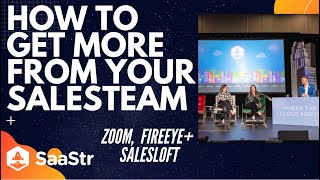
Hilary Headley from Zoom and Christina Foley from FireEye discuss how to boost revenue per account executive. They cover hiring the right profiles, structuring ramp programs around learnable outcomes, and using tools like Salesloft and LinkedIn Sales Navigator to automate outreach without losing trust.
Chapters
Final session of the day, we have for you. Kyle Porter, Sales Loft Chief Executive Officer, Hilary Headley, Zoom Head of Sales, and Christina Foley, Fireeye Vice President of Commercial.
Sales, Please welcome them to the stage.
All right. Hey. I am super excited for this session. We've got some wonderful content in store for everyone. Thank you all for coming out. Really deeply, deeply grateful for the opportunity. So let's get started. We're going to talk about something that I'm thinking is near and dear to the hearts of entrepreneurs and SaaS executives. It's getting more revenue and more productivity from your AES. And we've got a superstar cast of amazing sales leaders. And I want to first introduce Hilary Headley in the white chair in the middle. Hillary runs all of sales operations and sales enablement for Zoom Video Communications. And I think many or most of us know who Zoom is. They are really revolutionizing the way companies interact with each other over video. So super excited to have Hilary here with us today. And Hilary, you've been at a couple of billion dollar companies. So Hilary was with previously with Alteryx and Mindbody running sales leadership there. So she's got tons of great content and it's going to be incredible talk. And then next up is Christina Foley, who is the VP of Commercial Sales at FireEye. And FireEye is a $4 billion publicly traded security company. And Christina, also no stranger to big growing businesses, having spent time at is it Cisco and Ironport as well. So let's give a round of applause to our two speakers. I actually forgot the biggest part that deserves a large round of applause. Christina has three seven year old daughters and Hillary has three boys as well. So big round of applause for that also. Okay, cool. So before we got up on stage today, we were talking about some of the massive trends that are going on in business. And what we realized is that the way buyers and sellers are interacting has dramatically changed. There's no shortage of information out there that talks about how the buyer is more empowered than ever before. They've got more information than ever before. The seller no longer holds the keys to the information that they need. But what's happened is it seems like that's even the buyer's now inundated with all of that information. They've got so many content, so much content. Sellers are leaving hundreds of voicemails on their system, sending thousands of emails, and buyers are trying to solve their problems, which are complex and increasingly difficult. And what they're doing is they're yearning for our organizations to rise above all of that noise. Out in the marketplace deliver them with a better sales experience. And so we've seen some changes and shifts happen in marketing. There's lots of content on what's happening around the sales development area. But really this account executive or closer or seller role is just so close to the revenue and it's so important that the productivity gains there can be so instrumental to your company. So that's what we're gonna talk about today. And what we identified is that there's three areas that are really important. The people that you have on board, the process that you enable, the technology that you use. So Hillary, I want to start with you. Let's talk about people. And I was inspired by a gentleman named Mike Gamson. He runs the global sales organization for LinkedIn. He told me leaders are the most important thing leaders focus on is identifying great talent, inspiring great talent and developing it. Let's start with identifying great talent. How do you find great talent at Zoom? Sure.
So, hi everyone and thank you. I don't know that it's necessarily at Zoom, so I'm going to talk about multiple companies that I've been a part of. But some of the ways that we're able to do that is we start with an ideal hiring profile. Just like you have an ideal customer profile, start with what that is from a BDR to an SMB to a COMM to an enterprise rep. So if you're in those motions where you're moving from inbound to outbound, have you updated what that hiring profile looks like for your group in HR to make sure that they're finding not just folks that can close hot leads, but that are able to go out and prospect and move a company from cold to warm to hot. That would be a shift that you would want to look at. Another one is when companies want to move more upstream and focus on enterprise sellers. You might be excited to go and find some of those heavy hitting companies, but if they haven't done a call without a sales engineer in three years and you don't have a sales engineering staff ready to go, you're going to want to make sure that your hiring profile is heavy on tech and not necessarily around, just maybe mobilizing big buys internally so you can align around that ideal hiring profile at your different stages, what really helps next is to get a scorecard and make sure that when you're interviewing you have the right things that everyone is aligning towards that you listed in that profile. Why is this important? Because anytime a manager has open headcount, they typically have open quota and they will be excited to close maybe that first person. And they might not be the best person that aligns to what your business needs. And then last, this is one that companies will see. If you have a lot of inbound folks coming to you that want to work there, remember that just as your sales might need to move from inbound to outbound, so might your recruiting efforts. So if you haven't enabled your recruiters on your HR team to understand what it's like to move from getting people coming to them to writing those really solid LinkedIn emails to get the hooks for those good folks that you should invest maybe a little bit of time in there and make sure that they understand how to make that shift as well for you. And again, it all kind of lines back up to that ideal hiring profile so you have that nice harmony between sales and operations in hr.
Can you double click on that ideal hiring profile? What is it for you and what are the characteristics of the people you're hiring?
Yeah, it really varies. I mean, from at Zoom, we have bdr, SMB, all the way up through to enterprise. And so they vary. What I talked about there, that shift to inbound to outbound, that's definitely happening along with that look at an enterprise seller that maybe doesn't need to have as much technical expertise. Excuse me, that needs to have that technical expertise and make sure that they can knock those down if there's not that sales engineer there. So ours varies and we try to look at them at the beginning of every year to make sure we're all set.
I heard a pro tip the other day at an executive that I work with said when hiring account executives, they ask the candidate to pull out their phone and talk about a customer that they've text messaged with to close a deal. And I had never heard that before, but it makes so much sense when I look at our business and the deals we bring on board and even in financing and raising capital. So we've raised $75 million. I can tell you that we're not going to raise money from an investor if I'm not text messing messaging with them. And I can tell you the big deals aren't closing if someone's. So that's just one tip that I thought of that I had heard recently. I don't know if any come to mind along the way, let us know. Okay, so now we're going to go out and identify great talent, bring them into the organization. The second thing was inspiring that talent. Christina, how do you get Your sales executives or your closers on board with the mission of the company so that they come in just ready to rock and roll. All in for the business.
Yeah. So I'm passionate about this. I always say inspiring talent, and it goes hand in hand with retaining talent. Those that are inspired and like what they're doing and feel valued will stay with the company, will stay with you. And so when I look at that, I really think about whether it be a team of people or an individual that I'm bringing on and growing and is help them understand what is your mission? What are you doing every single day that is tied to the greater strategy of the business? So at FireEye, we're trying to solve nation state attacks, cybercrime, that sort of thing. How do I help my individual sellers feel like they're doing something for the greater good, Whether it be the mission of the company, the mission for the customer, whatever it may be, and then on a reoccurring basis, remind them of that. Understand as individuals, what are they motivated by? How do we recognize those individuals along the way? And some people are really motivated. Different and inspiring motivation, I feel like, are really parallel tracks here. So I might be inspired by career growth where someone else wants to be recognized for a win. And so I look at each individual and I recognize them differently. But at the end of the day, at the core, it's really making sure what each rep feels like they're doing on a daily basis comes to the surface, and they feel valued and that they're making an impact to the greater good of the business.
I love that, you know, tying it back to the mission and what the company is doing that makes the world a better place. You know, everyone wants to do something that's not just about a paycheck, right? That's right. And, you know, if I was working at Zoom, imagine now the people that can connect and build relationships and the impact they can have on each other's lives. I actually have a Zoom room in my house in Florida, and sometimes my wife and kids are in the Zoom room, and I'm at the office connecting with them. So it's not a business purpose, but, like, that's a meaningful thing that happens. And, you know, we obviously do it with our customers as well. And then securing the world's companies. Right. This is something that if you wake up every day and you go in and your company is changing the world in these amazing ways, that's important to story to tell and retell and retell, you know, from the day they come on board to the, you know, third year, fourth year, fifth year. They're there. Cool. Okay, Hilary. So we have great people. They're inspired. They know that working at Zoom, they're going to connect with people in authentic ways and build relationships and. And they're gonna help their customers do that. How do we get them ramped up for the specifics of the AE role? So they're most effective there.
Yeah. So Ramp, I know, is a really popular one out there. And it usually starts with what your new hire training or sales academy looks like. I'm always a little surprised when no matter what company I go to, folks will say, well, they should have learned that in new hire training. And I'm like, that is their first five days at a company, they're trying to figure out where to park, where the bathroom is, who their manager is, did they sign up for the right job. Like, they didn't learn the intricacies of closing a deal in some of those areas. So I would always challenge folks of what is the outcome that you want your new hire training to be and be very intentional about that. So one of the things that I've done in prior companies, I just took over enablement at Zoom, so we'll do this soon. But what are the top 20 things that you want your reps to walk away with and why is it 20? Because you can structure your five day a week new hire training. Two sessions in the morning, two afternoon, and. And that's where adults can really learn, and that's about what they can take in in a day. If you make it interactive, those top 20, then things be very cognizant and share that with sales leaders or other folks and say, this is what they'll learn and they will have mastered. This is what they won't, but this is how they'll learn it. This is when and this is who will teach them. And it starts to get alignment around. If your productivity metrics aren't exactly where you want them to be, it's not a quick point to a new hire training. You've really set that piece up and then it allows you to be very candid of the other areas that need those additional spots and kind of attention for reps, I think you can just kind of wrap that around. Then just as a general best practice is, if you have folks coming into your new hire training and ramping them, and it's just a series of death by PowerPoints or open Q and A without a ton of structure, your folks probably aren't going to be Walking away with what they should be very clear with what they need to learn. Teach them what that is, have them say it back to you. Do interactive skits, do drawings, make them do whiteboard certifications, whatever it is that gets them talking, doing, sharing, and all of those pieces that will help in those five or ten or however many days that you have for ramp. If it is about culture and having those pieces, that will happen naturally, I think when you're able to structure it that way. But again, that intentional of these are the 20 things they will learn, this is what they will not learn. But this is who, how and when can be a really great way to get that harmony going around. Ramping, does that make sense?
Absolutely. The importance of ramp, it can't be understated. I learned this through my journey as a CEO because as we went out and we raised a series C round last March, 50 million dollar round. And we're modeling as we scale the business and that lever on ramp is so important for what it does in the future of the company. Right. And so for everyone out there that is starting a business or is in early stages or once you get that sales momentum, that number is so critical. How fast can you hire the right people and then how long does it take them to ramp up and then which ones do you lose? Right. Retention being so important. But I started modeling out, okay, what if the ramp goes from six months to five months? What if the enterprise ramp goes quicker and the delta on that is just insane. So a very critical and important role. And then once they're ramped up. And by the way, how do you define ramped?
Yeah, so I've defined it five different ways and I think it depends what company you're at and where they're at in evolution. So the first can be time to first deal is a measure of productivity. And ramp time to full quota, which is an important one when you are setting your annual plan and what you can maybe change to get some big gains. Then there's the average number of reps attaining quota, which typically is about 50 to 60% in SAS, the average attainment of those reps. So it could be that your reps are attaining at on average 105 or 80% and then the average revenue per rep. So there's a lot of different ways on how companies measure productivity. And for me it's varied at the companies I've been to and where they're at and what they want to measure and sometimes how many reps they're hiring at any given Time. So are you doubling down on making your reps more productive? Rev per rep is going to be a big one. Are you banking your plan on hiring new reps and ramping them faster? Time to first deal and time to quota might be more important productivity metrics.
Now we want to retain our reps that are ramped up. And one way to do that, Christina, we talked about is ongoing development of those account. Executives. Talk a little bit about how you do that at FireEye.
Yeah. So number one is we always look at really what does good look like? How do we identify sellers within the organization that are doing a great job, that have attributes, the seller's DNA, that sometimes you can't really define it perfectly until you see that person doing it. So we really make sure that we have defined characteristics of really great sellers. And then we ask ourselves, how do we measure them? How are we recognizing and rewarding them and how do we reinforce their behavior? And that's the big thing. We talk about ramping them but reinforcing what they're doing on a regular basis. So we oftentimes, I mean, whether it be wind wires, whether it be what's a wind wire? So they're definitely spontaneous. But when we take down a deal that was either a customer never thought we would get, it was a Fortune 100. It was all products and services. And we send that out to the entire company. Oftentimes we get the stamp of approval from our CEO. We have him send it out.
So.
So it's a great way to basically publicize what we're doing within sales, publicize what the reps are doing, and really reinforcing the good behavior. We believe, especially being a publicly traded company, we have to be a little bit careful about what we can say externally. But internally, we really try to give as much information around the opportunity and what the seller did that was successful. So we try to really reinforce that behavior over time, whether it be in public acknowledgement on, you know, we're also really maniacal on regular, frequent cadence to make sure we're following up accordingly and building them growing.
Awesome. Talk a little bit about you've got. We've got our account executives, but there's so many roles around those players. Christina, talk about how that kind of inner working of the team helps them be productive and generate more business.
Yep. So I call it a supporting cast. And I think any seller, any leader within sales, recognizes that there are teams of people behind you trying to make your jobs and your lives easier. And the one thing that I think about as A sales leader all of the time. I tell my team this at the beginning of every year, hey, I work for you. You guys don't work for me. And so my role as a leader is to take the friction out of the business and make their job easier. So I would work with someone like Hilary in sales operations to say, what can we do to automate to refine our process? And it could be anything from how do we quote better to how do we process an order, but really, how do we take any bit of friction out of the business to make the job of a seller easier? The other piece that Hilary talked about a bit was enablement. How do we leverage our enablement teams to really train consistently as a global organization? We need to be sending the same message out, the same sales pitch. We want our customers to basically, whether you be across the world in Japan or you're here in Silicon Valley, we want everyone to hear, what is FireEye? We're pitching the same thing that's hard to do. And the other one are playbooks and enablement really rallying around that. And the last one which is most important is what I would call sales engineers and call them your work husband, your work wife, whatever, but you better have that number on speed dial to have your se. You better love them and thank them all the time. And they end up being trusted advisors within the company, especially when you have a really technical product. And so I believe those relationships are critical.
When you were talking, it gave me some ideas of some quick tips that I wanted to share. And then think about your own too, because I might ask you what that reminded me of is we identified that many of our reps were engaging with prospective customers and they were selling in high to the executives there. And those executives desired some executive connection. And so I'm sure everyone has seen this in sales. But what we did was we started with this concept of the draft on behalf of. And what that meant was the rep would draft up an email and then they would send it to me with the executives, and I would tweak it to my liking as it pertains to my understanding of their business or how I wanted to connect with them, him. And we actually liked it so much, we developed it into a little technology that runs inside of Gmail. But that was a really easy way for us to say, hey, customer, our CEO would like to connect with you and learn a little bit more about what you're doing. Then what we did, which I thought was even more effective, is once we got customers in, once we Acquired a new customer. I set this rule up in Salesforce that would say if customer comes in and deal is closed, 1 above 50k is the threshold I put on. You know, you may do differently. Then it would automate an email from me to the rep saying, congratulations on bringing company XYZ into Salesloft or super excited. I'd like the opportunity to connect with them. Would you forward this email to them and CC me so they. The minute the rep goes into Salesforce and hits close one, boom. The actual inbox, they go in their inbox and they have an email from me and. And they can afford that. And so just things like this. That reminded me when you were talking about that surrounding cast being able to keep up that continuity of the buyer's journey and the relationship. So add any tips along the way if they pop into your head. But we are talking about the surrounding journey. Right. And Christina, what happens after the customer comes on board? Because today we know, of course, in SaaS and in subscription economy, that first deal is just a piece of it.
That's right. So, yeah, so you say. You mentioned about the first deal. Many people know this. It's land and expand. How do you take a customer and grow them over time? We also at FireEye, and I'll quote Vasu, our CMO, we believe a customer's journey is an infinite loop. It goes around and around and around and around. It never ends. And so we really take that to heart. But if we talk about land and expand, the biggest thing is how we take care of our customers, how. How we value our customers. They become apostles for us. And they're willing to make more Investments with FireEye or whatever company you're with, or they're willing to be a reference or they're willing X, Y and Z. Right. So it's really important that we think about what's our customer post sale, how do we take care of them. And there's a lot of things that we can do. Small companies, big companies, whether you have smaller customer advisory boards, we give out quarterly awards to the chief security officer that we believe has made some major changes and advancements in the security world, whatever it may be. And so we really try to recognize our customers along the way, make them feel special. But we also know that our brand sits within our customers. And if we ever walk away from that, we lose the opportunity to expand and become even larger from a brand perspective. So we take that very seriously.
Awesome. In that supporting cast is the managers. Hilary, in your leadership experience, we talked a lot about how important they are. And great leaders are the ones that are enabling other leaders to do their job. So talk a little bit about that relationship and what you see the importance there on the leadership side.
Yeah, absolutely. I'm starting to get more passionate about this in 2019, which is sales enablement, seeing to almost be exclusively for sales reps. And I think we've forgotten our managers and there's some things out there that I feel like a manager ratio. Some of the companies I've heard or even been at have been 50 to 1, 20 to 1. And I'm not sure then that that can really be a successful recipe. If you want to really bank your number on ramping your reps and having them be more productive, you need someone who knows how to run a one to one, a pipeline, call a plan and review an mbr, whatever it is that all the great sales managers are doing. If there's not even a normal rep to manager ratio and you're not surrounding them after you typically promote them internally, I think we're missing out on a really key ingredient around rep productivity is what does that look like again from like ratio to are they set up to do that? Did they get certified and trained to be there as a sales manager to the tune where I hope that it's something we can do at the zoom, where we assign someone just to focus on our manager enablement to make sure that they have what they need. And I think I don't know what the right ratio is, but 20 managers, 30 managers, that's a really important multiplier and mobilizing effect that I think companies can have. That takes it a little bit off the rep because that's a lot of pressure just to put on reps. I think we need to surround our managers with just a lot more enablement in the coming years and I'm very excited.
What are the best ways to enable managers? What are the like any tips on that?
I don't know that any of them are tried and true best practices. So I'm nervous about tips. But I think there's a couple things that might pop out. Making sure that if you want to promote internally, you have the right kind of tests in there. Are they a good rep that can do it? But are they like consciously competent to be able to explain this is what it would look like to be a good rep and other people can replicate it. So can they take their skills and replicate it and then mobilize other people to do it? I think would be one thing to make sure that you can test for that. And then just being open about it and having the right manager meetings and structures and trainings down to giving them one to one sheets. I mean I use a one to one sheet in sales operations just because I'm as Kyle as you know, I'm a little structured and planned and some of the sales managers saw it and said we want to ask those same five questions to our reps and keep the same conversation going when I have 15, 20 people. So even just the intake of communication, I think for some new managers, if you haven't done it a lot, just helping them sometimes with the basics I think can go a long way. So I'll crack that code here in.
A year and then write something about it on LinkedIn so everyone can learn.
Yeah, I'll try.
We'll just bring you back on stage.
Sure. I was just going to say that one of the things that we think about that we've really embodied at FireEye and at some other companies, but specifically at FireEye is understanding the characteristics of a leader. What are the characteristics of a great leader? Do they understand the core values of the company? Do they know how to cross pollinate different organizations so that they can communicate together and they can act as a liaison or a bridge? How do they manage their, how do they manage their money? Like, are they fiscally responsible? And so there's core, we've got seven, seven or eight characteristics that we live by, core values for leaders. And there are specific things that we expect. Our managers, our senior managers, our directors, senior directors, VPs, SVPs, there's expectations that we set for them. The great thing is if you're extremely transparent about what they are and you help them understand how they can get there and for those that want to grow, it's a recipe for success.
Does the executive do that? Does the HR team do that? Who, who does that? Leadership development.
So from HR we'll educate someone like myself and then I will go and help my team, my direct managers along the way. So I've been educated. We spent two days behind closed doors really understanding the values of the company, how you promote and how you promote leaders and managers, not just individual contributors. And then hopefully we're ready and tuned enough to go out and do that.
Let's flip it up a little bit here. I've identified attention in sales and this tension arises from the fact that the best way to connect with a buyer is in an authentic, sincere, engaging and relevant way. But on the other hand, companies need to scale. They need to create repeatable process. They need to be able to forecast, show their plans to their board or management. And those two things often come in conflict because when companies emphasize on the scale side, they may blast their customers and be insensitive. And when they emphasize on the connection side, they may not figure it out in a way that's repeatable. Talk a little bit about. And I'll start with you, Hilary. What's your theory on automation? And then also if you've got any ideas around technologies that you're using or tools that are helping you.
Sure. Automation is a big one. It is the foundation of scale, if you will. I think there's kind of two different buckets for automation that I try to look at. It's not only what's manual and repetitive and, and that should definitely be automated for anyone that's there in a smart way. And then there's the automation of those things that can and should be. That can and should be repeated, but are difficult if you don't have kind of a human heart and head in front of them. And both of those matter, I think for scale because like you said, the one gives you the speed and efficiency gains and the other gives you what you need to do to kind of do it fast and do it in that fast manner.
Yeah. I've never heard a buyer who said, oh, your sales process is so cool. You know, like it's the coolest sales product. It's the sales experience that they receive is what matters to them the most. Right.
Yeah. It's basically speed of trust. So how can you get enough out there to like cast a wide net and then how do you bring them in really fast to get the trust there? I think there's three tools in, you know, in the past couple years that have popped up to really help with that. I love alliteration. And they all have an L in them, so that also helps me remember them. But LinkedIn Sales Navigator is a big one. Just even find those folks who are they. Do your diligence, do your research, bring them into your system. If they don't come to you through LinkedIn, there's a great tool called Lean Data that can help map your entire go to market session. If you have things like you have a GEO with a vertical with a named model to get the right lead to the right rep at the right time and then to be able to reach out to those folks in a scalable yet sensible and with a head and a heart way is a tool like salesloft. I think for those of us I Don't know if there's a sales ops audience. You know, we used to build marketo workflows that would then tie up into and give you a salesforce task of task one, do this. Task two, do this. Like thank goodness something like Salesloft came along to help our reps be able to do that and to keep our content going out there that has the consistent messaging that we all want to be able to have around what those are. So yeah, between LinkedIn like a lean Data and Salesloft, I think that's that was a really perfect marriage at a couple prior pre IPO companies.
It's ironic you said that about marketing automation because the last speaker who was up here is David Cummings who was the founder of Pardot and I actually founded Salesloft in the Pardot offices. Watching them do similar things and having a lot of those difficulties. So that was a lot of the inspiration. Thanks for the shout out. Really appreciate it.
Well, it's true.
And we love the three of those solutions as well. And the way they all integrate together really makes things more simple. Christina, what do you think about this concept of automation and kind of the balance there?
Well, I think it's necessary. I mean, we were talking about this earlier is we live in a world of immediacy and people are expecting answers and responses as quick as possible and they want to be sold to immediately. But the reality is you can't be insincere, you have to be efficient. But as a seller, it does. It does sort of often feel insincere if you don't do it right. We do use Salesloft a little plug for you, but it's the truth. We use Salesloft really to make sure that we have the right messaging at the right time to the people that are raising their hands and saying, please come to me, please talk to me. We're interested in FireEye and that's our opportunity to really build that immediate trust while doing it efficiently. And the big thing, and we were talking about this as well, is because of the world of immediacy. For some reason, it goes hand in hand with people want to buy from people they like because they have lots of choices at their fingertips. So what sets you apart, what sets you apart is being unique, authentic and sort of transparent. And so it's really, how quickly can you get in front of a customer being authentic for them to like and trust you? And then knowing, just as a side note, knowing their IP is protected with whatever tool you're using, their customer data is Protected. Protected. That they're being taken care of. Yep.
Yeah, you talk. That's really important, this side of trust. I think, you know, we talked a lot about this sales experience, and gartner says that 53% of customer loyalty is derived by the sales experience. So if that's not important, I don't know what is. But what's more important than that is that your customers trust you. And I think we've entered this era today where there's so many cloud applications, so much data everywhere. You know, that security side, if you're not focused on that as a business leader today, you've got to dive in, go through your SOC compliances, get protected everywhere, because that's how you're going to be able to acquire bigger and bigger customers. That data matters. A couple tips came up for me on the automation side. A few things I've seen that have been really neat. One is I saw a company two years ago, a gentleman from service titan Kevin Dorsey. He showed me this really neat structure where these leads were coming into his business. And they automatically would identify what industry they were in and what Persona they were in. So it could be electrical, a general contractor, and that would automatically route down a path to communicate in a cadence with them based on the language around what they responded to. So there's some really cool things you can do there. The other one that I saw was a company, when they closed, lost a deal, they would pick, list the reason that they closed, lost it, and. And that would kick off a chain of sales, prompted emails that would go out to the customer that were very relevant to that need. So a couple other cool things that I've seen. Well, hey, I am so proud to have had the opportunity to sit with both Hilary and Christina. Thank you for your contributions here. They're awesome. And thanks all of you for being here. Let's give a round of applause to our panelists. Thank you.










