7 Secrets to a Successful SMB GTM Strategy with PayFit and Accel | SaaStr Software Community
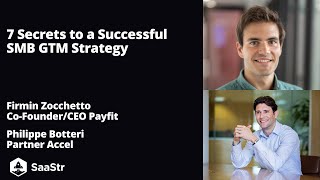
PayFit's CEO and an Accel partner share seven lessons for scaling SMB SaaS: design self-serve products, hire sales in volume with clear career paths, protect culture through engagement rituals, keep pricing simple, build B2C-style brand awareness, prioritize net retention, and nail operations before going international.
Questions this video answers
2015
About 1,000
More than 7,000 customers across Europe
France, Spain, Germany and the UK
2017
Chapters
Payroll was so complex in France. I mean, if you, if you can automate payroll in France, then you can automate payroll everywhere. That's something we've done in France and it works like a charm. We are growing really fast at payfit. Spain, the uk, Germany. We want to sell every business in the world. That's what it takes to build a future European giant. The three of us, we share the same values, the same passion and the same willingness to build something that has never been built before. What is really important to us is everyone is as happy as we are. It's not just like ping pong tables and chocolate fountains. It's all about recognition, I guess, you know, knowing that you couldn't exist without the other. We are automating everything, simplifying everything. Each time you are growing, you need to give other people responsibilities and just let them work. More custom, more features, more payfitters, more countries, more happiness. A lot of more. Like millions of employers and employees that can be happier thanks to what we are doing at PayFit.
Good afternoon everyone. It's a pleasure to be here in sunny Barcelona. And today we're going to talk about the seven secrets to a successful SMB go to market strategy. My name is Philippe Boteri. I'm a partner with Accel. So we're a global venture firm. We started in Silicon valley for about 40 years ago now and we realized that Silicon Valley did not have the monopoly on innovation. And this led us to open an office in London from which we cover all of Europe and Israel. And we do anything from a seed investment of a million dollar up to a gross equity check of $100 million and.
SAS.
Okay, lots of sound. Does anybody doesn't love SaaS here? Who doesn't like SaaS? No one.
Good.
So we do love SaaS and we had the chance to partner with great companies like Atlassian, DocuSign, UiPath and of course Payfit. So we had a chance to lead the series A in Payfit. That was in 2017 if I remember. Well, super excited about that. And I'm here with Fearma, who is the founder and CEO of the company. So Fear man, maybe just to get started, do you want to just give a quick snapshot on PayFit and so everybody knows what the company does.
Yes, sir. Thanks Philip for the introduction. I'm Firman, co founder and CEO of Payfit, a company we created with two of my best friends back in 2015. So more than seven years ago. We loved SaaS at that time, even if we were pretty young to exactly know what SaaS was about. But we learned along the way and we built payfit. So payroll and HR company that help entrepreneurs digitize payroll and HR. We grew very fast in the past seven years. So we went from three founders to 1,000 Payfitters. We are now serving thousands of customers. So more than 7,000 customers all over Europe, in France, in Spain, in Germany and in uk. And we are helping hundreds of thousands of employees strive in their SMEs. And as Philippe mentioned, we raised some funds during our history and we raised the funds with Accel five years ago to accelerate on our growth. At the time we were only a team of 30 people when I got the chance to partner with Philippe. So that was really not the same company that we have today. So happy to be there with you today and discuss a few secrets that we've learned over the past few years.
Thanks. Thank you, mom. So when you think about a SaaS company, there only two things which do really matter. The first thing is building the product. The second thing is selling the product. Everything else is just to support these these two motions. But sometime the product sells itself or you want the product to sell itself. And in the case of SMB, this is actually something that is critical. So we're, let's start with secret number one which is self serve when it comes to product is non negotiable for SMB. So Fermat, this is, you know, this comes from you. This is the number one secret was the most important. Why was it so important for you to develop very early on a self serve or actually to think about the product in a way that it would be self serve.
So in the beginning, when we started PayFeed back in 2015, we built the product and we built the sales funnel to have payfid self serve. Because we wanted our customers, entrepreneurs to become autonomous in signing up for PayFit. But we had few challenges that made us realize it was super complicated to have customers autonomous on the transition from a payroll solution to another one. And so it took us years to get this challenger cracked. And this year we are still working on this and we are still building an engine that can make customers autonomous. Discover your product. Because if you don't have this engine, then you are forced to have manual conversations with all your prospects when they discover your product. Which is fine when you are selling to enterprise and to big customers. Because you can invest a lot in sales, you have complex product, you have a sales cycle that can last for a few quarters. For a few years when you are talking to entrepreneurs, when you are selling to the mass to SMBs, you can't do that because either your prospects won't get the chance to wait for your salespeople to talk to you so they will just go and see another competitor or either they will just want to reach the end of the funnel because they want to be autonomous in discovering the product. I know there are a lot of entrepreneurs in the room, I know you are part of the 1% of the market that want to feel autonomous when you are discovering a new SaaS product. So if you are looking at a product that don't have a self serve funnel, you probably will be just ejected from the funnel and the system won't get you. So that's something I would recommend to invest very early on and that I think I would do it better if I had to do it again at payfit. Just one precision on self serve. It's not either sales either self serve. The two goes together which means that there will be some Personas, some prospects that will be fully autonomous. Along the way there will be prospects that would want a new payroll solution, but that will never be autonomous. Like for example my father, my father, you know, he will never be autonomous in a self serve funnel to change a payroll solution for his little company. But if I have a self serve funnel, I can help him discover the product and I can make our sales team save a lot of time in some parts of the funnel.
And it's not about, I mean it is also very important for customers to be able to discover and try the product on their own. But even when they're customers, especially on payroll, which is fairly complex with rule changing, you also want them to be self serve during their entire lifecycle, right?
So you want them to self onboard and make the whole transition from the former payroll solution to the new new one to pay fit. And then you also want to have the least support and declaration processes possible, which is a big challenge when we are talking about payroll, but which should be the goal of every SaaS targeting. SMBs automate a lot of things through the product through also the marketing or customer communication that you are sending your customers.
And can you maybe just give a couple of examples of how you have evolved the product to make it self serve. Right, because at the beginning you have your products, some of the customers are self maps, the most advanced, maybe self serve, others are not. But how do you understand where is the workflow broken right when you need an in person intervention? So how do you spot that? How do you prioritize the intervention and the changes on the product to basically smooth out the flow so that over time you get more, you increase a portion of customers that can be self served?
Yeah, that's a good question. So in some businesses you just have a look and see that you are losing prospects on the funnel looking at your conversion rates. To us it's very easy. We just have a look at when prospects or customers are reaching out to them. Because we're talking about payroll, we're not talking about a nice thing to do. You know, our customers are forced to process payroll and this is very important for them. So the metric that we have to assess if we are doing a great job in making our customers autonomous on discovering self onboarding and then using the product is the number of tickets we get from them or the numbers of errors that we can see along the, along the way. But it's true that you need to prioritize that with the building of new features, which is not always something very easy to do, but I would call it like part of the foundations of your product. That's not new features, that's not shiny, but that's the basis of your growth engine. Because at some point if you think that you are going to grow at scale with just spending more euros on marketing or adding more salespeople in your team, you know that that can't scale, unfortunately.
So you mentioned talking about products, that having a product led sales motion is very important. But that's, you know, usually it's not enough and you need to complement that with salespeople. I mean the difference like when you're selling to enterprise, you have, you know, fewer sales reps, more expensive, high quota. When you're selling to SMB, you have a lot of sales rep and you know, obviously lower quota and lower cost. So this leads us to the secret number two, which is the volume game, right when it comes to sales talents. So you put as a number two, it was very interesting that you know, number one was product number two is like how do I really hire and scale my sales team? So why was it so important? Is it like so hard to hire salespeople selling to SMB? How do you think about it? How do you set up the infrastructure to make this as efficient and scalable as possible?
So yeah, as you put it Philippe, when you are selling to SMBs, you are not looking for the same sales rep as when you are selling to enterprise. So basically you need people that are a bit more junior, that have a Bit less experience that have also not the salaries that SDRs or AES that are selling to big corps are having, but you need more of them. So this is why it is the volume game. So you have a lot of people that are wanting to learn a new job, a new sales job and they come to PayFit so that they can learn this job and then become an SDR and then either a manager as an ae. So you need to build career path to make sure that those young people that join you and you'll need a lot of them can evolve in your company and you need to just train them and you need a lot of them. It's really different than when you are serving enterprise and when you need just a few AES that have like 10, 15, 20 years of experience, that are paid a lot of money and that can, you know, not evolve, but keep this individual contributor job for the coming years. So that's why it's just so different. So you just need to know when you are serving SMBs that it's different than serving enterprise and that you need to go and look for the right people to join you. So build the right hiring machine and then build the right HR processes so that those people can stay with you during numerous years and not just one or two years as it is the case unfortunately in most SaaS companies where we see a big attrition with salespeople, sometimes more than 50% a year.
And where is it at Payfit right now? Sorry, where is the attrition at Payfit in your sales team Just to give.
At the moment it's around 35% which is, which is not bad given the market and the fact that it's intrinsically higher in sales team.
And maybe can you just give a few numbers just to help the people here on how do you plan your sales capacity? So what is if you need to make 100 for the year, what's your quota coverage of the hundred that you want to make? And how do you think about increasing your sales capacity to make sure that you meet the goal for next year? Is it something where every quarter you have a batch of salespeople coming? Is it every month? How do you ramp them? I think it would be great to click one level deeper into the planning.
It's very important, this sales hiring planning because in a sales driven SaaS business model, it's what drives growth. So basically when you want to look at your growth from one year to another, you need to annually plan how many people you are going to Hire and then look at the improvement in terms of productivity. So you plan this annually and then you can review it, you know, quarterly and then you can make new salespeople come each and each and every month. But it's really what is driving the, the growth. And it's not AES so people closing deals that are driving, you know, the figures, the growth. But it's the SDRs and especially SDR outbounds which will, you know, generate new leads on top of the leads that will be generated by marketing.
And so now that you have your product self serve, you have figured out how to hire and scale your go to market team. Now how do you keep everybody together? And that's the secret number three, which is don't underestimate the importance of culture. This is the glue holding your company together. Another way to describe secret number three would be the barbecue test. Right. I think this is one of the things that was very original that you put in place. So maybe can you stop with that? I think it was a very good practice.
Yeah, we created this BBQ test which is actually not a BBQ test because there is no bbq but that we created when we were eight in the company when we wanted to create an informal time after the hiring interview so that candidates and current payfitters could meet each other an informal way. And that is something we are really happy with and that continued today. I think that when you are playing the volume game in terms of hiring and that you need a lot of people in your teams to grow, you need to be good at making sure that the culture is real and that is lived by your people. That's super important to have high engagement and to limit the attrition, especially in sales team. So I know that Jason Lemkin often talk about this. You know, the celebration that is happening at the end of the quarter for sales team is like almost as important, if not more important than the bonus a sales team will get. I've seen that over the past five years. It's really, really, really crazy. So everywhere you need to celebrate your success as a team, as a company, but especially in in sales team when you hit the numbers, when you, you know, you're in success in a given quarter, celebration is everything.
Do you have a gong?
Sorry?
Do you have a gong? A gong?
We used to have one.
How long did it last?
A big gong. But yeah, after a hundred people in the company it was hard to keep that because you know, we are acquiring more than 100 customers each and every week. And so it was Ringing quite often. Yeah.
So when you get rid of the gong, it's actually a very good sign. That's a key milestone. Great. So you've hired your sales team, you keep them motivated with a very strong culture. So now that leads to, now you have to face the customer and when you face the customer, that leads us to secret number four which is be transparent about pricing and keep it simple. So on pricing, I mean there are two line of thoughts on pricing. I think one line is let's keep it simple so that the customer can really understand it easily. It's very transparent and it's clear. And there is another line of thought which is, well actually if you make your pricing a bit complex and a bit harder to understand then it's much easier to make changes and obviously to increase your price over time, which is, you know, as a startup you always start with pricing low because you want the customer count and then stop pricing on value and you increase your price. But if the price is very transparent, then maybe come harder. So how did you think about the pricing for PayFeed and for you and for SMBs for what you're doing? Why was it so important to have very simple pricing?
So in the beginning I think we made a few mistakes because we had too complex pricing as we were shipping new features, new experiences and we were not that transparent for our customers. And so we evolved them and we changed that so that when you are a customer you can just look at the landing page and see, okay, that's for me. I'm not an expert in payroll, in HR because I'm an entrepreneur, I'm the buyer, I will be the user. Okay, that's simple, that's transparent. I want to get it. So we changed a lot of.
So what did you change? So what did you start with? Which was not transparent and then how did you evolve it?
So at the beginning, you know, we had payroll and then HR and then we added features and then we had on top of different plans, we had add ons. And the rules, the pricing rules of the add ons were different than the plans either you have ex employees, you use it from a month to another. So we decided not to over optimize pricing so that it can just fit the requirements of the mass and so that it's. You may, you may think that you are losing money on the table, but you're not. When you have a transparent and simple pricing structure, you know, you just to get back to this self serve funnel, you don't lose your prospects. Then when you Want to change your pricing offers, the communication to your customers, don't get too bad, don't lead to bad NPS because your customers will understand the changes. They will seize the value that you are bringing them with the new features, the new experiences that you invested a lot in and that you are releasing. So. So I would advise you, even if you are worried that you will put money on the table, to be super simple, super transparent. Because once again, you are not talking to experts, to buyers that are working in big corps. You are talking to entrepreneurs who will be buying your stuff but not be experts in that domain. So just be caring about them.
And how do you and this leads to secret number five like how do you get the awareness? How do you get the. How do you build the top of your funnel? How do you get your customers interested? And your secret number five was build a B2C rather than the B2B marketing engine. So for a B2B company, it's a bit unusual all. So tell us more about what you've tried, what worked, what didn't work and why did you come to this conclusion?
Yeah, so what I call B2B marketing is for example, have a big, big, big, big events and have a lot of of budget for those big physical events that were quite numerous before the the COVID era. That's the kind of events that you are investing in when you are talking to the people that will buy that will decide are there. Clearly when you are talking to thousands of prospects each and every week, you can't rely on that. You need to find a very scalable way so that your brand becomes famous with the mass and with millions of people in Europe. That's the only way to build some awareness and to build the funnel. So we were not great at that in the first place because we didn't know that good that our segmentation was for SMBs. And so that's why we are using a lot of marketing techniques that companies striving with B2C are using because you are playing the volume games in terms of lead and you need that strategy if you want to bring enough leads into your funnel. At the beginning, it may not be a problem because there are so many prospects out there that applying all good B2B marketing, reaching out with outbound can be great. But at some point you reach a level where if you don't have the great brand awareness that Most of successful B2C companies have been building, you will eat a sailing glass. I guess.
So we talked about several levers for growth. So we talked about products as a first lever, we talked about sales, we talk about culture, about marketing. But your secret number six was about customer satisfaction. So customer satisfaction is actually your first lever for growth. So why that? Because you would think intuitively that sales is probably your best number one lever. Right.
I think that on top of sales and marketing and beautiful product, I think that making your customers happy with what you are delivering them is the most important lever for growth. It's hard to get to this idea, it's hard to trade and to understand that one point of NPS is one point of growth. But I truly believe it. And especially when you are selling to SMBs, because once again, you need your brand to strive. People will be talking to each other. One entrepreneur will be recommending your solution to another. And if you don't have, if you have a customer that had a bad experience with you, that can kill you another 5, 10, 20 deals in the coming few years. And you, you will be able to spend marketing, you will be able to hire salespeople. If you have those unhappy customers, that can kill the growth engine that you would have built in parallel. So that's why you need to grow fast, to keep your customers, make them happy, make sure that they buy more from you with different products, with more seats. But it will also drive the acquisition of new customers, new prospects that will hear from testimonials or from references that you will, you will not be even aware of, but that will play a role in the decision to get to talk to you or to just buy from you.
And your happy customers are growing every year by on average, what, 15%?
Yeah, that's true.
So you have 15% of growth that basically just come from your existing customer, which is for an SMB business is pretty remarkable.
Yeah, that's another reason why you need to keep your customers current customer bases happy is because without doing anything in terms of growth, you will grow thanks to them. And that's I think the secrets of Most of successful SaaS company what we call a net retention rate that is above 100%. Meaning that you will grow just by relying on your current customers basis, which is the. Yeah, which makes SaaS, which personally makes SaaS very, very magical.
Nice. And now so we're getting to our last secret secrets number seven, which is about going international. So get your foundations right before going international. Tools and processes are vital. So Fermat, tell us a bit more about your experience going international. What worked, what went wrong?
Yeah, we made quite a number of mistakes with this one. Quite obvious was to go international before having a CRM implemented. So we opened Spain, we opened Germany from France without having Salesforce. You know, we were, we had our own in house salesforce and that was a mistake because when you go international you add so much complexity compared to one country. So that can be true with other European countries. That can be true if for most of SAs you go to the US so I would highly recommend to have you know all the tools and processes and the learning from your sales team that is quite clear and quite good before adding another layer of complexity and going international. So that's true for your entire funnel. Not just, you know, the tools that your sales team will be using, but how your marketing engine is built and then how you pour salespeople into that gross engine.
Well, thank you Fear mer. So we're down to the last seven seconds so I'm just gonna recap what we discussed today. So Steven, secrets To scale your SMB go to market 1. Think products self serve non negotiable for SMB. 2 Be prepared to pay to play the volume game when it comes to talents, people, everything. Make sure that you build a scalable hiring engine for your sales team. 3. Don't underestimate the importance of culture. Hold your company together. Holds your culture together. Make sure you celebrate your successes with the sales team. 4. Be transparent about pricing. Keep it very simple. 5. Think about your marketing engine as a B2C engine, not a B2B engine. It's all about volume. 6 customer stat is your first leverage of for growth and 7 make sure you get your foundations right before going international. Make sure that your tools and processes are well set before you start to replicate them in other country. Well thank you very much was pleasure to be to be here today. Sa.










