7 Things All Founders Should Know About Sales with Dave Kellogg: SaaStr Workshop Wednesday LIVE
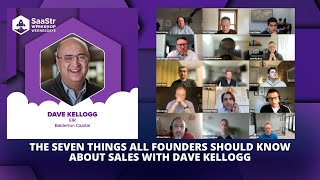
Dave Kellogg shares seven sales fundamentals for founders: customers buy solutions to problems, not products; listen more than you talk (data shows 57/43 is the ratio); ask open-ended questions; treat sales as a quid pro quo with cost-per-opportunity logic; and manage competitors carefully. The Q&A covers hiring sales leaders and calculating allowable S&M spend from CAC ratios.
Chapters
Welcome everyone. Welcome to workshop Wednesday. This is Wednesday after Wednesday. We get your questions answered. Talking to SaaS, experts, VCs, sales, making sure we are week after week working with you to make your company stronger. So this week is Dave Kellogg. We have been working on this session since November. Right, Dave?
Easily. Yeah, yeah.
I used to say that these sessions happened rain or shine and Dave was the one exception to that because we lost power the last time we were supposed to have this session.
Yeah, I tried to do it from a Starbucks. We lost power for three or four days after a storm and it didn't work out. The Starbucks was too crowded and the wi fi was dying so we had to cancel. So thanks for flexibility, of course.
No, if you are dedicated enough to try to take it from a Starbucks, we definitely had to make this work.
Absolutely.
Well, now that we have finally made it to this session, want to ask a few warm up questions to get to know you a little bit better. How would you define your day to day role?
Sure. So I do a couple different things. I'm an independent consultant and I work as an EIR at Ballerton Capital and I do the same work in both capacities, which is I work with early stage startups on matters of go to market. You know my background, I was 10 years a CMO at two or three different companies, depending how you count. I was a CEO of two different companies and I've been on the board of 10 different companies. So I have what I like to call mostly a 360 view. I don't quite have everything, but I can look at things with a marketing hat on, I can look at things with a CEO hat on, I can look at things with a director hat on. And that's the perspective I try to share.
Great, so you're super lazy is the moral of the story.
Yeah, yeah.
All right, and then our second question before we get things kicked off, what project are you working on today you are most excited about?
Sure, that's hard. But I'd say, look, I love the Balderton work because it lets me work with all their portfolio companies. Right. So I get to work with instead of the dozen or so companies I work with directly, I get to work with their portfolio. And it brings in all kinds of really interesting challenges and Both within traditional SaaS and on boundaries, a little bit of B2C and some other areas as well. So I'd say the Balderton project is fun. It's good being the eir. It's a day a week, so it's not too much Work back to the lazy thing, but it does give me a fair amount of diversity of experience. Plus, as you may know, I lived in Europe for five years. I'm a bit of a Europe file and it lets me help European companies come to the US which is a big challenge for them.
Great. Okay, well, we already are getting comments in the chat that they love. Kel Blog by Dave, so I think this session is going to be great. Lots of interactivity, so we'll let you kick things off.
Super. Well, thanks for joining everybody. It's great to see you. And sorry for the delay last time, but it was definitely out of my hands when we lost the power for four days is the longest power failure I've ever been a part of. So today we're going to talk about the seven things all founders should know about sales. You know, I started my career as a tech support rep. My first job out of college was $26,000 a year tech support rep for a relational database. So I'd like to say I started kind of at or near the bottom of the software industry and most certainly not in sales. And I got interested in sales and marketing because I saw how powerful it was because the company I worked at was one of the original three relational database vendors and we sold for literally a fraction of revenue, like.9 times sales, whereas our tribal was Oracle, who is, you know, now worth hundreds of billions of dollars. So, so and the difference was to me, sales and marketing. So that's why I got interested in this stuff because at Ingress we had literally a future Turing Award winner was our cto. So this is like technology clashes with sales and sales won. So I wanted to be part and learn about the. That was more powerful in my mind. So I spent a lot of time trying to help founders, and product oriented founders in particular understand sales because in some ways I'm just taking you through the journey that I myself went through. So thanks for joining us today. The material here is derived largely from project I did for Baldur's and Capital. As you mentioned, I work there a day a week as an eir and one of the things I do for them is produce content. And we built this basically kind of everything Dave knows about sales and dropped it into this nearly 100 page guidelines that represents most of my views. So. So check it out if you're interested in this. The title is quite deliberate. I wrote it for product oriented founders. So if you're a 20 year sales veteran, it may not be anything new but. But the audience is supposed to Be somebody who wants to learn about sales, who's not from sales, and also the founder perspective of how to manage sales. So there's, there's a little bit more in there about how to manage a CRO than there is about how to be a great seller. But, but that's on purpose. Our format today in this workshop is brief intro which we did. I'm going to do about 20 minutes of presentation and then we'll open it up for Q A and see where it goes. So here are the seven things I think founders should know about sales and we're going to do a slide on each one. So just to go through them quickly, first you have to do it. Most people know this now, but the only way to learn about sales is to go out and sell or not the only but the best way. Second, customers buy solutions to problems. This is an old theme. We'll talk more about it. Third, sales is 57% listening. We'll drill into that one. But a lot of people think sales is talking and in my mind the best sellers are great listeners. They're good talkers, but they're amazing listeners. The best sellers are curious about everything. You know, there's a ton of sales methodologies out there, but one of my favorites is called selling through curiosity. And you can literally derive everything, sales, sales, management, forecasting, all from one word, curiosity. Just be curious. Which by the way is why some non salespeople are such good sellers. Like I remember when I was early in my career, the top seller at the company and the CTO were the two most effective people on sales calls. And I viewed it like the Andromeda Strain, an old movie. Like what do these two people have in common? Like why is the CTO so good at selling? I know why the salesperson is, but the answer was they were both really curious and they wanted to solve the customer's problem. And everybody else had a bunch of baggage in the way, like I want to make a deal. Or like no, these two people had a pure motivation, I want to understand your problem and solve it. That even though they're from opposite sides of the spectrum, they're both really good and what made them good was curiosity. Number five, ask open ended questions, easy to say, very hard to do in my experience. Number six, manage the sales process is a quid pro quo critical for product oriented founders because it doesn't come naturally. But, but you're investing money in a deal and you should get back things in return for that investment. So the whole process is a quid Pro quo. And then finally, don't talk about competition unless directly asked. I think companies do a lot of research on competition to understand their differentiation and they're a little too quick to want to share it. So we're going to go through these seven things now one at a time. The first is to, you know, get out there and sell. And look if I see some marketers on the call as well. Get yourself on sales calls. Listen to sales calls. If they won't invite you, if they won't invite you, find out why, by the way, because they should want to invite you. But either way, get out there on sales calls and. Or just listen to them en masse. Because sales calls are where kind of corporate pitchmanship meets field reality. And like, as I've told people, you know, I'm a big believer in convertation, conversational intelligence systems that listen to sales calls like Zoom or God Gong or Chorus or Jiminy. And I like these tools so much because the first time you listen to them, you want to crawl under your desk and cry, right? Literally you go, oh my God, I can't believe my people are saying this. And then over time you say, well, wait a minute, now we can coach them and we can change the messaging and got our messaging. That sounded so good in that corporate meeting room. Doesn't sound so good when you're actually delivering it to a customer. So get out there and sell. Try your own messaging. If you're in marketing, if you're a product oriented founder, experience what it's like to try and convince somebody to use your system. This lays the foundation for hiring your first VP of sales. And it should go without saying, but really helps fundraising. If a VC asks you, like, how many sales calls you've been on lately and the answer is, not many. Not a good thing, right? They want to know you're out in the market selling, basically, especially in the early days, you're kind of chief sales officer as well as chief executive officer and founder number two. This, this one point causes a lot of confusion. But customers buy solutions to problems. A lot of salespeople think that customers buy products, right? And the answer is no, they don't. They buy a solution to a problem. That the old fancy way of saying this was a Harvard professor named Theodore Levitt who said, the customers buy holes, not drill bits, which I always thought was interesting, right? In the end, they want the end, not the means. The modern way of saying it is Clayton Christian, which is customers hire products to do jobs for them. It's the exact same Thing said in different words. But. But nobody wakes up in the morning and wants to buy your product. They wake up in the morning and have a problem they want to solve. And this is particularly difficult for platform providers. For app sellers, it's a lot easier because you've got an app built to solve a problem, so it's more natural to sell it as a solution to a problem. For platforms, it's much harder if you're selling like I sold an XML database system. It wasn't built to solve any problem in particular. And you had to go map it. You had to go, you know, it was kind of on us as the seller to say, we're good at solving this problem. Do you have this problem? And let me tell you how we can solve it and tell you how other people solved it. So your product is a means to an end and your marketing should emphasize either the end of the means or the end as a function of strategy. One of the more interesting questions here is that I've worked with some startups that as they create their category, they have to say, here's why you should buy a thing in this category, right? Like elation. Here's why you should buy a data catalog. I did a lot of work with them and at some point the conversation switches and customers call them and say, I'm going to buy a data catalog. Tell me why to buy yours. And you need to be able to switch your gears at that moment and say things have changed. Congratulations, We've created a category. People are calling Gartner who to evaluate and we need to kind of switch from solution mode in that case, believe it or not, to product mode. They're still buying the product to solve a problem, but the sales cycle may change because they may say, I'm going to solve this problem. You've convinced me I need to buy an entry in this category and now I need to know why to buy yours as opposed to another one. Right? So it's kind of a subtle point, but I think it's important because I think sometimes vendors don't recognize these inflection points along the cycle. So that's what I, that's what I mean when I say marketing, why they want to emphasize either the end or the means. Because in the early days, you want, you may want to talk about the end. Here's the solution you're going to solve. And then when the market gets hot, ironically, you talk less about the solution and more about why your product is the best to solve it. So kind of crazy, but look in sales, it's universally good advice to always focus on the customer's problem. In marketing, we have to deal with this. But in sales, if you just say what's your problem? How can we solve it? It's always safe. The third principle to know. So the first was, the second was customers buy solutions to problems versus you got to get out there and sell. The third is that sales is 57% listing. So thanks to tools like Gong, we now have data on how much salespeople talk. And I'm sure you all know this by now, but sales performance is generally inversely correlated to how much the salesperson is talking. Right? I talk less, win more deals, talk more when fewer deals. So per Gong, at one point they did a blog post that said the Perfect ratio is 5743. The old sales adage is you have two years, one mouth, use them in proportion. So, so roughly supported by the gong data, right? 6633 instead of 5743. But, but close enough. And in my experience, the best sellers are great listeners. They ask clear and purposeful questions. They listen to the an, they don't interrupt. So important. If you're listening to sales calls, listen for times when your sellers are interrupting. That's, that's really, really bad because you kind of lose forever what they were going to tell you. And they asked thoughtful follow up questions. One of the tricks I teach people I'm not interrupting is just take notes and take a corner of the page and write down every question you're about to interrupt and then go back and see how many you actually end up asking. And it's scary because I'll write down 10 questions that I almost interrupted somebody for and maybe I'll only come back and ask two. So it's a good little trick. Tools like Gong and Jiminy and Chorus can provide listed talk ratios as well as many other benefits. So the real question, the real issue here is you need to be a listener. Great listeners don't interrupt. They listen to the answers and they think about their next question. Next one, number four, the best sellers are curious. I alluded to this earlier with the Intromeda strain example, but they're curious about everything, right? The customer as a person, the customer's business, the problem they're trying to solve, the impacts of solving that problem, how they've previously tried to solve it, what are their solutions they're looking at now? How did you hear about us? Why are you considering us? Right? They're curious literally about everything. And most People will answer a lot of questions if you just start by saying, hey, I'm curious, why did you guys bring us in? Hey, I'm curious, how did you try to solve this problem before? And the part that many sellers get correct is, is to be curious about the problem. The part they'll often miss is curiosity about the process. Right? Like, hey, whose budget is paying for this? And what documents do we need to sign to get this deal? You know, I'm curious, have you ever done a deal of this size before? I'm curious, you just got a new cfo. Have you done a deal and gotten a deal approved with the new CFO in place? I'm curious, the person who needs to sign this paper on March 31, are they going to be around that day? Right. So we can use curiosity not just to the problem domain about, well, not only about the person, which I think is very important. What are your motivations for wanting to solve this problem? What happens to you? Do you get promoted? You get to become cfo, Right. If we fix this problem. Curious about the customer, curious about the problem they're trying to solve. But the part people miss, as I said, is about the process. And as anyone will know who's managed sales, oh, a deal slipped. Surprise. Like, we can't close the deal because we didn't have some piece of information. And my answer back to the founder perspective here, the CEO perspective is, I pay you not to be surprised, right? I pay SES to be experts on the product. I pay consultants to be experts in deployment. I pay success people to make customers successful. I pay you to never be surprised. So why were you surprised again? And I think it's very important because that's the, you know, sales has the right to do a lot of things, but they don't really have the right to be surprised. So when somebody gets surprised, I start to drill into, how did we get surprised? Who did we talk to? What did we ask? And look, sometimes companies get bought the day before your deal closed, and they couldn't possibly have known. But there are a lot of other cases where it's just a simple lack of curiosity. And you could have known that the deal was in jeopardy had you asked more questions. So one of my favorite ones on these is the very last question, the bottom. So a lot of salespeople, when the customer goes, you know what, you're our vendor of choice salesperson goes, yes, and. And that's a great time to be curious. Really, why I'm curious. That's fantastic news. Why are we your vendor of choice. Right. Because you may need to remind them of that further down the sales cycle if the deal's not closing. So the best sellers are curious about everything. You know, part of curiosity is being able to ask open ended questions and everybody talks about this. But again, this is the beauty of the conversation. Intelligence tools. You can listen to your sellers and you can see if they're asking open ended question questions like hey, tell me about the other vendors you're evaluating versus closed ended questions like are you evaluating other vendors? Right. And I'm sure you all know this, but the definition of a closed ended question is it kind of can get a monosyllabic answer. Right. So. So yes or no is the answer to the question. It is a closed ended question. It doesn't invite conversation, it doesn't invite the customer to talk more. And as a great seller, if you want the customer to talk more, you kind of need to lead them to. So. So it's always Pete, tell me about the other vendors you're evaluating. It's not have you established evaluation criteria? That's yes. No, it's yeah. I'm curious, how did you arrive at these? Boy, that's an incredibly important question in sales. Right. Not just what the evaluation criteria are, which is a little bit more closed ended things one through five, but how did things one through five become the yardstick against which you're measuring solutions of the space? Right. So does this problem have any downstream impacts? Well, first it always does. Right. So it's a really dumb question. It's closed ended and we know the answer before we ask it. But the other one is, tell me how this problem impacts others in the organizations. If we can't roll the financials up quickly and get financial reports produced within two weeks, what happens? Oh, oh, really? Well, the board gets delayed. Oh, what happens? It delays the audit. Oh, what happens? It delays potentially public earnings calls. Right. Those impacts ultimately are the problems that the business is trying to solve. So. So number five is as part of being curious, which is number four, we need to learn how to ask open ended questions. And I will tell you, it's so easy to say this and it's really, really, really hard to do. So that's why I advise that you listen to your sellers, you listen to sales calls and you kind of, you know, pinch yourself every time you ask a close ended question. Because it, I don't know why it's so hard. It's just really, really hard. And some people are very good at it, but it's Not a skill that you're born with. In my mind, it's a skill you have to train yourself on. So next one, Manage the sales process is a quid pro quo. You know, I have a couple of tricks I used to do. One is I actually bought a couple of 1 ounce gold coins. And once in a while, the sales kick off, I would drop two gold coins of the sales rep's hand and I would get them back. Don't worry. But. But I'd say that's what an opportunity costs me. So every time I give you an opportunity, I'm giving you two gold coins. Because my cost per opportunity at my last company was around $4,000. So to get a stage two opportunity, right, that made it through the whole system and it's ready to get handed to a salesperson. I'm literally giving you what cost me two gold coins. And I want you to treat it like that, right? Because a lot of times they don't, they don't call back or they're managing 15 of them and they don't treat it with the respect it's due, right? So I always think about the money I'm investing in these deals, right? It cost me 2 to 4k just to start the sales cycle in many SaaS companies. Might be, might be a lot less, could be, could be more. And then now I'm working with a customer and every time I send in a seller and an se, that costs me money, right? Oh, they want to do a custom demo. If that's part of your sales process, that costs me money, right? We want to do a big meeting with the cfo that cost me money. And I encourage you to, to actually go ask finance to figure out how much you spend in sales and marketing to get a deal, total sales and marketing cost per deal, and then talk to people about that. Like, use the gold coin analogy, because you need to use that with the customer. When the customer says, I want a custom demo, you don't say, oh, we do. My joke is we say, oh, my name is Dave. I'm an sc. Well, what's your job? And they say, well, I do custom demos for people who might buy our software. And the person goes, well, I might buy your software, so can I have a custom demo, right? And that's a terrible framing, right? We need to frame this as. Look, I need to ask you a bunch of questions to make sure we think it's a good enough fit, right? This is a mutual selection process. This is not about us being a supplicant. Asking you to buy our software. This is a mutual selection process. You are selecting us as a vendor, potentially, we are potentially selecting you as a customer. We're investing time and money in exploring whether there's a fit here. So every time you want me to spend time and money, I want something back. Right? And that's the quid pro quo. So if you spend two hours with us on requirements, we can build a customized demo. But I'm not going to go build it just by looking at your website. I want to talk to you for two hours about the requirements and what you want to see, and then we'll go build it. If we build a customized demo, can we meet the cfo? Because right now we're just working at the VP level. The CFO ultimately owns this project and you've asked me to spend 10, $15,000 building this demo. I, in return, I would like to ask to meet the cfo. Can we do that? Right. Some salespeople think of this as keeping power in the relationship. I think of it more practically. It's just as give gets and more practically as I am spending money at each of these steps. So if I go through a wholesale cycle and lose, that cost me 10, 20, 30, $40,000. Right. Depending on how enterprise you are. But it can cost me. And that's why I want you to know that number. Because if it's in your head, you're going to act like it. You're going to be like, if you walk up to the altar with me and we don't get married, that cost me $40,000. So I'm going to ask at every step what I'm getting in return. By the way, the same principle applies when you're selling your company. Right. I want to give you as much information as I think it's likely that you're going to do a deal. It's the exact same process whether you're selling a deal or selling the company. You got to give commensurately with what you get and commensurate with what you think the odds of winning are. So at the right time, this obviously also includes asking for the order. If we do this final step that you're asking me for, will we win the deal? Right. Some people call that a trial close, but. But it's the same thing. It's just a special case of quid pro quo. Every step I'm asking for the next thing. Very important doesn't always come obviously to product oriented founders. Good sellers understand this, but if you're product oriented Founder, we need to walk through this and kind of explain how much we're spending. Like, we don't owe these people a demo. We don't owe these people a meeting. Right. We need to qualify them, figure out if they're going to buy our software. And if we don't think so, by the way, we should tell them. Just say, look, we don't think this is a great fit here. So if you want to explain to me why, how we can win this deal, I'll invest the time and money, but otherwise, I'm not going to, so. So can you explain to me why I should keep working with you? I've done that. It can work very well, by the way, because especially when you're wrong, they will come back emphatically and tell you, no, no, no here. Why you need to keep working with us. The last point here in the seven rules is don't talk about competition unless asked. You know, we spend a lot of time hopefully understanding why we're better than the competition. Like, my first job at marketing was a competitive analyst. So that's all I did. And the occupational hazard here is that you know so much about it. You might want to talk about it. And the answer is, you don't want to talk about it. There are many risks if you talk about the competition and selling. I literally have been on sales calls where a competitor would say, we're better than xyz. And the customer would say, I'm sorry, who's that? And I'm literally like, oh, great, we have 1, 800, try Brio. Why don't you just call him here? I'll dial it for you. Right. We're literally introducing customers into a sales call, which is terrible. So you can accidentally introduce somebody. I have a rule to fix that. You can appear competitive focused, not customer focused. This quote was actually from a loss report at Host analytics. When I ran that company, and my salespeople were too competitive focused. And the customer said, all they talked about was us. All you talked about was them. Terrifying, Horrible. The last thing you want to hear as a CEO, right, that your salesforce is giving the impression that you're competitor focused. And we're just trying to tell you why our product's better than the other person's. And the other people go, guys, they seem actually focused on me and trying to solve my problem. So Lord knows you don't want to end up hearing that. You can seem afraid that, gosh, maybe the other companies, the market leader, you talk so much about them that you kind of convinced us that they're who you're worried about and that means they're the leader. And I like to buy from leaders because it's safe, right? So you can literally, there's a thousand ways to hang yourself when you're talking about the competition. So in my mind, literally every second I'm talking about the competition, I put like a mental red flag or yellow flag in the corner of my, you know, visual space. And I just have it up and I want to get that flag down as quick as possible because I know that I'm in the danger zone and I can say something that I'll regret. The last is obviously if you say something incorrect that damages your credibility. So here are the three rules I've established to avoid these problems. One, generally don't do it. Put up that yellow flag for every second you're talking about competition. Two, be sure everything you say is true and defensible. And then three, only say the name of a competitor when it's been said to you first. I will literally not say it. You'll have to pry it out of my mouth. But if somebody finally says, you know, we're looking at competitor xyz, then I am now permitted to say their name. It's a great rule. So those were the seven ways. I'll just summarize them. But it's get out there and do it. Second, customers buy solutions to problems, not products. So they buy holes, not bits. They hire products to do jobs for them. However you want to say it. Sales about 2 thirds. Listening. The best sellers are curious. If there's really only one thing I take from this whole, this whole session, it's be curious about everything. Ask open ended questions. A part of that curiosity. Manage the sales process as a quid pro quo. You're spending money you deserve to ask, give, get, give, get. And then just on the competition, don't talk about them unless directly asked and try to give. I'll finish this with like I started my marketing career in product marketing and I in. Well actually I started my marketing career in competitive analysis and then I did product marketing and in both disciplines I felt like my job was to give the shortest possible answer. So if somebody asked about how a complex technical thing worked, I wanted to hone my answer down to the head of a pin. Why? So I had time to ask more questions, so I had time to listen. So to me that's products marketing job. It's actually to create time for more questions and to create time for listening. So that's why you Want your competitive answers to be compact. It's why you want even potentially complex feature function answers to be compact. And finally, it's why, as I often say, God created white papers. Which is if you're getting very technical questions that take a long time to answer, the best way to compact that answer is say, hey, I've got a white paper on that. You seem really interested in that topic. It's 15 pages. It's really good. Knock yourself out. I've got a few more questions, so we'll end the session there and switch to Q and A mode. Caitlin. So back to you.
That sounds good to me. If you want to take your slides down to make this a little bit more communal. Thank you so much for running through that. I know running through seven different tips in 20 or so minutes is quite the feat. Moving on to the Q and A portion, we can practice, I think it was number five and ask some open ended questions here. If you do have a question, please put it in the chat. I will be asking if you want to ask the question out loud afterward. We are getting a lot of questions about presentation where you can find this afterward we do live stream. You will be able to find this entire session on YouTube after on the Sastra YouTube channel. All right, our first question comes from Jason, last name cto.
Hey Dave, thanks for presenting. Great presentation. So just had a question. What would be the like the top five red flags to easily identify or be able to identify of a new sales resource in the first 30 days? Okay, that's a good one. Let's see. Top five red flags, new sales hire. Okay, five is a long list to generate off the fly, but I'll do my best. The first one happened, the first one is non attendance like not showing up. So why. Because in this day and age they may have another job. Right? This actually happened to me once a couple of years ago, but I had a rep who decided that getting base salary from three different companies was a great way to make a living. And I think the work from home, that, that was a rare problem when it happened to me. But I think work from home made it happen more. So anybody who's not showing up for any reason and they're new, you know, they miss the onboarding, they miss a kickoff, they miss something huge red flag. It might just be they're a bad hire and don't show up, it might be they have another job, I don't care which but, but you got to show up in sales, right? 80% of success is showing up. So People who don't show up, big problems. I think what would be another big red flag, I'd say non. This is more advanced, but I'd say non adaptation. Like if you hire somebody and all they talk about is what they did at their last company, at some point you have to say, hey, this isn't your last company. This is our company, and this is how we do things here. Ideally, you filter for that in the interview process, Right. I think I'm terrified by the number of people, actually. It's also just human nature. But if you make a lot of money doing something, you tend to want to do it again, right? Like try to argue with a billionaire about, you know, how to run a company, which I have done, and it's difficult. You know, the answer is, I made a billion dollars doing this. We're going to do it my way. And it's like, okay, so the same thing. If I made a lot of money doing this approach at my last company, I have a tendency to want to do it again. Right. I'm kind of Pavlov trained, and I've literally seen people do things that make no sense whatsoever, but it's almost impossible to reason with them. So I think somebody who's not adapting to your world, odds are they're not going to adapt. It's not an easy correction, right. I can't correct a dishonest person who's not showing up or a lazy person. Somebody who's late, by the way, in sales, to me, it's unacceptable. It should be unacceptable everywhere, but I tend to tolerate it. But in sales, it's the one place, right? Your job is never to be surprised and never to be late. So if you can't manage those two things, it's a huge problem. I would tend to say, look, I ran the onboarding program at Business Objects for many years. People who don't treat onboarding seriously. Once in a while, we would fire somebody directly out of the onboarding program. And that was a great collaboration between me and sales because I'd literally just say, this person has done terrible. They didn't take the program seriously. They didn't show up. They failed in the exercises. I think we need to make a message that this onboarding program matters. And if you're going to not take onboarding seriously at this company, we don't want you here. And in that particular case, I was running marketing, so the salesperson didn't have to do that. It wasn't their program per se, but I think that's also really important. In terms of a fifth one, I think it would just be somebody. I mean, I would listen to calls and just, I'll call it the cringe task. But if you want to crawl under the desk when you listen to them on calls, you should probably just get rid of them because, because you can't fix that. So those are the, you know, do they sound good on sales calls? Are they, are they doing good things? Because look, I'm a big believer we can teach people things, but if you've hired somebody who's, you know, a 10 year experience seller and they don't know how to conduct themselves on a sales call, I don't think that's a good investment of your time to try and fix it. You're probably better off just finding someone else. Thank you, Dave.
Great. That was a great five off the top of your head. Impressive. Okay, our next question comes from David. If you would like to ask it out loud, feel free to do so.
Yeah.
Hi Dave, how are you? Quick question, Dave, Just in relation to your views on assisted free trials, we have an ACV of about 15k. Probably would cost us about, I'd say for customer success person to set up a customer about two hours, three hours max. I'm just interested to see what your conversion rates, what you think conversion rates might be for free trials for that level of investment. So I'm reluctant to do the math on the fly, but my experience is that should work. I think that's a high enough ACV. So it's 15K ARR, correct?
Yeah.
15K ARR. Yeah. Right. So here's the way I think about it. If you want your CAC ratio to be 1.5, you get to spend a total of 22.5 in sales and marketing expense to win that deal. Right. So I won't give you an answer, but I'll tell you how I process it. I always go back to the CAC ratio. I just start there and it's like if. How much am I willing to pay for a 15k deal? Well, the CAC ratio says I should be willing to pay 22.5k in total. And this is the hard part, sales and marketing expense. So I can tell you we shouldn't be going out to $1,000 dinners in New York for a 15k deal. Right. What are the more common problems in early SaaS where you'd hire somebody out of a big company? It's just doing 150k deals. They're doing 15,000 DOL. 15k deals. It's like no, the dinners are out the window. All the perks are out the window. Can I afford two to three hours with somebody? Yes, I think you can. Just. And I just know that intuitively because I work with some companies that asp similar and I know that model can work. In terms of the conversion rate, I don't actually know. And I wouldn't want to throw a number out there because I tend to be very careful about numbers. Thanks, Dave. Thank you.
Great. Okay, our next question comes from Dan. What are some good verbal clickbait tips you can give while on a sales call? Questions that pull a customer in to ask more questions.
Questions that pull a customer in to ask more questions. I'm not sure. I mean, look, I think many good marketing campaigns ask a question. So in general, I like marketing campaigns that ask a question. Like, for example, I don't know, are you paying too much for your conversation intelligence? Right. Or are you paying too much for your data provider? Or are you like. And I would use those as examples of spaces that have commoditized. So take a space that used to command a high price point because it was unique, and now say it's kind of commoditized. There's 15 people who do it. Then I think it's a great question. I remember one of my favorite funny headlines was, if DB2 was the answer, what was the question? Which. I've always liked that style. If you like the dry humor, right? So if this is the answer, what was the question again? That one's fun. But if you want to pull people in, look, I like questions. I like marketing campaigns with questions that make people think, think. In general, I like slide titles and questions. So I think questions are really good. I don't have any kind of stock answers. To me, it's all about the situation. Like, I mean, I'll give you an example just because I hate to be so abstract. But one company I work with closely over the years is Elation. I was on their board and angel investor. I know them real well. And in the early days of Elation, the question would be, how much time are your data scientists spending looking for data? Right? Because Data scientists make 2000-004000-00500. These are expensive resources. And if they're spending lots of time trying to find data, if I could sell you a software package for 100k and you've got 10 or 20 of those people, I'm going to save you a ton of money by cutting the time of time they use data in half. And it all starts with the question, which is how much. How much time your data scientists spending looking for data? So that would be an example of a question that if they say, I don't know, then you. But you can now fire off 20 more questions. Well, how much they make and what do they spend their time doing? What do you want them doing? And do they enjoy that activity? Oh, no, they don't. Oh, okay. So. So not only are they unproductive, but they might actually quit. And then you have to hire a new one. How much does that cost? Right, so. So you can lead down a path of questions.
Great, great example there. Our next question comes from Meredith. If you would like to unmute yourself.
Hi. Thank you for, for calling on me. I have to admit that I'm getting like a little bit angry in this meeting because everything you're saying is I cannot write fast enough. I actually work in conversational AI. So thank God. This because I'm like having a. Whatever it's called a metaphysical reaction. But my question is this.
So.
If we don't have a cfo, and so the CEO is everything you've said, in terms of which I'm probably going to get talk to after this call, is very product driven, very technical CEO and he also manages CFO piece. So we don't have one. All of our ARR is from last year. No new from this year. And so arriving at that 2 to 4k and what it costs to start the process, I don't have some of those aspects that go into the calculation. So how do I begin to think about that aside from the actual equation itself, like how do I begin to do that and pseudo take on that CFO role, even though I hate math. Begin to think about that so that I can ask these questions. Sorry.
So I understand. Sorry for talking fast. I'm from New York and no, I'm from Jersey.
I'm in Jersey.
Hey, okay, for Westchester. So I go fast. And I was trying to summarize stuff. So thank you. But in any case, look, we don't need a lot of finance to answer that question because really that two gold coins is actually demand generation cost in my experience, just to be more precise. So when I use the CAC ratio is total sales and marketing cost. But when I calculate the cost of an opportunity, I do it on demand generation spend. Why? Because it's a variable cost, not an average cost. Right. Because I want to know if an opportunity cost me $2,500, then I know to get 10 more cost me 25,000. And to get 10 more opportunities. It's a marginal cost argument. Right. I don't need to hire another product marketer, I don't need to hire another VP of marketing, I don't need to build another website. Right. So I don't really want an average cost for the CAC ratio for investors. We want to talk about the average total sales marketing cost. When you're talking about the cost of an opportunity, you actually want an incremental cost. So that makes the math much easier because all you have to do is look at how many opportunities were generated by marketing in a quarter and how much did you spend on demand generation in a quarter? You just need two numbers. Hopefully you can get those two numbers and then you can say, look, we spent 50k on demand generation, we generated 20 optis, so they cost 2.5k each. Each. And there you go.
Thank you. So if that's the answer, then do you want to be my cfo?
Yeah, well, I got, you know, I'll tell you One thing about CFOs that are, I love the fact that you can rent them, right? Because there's a lot of positions you can't rent at a startup. Like you can't rent a VP of product. You can't rent, you know, it's, you can't really rent a CMO. You can get lucky sometimes, but, but CFOs are highly rentable. So my advice would be if you need a piece of a CFO around, go rent one.
Hey Dave, it's Jason. A follow up question.
Thank you.
When you think about cac, the very atomic version of cac, which is what does marketing spend to generate an opportunity? How do you think about models where a lot of the pipeline is from free is from word of mouth is from viral. How much credit, how much leeway do you give marketing to blend these numbers so they can hit the overall goal?
Yeah. So I think. So the short answer is a lot. Partly because I'm a marketing person, as you know, so you have a sympathetic audience. But this is why I think there's an increasing trend right now, which is despite all the automation, despite all the tracking and the attribution systems we have, people are increasingly going back to a technique that we used 20 years ago, which is how did you hear about us?
Right.
And they literally ask that as a survey question at the top of the funnel. And that's where you're going to find that out. They're going to say, oh, I just heard of you, reputation, word of mouth. And I think marketing should get credit for word of mouth. I mean, unless, you know, I can think of other examples. If you have a massive community or a massive open source community. Right. Okay, maybe somebody else gets credit for word of mouth. But I like to take all the data that we actually risk drowning in these days. Right. But all the martech, all the automation, you can drown in attribution data and not really understand what's happening. And I think the life preserver is just ask the customer. Right. And then you could diff that and just say, yeah, no, this was dark traffic or direct traffic, so we don't know where it came from. Right. So it's hard to attribute to something. But. But if I got somebody who's dark traffic and I asked them how they heard about us, I now know. So. So I. It's kind of funny to. To see the. The cycle go because, like, in 1990, that's all we could do, you know, and here we are back 30 years later, like, we're doing it again because we almost have too much data.
Great. Jason, while we have you, we had someone in the chat ask your opinion of number seven. Not talking about competitors during sales calls. Do you want to talk about that at all?
Oh, man. I want to let Dave do the answers, but I really thought this was one of the best things I heard. I want to turn that into a post. I'm looking back in the day. I've been reflecting. I'm dating myself today, but when I look, you know. You know how we got profitable at Echo Sign back in the day was our marketing spend was zero. I need to write. And how did we do it? Well, we had a viral product. We had word of mouth. But you know what happened? Every customer and DocuSign spent 40 to 50 million dollars at the time in marketing. And they would go in and, well, who else are you looking at? You know, the reps couldn't help but send us these leads, and they sent us so many leads. Right. You almost had to, like, I don't know whether they violated your rules and immediately started blabbing competitive stuff and explaining why their product wasn't localized or why it didn't work on mobile. There was probably a lot of that, but even they just handed us these leads up and then we had a great SAL team that could close them. That's the real risk, Right? If you do your platter and you bring it up, we had a sales team that was optimized on ripping those deals out of the heart of your competitors. So I think. I think it's really Interesting, because if you're too clever and don't mention competition, you look like a dumb rep. Right. You're not helping the customer. Right. You have to be thoughtful. But going too far really does generate a lead for number two, doesn't it?
Yeah, totally. So, so, and this is to be clear on point number seven there. The, the, it's not, never talk about the competition. I'm trying to overcorrect, right? Because I think the natural tendency is to talk too much about them. I talk about, I mean, like I said, my first job was competitive analyst. Right. I, I, I'm, I'm ready to talk about competition, but I don't want to overdo it. So I kind of use that to keep myself honest. So, so, so yes, because I agree with you. You can appear evasive. Right. Like if you go too far not talking about the competition or if you say our competitors are ignorance and apathy, one of these, you know, high, high level indirect competitor quotes, you start to lose credibility. So, so I do believe you should talk about the competition, but there's a time and a place to do it. The other thing I'd say for you on who else gives you leads when you're a runner up, because a host was kind of a runner up of the finance market and Gartner became an amazing lead source because people would call Gartner and say, we're looking at adaptive. Who else should we look at?
Who else? Who else should we look at? Right.
And Gartner would say, oh, so we actually got it immediately. It was the first time in my career because otherwise I'd worked at leaders previously, so you worry about that less. But if you're a strong runner up in a category, the analysts will actually send people your way because they want to evaluate multiple solutions.
But don't you think just on it? There's a couple of discovery calls that I think especially founders were not comfortable asking, but one is like, if you're.
Not going to ask, not to bring.
Up competition, I think you do want to ask what solutions are you looking at to the problem? Right.
I'm happy to hear it.
You got to ask what solutions and you got to ask if it's budgeted too. That's one that we get uncomfortable asking about. But it's a great question too. You got to know where you sit on the budget continuum.
Absolutely. Let me be clear on this because I don't want to go so far as it's, don't talk about competitors unless directly asked. Right. That's, that's the rule I try to espouse. And then the other one is look in discovery. You absolutely have to know who you're competing with. But, but I wouldn't say are you evaluating EchoSign? I would say, hey, tell me about open ended question. Tell me about some of the other alternatives you're evaluating. Oh really? I'm curious, why did you decide to look at EchoSign? I'm curious why, you know, in my case, why did you decide to look at Enterprise? So, so, so yes, but just basically the rule is there because what I'm trying to compensate for is somebody who spent 20 hours studying the competition and knows everything about why we're better and is just so eager to tell somebody. And that's, that's how you get yourself in trouble. You really do great.
Looking forward to that blog post. Our next question comes from Brett. I'm sure you're excited to ask after that segue.
Oh well, yes, Dave and Jason, as always, you two are just so wired in. As a former Gartner analyst where I spent five years, my favorite of your list is actually the way I phrase it is shut up and listen. Because I had to unlearn from five years of talking with enterprise government CXOs. They would ask a question, I would push mental play and I go into analyst mode and I would tell them, well the following are three things and then you got two sub variants and then this blah blah blah blah. And you, you're you know, and I did my reading and I know your future architecture is blah blah blah and versus as a founder I need to just ask you good questions and shut up and listen. The question then becomes I have tried a zillion ways seemingly form the sales team to learn that skill. I have failed horribly. Where either the I have been, I have been with senior executives where the sales team has to sit outside in the kids room where they say I want to talk with Brett one on one. And I say can't my sales team come? They go, no, they're not invited. But when they are invited, I literally have had the salesperson and grab my computer, grab their computer, crash the table, flip it up, rip into the slides and drone on. And meanwhile the person just started to say, well our major decisions about our data architecture are. And this guy's like droning on, so how do we first of all thanks for Gartner and I no longer own any stocks. So if you want to pay Gartner, go ahead but how do we convince our sales cop, you know team, you know Because I tried solution selling. I've tried bringing in people all, you know, half a dozen really great sales teachers, and the salespeople go out and they just want to crash the party with their laptop and show the slides to the next meeting.
Yeah, okay. That's a hard problem. Ultimately, to me, I think it's a sales leadership problem. And if you're the. If you're the sales leader, it's your problem, I guess. But. But if you have a sales leader, you need to talk with them and say, this, this needs to stop. I mean, this is back to what I said at the beginning. I'm worried. If these are experienced salespeople and they're still doing that, you probably just need to get new ones, right? If they're new salespeople and they've just been raised raw, right. And these are not ingrained habits, then I think there's a chance you can teach them. And the best way, if you are running sales, then the best way you can teach them is just by doing it yourself. Go out and do a couple sales calls and record them and play them and then play yours. Right? And this is again, back to the conversation intelligence pitch. But I love playing sales calls back for people. And you just hit pause and see right there where you interrupted. They were about to tell us, you know, well, the real reason I want to buy the system is. No, wait, let me tell you about our great architecture. Like, do you. Do you understand what they listen to, what they said and what you interrupted? Right. What didn't you learn? Right. I think you can train them by listening to calls, doing group listening sessions, and just say, guys, while you were talking, what didn't we find out? Or go do some deals that we lost because we didn't know things. And say every time you're talking, you're denying us a chance to listen. You're denying us a chance to learn something. This is back to what I said earlier. We have to get really good at super compact answers to questions because it gives us more time to ask more questions. That's why. So I don't want you droning on. I want the next level of my pitches. I want you to do layered answers. So if somebody says, why are you better than the competition? I would say it's three things. Power, deployability, needs of use. If they take that, great. If they say, why power, great. But it's a layered answer. I've built the marketing message into a tree. So if you ask me about power, I can tell you three reasons why we're more powerful. If you ask about reason one, I can tell you three is about what reason one. But I built this layered ternary tree of messaging that allows me to. I always call it peeling back the onion and leaving threads hanging. Right. So I'm leaving. If the customer cares, they're going to ask, well, what do you mean by power? If they say, I think their competitors, as powerful as you are, are great, they pulled that thread. Now you can answer. But. But if you build a layered message and you teach them the value of listening by. By analyzing deals we lost because of stuff we didn't know, or just literally analyzing sales calls and just saying, admit it, 201, you interrupted the customer and they're about to say this, and that was a critical piece of information. So. And the other option is just get new salespeople, which I fear maybe you're. Like I said, if these are ingrained patterns, you just may need to go get a new salesforce.
Let me add one thought, Dave. I'm curious your thoughts. Obviously, the answer to the question is leadership, right? The best leaders, they do it all differently, but they find a way to train the team well enough that fewer of these issues happen, right. It's a symptom of not having the right. And if the leadership is, you get some help, right? Find someone under you or with you, that's. That's better at this. I will say one thing. A lot of these issues, and you got to listen to the, to the gongs and the choruses. But a lot of these issues come, I find, when the sales reps aren't really experts in the product. They don't know what to say. They don't. If they really know, you can have a very. You can have a great conversation. But if you don't know, you immediately run into competition, immediately run into discounting, immediately run into the dumb three things. And it's hard. But I find reps, especially the ones hired the last couple years, just aren't experts enough in their own products. How did you get folks to be experts at host analytics that were not out of the space? How did you teach them to be experts?
Yeah. So. Excellent point, Jason. First and second, here's how I would solve that problem. I would make a standard deck, right? Here's our standard messaging. And then I would forbid people to use it, which. Which may sound absolutely ludicrous, but the benefit of the standard deck is we knew what the message was like. We did agree on the like. This is our message. And when we did certification, I would do it one on one at a round table with a paper napkin placemat. And I would ask them questions and they could use their mouth, their pen and the placemat, but they weren't allowed to use slides. So if you can't deliver the standard messaging by writing on a tablecloth, basically, then you don't know it because I think Jason hit on a really important point. People talk when they're nervous, so they're probably afraid and that's why they're talking. Because if they're really calm and confident, they really want to win the deal. This is just us having a conversation around lunch and if I need a picture, I'll draw it on the place mat. So, so make the standard deck, but make it illegal to use it and certify people. I do a big believer in certifications. A short answer, Jason, but what you, you don't certify them on delivering 32 slides because that's precisely what you don't want them to do. Right. If you certify them on that, that's what they're going to do. So you have to certify them at a lunch. At a lunch table. I like it.
Great.
Okay, our next question comes from Kunal.
Hi, Dave. Thanks for this. You know, we run into these great sales reps. We're just having a bad quarter or two, particularly in the early years. And how do you spot these and you know, keep them on board and encourage them? Yeah, it's a great question. I think that's the hardest question because if you hire a VP of sales out of a big company, I gotta tell this story. But I had a guy walk in and like, like, well, this company's weak because if you miss, you know, the class company I worked out, if you miss your number two quarters in a row, you're fired. And we've got a bunch of guys who missed two quarters and I'm like, well, if we fired every guy missed two quarters in a row, we wouldn't have a sales force. So we just shoot the propeller off the plane. Right. It might feel really macho. And by the way, when you're the market leader in the, you know, in the 1990s selling CAD automation and you do miss your number two quarters in a row. Maybe in that situation you do need a bullet. Right. But in our situation, we're at a 50 person startup, everyone's kind of struggling to hit their numbers. It's not so simple in my mind that you can't just fire salespeople, especially in the early days. Get to 50, 100 million, things change. But if we're 0, 10, 20 million, and we're still figuring it out, in my opinion, you need to have some subjectivity in there and guess where the subjectivity comes from. It's back to the cringe factor, or lack of it. Like, literally, I would look at guys who are missing their number and go on calls with them. And I had one question. Am I proud that this guy is representing my company? This guy or gal? If the answer was yes, I'm proud to have you as my representative. I would actually try and cover you on misquota. I'd try to give you MBOs because I understand you're not going to stick around. By the nature of the comp plan, a lot of people might see that as weak because, you know, but that my old macho boss would see that as weak behavior. But I just think it's necessary behavior in a startup that, yes, you can judge people by the numbers and you should clearly reward the performers, but if you're going on lots of sales calls and this person seems to be doing everything right and not getting the right result, then I'd say you stick with them. Because. Because remember, the alternative, you. You fire them and you have to hire somebody else and restart the process. Right. So it's not a universal hall pass, you know, But. But I do think it takes courage to. To make that subjective call. And I literally will tell them the guy's name was Mike. I was like, mike, I've been on a bunch of calls with you. I know you're missing your number, but I'm proud to have your company. I like the way you work with customers. I like your answ to win more. So we need to figure out why you're not winning. But by the way, in that particular case, I had him in a very rough patch, which is the other variable. Right. He was in the new market patch. I had existing established markets. You've missed your quota. In our established markets, I was far less sympathetic because I got 10 other people making theirs. But you're in the horizontal patch of the new patch, so you have to discount it that way as well. Thank you.
Great. We have just about five more minutes. I do want to flag that there are a ton of questions in the chat. I'm going to try to get through as many as possible in the next five minutes, but thank you for putting them in there. Sorry if we do not get to your question, but our next question does come from Saeed. If you want to unmute yourself and Ask.
Yes. Thank you very much, Dave for the presentation. Big fan of yours here. When to move from founder led sales to hiring a salesforce. Yeah. With this currently and would love your input on this. Thanks. So this is an answer that took me a long time to kind of come up with but it may be, we'll see how it maps to your company. But I now believe the smartest way to get a sales leader is as follows. Get them very early, basically go hire an RVP super early, bolt them to your side for nine months and then release them to go build a salesforce. And the reason I said why do, why is each element of that important? I want to get an RVP level person. Meaning in my mind somebody's managed 10, 20, 30 reps. So, so that they're not managing 100 reps. They're not kind of a professional spreadsheet jockey. Right. They're, they're. Because in big enterprise companies, right, the sales leaders stop being salespeople in my opinion, with all due respect, it's just a different job that they're not fresh from the trenches. So you want somebody who's a first line manager or second line manager, probably second managing 10 to 30 people, you want them loving being in the trenches. So when you ask them what gets them up in the morning, it's the smell of gunpowder, the thrill of the deal being in there, right? So and you say you're going to be IVP of sales but you're going to spend six to nine months bolted to me, maybe six to 12. We're going to do everything together and at the end of that period you're going to know everything I know about how to sell a system and we'll have discovered a lot together. And then, then I can release you because you know how to manage, you know how to build, you know how to hire, you know how to put an infrastructure right. The mistake people make in my opinion is they hire their first seller, they spend six to nine months bolted to that person and then they say build a salesforce. That person has no idea how to build a salesforce. Right. You might get lucky. I've worked with startups to get lucky and wow, that that person took us to 50 million or 30 million, never having managed before. But my solution is to try and make your own luck. Hire somebody who's basically got the management Runway to take you to 20, 30 reps. They've done that already. And then you, by just bolting yourselves together, do this mind meld with them and then you say you're released. Go build force. So that's my favorite answer to the question. There's probably a derivative for your case. Awesome. Thank you.
Our next question, probably our last question again, sorry everyone is from Marcio.
Thanks for taking the question. Huge fan of Calblog. Thanks. What advice would you give to someone thinking working for a company that has low ARR in a product that's very fast moving almost behaves like a B2C product looking to up level to more of an enterprise audience. On the marketing side, there are some new features and functionalities that are going to come in and they're going to be thinking about selling it to a longer sales cycle, higher ARR type audience. What are some of the advice you would give to somebody running that type of marketing organization? So I've never been in that precise situation, but I'll tell you my gut reaction first. Ideally be darn sure it's going to work. Do you have accidentally any bigger customers? Because even if you're running this velocity business, if you have zero bigger customers, it's not a good sign. But, but if you have kind of the grain of sand in the oyster, right? Like you have a couple that you got by accident or they grew with you, then we go understand them. So my first thing is understand the people who are using the scale. If you don't have any, it's much harder. I'd view the whole thing as an experiment. If you have a couple, then it's less of an experiment. It's more like, okay, what is it about this customer that made it use us at scale? What, what features do we not have? Have, right, because we didn't build for them that we need to have and how do we prioritize them? And then the marketing, to me, in a perfect world, just because the world is a very big place, can we pick a vertical? Can we pick some space where we try to do this rather than Fortune 1000 enterprises? Because you can spend a lot of money trying to reach zillions of people at Fortune 1000 Enterprises. I would try to pick almost like a test market, right? I try to pick a vertical and it's really, it's not that you care about the vertical per se. The software may be completely horizontal, but it's that you, you want to run an experiment within a market and try and learn something from it. I, I think this wasn't cool when I felt this way 30 years ago, but now I think people understand. Startups are a series of experiments. Everything you do is an experiment. You might call It a strategy, but, but, but it's an experiment. You don't know if it's going to work. Right? You only know if it's going to work if you have 10 people who did it already, right? Or 10 customers doing it. So, so basically I say think of it as an experiment, design it as an experiment, which means if you fail, you learn something as well as if you succeed, you learn something. Because a lot of time the worst thing you could do is do something, fail and learn nothing. But at least we'll learn. Hey, we tried to sell this to billion dollar companies in the oil and gas sector and we had three different people try it and we tried it for a year. If it didn't work, I think we can rule out oil and gas. And if it did work, we know it to scale. So think of it as a series of experiments. And the marketing to me would then be targeted on that is now you've told marketing where to aim the cannons. It's the biggest problem in my mind as a cmo, where do I aim the cannons? Because if you want me to aim at the Fortune 1000, I can, you know, I can spend arbitrary amounts of money firing lots of artillery and doing very little damage. So try to give them a place to aim at and you'll get better results.
Thank you so much and thank you everyone. We started these sessions at like, like 30, 40 people and now we're at like 120 every week. So it's so great to see you. Thank you, Dave. This was a long time coming and the questions were amazing answers, amazing. Thank you again for joining.
Thanks everybody for coming. Thank you, Caitlin, for having me. Thanks a lot, Jason. Take care everybody.
Of course. We'll see you next week with Back to Basics, the playbook to investor relations. See you all then. Bye. It.










