"Aligning Sales, Marketing, and CS to Scale Revenue and Retention" Theresa O'Neil, Showpad CMO
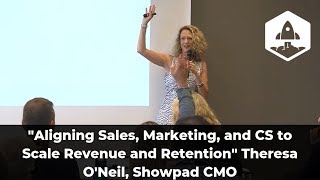
Theresa O'Neil, Showpad's CMO, explains how to align sales, marketing, and customer success teams to grow revenue and retention. A Showpad survey of 600 B2B buyers found they spend 1-2 business days researching, up to 40 hours for large deals, and care more about relevant content than volume. She outlines six strategies: align on ICP and priorities, map content to the buyer journey, define shared metrics, plan together, enable the whole revenue team, and measure results.
Chapters
I went from being the marketer that asked sales, if you could just fill out these 15 additional fields in Salesforce, that would help me out a lot, I'd be able to do much better segmented marketing. I went from being that person to the salesperson whose opportunities were never updated in Salesforce, so became much more empathetic and it really drove my passion for the being a marketing person that supports the sales team. And that's what I'm going to talk to you about today. So we all want that big payoff in the end, but the reality is most tech startups fail to exit and there are a lot of reasons. My belief is that it is related to how we relate to our customers, not only with our products, but through that buying journey. Are we selling the way that buyers want to buy? So let's talk a little bit about that gap between our buyers and how we're selling. The market has shifted as consumers, right? We're all both people who buy software as well as consumers. The market shifted. We buy based on experience, whether it's booking.com or Amazon. We go for convenience and experience over price or product and those same expectations that we have at home of our buyers in the office. So now more than half of B2B buyers are buying based on experience over price or product. So Showpad wanted to learn more about this, so we surveyed last fall, 600 B2B buyers in Europe and the US who had made a software purchase. The whole study is available. I can share a link with that, but I'm going to just share a couple of highlights today. So we all know we hear that most of the journey is done before the buyers get to us. But what we wanted to know is how much time are people taking to research before they get to us? And the answer is, on average, one to two full business days before they ever. So that was interesting. But what we then wanted to know was how does that change based on the average deal size? So we looked at this is a little hard to see from the back, but if you look at the green bar is zero to five hours. The gold bar is more than 40 hours. Right. And what you can see over there, when the deal is less than $5,000, they're spending about five hours. But when you get over to $100,000, they're spending 40 hours a full work week researching before they go to sales. So what does that mean for your sales team? It means the buyer is really informed and so your salesperson has to be really sharp and really skilled. So We. And what can speed them up? So poor content slows down deals. People feel that the information wasn't relevant. They didn't trust it, and it wasn't. It was confusing. So poor quality content can slow things down. So the answer might seem we'll just give them more content. No, buyers are overwhelmed by the content that you're sharing. Most people are overwhelmed when there's more than 10 pieces. And if you think about a whole buying cycle, it's likely you're sending more than 10 pieces, but almost half were overwhelmed with five. So they're not getting the information they need. But the answer isn't sending more. Buyers are desperate for relevance. Remember, they're doing a lot of research. They want only the information they need to close the gap between what they already know and what they need to know to make a decision. Information that's relevant to them and their use case. The other thing that came out was that interactive content experiences can really accelerate sales. So these are the top three. First is a personalized content portal. So imagine a place that as a seller, you can put all the content and information for all the stakeholders in the the buying organization. Right? Because as a seller, you might be talking to three people. There's probably another seven that you don't even know about. If you could put all the information there and the buyers could all look at it together. And then as the seller, now you're interested. ROI calculator. I've been around a long time. This has been top of the list for every sales team I've ever worked with. And then things like augmented reality. So if you're in manufacturing or maybe you're making large medical devices, how great would it be to be able to show your product in the context of your buyer's environment? So buyers want relevant, personalized content and helpful sales teams. They still want to interact with salespeople. Right. But they want those salespeople to have great information and skills. So buyer expectations are high. And that means that the pressure on sales and marketing has never been higher. In the end, the best buyer experience wins. So how do you deliver that? How do you transform your organization to scale? So at Showpad, we put together what we call a sales transformation maturity model. And it's based on the experience of hundreds of clients that we've talked to. And I'm not going to go through the whole thing because that would be a whole session in itself, but I wanted to talk about these three startup selling. We've all been there. There's a small team, your founder is probably your number one salesperson. You might have an informal marketing organization and then you start to have some success. You start to understand which use cases really resonate, adopt more. All those things that you're learning in those first time selling. This is the gap that most companies have a really hard time is like how do you take that initial success and scale it? And whether scaling means multiple geographies or if you're going to be in multiple regions, multiple languages, are you going to go to multiple industries, are you going to expand through product lines? How are you going to take what you're doing today and scale? And so that's what I'm going to talk about is how do you get from today's success to scale into, you know, a really large SaaS company. The key here is that the marketing and sales transformation challenges are shared and it's both the reality and if you don't treat it this way, you're not going to get to that end. So just starting. So I always look, you know, marketing is about revenue and return on investment. Sales is more focused on revenue. So from a basic function here, ask how many people in here are marketing focused marketing leaders, great sales and just other others probably. All right, great. I see. I think I saw some multiple hat people too, so I get that. So for, you know, a bane of a marketer is sales presenting off brand content. And sometimes it's just annoying because it's ugly clip art and you've created all this beautiful stuff and then sales creates their own content. Two things. One, if you're in a highly regulated industry, if you're selling to financial services or life sciences, you need to be really careful about the content that's presented. But the other thing is, you know, sales does not. Sales people here like enjoy spending their time creating content instead of selling. Oh, I get a little. All right, one honest guy. That's good. They're doing it because marketing's not giving them what they need. Right. And as marketers, we cannot be creating custom content for every opportunity. But we need to get better about delivering those sales needs. As marketers, we have a lot of insight at the top of the funnel, right. I can tell you all day long about my ADWord performance and my email performance. But if I ask you what content at the bottom of the funnel is tied to close one revenue, we don't have those insights. On the sales side, they don't spend enough time selling. Like Forbes says, 35% of a salesperson's day is actually spent selling because they're filling out all those 10 extra Salesforce fields for me so I can do great segmentation. They're doing forecast reports, they're doing all those things they have to do. They're creating content. They're looking for content rather than selling. Selling. So how can we improve how much time they have selling? It takes new reps a long time to onboard now, especially if you're a fast growing SaaS company, you're going to be adding reps at a pretty high clip. How do you take that initial success? Find out what works and give them the skills they need. Not just on your product but on selling methodology and negotiation. Basic sales skills. How do you do that in a scalable, repeatable way? And then it's tough to turn mid performers to high performers. This is where I'm going to be challenged. Having a mic and a clicker. So if you think about a bell curve on this end we've got your low performers. You're probably never going to help them. You just need to move them out of the business. Then you've got the majority these mid performers, solid performers and then at the other end you've got your top performers. There's always a couple. And learning to tell the difference between just the first two salespeople who've cherry picked all the accounts as you grow with the real skilled ones. But if you can take that bell curve and move it just a little bit so that more of your mid performers are at that high performance rate, think about how that could impact your revenue. And then finally struggling to articulate unique value. Oftentimes a salesperson when they get faced with competitive fud, fear, uncertainty, doubt, they have a hard time responding and they don't know how to take control back of the situation. In fact serious decisions for many years it says the number one reason that salespeople don't make quota is their inability to articulate unique value. To tell the story about why someone should choose you over your competitor. Nothing. We spend a lot of time on value propositions and messaging. A lot of time there's a lot of discussion and then it goes to sales. And who knows what salespeople are saying out there. Like when you sit, if it's a marketer, when you sit on sales calls, 99% of the time they are not articulating the value proposition that you spent so much time working on. So how do you help both improve marketing? Developing the value prop. But then sales needs to be empowered and enabled to articulate that unique value. So I'm going to outline Six strategies to align marketing and sales to drive revenue. Number one, align on your ideal customer Persona. Priorities. Priorities is the key word. So let me give you an example. Say you've decided your top ICP is technology. You want to sell to other SaaS vendors and then the sales leader goes and hires someone whose background is financial services and they've got a great book of business, they want to go out to those accounts. Marketing has no content, we have no expertise to sell to financial services. So you need to align on industries, on roles, on use cases, on geographies because it impacts where you're going to invest in demand generation, messaging, enablement and even product. So priorities is the key word. You might have six ICPs you're selling to. What's number one, two, three, four that order? Number two, map content to the buyer journey. So marketers are really good at this because especially when you start you're thinking about demand gen. So why change? Why change from doing nothing? Why change from a competitor? We're okay at middle of the funnel, why now? Right? Because that's what we're trying to push to an opportunity with sales. Give them enough reason why now? So that sales can engage in an active opportunity. Most marketers, most organizations are not great at this because once it goes into sales, it's typically the skill of that salesperson being able to articulate this. And marketing has no data to show what content is being used, what sales collateral is being used by sales viewed by prospects, and what's tied to close one, revenue. Once you map content to all of those stages, now you want to align on sales stages methodology. So what is an mql? I have been in an organization. When I joined, every lead that came in was an MQL and if they were going to give 6,000 raw leads to a sales team of like 10, not helpful. Right. So that the leads that are going to sales have a high propensity to convert into a meeting and then an opportunity and then a deal. So align on those stages in the roles of marketing and sales and that leads US to number three, define your metrics for SaaS success. So one is the definitions. Again, what is a marketing qualified lead get agreement with sales, sales stages we talked about and the waterfall. So as a marketer, like we're not just the creative, right? We're more math. I don't know when marketing became math for that originally, but there you go. So you want to start out, how many raw leads do I need to get a marketing qualified lead? How many MQLs to get a meeting, how many meetings to get a deal or an opportunity, how many opportunities to win? So you agree on that with sales using. If you have historical data, great. But when you're starting out, sometimes you don't. So you have to make it up and then just test and see. Test your hypothesis. Take your revenue target, your average sales price and that will tell you how many raw leads you need. But you have to align on this with sales. Once you align on the model, then it's pipeline of revenue contribution. Now, depending on how much you're selling directly or through channel or even online marketing contribution expectations will differ. So are you expecting marketing to contribute 20% of your pipeline? 50, 80. Agree on that with sales because that's going to drive marketing investment, right? So if you're going to drive 80% through marketing, you're going to invest more in marketing than you are in sales. And then attribution, this is the conversation that never gets old. What is marketing sourced? And it's something you just have to keep agreeing on. If you move toward multi touch attribution, then you can have a different conversation, right? There's marketing sourced and then there's all the things that marketing does to influence. But just agree on it with sales and you'll have to repeat it over and over again. If you. And then gross and net. We'll talk a little bit more about this later. But like I am, I'm compensated on net, right? And we'll talk about why it's important it changes behavior. Right? When you compensate on net versus gross for revenue in churn data and reports, this might seem simple, but as you grow, you might have a sales operations person and maybe you get a marketing operations person later. If there are different people reporting into different orgs, they're probably going to have different reports and sales will never believe marketing's numbers. One report, one set of data. It sounds simple. I see. It's true, right? I mean like when marketing, when sales, if sales has a difficult quarter and marketing is all green, sales calls, you know, baloney on that. So I'm going to keep it polite. So same data and reports, keep going back to them. And then finally KPIs. What are your key KPIs? Revenue. For a marketer? For everyone. Revenue is the number one metric. You know, leads are nice. I had a colleague who said you can't buy a beer with an mql, right? In the end it's about deals and revenue for SaaS, right? Go a step further and say you want to look at Net Net revenue. Net whoops. Net bookings. So not just new logo acquisitions, but what are your upsell and cross sell targets? How do you look at Churn? Because it changes behavior. Think about for your age. So that they're responsible not only for new bookings, but for the net for that account. If they're responsible for churning. Because if they say they're. I'm gonna use. Not again the math thing. Say they're responsible for €100,000 if they churn 30, that means they have to go sell 130. It's harder for them. Right. So by being responsible for Churn, they're gonna do what they can to sell into the right ICP that's not gonna churn and keep that customer whole so that they have to sell less new bookings. So consider that it really does drive behavior. Chief revenue officers drive sales and customer success for the very same reason. Right? A revenue leader who is measured on net and owns customer success just drives that idea of customer success over time. Okay, four Whoop. Giving away. So four is plan together. So some key elements. And this can be done at the global level, but really at your regional levels depending on how, whether it's region or sub region. But getting the sales and marketers aligned first on the numbers, that waterfall model so they all agree on who's generating what and then marketing commitments for demand gen. Again, what is the percentage? How many and not just leads, how many marketing sourced meetings, how many marketing sourced opportunities. In the end, what is the revenue that I as a marketer am committed to? Seems simple. A calendar of events and campaigns. And by the way, sales doesn't matter how many links, they're not going to go look at it. So just keep putting that in front of them and getting feedback and staying in front. And if you have inside sales or SDRs who are booking meetings for sales as your marketing team, team with them to think about outbound campaigns. Whether you're giving them content or messaging or value props. What tools can you give the SDRs so that their outbound efforts can be more successful? Content and experiences, like we talked about those interactive content experiences, what can you develop for your sales team? And then finally enablement. And we'll talk about that a little bit later. One, we're going to spend two minutes on account based marketing. First of all, the name is stupid because it's not marketing alone. ABM is partnering with sales and marketing. It's account based engagement. Right? And it's an orchestration of account planning and execution between sales and marketing so some key things now if your model is you've only got 500 target accounts, this might be your whole marketing and sales strategy. If you have a broader base to go after, broader market, this might be a partial one that you work toward over time. So some cornerstones you have to have sales has to be good account planners because in the end this is what this is. It's joint account planning and execution. So make sure they have those skills. You're going to have to have messaging and content for each ICP and Persona because that's the starting point and you personalize it further for that account. You need data, you need the contacts in the organization, right in different regions. That's more or less difficult. So have a plan for that. Technology can help with that. You might get those contacts through retargeting or content syndication and then technology can help with personalization gifting. But technology is just going to help speed things. It's not a requirement. It's mostly about process, sales and marketing alignment and enablement. So, so having that if you're going to have and marketing all reaching out to the same account, you need to orchestrate that so you look like one company and you're making meaningful connections with the prospect. So 5 enable the revenue team. Now often you hear about sales enablement and I will talk about sales enablement and that's generally where companies start, is enabling your account executives. But everything I talk about applies to your SDRs, Customer Success, Professional services, anyone who is customer facing. It's just the biggest bang is going to start with the AES. And that's why it's often called sales enablement rather than revenue enablement. So you have technology, there's some core technologies that you have, so content management or a DAM to store all your files, you've got your CRM, really that's just a data collection for executives to do analysis. It doesn't help the sales team, right. It doesn't help a seller at all. And then marketing automation for scalability. So these are all super important, but they don't help the seller in their day to day work. And that's what sales enablement comes in. So sales enablement, it's not once and done, right. You might think about onboarding, right? So if you're bringing all those new reps in and you want to onboard them, that's really important. But again not once and done. Because as SaaS companies you're probably releasing new products and new features all the time and you need to enable your teams on them, enabling them to deliver competitive messaging, differentiating messaging, new presentations, company overviews, how are you empowering them to do that? And then finally, hopefully you'll get to a size right where you're doing sales kickoffs and bringing everyone together to both educate and inspire them. So sales enablement is a continuous process. What does it look like underneath? So the first one is training. So this can be a combination. It can be face to face and maybe when you start, you're in one location and that works. But as you scale and you have more and more remote sellers in different countries, you need a way to combine face to face with online learning. Assess information, but actually assessing them, whether it's through quizzes or however you want to assess that include including having them actually present back. So one of the things that we found with our client base to record a pitch for their manager to review, they record it on average 6.6 times. Right. It's a lot. So just think about, we'll talk about it. I'll go forward when you hear something. So like at the end of today, after you've heard all these great sessions, you might remember 20% of what you've heard all day. But if you were to practice or your salesperson is going to practice, they're going to retain 75%. So just the act of having them practice their pitch and submit it to their manager is going to increase retention and then giving tools to the sales manager to coach. So giving them the opportunity to review all of those presentations at scale, at their leisure, rather than trying to set up meetings. But think about your sales manager. They are what really can make a difference in the performance. And then on the content side, you want to centralize all the content so it's easy to find. And not just asking the salesperson to find things, but surfacing the right content at the right time, ideally right in your CRM. Based on this sales stage in this industry, here's the collateral you should use. Making it easy to personalize and stay on brand. So finding ways for them to, you know, give your company presentation, pulling in the slides that are important for them and then doing some customization to talk to that client. And then finally optimize. Measure the stuff just like you do at the top of the funnel, measure the bottom of the funnel for effectiveness. So all of this comes into a platform for enablement. Right. The most important thing is that buyer engagement, but it's supported with content solutions that make it easy to discover and share and measure content that is impacting your buy. It's about that ongoing training and coaching for not only new sellers, but sellers that are evolving over time with your portfolio. All of this feeding data and AI to make recommendations and improvements and then finally measure, iterate and improve. So with all of this, you're going to do the same processes that you would do in marketing and sales, but coming together to understand what's working so that you can continuously improve. So align an ICP Persona, priorities, map content and messaging to the buyer journey, define and measure success together, plan together, enable the entire revenue team starting with your AES, and then measure, iterate and improve. You know, all of this requires alignment at the top. So this is me, our president, Jason Holmes, and our CRO, Domoteco and Don and I. We talk every day. We are aligned on everything. Mostly it's him complaining to me about what marketing's not doing, but that's what marketing here is. But we are aligned. And because we're aligned, our teams are aligned. We've set that expectation that their job is to work together to solve the problems. So if you do that, you'll win because you're going to deliver the best buyer experience. There's more. There's some. There's a bunch of, including the buyer report and everything else. Some good resources here. I'm happy to talk to all of you, but thank you so much for your time.










