Beyond $1B ARR: Lessons from Zendesk on Why the Cloud is Unstoppable
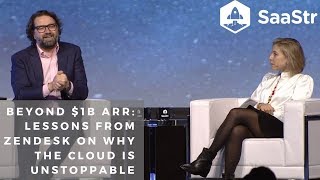
Mikkel Svane, CEO of Zendesk, discusses the company's path to $1B ARR and why cloud computing won. He covers the shift from startup scrappiness to scaling culture, launching Zendesk Sunshine as a CRM platform, and how customer experience became the real differentiator in SaaS.
Chapters
Hi everyone. Thank you for taking time to listen to us this morning. So I'm here I guess about seven years after we first met. Seven, six years. Tables have turned because I first met Michael when just after I was working for a previous fund index had just invested. And I used to send every founder Mikael's way to help them or European founder Mikael's way to help them figure out how to relocate to San Francisco about six years later. Mikael's now an investor in my farm and Blossom and I'm trying to get him to tell every founder in Europe to stay there rather than to move. So Mikhail, it's been an amazing quarter for you and recently you announced plans to reach about a billion of revenue next year.
Seems like you should 2020. Easy, easy, easy.
Oh yeah, next year. Sorry, yeah, hate to break it to you. How's that going?
No, fantastic, Fantastic. Zendesk. We had Q4 and 2018 earnings call yesterday. We ended just shy of $600 million in revenue for the year. We had a 700 million dollar run rate, close to 700 million dollar run rate right now. We guided towards 800 for 2019. So we feel very confident, increasingly confident about getting to a billion dollars in revenue by 2020. And that's going to be a fun milestone. I still remember getting to 10,000 and 100,000. So it'll be an amazing milestone. Thank you.
What do you think are some of the biggest challenges facing any SaaS companies today? And what do you think has changed since you started about 10 years ago?
Everything. Everything. First and foremost, do we have any kind of European SaaS startups here today? There's plenty, yeah. First and foremost, you guys are so spoiled. You know, like 10 years ago, I tell you guys, kids, that was a very, very different back then. And I think it's one of these things that sometimes you forget how quickly things have developed. Like even just like the notion was cloud gonna be kind of the future, like that wasn't something, that was a fact. Ten years ago there was still a lot of people who told us like, oh, you need to build on premise software and this cloud thing, you can't really, it's not a certain thing yet, et cetera, et cetera. This model of trialing and buying your software, that doesn't make any sense. You stop that. So it was a very, very different environment back then. And when you build your software, you had nothing. We started, we had to build everything from scratch. How our web server, how we handle emails, how we build our customers, all these different things. We had to build the entire stack ourselves and we ran it on our own hardware in somebody's basement. Not like today where you can get the entire stack, you can combine the entire stack and you have everything running on AWS and in no time. So very, very different back then. And like, you know, being just a little bit different back then was being very different. Like today it's much harder, like differentiating yourselves today. So much harder. But what we have seen is that, you know, part of differentiating yourself today is also providing a different customer experience. And we've been very fortunate about being a company that helps company is providing a fantastic customer experience and, you know, fortunate enough to work with a bunch of you guys and helping you provide that customer experience. I do think, like, because we have European founders here today. I think it is very interesting because Zendesk, of course, you can hear that on the broken English. I'm not from around here. I came to the area 10 years ago, almost exactly 10 years ago. And back then you could not build a business in Europe, forget about it. There was no money, there was no VCs. You know, you had talent, of course you had talent, but you had zero experience, zero experience from building software companies and like, there was no startup communities, no startup environment. There was nothing. Like Index was one of the only kind of VC funds in Europe back then. And like, for us, we did not have a choice. Like, if we wanted to succeed, we had to get out of Europe and land in Silicon Valley. And that's different now. That's a, you know, that's what you put your business on.
Brighter. He's not dabbing it for everyone.
Yeah.
And so now you're saying that things have changed somewhat.
No, I'm not. You're saying that.
I'm saying I believe there's much more accessibility to talent and obviously new funds. I have to do the promo for Blossom that can back you and help you build from the early stages. You mentioned how things have changed. Obviously customers are always somewhat demanding. But how are you seeing your customers demands have changed and how has demand for customer experience changed over time?
Yeah, it is funny to think of like 10 years ago, what a different world it was. Like, I remember when, in the 90s, when I came to Silicon Valley, you printed, you had maps, physical maps, and that's how you found your places. You had to go and you had to agree on a meeting at a special time, at a special place, because not everybody had cell phones, et cetera. So if you think about just over the last 10 years, how much have changed? Because now we all have smartphones and we have the maps going with us everywhere and everybody's GPS and everybody's reachable all the time. It's a completely different world. And like our expectations as consumers to the services we're using are also completely different because like things are so easy for us in so many ways. Like we can order anything, anywhere and like it's here instantaneously. You know, if I want to sit down and have a pizza in a car while streaming, I don't know what I can do that. Like everything is instantaneously available. And that's also changing our expectations to, to business software. Like business software used to be terrible. I think we guys, you guys, we've all helped change that and now the bar is just so much higher. You know, like businesses have very different expectations to the kind of software they put in their business. They want to be agile, they want to be quick, they want to see results. They don't want to train a thousand people, they want to get them up and running instantaneously. They don't want to have like a big manual to read. They don't want binders and instructions. They just want them make things intuitive, easy, so people can hit the ground running and focus on the business, focus on the customers. And that's such a different mindset to how it was 10 years ago. Business software back then was like two year projects. Everybody had to retrain and go to school and like the good old days of SAP, everything just took forever. And that is not the world we're in today. And businesses are not going to accept, accept that going forward they need to be able to take these things in and out the same way we do with our consumer services, with our consumer apps. And I think that's fascinating. That's fascinating. It's been fascinating being part of that giant change. I say just 10 years because it feels like yesterday, but it's really like the world has truly changed.
And you mentioned very briefly the demand for on premise. Obviously that's not really so relevant today. What kind of role do you think the rise of the public cloud has played and how important is that for SaaS companies today?
Well, again, like the public Cloud AWS, who's the dominant leader, they can just provide an infrastructure and a platform for companies to move really, really quickly. So if you are a startup today, like what we spent like nine months, 12 months building initially, you could do that in like three weeks. Today you can get up and running so ridiculously quickly. Today. So that's less kind of the differentiation, is less about kind of the idea and the concept and so on. It's much more the execution of your business and kind of the results you bring to the business out of the gates. The public cloud has become kind of a, it's become a weapon of choice not only for new startups, but also for more and more kind of established businesses. And we are seeing like platform shifts from how they traditionally run their infrastructure and their services and business to seeing them run that stuff on aws. And I think the real opportunity here is that these public clouds, they can be the ultimate kind of dream for how we wanna cooperate and have all these applications work together. Because like, why do we all need to maintain our own APIs and all these different things if we are all like on the same infrastructure and can use native services to have data flow seamlessly between applications? And that's part of how we think at Zendesk. And our promise also to a new generation of developers, new generation of companies, is that if you build on aws, we will make it incredibly easy for you to have to use data coming out of the center's portfolio of systems, but also make it easy for you to collaborate with applications that we have built. So we think that the public cloud can be a paradigm shift and it's the beginning of a new cloud generation where it's less about just getting your infrastructure out of your basement and more about really taking benefit from having this worldwide phenomenon that basically can connect all of us people and all of our data.
So lots of exciting developments for Zendesk in the last year. The acquisition of base and now the launch of your new CRM platform, Sunshine.
Sunshine, yes.
We could do with some of that in here. Tell us a bit more about it. Why now do we need another platform? Motivation?
I think we need a new generation platform. I think we're sick and tired of the old vendor login platforms. Like, you know, you know, just because a vendor, a company comes and say like, you can build everything on our platform and you know, that can help, like it locks you into that vendor and everything will happen at the pace of that vendor. I think that thinking about the cloud infrastructure and as your platform, and that's really our ambition with Sunshine, is to say that we're going to provide a lot of components, a lot of helping stuff, a lot of infrastructure, a lot of reference stuff, but you should think about the public cloud as your platform and instead of retraining your developers on building for this and that platform and using these and those APIs and libraries, just train them on the public clouds and on aws and you can kind of run so much faster and stay true to your business and actually work in an environment that is familiar. So that is our big bet. That's how we think kind of the future of enterprise technology is gonna be built. And that's gonna live up to the expectation of businesses today that don't want login, that wanna be agile, they wanna move quickly and wanna stay relevant for their customers. It's one of the biggest challenges today that like it's so hard to stay relevant for your customers. Businesses are coming and going at a crazy pace because we're not, we don't stay relevant to our customers. Once we get to a certain size, we become slow, we become, you know, outdated, we become hard to, we become hard to satisfy the needs of our, harder for us to satisfy the need for our customers. So giving businesses today the tools to stay agile, stay relevant, to be able to continue to run quickly, I think it's going to be critical for new generation of businesses.
So do you think that's the opportunity for all of next generation SaaS companies and you've spoken a bit about what's driving it, but do you think anyone who doesn't jump in that bandwagon is going to be left behind?
I think we're still in the very early phase of redefining all of enterprise technology out. There's still a tremendous amount of companies who spend all their money on Oracle, on SAP, on, you know, a lot of outdated technology and like they're locked in and they can't move anywhere and it's hurting the business and it's hurting the customer experience and it's ultimately hurting us as consumers. I think we have an opportunity to provide these businesses with a new set of much more agile technology that doesn't lock them in, that makes it so much easier for them and, and ultimately I think that will help these businesses be much better, much more successful, it will help them provide a much better customer experience and always keep up to the expectations of the customers. And ultimately I think it will be good for people, it'll be good for us as consumers that the business that we're dealing with are able and can provide us with a great experience. I think we've all known that, we've all experienced that where like a large organization becomes so big that suddenly the product experience, the customer experience just becomes terrible. But now they're so big, it's actually hard to move away from Them. We've all tried that with, you know, our phone providers, our cable providers, our Internet providers, all these at some point, you know, like the sexiness of the application or the service goes away.
The.
Customer service, the customer experience becomes terrible. But Laos becomes like super hard to move away from them. And I think that's one of the things we have as an opportunity as businesses today provide a new generation of technologies that can make these businesses stay relevant.
So when you started out, you spoke a lot about the differentiator being Zendesk. Focus on user experience. That's what the key selling point was. Yeah. Do you think that's enough of a differentiator today? Is just solely focusing on UI going to make a new SaaS company stand out? And is it enough for you to stand out?
Well, I think a fantastic user experience is table stakes today. Like you, like you can build the smartest product in the world if you don't make it slick, easy, super, like beautiful, relevant for your customers. Forget about it like that. It's like your phone apps. If it looks like a piece of bricks, you're not going to use it. And I think that's kind of, it's table stakes. It's the new bar for apps today is that they have to be super easy, intuitive to use. So I think the ease of use now goes beyond just the user experience goes on. Like, to what extent does this log us in? To what extent is it easy to get, you know, developers to work on it? To what extent is it easy to scale it? You know, like just scaling software. We have opportunities to scale software from very small implementations to very large implementations due to cloud technologies today. And that's kind of, that's. That ease of use is going to, is going to be important for that whole kind of life experience around the product and not just kind of how does it look in the interface. So I think there's a new kind of front, there's a new battleground for ease of use, if you will, and.
You have a stellar roster of customers. How do you think some of those, to name a few, like Slack or Mailchimp or Zero, how do you think those SaaS companies stand out today?
Yeah, I think these, like, so that's one of the things that have been amazing in our journey is that we have worked with like the coolest companies in the world. You know, all these companies that have completely changed how we do, how we do stuff today. Companies like Uber and companies like Slack, as you say, and mailchimp and Shopify, Pinterest. And Netflix, all these postmates, all these new generation of services and we work with these kind of companies all over the world and that we have learned so much from that. But even I think for these guys, they all know that it's the ease of use, it's the transparency of the applications, it's the responsiveness and it's the empowerment to the user that ultimately is going to make these companies successful or not. And I know it's obvious that these guys know that the experience and the ease of use of the applications is critical to kind of their success. So it's been, it's been fantastic for us to have the opportunity, the privilege to work with these amazing companies. They've really shaped us as a company. And it's also obvious that they have set a new standard for how we as consumers expect to do stuff. Like when my kids, they are ruthless, ruthless in how they use applications. If it's not like on their iPads, on their phones, if they have games and stuff they're using, if it's not good, they're just not going to use it, if it's not engaging and super easy, they're not going to use it. And they don't think two seconds about it. And I think that's the next generation of consumer, the next generation of consumers is going to be ruthless. If things are not fantastic, they're not.
Going to use the ship, keep the level high. So obviously reaching a billion isn't enough for you. After that is a multi billion revenue target. What kind of customer experience, what innovation do we need next in the industry to help you get that?
That's a lot of stuff we truly believe in like more and more businesses adopting the public clouds as their platform. Thinking about that as a platform, that's really a new generational kind of shift, a new generational change in how you think about your stack, how you think about your infrastructure. We're going to be part of that. We think that is ridiculously interesting and I think it's a huge opportunity for a new generation of companies. We, our business, we're gonna, you know, we started out helping customers with very basic customer support. You know, helping businesses be responsive and you know, transparent and empowering to their customers over different channels to engage with their users. And we're gonna expand that into all kinds of fields. We're doing more and more investments in machine learning capabilities that can kind of help our customers automate much more of the flow and provide a greater customer experience. We're doing more and more around analytics to Help customers not only understand their customers and their operations, but truly, like, what's the sentiment of the market? Like, what are actually behind the ticket, behind the user, behind the kind of interaction? What is the sentiment of the customers? What do they really think about the business? And how can you apply that knowledge to improving your business? And then we're going to help customers across the entire customer experience. Like anything from sales, now we do sales tools to marketing and all these other tools. Everything that basically touches the customer. And we're very, very excited about that. It's going to be a fun journey hiring a lot of people. Just saying.
They'Ve all got their own entrepreneurial journey.
When you have failed. Sorry.
Speaking of hiring people, 10 years on, you know, 3,000 employees, you have multiple offices across the world. How do you find retaining an innovative culture? How do you kind of give people the promise of something new every day?
Yeah. So like, we grew.
This is your opportunity to recognize, recruit everyone in the crowd.
So we grew. What did we do? We grew something like 40% last quarter at a run rate of like $600 million. That's a lot. That's a lot of change with 27, 2800 people. It's a lot of change to the organization. And I think you have to be a little bit crazy to enjoy that, but it is a fantastic journey. I think when you're building a startup, that's. That you have new challenges, new set of challenges and things every single day. That's what, that's the, that's the, that's both the craziness and, but also the excitement about building a startup and that we can keep that at our size gives our employees ton of opportunities. Because, like, the company today is a completely different company that this company is going to be in a year. You know, like, we look, when we do our projections, we think about, oh, we're going to be, you know, 5,000 people at that, at that point. And then we're like, we probably have to. With kind of just the rotation and churn and, you know, people's lives and everything. We probably have to hire 5,000 people to get to 5,000, you know, and it's just such a ridiculous amount of change and, and disruption that it's crazy, but it's also amazing and it gives our employees an amazing opportunity to learn a lot of new stuff.
So for a lot of people sitting in this audience, they're probably where you were 10 years ago, thinking about how to get to that first 100k of MRR and kind of starting out. If you can take yourself back to that point, given all the trends you're describing in the industry and where we are, what would be the few pieces of advice that you have?
I would quit whatever I'm doing and I would take this job with this fantastic company called Zendesk. No. You know how it is the early days of a startup that they're frightening because there's a lot of things about building a startup today, like the funnel model, that customer acquisition kind of principles that we didn't have 10 years ago. Like, we thought, like all the customers we got initially that paid monthly, we had this constant fear that tomorrow they would all be gone, that they would actually retain these customers and that we could predict our retention of these customers was not. Like, that wasn't common knowledge back then. And so it's like living with the terror of, like, you don't know who's gonna pay your salary in six months and who's gonna take, you know, who's gonna support your family. All these things. Like, the terror of living with that is terrible. You know, the early days of building a company, and then you have the amazing part, you know, that you learn all these amazing things and you're like, you're like, trying to push the boundaries and the envelope for everything, and you're out there at the forefront of innovation and meeting all these cool people and doing all these cool stuff and working with cool companies, and that's fantastic. So you have to live with this dilemma constantly. You also know that you're probably going to fail. That's crazy. You know, but like, you know, most companies. Yeah, but like, that's. I think that's, you know, I think that's. That was realizing that you're probably going to fail, especially probably what helps you succeed in the end, if you're unrealistic about your own mortality, you're not going to truly live. You know, it's not until you realize that you die that you're actually going to live. Sorry. Very dark suddenly. No, but I think that, like, realizing that your company can be gone, you know, tomorrow or next month for next year, that is what truly kind of gives you the grind to build a successful company. But living with that dynamics of the early days of building companies. Terrible, terrifying.
And when you started out, did you worry a lot about competition and more so today or less so today?
I think we worried a lot about the market. Like, we didn't. Like, there was so many people who told us, like, don't go into anything remotely around customer service. Nobody Gives a shit. Nobody's going to pay any money there. And all the innovation has been done. That was kind of the common sense. I can name a few VCs that told us that, and one day I will.
But.
So, like, we didn't worry too much about competition. We worried about the market. Was it truly a market? And of course, like, as you grow a company, you have to navigate, like, what are the other players in the market? And there's always competition one way or the other. I think the most interesting competition is kind of the companies that are trying to redefine the market, redefine the playing field. And these are the kind of things that is both inspiring and scary.
So we're almost running out of time. If you had one thing to leave the audience with, other than the fact that they might all fail and die, let's try leave them with something a bit more positive. What do you want to say? Other than apply to Zendesk?
No, but I think it's like, you know, like, think about what a fantastic journey this is. Like, you're on a journey now with your second fund, or your first fund, your second fund, and a lot of you guys on your initial journey with your startup with your. With your company, like, this is the. This is the. I really appreciate this time of your life because, like, you don't. You don't. It's really hard. Like, outside of this little bubble we call Silicon Valley and some places in Europe, et cetera, nobody, so few people have this opportunity. So regardless of how you're doing with your company, you're gonna learn so much from this. And I think it's important to think about it first and foremost as a big learning experience, because as I said, you really have to enjoy the journey.
In case. And on that note.
Yeah, no, so I think it's inspiring. It's inspiring for us as a company to meet all this innovation. It's inspiring to be part of this community. We have a booth here today. We make sure that startups can use our software free of charge for a year. And we really. I think part of the lifeblood of companies as and is, is the constant kind of innovation you're being exposed to from the startup community. So, like, we feel very much at home at conferences like this. And it's very inspiring to work with so many of you guys. I know a lot of you guys are working on our platform, building to our customers. We have a huge community of customers. We have 130,000 customer accounts or something like that, and building such a platform, such as community, for other people to do their business, too. It's very exciting. I also want to say that we're both having. We're having a Q and A, both of us, after this. We don't know where and we don't know what it's going to be about, so I think that's up to you. But we both have Q and A sessions. Ophelia is going to talk about why you should stay in Europe.
Excuse me.
And I don't know what I'm going to talk about. I got to talk a lot about death.
I think we have time for just one more question that's just occurred to me. So when you started out, who are your role models in the industry and how has that changed today? Which companies do you look to and really aspire to, what they're building?
I don't think we had that many role models back then. I think as an industry, if you're building enterprise cloud software. So I think we all owe a lot to Salesforce. They're probably sponsoring this thing, too. But I, you know, even though we also. Everybody's competing with them, we owe a lot to them for kind of starting the cloud trend. And back then, they were more or less the only company, so I think there's a lot fewer. You know, it was fun back then In San Francisco 10 years ago, it was fun, like all the. You could. You met all the other cool founders on the streets and so on. That was fun. When I say all the other cool founders, I mean you met all the cool founders on the street.
Mikal, thank you so much. It's been a pleasure.
Thanks, everybody.










