Bootstrapping to $2B When Everyone Says It's Impossible with Cloudinary’s CEO
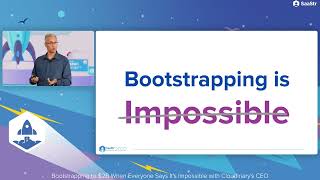
Itay, CEO of Cloudinary, built a $2 billion company without external funding. He discusses why bootstrapping forced better unit economics, how it shaped hiring decisions, and the trade-offs between speed and independence.
Chapters
Hey, good morning, great to be here today. My name is Itay. I'll introduce myself in a sec. Just so I get to know you a little bit better. Just one question, maybe with a raise of hand. So how many here are working in a bootstrapped startup? Bootstrap startup. Everybody is working in a bootstrap startup. I love that. That's amazing. You know, 15 years ago, so before Cloudinary, we had a, we had a dev consultancy and was incredible, loved it. Small dev consultancy, worked a lot with entrepreneurs, really early entrepreneurs, early in their journey, helping them build their products and get them to market. And every so often met hundreds of entrepreneurs, shiny eyes, heard their stories, incredible products and every so often I heard an entrepreneur that told me, hey, I'm bootstrapping my business. Which was insane to me. It was really. I was working several heavily VC backed companies before that, senior level roles. I knew how hard it is to bring a product to market. So doing that without any, it's crazy. Out any cash and you're doing that so well that you're self sufficient, you can grow and that's incredible. But the thing is I think that what actually they were telling me entrepreneurs and I'm not sure what I was hearing wasn't that heavy. Hey, we're self sufficient, we're amazing, we're growing so fast, we don't need that money. Was basically that, hey, we're not there yet. And not there yet usually meant, hey, no VC said yet. Yes, right, just yet. So we're bootstrapping it, but we're gonna get there really, really soon. And that was okay, that's crazy. That's money out of your own pocket. It's crazy. You can't do that. Some people, by the way, they meant, hey, we're really early, really early in our journey. We need some more time and we'll get a product out there in market soon enough, but then we'll hit the VC crowd in some cases. I remember some veterans that said, hey, you know what, I'm not gonna do that this time around. I've been around, I met with financial institutions. I got burned in the past. I'm not gonna do that again. So desperately need the money, but don't have it. And the thing is, my definition, my head of what bootstrapping it was, was a little bit different. Right? Cause you can hear that from what I'm saying. It wasn't about, hey, I wasn't able to raise funds just yet. It was what I was thinking, I was hearing was, look, we're Doing so well. We really don't need that right now. We don't need that money. We have everything. So let me try that question again. Right. So who here is working at so SaaS company? Recurring revenues already beginning of initial scale. So there is let's say 3 million in ARR and growing trajectory is 2x next year. 10 full time employees paying them full salaries. And even if a VC will put an offer in front of you right now, you'll say we don't need it. We literally don't need it. We have everything we need to continue to grow this year. So who here works in a bootstrapped company? Good for you, by the way. This is crazy. So much fewer hands, but this is crazy. Why am I saying that this is crazy? First of all, first of all, the word itself, I hate the term bootstrap. I'm not sure if you've thought about that. Bootstrap. What it means, literally means is that your picking yourself up with the straps of your own boots. Right. The charm itself is a play of impossibility. And I remember a story that I read as a little kid. Not sure if you've heard Baron Munchausen. Anybody heard that? Really great stories, so fantastical stories. And in one of those stories I vividly remember, the baron got stuck with his horse in the middle of a swamp and didn't lose his composure. And what he did basically was really really easy. Was he? He picked himself up by his own hair with the horse and just took him outside of the swamp. And that was it. He was saved. Right. This is bootstrapping. Good luck to all of us. Crazy. Let's talk about the recipe for a sec. It's easy. My recipe in a way. What does it mean? You're not taking a strong fund because you don't need them. So a you need to be profitable. Day one. Profitable. Revenue is bigger than expenses. Day one they won. There's right no money. It's not me financing yet. This is literally the product is finances itself. Right. A lot of value that is there. And you don't take money because you don't need it. You literally don't need it. You have everything. Maybe in later stages, but currently you just don't need it. You're doing really well. Why is that impossible? Let's talk about the early days. Let's talk about the later days. Right? Early days. I think it's really improbable later days. It's practically impossible. Early days. What do you need to do? You need to get to markets. You need to build a product in insanely cost efficiently, right? Crazy cost efficiently. There's no money, right? Literally it's going to finance itself. I need the product out there and it's not enough. I also need product market for day one, right? Needs to. I can't. The vast majority of startups will pivot the first year. It will redo everything that you're currently doing. You can't. No money, right? This is it. The product needs to finance itself. Product market fit at day one, which is crazy by itself. You need an incredibly efficient go to market model, right? CAC lifetime value. Let's return an investment into. No, you can't. It needs to zero cost. You need to be up in market. You need to be selling right now. How do you do that? It's crazy. And last thing, you need fast ROI on every return on investment. Everything that you're doing starting day one, you're building the next version. Let's build the next version of our product. No, literally, if Mitsu fast roi, how do we even get there? So it is doable. Very unlikely, but it is doable. Talk about our recipe there. But I want to talk about late stage for a sec. Late stage, let's say 10 million and above. 10, 50, 100 million. That journey there. I'm gonna, I'm gonna do a quick math for a second, right? You're 10 million, 20, 50 million. You're at scale. You have a very highly efficient go to market machine. You're growing, going from maybe bottom up to enterprise. There are market numbers, B2B software as a service. About 20% of your revenues immediately go to cogs, right? It DevOps, so forth. 10% will go to marketing. Highly efficient at scale machine. 10% goes to marketing. About 5% will go to G&A and offices and flights. 10%, rest of the teams, that's automation and consultancy and so forth. Leave about 5% for just, you know, money in the bank safety nets. So I just counted 50% of your revenue. That's gone, that's out. Which leaves about 50% of your revenues for salaries. This is it. This is what you can play with. Okay, that makes sense. What are we, what does it mean? Let's talk about salaries for a sec. I'm going to again throw some numbers out there. So let's say what is an average salary? Think 100, 200, 500 employees, right? A lot of people across the world. Let's say $10,000 per month. Let's add about 30% company cost. Let's use about $150,000 for an average salary. Okay, what does that mean? Right, let's take both of those numbers in. This is what it means. It means that if you want to be break even you need to hit a number that is 300k ARR per employee at scale which again it's a nice number. Great, let's use that number. What does it actually means? So let's talk about what it actually means for a VC backed company. There are market industry numbers. But we run the numbers. People are running numbers in their head. Huh? We're far off maybe numbers. Industry numbers are average year over employee at 10 million and above is about 75k to 100k. Right. So let's run the math. If you want to be self sufficient, not highly profitable, just self sufficient in your business, you don't need to be 10% more efficient or 50% more efficient. Not even 100. You need to be 3x to 4x more efficient than what the average VC back company successful, really successful and growing VC backed companies are. Which is crazy, crazy crazy high number. How do we even get there? Here is an easy recipe. You need to part ways with three quarters of your team tomorrow morning and continue to do well, amazingly well. Don't lose a beat. That's not going to work. It's practically impossible. So I'm saying that it's impossible. I'm saying that a lot. But. But we're bootstrapped. Cloudinary is bootstrapped. There. There are a few bootstrap companies out there. So let's talk about that for a sec. So Cloudinary, we're software as a service B2B CEO co founder three were three co founders. Myself and my two very good friends, very talented individuals. Talon and Dub co founded CloudRay about 10 years ago. So software as a service B2B you cater for developers primarily. Primarily for developers. You think images and videos, APIs build your, you know, stack from that. We just hit $100 million in ARR. We've never raised any primary round. We don't have investors. Not external. We don't have a board. We don't have a board. This is only us. We have the easiest cap table in the world. It's all common stocks. This is really weird. How did we do that? We were very lucky. Thank you for listening. But. But we were by the way. We were. We were incredibly lucky. Let me try to see if there are. We were very lucky. It's winning the lottery. But there are a few things that can be translatable. Hold me Accountable. So it's not all luck. But let's talk about that. First of all, I'll split that to two. Early stage and late stage. But early stage. Let's talk about dev consultancies for a sec. Because we started, I said dev consultancy. There is a surprisingly, I think statistically significant large number of bootstrapped successful companies that started as a dev consultancy. Let's talk about why. So. Mailchimp. Mailchimp started as a dev consultancy. 37 signals started as a dev consultancy. We started as a dev consultancy. When I say started as a dev consultancy, what I mean is this. So you start as a dev consultancy. We're catering for amazing customers. We build products for them and again and again. And then you realize that there are a few parts of the products that you repeat all the time. You build again and again. They don't exist in the market. So in some cases you'll find an amazing solution. Solve that. In some cases you find, hey, there is a gap in the market. And then you decide to turn that into a startup company, right? So this is what I mean by dev consultancy. But what does it mean in practice? What it means is that we, when we build that product, we know the market. We really know the market. We are the market, right? We've been there, we're doing it doesn't. It doesn't. It's an interesting proof point. Doesn't. Doesn't guarantee success, but it's a very interesting proof point, right? The second thing is we know how to build this. Bring it, not bring it to market, but build the product. This is what we've been doing. That's our day job. We're building the product and we've built it before for other companies, right? We know the product. We can build it incredibly efficiently very fast. We already have initial paying customers day one, right? We need profitability day one. We have initial pay customers because our customers, by them, consultancy customers will be our customers day one. And then there is something about running a business as a consultancy and not as this startup company, right? It's, first of all, it's, it's all about our customers, right? We're trying to give a lot of value to our customers and it's drilled into you, right? It's, it's a business. You run a business. You're. You're here to Support your customers 100% from day one. And which is a little bit funny, but. But there is no vc. There is, but not vc funding for dev consultancy, right? I'm giving you a lot of Value, you're paying me back. This is how it works. It's a win win situation. I'm not, you know, let's give it for free for a few years and then let's figure out the market. No, I'm used to building a product that is very efficient. My time, my value, a lot of value. And getting back, getting paid back for that. Since day one, I think it's interesting mind frame, thought process. And the last thing is which again, a little bit weird, but we have a day job. Startup is tough and there are ups and downs and slows and fast. At least in the very early days we have a day job and we can, we can pivot. We can do both, you know, both in parallel. Let's talk about the later stage because I think my answer for the later stage is a little bit slightly different. What happened to us $10 million and above, you know. But just to summarize this point, maybe one point, so don't skip that. So does that consultancy. That's a. There was another small point before moving onwards. That's developers. I think there's something interesting that happened to us with the developer community. So developers are unique. Every Persona that you work with will be unique. You know, I won't overgeneralize. I'm a developer. I used to look at those products. I would use them at my own time off. Right? That's evening hobbies, tinkering. We'll tinker with products out there. It's not for profit, just trying around different packages, different solutions. Solutions such as clouding. I would have used that in my own projects and then brought them into my own company. Because if it works, and then I would embed that in all of my code and then probably tell someone, hey, you better pay for this because it's already embedded across all of our systems. So pay for this solution. Right? So developers and then tell everybody about that. And I have a good feeling that a lot of what happened to us success was because of the developer community that we cater for. So with dev consultancy, easy, fast, time to market, profitable day one. Paying customers day one and cater for developers. Very efficient. Go to market, word of mouth spread around, at least for the early days. It doesn't solve the later stage. Let's talk about the later stage for a sec. And I think at the later stage, and again, no easy solutions. Right? How can you be 3 or 4x more efficient than the average company out there? I think that our core values miraculously aligned. It's a little bit fluffy, but let me help with that. It needs to be something big. So you're completely different than I think other companies. We truly do believe that a small team is better than a large team. Right. And larger team, more people. You have to have more working hands. Right? But more people, a little bit more, you know, managerial overheads. You pass the ball around lots of areas that you can fall. There's a lot of diminishing returns. Communication is more complex. Knowledge management and sharing is more complex. But still you have more working hands. Right? So it's more efficient. But it's not like, you know, a 3x larger thing is 3x better than a small team. But you add to that another thing that we deeply believe in. 80, 20, Pareto's Law. Not everything, everything brings value. Not everything is really, really valuable. And you really, if you can really focus on value, you can do some incredible stuff. 80, 20, where the value really is and where we need, need to find that value point and solve that and not the rest. And that helps really move the needle. And the last thing is there is something, again, very emotional for, for me, I think I hate throwing people at a problem. Let's empower the team. Like, let's do better. Let's automate. There are solutions out there. Let's not, let's throw smarts at the problem, let's solve it smartly. And all of these means that we can do a lot with a very, very few individuals. It's not for everybody though, right? I said core values because for other individuals it's all about value. It doesn't matter if it's small, it's big. Let's add more value. Let's see that growth rate, which is great. It just wasn't us, right? Leave a little bit value behind. Smaller team, amazing. Let's move forward now. I'm not sure how this, how much this is translatable, but let me try a few different personal tips for your journeys. I'll start from the very beginning. It's maybe contrarian. It's really costly. You think bootstrap. And no, it's free. It's not free. It's really, really costly. So we were incredibly lucky. Don't use that as example. Work with a lot of different entrepreneurs. You will need to pivot, you will need the money. You will find yourself back against the wall without that money. And that's not a good place to be. So put the money aside, know where you're heading into and manage this. It's, it's, it's tough. Second thing is it can't be about your journey, can't be about not talking to investors. There are many insane individuals out there much smarter than me and probably with many here, maybe not all. You need to be in touch. You need to contact these guys. You need to learn from them. One thing about advisor, by the way, the first we were looking at VCs early on we said, hey, we have to raise funds. There is no way that you can build a successful startup without raising funds. One of the first VCs that we met didn't exactly understand SaaS developers, that's 2011, 2012, brought in their own advisor to help talk to these guys. It looks smart, but is there something there? And this advisor talk to us, look at what we're doing. And basically VC advisor, right? Told us you're crazy. Why are we even talking to those guys, to those VCs you have everything that you need. You're growing so well. This is fix that disconnect that says, hey, you can't do that. But look at the numbers. It's crazy. Don't talk to them. It's all good. Continue forward. You're defocused. Focus on your customers. I don't know what you're doing. Continue doing that. We immediately hired him as an advisor, by the way, but that was a VC advisor. Hire a CFO early, which is again crazy. What do you mean? No, that's late stage. We had I think our head of HR first when we were 10 people, CFO when we were 15 people. This is what we do. We manage our money, our plans, our budget really, really, really well. It's all about that. We need to be self sufficient. We need to be held accountable to the value that we're driving. We need good plans towards the future cfo. It's not about me to be very accurate. Then you have a fighting chance in this. Talk to VCs all the time. You need to be challenged by the thought process. Again, it can't be about that. Think about why are we trying to bootstrap our business. It can be about not talking, not listening, not hearing the market. Incredibly smart. The only people that know how to successfully and repeatedly grow startup companies to be IPO ready, right? So challenge yourself with a thought process was instrumental to me. I think I said, hey, you need immediately immediate ROIs. But again, be very careful of the short term view. I think mistakes that we've made in the past. Short term view. Short term view is yeah, I need immediate return investment, which means that I'm just looking around at the next Thing that has some value. I'm gonna go here or there. That's not what what it means. Right. You have to know where you're heading. Please set some specific goals, missions, where are you heading with that? So yes, continuing small and impactful steps, but towards some goal. Right. Otherwise it's really easy, really easy to distract you. Oh, there is an amazing company. Oh, there's a lot of money here. But then focus on that. Careful of the short term view. Get paid in advance. So here is another thing that may sound contrarian. Recurring revenues. You get recurring revenues, monthly payments, right? The difference between getting 100% monthly payments versus 10% of your customers paying annually is that you have twice as much cash to work with. Twice as much cash. Do the math later on, 10% of your customers paying annually. You have twice as much cash and it's crucial for your success. Last point, last point about this. Secondaries. So Cloudinator. If you look at Cloudinator, you'll see that we haven't raised any primary funds. We did secondary rounds. So this is not VC's financial institution giving money to Cloudy to run its business. But this is us building the legal infrastructure, getting partners so that our employees can sell to these venture funds and get some distress, get some money off the table so money doesn't go to cloudinary. There is no board, nothing changes but just stocks exchanging hands. It was again for me, by me, I think instrumental for our success. This is not the wait for this miraculous IPO and all or nothing game. No you ever since. So for the last, since 2015 we're doing secondary rounds. We started secondary rounds at a hundred million dollar valuation of the company. And now the Last 1 was 2 billion dollar valuation earlier this year. And we have a lot of, I hope very happy employees. And for us founders, again not an all or nothing game. We can look further into the future, right? And bigger company, more successful. Successful companies, secondaries. I didn't say why. Why be bootstrapped? The goal is not to be bootstrapped. Again, completely lucky. But there is something to say here about being self sufficient and growing and aiming to be self sufficient as a company. And I think it's incredibly healthy way to grow. Even just aiming there. There's a 300k line aiming there. Being successful towards that goal is incredibly healthy. It's holding you accountable to the value that we're bringing. Get VC money, get that to grow beyond inorganic growth. Something big change. But for the normal run of the business. Normal run of the business. If it's not self Sufficient. Is it okay? Are you delivering enough value to your customers? Think about it. You'll find a lot of areas that doesn't match, doesn't mix build healthy companies. The second point I think, I think very important here is choice and here's the thing. There is only one consistent way to get to ipo. If this is your goal, IPO level, billion dollar plus companies, hundred million dollars plus ARR. This is your goal. There is only one consistent way to get there. It's incredibly risky, it's incredibly rewarding. And that's VC route. This is it. What you're doing in that route, you're shaking hands that for the next 10 years of your life you're going to work on this company. You're going to play a double or nothing game every year and a half, something like that. Half of the companies will not get to the next funding rounds. Statistics flip a coin six times, you get there to the ending line. That's the most you know, this is it. This is the most consistent way to get to those numbers. 1 in 100 will actually get to the IPO level. Successful seed to successful IPOs. Having said that, if you lucked out and you can do that in a more self sufficient way, different things start to open up. Cloudrating. We could have theoretically sold the company after one year for $30 million. We would have had amazingly happy employees, would have been financially set for life, made the biggest financial mistakes of our life in retrospect. But it doesn't matter, right? We didn't know that. But we could have done that after one year. We could have stopped. It made sense. Could have. We could have stopped at 100 million or 200 million. We could have made that decision. You can build an incredible company that is not a billion dollar company but an amazing 100, $200 million worth of company. Stop there. Grow slowly. This is partly what 37signals is doing. Try and build an amazing culture in house. Enjoy what you're doing. Support your customers, support your employees. Grow at a different trajectory. It's not an all or nothing move fast and break things a different path. It gives you a choice and I think it gave us a choice. Let me try and summarize in a few key takeaways. As I said, this is. Bootstrapping is not a goal. Bootstrapping is not a goal. It shouldn't be a goal. Right. It's about building very successful, very healthy businesses. It's practically impossible to do that. But it's worth striving towards that self sufficiency. The goal. There is revenue bigger than expenses. This is non gaap. This is cash in your bank that you can move. Cash in your bank increases every month. And it gives you a lot of health and a lot of choice. And think about this. Think about this point. See if you can get there. See what challenges it brings. See what you can shake that tree and see what falls. When you're looking at that goal is a 300,000 here or per employee. But the bottom line, as I said, it shouldn't be about bootstrapping. You need the funding to build very healthy companies. It is about building healthy companies. So with that, some of these tips will click. Think about it some more. And again, kudos to all of you. I wish you an amazing journey forward. And please go and build very healthy, long lasting, self sufficient, great companies. Thank you so much for listening.










