Bringing Product-Led and Sales-Led Growth Together For Go-To-Market Success with Zapier's CRO
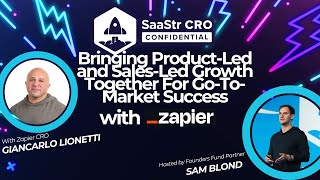
Zapier's CRO Giancarlo Leonetti explains how to blend product-led and sales-led growth. He covers when to hire sales, how to structure teams, and what data to track so your product and sales motions actually work together instead of fighting.
Chapters
Saster fans, welcome to another episode of the CRO Confidential podcast. I'm your host Sam Blond. We have an unbelievable treat in store for today with a guest that I'm just thrilled to have. Giancarlo Leonetti, more famously known as gc, the current Chief Revenue Officer at Zapier gc. Let me just quickly run through your background here and then I'm going to flag a few things that stand out that make you exc exceptionally unique. So giancarlo, back in 2007 started at Atlassian as a technical sales lead, moved into product marketing, had a six plus year stint at Atlassian, moved on to Dropbox in a senior Director of growth and monetization role. Also was a Vice president of self serve growth with Dropbox. Became the Chief Marketing Officer at Confluent after a five year run at Dropbo. Currently occupies the seat of Chief Revenue Officer at Zapier. And there are three things about this experience gc, each of which on their own are incredible, but I think as a combination make you like effectively an inn of one. Maybe the only person that has these three things. The first is the quality of the companies that you joined at a very early stage. We are four for four. I think you were one of the first U.S. employees at Atlassian, Dropbox in 2014, Confluent and now Zapier. So first quality of companies. The second is the tenure that you experienced with each of these companies. The story at Zapier is not done. We're approaching two years here, but an average of something like five years at these other businesses. So just incredible runs time and time again. And then lastly, the breadth of your experience is exceptional. So we have technical sales lead. So sales, we have product marketing, we have self serve growth. The thing that comes to mind there for me is like product led growth. We have chief marketing officer and now we're coalescing all of these experiences into the chief revenue officer role where most folks like myself typically come up either through sales or marketing and land in this CRO role. But you have done it all. So with that, welcome to the pod and ecstatic to have you on hearing.
It back, it sounds, it feels like a maze, not a ladder, if that makes sense. Thanks for the intro there, that's awesome.
Very cool. Before we get into the first topic which will be relevant to the sort of breadth of the experience that you have, I think let's first give the audience some context. Many, I'm sure know the answer to this first question, but I think it's helpful for level setting what is Zapier and then if you could just give a brief history of Zapier's go to market and how that has evolved with the business.
So Zapier is a category leader workflow automation platform for SMP businesses that really want to grow faster by maximizing the efficiency of their teams, tools, processes and really without relying on development teams. So that's our core value prop there. And when you think about it from a go to market perspective, today Zapier is a hybrid go to market really that leverages product led growth but also a sales led notion. And Zapier is a two sided marketplace. So we're doing this via both our product and our partner ecosystem. The go to market strategy involves a combination of things like freemium offerings, subscription plans and partnerships. Like those are really the big three and we really leverage this like land and expand models. So you land a customer at a lower price point or skill expand via like feature differentiation, cross plans, product usage or you can add additional products. And Zapier's go to market has several complimentary motions and this will describe our evolution. First there's product led and really what this means is users will start on a trial VR zapier.com and purchase via credit card. This has been traditionally Zapier's motion throughout its history. Then there's product led with integration partners and we basically co develop embedded product discovery surfaces with other products and so you can use their like we are leveraging their ui. Next is sales led and this is new for us. So over the past few years we've started to integrate a sales or human touch motion and this really caters to these higher complexity problems and use cases to solve for businesses that which in turn introduces all these things, different stakeholders, buying process and that's all supported really by a channel who provide key services around the Zapier products. Long winded but hopefully it gives you the shape of our go to market.
Super helpful. What's going through my mind is today we do it all, but it was a process getting here and I think much like Atlassian where you spend seven years, we started with a product led growth motion and then added in other go to market strategies on top to accelerate growth even beyond what we were experiencing.
Exactly.
That's super helpful and I think we'll incorporate a lot of that experience into today's conversation. Let's actually start on the people side of things and as I talked through your experience in the intro, I can't think of anyone better to provide guidance here given Your background where you have sales background, product marketing background and product led growth background. So one of the most common conversations that I have with probably folks that are on this call, which is going to be founders and go to market leaders at tech startups, is around staffing the team and what people do we need and win. And we have these sort of like broad categories of marketing, sales, servicing. And then within each of those categories we have subcategories within marketing, product marketing and demand gen. Within sales we have SDR and ae. Within servicing we have implementation, account management, csm. This is obviously not one size fits all, which I think is important to flag. But do you have a rough framework for what people and areas of focus tech startups should resource and the sort of sequencing around those things?
Yeah, I will start off by saying I don't know if I have a perfect framework and I don't know if there is a perfect framework as you mentioned, but let me start off with some of the areas. I'll talk about three areas that I think about when you're asking that question. So the first is needs short term and long term. So oftentimes when you're like debating a role, especially on the go to market side, you're balancing these like needs of short term and long term. So let me give you an example here. A key goal of the company is to drive top line growth by X percent, right? I think about that for Zapier, the first role that comes to mind when I say that is something around driving revenue and most likely in sales. So I'm going to hire X inbound sales to meet that growth. But then that could be a short term way of thinking. But what sometimes happens is the long term thinking here you might be debating a hire, let's say on the demand gen side. So meaning you can't hit that top line growth unless you have the right demand coming in. And what if you can only hire one of those right? What are you hiring for? Are you hiring short term or long term? I'll come to more how I choose the path in a second, but that's something I think about. The next thing I think about, which I think is incredibly important is product maturity. And I'll speak to this from Zapier's point of view where if you had talked to me two years ago and said gc, go and build a sales organization at Zapier, that should be X people, let's even say fifty or a hundred, our product maturity at that time was as far as the upmarket side was still new for us. We had primarily been adopting or been building towards this VSB SMB audience and to hire 50 people against a product that wasn't ready for a specific audience would be a mistake for us. And we've actually grown into that over time. So something you have to think about is where is your product maturity example? Would you hire a growth person, right, if your product didn't give them the capabilities to like tinker with the product, maybe in product onboarding, maybe even the website, et cetera. So you've got to think about the where your product is at at that time. The last thing I think about is the role focus. Is a role like more experimental or will it help you scale? And even in the startup world you sometimes you have strong hypotheses but you don't know if those hypotheses will work out. As an example, I'm going to use Zapier here where sales two years ago was a new function for us. When I arrived here we actually had two salespeople and one customer success person. But we were still trying to prove out that model. We were not ready to scale. And so really thinking about is this like an experiment role or a scale role that will help you figure out that hire when you add more to this. But those are like the three that come to mind when you're talking and they usually fall into one of I would say four categories. When you're talking about go to market, distribution, revenue, storytelling or messaging or some type of operations, I'm using that one more broadly and even in the experiences that I've had with founders for quite some time at this point asking that same question. Their needs normally fall into distribution and revenue. Initially there's some in the storytelling messaging side, but it falls in the distribution and revenue. So that's like usually during a conversation I start to like veer towards those two area and I'm either trying to qualify them in or out. And so the way I think about this if I'm listening to this call is like how do you prioritize against those categories? Maybe using those three like that rubric of short term, long term product maturity, an experimenter scale.
And then one thing that you said around these broad categories, distribution, revenue, storytelling and then we'll like separate operations but functions that come to mind just to reinforce here distribution. This is like marketing on top of the funnel. Largely demand gen could be SDR or anything that's oriented around generating demand. The next one around revenue is sellers, people to close business. And then on the storytelling Side, what comes to mind for me, where I actually have the least amount of experience is around product marketing. Is that the right way of bucketing sort of people or titles functions into each of these categories?
Yeah, dead on. Nodding my head. That's dead on. So if you look at that spectrum of what you just described and like the titles that you described, the one that I'd include in there, that's probably some middle between distribution and revenue is this growth category, right? Where sometimes it could fall somewhere in the middle, but that's the only one that I'd add to your list. So that was dead on the.
That makes a lot of sense. Then you joined Zapier when it was a more mature business than when many hire their first CRO. And so we use that as a data point. We can also use. I'm sure you speak with startups regularly and just get some broad under either as an advisor or consultant, whatever. And do you recognize any patterns or themes with businesses where there's some category or some function that is almost universally under resourced in a given area? That's like a missed opportunity.
I'm going to give you the answer that I always give, right? And I do think it normally is sales and marketing, right? And not just because I'm on this podcast. That's what I, that's where I usually observe it. And I'll give you a couple reasons why I see it that way. You usually expect your, your heads down, especially like early days, your heads down building an incredible product, which you should be doing. But at some point you need to get it out there to the world, right? And you need to drive, like you said, top of the funnel. You need to drive some level of demand, right? And you need to close that demand and demand into dollars. And what I see happen is you expect big things, but you under invest in like the sales and marketing side. So it doesn't mean you need to go crazy, right? But sometimes if you don't have somebody who's capable of a demand person to drive demand, right, you're. You're going to struggle in driving demand, right? Unless it's a purely organic business, which is quite frankly is extremely rare these days. So that's one thing I'd call out. The second thing I'd call it out is you're actually not clear on the actual needs that you have. I oftentimes see this in marketing. So in marketing you name some of those categories, but we're talking about demand generation, we're talking about storytelling. In pmn, we're talking about comms and communication, we're talking about strategy. Which one of those do you actually need and where do you actually, where are you actually under resourced in one of those areas? There's no silver bullet. Marketing is probably the category. This includes early days Zapier, but also in other organizations that I've been at where you quite frankly, you miss because you hire somebody, that you hire a demand gen person that you eventually are like. I want them to do the storytelling side. That's not in for most folks, that's not their skill set. And then the last thing I realize is when you're under resourced, this happens internally at Zapier and has happened virtually everywhere else I've been at. You try to find a temporary solution. Contractors, consultants, these band aids for things that seemingly that you would describe as one of your most important things that you need to accomplish. And I just think there's a mismatch there, right? If it's a priority, it's a priority. You should hire around that priority. And if it's not, that's okay.
Lots of takeaways. I'm going to that. The one that I gravitate most towards that you mentioned was the second point that you had which was around not understanding what the business actually needs, just hiring. Because we think this is where somebody should go without being super thoughtful about understanding where the bottlenecks or constraints actually exist. And in many of the conversations that I have with people, not only is it not understanding, it's oftentimes also misdiagnosing. And I'm going to touch on two areas that I see most commonly. The first is on the customer acquisition side and I spend a lot of time on this podcast talking about it. So I'm not going to go super deep. But I see over resourcing on what I will describe as middle of the funnel and closing customers and under resourcing on top of the funnel or generating demand. And so that is something that I see like seemingly universally. But there's a second one that I've talked less about on this pod that I'll touch on now, which is post sale. I see lots of resources in this category of csm, which is like ongoing maintenance and servicing of customers and under resourcing in implementation. And I just think the initial experience that a customer has on a product or with a company has so much influence on the lifetime value of that customer, the happiness of that customer. And people oftentimes lump all customers into one category versus segmenting. Where are they along their experience with our product. And I see that sort of manifest in under resource or under focus on the initial experience that a customer has in implementation. I would over invest there. So that's just one thing that comes away is under resourced area. And I think piggybacking off of your comment around not understanding the business.
Yeah, I love the takeaway there. Let me hit you with an example here and things that we think about even at Zapture today during our hiring process. Sales acumen is incredibly important. But what's more important to me is what I call like the learner mentality, like to where you want to help a customer get up and running. Right. Like you want to help them implement the thing they're trying to get to. And so to some degree, if you look at our rubric, even as we're hiring for sales, it has a little bit of that support and customer success mentality behind it, partially because the nature of our product and the PLG motion where like customers have started already experiencing the product in some way potentially before they talk to a human. And in most cases that's true, but like leveraging, that's incredibly important. Point well taken.
Let's wrap up the people related topic on a question that I'll maybe give a couple examples first because the question might be. Might not be specific enough, but it's around are there any guiding principles that you like to follow from a hiring standpoint? And what I mean by that is I'll just give two illustrations and then maybe that will trigger some thoughts for you. Gc but I talk a lot and Jason actually from Saster as well talks a lot about when you're hiring your first salesperson or your first sdr, you should always hire two. And I preach this. I think Jason preaches this. I still see regularly we hired our first salesperson, we're not planning on hiring our first salesperson. And all the problems that come along with that, I'm not going to go into what that is, but yeah is higher too. And then the second one that comes to mind and then I'd love to hear your principles around this stuff. But when you hire your first marketing person, don't hire somebody really junior. You should hire someone in look, we could say director level or above something like that. But someone that can come in and operate in an environment with ambiguity where they know what to do intuitively versus needing lots of instruction on the marketing side. Would love to hear of course, if you have any thoughts on those two. But also principles that you like to import.
Yeah, I'M just going to plus one those two. I could add more but let me give a little bit. I'll add two to your list and maybe you'll gravitate towards these. The first one's broad but I'm gonna, I'm gonna connect it to product marketing in my. One of my first principles is focus on the anti charter of that hiring. So oftentimes when you're hiring a role a lot of this happens in marketing. You mentioned customer success so that's another one as well where you, you have clarity on what you think you want them to do but you're not clear on what they should not do. What's the anti charter of that particular group. And for product marketing that's the one that comes to mind when I say that it's such a broad discipline in every organization that I've been at, I've ran product marketing and if I describe product marketing to you at that organization at that time, it's different for each organization. Like each of the organizations I was at and what I like to tell people is what do you not want product marketing to do? And that's where you have some of the bigger misalignments. And so I can come back to that point in a second. But that's like focusing on the anti charter is incredibly important. The second is I'm gonna just cause you talked about sales and a little bit about marketing. It's like the demand gen skillset. I always like early days like to focus on analytical skillsets on the team. And so when you when I think about a potential first or second demand gen hire or leader of that team, I oftentimes gravitate towards how do I get the most analytical people like focused on that problem set demand gen and growth for me go hand in hand. And so that's another one that I think about is do you have the analytical rigor across your go to market team in particular in that area, some focus there. And then the last thing I'll call out I said two but I'll give you three because it comes like general athletes as best you can do. Not specialize early like focusing on hiring top down that can navigate challenges and not just fill a role. That's the key thing here. And so think about just connecting it back to some things that you're saying you mentioned like sales, sdr, customer success and you mentioned those two hires for sales. Like the way I've approached things specifically even at Zapier and previous to Zapier is like you start off by Having them do those like one, two or three people do those jobs and then you hire where you have gaps or see success. So ultimately you're almost justifying hiring those roles because oftentimes early days it could feel pretty daunting. You talk about inbound sales, AES, SDRs, customer success solutions, engineers, like the list goes on. And so that's what all those are. My three, I gave you the bonus there.
Those are awesome. The third one, what comes to mind that it's maybe just a different version of what you said, but something along the lines of hire people with startup experience. Most people with early stage startup experience are going to be like maybe more generalist or just get done what needs to be done. And as businesses get larger roles become more and more specialized. And so if you try and bring somebody in who has had a hyper specialized role at a larger business that oftentimes doesn't map well to a startup where you want a general athlete to use your language. The one that I think is really interesting to touch on because I'm interested maybe selfishly is the hardest that I have ever tried to make. And then also what I have observed others try to make is in the category of marketing and maybe even more specifically demand gen. Would love to learn and maybe like a qualified part of why much of go to market is really objective especially at the sales level. You can point to like how much revenue a person or a team closes in demand gen. It is objective but there can also numbers can be played around with or whatever. It's a two part question. What are the things that you look for in candidates that differentiate them in marketing or demand gen? Specifically roles and then two, how do you assess performance of these people? Let's call it over the course of the first quarter or two.
Yeah. So I'm gonna be, I'm gonna be biased in my thinking here so I just wanna call that out. And so just because of how I think about demand gen and the way I'm gonna describe this is there's like generalizing it but there's two type of demand gen leaders that I normally come across. Let's say I was interviewing for this role. There's two types that you're going to come across. The first is what I call like the growth demand gen person. So this is one of those folks that's an iterative thinker, more metrics and analytics focused, understands not only top of the funnel but also mid funnel. Looks for the connection points like through the customer journey. Thinks less about paid marketing in most cases and more about leveraging other channels, content, blogs, video, the list goes on. They have a different mindset. Most of those folks if you look at their background like somewhat could look like a consumer. Like they could have a consumer background. Not in all cases but they could have a consumer background. That's one type of the other type is what I call like the more core B2B demand gen person. So what they're going to function as is they're going to use words like account based marketing, they're going to be more targeted, they're going to focus a lot on segmentation customer lists, looking for specific profiles, fortune X type companies and how to attack those and target those still analytical thinkers but sometimes don't know how to think and leverage volume. And so I keep going but I'll stop there. But that's how I generalize the two demand gen type folks sometimes they could do both. But I'm saying when you interview like you're gonna look, you're gonna see both of those profiles. And I'll tell you what I gravitate towards. I gravitate towards the first one which is the growth one. And not just cause I'm a PLG person right. But I think especially early days it's not always clear like where the, where the opportunity is but also where the challenges are in your funnel. So is it top of funnel? Once you drive top of funnel I will say it's awesome to drive top of funnel because you now create another challenge for yourself because you need to now you need to convert them into X. Whatever X is for your product, it could be a sale, could be activation, whatever that may be. And I gravitate towards this like iterative analytical thinker. I really like people who could or demand gen folks who like who think with volume in mind right like and leveraging that volume in some way. And so that's where like I gravitate towards. But there's also merit in the other side where you need someone depending on your business model you need someone who can really be more targeted. Right. Like you need somebody who could find the specific icp, bring them into your funnel that is is valuable for whether it's the PLG motion or sales. And but the one that I gravitate towards like if I have to choose every time I'm choosing that category bias.
I love the specificity of the answer which is exactly what we try and bring to the audience. So hopeful some tactical takeaways there. And then the second part is 1/4, 2/4. What are the things that you are looking for out of this demand gen or marketing focused hire that give you sign of performance?
Yeah, solid question. So there's two things that I normally look for. Like the first is like focus tactics. It's easy to look at the demand gen funnel or demand gen in general and do what everybody else is going to do. But it's, it isn't going to have the impact on the business or probably not an outsized impact on the business. Yes, you can go and stand up a paid marketing funnel. Yes, you could think through some parts of SEO and leveraging your website and blog and all that stuff. Like those are table stakes. But what I look for is there something creative that's coming out of this group. Like one or two tactics that I'm like ooh, like you're thinking differently. Something I think you have experience in to be fair. Right. Is that creative thinking that the thing that you don't do, like that's everybody else. Like everybody else is usually the thing that has the most outsized impact. It's not always obvious to be fair. Right. But that's the thing that has the most outsized impact. And I'll give one recommendation here on how to get there and then I'll move to the second thing. I look at the recommendation and something we have been doing internally a little bit is oftentimes you could look at competitors or you look at things that work. You try to do the thing that they did that worked. But we try to reverse engineer competitors failures. Does learning from these competitors mistakes like really directly feed into like our ideation and campaign thinking? And that's something that been interesting internally is like what didn't work for them? Because one, we don't want to repeat that but like how can we do something different and have a more outsized impact? And the second one to me is pretty straightforward which is are they understanding the puts and takes to the business? What's very important to me is to understand the whys behind our tactics. So why is something going up? Why is something going down? And do they the first one to two months, do they start to have that foundational understanding of the business? Because if you do then you can start to tweak some of those levers. But that's like the second thing.
It's a smart answer. The first one sounds subjective but in a weird way, like it's almost not where are there at least one but hopefully multiple times where there's an initiative that comes out of marketing, it is, that's really clever and it's not clever to pay LinkedIn to put an ad about your company to your target buyer. Like anybody can do that. So again, it sounds, and I guess it is technically a little subjective, but there should be aha moments where you're like that was a really good idea and it worked. Okay, let's continue along. We spend most of the time talking about people and let's move or sort of transition over to tactics. So related but different. Specifically want to talk about what the highest ROI activities from each go to market function. And let's actually start with something that's not a function per se, but more of a strategy and one Zapier is famous for and that's product led growth. And I think for me in the audience, actually both. First, can you define what PLG means to you? And then for many of us who are like plg sounds awesome, we want that. Where do you get started?
What's plg? Simply put, the product doesn't sell you. So when you think about acquisition, retention, expansion, they all revolve around the product capabilities in a PLG motion. And it really starts to flip the traditional sales model on its head where it's less about the executive buyer and really more about the end user. So the user. So the product essentially becomes your sales team. And so what are the most important things about this acquisition strategy makes it successful? I'll label this into three buckets and I'll try to keep this succinct. The first is product, the second is audience and the first and the third is team and organization setup. So let's talk about product real quick. The simplest one is it has to be easy to try and buy. You need to allow users to experience the product before committing to a paid plan. That's become the norm that in free versions, freemium plans, free trials and that's how you showcase the core capabilities of the product. The one thing I'd call out for people or folks that are listening is give folks the full product, let them experience the whole thing instead of limiting your trials. That's what I always tell folks is don't limit your trials to some diluted version of your product because then your customer is going to get a diluted experience. Second thing regarding product is just being more user centric. And that's where the focus is. You need to design your product with a focus on things like user simplicity and intuitive interfaces. Interfaces features that directly address like user pain points. And that includes things like in product upsell expansion. All that stuff is built into this user centric Focus. Next one is audience. So this one's pretty straightforward to me. Just make sure your audience actually prefers trying and buying the product via a more like product and marketing experience. In some cases that's not true. The example I'd give here, why did self serve work so well for Atlassian? The audience was developers primarily. Especially early days developers actually didn't want to talk to salespeople. They preferred to consume everything from documentation to the product experience to even onboarding for that matter. Right. Like through the product, through marketing, through technical documentation, all those things. So that's something to think about, audience. And then last thing that I think doesn't always get called out is team and organization setup. And the way I talk about team and organization setup for plg, but this is relevant to sales. LED is the front and back end of product LED growth. So the front end of PLG is executing on the key tactics for growth like your website, product onboarding, even human interactions. But the next piece is the backend. And this is the part that most companies actually underestimate. Quite frankly, I think it's the most important part and that's areas across data systems and tools to support this motion. They may be just as critical, if not critical, if not more critical as you scale. So those are the things that, that's what I call out for the PLG motion. And some of the acquisition. Getting the acquisition strategy right.
Can you go one layer deeper on the back end, the data, the system, the front end is intuitive. Talk a little bit more about the latter.
Yeah. When you think about the data systems and tools, I'm gonna, I feel like I'm gonna date myself here. I wanna be like when I was a, when I was a youngster. Dropbox. Right? The. During our Dropbox days, everything that a user was doing within your product, we would log. And the reason for that is that had an important impact on how we were doing any type of marketing or selling. So let's imagine the traditional sales motion today. How does a traditional sales motion work? Lead comes in, that lead gets qualified in some way, turns into an opportunity, and then ultimately it goes through those stages with your sales team. In a PLG motion, it's actually a little different. The experience starts when a user, ultimately even before a user comes into your product. So you're basically logging every data point from top of funnel all the way through your product. Now think activation rates, think product usage, think key conversion rates. But across the funnel. And you've got to log all these moments in time. And the reason you want to do that is one, you just want to understand them because the truth is you don't have a salesperson involved in those interactions. There's nobody like catching them if they're going to fall out. So that's one and then two, it becomes a key things to a key thing to leverage whenever you're doing sales and marketing. Right. We use this as at Zapier, we use it as a way to segment users or qualify them into the sales funnel based on their product usage. And so that's why it's so critical.
Super helpful.
Yep.
One other thing that comes up on like clearly resourcing changes when the business is product led versus sales led. And of course companies like Atlassian and Zapier are both with product led though I think there's this maybe misconception. It's something around Field of Dreams. If you build it, they will come, but you still need to generate demand. And so I guess if any, if there are any, what are the differences in how people. If we are a product led growth organization first, so we're Zapier Atlassian at the beginning of the business versus a sales led organization, let's say more complex products to implement. We actually require salespeople to be successful here. What changes on the very top of the funnel marketing and demand gen strategy, whether you're PLG or saleswater, the first.
Is for a PLG motion you have to focus on volume, right? So the, that's the whole point of the PLG motion is like your acquisition strategy actually needs to be very ROI friendly because if we put a human in the loop, one that brings down the roi, but also putting a human in the loop will, if you're doing that like you probably have a bigger appetite for selling larger deals or certain icp. So you're focusing less on the volume and specific icp where I think for the PLG motion you actually have the opportunity to go broader. But remember, the ROI should be much better than the human lead motion, right. So that's one key difference that I'd describe. The second is the tactics aren't that different. Right? So if you like squint at the tactics, right. If you look at a true sales LED company and a pure plg, those motions from a pure tactics perspective were not different. The channels were the same and those things were the same. But how we leverage those channels like was actually quite different. So for, as an example for Atlassian we lit up content and SEO in a very aggressive way. Whereas at Confluent we had the. We lit up content, but we didn't light it up as much. We would light up more like the paid side, et cetera, because we were more targeted in our ICP and we felt like we can have the right ROI for paid marketing, at least at that time. So something for folks to think about is just does you. Which one does your model like need right for your for the organization, what does your product support?
Awesome. Good segue. Talking a lot about top of the funnel and the differences between PLG and sales led. So let's move on to marketing specifically as a function. And earlier in the show I mentioned that I think of marketing in two broad categories. You have product marketing and demand gen. So maybe we take each separately and get your guidance again on what you think is important for businesses to nail. With each of these, do you have any guidance or common pitfalls, specific tactics even that you put in place that might spawn ideas for people listening when they're getting started with product marketing or demand gen?
First I'll talk about product marketing and then I'll hit the demand gen side. So from a product marketing perspective, I'll touch on something I said earlier which, which is building the charter and anti charter and I'm going to be very specific here. I'm going to tell you exactly what our charter is for product marketing or the high level themes for product marketing in zapier and then a little bit about the anti charter. So if you think about the charter for marketing and zapier and we did this recently, it's focused on product positioning. So think storytelling, merchandising, our product, think things like pricing and packaging, product launches and go to market strategy. And for go to market strategy that's really shaping the strategy and really bringing current and future products to market. Okay, so that's like the high level buckets for the charter. But then when we looked at the anti charter and this is where we had like high level the most disagreement. Nobody, no, everybody was thumbs up on the charter side was things like limiting project management, reducing focus on our lower tier launches. As like two examples where this is where we said product marketing was not going to spend our time and we needed to find another way to support it. There's certain parts of strategic work that we left out as well. And so those were the more controversial parts of the charter versus anti charter. So that's something around pmm. The second thing for PMM that I'd like to call out is just like understanding the customer. We are very specific and we want PMM to be involved with Our customers, you could think through it as should they be involved in X amount of customer calls per month. And that's a goal that we have for ourselves. Another thing I'd call out there is they should partner with sales to pitch a prospect. So what that means is product marketing should be on almost, I wouldn't say every call, but could be almost every call actually doing the pitch and seeing how that resonates with the customer, making the changes and tweaks based on what doesn't resonate. And then the last thing we do that I'd call out is we actually run these like customer spotlight sessions with our product teams. We do it roughly monthly here and I've done this in virtually every single organization. So imagine getting a cross functional team into a room engineering product design and the core leaders of those parts of the business and really helping them understand key aspects of the business from a customer point of view, whether it's like a customer win loss report or something that we're seeing on the self serve side.
Very cool. I'll give my 2 cents on the demand gen side and then we can maybe wrap with sales on demand gen. The thing that comes to mind to me, and you actually touched on this earlier, the most effective demand gen campaigns I've put in place have this common thread of just being different, almost contrarian. And you described if somebody comes in and just goes through the motions and does what everyone else is doing, did that not. That's not like what you want out of an effective demand gen or more specifically a demand gen campaign. And I approach basically every sort of demand gen channel or demand gen concept with like how can we be different in doing this? How can we do paid online ads differently? How can we do outbound sales differently? And so if you approach it from that standpoint, like maybe you do some of the table stakes things that are just smart to do that everybody else is doing, but I think you at least are like throwing stuff up against the wall and some of it is going to work.
Your contrarian example resonates a lot with me. And maybe I'll add one just for to give a plus one to yours and all and one to this. Something we've been doing internally is focusing on what we call or learning about micro moments. And what this means is we analyze the data, know the user buyer paths inside and out and document those micro steps and then build campaigns to like really move each step, like really bit by bit. And sometimes that takes a longer time. But really understanding that customer journey has been incredibly Valuable for us internally to understand what knobs and levers we can move. But also to your point to figure out where we could just be different. Right? Like where can we just be different than everybody else and impact the business?
Perfect. Let's end on the sales side. We've gone product led growth, marketing. Let's end on sales. Let's be really specific with the last question that we'll wrap up on that I think incorporates your experience. Both Atlassian and Zapier. How do you use sales to complement plg? Uh, so both in Atlassian and Zapier both started almost famously plg. Now both have sales that have been layered into plg. When do you know to layer in sales and what do you do when you are ready to make that supplementation?
What happens oftentimes when you think of like PLG and sales for let's say for any PLG company, I'll use that last name Tap Here, here's what happens. You have this PLG motion. You decide for some reason you want to start a sales motion. You treat them as separate things, right? It's almost like they're two separate funnels. You oftentimes hear, and I heard this internally is okay, let's have a contact us form. All those leads go to sales. Everything else is self serve. The buyer's journey is actually not that simple, right? In some cases it is and that makes sense. But really what the way I encourage folks to think about PLG and sales is you want to add human engagement and it shouldn't be segmented by stage of customer journey, but really the complexity of the problem solve across the customer journey. And this is where I'll start to answer your question. And it's important to understand that like more complexity is usually where there's more money per customer. That's the way I think about it and that's where you would need a human involved. But it may not be, it may be in different parts of the journey, right? Like it's not just through a contact us. And so there's one or two scenarios that I talk about there and that's what this is where like I'd introduce like a sales motion and a PLG motion. One is just there's complexity and importance of a problem to solve for your business. So example here is like the pricing and packaging maybe is different and getting signal on willingness to pay is another one. Or use case identification is another one. So leveraging humans as part of that. And then the second thing is stakeholders and focusing more on senior stakeholders and that, like, really typically translate to, like, larger problems and then more stakeholders to convince to get part of that buy in and get to a close. And so those are two areas that we actually introduce our sales team. And. And then I'll throw in, like, a bonus here that I think is the most important thing for anybody introducing a human into a PLG motion. Use the humans to learn. That's what I'll like, that's what I'll leave you with, is like, wherever you inject a human in a PLG motion, PLG is the most efficient model. You actually aren't using humans in there. Right. There has to be a reason to inject them in there. But it's okay to use them to learn as part of that funnel, because the truth is, the worst case scenario is you actually don't need a human, but they learn something about your funnel that could change something in your product, the experience, your messaging, whatever that may be. So leverage, like your sales team to do that as well. So that's what I'd call out for the sales. G side.
Awesome.
Gc.
This was a ton of fun. So thank you for spending so much time with us. Lots of just incredible learnings that I'm coming away with, and hopefully the audience is the same for folks listening in. Thank you for joining. We'll see you back next time. Take care.
All right, see everybody. Thank you.










