Build a Customer Support Team from Scratch w/Peak Support CEO Jonathan Steiman + COO Hannah Steiman
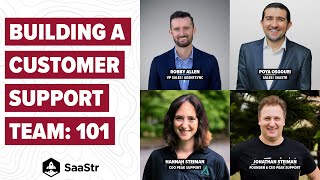
Jonathan and Hannah Steiman built Peak Support from a 2015 layoff into a 450-person company serving 26 clients. They explain why outsourcing support makes sense when it's not your core product, and why speed matters more than perfection.
Chapters
But if you can just put in the chat where you're maybe you're joining us from. I think it's always awesome to see how far and close our network and community is to give people some context. The goal of today for Sasser University is to share a lot of how to's. Hopefully you get a ton of actionable insights from our guest today, Robbie and I, who we both are very, very close. We've been part of the SASA community for five plus years now and we've been fortunate to meet some amazing people. So about a year ago we started this podcast called Uncharted and Eclectic because we want to highlight the human side and the story of some of the greatest people we get to meet day in, day out that are doing some great things in SaaS and the broader tech world. With that said, the format today is a little different than the other content specific speaking sessions you'll be a part of. It's a live recording of a podcast that we run. It's called Uncharted and Eclectic and Robby and I are going to do quick intros. We'll introduce our guests Jonathan and Hannah and then from there we'll have some questions that we've prepared. But throughout this process, please, please, please, if you have any questions for Hannah, Jonathan, any of us put it actually in the Q and A. So in chat let us know where you're calling in from. And then the Q and A functionality in the bottom is where you can kind of put in your questions, upvote, downvote, various questions as well. So Robby, I'm going to defer to you, please say hi and then allow you to ask Jonathan and Hannah to introduce themselves.
Oh, how nice of you. Poya and I have to comment before we start. How regal you look in your cap and gown on this fine morning. Hi everybody, my name is Robbie Allen. I'm the co host of Uncharted and Eclectic alongside Poya. I'm calling in from Denver, Colorado, my day job. I'm the VP of Sales for a company called Agent Sync, based here and I'm so excited to be talking to Hannah and Jonathan. Hannah, maybe I'll kick it over to you next.
Sure, absolutely. I am Hannah Steinman. I'm Chief Operating Officer of Peak Support. We're based in Cambridge, Massachusetts and really excited to be here today and excited to see where everyone else is from. What a great question. People from Oklahoma and Scotland. That's incredible.
And Jonathan Steinman, the founder and CEO of Peace Support and based in Cambridge and so Happy to be here today. This is fantastic. Thank you, Robby. Thank you, Polya.
Yeah, absolutely. So, Hannah and Jonathan, one of the things we'd love to kick off, and it's one of the differentiators for our podcast, is maybe having one or two things that make you interesting that the average person that even may know you doesn't know about you. And I think it could be kind of fun to maybe reverse it. So, Jonathan, what's an interesting personal fact about Hannah? Maybe like a quick bio about where she grew up. Who. If you want to chime in. Yeah, Hannah will let you answer.
So Hannah grew up on a commune in Vermont. And interestingly, that commune has now graduated. I believe it's more of a co op. And kind of an interesting thing that's happening in Hannah's family is that her father just wrote his second book. Years and years and years ago, he wrote a book about building your own home, your own way. And then when he was about 71, he got hit by a car. He had a bunch of time recuperating. He's fine. And he wrote a mystery novel called the Inland Sea that is very good. And that is just kind of the interesting news in the world of Hannah these days.
And that's what John's mug. John's mug is promoting. Promoting my guest.
I'm actually not promoting it. It's just a good mug. I saw the mug and thought of the truth.
So I think one of the things that defines John is John is a motivator of people and teams. And obviously he does this every day in his role at Peak Support. It's one of his corporate core roles of Peak Support. But one example of this is he decided that in our backyard in Cambridge, Massachusetts, in the middle of a city, we needed to have a brick pizza oven. But he had no skills to build a brick pizza oven. He did have a pile of old bricks in Cambridge. There's a lot of old bricks. So he motivated a neighbor who had these skills to build us a gargantuan brick pizza oven, which we used three times about 10 years ago. And now it is just extremely heavy lawn ornament in a very small backyard.
What a story.
What a story. Always, always doing what he can to outsource the job. I like it right off the bat. So let's transition to the business side, I think. Cause that's what the audience today want to get out of this session. So, John, I'll start with you. Cause I think the support. Peak Support background came from. You would love to Know, kind of how you came up with the idea, how it got started, what is peak support today? And then kind of, Hannah, I'll defer to you when you decide to kind of jump on board and join the journey as well.
Yeah, absolutely. So we started from a layoff back in 2012, 2013. I joined an early stage company in the Cambridge area and started to work with this team of agents of concierges. We were offering this concierge service and we progressed for a couple years, and in 2015, the team had grown to about 125 people. We had just great culture, great processes. We just all loved showing up to work. The product we were delivering was awesome. The company got acquired and I got a phone call at like 9pm at night that the acquiring company no longer wants to support the product that you and your 125 people are working on. You have two weeks to lay off all but about four or five of you, and then take the final two weeks to lay off yourself and the rest of the team. And so in that moment, we could have gone just our separate ways, you know, good to know you, Great knowing you. Stay in Touch on LinkedIn. You know, good couple years working together, but we just had something. And so Bianca, Hazel, Judes and myself stuck together. And we said, let's just, you know, go out there. We're stronger as a, as a, as a group than we are as individuals, and let's see if we can win a client. And, you know, as with all these stories, there's just incredible support network that comes out. And the company that laid us off ended up being an incredible support network and introduced us to our second and now one of our largest clients. So basically, the four of us went out, we won one client, we delivered for them. They are still our client six years on. And we said, okay, while we're doing this, can we win a second client? And we won a second client. And so in those first six months, we won three clients headed into 2016, being like, okay, let's. Let's do this. Let's start this business. And so here we are today, it's 2021. We're at about 450, maybe 500 people, 26, 27 clients, and we're just offering a broad range of services. So it's still very early. I mean, I think of us as maybe in the second or third inning. And we just have so many things that we want to accomplish in so many places that we want to go. But we've also come very far from that phone call and that decision to stick together. And like, it was scary. It was very scary. Everyone except for myself at the time, everybody else had children and where's the paycheck gonna come from? And we just made it work.
Loyalty above all else, you know, Robbie, take note. Loyalty.
I think that's true.
Relationships, relationships.
Trust and love. I mean, like, yeah, it was like I couldn't even imagine going to another job without Jude, Bianca and Hayes and what we could do. Like, it was just like, I don't want to do anything else. Like, we all want to be doing this together. And that still exists today. They are the linchpins of what we're doing. And we're still showing up and having fun together.
Yeah. You guys found a team and you took it with you. I love the story. Hannah, tell us about your joining the team and kind of. Yeah. How that started for you.
Sure, yeah. So John and I had started talking about it pretty early on, probably like, hey, maybe we could work together. But we were very uncertain. Weren't sure that it would work out. Weren't sure that it would be a good idea to be spouses working together. And also peak Support has been 100% remote since day one. And I wasn't sure that I would really like working from home. So then in 2016, we had our first kid. I went back to work at my job where I was consulting. And about six months in, I got staffed on a project in San Antonio, Texas. So it takes 10 hours to get from Boston to San Antonio, Texas. There are no direct flights. I was leaving every week with a six month old John at home. And we realized very quickly, this is not working, this has to end. And John in the meantime was at the point where he was probably entering that second inning. So John had finally gotten to the point where he said, I need to hire someone. I can't be doing this all. I can't be the only person in the US managing clients, doing marketing and sales. So if it's not you, I need to hire someone else. And I had been looking at jobs, I had been looking at startups, and coming from consulting, I had gotten a lot of, well, but what can you do? Okay, you're a consultant, you have an mba, but what can you actually do? What can you do for me? And what have you done? Yeah, and what have you done? And we figured, well, you know what, let's just try it. We need to make these moves. John needs to hire someone. I need to make a career transition. Worst case scenario, in six months I'm looking for another job and I'm still probably in a better position to get a startup job than I was coming out of consulting. So we just took a risk, we just tried it. And I think our biggest fights were actually in that decision making phase when we were thinking about it and thinking about all the potential challenges that we could face and whether we would work together. And once we actually started working together, it was a lot easier than we thought. I mean, there have been plenty of kinks along the way and continue to be plenty of kinks, but I think we. I was at least really surprised by how well it worked and also how much I liked working from home. So, yeah, the rest is history. It's been now almost four years.
Also, I would add the way that you immediately integrated with the team and so the team had known you, so Bianca, Jude, Hazel and Shel and Trish and everybody else had gotten to know you as Hannah, John's spouse, and then joined and was like, immediately integrated into this community.
Community, yeah.
So I got to ask Ken, and I love the story and I love the humility around coming from a consulting background and the humor there. I appreciate that. So, you guys, we have a married couple on the executive team. I actually, I work for a co founding team that's a married couple as well here at Agent Sake. And it's been a really eye opening experience for me where I kind of came into it with a certain perception of how I thought, thought that was going to be as somebody who worked for a married couple, so to speak. But it works really well in the case of Agents Inc. I'm curious, Hannah, in your perspective, what makes this work so well? You and Jonathan working together in this day to day.
I'd love to hear your perspective and the perspective of our team members, what they think. I think one of the things we talk about is in a lot of cases as a married couple, you're already working together. You manage a household budget, you might manage children, you manage your relationships and life together. John and I had managed an Airbnb for a couple years. I mean, obviously that's not the same as managing a company with 400 to 500 people. But you and your spouse or your partner are working together all the time. You're collaborating to solve problems, you're figuring out how to communicate. So I think some of those big fears for us didn't really materialize. We were already working together. We have certainly expanded that working relationship. But we've been working together as a couple for many years and we actually met in school, so we met in graduate school. And that's kind of a working relationship as well. So I think that helps. There are certainly challenges to it. I mean, I think that one of the biggest challenges is if you have a bad day or just a challenging day with your boss at a normal job, you can come home and you're in a different environment and you can kind of put that aside and focus on your home life and it's a little bit different. That's what you can't do. When you work together, it's really hard. It's that much harder to put work aside at the end of the day, especially when you work from home also, as I'm sure many of you have experienced. So there are certainly challenges with it, but I think overall there's a lot of positives and in many ways it's been easier than we anticipated.
Well, that's awesome. I hope that folks who are listening to this, who have any thoughts around going into business with a spouse, this gives them some confidence and some encouragement. Jonathan, I'm curious on your side. You're already in the business. It's the second inning. You've worked with this team for a long time. Hannah joins the team. What was maybe the thing for you that was actually the surprising, like the part of Hannah joining that like Hannah.
Is the smartest, most capable person in the world. I could never hire, like the perfect hire would be Hannah. She's just remarkable in every aspect. And so it was a no brainer. And it's interesting. We did start as like working together. So we were, we were in a graduate school program. We were, it was a journalism program. So we were doing, you know, research and reporting and writing and on deadline and we really did start working and we worked really well together then. And what's interesting is at peak support, we are not the only couple. There are several, several couples. And the reason it works, and I love this conversation, is because 2A players show up into a professional environment, whether it's NYU Journalism School or VXI or Convergis or some other BPO. And those are the people that gravitate together and they're 22 or 23 years old and that's who meets. And so they're in the space, they're in the industry, they're going forward. And so, you know, we have several, several couples here. It definitely presents challenges because, you know, you're, you might need to be making a decision, you need to compartmentalize that that person is exposed. But there's it's the greatest trust in the world. I mean, I know and everyone on the team knows that the Steinmans are all in. Like, there's nobody else who's more in. And then we have in that founding group, there's Bianca and JM and they're all in. And there is Judes and Frank, and they are all in. And then there's probably 10 or 15 other couples that are at peak support and from a remote world. It's excellent because now you can start to create an environment where, yeah, you're remote, but you're also there with. With your.
With your.
With your partner. And then on the. On the comment that Hannah made about, you know, like, separating today, I think we actually do a very good job. Like, it's often at the end of the day, like, our. We're really focusing on dividing and conquering, having separate work streams. And so we come the end of the day, you know, nine out of ten times, it's like, what did you do today? How was your day? And it's normal. There are certainly moments where we come. We're in the same meeting, we have different goals that we're trying to get to, and we maybe cross the line and communicate more like husband and wife than two professionals. And you then work on it that night and just don't go to bed angry.
Yeah. It's helpful tips, to say the least. I appreciate you sharing as well as the audience appreciates you sharing that. Jonathan and Hannah. So going to the business side of the topic of today's session, and if people are joining in, feel free at any given time to ask in the Q and A what your questions are, if you're in the zoom. But talking about how do you build a customer support team from scratch, I think there's a lot of different factors to keep in mind. There's lots of different questions. The average person usually thinks about it when it's too late. Meaning you're in the midst of the fires. Right. Or too early, two or three, whatever it may be. So talk thrust, like high level. Right. Imagine I have this company. It's starting to kind of take off. How do you think about customer support? Like, I don't think the average person usually, like, that's one arena that they don't really see, the roi. So let me defer to you and give us your thought process frameworks. Please give us the actionable tips, the how tos. Sure.
So I'll take a stab at Hannah. Feel free to jump in anytime. So you're exactly right. What Often happens is you've started something, it's working, you've put a product out there and you've just been focused on getting that product out there, selling it, and now all of a sudden you're getting inquiries. And each time you sell a product, you have greater and greater number of inquiries and you completely failed to plan for that moment. It's interesting too. There's another thing where sometimes we'll talk to people and they haven't even gotten the product up, they haven't even gotten it out. And they're like, we need to be. And I'm like, I love that you're thinking about customer support. But like, go nail the product, get it out there, figure out who your market is, get that fit. And then, and then we'll be there. Like, we can be there pretty quickly. So you know, in this example, you're talking about an early stage company. So the first thing would just be very simple on the technology we so often see. A founder will go out and just be using his or her personal email or email. And it's. And the thought is, well, I'll just share the login with you to my Gmail account and that will be how I get my support. So just the first thing is just a basic ticketing system so that.
You.
Can see the activity coming in, you can understand response times, you can QA the activity that's happening. And then now moving to the service framework, the way I like to think about it is people care about customer support being timely, accurate and delightful. People often start it reversely. They're like, I want the most amazing, delightful experience. And it's like, okay, let's just imagine that somebody calls in and they wait on hold for, for 60 minutes and then the agent comes on and they're just peaches and cream. They're just so perfectly delightful. It's the worst experience ever. So the first thing that you need to plan for is that speed to answer. It's when the phone rings, you're there to pick it up. When the email comes in, you're answering it in four to 12 hours. If you've opened up chat, you're there. And then it's an accurate answer. Like there is nothing worse than okay, now Peaks, you know, the company has answered quickly and they have a really delightful person, but they gave me the most inaccurate answer possible. So it's accuracy. And that's all about training, that's all about providing resources to the customer support team. And then the last part, again, people think about it as most Part, it's that delightful experience. It's that human experience. It's that, wow, this person understands, they empathize, they understand that I bought this product and with SaaS products, a lot of these are like mission critical. Like, you know, you're a store owner and you've bought a SaaS product to run your store and if it goes down or you're not optimizing it, you're missing out. And like the team that's supporting that needs to understand that. They need to understand, wow, this is a small business owner, their system's down or they're not using it right, that's putting their rent at risk. That's putting everything on that business at risk. I get it and I'm going to solve it quickly. I'm going to solve it accurately.
I'm going to go to Hannah with this question. So knowing how to prioritize, knowing how to do everything, I think is important. One of the questions in here is like, what KPIs or elements should we think about? Thanks for asking that, Marouche. I'm going to rephrase that. What do you think about? Like, what factors do you take into mind? Like when you think about, should I outsource, should I hire somebody in house? When do you think about specializing? Robbie is scaling his sales team. Do sales, do support, do we need to hire and separate those things out? Like, talk to us a little bit about, like, I know we're only about five, six minutes, so in quickest way give us the intel.
How do you decide how to outsource, how to structure your customer support team?
All of that.
Exactly, sure. So look, we think the reality is customer support can be outsourced for most firms. But the one time we don't recommend outsourcing, it is typically if support is really your product. So for example, we, we get calls sometimes from virtual assistant companies. We provide concierge virtual assistants or often this is like a healthcare thing. We provide concierge healthcare advice and they wanna outsource that. That's your business, that's your product. This is not support. You should outsource your customer support. When your support is really critical and you need it to be able to scale, but it's not your product. Customer service is the kind of thing that it's really important. It really has to be done well. It can't fall down. But usually the C suite management doesn't want to be thinking that much about it. They don't want to be. This is not something that they want to be. Have to be worried about on a daily basis. And so that's why outsourcing works really well for it, because you want to bring in someone who's an expert in this, who thinks all day about KPIs for customer service teams, who has experience scaling a team from 2 to 20 or 20 to 100 people. Like John said, you're focused on your product, you're focused on your service. You want customer service to be good, you want to feel confident in it, but you don't want to have to worry about it. You don't want to have to focus on it yourself.
Yeah, I love it. And, yeah, that's fantastic. So, guys, we've got about four minutes left here in our session, but we always like to finish. And this has been a slightly unconventional version of an uncharted and eclectic podcast. But we're super grateful to the Saster team for putting this together and letting Poia and I interview both Jonathan, you and Hannah. We like to finish with one final question, though. I'm going to ask you each of this and we'll start with you, Jonathan, and then we'll go to you, Hannah. So, Jonathan, if you were to go back in time visiting your younger self, maybe fishing for bass off the coast there up in Boston, and you were to give yourself some advice from the older, wiser Jonathan, what's maybe one piece of adv advice that you give yourself to that younger version of yourself?
Is Hannah getting the same question she is?
Yes.
Okay, Hannah, if you have an answer, you can jump in quicker.
Yeah, I have a good answer. So I actually got some really great career advice. When I was around 30, I was thinking about going to business school. And a lot of these business schools ask you, where do you want to be in five years? And thinking about my answer to this question, and I got some really good advice from a former boss at the time who said, don't worry about where you're going to be in five years. Think about what is fun for you now, and that will get you where you need to go. She said, if business school is going to be is going to be. Is the right choice for you now, maybe you're going to end up being a business school professor, who knows? But that's going to get you where you want to go. And I think I have really kept that in mind. I mean, I never thought I would be in a customer service outsourcing firm. I thought I was going to be a journalist. I was going to be more endowed when I came out of college. So I Think that has, that really resonated with me at the time and has really resonated with me now.
I would say don't be afraid of extreme transparency and transparency about the business, but also transparency about your emotions and like business side and personal side. So when we started and we started with nothing, it was really hard to share revenue goals with the team because it's like, are they too small? We're going to scare people off if they see how small we are or they know that, like it's just a very small organization and that seems like a big revenue number. So it was, we struggled with for years to do that. And so now we're finally in a place where it's just like, you know, we're an ongoing concern. Just be as transparent as possible and do that with your emotions too. Like we like this is a, you know, this is a job. This is a place where you, you show up and you want to show up to a place where you can be yourself and if you're, you know, flying high, that's awesome. Share it. If you're struggling, if you're concerned, if you're worried, it's okay to let people know about that. So just like extreme transparency from the get go.
Amazing.
I love that.
Go ahead, Ravi. Always cutting each other off. No, go ahead.
Yeah, I love the radical transparency. I think that's something. You hear a lot of great companies say that, but they don't say that necessarily in terms of your emotions and being your full self every day at work. And maybe that has something to do with the close personal relationship that the executive team has or some of the other team has that are part of the founding team and maybe that's kind of part of the DNA that makes Peak support such a unique company. Well, guys, this has been so fun. Thank you so much for showing up and sharing your personal stories. There's been a couple questions that have come up around the types of customers that you guys serve and I think a few others maybe that we didn't have time to get to. Hannah, if folks want to get in touch, what's the best way to get in touch?
Yeah, absolutely. So you can email us directly. I'm hannaheeksupport IO H A N N A H. John is at jonathanqueaksupport IO and then we're also going to share some links in the comments to some resources. We have a lot of videos and articles on remote teams. I saw a question on that in the Q and A. So we'll share a link to some YouTube videos on that. We also have an ebook on how to outsource and some stuff that gets at that question about how to decide your outsourcing and customer support strategy. We have an article on how that relates to your customer lifetime value. So thinking about who your customers are, what's their lifetime value and what that means about structuring your support team. So those links will all be in the comments as well, but feel free to reach out to us by email. We can share more resources or talk more.
Thanks so much. Go ahead Hannah.
We really serve clients in a very wide variety of industries. Social media, gaming, SaaS of course, E commerce. Very very wide range. We don't have a specific specialty so usually the answer to that is yes.
Answer is yes. Let's connect is the best way to go. So thanks Hannah, Jonathan, the broader community I want to thank the Sasser team for giving us the this opportunity. I would encourage you to go to the other sessions today. There's a lot of great actionable insights that you can probably get out of them. And if you want to learn more, whether it's about this topic, our guest peak support or podcast, these are the different methods you can learn more about us. Until next time, be well, be safe and be good.
Thank you so much.










