Building Sales Operations from $1M to $50M: Who to Hire, When & Why
Two stages of scaling sales ops: at 1-10M, focus on repeatability and hire junior enablement staff to run systems; at 10-50M, build forecasting discipline and bring in director-level ops leaders. Key moves include separating pipeline from forecast probability and operationalizing onboarding and coverage rules.
Chapters
Good morning. My name is David Apple. I'm head of the software and SaaS vertical at intact. We help companies know their SaaS metrics by automating their financial processes to bring scale and complexity so that they can you can ultimately own your market. We are sponsoring the tactical stage today. We got a great first session all about how do you scale your sales operations functions from $1 million in ARR to $50 million in ARR. Two great speakers today, Matt Cameron and Volney Spalding. Matt's got a great history just to put one plug in for him. He's been doing sales enablement sales process optimization for a long time such that in the mid 2000s Salesforce recruited him in order to run the Australia and New Zealand enterprise business. Vonli Spalding equally joined Salesforce in 2007 and was part of the team that put in the processes and principles to help them scale up and understand their business. And there's what we, we've been talking and prepping a little bit for this and there's something we'd like for each of you to get out of today's session because who's ever learned a lesson the hard way, particularly in sales and sales operations the hard way. What we're hoping for is some of the insights they're going to pass on as you can bypass all those problems, most of those problems and how you get from the $1 million to $10 million mark and then separately this separate part of the conversation getting the $10 million to $50 million dollar mark. So with that, please allow me to introduce Matt and Volney.
Good morning, how are you? Well, good morning. I thought I might start by setting the stage today with a little story. It was 2007. I'm sitting in a big office with a great big wooden desk in front of me and there's a pair of naked feet sitting on the desk pointed right in my face. And those feet belong to the executive vice president of international@salesforce.com she was my boss and I was sitting there kind of like this because I'd just been destroyed in front of all of my international peers on a forecast call. I couldn't defend the forecast. I couldn't tell you with certainty the deals that made up my commit number. Much less could I talk to how I was going to close the gap for the quarter ahead. And she taught me a phrase that day. It was hope is not a plan. So from that context from way back 2007, we're going to walk you through how to avoid that experience. As David said, we're going to split it into two halves to hopefully keep it relevant for everyone in the room. I understand there's a New Zealand contingent somewhere in the room.
Kiwis.
Yeah, Kiwis can fly. So welcome. Afterwards, perhaps you can find me at the chorus stand and if you're lucky and get there quickly, I'll give you a jar of Marmite for the Australians. That's like Vegemite, only it tastes good. So let's begin.
Well, Matt, if I had been your sales ops guy Back in 2007, you would had an ally in two key areas. First of all, I would have owned your forecast and I would have given you a defensible forecast, a forward looking forecast that you could defend. Secondly, I would be your ally against the forces of evil. As you can see here, things like 50k deals in your commit pipeline that you're expecting to close this month but realistically have no possible chance of closing.
That would have been nice. So we're going to talk about that. Our topic is 1 to 50 million sales operations. Who to hire when and why. Now to do the who and when we need to talk about stage appropriate operational aspects. So we're going to split it up 1 to 10, 10 to 50. And I'm aligning it to this really great post that Jason Lemkin did a couple of years ago and if you haven't read it, I'd encourage you to do so. That's an image from it on the left hand side. It was entitled something along the lines of the 48 types of VP sales and what he's getting at is hiring stage appropriate people, which is what we're going to talk about in sales operations. We wrote a post which inspired this talk which you can see a graphic from the right hand side. So we're going to go through the details, we're going to skim off the top of the ways and give you the core things you need to be thinking about at each stage and then we'll talk about the hiring profiles.
So let's talk about the first section between 1 and 10 million. We're really thinking of this as the second launch. I mean your first launch you just got some funding, you've got your initial team together but you don't know anything. You're just going after the market. At the second launch you've learned some things. If you've got a million in ARR, unless you're doing 500k deals, you've got a bunch of customers you know a little bit about Your ideal customer profile. And the whole point of this phase of growth is to get repeatable. So how are you going to do that? Well, probably most everyone in this room is familiar with the lean startup concept. And if you take those same principles and apply them to your sales organization, the whole concept of repeatable learning comes into play. What you really want to be doing here is build, measure and learn. Continually iterate, test out your hypotheses, build, measure, learn, and ideally get to the point where you can do lather, rinse, repeat.
Makes sense. And if I wanted to give you an analogy talking about flying planes before I do, put your hand up if you recognize this formula. Anyone seen it before? All right, I'm going to assume that half of you I can't see because of the lights. I hope there's more that I can see because this is a very important one for you. This is the sales velocity formula. And essentially what it's doing is it's telling you how many dollars you're getting in the door in a given period. The absolute number doesn't matter. What matters is is it going up because we want more dollars in, in a shorter period of time. So google it, understand the elements of it. And at the 1 to 10 million phase, this is really core to what you should be worrying about. So if we're flying a small plane at this stage, I'm not worrying about trimming the tabs and going a little bit this way and a little bit this way. I'm just terrified that the plane might start doing this right. So the sails velocity formula is key to doing that and it's what we should be instrumenting for. So as we talk about the higher they'll be making pretty blunt instruments like this to make sure we're on track.
So one of the key variables in helping you solving for that right hand side of that formula is two things. Your sales process and your sales methodology. And they're very different. I want to define the two of them. I know that's a horrible looking slide, but that's. The concept of a sales process is largely thought of as sales stages. The things that have to happen largely in the same order in order to close new logo business. So. So the stages are the things that have to happen. Your sales methodology is how do you get from one phase to the next. Basically how to shape your shot from the initial engagement all the way to a successful close. Now I'm going to point out there's some percentage probabilities up there at the top of those columns that We've got to line through. And there's a fallacy that Matt and I believe exists that Matt's going to address a little bit later.
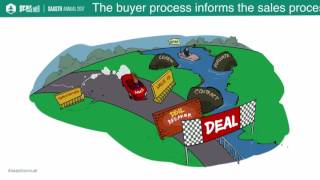
Yeah, we'll get to that. So before I get into it, who has a defined sales process? You've actually got sales stages, exit criteria, quite a few people. All right, put your hands down. I won't point specific people out, but what I would have liked to have asked you is who built it, having researched an ideal customer profile and then interviewed all the companies that have bought from them to understand the buying process first. Almost without exception, every VP of sales that I talk to or CEO of early stage companies goes out and builds a sales process that they want. And I'll give you a specific example. I work with an IoT buildings company, so they build really leading edge stuff for managing all the devices, counting people, the temperature, the lighting, all that sort of carry on in their sales process. The ideal sales process is a bit of discovery, some needs assessment, a demonstration of the platform and then a proposal and then close. That's their sales process. What they learned to their detriment over time was that's not how buyers buy. When you've got a leading edge technology, and many of you do, right, it's not a standard in the industry, yet people don't trust you. So their buying process was all of that plus a pilot. They had to have a pilot and they had to have certain exit criteria and milestones and whatever else. And this company could have accelerated their sales process, reduce their sales cycles and improve their win rates if they'd understood that and just put it in by default, talked about it early. So our image here really is about aligning your buyer process with your sales, your internal sales process. So you have to do the former first. What does it look like? It looks just like a sales process, but the language is all from the customer side. So we might have qualify, for example, they might have compare. At the end of compare, they're going to create shortlist for us, we make shortlists and so forth and so on. So it very much informs our sales process. So a specific action I want you to take when you go back to your organizations is sit down with your head of marketing and head of sales and have this conversation, right? How did we derive our sales process and the stages and the exit criteria? Because oftentimes that's another really important one, isn't it? Right. The exit criteria is all about us and about what we need to accomplish, but actually it should be about facilitating what the buyer needs to accomplish. And this is important because at this early stage, it's your sales operations function, which Rodney's going to talk about in a moment, and the analytics and operations side of it, that instruments to test for this and to make sure we're doing it and to build it into the workflow of the rep. So who do we hire? So remember, we're less than 10 million at this stage. We're over a million. We're hiring two key roles, sales effectiveness or enablement, depending on how you think about it, and operations and analytics. The effectiveness person is going to be the one who is responsible for onboarding your new reps. And for those of you who've done this journey one to ten, you're hiring two or more reps a month. And the quickest way to fail is to overscale. How do you overscale? Because you haven't instrumented in your business to understand what's going on and you haven't enabled those people through good replacement, rigorous onboarding. So you need somebody who understands your product, your market, your company and culture. Where do you find them? Usually within the company. So that's my favorite place to hire. So you'll take one of your existing sales reps who knows all this stuff. They're not going to be a player, they're not going to be a top rep because they're out there making money and they're probably incentivized personally differently. They want to make the big bucks. It's somebody who gets joy from helping others. How do you notice them? They're the person that is sharing email templates with their peers. They're sending it around via the Slack channel. They're sharing their sales presentations, making those available. When I first did this run through with Volney, I had to watch my accent because I was calling them sales decks and he said that sounds rude. But anyway, so they're doing that and so they have the respect of their peers already and that's really important. Don't promote the person that you like but no one else respects because that's not going to get traction. They're not going to know how to architect it. You're going to have to tell them. So it's either your VP of sales who may have done this in the past, who can say, look, this is what a 30, 60, 90 day onboarding is going to look like. Go build this, go build that. They're not going to have that knowledge. Or you get an external advisor to assist you at this stage. And all of this stuff should be informed by the data you're learning in analytics and operations.
So another key person to help out at a million, the sales leader is doing almost everything. By the time you get to near 10 million, the sales leader can't possibly do all of the work that we're talking about here. So frankly, you need an ops person to keep the lights on. You've got a CRM system, you've probably got an entire sales stack at this point. This person's got to keep it running and make sure that the sales train can keep moving. Also doing things like commission calculations, other things that are fundamental core ops functions at this stage. Now, where are you going to find this person? Possibly somebody in your pre sales organization, possibly somebody in finance, maybe somebody in customer success that has a technical bent. But what's important is that, you know, I want to make sure that you don't just hire the first person that seems interested in the technology. You've really got to find out whether this person's internal to the company or external, if they can solve the kind of problems you need solved and if they can do them at the cadence that you need them done. So that third column there suggests that you should come up with some kind of test that helps you understand whether or not this person operationally can kind of keep up with the business. And to Matt's point earlier, these are probably at this point fairly junior people that are going to need a lot of supervision and it would make a lot of sense to give them some sort of or provide them with some kind of advisor so that the sales leader doesn't have to spend all of their time directing their functions.
Yeah, good point. So we made it. We got to 10 million. We're not quite at escape velocity yet, but we're certainly scaling. It's at this point of the business, we're no longer just focusing on repeatability, which was the early phase of our business. Now it's about scaling. Right. You've definitely got venture funding and what we want to do is pour more fuel on the fire, but we don't want to throw ourselves off the rails. So not only do we scale, but we need to have predictability. And in order to do that, we need to build a new management framework or operations engine so they won't get the speed wobbles and fly off. It's at this stage most people end up doing a big hiring run. And you've all read the press. There's been some recently where you have a big round of layoffs because they've Overscaled and that's because they haven't really understood the predictability of their business. Right. They've just been throwing heads in really quickly.
So at this stage of our growth, our operational environment is getting a lot more sophisticated. Earlier on we were very tactical, we were just chasing, we were just going after business. Now you can see we've got a lot of operational functions on the left side of the slide. There's a lot of people oriented functions focused on driving revenue from account reviews to deal reviews to pipeline reviews, territory reviews, all the way up to QBRs and your enablement and ops people are probably helping you or core to your ability to execute these functions. On the right hand side, business processes and analytics around what markets should we be going after, what segments should we be attacking? Do we have the right team to help go after that opportunity as we see it? So we've really got a lot of complexity in the environment. On the left side, if you think about it in a sports analogy, you've got the people, you've got the plays, you've got the players, you got the execution. On the right hand side, it's like the coaching staff trying to figure out are we even on the right playing field.
Nice analogy. So at this point, if we're talking about predictability, we gotta get good at forecasting. I had this drawn, I hope you like it. I've had this experience many times, right? I'm sitting there on the sales manager and somebody's painting me pictures of rainbows and unicorns, trying to divert my attention from the skeletons in the closet, right? Things like pipeline, which is the same pipeline that just keeps shifting, right? Nothing's closing, but my pipeline's full, I've got four times my quota, all that sort of carry on. So we're going to get more sophisticated than this. That and I want to raise a really important point. It's crucial at this stage, it's important early stage. But the CRM industry, of which we were both part, has been responsible for creating a bit of a problem in understanding the difference between pipeline progression and forecast. If you look at many CRMs, what they do is if you put a deal in stage two, it automatically says, oh, that's now at 20% probability that that's not true. If you're at negotiation stage, maybe it's the last stage, you're a long way through the deal, you're at 90% progression, but you could be losing. You might know that you're shortlisted to two and you've got some technical challenges. So you have to separate the two. And I've shown a couple of examples on the right hand side here, depending which CRM you use, you'll have a forecast category. So an action item. If you're not doing it today, I don't care whether you're using Excel or fancy CRM, create a way to understand how far through the deal you are. Measure against that because of course that represents that sales process we talked about. And we have to learn where we're getting stuck. Right. We also have to learn where we're losing. If we're losing at stage three, is that the stage at which we're doing a demo? Are our reps no good at doing demos or are we in the final stage of negotiation? Are we stumbling over our terms or approach to market? Really important, separate the two. Which brings me to coverage. I have a rule. I actually learned it from the person that owned the naked feet, which was it's the 8120 rule. And it's particularly important if you've got a mid market or enterprise business. In those businesses, what most people do is they like to swing for the fences and go after the big deals that are going to get them to their number. And the problem with that is if you miss the deals, you miss your number by a long way. So what I was taught and what's worked well for me over the last 10 or so years is get 80% of a rep or territory number from run rate business. These are the deals that are your average deal size and your average deal value. Right? So if you miss one of those elephants, you're still within striking distance. You can make it up in the next quarter or the next month, whatever the period happens to be. If you get one, then you threw your number and that's what all the reps are there to do. Right. None of the reps that are working for you should be there to make their ote. They should all be trying to get to their accelerators. So remember 81, 20 and there are a couple other points too, right?
Yeah, just your forecast is getting more sophisticated at every milestone in your growth. And just a couple other things here to have a defensible forecast that you can believe in the green column there is really, it's all about are we positioning, are we going after the business in the right, predictable, consistent way? And your enablement person is probably helping you out there. The red bar down below is your process. Are you approaching everything the right way? And your ops person is probably making sure that, for example, if the buyer journey and our sales process are in alignment, then both the customer and we agree that we're in the same place in the sales process.
Absolutely. And speaking of that level of granularity, it's now we need to look at the market more generally and the TAM we're going after or the segments we're going after within that tam. So this slide here is showing you how I might focus my marketing effort on 51 to 100 employee companies at the time, same CIO level, and find that that in fact is my best conversion rate. So it's a collaboration between sales and marketing because it's a matter of which leads are converting best to opportunities, which opportunities are closing best, and what's the average ASP for that segment. That's really important because I've actually seen a few folks do this and they're super excited about their conversion rate. But the ASP is four bucks a month, so we don't want that. So this looks simple, but the complexity behind instrumenting this is where people trip over and we'll talk about the role that you're going to hire for in a moment. But a takeaway, talk to you folks about how you can build this if you're at 10 million going forward, because if you don't, this is where you can find you boxed yourself into a corner not only in terms of a go to market, but also at a product level we could be building for the wrong segment. There we go.
So another example of how your operations are getting more sophisticated and potentially more data driven. You can see here, here's a chart of 5 reps. They don't all ramp at the same rate. We all know that intuitively, but you almost never know why. And maybe your effectiveness person at this point can start to do some analysis and they can track the success of people and the profiles of people that are coming through your onboarding process. And it may be that they can come up with some correlations between who's ramping faster and who's not. For example, maybe it turns out that only people who have sold SaaS are successful in your your environment or have done their own demos or have worked on a monthly cadence. If we know that for a fact, we can inform the recruiting engine to make sure that we're going after and refining our recruiting profile at the same time. We've learned quite a bit about what our people are successful at and we can inform the sales leadership side of the business with here's what we're learning in onboarding, here's what people's strengths are you should make sure you coach them in the areas where they need help, but don't be coaching them in areas where they don't need help.
So to round out the discussion, who are we hiring now? We need to uplevel and it's more than likely that the enablement person you put in place that you promoted from sales is not going to scale to this group. They just don't have the experience. It's at this stage.
Not always.
Not always, sometimes. And at this stage you're really talking about a director level person who's more of the architect as opposed to the the builder. So they probably won't be in their hands on building content necessarily, but they're the person who can build the 30, 60, 90 day program thoughtfully and they start all the way, as Volney said, at the hiring process. So looking at the data that informed who's most successful and why and analyzing the success of those hiring cohorts because you're big enough to do that now, you might have a hiring class of 10 people and watching their progression through, thinking through how do I get them through the 90 days. And then of course, skills reinforcement over time. So that's definitely a more senior person. They've done it before, they've probably worked for a larger organization than yours and they want to get down and dirty and sort of make their name in building something from scratch, put their paw print on a sales academy again, all informed by sales operations.
On the op side, you're also looking for a director level person probably at this stage of your growth. And if the initial person wasn't able to grow and scale with the job, you're looking probably on the outside. And it's real tempting to look for real detailed technical skills because certainly they're important. However, at this level, your ops leader is actually their relationship skills and their ability to go arbitrage between different stakeholder groups in the company is actually almost more important than their technical skills. So you need to be able to go to finance and figure out what they need. You need to make sure that customer success is not taking over your CRM environment and and marketing as well. So at this stage it's important to get some real leadership helping you manage the business as opposed to just the pure technical skills.
Right. So whirlwind in 20 minutes. I want to reinforce something at the end. So from the horrible experience I had looking at feet in 2007, I learned some stuff, partnered with sales operations, really got to understand that function. In 2012, I joined Yammer, some of whom you'll be familiar with. And they exited for $1.2 billion to Microsoft. And I would say that one reason for that, one part of it was they built a very, very scalable, predictable engine. So I would encourage all of you to invest early in these two functions. And Volney and I are going to be over at the chorus booth right now for the next half hour, so if you want to chat more about ops and get some more detail, happy to. And I'll finally close with Go Kiwis. Good to see you flying.










