CRO Confidential LIVE with Sam Blond Founders Fund and Gong’s SVP Sales
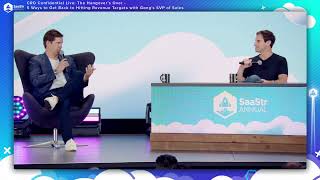
Live CRO-focused conversation (Sam Blond, Founders Fund; Jameson Young, Gong) about five tactical things to regain revenue growth: (1) reassert effort expectations (work intensity), (2) diagnose and fix the funnel bottleneck—often top-of-funnel, (3) use creative demand-gen to stand out (direct mail, unconventional ads, referral mechanics), (4) invest in relationships and onsite visits to improve win/renewal rates, and (5) align incentives (employee and customer) to desired outcomes. Includes examples from Brex, Rippling, and Zenefits and an audience Q&A on attribution and urgency.
Chapters
Please welcome to the stage sam blonde, partner at founders fund and former CRO rex and jameson young, svp sales at gong.
All right, all right, let's do this.
Excited to be here. Before we jump in, huge shout out and thank you to the team at Saster, Jason and Amelia and Caitlin and everyone else. There's a lot of effort that goes into these incredible conferences and they just keep getting bigger and better each each time in each year. So delighted to be here and happy to share the stage with my close friend Jameson. As the introduction alluded to, my name's Sam Blond. I'm currently a partner at Founders Fund. Most recently, I was CRO at Brecks. I was there for a little over four years. My attire, I think matches the vc. Jameson is an SVP of sales with that fancy looking sales leader jacket on. We're close friends and Jameson now SVP of Sales at Gong. So happy to have you here. For now. The second time around on this CRO Confidential podcast series, we'll jump right into.
How much thought I put into what I was going to wear today. You'd feel really bad about that comment you just made.
You just represent the sales leader with the jacket. All right, so we're today going to talk about the five things that we can do to get back to growing and hitting revenue targets. The goal here is we want to be really specific with five things that you can do and then we also want to be very tactical with how to accomplish those five things. Before we jump in, we're going to do a bit of context setting with where are we? So the first two sort of seem obvious. We had a party. This was 2020 and 2021, where crazy valuations, growth, spending money and more. We had a hangover which was probably 2022 and maybe the first half of this year. I think what's less obvious or less talked about is where we are today, which is this concept of returning to normal. And I'm seeing this a number of data points in the portfolio. Investing is coming back, public markets have returned. And so given this context, we wanted to spend today's time talking about the things that you can do to start getting back to hitting revenue targets. Is this in line with sort of what you've experienced at Gong? And any thoughts there?
Yeah, yeah, 100%. I mean, I think the last time we sat down together was December of last year, which was like kind of right in the middle of the hangover. And I mean, we've certainly seen significant amount of rebound and I think we can Kind of see it across the, you know, our company as well as Pearset.
Awesome. Okay, so given this context, let's jump right in. Number one thing that we can do to get back to hitting revenue targets. All right, the days of work life balance are over and the emphasis here is on work life with little work in big life. And sort of mapping back to the previous slide, there was this period of time that was sort of the party where people were people in sales specifically, but I think more broadly within the company were able to make twice as much money and work half as hard. And this was when everyone went remote. People were working from the beaches of Cabo and life was good, companies were growing, and so it didn't really matter if you were working half as hard. I think during this hangover phase, one thing happened and one thing didn't change. The one thing that changed was people stopped making as much money, especially on the sales side. So if we think about sort of mid 2022 to early 2023, people weren't making as much money on the quota and compensation side, but. But they were still working half as hard. And so the reality is startups are really hard. Jameson, just pressure test if this resonates with you and then more specifically we'll get into how do we get back to working hard.
I mean, Yeah, I think 100%, right. Like we went, we. There was. I mean, last time we spoke, right, about six months ago, we were talking a lot about right now. It's hard right now, the macroeconomics, tough. Your buyers changed and you need to focus on the inputs. You need to focus on, you know, making sure people feel like they're accomplishing something, even though the revenue might not be there. And I think that's changed significantly. Right. Suddenly now we're back to looking. The expectation is revenue. It's not just, are you trying your hardest? It's are you trying your hardest and is it actually working out and turning into the numbers we need it to? And I don't think that was the case six months ago.
And are you. How do you approach the sort of expectation setting or tracking of effort?
I mean, I'm a bit gong, so I'm kind of unique in the sense that we have a lot of visibility, right? You know, how much activity people are doing on a daily basis. You have a general sense of that type of thing. But I think some of it's just like the expectation you set a. The minute they walk in the door. Every single onboarding class, I worry about, right, the fact that when we were hiring, when we were 50 people, it was easy to hire people that wanted to fight. It was easy to hire people that wanted to push. And when you start to get a little bit bigger and people start to recognize your name, you might attract a different set of talent. And so I think early, it's about from day one, setting the right level of expectation, and I think even now resetting expectation, we were in a world where we were starting to measure effort, we were stopping and measuring revenue. We're now getting back to that other world. I think you need to tell your team that you need to set expectations of how much they're supposed to be in the office, how much activity you expect them to do. It's on you if you don't tell them. You can't expect people to change their behavior without you telling them you're expecting them to.
Yeah. A couple things come to mind. One is that historically this concept of micromanagement and measuring how hard people were working in an in office environment, you just did that organically. It was obvious who was coming into the office early, it was obvious who was leaving the office late. It was obvious what people were doing when they were in the office, if they were at the ping pong table or if they were at their desk in this remote environment, that what I'll call advantage has sort of dissipated or disappeared. The two things that come to mind on how I approach this topic, number one, is just expectation setting and reinforcement. Expectation setting from as early as the very first interviews, this job isn't for everyone. We are a technology startup and in order to be as successful as we expect we're going to be, it's going to require a lot of hard work. And what that means is for, for many people, pretty long hours. And so if that isn't something that you're able to do or isn't something that you're looking for, this just might not be the right fit. And then I continue to reinforce that throughout everyone's tenure within the company, we talk about what people can do to progress their careers within the environment. And we talk about performance being of course, extremely important. But there are also things like effort and attitude because teams are going to emulate the things that they see in their leaders. And if folks aren't working hard, if they're not being positive, positive, then their teams will sort of emulate that type of behavior. So again, it's like expectation setting, constant reinforcement. And then the second thing that comes to mind is when I am managing someone, I oftentimes will just sort of categorize them based off of their performance. And if there are people that are performing below average and sales in particular is very objective, you can see the leaderboard and the folks sort of definitionally that are below 50%, they are performing below average. They're on the bottom half of the team. I want to understand, and they should want to understand why they are there. And so I'll just go a layer deeper with trying to diagnose what are the things that the people that are performing doing that you might not be doing. And it oftentimes will fall into one of two buckets. It's either there's not the effort being put forth or there are very specific tactical things you are putting forth the effort. But there are some areas of improvement that we can work on.
Well, it's really a quadrant, right? I mean it's like you've got a grid and you've got the folks that are doing a bunch and it's working really well. And those are your top performers and the people that are at 200% of their number or whatever they're at. You've got people that are doing a bunch and it's not working out and they're the ones you invest in just try to make it so that that activity is turning into something real. And then there's folks that are, you know, it's working out, but they're doing very little. And if you can get them to do a little bit more, right, you set expectations of, you know, what is reasonable as far as the amount of work you're supposed to be doing, you can get them in the high performer bucket. And then there's a bunch of folks in the bottom left that aren't doing the work and it's not working out. And then it's time for a tough conversation.
Yeah, that's right. I think as you described it, that fourth quadrant which is underperforming and not putting in the effort. For me, this is like a one time conversation and if things don't change there, then it's not the right place.
And I think that one time conversations changes by company. Like some people are doing do coaching plans or performance plans, right? With the intention, not trying to get somebody out, but to be like, hey look, this is what we have to do. This is the time when we have to do it and do you want to do it or not? And it's amazing how much you see somebody's behavior change. I mean, I think most people wish they didn't. You didn't need that kick in the ass. Right. But sometimes people do and sometimes people change drastically. And we've had some top performers that were on a plan at one point, and now they're at the top of the sales board and they just needed that push.
All right, so number one thing that we can start doing today, startups are hard. We need to get back to working hard. Similar to the 2010-2020 days, where it required a lot of effort to build a really big business. The next thing, I've talked a little bit about this in a, I think workshop Wednesday is what they call it at Saster, and it's this concept of diagnosing the bottleneck to growing faster and fixing it. And what I mean here is if you think about the customer acquisition funnel and you have the very top of the funnel, the middle of the funnel, and then the bottom of the, there is likely a constraint to growing faster. And it's oftentimes diagnosed or misdiagnosed as the middle of the funnel or the bottom of the funnel. And a good example of what I mean by this is, you know, we're early September. If I talk to a founder or a sales leader about how they performed in August, you know, we finished at 90% of the number. Okay, well, like, what happened? Why didn't we get to 100%? Well, there's like a deal or two that pushed and had that deal or two closed. We're at, you know, 110, 120% of our number. And so most folks sort of gravitate to or diagnose the bottleneck to growing faster being the middle or the bottom of the funnel, that they aren't converting deals. And in four out of five instances, the real diagnosis is that it's actually the top of the funnel.
Yeah, I mean, those two swing deals should be putting you to your best case. Right. Not bringing you to your number, ideally.
Well, yeah, I think, you know, if one or two deals pushed, I think in a perfect world, you actually have four or five deals and you only really need to close one of them in order to hit your number. And so there's. Let's get into sort of like how to address this. But thinking about this, conceptually, you have this customer funnel and then what you want to do is you want to look at your employee resources. So where do the people map to that customer funnel? You wanna think about where is the focus? And so again, if you diagnose the problem as top of the funnel, which I would suggest four out of five Companies. That is the problem. If you then map your employees and where your focus is, what I oftentimes see is more people are focused on the middle and bottom of the funnel and so these resources aren't mapping to where the bottleneck is. So before I get into some ideas on solutions, just see if that resonates for you and sort of how you approach this.
I mean I think that's definitely the case. Right. I mean I think a lot of people over hired over the last couple of years and is somewhat right sized but oftentimes demand engine is still not keeping up with the size of their sales team. And if you just look at how many salespeople they have versus how many marketing people have versus how many CS folks they have, you'll see it weighted away from pipegen. And so you can either start to hire people into those roles or you can start to shift the focus of your existing roles to care a lot more about pipegen.
Makes sense. I think so just conceptually, I think the process that you want to go through now and maybe on a monthly or quarterly basis is trying to diagnose the bottleneck to growing faster. If it is top of the funnel, apply pressure there both in the terms of resources so people and also focus until you fix it and it moves somewhere else and then celebrate that and do the same process all over.
Well, and I think the people one's obvious, right? I think the one of like okay, hire more people to do it. I think the one that's less obvious is like how do you get your existing people to pay attention to another point of the funnel? Right. Like how do you get your CS folks to pay attention to pipegen? Right. Referrals or you know CSPLS is what we call them or CSQLs. Excuse me but like you can take your existing resources that are a different part of the business and get them focused with. We talk about incentives later but with the right incentives, with the right just spirit of their job and helping them understand where the problem is, where you need their help.
Yep.
It doesn't have to be hiring more people or different people.
That's right. So let's, let's go one layer deeper on this demand gen example and then we're actually going to talk about some specific types of campaigns within demand gen. But if you diagnose the bottle as we need more opportunities, that is the biggest bottleneck to growing faster. You have this existing team. Some folks are obvious that they are focused on this problem. It's gonna be marketing and it's gonna be your SDRs. The next thing you wanna do is you wanna look at your AES and are these AES focused on sourcing and generating their own opportunities? If they aren't, you need to start encouraging and emphasizing that. It even goes further down the funnel where if you have folks that are servicing your customers, you can actually incentivize and create some focus for them to start generating additional demand by things like customer referrals. And so that exists within the go to market organization, focusing a bit on fixing this bottleneck regardless of where they sort of sit in the customer funnel.
I also think the earlier you are in your company, the more it is important to. It's really hard to make a sales team that's not used to doing any kind of outbounding or prospecting start to do it suddenly. Right. So the earlier you can instill that in the team that that is something you're going to need to do whether you need it or not. Right. Even if like in the world of zenefits we were overloaded with pipeline, but the minute we started running out of pipeline, right. And we hit another bottleneck, it was really hard to make that pivot. And I think in retrospect I'm like, man, I wish we would have at least had us do something early on so it wasn't completely foreign behavior.
Yeah, I agree. I think early on establishing some rigor around sales folks doing outbound is universally.
Applicable and just controlling your own pipeline. Right.
So all right, let's keep going. So just continuing along this talk track, diagnosing the bottleneck oftentimes the bottleneck being at the top of the funnel. Let's talk about some demand gen been effective that we've seen in different roles that we've been in. So the slide here, it just talks about this concept of getting creative and standing out. And every time that I have experienced a campaign or a channel that has heavily influenced demand gen, it has been through this concept of thinking outside the box, being creative and standing out. And I'll give several examples. But before I go into mine, I want to see if this conceptually resonates with you. And then if you have any examples at GONG or otherwise that come to mind of specific things that you have done around being creative standing out from a demand gen standpoint, maybe folks can make it their own.
Yeah, I mean I think like we live in a world now where it is so easy to send messages to people. I've got like probably 47,000 on read emails. All of them are like how, you know, hope you're well, and then asking me for 15 minutes of my time and they're sent faster than I can delete. And so you're just in, you know, you're in the noise. It feels like you're doing something. You're running on, you're running, but you're not going anywhere. Right. It's like, I'm going to send more, I'm going to send more, I'm going to send more. It just doesn't work. Whereas, you know, a guy sent me a coconut in the mail a week ago, showed up at my house trying to get an interview and he had like this pun about, you know, you're nuts if you don't talk to me. I forget what it was or something like that. And of course the, the guy gets a phone call, right? And I mean, I think that's what it's all about. It's like, how do you look different than everybody else? And like, you can keep spending more and more and more energy doing things that have a 3% reply rate, but it's just not going to help you.
Yeah, I think you, you nailed what I'm trying to get at, which is there are these status quo or conventional tactics to generate demand. The most popular one that you just described is you buy email sequencing tool. You buy a tool that provides you some contact, you have a CRM, you just start blasting the universe with some five email sequence that 99.9% of the time goes directly in the archive inbox or whatever.
So direct mail campaigns, something we do ourselves and it works really, really well. We've been consistently doing them. Every time we do them, we get a significant boost. We change the idea every time. But it is something that is continuously working for us. And I think it's not like everything you do could be direct mail. You still need to do something through email, you need to do something, something through LinkedIn. But I think it's about thinking about the edge that makes you stand out when you're doing that. I mean, at gong, we have data that people don't have access to, so you can start to tell people things about their own business or about other businesses that are interesting. So suddenly, yeah, maybe you're resorting to a medium that they're used to, but you look different.
So yeah, I think maybe, maybe tactically the way that I would approach this is just because this scenario that I just described with the way most people do outbound, it doesn't mean that outbound doesn't work. It means Outbound, the conventional way isn't super effective. And I think you can apply that to most demand gen strategies. That can be an events strategy, that can be your outbound strategy, that can be your customer marketing strategy. I'll give a couple examples. And you know, I regularly do Saster talks, so I don't want to repeat over and over again what they are. But the outbound one, Brex sort of famously did a champagne campaign where we were sending bottles of champagne as part of Outbound crazy high reply rates. With that when most folks were going paid online advertising, Brex did paid offline advertising. We had a geographically concentrated customer market. It was San Francisco. We bought all the billboards in San Francisco and then we were really targeted with who we were sending outbound emails to. Because the folks that would walk past those billboards at a much higher probability of replying to our outbound than somebody in New York who had never heard of the business. I'm going to give one more example. I'm on the board at Rippling. The conventional thing to do with like LinkedIn paid advertising is you just pay LinkedIn and they surface an ad based off of some ICP that you want to surface the ad to. And Rippling does this really creative strategy where when you are onboarded by one of their customers, so part of their product is onboarding. And when a new hire goes through this onboarding process, Rippling sends them an NPS survey. Anybody that marks that survey a 9 or a 10, they follow up with an email saying, we're delighted that you had a great experience. If you're willing to post about it on LinkedIn, we will send you a 25 gift card as a thank you. Just use hashtag Rippling, hashtag sponsored. And so there are hundreds if not thousands of these LinkedIn posts that are sort of organic from new hire employees talking about this awesome experience that they had onboarding on Rippling.
Well, that one's cool. It's a nuance that Rippling has where they're reaching a specific person right. During an onboarding program. So it's like thinking about what do you have that's unique against everybody else that's around you and how do you leverage it?
Yeah, I think they probably did this process which I'd recommend for everyone. It's like online paid advertising makes sense. How can we do online paid advertising that is different from the status quo and will be really effective? And in their case, they have. When these people do I join this new company, there are hundreds of likes because you think about when you see.
Somebody that posts about everyone's congratulations, welcome.
To the all this engagement and that $25 from this, what's seemingly an organic post from, you know, new hire, that's a far more effective $25 than you're ever going to get by paying LinkedIn directly $25 to surface and add to your ICP. And so these stories aren't meant to be things that you just mimic directly. Don't send everybody bottles of champagne. Don't buy billboards.
It wouldn't work if we all do it. That's the problem, hon.
It becomes unconventional. But. But do try and find something that is differentiated contrarian. However you want to approach it, get creative, think outside the box and.
And likely you have to change it every quarter or every two quarters. Right. Because the minute it starts working, you know it's going to stop working. So.
That's right. Great. Let's. Let's continue along here. So relationships matter. This is another one that maps back to the initial framing slide a bit in that sort of when mid-2020 happened and everybody went remote, this thing also happened where visiting customers in person went to zero. You weren't going to meet prospects in person to try and sell to them. You weren't going to meet customers in person before their renewal to try and develop a relationship with them. But it does seem to sort of not return to the way that it used to have been historically. And so the sort of framing here, relationships matter. Much like the last slide, you can almost stand out by returning just doing.
Something you used to do. Right. All the time. I mean, for us, a lot of our deals, we close with pilots. We give people the products for a little while. It used to be if over a certain size, we would always go visit customers. And we just stopped doing it and we brought it back, you know, since kind of Covid's all calmed down. I mean, our win rates night and day different and it's just us doing something that we used to do, which simple but. And I almost think it goes back to the first slide, which is like it's a lot of work to get on a plane and go somewhere for two days. And people are used to working in their own office. So it's a mindset shift. But if you do it well, the conversion rates are insane.
Yeah. A couple things come to mind here. When we measured conversion rates at Brex by whether or not we visited the customer in person, and I think we had like 15 to 20% conversion rates, that was sort of the norm where we didn't visit a customer and when we visited a customer they 3x so they went like 45 to 60% depending on where they sort of originally started.
Applies to customers, applies to prospects. And I think the other thing is if they don't want to meet you, then you've got, you know, you've had a massive red flag in your deal. Right. It's like, it's like an early warning sign, whether it's a renewal, whether it's whatever that tells you something in itself. So even the act of doing it, whether you get out there or not is going to tell you something.
Yeah. So visit your prospects for deal sizes that are large enough, visit your customers and you will see renewal rates and increases improve in the customers that you visit. The one other thing that I'll flag, you talked about the coconut thing, which made me think of something. So I try and help startups pretty regularly, whether it's with recruiting a new hire, send them an ae, send them a VP of sales, whatever it is, or just take a call and provide some advice. And the sort of norm standard, I almost always get an email that's like, you know, thank you so much, really appreciate the referral or the advice, whatever the thing might be. I can remember very specifically when I received thank yous that were the non standard outside, just the sort of like email thank you, somebody maybe sent me a bottle of wine, somebody sent me a handwritten thank you note.
You're just trying to get presents right now, Is that what's going on?
You got. But genuinely like it's happened maybe on one or two hands, like the number of times that I have received a thank you, handwritten note, a thank you, bottle of wine, whatever it is, and it just so positively reinforces that behavior. I want to help the people that go outside of their way with that type of a gesture. And so applying that to businesses, if you see someone that posts positively about your company on LinkedIn or Twitter, send them a handwritten thank you note. You can even automate this process. But like send them a thank you, don't send them a thank you email because they get thank you emails all the time. Send them a handwritten thank you note and that will encourage more of that type of behavior. Somebody sends you a customer referral, reinforce that behavior by doing something different than a thank you email. And it's all like, you know, back to this concept of relationships mattering.
Jumping back to the on site thing we were just talking about, I think the number one thing you hear from your team. The minute you go up back to them and you're like, hey, like, get in front of customers, get in front of customers. You're going to hear them say something like, well, no one's in an office. Or they're all a remote company and they're in, you know, the exact same to meet with are in five different places. How do you imagine handling that?
Well, I think it depends on the scenario. But for many folks that are remote, if you think about a deal and let's say it's a big deal, enterprise deal, there are several stakeholders. You sort of map out which different stakeholder fits which profile. So maybe you've got a champion slash decision maker. There's somebody that you have the closest relationship with as part of this evaluation. They live somewhere and you can reach out to this. Regardless of whether you're meeting them in an office with everybody else that's evaluating this product. You can suggest, hey, like, would love to spend more time, meet you in person, take you to dinner. Are you around in the next couple weeks? I'll fly to Chicago, would love to take you to dinner. That's how I would approach the sort of in cycle or prospect type scenario.
The crazy part is we all used to be doing this and now, yeah, it's just kind of shut off.
But anyway, yeah. And to your point, if, if the person is reluctant to do that, I think it's a sign that like you, you actually might be behind in the deal. So you're still learning 100%. All right, let's continue along. I think that this is the fifth of five tactical things that you can do to get back to hitting revenue targets. So I'll frame this when I think about the two most impactful things that I have done at Brexit, Zenefits, at companies that I've been at, companies that I've sort of advised for and worked with. The top two, number one is influenced demand gen or top of the funnel. This concept of if we're able to double leads going into next month and everything else remains constant, we have just doubled sales. That's a lot easier to do than something like doubling conversion rates through a more sophisticated discovery process or whatever you approach it with with. The second thing is around getting incentives correct. And this can be both internal incentives for employees, can also be external incentives for customers. But would love to hear what comes to mind when you hear this and then I have some examples as well.
Yeah, I mean, I think you said the first thing that comes to mind, which is I think the Minute you say incentive, I think people think salespeople. And you're right, incentive for salespeople, very important. But incentivization across the entire business is where I'd be focusing. You can incentivize customers. There are things that cost your customers nothing, case studies, referrals, et cetera, and tying those to the things that they want, right, Discounts, et cetera. So I mean, thinking about kind of every interaction you're having and how do you make sure you're incentivizing the behavior that you want to come out of it. We talked about CS as well, right? Incentivizing CS to help with referrals. So there's things that cost nothing to somebody else but mean a lot to you. And how do you identify those and make them part of the process?
Yeah, I agree totally on customer incentives. We were at Zenefits together. We had a really successful customer referral program and it was successful entirely because of the incentive. There were customers that we had marked in our CRM as like red with high risk of churning. And they were referring customers because the incentive program was correct. So I won't even describe what it was because it's not one size fits all. But that's an example of the type of thing that an incentive, correct incentive can drive behavior. I'll take the sort of like internal angle on this one. There are a couple that come to mind. At Brex for AES, we started incentivizing people based off of logo acquisition. We wanted to increase market share. We wanted a specific market share of startup customers that were on Brex. And we believed that customers would organically migrate their card spend once they had been approved and activated on Brex. And in practice that didn't happen. And so we had a bunch of customers that were activating and not enough folks that were migrating their card spend and generating revenue. So we switched the incentive to basically top line just revenue card spend. And what that did was people started migrating their card spend much faster. Like lo and behold, sort of makes sense. Magic. There was a negative consequence which was Brex provides a rebate on card spend. And we allowed reps to go up to a certain threshold and again, lo and behold, basically everybody went right up to the threshold which hurt the gross margins of the revenue. And we then changed it again to a gross profit based incentive. And again like discounts or not discounts, which is effectively discount, but rebates started coming way down and gross profit started coming way up.
I mean, I think you're hitting on something else Here, right. Which is like this isn't like you said it and then forget it and then come back. This is a constantly changing thing. If like your renewal rates are significantly higher when auto renew is still in the contract, then incentivize that to happen. Right? But look at the things that are in your business that are going the wrong direction. Figure out how you shift incentive to make everybody care about it the way that you care about it.
And I think the one that is almost universally applicable because what I just described was sort of a very Brex specific incentive where interchanges the revenue and there's a rebate that. But there is as you have employees focused more on the top of the funnel. And so this can be marketing, this can be SDR playing with incentives. There I have seen have huge returns and I think most folks default to sort of an input metric to revenue.
You're saying like meetings or something like that or sdr.
That's right. So SDRS oftentimes are gonna be something like number of sales, qualified opportunities. Marketing folks oftentimes are gonna be MQLs or SQLs or some like pipeline, some metric that is a precursor to revenue. When I have toyed with those, the result oftentimes is what I actually want to drive towards. And so for sdr, if you actually do want more meetings, if you believe that you have and there's a point.
In time, right at the very beginning of Gong, we just wanted to talk to anybody. It was like, let's just get you on the phone. You have no idea what we do. This category doesn't exist yet. Like great, like let's talk. But obviously as the, as the company has changed and scaled, we have a much more specific person we want to talk to. And we don't just want to talk to somebody. Right. We want to close revenue.
So that's right. I think, you know, maybe referencing back to the beginning of this slide where if you are very top of funnel constrained, you actually do want more meetings and you're not hyper focused on the quality or conversion rates of those meetings. It actually may make sense to incentivize SDR's top of the funnel folks on generating meetings because that's the outcome that you want as companies mature. The experience that I had at Brex and the experience that I'm having in some portfolio companies is that if you incentivize revenue, which is sort of meetings that ultimately convert to being customers, the result is more revenue more times than not.
Well, you're tying them to the thing that you care about at the end of the day. Right. Like, I mean, I think the hard part though is, and I'm curious how you handle this, which is when you have a really long sales cycle and you don't give, you know, SDR's immediate gratification to that revenue. Right. Do you think it still drives the right behavior?
Well, look, I think like many things, it's not one size fits all. And you're right in that the longer sales cycle, I think the more you want to incentivize something that is either like meetings or reaching a certain stage within the pipeline just to make sure.
It'S a clear stage. Right. Because all you end up doing otherwise you start putting pressure on your AES to bring it to some random stage that, that they may or may not care about. Right. So like did they start a pilot? Did they start. It has to be very clear if it hit or didn't hit or you're just creating a bunch of internal friction in the business.
That's right. And you can also do a combination. So you can say, you know, some percentage of quota is on sales qualified opportunity, some percentage of quota is on actual revenue. I do like, simpler is generally better. But I remember just going back to the change that we made here, which was specifically changing SDRs from a sales qualified opportunity quota and commission plan to a revenue based quota and commission plan. The conversations that we were having were okay, but like the SDR doesn't have control over the meeting once it's in the AES hands. And so what happens if the SDR is paired with a less good AE and they are sort of penalized from the AE that doesn't convert them. There is the like time to gratification thing where it was, you know, if they set up a meeting and it closes 60 days later, they're not even like, remember that meeting that they set up? And the way that we approach the decision, which is the way that I actually approach most decisions, is first and foremost, we are going to do what we believe will generate the most revenue for the business. And there may be sort of second order consequences to that decision like the ones that I just described.
The crazy part is if you think about the second order consequences, they're all actually good for you. Right? So like if the SDR wants the meeting to go to the rep, that's more likely to close it. Like that's just gonna funnel more leads to your best performers. And so yes, you don't want that to happen. You still want it to be even. But even if they are trying to like twist the system, it actually still twists the system in your favor.
Entirely possible, I think just. Just sort of. And we made this change. A couple things happened. We made this change that we expected, especially from the SDR leader. We expected a lot of like, blowback around this change for the reasons that we mentioned. And what happened in practice was SDR started generating way more revenue. The average the ACV of an SDR generated customer went 3x about 30 days after we made the change. And so the productivity of SDRs, the efficiency, like every metric, just improved dramatically. And SDR started making a bunch more.
Money because the best SDRs probably made a bunch more money too, which is the best part about the whole thing. Right? You didn't have a bunch of people that were making meetings that didn't go anywhere wasting the entire business's time unintentionally.
So you spent a bunch of time on this specific example. But I think it helps reinforce the broader topic, which is show me the incentive. I'll show you the outcome. And Jameson, to your point, these should evolve over time. And so I don't know the exact right cadence, whether it's like once a quarter, but every once in a while, you should just sort of make sure that your incentives are designed correctly around the business outcome you are looking to drive at that point in time.
Well, I think it's probably not once a quarter because I think you can't change people's comp once a quarter, but I think every six months, every annually, at least. I think you should be looking at it makes sense.
All right, quick recap and then we'll jump into Q and A. So we wanted to talk about five things that you can start doing today to get back to hitting revenue targets. The days of work life balance are over. So how to incentivize effort within your employee base. The next one is around diagnosing the bottleneck to growing faster and fixing it. So if top of the funnel is the constraint to growth, make sure that most of your resources and focus are on the top of the funnel. Get creative and stand out. This is specific with demand gen. Have a meeting whiteboard session, nine o' clock at night on a Monday. We're sponsoring Saster this year. What can we do to make the most out of this Saster sponsorship that is gonna be different from what everybody else is doing? And it's not raffle an iPad. It's not give out like, you know, that have our logos relationships matter. Go visit your customers, Go visit your prospects. Handwritten thank you notes when people do things that are beneficial to your business. And then lastly, show me the incentive. I'll show you the outcome. We just spent a bunch of time on it, so don't need to reinforce it with the recap. But incentives really drive behavior both with employ and customers.
100%.
Great. Let's open it up to questions. I think we have seven and a half minutes left and mics may be out in the center aisle.
They're in the middle here.
Hey, thank you so much for the chat. Really insightful. I mean, two quick questions if I can. So one is, how do you think about sales attribution? Because sometimes you want to double down on things that are working, but it's hard to know what's working. You know, is it like this marketing campaign that we launched? Is it like the outbound thing? Is it the combination of all? So, like, how do you think about sales attribution? And then the second thing is like, how do you bring urgency into the deal without giving discounts? Or like huge discounts? I guess? Yeah. Thank you.
Okay, why don't we start with the urgency and then the attribution? So you go ahead.
I mean, I think I'm afraid I'm going to give an obvious answer, but I'll do it anyway. Which is like the way you drive urgency in a deal is you make it feel urgent to the other person. When you're starting to use discounts and things like that, you're creating false urgency. And so ideally, if you're selling somebody something, you understand what's going on in their business enough that you could be like, look, the opportunity cost of you not doing this for another month means this to you. Now, you can't always do that. Maybe you don't always do that. It's hard to do that unless you have a really good rep. And so then you can start going into other things that are things like, you know, commercial incentives, et cetera. But my answer would be like, that's the really lazy way to try to drive it. I think the other one I'd say too is if you've built the right level of relationship, people will do it for you because they like you or they want to help you. And I think that's probably above commercial incentive as well. But again, those first two, you need to have the right level of sales rep that has the right focus and understands your customer in the right ways.
But I'm going to take the, the other angle here and say I have never seen anything drive urgency like financial incentives. And so I'll just give one quick story though because I think the really thoughtful question was around like, how do we not provide heavy discounts? So I think there are two things that come to mind. One is you can price your product higher and I actually like to be a higher priced product in a given.
Marketplace because the, well, you can't be better and cheaper. Right. It doesn't make any sense. So if you're more expensive expensive, it's implied that you're better.
That's right. So I actually like to be the high priced product in a competitive landscape and then having the ability to discount off of that higher price with the sort of psychological implication around that being we are a higher priced product because we are the premium provider in the space. And then the second thing that comes to mind is this was Zenefit specifically, but I've seen it work super effectively at other companies.
Well, yeah, I mean I think what you're about to get to is like if. So I'll caveat. Like my answer is if you are going to pricing, there are things that people hate paying for and you can make it so that it goes back to incentivization. Right. Like you can make it so that the things that you're trying to optimize for are not the things that they're going after to negotiate. Right. Like you don't want to lose per seat price but you're comfortable losing a one time price.
That's right. So both at Zenefits and at other companies that I've, I've worked closely with, we have it's in if it's. And with these companies this like concept of implementation was a very heavy lift. And we had dedicated implementation department that focused on migrating data from different systems to create the product that ultimately was delivered to the customer. So there was a real implementation that had real direct costs to the business. And rather than discount the product directly to Jameson's point, because you, you would rather keep the sort of high licensing fees that are recurring that are a direct input to how your business will be valued, you can waive or discount an implementation fee so long as the implementation is real and you are doing real things to implement a customer, you.
Want to be able to fake random costs.
Yeah. Like flipping a switch and turning an account on. You don't want to create an implementation fee around that. But you know, that's like a creative way of providing a price discount, but off of a different type of price.
Well, I mean we did this at Zenefits and We moved a sales cycle that was completely uncontrollable. Well, you did, I should say, to something that was very regular, very controllable, and we can actually drive and forecast the business because of.
That's right. The implementation fee of Zenefits. It drove so many decisions. Okay, let's move on to the attribution.
Yeah, you start that one out.
Well, so if my interpretation of the question is I could go different ways. Well, I'll just do both. So if the question was in the early days, how do we know what is working and what's not? Is that the question? Or is it more like, how do you design an attribution model?
I can come back, but, like, honestly, like, when you have, like, word of mouth or these kind of things, like, you don't really know where they're coming from. And like, they can tell you, like, oh, because, like, I heard about you, like, somewhere. But perhaps it was because, like, you know, there was like this big thing that they saw on LinkedIn, but also, you know, there was this huge thing that they saw in the airport. And also that then there was this output campaign, like, where do you double down?
Yeah. So in my experience, and love to hear your thoughts on this too. In my experience in the early days, you just know, like, it's intuitive. And I'll give a couple specific examples and the ones that I've talked about today day, when we put up billboards, when any person got on the phone with somebody from San Francisco, they would just say, we see your billboards everywhere. Like, we sort of became famous for all of the billboards, the champagne bottles. Like, we were able to track that campaign, specifically reply rates for that campaign compared to reply rates when we don't send something. And so you just sort of like, intuitively know early on and you don't need to be incredibly scientific about, you know, where you're deploying dollars. It's just like, if this seems to, let's keep doing it. And then over time, I've had the fortune of working with really strong revenue operations, and revenue operations has owned this, like, attribution category. And so maybe the takeaway from that specific comment is, in my experience, I have seen companies wait too long to invest in revenue operations and not invest enough enough because they just own and sort of solve for the types of things like what we're describing.
Well, I think the other takeaway too is, like, the examples you gave where you know what it came from were the creative examples that you did. Right. If you're just doing the same old Things. And it's LinkedIn ads and it's Google, you know, AdWords, et cetera, et cetera, et cetera. It might be very hard to figure out attribution, but if you're doing things that are unique, you're going to find out because your customers are going to react to them in a way that's going to allow you to find out. So it's probably harder to cut through the noise if you're doing the more standard thing.
Excellent question. Thank you. And I think, unfortunately, we are we're count down to 20 seconds. So I don't think that we have enough time for others. So I apologize to the folks that are in line. But thank you so much for the attending attending the session. Jameson, awesome to hang out with you again.
See you again.
Take care.
Appreciate it. Sa.
Sam.










