Customer-First: The Path to Hypergrowth w/ Medallia Strikedeck CPO & Hashi Corp VP, Customer Success
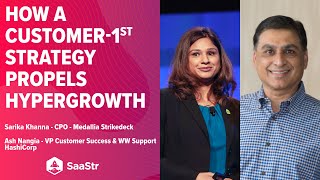
Ash Nangia, head of customer success at HashiCorp, talks with Sarika Khanna about how the company built a layered customer success organization across support, account management, and services to fuel rapid growth. HashiCorp tracks NPS, net expansion, and renewal rates to manage customer health and drive retention.
Chapters
Everyone, and welcome to this very exciting session today on how a first customer first strategy is really a key component and if not the most important one, in getting your organization in hyper growth mode. So let me start with introductions first and then we'll go into amazing content. My name is Sarika Khanna. I'm the Chief Product Officer at Medallia. Medallia is a company that's a customer experience platform. Medallia lets you capture all sorts of signals that your customers are emitting each day. Whether they're behavioral signals, digital signals, make sense out of all those signals. Using our AI technology, we route all those insights to the right people in the organization across all levels to enable action in real time to save customers. Understand your customers. As you know, customer is the focus, especially in these unprecedented times. That's what Medallia does. Now today I am super excited to talk to Ash Nangia, who is the head of Customer success at Hashicorp. Now let's talk about Hashicorp. Hashicorp is an amazing success story of a company that has grown to 5 billion 5 billion in valuation and they have been doubling their customers and revenue for the past straight four years. Now. How do you get there? That is super impressive growth. So today what we're going to do is talk to Ash and understand not only what Hashicorp does, but what's really the secret sauce behind all of this. We want to understand a value unicorn. What did they do to get this kind of a growth? And what are the tools and technologies and tips that this company has uptaken which you can learn from as well. So super excited about that. Now, Hashicorp is a Medallia Strike Deck customer. Medallia Strike Deck is a platform. It's a customer success platform that lets you retain customers, reduce, churn and give you a full view of your customer management from a customer success perspective. And that's a key component on why Ash and I are having this conversation today. So welcome Ash. Hope you can hear me, I hope I'm visible and I can be heard. And Ash, to begin with, do you want to give us a quick introduction about yourself?
Yeah, absolutely. Hi Sarika, and thanks for having me today. And also hello everybody on this broadcast. Yes, just a very quick introduction about myself and then Hashicorp. So I started my career in software development and worked for large companies like IBM, Oracle and Web Methods and then kind of shifted my focus to customer success, to apply that technical knowledge to building out CS and support and services type functions in mostly Silicon Valley startup companies. So I've been at Hashicorp for about three and a half years from the very inception and with the goal of building out a customer success organization from the very beginning of the company's journey, which is a key reason for, you know, the overall success. All right.
Yeah, yeah. So, Hash, do you want to tell us a little bit more about Hashicorp? What is the business problem you solve? I mean, I know you and I have talked quite a lot, but I think for everybody who's tuned in, it'd be great if they understand the background of the problem you're trying to solve.
Yeah, absolutely. So, you know, you all have heard about the digital transformation, cloud transformation, that is very real and it has been on a tear, I should say, for the last two to three years. We are providing key infrastructure for enabling this cloud transformation. So in 2012, our two founders, Mitchell Hashimoto and Armand Dadgar, formed the company to help automate basically what we call the cloud operating model, and that is infrastructure automation, to automate the entire fleet of resources that you might need on multiple clouds. How do you secure all of the applications and identities that are accessing your applications, the service to service networking between all of these services and apps, as well as finally scheduling workloads onto the cloud in runtime environments like Nomad, Kubernetes and others? That's the area that Hashicorp focuses in. Along with our very strong leadership, we've managed to grow the company in the last four years and that's where we are.
Got it. Yeah. Actually that's kind of so relevant at actually these times, just because over last decade or so, the movement to the cloud, the software developers and architects with all these mixed clouds and mixed deployment models that people are dealing with now, that's a big painful situation to be in if you don't have a solution like Hashicorp. So, so pretty impressive. Now, as I understand, the solution is actually rooted in open source. Right. And that has been the key driver. So I'm curious about what is the business model that Hashicorp actually follows in terms of how do you make money?
Yeah, from the very beginning, our focus has been on the practitioner. And so the practitioners are the ones driving decisions these days. They are king and they are enabling their CIOs and CTOs to make the right technical decisions about this cloud transformation that I mentioned. So our focus has been on open source, providing all four of those products that I mentioned in the last slide as open source technology, completely free for our practitioners to use. And as they build that knowledge base and understand the value proposition they are the ones that are enabling that commercial relationship that we are building with our global 2000 customer base. As customers need compliance, governance, high availability and scale, and customer support and success, that's when they themselves are moving to a commercial relationship. But it's all rooted in making sure that this cloud transformation starts with open source and also works across multiple clouds. So I'll use the picture that's on this slide to just quickly explain why this cloud transformation is happening and why it's going to continue to happen at a very fast pace. So there's been the traditional data center with static infrastructure that's in place. These are dedicated servers and hardware that you might have in a company. Well, that whole thing is shifting to a more virtualized and more dynamic modern data center, which might still include some private cloud installations, but also increasingly onto the public clouds, whether it be aws, Azure, Google, Alibaba and others. And so I think that's the shift that's happening. So we're basically providing that infrastructure here and hopefully continue to provide that in the future.
Got it. I guess. So, super hard problem to solve going open source. Right. And that literally means that any company that has their half their deployments on AWS and Azure and private clouds and on premise Hashicorp kind of brings it all together and helps you easily manage it, which is pretty cool. But in terms of go to market, like, what is your strategy in terms of handling all this in terms of going to market to your customers as well? Right. So can you talk a little bit about that in terms of go to market strategy?
Yeah, absolutely. And so in any company you need a go to market strategy, which in our case includes our marketing organization, our sales organization, and our customer success support organization. And these three functions are working in an intertwined manner very closely with our product teams as well as our finance as well as people team. This model is the one that has to scale with the company's growth. And so we've built this cloud operating model that solves four basic problems. And for folks in the audience, as you're building your SaaS companies as well as moving to the cloud, you're going to see these four problems and you need to solve for them. First one is I'll go from the bottoms up is to provision all of this infrastructure. It used to be dedicated, now it's on demand. You can have a virtual machine for a minute, for an hour, and you know, doing that across thousands of these containers and VMS is a very hard problem. So that's the first thing you want to solve. Second thing is you don't have a high trust environment anymore. There's no firewall, there's no perimeter. It's an inherently low trust environment. So you need to build identity based trust. Right. So there's a product called Vault and Terraform for the previous layer that are solving that problem. And then you finally have to connect these services that are all over the place. Again, they're not within a static pool or a host based network. These are all across the clouds, different clouds. And you need to have a service to service connectivity in a service mesh type manner. So we provide that through console. And then finally you have to schedule these jobs into runtime environments across multiple clouds. And so we have Nomad, which is similar to Kubernetes. And so this is our multi cloud strategies, like whether there's one product or all four, we interoperate across these four problem statements and whether it's an on prem solution or whether it's a SaaS based delivery that people are looking for, we provide both. Right. But the idea here is that these are the four problems to solve for any company to really move their business critical applications to the cloud.
Right. And in terms of the revenue model that you had mentioned, since it's open source rooted, you also have like premium solutions. But a lot also has to depend on premium support and all of those as well. Right?
Correct. Yeah. So as I mentioned earlier, like once the practitioner base is fully in agreement that these solutions are the right solutions for them, the commercial relationship starts which is all around high availability compliance. They need support, they need journey management, which is customer success. And that's where we use tools like Medallia, Striketech.
Got it. All right, and we'll talk about that in a minute. So what I'm very enamored by, of course, and everybody in the audience as well is probably wondering, Hashicorp is the value unicorn. It's amazing the valuation that you guys recently got of 5 billion. Now tell me how did you get there? I understand and everybody now understand what you guys do. What's your business model? But then there has to be that secret sauce. What is the path you guys took?
Yeah, it's all about, as the title of this presentation says, it's customer first. But it's not just getting the customer to buy your product or maybe initially install it. It's about getting that value. That customer needs to see the value in your products and they really have to utilize it. So we've focused from the very beginning on prescriptive guidance throughout a Customer journey, by the way, that journey could last for many, many years in order to get that full value. And so what we do is we provide from the very beginning, from day one, a prescriptive architecture, prescriptive guidance as to how to set up that central shared system. We also help actually implement that system through our services model. And then we track the continuous adoption and support of that application or that business unit as they're moving to the cloud. And as you know, in a DevOps environment, there's a continuous upgrade and a cycle to continuously improve the solution. So this cycle has to be managed very closely with the right set of products. As I've mentioned before, the four product areas as well as a very strong partner ecosystem, whether it be on the internal tooling side or whether it be on the interconnectivity that we have with various types of clouds as well as various types of backends that we support.
Got it? No, I think you're so right. And in my past and my experience as well, that I've managed a lot of SaaS products that some of the things that you just mentioned key in driving a SaaS growth business, which is helping the customer from the very beginning, prescriptive help that you're talking about, prescriptive guidance, making sure that the customers are actually adopting. There's a lot of times, and this is not about just this kind of a solution, it's about any SaaS solution. How do you make sure that the customer actually logged in, Even it's a SaaS application, how do you make sure that they're using it? Are they getting immediate value, some sort of immediate value right away? And then having that partner ecosystem, it's just super, super important just because you can't just do it all. So what you just said, it makes total sense. But then there's this bullet point here which is renewal and expansion and that's a huge part of SaaS revenue growth, right? So I wonder for that renewals and expansions, what's the role of. Obviously your role is customer success. What's the role of customer success in all of this strategy?
Right? So as I mentioned, the CS or customer success, which to us is support success as well as services, it's a key component of the go to market as the customer renews. And that is a key metric for us to track very high retention rates. It's only then can you actually expand that customer. Right? And as you know, in customer success, we're looking always at a five to seven year lifetime of the customer base. And that can get enormous dividends as long as the customer is renewing and expanding. So customer success is providing that journey management, that adoption support to make sure that customer is actually getting value from the product. And then the rest of it is transactional. If they are getting value, they will renew. If they're getting good value, they're going to expand, they're going to add more licenses, they're going to add other products. And so I think the whole reason of customer success is to make sure that that retention rates are very high, that expansion rate is happening at a very healthy rate as well. So all of this can be done using customer journeys, using segmentation. So you cannot have all customers equally managed. There are customers that need a lot more support, they need a lot more touch. There are other customers that can get by with the digital touch and more automation. So you have to balance all of that because your resources are limited in a company. But that's what we've done. We've managed these journeys through a layered CS organization which includes relationship managers, technical account managers, deep professional services that can go on site. Of course not these days with COVID but you know, certainly provide the deep level service as well as, you know, not to miss on technical support. This is a, I would say the key thing to Build first is a 247 technical support organization. So this end to end management for many, many years is what CS provides and that is key to the growth of SaaS companies as well as enterprise companies alike.
Makes total sense. So I'm just going to recap because it's just so important in terms of understanding the customer journey or mapping it out. So you're helping them, providing them support, probably as you said, the first layer and we'll talk about that. In what order should people go to. But making sure there are layers in the CS Org, since that's kind of the one organization that is always in touch with the customer. If you think about whether it's marketing or sales or any other parts of the organization, customer success is the organization that's sort of managing the relationship and they need to be kind of the quarterback in this case. So super important. Thanks for that. Now how do you scale this? Right? I mean what are the systems and let's go a layer deeper strategies there. But then where do you go about putting the right things in place to make sure you can scale as you grow as a business? Right. So would love to hear your thoughts on how you approach that.
Yeah, yeah, absolutely. I mean in any company you need very strong people you need very strong processes and you need very strong systems. So this overall trio, or the machine if you want to call it that, is really what you have to build and continuously improve. And this machine has to really work. And so you have to invest in all three of these areas. And so obviously from the very beginning we have chartered our processes or we have a charter to build the best processes, make sure they're repeatable, we hired the best folks, make sure the job descriptions are 100% accurate. Then finally it's all about systems. You need automation, you need repeatability and that's where we have built a highly integrated best of breed solution. And again, these solutions are these platforms that you're building for customer success. They continuously evolve, right? So as I mentioned, we have a CRM system, we have a retention system, we also use Strike Deck, Medallia to manage the journeys, the risk that we're seeing. So you can have a dashboard of the entire customer base and see where the red zones are. And this kind of a system has to continuously evolve and scale. You cannot just set it in year one and expect that to work continuously. I highly recommend a highly integrated best of breed solution here. And then finally, as I mentioned, that go to market strategy, whether it's an open source or whether it's some kind of a combination package that you have with software and services that has to be built up front and it has to continue to drive the renewals and expansions which are key to all of this. Right.
So makes total sense. Now would you tell us a little bit about the kinds of best of breed solutions, like what are your go to solutions? Of course there's Medallia, Strike Deck and we always like to hear about that, but really want to hear what are the different kinds of systems that you're using and how did you integrate them. And a little bit about how are you using strikedeck, how that's helping you?
Yeah, absolutely. So I mean like I said, the first thing you want to focus on is making sure that the customer, customers are supported, they know they can get to somebody, they have a dial tone all the time where you can in real time connect with a support organization. So we use a support management tool. I'm not going to actually name the tools here, but let's just assume there's a very, you know, one of the popular support systems. So that is a very key thing for continuous collaboration and interaction with the customer. Then you have a CRM system. Right. And there's many best of breed systems out there. You do need to have all your customer data in a very hygienic manner in one system. And then from there you start the journey for customer success management through tools like Stripe Deck where the risk management occurs. And we have four stages in the one year journey starts with onboarding the customer, getting them to set up their installation. Secondly, there is an adoption phase where you are making sure that deriving value from the product, it's not just installation but it has to be use of that product across the business units and integrated with their applications. Then there's an expansion phase and then finally there's a renewal phase. All of these are tracked and then the retention piece again. There are systems out there that provide you with forecasting tools, very strong AI driven forecasting tools that will let you understand how your customer retention is going, etc. And closing those transactions. So I think those are the key systems. And then actually one more there is a services system that you must have so you can capture the billing, you can capture the customer, project management, all of those types of things. So that's another key thing, a service delivery system. And all of these are highly integrated. And that's really what you have to do is continuously make sure that these systems are going back and forth and giving you that those alerts that you talked about, Sarika, and getting to manage those in a real time manner with get well plans as well as whatever you have to do to bring that customer back on track. Because if it doesn't happen in the first six months of the journey, that risk of renewal is very high.
Right, right, agreed. And so it comes down to obviously there's a whole strategy behind it, but making sure you are taking a customer first strategy and whatever systems you need to manage that. Having one view, defining the KPIs I think that's a pretty important piece. And if you define a journey for a customer, you have to for every step of the journey, what are the KPIs that mean success to you and how do you go back and react to it in real time or near real time or making sure you bring the customer back on track at scale. That's kind of the value I feel in having this integrated best of breed solutions. So it's a great point there. I think we're going to almost run a time, but I want to understand or I want to at least ask what are your top recommendations for everybody who's looking for hyper growth? Like if you were to summarize everything, let's go ahead and do that and then we can take a couple of questions as well.
Yeah, absolutely, yeah. So I think as I mentioned throughout this presentation, you do want to set up a end to end journey for your type of application or whatever your company is service that you're providing. And you have to be able to track these value business value adoption metrics, right? So you got metrics like nps, net expansion rates, retention rate, customer sat and so on. Like these are really key to be tracking continuously. But thinking about that journey so that you basically are able to figure out like how the customer is doing at any point in the journey. That's the key part. Secondly, as you mentioned, being KPI driven is really, really important. So you have to focus on these retention and expansion metrics. Of all the things, Those are the two things that I think all SaaS companies need to measure on a continuous basis. And finally, you've got to think about this from the very beginning. It shouldn't be an afterthought to build a customer success organization. It's at par with all the other functions in the company. And if you are going to do it in phases, then my recommendation is you start with support, you know, worldwide support if your business spans, you know, globally. And that is a key thing to build in the first six months, one year of the journey. Then you move to a technical account management role with profiles like CSMs and CAMs. Then you move to an implementation service model as well. And that's a really, really important function because lots of customers can't do it.
Now. I think I just lost ashes. I think we did too on this end. Okay. All right.
So we're not the only ones.
Oh, he's right back. I think I can see moving. So I wasn't sure it was my. This is live tv. So this is my. Great Ash. You were. Can we still hear you?
Yeah, I can hear you. Can you hear me now?
We can, yes.
Okay. Yeah, I don't know where you lost.
Me, but we were just about done with implementation services.
Yeah, I think implementation services is key. And then having a strong team of enterprise architects that can provide you with the deep technical guidance on building scalable systems. And that's always a very good thing to have for the extremely large customers. So that would be order that I recommend that people build out their function. It's all four of these things that I call customer success. Then of course managing these KPIs very, very closely for customer first success.
Got it. Yeah. No, this is great and truly nicely sums it all up. Now I know we have a few more minutes left. And I want to be respectful of time, but I do want to also answer. I'm kind of being conscious of a couple of questions that have come in that a couple of for you and maybe a one for me that I think we should take the time to respond to. One of the questions is super relevant and the question is, can you talk about the roles and responsibility of technical account manager versus a relationship manager and who's actually ultimately responsible for for the renewal, whose number it is? And maybe it's different. I personally think it's different for every different company. But would like to get point of view from your perspective.
Yeah, no, that's a great question and I think it's a common one that lots of people ask. So there's two, you know, depending on the type of service that you're providing in your SaaS environment or enterprise company, there's usually a technical journey as well as a business journey. Right. So the business journey is owned by the typical CSM customer success manager. They drive the, you know, the business value and any risk management and escalations and are more responsible for the renewal. But at the same time the technical account manager is also responsible for the success of the customer. They're making sure the technical journey is going smoothly, they are using the product, they're integrating it and all of those things. So both roles are important, but the csm, the business relationship is ultimately driving the renewal. Right. There may be other people within the sales organization, I should say, that are responsible for closing out the renewal and actually doing the transactions and all of managing the account as well. But I think it's the CSM that works closely with them and the TAM does, manages the technical journey.
Right. Okay, makes sense. Now I'm going to go quick here for next couple of minutes. I have a question that I can take and then I'll go back to you. So we'll tag team here. So one of the questions is can you tell us how customer success relates to customer experience and how does Strike Deck fit into what Medallia does? Right. So from my perspective, I will take this one and Ash, you're welcome to respond as well. But the way I see is the customer success is a part of a bigger customer experience umbrella. The reason is when you talk about customer experience, you want to talk about every touch point you have with the customer, right? From marketing to sales to post, place to post, implement implementation, you want to be always understanding what your customers are telling you. What Stripe Deck brings to the table or how it fits into it brings all those Signals into one platform. So you get one view of the customer. Right. And that's what Ash was actually talking about. He's really talking about after the sale is closed, after the commercial agreement has done. But from a Medallia perspective and Strike Deck perspective, you get all the signals that the customer is doing. You can actually get what they're doing on your digital channel. What are they doing on your website? Again, this applies differently to different organizations. But what we do is bring all of those together, entire journey, not just from the sale, and give a comprehensive view. And then other aspect of it is actually helps customer experience, managers or customer experience, which has become a pretty hot topic, close the loop with the customer. Because if you don't know when the customer is renewing, what the problems they're having, you can't really get back to them. So it's not only the CSMs across the organization. Execs need to know what the customer is thinking about you, your closed loop feedback where you get back to the customer. If somebody sends a support ticket or even a survey response or a feedback, that's what Medallia and Strike Deck do together and that's the value that they bring together. Ash, did you have anything to add to that? But I have a really interesting question for you that I think somebody brought up.
You got it. All right.
All right. So one question was thank you for somebody saying this was great. But what their key question is, and I think this will be our last question, is what are the actual KPIs that you give us an example of the KPIs during some of the onboarding or retention metrics that you're talking about?
Yeah. Yes. There's two levels of KPIs, right? There's the corporate level KPIs that executives are looking at all the time. And those are NPS, Net Promoter Score, Customer Stat Levels and compliance. On SLAs. The two key ones are net expansion rates and renewal retention rates. The net expansion rate is basically if you had a cohort of customers from last year that renewed and then added more licenses, then that number should be upwards of 130, 140% of that cohort. So measuring that net expansion rate, and you can look it up, that's a really key indicator as well as the overall retention rate of 90% or higher, maybe much higher than that if it's a SaaS company. So I think those are the corporate level KPIs. But then from a journey point of view, we always track in real time the health of the customer. Base. So that has to remain under 10% unhealthy. And again that could be yellows or reds and 6,7% is probably a good number. And then from there I think you want to track essentially all the low level indications of what exactly is breaking, what is the utilization of that customer, is it high, medium, low, and things of that nature that are more journey related. But I think everything kind of rolls up Into Health Management, KPIs, NPS. As to why, if the customer likes your product, likes your experience as well as the net expansion and retention rates.
Yeah, yeah, no, you're absolutely right. And I could go on for that topic as well since in our business as well we have a ton of KPIs, at least as a product leader as well that I measure. So definitely, probably the next topic we talk about. I think we're about time and I have a ton of questions. Maybe we'll send it to you and reach out. I would say anybody who's listening to us, please reach out to me or ash via LinkedIn or have to answer any questions. We couldn't get through all of that, but I think what we'll do is maybe have these questions and maybe put a blog together and work with Ash to come up with answers and make sure Strike Deck gets back to you on that. But feel free to reach out to us. Thank you so much. Ash. Is there anything else you want to add? Last. Last words?
No. Thank you very much Sarika for the great questions and thanks for inviting me. I hope this was helpful and certainly, you know, folks can connect with me on LinkedIn as needed. But thanks again and thanks for listening.
Thank you guys. Have a great Wednesday. Thank you both. I hope to see everyone in the next session and we will follow back up with you shortly. Have a good afternoon. Bye.










