Customer Success In The Era Of Efficiency: A Deep Dive With ChurnZero, HubSpot and SaaStr
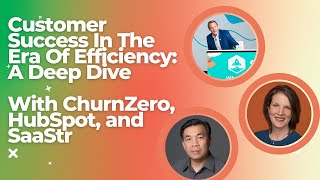
This content was created by Jason M. Lemkin. This content was uploaded by Jason M. Lemkin. This is a YouTube video titled "Customer Success In The Era Of Efficiency: A Deep Dive With ChurnZero, HubSpot and SaaStr" created on February 14, 2024. It features a discussion led by Yuman Zhang, CEO of ChurnZero, with guests Colleen O'Sullivan from HubSpot and Jason M. Lemkin from SaaStr. The conversation focuses on customer success strategies, the impact of AI, and efficiency in SaaS companies, with insights into team structures, renewal processes, and the role of AI in enhancing customer success operations.
Chapters
Hello, everyone. This is Yuman zhang. I'm the CEO and co founder of Churn0. I'm really glad to have you here today for our customer Success Leadership study. It's a study that was done by Turn Zero alongside with our co sponsors, ESG, Sastr and HubSpot. And today we're going to talk about some of the more interesting findings that we found from the study. We'll talk a little bit about the study and then we'll dig right into some of the details. My co host today, really happy to have two great guests. We got Colleen O' Sullivan and Jason Lemkin, two folks who really understand SaaS, who really understand customer success. And we'll have a really good time talking about some of the findings. Let me start with Colleen. Colleen, welcome.
Thanks for inviting me. My name is Colleen o'. Sullivan. As Yuman said, I am the VP of our integrated Customer experience team, which is a pillar within our customer success team at HubSpot. And for those of you that may not be familiar with HubSpot, HubSpot is a customer platform that is this AI power solution that our customers use to connect businesses and their customers to help them grow better. And it's a combination of three different product layers that are all connected by design. And it basically what HubSpot does is puts the customer at the center of every action within inside your HubSpot platform.
All right, thank you. Colleen, welcome. And Jason, introduce yourself as well.
Sure.
Jason Lemkin, founder of Saster, which is the world's largest community for SAS founders and executives. Excited to be here and excited that we have this data. Right. I've been passionate about this topic since I started as a founder and Saster's been writing about it for 11 years. And some of the stuff that, when I go back and look at the original stuff that I wrote 10, 11 years ago, it was. Right. But there was no data. And having actual objective data on this from 1263 respondents that churn zero did, it's pretty epic. So I'm excited to dig into the data and HubSpot, for what it's worth, not only do the majority of folks watching and listening are already HubSpot customers, HubSpot's kind of, I think so, Right.
Thank you, customers. Yeah.
But I also think they're great because HubSpot's. Listen, HubSpot's over 2 billion in ARR. So in some ways it's not like all of us, but the fact that it. The fact the types of products it sells, marketing, sales support, its price point, 10 15k or so. It's like a lot of us. So I love to learn from HubSpot at Saster because of there's. It's one of the handful of leading SaaS companies that's the most like the rest of us. So study. So I'm a student of HubSpot as well as a fan and a customer.
All right, welcome. So a couple things by the way, both SaaS, they're in HubSpot create great content, right? Renowned great content. So if you are not taking advantage of it, please do. And Jason, to your point, there's one tweet you made probably 10 years ago that I still use and that is customer success should be a single digit higher. Right. Which is if it's got to be one of the first 10 people that comes joins your company. Right. So it's just a good sort of actionable content from both Saster and HubSpot. Make sure you take advantage of. All right, let's talk about this study, the history of the study. This is the fourth year we're doing this study. The reason why we started it was when we started it wasn't like Jason said. There were, there was a lot of ideas about customer success, but there were not a lot of CS focused studies. So we decided to partner on this at 1263 survey respondents. It's the biggest survey in the industry. So just to give you a sense, the largest representative samples make a lot of sense. Right. Generally these are leaders, directors and senior directors. Only one to five years in customer success. Right. You know what we're saying? A lot of people are still new to customer success, which also means it's growing really quickly. And you can see it tends to be probably a mid market. Most of the survey respondents are mid market companies have been around between six and ten years and with NRR just over a hundred to 111. So let's actually go quickly and talk about influence. All right, so this is basically what's the highest title of your customer success leader? Cco, A VP Director Senior. There hasn't been a whole lot of change here, right? Maybe a little puts and takes here and there. So let me ask maybe Colleen, this question first. We still believe that CS is growing in importance. What's your thought about CS, the importance of CS in SaaS and how does it reflect or not reflect in the title changes?
First of all, I'm in cs, so if it's not important, I'd be in the wrong business here. So I am absolutely an advocate of The CS organization. And yes, it is growing importance. I think now more than ever businesses are looking into their install base and saying how do we make sure that we're protecting our customers, doing the right thing for our customers because that is how businesses are going to scale and grow. And certainly there's a lot of untapped potential that maybe businesses haven't always thought about when it comes to their install base versus filling the top of the funnel. So I would say despite what one would call some concerns around titles, I don't think that's necessarily telling. Telling us that CS isn't important in SaaS. It certainly is.
So Jason, let me. Maybe I'll challenge you here. Yeah, we've been calling the ascendants of the CCO lease. We have a turn zero. We think there are more CCOs than ever. I get the data doesn't reflect that. Did you see a disconnect here?
I think even in 2023 the head of customer success is this amorphous reporting structure. And Colleen can challenge me or say the others, but for sure, but I see most scale ups and startups, it's lost. No one really wants to own customer success. The CEO doesn't mind the founders because all us founders are passionate about our customers. Right. So at some level we want to be profoundly involved in customer success. But do we want to own it? Do we own the metrics and the people and no. We'll talk later about having IT report to sales. I'm personally very opposed to that. I thought it was a bigger trend, but the data suggests otherwise. Marketing, that's pretty uncommon. Right. So I think the good news is that there's plenty of VP titles out there which we could chat about. But I don't think we've solved this issue of who to customer success report to. When I talk with CEOs and founders, I give the answer it's gotta report to you. Okay, that's gotta be the answer. And maybe that's good for customer success professionals because it gives them a seat at the table. But it's not necessarily for the right, the really the right reason. I still think it's tough, but it's not clear exactly who owns what. And I think it leads to a lot of at the edge anxiety in the industry.
In my experience and education there too.
Yes, I think that's part of it where you're saying nobody wants to own cs. That's just because there's a lot of confusion as what is the value honestly, like what is the value that this team brings and articulating that sometimes is what causes those challenges in my mind.
Is it that nobody wants to own CS because it's a hard job, a thankless job. What's the reason you think, Jason, for folks not wanting to own cs?
I think it's two things I think. And you're in the growth phase. We become overwhelmingly sales oriented to a fault. Right. Which I've talked about years. We all become customer or new customer oriented. Right. We say we're focused on our existing base, but once you have a sales team and once the sales team becomes like 30, 40% of your head count, it tends to dominate every conversation. What's the big deal? What's in the pipeline? What's going on? Every conversation. And there's not a lot of oxygen left in organizations for maintaining customers. It's all wrong. As we know, in any organization with triple digit nrr, the conversation should be flipped. Right? We should be spending all of our oxygen on making our customers happy and worrying a little bit less about the incremental customer. But it's not the way B2B businesses work. Right. We're just overwhelmed. We're all still. We're either freemium or self sales driven. And founders have to fight this. They have to force this almost unnatural way. We work as humans because our energy does not reflect our revenue structure. We don't put the amount of energy into customer success that recurring revenue deserves. In SaaS, we don't put the ratios right. We don't get the pie chart.
And Colleen has that flip for HubSpot. I imagine that even at HubSpot now, it is the CS team that's probably driving the most incremental new revenue. Or at least it's close. At least it's substantial.
Yeah, I think that Jason's right. You're right here. HubSpot is trying to put like a deeper emphasis on our CS teams, but obviously that doesn't necessarily mean that we're growing or we're in the right positions always to be able to do that at the level that we need to.
The survey highlights a lot of these tensions. There's a third prong that just makes this whole space interest intellectually interesting, complicated, which is there's only so much money to go around. And there's two threads. First of all, it's hard to get perfect data. But if you try to analyze different data sources, typically companies at scale, HubSpot, certainly at scale, spend about 5% of their revenue fully burdened, including benefits, whatever, on customer success. So that's not really 5% in terms of raw salary. Right. So I wrote an early Saster post about the $2 million woman or man. Right. Which was what I thought it was at scale. But I said, if you're scaling, do 1 million, right, 1 CS person per 1 million. I still think those are the right rules today. But we're in this era of new efficiency today. Right. Which has changed, even change at HubSpot. It's changed across the board. And that 5% is getting squeezed. And so we all want more money for cs. We all want more humans, we want more help. We get that. Oh my gosh, 25% of our revenue goes to the sales team, but only 5% to CS. It doesn't really make sense, the 5 to 1 ratio. But what are you going to do in an efficient era? Like, you can't manufacture CA in 2021. We could manufacture capital. How we can't manufacture it today. So there's an era of reckoning which makes everything harder. And I think CS is bearing a lot of the brunt. It's bearing a lot of the brunt here.
I think we'll see that. Let me go to the next one. Okay, so we asked the question, are your teams growing or shrinking? And you can see that the dark blue was 2023, actually, I would say, surprisingly, almost half of the CS teams were growing 45% and then 42% were staying the same and only 13% were letting people go. Any thoughts on this? To me, I would expect more given all the talk of layoffs in the SaaS community in the last 12 months. Jason, maybe I'll throw it to you since you do see a lot of.
SaaS companies, if you really look at the data, layoffs seem like a big deal. But they're. And I don't mean to trivialize it because the human impact's huge. They're not that big a deal. What I mean is there's a lot of startups and unicorns that got overfunded, that laid off a lot of people. But at the public companies, the layoffs for the most part were small. For the most part, they're done and many of them are rehiring. I'm not exactly sure what HubSpot's doing, but Salesforce, Samsara, Monday all basically did hiring freezes last year, and a freeze is basically a hidden layoff. It's a nicer layoff because people leave. Right. But it's rehiring. So as much press as they get, I don't know that it should impact things because it's not as dramatic an impact overall as it looks in the media. I think a bigger impact was freezes and try and get into this area. Efficiency. We're going to have to deal with fewer heads per account going forward. And that I think is a bigger deal than layoffs.
Yeah, I mean, we had layoffs at HubSpot. It was obviously fairly public and then we had a hiring freeze and we are hiring again. But yes, we are thinking about how do we hire internally. Right. There's just business changes that happened where maybe one team was growing at a record speed. And then when we went in and start to dig into the actual strategy behind is, is that the right place to invest? Strategy equals choices, as we all know. And we've had to make some tough choices at HubSpot around what teams we're investing in and what ones we want to scale in a different way. And being able to dig into your existing employee base and say, hey, like there's an opportunity for us to shift direction here. And that's been pretty successful for us.
There's sort of two areas that are easy. I put easy in quotes. Nothing's easy. But we're broad leadership. It's easy to hold the line on rather than increase expenditure. One is long term marketing spend, which I think's a terrible idea. But most marketing, a lot of companies marketing spend the last 18 minutes all pivoted to this quarter. Okay, what can I do for marketing spend? Not for brand, not for awareness. Like right now, there's plenty of budget for this quarter and there's no budget for next year. So that's still reverberating in marketing. I see Sastra has enough sponsors. We have 200. I can see a little bit of a change, but it's minor. Right. And the other one is let's just hold spend on CS flat.
Mm.
We love cs. But look, let's be honest. It's HubSpot. They're going to renew. I know we should put more money into this, but when things are stressful, we have some of the highest NRR out there for SMBs. It's not that I don't want to spend, but maybe we'll Skip on our 2025 marketing budget and more in CS. I'm not saying literally that happened at HubSpot, but these are the conversations that are happening across boards.
Yeah.
And those are the two areas to pull back on a marketing to hold on in cs. And so these two areas are burying some of the biggest brunts out there.
That's Flat. And it's going back into it. Like we talked, we've been talking a lot about efficiencies, but I think it's. It's been hard, but the challenges is right. Like the pushes are right. We've had to go back and really understand what do our customers need? What are our customers telling us? What are those really important investments that are going to help us make the best customer experience at scale? And it's been a challenge, but I think it's going to ultimately really benefit our customers in the long run as we continue to improve upon this.
I'm seeing, especially for folks that are SMB focused, I'm seeing far larger onboarding teams. I am glad that onboarding percentages has become a core KPI because it's one of the best ways to bring down churn for SMBs, right. If they never start, if they never use the product, they're going to churn as an SMB. Right. So I've seen a lot of organizations where maybe traditional CS is growing moderately, but I see large teams thrown at driving activation rates into the 90s in the first 30 days. And I think that's one of the best investments you can make as leadership. Right. There's nothing sadder than marketing, qualifying, talking and closing a customer and then they never use your product. It's like the saddest thing in all of the life cycle there.
When people ask me, what are the top three things I can do for retention, I always say onboarding, onboarding, onboarding.
And I'd like to know where it sits. Does it sit in customer success? Does it sit in ops? I'm seeing more and more onboarding teams reporting to sales, which I don't personally love, but whatever works is also my role. Whatever works to some extent, right.
Onboarding is part of our services, organization, services.
I see it a lot of services.
And that activation within the first 90 days. You're both absolutely like, it's the critical piece to getting customer retention.
Yeah.
I think it's interesting, Jason, that you're saying that you're seeing onboarding teams grow. I think at HubSpot, we are definitely trying to better understand that first 90 days of a customer's life cycle to the best ability and figure out, like, what are the right investments and resources that need to be there and how do we leverage partners as part of that ongoing experience as well. That certainly is something that HubSpot has really started to dig in much more deeper over the last couple of years, is that doesn't necessarily have to be an internal team has to figure out what good activation looks like. But how do you leverage these great capable partners to help us with that as well?
Yeah, it's a great way to do it too. Right. If you have partners, whether they're pure partners, or whether your agencies or other partners can do some of this heavy lifting, it's a good way to get it done too. Right. You don't necessarily have to have it be internal.
It is pretty heavy lifting for, for some products. Right. So worth the investment. So this actually finding. The only thing I would find interesting here is that compare the headcount. Budgets decreased more. Right. As a percentage, people lost more budget than they lost headcount. Is that just, you know, you always, when budgets get squeezed, you're going to hit everything else first. Travel training, software. Is it as simple as that?
Jason, Colleen, I think we've been through something the last 18 months. I've never seen in my life in SaaS. With the possible brief exception of February 2016, I've never seen app layoffs before. I've only been through one round of layoffs in a big company. But the way human layoffs work in big companies, you just sit around the room and everybody and they say, guys, I know it's tough, but we're over budget. 5% of we're going to have a 5% attrition at the company and all the VPs get together and look, I know it's tough, but the truth be told, you know who your bottom 5% are. So it's actually after that that layoffs get really hard. But everyone, they literally put names into the table. I've seen that with time and time again with companies. This is the first time I've seen it where people got together with apps because there was such an app explosion the last 18 months. Every company got around the table and whether it was CIO driven and bigger companies or CFO driven, they said, listen, everyone's got to give up a couple of apps. We never saw app layoffs. We saw this and that churn, but we never saw people go around the room. And people gave up apps they loved for the first time, but they gave up apps they love so they could keep apps they needed.
And that's why you need folks need an all in one platform like HubSpot.
It actually helps. The suites benefited from apps layoffs for sure. They massively benefited. They massively benefited. Yeah. I might have this other little thing, but wow, I can get it in HubSpot.
Yeah, exactly.
This conversation happen, happens every week. Still, we're not through. We're getting through the app layoffs because they actually were pretty successful. But this was like the revenge of the suite. If it was in HubSpot or another platform, you just stuck with your. It was this simplest thing to do, right?
There's always a give the back and forth between Best and Breed, lots of apps and then the platform and it'll go back and forth.
Listen, if it's in HubSpot, the bar's pretty high. Okay. I don't know every piece of the marketing suite, it's so big. But what's very interesting HubSpot and CRM is it's incorporated a lot of functionality that you have used to pay standalone, especially for Salesforce. There's so many of these apps and it's all built into HubSpot. So the bar to do some of these functions on the serum is just super high. I don't need my calendar or scheduling or visibility or recording because it's all part of the serum. It doesn't mean there aren't best of breed vendors. So traditionally what happened is, look, if you got above that line, you are in because you were so good that you beat the free. But I never saw him get laid off. I never saw that. If you got above the best of breed app, that you didn't spend the next decade putting your whole company like HubSpot can't put all of its engineers into these functionalities. Right? So the standalone vendors, if they get above the hump, I never saw them churn. But the last 18 months, especially in the sales category, you've seen Brutal Churn. Brutal. Everyone cuts CRM apps right across their sales teams. Brutal churn from beloved apps. So that is different, Right?
Yeah. And that probably is what driving. When your budgets go down, you're going to hit the apps first and then you're going to hit the people second. Right?
So, yeah, So I don't. I think the learning from the last 18 months is best of breeding. We thought it was enough. It's not necessarily enough in tougher times. I'm going to.
Actually, I'm going to pause for a second here. Describe this chart, but I want to talk about it later. This is. This chart needs a little bit of explanation, but this is back to your point, Jason. Basically, if your CSMs own $1 million book of business, you know, if you're a $500 million company, you should have 500 CSMs, right? If they own a $2 million book of business, they should have 250. Yet the biggest teams we saw were only 100, you know, 99 in this category. In other words, CSMs have a very large book of business, right? 4 million, 5 million, things like that. So we'll talk about that later. In terms of efficiency, I want to put that all together but just, just give that slide.
I want the bars on the left to be true. But if you think about the fact that all of your CS expenses have to fit into 5% of your revenue, it has to be the one on the right. A hundred is going to be roughly 5%.
Is that your benchmark is 5% because some folks I've seen 5 to 15%.
Jason, when you're growing and you're pre public and you're well funded, you can make decisions you can't make as a public company. Everyone's efficient. HubSpot Monday Salesforce. Everyone is in a new area of efficiency, right? Even the public companies. Colleen could talk about the public companies got a pass in 2021. No one cared if you were efficient as long as the top line was there. So these bars worked in 2021. They don't work for anyone except a handful of blitz scaling unicorns today. No one can. It's not that these aren't good ideas but you just can't afford them as you scale. There's not the dollar only has a hundred cents in it. This is stuff in SaaS there's only a hundred cents in the dollar.
And where you invest your humans and how they touch your customers, that is essentially what every CS team is thinking about right now. That one to few model where you are literally hand holding a customer. We're really thinking about what is the value, what's the impact that we're having with those inter interactions with those engagements. And I think that's a. Everybody is rethinking how we set up our teams.
Let me give you an example just for a fun one. There's a $10 billion plus decacorn, not public yet where I'm tagged a VIP customer. I can see it when I log in. Okay. I have all the special stuff. I lost my CS person. I tried. I had an issue this week. I couldn't talk to anybody. This company has raised, I don't know, a couple billion dollars. But they have to be more efficient too. It's 2023, right? I literally log in. I have all this. I'm blessed to be a vm. I don't have a human. Why do you think it is? It's this chart, right? I don't have A human anymore. Right. I used to get a 60 second response time. Now I get a nun's response time. I was dumped into standard support from VIP support and there are no humans on standard support anymore. So I could not find a human to solve this problem. This was a million dollar problem.
Yeah. Okay. Either Jason, I think there's. You know what we're trying to figure out how to create standard. Still that great customer experience. Right. With not all not being able to offer white glove to everybody. Right. Or if you're going to offer white glove maybe you have to pay for it.
Maybe our software isn't good enough. I'm not speaking about HubSpot but maybe in general my belief is we build sloppy software in SaaS. I think we will fail if we're not the first vendor to make software that is so good. In this space you do not need humans to onboard. It doesn't mean eliminating humans. It means using AI and other things to make it so great that an SMB that barely logs into a computer can self onboard. And that's where we got to. We have to make better software so that our CS people can do higher value activities.
Yeah. Ease of use has to be the one like one of the top problems that you're solving for in order for. Yeah. And that is critical in order for us to any customer to feel like they can execute on their software successfully. Ease of use.
Colleen Head HubSpot for your team. Have you been given a bigger book over the last 12 months or being asked for each CSM to take a bigger book in the next 12 months due to any efficiency gains from AI or whatnot? Is that being asked directly of you right now?
We are deep within planning at the um. But yes we are. We are being asked to think more efficiently. And I'll be honest with you, there are a lot of great. I know we haven't mentioned like the million dollar word AI use cases within CS that we are trying to figure out right now within HubSpot where digital where AI can help take the place of where maybe there was a human intervention and really understanding that customers journey along their experience with HubSpot to figure out when does a customer really need a human and when is there a digital engagement that also can solve for them. And that's trying. That's also going to help inform how we're going to be managing our books of business going forward.
Let's talk about it right now. 43% of the CS team have adopted AI already have adopted AI which means that 57% have not. Does that make sense to you? One it feels, by the way, it'll be feels hard to actually avoid AI now. Right. So I don't even know how 57% of people are getting away with actually not using AI bots. Colleen, are you. Is there AI? I know there's AI technology in HubSpot. I'm sure your CS teams are using it. But are you really focused on making sure they're getting, you know, 20 to 40% productivity enhancements over the next few years from AI?
We are hyper focused on this. Not just focused, hyper focused. This is it. This is how our teams will grow like full scale. Right. Being able to give them the tools that provide them the right insight on their customers, the right drivers for how do they manage their time efficiently and effectively. Understanding opportunities within their install base. Like it's all this and if we don't get this right, we will fail. We will fail our customers. And so this is absolutely critical for us as part of a massive focus area for cs.
One quick thought on this. I do think AI is super important. Of course, it's everyone's top priority. Going to Colleen's point. Right. I think for post sales though, what really matters is automation. For most folks and we call, it's great to call this AI and it is AI like generative AI is absolutely brand new and disruptive. Right. But what really matters is positive experience. Automations. I don't know that acronym exists. P E A's you want not just how many interactions are automated. Right. But how many are done in a way that the customer is happy with. Right. Because some are terrible. Right. This is the problem with non AI bots or mediocre bots. The experience is abysmal. Right. If you can automate away 40% or more of human or. And that's positive, that's a, that's what I find best to breed folks looking for 40% with a great experience, not with a mediocre experience or my inability to reach a human on a million dollar problem yesterday or this week. And but if AI doesn't do that, if it's just a crutch, it's okay. But it's not going to be a game changer. For the other issues in this presentation.
There'S two parts of it, like what your customer sees from automation perspective but also when you're like I'm talking internal teams, tools and that, that's the part that's okay. You've got a human and you want them focus on the most important actions with that.
Exactly. Yeah.
So how is AI supporting them and their time management so that they're driving the right behaviors with your customer. Things that AI can't do. Right. And then of course there's the automation piece where you want to make it easier for your customers to get the answers they need. You know, chatbots, the knowledge base, other digital resources. But I think there's two parts of getting this puzzle right as we look at next year and it's not going to happen overnight either. This stuff is like tough, right. And making sure that we've got all the right parts of this together in order for us to adopt all of this next year is where we're at right now.
And now we can spend an hour on AI, maybe ask one specific question because there are questions from the audience. They just, they want to know two or three things they ought to do right now in CS with AI that will have an impact. I can add one or two. But Colleen, is there one or two things that you think made a huge difference of saving time and energy for your cst?
There's a ton of data, right. For a cs, a customer success manager come in and manage their day to day. I think being able to create tools that are like serving up the right information to your CS person so that they don't have to think or mind their install base, that they have a simple way to hear, listen, get focused on what are the right interactions. And I think that's if we can, if you can solve that, that that's going to certainly make your CSMs much more efficient.
There's a couple things I would add that are just either they feel easy and that you ought to do them right. So one is just call summarization. CSMs do a lot of calls, then they spend a lot of time writing a good summary. It's remarkable what AI can do on summarizing calls these days, like getting rid of all the chaff. So whether it's zoom or chorus or gong, whatever you use, right. That technology is very strong on summarization. Also, I think CSMs create a lot of content, right. So they're always writing up suggestions, strategies, whatnot. And I think generative AI can be super helpful in writing the first draft and of those types of suggestions. So just two things that I would do right. For the folks who are asking those I think will take out an hour of time at the very least from all your CSM signs.
So nice. I do think the next level that we're looking for, going to Colleen's point, especially on the internal side is we want everyone in post sales to never give a wrong answer. That's right. This is what AI should do. I'm excited about AI things that let us analyze data that we can't do on our own. That it's so complicated, it's in so many silos, it's in so many places. Is that in all of the data on your customer, no matter what tools and systems you use, all of the data will never be in one place. Right. So if there's a generative layer on top and the CS can get the a 98% correct answer and then they can do the higher level activity which is really solve the problem, not just frigging figure out why the problem is happening. That's the next level here that all the rest of the stuff. I think. Yeah. Make them more efficient and the email's better and every SDR in the next 12 months is going to run. They're great. Right. But the epic things that will change the world are taking unstructured data and structuring them for knowledge workers. And CS can be huge here. Huge. I literally was on, I'll tell you another terrible story. Another company where a multibillion dollar company, I was talking with a senior executive and this person had no idea if I was a customer or not.
Right.
They had no idea. Now we could talk. Why didn't they log in? The just what? Imagine there's just a thing where like you just type in Jason Lemkin or Sasser and just the answers are just there for you. Literally did not know if I was a customer. An executive at a multi billion dollar company had no idea. And I've actually interacted with this executive many times so this. Anyhow, a point like that shouldn't happen. That's a, that's an AI problem. So that's what I'm excited about. And if this can let CS really handle the real issues and not be firefighters, which is what they really are, that would change the industry because 90% of my experience, at least with startups and scale ups, CS is firefighters.
Yep. Turn chasers.
Yeah. And it's great because that's why I want to invest the million dollar woman or man, not the 5 million because that's where it's worth it. They solve your product problems and your feature gaps and your team gaps and issues. That's the cheapest money you can invest. But it doesn't scale infinitely and we shouldn't be in 2024. CS shouldn't be firefighters or chasers. Yeah. We should be moved beyond that. We should move beyond that. I shouldn't show up to a qbr and the CS person doesn't even know what they're talking about. They don't even know what happened. I had a QBR about a year ago where the Saster is tiny, but we're one of the five largest customers. And the CS person showed up and said everything's great based on my data. I'm like, no, you're the worst vendor we work with, but we're going to stick with you. I'm here because the CEO is here because I'm going to stick with you. You're literally the worst vendor we work at. And she ended the zoom.
Oh wow.
That was the wrong. Like she shouldn't have had that data. She should have showed up. And that is just a fail on multiple CS should not be doing that.
I think the amount of time that CS time and frustration CSMs spend hunting down stuff that will be solved by AI, I think that will be the biggest impact. And then the second that happens and you feel confident about it, you can actually have customers directly access the same information. Right. You almost bypass a lot of CSM interactions. Hey, let me actually talk about some other interesting things that we found. So who owns the renewal process? And this is really the change over the four years. And surprisingly actually customer success has gone down. Right. And, and there was a rise this year, a big bump in a dedicated renewals team. So not account management. Right. So they probably use their folks do nothing else but renew. So that's actually the biggest change from 9 to 14%. A dedicated renewals team. It feels like maybe as a response to the downturn. Colleen, how does your team work? Do your CS folks are they. Do they own the renewal process?
So they work with our contract management team. Our CSMs absolutely work closely on renewals, making sure they're. They're measured on customer dollar retention. So it's a massive part of their book of business. But it's a close partnership with our customer, with our contract management team as well. And as I see us looking to the future, I'd say there'll be lots more emphasis on that contract management, how we work and collaborate with that team on renewals.
So for you, it is that you would put that under dedicated renewals team, your contract management team. Right. That's what they.
I would put that under customer success.
Right now, customer success.
And our contract management team is within customer success as well. So we've got contract manager managers and CSMs.
They do you have account managers as well for Upsell Cross. Sell another team that do that.
We tap back into our sales team. Yeah, sales team.
A bad sign. I think I missed this data in the study. I think this is very telling. Like it's very helpful to see this. Is this orange? I'm sorry I'm colorblind or the standard dedicated realtors. I think this is the most telling. One of the most telling statistics like I that people renewals may be. There may be quotes in some of these teams. These may be teams who are tasked with getting nothing but get. I'll tell you a story in a second if you want to hear one. The worst one of the year for me of getting the most revenue out of our customers. But I'll give you a related story. There is a public SaaS company that we all love. Okay. Hero company that brought in a renewals team and earlier this year we got this email at 10pm at night and we pay, I think we pay 299amonth for this product and we paid for five years happily every month on a credit card. They said it was $60,000 or they would shut off our service in eight.
Days.
From 299 and shut it off in angry clips. And how did you get from two to 98? First of all, they said we needed 60 seats. We use eight. Okay. We have eight people on Team Saster. They said we needed 60 seats. They said we needed the Enterprise edition because we were. Because we were so big and we wanted. Here's the kicker. Four years prepaid cash up front or they would shut us off in eight days.
Eight days. That's insane.
So what happened? So of course I didn't get my. I didn't get so upset. I had. I'm Sasser. I had to learn what was going on. And I found out this company we all love had built an outsourced renewal team with just one job. They only had one job and they had bonuses and KPIs. And it was to bring in as much cash immediately now as possible. Okay, maybe not cash because the company's profitable, but as much bookings, probably as much bookings as possible. And yeah, this threatening thing like if it got enough folks and we could afford it, if we had to spend 60,000 instead of 299 we could. But there was no way. Right. So I had to track it down and with this person. What?
Oh.
But eventually I talked with one of the senior management team and they said it was this outsourced renewal team. So I mean it Sounds crazy. But you could see how it could happen. Right. Incentives are incentives and the company came under a lot of stress to grow Churn had was way elevated this public company. And so they said. And interestingly I found out the team reported to the. To revenue, to CRO. It changed the reporting structure of this company because they're under stress. And this was one of his ideas. Like under granted, under enormous stress. Not HubSpot's had a little bit of stress. This is a public company under enormous stress. So he built this outsourced renewals team and crazy to get that email though. Right?
That's not even. That's a problem like you're not thinking about.
But it's the stress that people have come under. The reverberations are everywhere. Right. They still. And so yeah. It's just. But that this is what can happen if you don't get incentives. Right. This is the problem. So hard to get incentives in renewals and upsells. It's so hard. It's so it's the existential challenge here. Right.
And we were talking before when we were in, in our practice room, you were worried about actually a long term trend of CS moving under the CRO for these exact reasons. Right. So it's actually, it's not surprising that there's a dedicated renewals team right. In this arm. A jump. Just because I think in the downturn people are looking for dollars.
Yeah. But why do. But why? I'm terrified of renewals now.
Yeah.
When I get an email about a renewal call. An email from a CS person. Hi. I don't. Listen, I'm happy. Just send me the invoice. I don't need to talk to you. If you, if I had a problem, you'll hear it from me. Okay. I don't need to have a call because the call is a ripoff call coming. And even if there's a price increase, maybe 299 to 60,000 is like a little bit high. But just tell me an email. I don't want to get on a call for this to be tortured by some, some human being. Right.
For the bad news.
Yeah. And it's almost never anyone I've ever heard of. It's my new rep. It's my new person in customer success or account management or renewal. Why do I have to get on a call?
Yeah.
Let's do one more. I found this very interesting. This was actually a question that the folks at Sasser wanted us to ask and that is how frequent do your CSM to meet with Customers in person. And I was expecting to never chart to be higher.
Yeah, yeah.
Because we live in a world of virtual, by the way. Visiting customers is harder than ever. Hey, let's go meet. I know your headquarters is Nashville. Let's go meet. It's like, I'm not in Nashville. My team's not in Nashville. You know what I mean? It's just so much harder to meet people in person. So this must be happening at places like Inbound. Right. The HubSpot Conference or Saster Annual. This must be happening here because I can't explain it otherwise. I don't know. Thoughts here?
Yeah, I think in certain use cases, strategic accounts, you've got like a big situation that you're working through that's complex. You just need to like, sit in front of the customer and work it out. There's good use cases that's really only at least at HubSpot that is reserved for, like, very unique use cases, essentially. Like, we're not suggesting to our CSMs, like get on a plane once a quarter and go visit your customers. Just not possible. Right. There's just too many customers. There are like, again, these strategic accounts where there's good business case, good strategic case. But maybe that's happening once a year. And certainly we're encouraging the majority of our customers to come to inbound and we're bringing in our teams to make sure that we get some face to face time with them there.
Casey, let me give you the last word on this.
Right?
You really think a lot about face to face.
Yeah.
So what do you think the future of face to face meetings look like?
Look, if you have a massive number of customers, as Colleen says, you need to create spiderwebs for them to come to you. Like Inbound alone or Dreamforce are worth it just for that reason. Right. And certainly you. But you. But the organization can do one a quarter if you want. It doesn't have to be annual. Not everything has to be inbound. In Boston, with 15,000 people, you can have regional events once a quarter. We used to do that. I would say this look. Yeah. At some point it's too many names per csm. But imagine it's more manageable. Right. The deal size is a little bit bigger. You're absolutely right. It is hard to just show up into town and walk into someone's office and just assume they're actually in the office anymore like we used to be able to do. But what's really easy and there's. I don't think there's any excuse to do it if you have bigger customers is every month hit a city. Okay. But grossly, we're going to do SF and then we're going to do Boston and hey, I'm Spot's my customer. And you reach out to Colleen, hey, I'm in town for four days. Colleen's not in town. So be it. But someone else is going to be like Klaviyo is going to be there or whoever else is in Boston, they're going to be there. You don't have to have a hundred percent hit rate, but you got to do it. And even on our little team, we now have a rule. Every month this has to happen every month. We have. We only don't really even have sponsor customers. We have sponsors every month. We have to meet them in person. And once we force this rule, it change things. And you can do it. It's just, it's okay that not everyone's in the office. They're there sometimes or there's some. They're in another city, right? Maybe they're in Saskatchewan or north of the Arctic Circle. So be it. But even if Colleen has decided to work in South Chile, someone on her team's probably still in Boston. That's senior enough. That' fourth meeting city tours. Bunch these up and do as many bigger customer events a year as you as your marketing team or team can tolerate. At least do one. But you could do four, right? You could do one in Boston and then you could do one in London and you could do one in Sing. I saw Yamini in Singapore when we were in Singapore, right? You can't. They don't all have to be perfect just talking to them in person. They don't all have to be structured. They don't all have to have slides. Could be nice.
But I'm excited for the future events and how that changes and the future of state face meetings. But for now, we're over our time. But we had a great conversation. Colleen, Jason, thank you so much for being one being co sponsors of the study and to joining me today to talk about the findings. I hope everyone learned something. Thank you, Colleen. Thank you, Jason. We'll see everyone soon.
Thank you, Iman. Thanks, Jason.
Thank you.
All right, bye. Bye.










