CXO Real Talk: Evolving CIO Experience with Zuora, Zendesk and Nutanix
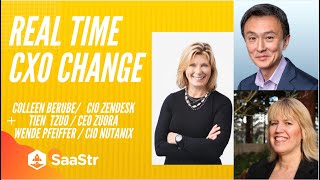
Wendy Pfeiffer from Nutanix and Tien Tzuo from Zuora discuss how SaaS companies adapted during COVID-19. They cover subscription model resilience, flexible pricing to keep customers, and the security risks of employees accessing enterprise apps from personal devices.
Chapters
Wendy.
Hi, I'm wendy pfeiffer and I am the cio at nutanix and also a qualys and SATA board member.
And tien.
Sorry, that's a Sasuke website. Sorry about that technology. My name is Tina, I'm the CEO of Zora and really glad to be here. Thanks Colleen. Thanks Wendy. Going to be a great session.
So excited to get to spend this bit of time with the two of you, both well known executives in the SAS industry. And I think we've got some interesting things to talk about today. You know it's interesting for all of us being executives at SaaS companies during this unprecedented crisis. For a lot of folks they this may be the first time that they've been through this kind of a crisis in their lifetime. For others of us, this is not the first time that we've been through some nature of crisis. We of course in the past, you know, there was the dot com bust, there was 9 11, there was a mortgage crisis of 2008. Each of these different crises, they have different character, they have different circumstances but they have all had implications for us in different ways from a technology perspective. This time, however, lots of shops are finding themselves in a different situation being SaaS based and we know that there's a certain amount of resilience that this model has. What I would love to hear from you is a little bit about your thoughts on the goodness of being SaaS based during this kind of crisis.
Yeah, sure, I can start. Well, it's a fantastic time to be a SaaS business model, a subscription based business model. We're in a unique position where we're not only a SaaS company but all our customers by definition are subscription based business models because that's the companies we serve. And it's not just SaaS companies but digital streaming companies like Netflix, digital news companies say like the Financial Times and a lot of IoT companies that have digital services. And we actually did a study and it's available if you just Google Covid Zora that really showed that if you just look at subscriber acquisition rates in the month of March and to see what the early impact is, about half the businesses are actually have not seen an impact yet. So their subscriber acquisition rates have been going the same pace in the month of March as the previous year, about 25% actually saw and accelerated. If you dig into the categories, you're going to see collaboration software like a zoom, for example, you're going to see video streaming companies, you can see E Learning Companies and even the 25% that were decelerating, half of those are still growing and then half of them that are contracting. The beauty of it is you're not starting at zero every quarter where you try to build up your revenue base. You're starting with the recurring revenue base. You're seeing how much of it can I protect? Can I still service my customers? Can I bear hug them? And so it's just a much, much more resilient model. You don't have these steep drops in revenues that you have to manage through. And so we count ourselves lucky to really be in that position.
Yeah, fantastic.
Yeah, I think.
Go ahead, Wendy.
Sure. Just to add to that, I mean, just in human terms, first of all, we're so fortunate to have a business where we have the ability to continue to work and to continue to enable our customers to work from home. I mean, there are so many folks who are in industries and businesses who can't do that. And so starting with that note, now our challenge is how do we make use of the good things about a SAS model. We have this ability to scale, we have this optionality, we have this potential to connect processes and capabilities to other tools and systems. And all of that can be done both internally with a remote workforce and externally by connecting with our customers and our prospects wherever they are. So we're quite fortunate. And you know, with that sort of, with, you know, great benefits come, great responsibility, we're now, you know, racking our brains to think about how we can help and how we can extend and how we can support.
Yeah. So I'm curious, like it's clear both from a business model perspective as well as just the ability to be flexible and agile and work in a very robust way, that there's a lot of benefits to being a SaaS company. What about, are there any particular challenges that you are running into that you may have anticipated or didn't anticipate?
I think for us it's a little bit about trying to anticipate the effect of all of the changes to our customer environments on their ability just to, just to financially operate. Right. We're trying to be thoughtful about offering flexible terms about usage based pricing, et cetera. As a CIO on one side, I'm in the midst of negotiating and renegotiating contracts, and as executive in a SaaS company, I'm on the other side of that. I'm also in the midst of trying to understand the effect of these elongated sales cycles and elongated payment terms on the business. And so it's a dual sided challenge. With flexibility comes some complexity, but with complexity comes capability in the midst of working through that. And I wish there were, you know, none of us have a crystal ball. And so part of understanding how to adjust and how to retool involves, you know, making a really good guess as to what's going to happen next and the timing of how things play out. And you know, boy, if anybody has great ideas about that, I'd rather listen than speak.
Yeah, I think one of the biggest challenges at the moment is nobody really knows what the future holds. We're all trying to make our best effort, guess at it. Dean, in particular for you, I am really curious to know, given the benefits and opportunity and challenges you're experiencing right now. I know we have a lot of folks in the audience who are in maybe earlier stage SAS companies, they would love to know if you could go back in time a little bit and do something a little bit differently or if you had to, if you could tell your younger self to make sure you were thinking about something, what, what would you throw in there?
I think the, I think there's, there, there's, there's, there's a short term phase. In short term, you can call it three months, six months. Right. And as long as you, you got a good investor, you got a good business model, you got a recurring revenue, you're going to do okay. And it's important to kind of remember that these are long term customer relationships that you have. You have to do the right thing by the customers, you have to do the right thing by your employees and not squander the advantage that you have with the recurring business model. I think the longer term, I think Winnie touched on it, the big question really is when this thing, we're through this thing, what does the so called new normal looks like? And there's a general sense that a bunch of things have changed. And so people are saying, do we really need to fly everywhere or can we just get a lot of work done over zoom? Do we really need office spaces at all? And I would say if you try to extrapolate the lessons, having more agility in a time and place like this, if I could go back, well, maybe, maybe don't sign those long term office leases. Right. Pay a little bit more per square foot so you've got that flexibility and maybe try to outsource more of what you do. SaaS companies, we tend to already outsource quite a bit, use other SaaS products, other services. But the whole theme of agility and Being to adapt to whatever is going on in the marketplace seems to be a big, big theme that's coming to the front.
Yeah, yeah. If I could add to that. If I could add to that. Sorry, I keep stepping on. You need like a flag, a signal of some sort. If I can add to that. I see a couple of things that are putting pressure on us as developers of SaaS products. The first is that many more folks are accessing what in many cases are intended to be enterprise applications from consumer devices, from the gaming computer that has the good monitor in the spare room, from a mobile phone of some sort. And so our applications need to be performant. They also need to stand up to the other applications that are in those environments in terms of their interaction design, their accessibility, their use of shared platform resources, et cetera. So there's that challenge that we have as we're developing. And then secondly, because we're accessing these, what used to be enterprise applications from this broader consumer space, there are now challenges as well in terms of cybersecurity and data security and privacy and how we maintain that across less secured networks, et cetera. So there's lots of things we're doing to try to address that, but these are core challenges. When you think about developing the applications and then you think about operational capabilities of operating a SaaS company at some scale. The scale is also variable. At this point. We're seeing large peaks and valleys, and so all of those put pressure on the code itself, the operational abilities themselves, and they are likely the new normal. At a minimum, we're going to be in this hybrid mode for some time. So that's where I'm seeing emphasis and need for emphasis.
You know, what both of you said really resonates for me. Tien, on your side, it's kind of the inverse of what you said as a cio. We at Zendesk, we pretty much have a practice. We don't sign contracts for more than a couple of years with any of our SaaS vendors. And I'm glad we don't right now because I have that flexibility when things are changing to be. To change with it. Right. And that need to be able to give people more flexibility to access from any device securely and to make sure that we're retaining privacy and so forth is also a great pressure right now. So both of those really resonate for me. You both have touched on customer experience. I'd love to shift to that a little bit. I think we're all facing a range of challenges with our customers helping our Customers right now you have on the one end customers who are experiencing dramatic increases in business and volume. I know for us, a customer such as Instacart is one, you know, we're having to make sure that we stay on top of that they can support their increasing volumes during this time. And then we have other customers, maybe more in the SMB space where they're needing help with financial terms, just as you suggested. So I'm curious, even on a good day before COVID if you look at the industry studies, companies, even the best companies are struggling to do an admirable job of addressing their customer needs. I'm curious during this crisis how you are thinking about your customer needs and are you rethinking at all how you engage with your customers and what you need to focus on there?
It's been a really interesting experience for us because we're smacking the thick of that. You're absolutely right. This situation has had a disproportionate impact. And so we see the same stories and so on our side. And all this is playing out of the news. I mean, Fender Play said, look, we'll give away 100,000 subscribers for free because people are stuck at home and they had a million subscribers sign up for free to service. And so, you know, you hear the stories about Zoom pluralsight did their April is free campaign. And so companies are realizing our product really has a strong, strong intersection point right now in terms of what people need. And the way we have to take advantage of that is to scale up. And then companies that can't scale up because they haven't built the engineering or the processes to do that are hurting. And we're making sure that we can scale up with them. If they're going to have a 20x load in our systems right now, then we have to make sure that we're there. On the other side, you have companies who are their customers are restaurants or customers are hospitality companies, transportation industries. And so their needs are more about to hold on to their customers. They've got to suspend a bunch of contracts. 24 Hour Fitness was in the press saying, look, we're just going to spend three to four months these memberships because the gyms are closed. But if you don't do that, the customers are just going to go ahead and cancel. And so the ability to be agile and meet the customers where they need right now really, really important. And so it seems applies to us. We're basically just doubling up in our customer support and our customer success organizations to make sure that Whatever our customers are trying to do that we do that. The other thing that we're sensing is no one wants to be alone in a time of newness and certainty. So people are very, very hungry to talk to other companies that are in the same situation. So we've been able to take advantage of Zoom that says, look, spend resume is a major, major topic. Let's get our experts on a Zoom call. Hundreds of people will show up and then after they learn about the technology, they actually want to then go ahead and break out. Use the Zoom breakout rooms features to kind of talk about, well, how did you go about it? How did you talk your leadership team to doing this? Did you get any customer pushback and how did you have those conversations? And so really bringing customers together in a community around the thing that you do has been really, really important. So we keep thinking about, okay, how do we make sure that we continue this, how do we make sure that we continue this process and everything that we learned. So this isn't just a moment of time thing, but it's fundamentally changed on how we interact with our customers.
I think it's creating an opportunity for intimacy with customers that hasn't existed in the past.
Yeah.
Wendy, any other thoughts?
Yeah, you know, I'm with Tien in terms of the emphasis on our customer success organization. I would also say, you know, it's a little like, is it miracle on 38th Street, 34th street, you know, where like Macy's is recommending gimbals? You know, we're in this community now where we're not just sharing about our own product, but we're sharing about the products that are playing well in the, in the new ecosystem. And we're becoming expert in more than just, you know, that one, that one product. And so thinking about Nutanix is a, is a platform and some of our products on the platform are suddenly much more interesting than before. We have a product called Beam that helps people to determine what it costs to run in different clouds, aws, GCP on premise, et cetera. And to make choices among those clouds. We have a product called Frame that's a easy to spin up VDI if someone is working from an insecure location or doesn't have a company provided laptop. Those used to be feature, now they're stars. And then at the same time, just like Tien said, every single time we meet with our customers, we find ourselves giving advice about, here's a great time to use Zoom and let me show you the breakout room feature. And hey, we're Using Google Meet for this and let me show you how that works. And it's really kind of interesting. We're sort of all in this thing together and you know, sending folks to other vendors when we don't have what they need and being sort of more open, that optionality is huge.
Yeah, definitely makes sense. I'm curious, you touched on earlier some, you know, some customers looking for financial relief and you going and negotiating some of your contracts. I'm curious from both of you, can you share with us some specific things that these creative ways you're coming up with to help your customers during this time, whether it's on the financial side or otherwise. We had an interesting conversation the other day about this. I'd love to touch on that again.
Yeah, I think at the end of the day we all know the metrics, right? And imagine most of the people listening on this are obviously SaaS, companies, Cactl TV and so on and so forth. And so you just gotta remember you're looking at a long term customer value. And so we try to see this as this is a chance to build some goodwill. Now you gotta be able to sort this through, right? And so we definitely companies are saying, look, what is the business space that you're in? If you're in the transportation sector, if you're in the hospitality sector, we know that you're gonna have a difficult year. We also know that you're a subscription business. You're going to be able to survive it if you got an essential service that people will want to use. And this is really about weathering the storm. So we've done things in certain situations where the right thing to do was for us to push out the contract because the volume that they expected to have this year, they're just not going to get. And yeah, you take a financial hit yourself for that one year, but you're really building long term goodwill with customers.
You're retaining the customer and building goodwill.
Absolutely.
Yeah, yeah. Very similar theme. Look, I think what people are trying to do right now is they're trying to preserve cash. And that makes a lot of sense. And so the extent to which we can balance that cash preservation mode with the potential to take some market share in multiple markets, I think we're trying to do both of those things in some mixed portfolio way. And back to some of our SaaS founders who are new, who are in their first or second year of service, I think the watchword here is optionality. The extent to which you can offer optionality in terms of consumption methods Pain methods, you know, everything from being able to change up the mode in which licenses are counted and usage is counted. I would focus on that optionality. The more optionality you're able to provide, there's likely some consumption model that works for each industry or each kind of business or each size of business. And you know, just like we're making that up as we go, I think a lot of our CFOs across all the industries are trying to figure out the most optimal use of cash and so on. So optionality is key and just understand that cash preservation is key for most folks.
We were talking with a company that's in the hotel industry and they're saying, look, instead of the fixed annual fee that you're paying, we'll have a much, much lower annual fee and we'll tie our fees to you based on how much bookings you have. Right? Because then it becomes okay, it becomes a fair situation. Right. I don't know how much bookings I have, but obviously if I'm going to book it, my revenue is going up, I'm using your service, and that just makes me feel a lot better in this type of environment. Then maybe next year when things come back, we'll go back to that large, predictable annual contract. So having flexibility in pricing and packaging and how you engage with your customers is one of the most critical things that we're seeing right now.
You know, it's interesting also, I think with some customers, even how small things can make a difference. You know, we have customer. We've had some cases where customers were working with on some of these questions. They're like, could you just stop sending me the notices while we're figuring. Right. And that really is also like a mental thing. Like, can you just take that pressure off of me since we're working on this together? And you can do something that really costs us nothing, but it makes a difference for them and it builds some of that goodwill that you talked about. Any other, you know, we kind of have hit on here like this. Goodwill and retention. Is there anything else, any other creative ideas in terms of customer retention that come to mind that you would like to share?
I think one of the things that we're seeing is just the opportunity to partner, to cross sell, to sell across channels. Right. We really are in a situation where, look, we're having a ton of personal conversations. Somehow people in the mix is much more front and center. And so it's just not possible to have a single threaded conversation anymore. You know, we talk about all the other challenges and all of the other opportunities that we have. And so for me, the trick has been in that moment, to follow up in that moment to make the referral, to make the connection, to grab one more person and put them on the zoom call or you know, add them to the Slack channel. And I would just say, you know, that immediacy that the immediacy that the technology enables, that's something that we need to get better at as human beings of sort of making those immediate connections. In the old days it was pick up the phone and call or walk across the aisle and talk. And now it's add to that meeting, make that connection right then before you forget, before your kids run in and need help with homework. And I think I am seeing, actually, you know, if you think about making those connections as starting a new sales cycle, those, the sales that come from those connections across industry, across companies, the conversion on that, the conversion rate and the conversion speed on those sales is pretty extraordinary, right? There is a fully qualified lead who is desperate for this thing, who has been referred by colleague. And so there, you know, at the same time that sales cycles are elongated in other aspects of our business, that's a real accelerator and we need to be conscious as sort of a community of employees of companies, we need to be conscious of our role in making those connections. You know, I was going to say something about those connections spread, I was going to say something about the virus, but I decided that would be not a good analogy. Too soon. Too soon.
I think that's a terrific insight. So let's shift the conversation a little bit. One of the things that we know very well running SaaS companies is that part of what makes an amazing customer experience is to give your employees an amazing employee experience. And as we've all had to shift to this work from home scenario, it's probably for us been relatively easy versus other companies, but a strain nonetheless. I'm curious, what are, could you share with us some of the things that you're doing for your employees that you think are making a difference during this time?
I would say this, I would say the most important message that I'm trying to get out to my employees is not to think of this as a temporary thing. And I know that's a bit of a shock for them. And you know, eventually we will come out the other side. But my concern that I hear is that people have to make their work environment at home worth for them today because this could go on. Yes, there will be, we will get out of it eventually. But it's not clear whether it's two months, six months or something. You're saying through the end of the year. Again, we hope not, but I think it's best to plan for it. And so what we're telling our employees is, look, if your work environment doesn't work for you, if you need that standing desk, then go get that. If you need a new chair, then go get that. If you are two working parents at home with young kids and you have no help, then build your calendar around that, right? Build your calendar where you get to sort of hand off and you're only going to work certain hours and you take long breaks because that's what you need to do. And I think, you know, we're entering a new situation right now. And so we don't have, you know, the boundaries between commuting to work and coming back home. So you're seeing people do 12 hour days because there's no natural end. And you've got to figure out how to rebuild those routines, expectations, in a way that works for you and to.
Create those boundaries that you talked about. Yeah. Wendy, any thoughts?
Yeah, just very similarly creating structure and creating, you know, I like to think of it as containers in which, you know, people can plan. We create the boundaries of the containers. You know, we let people know. You're allowed to set a work schedule. We want you to be available 8 hours within each 24 hour period. But you can set that work schedule anytime and then you can share that work schedule via these tools and then we'll respect that. And so we sort of set that, that container boundary and then, you know, people inside of that container, they can write the code, right? They can, they understand what the boundaries are. And now they can, they can deal with the changes that are happening in their lives. And so I found becoming very precise about describing that those outer containers then allows all the creativity and rich ability to execute that our team members have. And you know, interestingly, I think as technologists, we're used to principles like this. And so we're really having an opportunity to show the rest of the business, the rest of our companies, some of our peers in other industries, the capabilities of working this way. I would also say the other thing we're trying to do for our employees is just sort of be more personal and being more personal. You know, I'm a nerd and so I'm, you know, I operate a little bit lower on the EQ scale. So we're actually kind of showing people, we're training them, teaching them Showing them and people like me, you know, how to, how to be more connected and more direct as human beings. And then the last thing I'd say is having an understanding of the cycles of things as an example. So we like to measure everything and I think measuring is actually really helpful during these times. So, you know, we noticed when our entire global workforce pivoted to work from home over the course of a couple of week period that we saw, you know, a measurable decrease in productivity against the normal measures. Now we've seen productivity increase back to, first of all, the pre work from home levels, but even potentially a little higher than those pre work from home levels. And we make that data available, right. So that's it's visible and available to all of the employees so that they have their own kind of, you know, quantitative, neutral view of their own productivity, productivity and recovery relation to others. So I think the more we measure and the more we make things transparent about what this is really doing to us, the more informed we are and therefore the more equipped we are.
I've definitely found that having to key in more so on what are the different work patterns in our business and how do we make sure we, we don't think of things as a global problem when maybe there are specific solutions. There's some people who sit on Zoom all day and there are some people who work just, you know, in Slack all day. Right. So really understanding what those different patterns are and attending to them accordingly based on what nature of employee there are, I think is something that has been a lesson learned in my shop. I'd love to dig in on one of those Personas. I'm curious because this is certainly a topic of discussion for us is, you know, we all sell into the enterprise and the traditional enterprise sales motion doesn't normally happen on Zoom. Right. And so I'm curious, how are you thinking about sales going forward and your sales force going forward in this new world?
Yeah, it's a very interesting thing. There was a lot of nervousness of that. But I think the big change is, the big change in thinking is a lot of us are probably visualizing how do we take our old environment and now do it over Zoom. And I think what we missed is the customers are all on Zoom and so if the buyer is all on Zoom and then they're adjusting their expectations as well. So I don't know what happens once we start, you know, going back to work. If this is like, you know, two years from now, we'll look back and that was an anomaly. You know, best thinking is, no, it's going to shift somewhere in the middle. There will be a bunch of legacy impacts. But when you find that the customers are all on Zoom, that it becomes just a great, great equalizer.
It's a complete equalizer. There's. I find it totally fascinating. There's no, like these people are in the office and these people are home or, you know, there's not that dynamic of some people are off on the video and others are all together in the room. It's fascinating.
It's fascinating.
Yeah. I would say you can see people are finding that because as human beings, just in general, we're just figuring out how to interact with each other in Zoom. Having happy hours. There's something about, you know, Zoom weddings in New York are now legal.
Really.
And so if everybody is figuring out how to use Zoom, then selling is just one interaction within that broader context. And people are figuring it out.
Yeah, for sure.
Yeah. I think the opportunity for us is to take advantage of how people feel in these Zoom meetings. One of the things is that our focus is a little bit different in some ways. There's this pressure, right, to be making eye contact and to be on the video. And you can't really multitask as much as you could in other situations. And so what that does is it makes our attention is a little more fragmented. And so what we're looking at is sort of breaking down the sales cycle and those conversations to more atomic elements, to smaller things and having kind of a more iterative sales cycle. We might be able to have more touch points. And in those touch points, we would share very specific things that meet a specific question or a specific need. And it's sort of the stream of consciousness that people have the ability to maintain right now. So I've noticed things like instead of having an eight hour ebc, we might have an hour long EBC focused on one product or one problem that the prospect is trying to solve. So I think there's some opportunity there to understand the interaction design. And then I think there's also. I think we should give up on something. Some things don't work well and we should instead continuously trying to do them. We should sort of pivot a bit. I had the actually terrible but useful experience of attending a relative's funeral via Zoom last week. And it was very sad. It was very difficult. It was, it was. You know, I have never experienced anything like that. At the same time, well over a third of the attendees, we had about 120 family members attending and A third of the attendees said they struggled. It was, oh, the struggle of the technology and you know, how many 90 year old relatives, you know, does it take to make the audio work? At the same time they said we could never have attended this in person, we would never have had this discussion, we would never have seen your face, we would never have a recording of this that we could play back later if we didn't have this. And so I think it's taking a look at the things that are different and building some sales, you know, chops around those different things. People might not have been able to attend fly to that ebc, but now we can have the conversation. Might not have been able to get that executive on the phone, but now they're available, you know, might not have been able to, you know, share a recording or a document afterwards, but now we can. That's going to push on tools, that's going to push on interaction design, etc. And sometimes just being conscious of what's happening and different, taking it in and then sort of finding that silver lining, if you will, or that additional opportunity that wouldn't have happened otherwise. And I can tell you the end of the story with my family from last week is we're remaining connected. We actually talked about having a follow up Zoom call, if you can believe it, just for family who hadn't seen each other to talk. And so there's that human possibility that we're seeing too.
I think that's a fantastic insight. I think it's also the inverse which is not getting too myopic. I had someone the other day send me a message and we were supposed to have a phone call and they said, do we have to get on Zoom or could we just talk on the phone like people used to? Yeah, you know, so we have lots of different channels and opportunities available to us remembering, like are we using the right tool for the moment. So I have one last question for both of you. Even though we, we said quite openly nobody has the crystal ball, I'd love to hear your thoughts and perspective on when we come out the other side of this. What do you think remains the same and what do you think will fundamentally change?
I think if you're a SaaS company, broadly speaking. Right. Obviously lots and lots of types of SaaS companies focus on different things, but as a broad category, you know, the good news is we're on the right side of history. Right. And so this is only going to accelerate the same trends that gave birth to the SaaS industry. We're going to shift more to the cloud, people are going to shift more to subscriptions, People are going to shift more to easy use tools. Right. And so there's a lot of good news there. I would say that the question is going to be this work at home thing and this concern of, you know, we'll get over this pandemic, but will there be another one? What is the permanent psychological changes that will happen? And it's hard to know. It's hard to know. It's hard to know that the mortgage crisis would lead eventually to Greece having big issues. And so I think that the ripple effect of this thing is going to play out over time.
Mm. And some of those things may be, as I think someone mentioned earlier, they may live for a couple of years and then dissipate.
Right.
Yeah.
Our sensitivity to getting close to other people or, you know, there was a lot of sensitivity to travel after 9, 11, and as of last year, people were traveling more than ever. Right. Wendy, what are your thoughts?
I think we are moving into a permanent hybrid mode as I think about the progression. When we first learned that we all needed to work from home, and we were in a pandemic mode. Early days, it was like a sprint, right. We were rushing to accomplish the things we needed to accomplish to get people safe and get them working from home. And I've heard people saying lately, well, now it's more like a marathon. Right. This is going on for a longer period of time. We need to deal with that thinking about going back to life as we knew it before. It's more like a triathlon. We're going to have people who are engaged in different parts of this race for some time to come. There will be people working from home. There will be people in offices. There will be people toggling back and forth between those things. And so, you know, those of us who are, you know, great runners have to be good at swimming and biking, too. You know, we have to be good at multiple modes and even good at the context switching. Some of the, you know, the best triathlon racers, you know, they win or lose the race as they switch modes, as they move from. From one mode to another. And so I think those are the new skills that will be valuable and that we need to develop in ourselves and also understand that our products are operating in that environment too. So, you know, hopefully we all come out the other side as winners. But that's what I see, that mixed mode for a long time to come.
Yeah. Yeah. Great. Well, listen, it's. It's an honor and a pleasure to speak with you both, Tien and Wendy. I hope it was valuable for the audience out there, and I'd like to thank everyone for attending today and have a terrific rest of your week.
Fantastic.
Thank you.










