Demand Gen Tactics that Pay Off Big | Stage 2 Capital, Lever, Sales Impact Academy, Zendesk
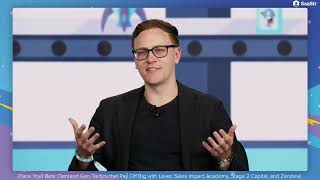
Panel discussion (YouTube) led by Sydney Sloan with demand-gen experts Mark, Keesh Shannon, and Perlini. The speakers share practical strategies for SaaS demand generation including investing in a media arm and niche creators, prioritizing performance (Google) ads and account-based approaches (MQAs), aligning marketing with SDR/XDR operations for speed-to-lead, using customer data and benchmarks for storytelling and value engineering, and pragmatic guidance on category creation and phased global expansion.
Chapters
Good afternoon. Oh wow, another full audience. This is great. My name is Sydney Sloan. I am a LP at stage 2 capital and kind of pre announcing that tomorrow I think I put it on here pre announcing that tomorrow I'm joining Scale Ventures as an executive in residence, getting to advise some of the firms in their portfolio. So very excited to be here to lead this panel of demand gen experts. And when they asked me to lead the panel I said can I, can I pick the panel? So it's my pleasure to bring the expertise of this panel to you because I have actually worked with every single one of these folks. So I'm going to brag on them versus them doing their normal like here's where I am, here's where I work. So I'm going to start with Mark. So Mark I call the master of building digital buzz for SaaS startups. So he was the first marketer at Dooley and now as the VP of marketing at Sarah Sales Impact Academy. Last year if you were here, the Dooley team ran this promotion for tickets to see the chain smokers. So if you were here last year, you know exactly the kind of buzz that Mark can create. Keesh Shannon is a demand gen PhD. This woman knows demand gen, I mean better than a doctor. And she started her career at Taleo and then at Jive where we met 10 years ago. She was at Fitbit and now is the SVP and head of marketing at Leverage. Her expertise and experience helps diagnose the customer problem, prescribe just the right demand gen strategies to work. You see what I did there PhD alright. Be it B2B or B2C. So she has a unique perspective is that she's done it for both B2B and B2C. And last but not least is my friend Perlini and Ferlini and I have known each other for over 20 years and I've admired how she elevates brands. This girl is all brand. So she we first met when she was running demand gen for Northern Europe for Adobe and then she's led demand gen for Lithium Bazaar Voice and is now the global SVP of performance marketing and regional marketing. So very a lot basically entire marketing field. The field teams for Zendesk. Perlini's Superpower is standing out by using innovative high quality programs and most recently her team won the Vimeo best of the year livestream for the Zendesk morning show which was an idea that she had during the pandemic. So welcome to our panelists. All right, So I don't know how many marketers in the room. But there's just this one question that we always get asked and that's the million dollar question. So let's just start with that and get it out of the way. So if you were to have a million dollars mark, let's start with you. How would you invest it?
Yeah. So this is one of those classic questions where marketers feel the same empathy as salespeople feel when they get told to sell pen. You're probably an early stage company trying to think about what do you want to do and give you two answers. First, quick one that you may think is a bit of a knockoff is we're in a market right now, specifically in terms of the VC market that's focused on efficiency and focused on extending Runway. So as an early stage company, one of the most important things that I early in my career as a marketer was power law of distribution. And this was from Brian Balfour over at Reforge and at HubSpot, which is that 70% of your acquisition is going to come from one channel in the early stage of a hyper growth company. A big part of what you should, from my perspective do is experiment rapidly. You should, you should build a culture of sprints within your organization. You should build a really tight feedback loop between go to market organization and you should make sure that you are testing, testing, testing at scale and quickly so you can start to find what that power law channel is. So if you're writing that off as kind of, you know, that's a non answer. If I was getting really tactical and putting dollars behind something, I would absolutely build a media arm. And what I mean by that is I would find a niche creator in the space of your company who focuses on a problem, not a product. I would invest in that creator social podcast newsletter community and I would start to rally the people around educating, inspiring, informing and challenging around that problem. So you start to become associated with that space and eventually you're on the track to becoming the verb in that space. So when someone's like, oh, I gotta get this document signed, what are they saying? Well, it's probably the equivalent to let's docusign that or for my PandaDoc folks out there throwing you some love. So those are my quick ones and I'll pass it back to you or.
Echo sign for Jason. Seriously, I could have just dropped the mic that. So $700,000 would go on promoting the problem and finding a niche creator inside your organization to own it. That's awesome, Keesh.
I hate that question. It really isn't a question for marketers to answer. It's really for you to think about what makes the most sense. So what's your company actually trying to do? Are you trying to double in size? That's what you spend your million dollar strategy on. Not actually trying to spend a million dollars. You actually bring the whole company together as stakeholders and marketing comes up with a plan along with product for roadmap and the company from a vision standpoint and you actually come together as a team. It's not like, oh, where can I spend? What channel is it? Content syndication, is it, do I do more direct mail, is it buying a software? All of those are tactical items in that strategy. It's the strategy that you should be focused on. And if marketing, marketing doesn't want to be seen as a cost center, none of us ever do. So it's more of a how do we be a partner in driving that ROI and be a partner partner in driving that revenue? So if you're asked that question, smile as you normally would, grin and have that inner cringe inside as I do whenever I'm asked that question and just say, what's the goal? Are we trying to double? Are we trying to get to a new ARR number? And that's the strategy that you're trying to formulate on top of what Marcus.
Said, both great answers and how do I follow that? So I'm going to be very tactical my response here because I head up performance marketing at Zendesk, I'm going to say if you've got a million dollars and you're going to focus your efforts into one area, put it into performance ads, specifically Google Ads in branded and non branded search terms. Many of you that are startups today, many people probably haven't heard of you. And paying for branded search terms is not going to necessarily help you. But being able to pick those non branded for terms that people are going to be looking for, that is going to help you. When Zendesk was a small company and it's grown to over six and a half thousand employees, we were buying ads on credit cards and we spent tens of millions of dollars on ads. But the other amazing thing is it helps across the funnel. I think it's the one activity or one channel that helps really across all funnels. So you're looking at the top of the funnel, middle of the funnel and bottom of the funnel that yields the results. So I think depending on where you are, if you're just starting out, if you're going to invest in one area in your marketing dollars, put it into performance ads.
And I'm going to answer this one too, because I get asked it a lot and I would put it in the bank is my answer. But no, seriously. And I think that's a good way to earn credit with your cfo. If I'm not ready to spend it yet, I'm not going to spend it or. But I'll let you know when I am. And I'd like to be able to call on that million dollars when it's time because you need to make sure that you have the infrastructure in place, that you've got all your processes that people can handle the awesome demand that you're going to generate when the time is right. So that's my quick answer. All right, so another quick fire. Okay, we're going with the place your bets theme here. I'm having fun. So let's roll. What are the three bets Marketers should make that pay off. Polini, you start three bets.
The first area, obviously performance, which I touched on. The second area, I'd say really get strong alignment with your XDR organization. So whether you call them BDRs, SDRs, that organization or LDRs are super critical to you no matter what you do. From a marketing perspective, if your leads are not followed up, it's not going to convert. So definitely have that close alignment and relationship with your xdr. The third area, which is a big bet that we're doing now, is actually moving away from MQLs and focusing on MQAs. The world has changed. It's no longer about leads or contacts. It's really about the accounts that you're targeting. We've spoken about account based marketing for a long time, but you need to have the systems in place to really be using Sixth Sense and other tools to really start thinking about where's the propensity to buy in an account, what is the lowest hanging fruit and how do I go after those accounts itself.
Yeah, and I loved what you in our prep call. This was unique for me. Their SDR organization reports into the coo, so it's actually not in marketing and not in sales. It's with the coo. And I think he's also the GM of the SMB business. Is that correct? That's right. And so I thought that was unique. Nothing that I'd seen before. Okay, Mark.
All right, well, I'm going to continue my thread from earlier. As you probably know, I'm a big believer in the media arm play and building a media arm embedded within your SaaS company. So I'm gonna consider that one and we'll deep dive on that later. But two is I'm a big believer in being different, not better. And if you only remember one sentence from this talk, at least for me, it's find a way to be different and not better. When you are focusing on better within a crowded market, you are gonna get compared as A to B. When you can position yourself as different, you begin to control the narrative and then you can start to actually own how the market interpret you. We'll see if the mic is down. Can you all still hear me okay? Yeah.
Okay.
Amazing. So I don't know. The tech is failing me, but we'll do our best. And how would I do that? So I'm a huge believer in creative brand strategy and creative top of funnel video. And I want to get really specific so you all can take away some key ideas that you can action today when you leave here. So watch. Probably in SaaS, there's probably some element of awards like G2 or trust radius or something that you use to promote, which in most cases when you promote them, they go unnoticed, unheard. One of the most interesting things that you can do is find what everyone else is doing in SaaS and put a unique spin on it to differentiate. So I'll give you two examples. My last organization when I was at Dually, we won one of the fastest growing product awards at G2. And unlike other companies who just promoted it, we created magazine covers that said G2, GQ, Gentleman's Quarterly, we did photo shoots on our magazine covers for our entire team. And we had about 100 people at G2, including their CEO, reach out and say, hey, this is one of the most creative campaigns we saw. We had a ton of buzz, a ton of inbound leads and people were talking about how we started to be different. So we carried that on. We did a play on R2, G2 of a star wars and we did a movie shot theme with our team and it became something that the market came to expect. So when we were two weeks out of G2 awards, we had 50, 100 companies saying what's coming next? What's going on? And we started to create inbound momentum and discussion around our space just by finding a path to be different and not better. And my last point is really investing in product marketing around segmentation, positioning and messaging and a path to category creation around that because that is the force multiplier if you want a fast sales cycle, Higher ACV and higher win Rate, you need to work with your product marketing team to get a narrative that's hitting with your user base and that is what elevates all demand gen initiatives. So those are my three and I'll pass it on.
Quick fire Keesh.
Well Mark, you stole some of my answer. No, double down, double down, double down on. So I'm going to provide you the foundational answer and it goes off of what Mark just said and it's actually five things. The first thing is know your ICP and not just you in marketing, but the whole company should know the icp. The second thing is know your messaging and your positioning and you might need to variate that a little bit based on who you're targeting from your icp. So it's not a one size fits all. There might be a little bit of tweaking in there. And then the fourth thing is who is your Persona and making sure that you have a journey, whether it be your content on your website and your demand gen, your email, everything. Create a journey for those buyer Personas and it's not just one. The larger the company that you're going after, there tends to be like five or six people at that table that you're going to be talking to. So make sure you know and identify your champion and arm that champion with information and then make sure you know who the influencers are and the stakeholders for that decision. And then my last but not least is the storytelling. Have a story. Know your why, why are you here? Why are you talking? Why do they care and what are they trying to solve on their end? All those five things coupled with knowing how to build your channel and being different, which a completely agree with. You're off to an awesome and excellent start.
Awesome. So I want to double click on a couple of the topics that you went in. So Polini, we're going to start with you. I'm not sure if we're declaring the end of the world or whatever, but the mql, let's just all face it, it's gone. So if you are talking about leads in your organization, the world has passed you by. And so talk to me about why in your world the MQL is no longer relevant.
Fantastic. So I would say MQLs are still going to be around for a while and that's just based on different organization size, et cetera. And also for us, if we think about it, we split it into two areas in the business and we call it core and non core. So core for us is bottom of the funnel. So Those that are really ready to buy today. If it's a contact us, it's a demo, it's a trial that they're completing, you know that they're about to complete. So those are going to be leads because you need to be able to find up on those. But then we have the non core which is pretty much everything else marketing does. And you think about it, we spoke about the messaging and ICP and being different and all the areas that you want to go after, but you're targeting all these different contacts and I always think of it as a scattergun, a scattergun approach. You've got accounts that you want to go after, you try to build the names for it and you start to go after it. So we've started to partner. We're doing pilots across the organization today with six Sense and what we're doing is really using the data to be able to understand when people are visiting the website today, what are they visiting, what are they downloading, who are the contacts within an account. So if we know these are the top 500 accounts and of that 500 accounts we've had 10 people from that company come and they've downloaded all this contact, then that means that's bottom of the funnel, that person's low hanging fruit and we should be following up. So we've found by taking that approach we're actually getting more contact conversion and hit rates so much quicker rather than just going after the accounts that we think we should do. But what's so important with this is you've got to get your whole organization to the change of concept. It is change of management. It is not just a case of you just move one part of the organization. The whole organization has to change. So for us we're doing it as pilots in each of the different segments we have and in each of the different BDR teams that we have. From there it'll be rolled out to max marketing looking at all our nurture tracks. The way you communicate is going to be very different. Then from there it's working with the sales organization. So it's not something you can undertake immediately. We talk about ABM's been around for the last 10 years. Everyone talks about ABM, but it's actually going a lot further and you have to take your whole organization on that journey with you.
So I'm going to kind of try and summarize that and having been at Salesloft for four years, kind of seeing that where you want to really look at your inbound and just get that speed to lead as fast as you possibly can. So if someone is saying, I want to talk to you, you should be communicating with them in minutes. And so you've mastered the inbound contact us pricing requests, those like high action hand raisers, to make sure that you're having that conversation. That to me was my inbound team. Then you're taking the rest of the accounts that are doing engagement and interacting with you and using different ways, maybe marketing automation to keep them warm. And, and once they start showing intent or have done enough engagement, you have your outbound SDRs start working those accounts. That is a classic setup for companies that are managing kind of the speed funnel as well as the account based funnel. So I'm with you. Yes. Mark, do you want to go next? Do you have a mic?
Yeah. We'll see if this is working. How's that everyone? We're good. All right. We did it. All right. Well, I, I think in this case, double clicking on that. I've seen the difference between someone following up on a high intent lead within minutes, literally 5 minutes versus 10. Making the difference with someone going with a different product based on experience. And I think at the end of the day, demand gen is only good as the process that has followed behind it. Realistically, if you don't have a really tight relationship with your operations team and with how everything is working together, doesn't matter how great your programs are. And I think fundamentally there is a gap in, in SaaS still where we have SDRs qualifying every conversation before you get handed to an AE. And then when you talk to an AE, they say, oh, I can't give you pricing until I get you in from my VP of my product team. And you've gone through five discoveries, you've gone through eight conversations. You don't know what the product costs, you don't know how to buy it. And I think at the end of the day, that is really what we need to focus on as marketers is building that cohesive system with our entire go to market team so that we can actually create an amazing experience for.
For our buyers and reduce the hurdles for the buyer.
Exactly. End friction, speed to lead. And that is your path to success.
Yep. So, Keesh, I've known you for a long time and I think one of the things that you've always relied on that has worked well for you is using data and benchmarks and not just in the marketing campaign process, but partnering with sales on that. Can you talk a little bit about your data and benchmark strategy? I can.
I want to make one quick comment I completely agree with Mark is saying one of the things that when he was explaining his answer there or sharing his answer, just think about how you like to buy. I mean, you want the information quickly. You want to be able to make a decision quickly. So I think your points are spot on. Just think about you as the consumer, the buyer, and what would you want and when would you want it and make sure you're doing that for your prospects and customers. But to answer your question, yeah. So I'm a big fan of data. And all of you represent an organization or represent a product or solution and you have tons of data sitting in your solution right now. So one of the things that I like to do is run a benchmark report. I take my own data and create a report so that my customers have an idea of how to benchmark themselves against each other. Because everyone benchmarks themselves. If you're wearing an Apple watch and you log into that Apple app, you're benchmarking yourself against somebody. So it's part of our nature, it's part of our DNA as consumers to do that, to understand is your score or your maturity, is it good relative to someone or something else. Another aspect that you can use these benchmark reports for is your prospects like that data too, because it helps them understand, like, wow, I'm gonna. This is what your customers are seeing. I too wanna see this myself. This is part of our struggle. This is part of why we're having this conversation. And last but not least, because Perlina is great at brand, these are great brand narratives that you can spin from a media standpoint. Media loves to understand the stats and they really love the customer data. So you're sitting on a wealth of information already in your solution that you can tap into. And not only it feeds back into the earlier question of storytelling. You can use all that data to narrate a story in the media. Narrate a story with your customers. It's being that partnered and continued thought leader. And then also have a story for your prospects as well.
Yeah. If you can become the go to source for the industry in terms of the knowledge, then you're building your brand. Right there you are. I think too, one thing that we did together was when we were looking at the benchmark data, that we actually tied that to the problem and made that the quantifier for our value engineering team. So if you can come in and you could say, how much time were people searching for documents? On average, we had benchmarks how many people do you have? And then when we came to selling, we tied that back to the benchmark of what the cost savings could be, which then drove the price. So tying all that data back to the value that the customer is going to realize takes that story all the way, all the way through.
You can actually double down on that. What you're hitting on is you can build assessments and you can build other tools that you can use as a demand gen driver to help generate leads and educate at the same time.
Yeah. And if you have data, science teams, they actually should be looking for that because then they're going to see those unique behaviors that's driving your customer adoption or other things that they can feed back into the product. So data all day long.
One last point on that is when you're working with your data teams, make sure that you have the most of focus on the social and emotional pains and problems. Because too often you can get just in that deep technical quant level. And it's not what's going to resonate in terms of telling stories and connecting data back to what your buyers feel. Create a story and make sure it's hitting in the heart. That's when you merge data and storytelling and that's where you win.
Yep. Well, speaking of winning games, look at this. Why did I have fun making this slide? So I actually did create this the first time where I just added a zero to the Gartner column. So anybody in marketing should laugh at that. So these are, you know, the category game. Right. How many times we talk to founders and people like, oh, we need to create a category. Guess what? Creating categories are really, really hard. But there's a benefit. If you follow Chris Lockhead, the guys that play bigger, there is a benefit for creating a category. So category leaders tend to take up 75% of that market if they do it right. But it's really, really hard. So whenever I get asked like, hey, let's create a category, like, well, why? What is it about that category that you believe that you're going to be distinct, distinctive enough in, or could we reshape a category? So can you take an existing category and reframe it to the point of view of being the innovator or the leader? And a lot of times if you're a disruptor in an existing category, that is a better strategy than starting a new category. But there's also been new category creators that have emerged like G2 and trust radius. And so Mark you, you started to touch on a little bit. Maybe if you want to go a little bit deeper on your strategy around G2. I could talk about this all day.
Yeah, yeah. So it's really interesting and I mean, I think the simplest thing to take away here is category in and of itself is not something that you can say, great, we're going to invest in category. It's a combination of brand, media, arm, demand generation, product marketing. And it's one of those things that not only sits within marketing, it's across the entire organization. And you need to have it coming from the top and built into your culture, your DNA, your leadership, how you show up. It's not something that you can flick a switch on and a CEO comes to you and says, let's build a category. I think if you have that conversation, it's probably the biggest red flag and you should run for the doors. So just some advice if you're feeling that from your leadership team. This needs to be a company level investment. Thinking about G2 and thinking about that play. We know we touched on some of the specifics, but my biggest recommendation to everyone is find a unique way to make your story memorable and feeling like. Pull inspiration from the consumer packaged goods space. If you're in financial tech, pull inspiration from other places where you're not going to see the same playbook and bring it back to a narrative that you can control that is more around the problem and how you can be different. My favorite example, 30 seconds is the difference between Gong and Chorus. Chorus, recently acquired by about $750 million by ZoomInfo and Gong is on the path to a multi billion dollar IPO. There were 1520 players in the space. Very similar technology. What helped Gong create a path? They invested in a media arm, they invested in brand, they invested in smart demand gen, and they took the best plays from B2C and brought them into B2B in funny, engaging, disruptive ways. When you pair that together with a company level where even their CEO has sunglasses in his LinkedIn picture, Amit's doing it right and he's creating a narrative that helped them forge that path. That's the level of commitment you need for Category. It's not a light switch.
Yeah. And I mean marketing, you know, that was marketing was the difference, not the product. Right. When they were standing up, product by product. So I'm looking at our time and I'm going to move to the next one unless you ladies have a really strong opinion about this.
No.
Okay. All right, so I want to talk about, you know, this is a global panel, right? So fellini is joining us from London. Mark's from Canada, I was Canadian for a while and Kesha's done a lot of global programs. So as you're thinking about scale and setting those initiatives from your, you know, your first hundred or five hundred customers to where are we going to get growth, a lot of times that growth is going to come from new geographies. And so as a demand gen leader, Perlini, I'm going to ask you this one first. What have you learned in working with North American companies? Because she's been her whole career as men and Amia and so in working with North American companies, what do they need to know about investing and being successful in global expansion?
Great question. So a couple of things. So I have my teams are distributed across Latin America, apac, EMEA and North America today. And one of the things or two areas I would definitely think about is not to peanut butter everything. So that's the first thing is we think we want to enter a market. We're trying to do everything at once, like tier out your markets and you might have tier one, tier two, tier three, tier four, you've got a strategy, you might say your tier one is going to be a direct model, your tier two is going to be indirect model. This is how we're going to use partners. Your tier three is looking for emerging opportunities. Your tier four is something to be able to be innovative in the future. But really look at your segmentation which is super critical and really stick to that segmentation. The second thing is when you stick to that segmentation, then think about your money again, not go across the board. Say we're going to do everything, we're going to be in every language, we're going to try everything, come out and be purposeful to say these are our two markets, this is what we're going to focus on. These are the languages. Because we often think when we go overseas or we go international, if we're going to Europe, Europe is made up of a lot of countries, not one country. And there's multiple languages in there, there's gdpr, there's so many issues. So you've got to really be precise about what you're doing and who you're going after. The third thing to really think about is maturity. So market maturity is very different in every market. The US tends to be at least 12 months ahead of the UK market. It tends to be around about 14 to 18 months ahead of the European markets, it's about the same. It's about two years ahead of Asia Pacific. Markets and it's about two and a half years ahead of Latin America markets. So as you're going out there, there's going to be things that you're doing here and it's like, okay, I'm just going to roll the exact same thing out in these other markets. They might not be ready for that. When you were doing webinars here and everyone was going to thousands of people to webinars that wasn't working in Europe in markets such as France and in Germany, they still want to do face to face in Spain like those markets in Japan, other markets people are going to face to face, whereas here we are okay with a lot more digital content. So really think about your markets very carefully. Think about those maturities and really have that segmentation and do not put the peanut butter.
So the key, and I really think about that because when salesloft moved into UKI specifically, like we kind of had to hold the sales team back from selling into some of those new markets because we wanted to make sure that we were number one in the market that we landed in. And so to keep concentrated to build the customer base and really build the brand relevance in the UK market and concentrate our efforts there. And it was like we were selling back as it was three years ago. They weren't ready to take the pitch that we were currently selling in the US market. And so we had to pull it back and kind of reframe it for a whole new market that was just getting educated. And so maybe they weren't ready to buy the whole platform and they just wanted to, and that's okay. So you just really have to be cognizant of that. Mark, what have you learned?
Yeah, I'd say my biggest advice is very simple. Those of you who probably played the board game Risk, it's my favorite analogy to think about it in terms of global expansion. You want to take your troops and as you create success and as you create a pocket, you move it in 1% increments. If you take everything and go across the world, you're going to just dilute your army and you're going to get annihilated. So, so find success in tangential markets, slowly begin to position and you know, really getting tactical. I would focus on channel model fit. So really like the simple way of putting that is the channels that you are going to be marketing or selling to will be very, very different and need to make sure that that model fits that location. So if you're going into APAC or emea, what you were doing in North America may need to evolve to WhatsApp or other forms. You can't just drop what you're doing from North America and expect it to work. So do your channel model fit, Think of the game of risk and keep it simple.
Keishla, do you want to maybe talk about it from like corporate and field marketing relationship too?
Well, I mean, I think all their answers still apply. And what I think what we're kind of hitting at is do the research, understand your competitive landscape. One of the things that I learned a long time ago when I was at Taleo and I was a marketing manager, I remember talking to the EMEA team and I was like, okay, so we're launching this campaign, we're getting it out the door. And they're like, what campaign? So start at the beginning. Include these teams in the strategic effort. Don't blindside them with a rollout. And they're going, what are you talking about? And then they educate you that the complexity and the maturity is not where you are and that it needs to actually roll back. Localization is also important, even in the King's English. It's so strange to say that now your platform and solution may be in English and you may go to market in English, but have the respect localize the language in your marketing materials and if you can, in other places like your website and eventually your product will catch up and do the research of knowing where you're going because you may end up having to sell your product through a reseller or through other channels, which is, I think, what we're also hitting at. Rather than being your sales department going to market and selling it from that AE and SDR experience, your traditional experience. Oh, last but not least, data. I'm back to data again. Be on the same platform. Otherwise, when you go and execute, however you choose to execute, you want to make sure that you can measure this. What you can't measure, you can't see. Did it actually work when the tree fell in the forest? Did you actually hear it if you weren't there? So the same metric, you really need to make sure that you're looking at everything in the same platform, whether it be Marketo, HubSpot, Salesforce, whatever it may be, Pardo, whatever you're using, make sure you're using the same platform across all.
Awesome. Well, one, thank you. This is a lot to take in. I appreciate the audience. Sorry, we don't have time for questions. I think we're going to hang out. Thank you very much. Keesh, Mark and Ferlini for being here. Thank you, audience.










