Demystifying AppExchange: 5 Insider Tips for Success
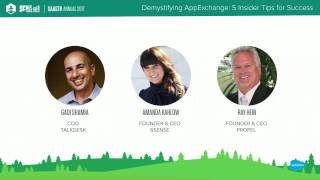
Gadi Shamia, Amanda Calo, and Ray Hine explain why companies list on Salesforce AppExchange, which launched in 2006 and now has 83% of Salesforce customers using at least one app. They share practical lessons: don't treat your listing as set-and-forget, invest in evangelizing to Salesforce sales teams, and use reference customers and Dreamforce visibility to drive adoption.
Chapters
Please welcome Ian Dunkle, senior product Marketing.
Manager at Salesforce to the stage.
Hey, how's it going? Thanks for stopping by. Really excited for the session we have planned for you today. We have a few of our panelists which I just want to welcome. We've got Gadi Shamia from Talkdesk. Come on up, Come on up. Yeah. How's it going? Amanda Kalo from Sixth Sense and Ray Hein from Propel.
Thanks.
Good to see you.
Are you guys permission? You can see it?
Yeah. So I hate to do this to you, but I'm also going to. We have a great panel here, but I also am going to take you through a few slides because I know that not everybody may be familiar with what the AppExchange is. So just want to level set everybody and give you a really short history and then it's really about our wonderful panel we have here today. Also, quick reminder that Salesforce is a publicly traded company. So we may be making some forward looking statements. Please make all your decisions based on what's available today. I have to say that. So first of all, when I talk about AppExchange, what do we mean by that? And what you'll usually hear is it's the number one business app marketplace, but it's really more than that. It's kind of the digital embodiment of our entire ecosystem, which includes our customers, our partners, and even our employees. And it's a place where everyone kind of goes to make their business better with the ultimate mission of making their customers really more successful. And what many people don't realize is that it's actually been around for 10 years. So launched in 2006, actually predates the App Store. So Benioff was really thinking about how we could open up our platform, build this ecosystem of applications that really can enhance or extend Salesforce to ultimately make our customers more successful. And really, I always like to show this slide because over time the ecosystem has grown quite a bit. And with that, customers, Salesforce customers now start to look at the AppExchange as a place where they can go to solve certain problems. It's kind of their first stop to see if there's something that's already pre integrated with Salesforce. So if we look at the chart here, over the first five years, we hit a major milestone, which was our first millionth install, which was really exciting. But then that growth continued and over the next five years, that figure actually tripled. So we had 3 million installs, bringing our total to 4 million. And we expect that growth rate to really continue at that same rate going forward. And the important part to realize about this is that an install isn't a single user. An install is actually into a salesforce. Org, which could have anywhere from five to over 10,000 users. So you can see with this type of scale, there's a lot of folks that are actually really benefiting from the apps that we have on AppExchange. And this is also why our partners love AppExchange, is because this is a way for them to plug in and to really participate and be a part of the ecosystem. And there's some really amazing kind of stats that can come out of that when we're talking about this install growth. But really, that's one install. Every minute is another way to think about it. But the stat that I think is kind of the one that I'm most proud of is 83% of Salesforce customers have at least one app from the App Exchange. So that's really showing. Like, they're coming to the App Exchange, they're engaging with our partners, they're actually installing applications. And this doesn't mean that they're just small businesses or large enterprises or American companies. It's really across the globe and across all different sizes, companies are benefiting from the App Exchange. So with this type of opportunity and volume, what we're really here to talk about at Saster is there's a great opportunity for any business out there who wants to kind of plug into the ecosystem. I think if you're out there and you're enhancing or you're extending or using Salesforce data, you should kind of go and evaluate if AppExchange would be the right strategy for you and for your business to plug into this ecosystem. Which brings me to my first tip, which is how do you get started? A lot of people will ask this question. It's really simple answer. Start off looking at what you have already. Do you have an app that you like? If you do start to integrate, even if you don't want to get on AppExchange, you should also look at what it would take to integrate, because your customers are going to ask for it. I know a lot of the attendees I've talked to today have been taking advantage of one of the things we have downstairs on the second floor, which is our growth grove. We have some technical evangelists that we brought here for all three days where you can sit down and talk about what that actually means to integrate. So I highly recommend you check that out. And then also, if you're still kind of at the idea stage or maybe you've built a prototype. You could also look at building on the Salesforce platform. We've opened up the platform for everybody to build applications on it. It's the same platform we build all of our apps on. So customers are used to it. It can scale internationally and it's actually a piece for customers that build on it find that it's easier to gain customer trust through that process. So like I said, it's not about the slides. It's about really talking to our panel here and the experience they've had with the App Exchange. So why don't we just actually start by going down the line, tell us a little bit about yourself, the company and what you do.
Hey, good morning. By the way, quick question. Am I the only one? I find it weird that the deep dive theater is in the fourth floor. Is it really me or. Okay, I thought so. My name is Gadi Shamiya. I'm the CEO of Talkdesk. We are five years old company building a cloud based contact center solution with thousands of customers. We have been Salesforce partner officially for little less than a year and before that we were the partners Salesforce didn't know they had. I'll talk more about it in a minute or two.
My name is Amanda Calo. I'm the CEO and founder of six Sense. We are a predictive intelligence company. Very simply, we predict for time when somebody is in market and they have a pain for what you're trying to solve and what your product does. Salesforce is an investor in Sixth Sense and we're really proud to now be on the App Exchange.
And I'm Ray Hine. I'm the CEO of Propel plm. We're a company that's just slightly less than two years old, partner with Salesforce all through that whole cycle. It's my third time around with being involved in the App Exchange. One with an integration, one with another company that was 100% native as well. We provide product life cycle management for hardware, software type companies. Anybody that's a product company that's trying to develop, launch and introduce products. So it's the product information and then the launch into the customer and then those relationships between the customer and the product.
Awesome. So I talked a little bit about just getting started with like an integration, but I'm also curious to kind of hear. Amanda, I'll start with you on this one. Just curious, how did you find the App Exchange? I know that you recently listed. How does that fit into your Overall strategy and what made you decide to join.
Yeah. So the first tip I have is we probably waited too long, so we should have integrated a long time ago. We're about four years in as a company. All of our customers, I mean, it's really simple. All of our customers pretty much are Salesforce customers. So when we think about our target market and our decibel market, who we're going after and where do they go to design their workflows for sales and marketing, and that's what we're integrating into because we're helping them find buyers when they have a need. We should have had our app a lot longer in the process and in the ecosystem. I will say, though, as you're building into the App Exchange, you really think about owning your own destiny in terms of you outsourcing that development or doing it yourself. We're integrating in. We're processing about 90 billion rows of data a day for our customers. So we couldn't build on the App Exchange. We're an integration partner on the App Exchange, but it's really transformed and given us the ability to grow our revenue streams. So we think about the big customers working with Cisco, Dell, Lenovo, all these big enterprise companies that we're helping them find buyers and in their sales process, if we're not in their Salesforce helping them with that workflow, when somebody is actually that sales rep is picking up the phone and trying to know who the next person to talk to, we're missing a huge opportunity. And for us, that's a chance for us to charge a lot more money per user per install base when people are actually using it in the Exchange.
Fantastic. Got it. You also have kind of an interesting story about how you got started. Why don't you share that?
Yeah. So we had a Salesforce integration for four years. It was one of almost 40 integrations we had for various CRMs and e commerce systems. And it was pretty deep. It was deeper than many other integrations, but it was not unique. It was not different than our Zendesk integration or Desk integration or many others. And we decided, about a year ago, we decided to go all in and move from being get this partner that has many mutual customers with Salesforce. But Salesforce didn't know about us to become a formal partner. So we build the managed package using our technology and we listed on the App Exchange in June last year. The results were actually pretty great. And obviously not everything is because of the App Exchange. And we'll talk about it too. There's no magic. It's like launching a website. You're not just go in the app exchange and the world stop buying your stuff like there's no tomorrow. There's a lot of work for us. Great, maybe we're doing something wrong. So tell us what you do. But there's a lot of work involved. But what really happens is twofold. One is the product is much better. So Salesforce has a really robust platform. So when we demo talk to us for Salesforce, people like it more than when we demo talk to us for other products. It just looks better. There's integrated reporting, the single sign on for users. We could just there's more we could do to deepen the integration, make the experience seamless. And we had some interesting side effects because of that. For example, we were very focused on service and most of our customers are in customer service. But all of a sudden sales teams came to us said, wow, this is actually much better than the typical sales contact center, call center solutions we use despite the fact we never built for this use case. So all of a sudden we have sales teams come to us. And some of our biggest deals with Salesforce last year were actually from sales teams, which was kind of an unintended consequence of this integration. And I want to leave some of the others, but I would like to go back and talk a little bit about the idea of working hard and not only just listing your app.
Yeah. And I do think that's an important point to notice that it really is kind of a partnership too. It's not something like a set it and forget it. And I think some people will go on and just put put up their listing and expect it to start kind of rolling in. And that's definitely not how it works. It's really kind of, like I said, the face of the ecosystem getting started. But Ray, you've been in the ecosystem a couple times now. Tell us a little bit about how you got started with Propel and also how are you kind of getting noticed and building some momentum early on?
That's great. Well again, enterprise product lifecycle management is a category much like CRM and HCM for human capital management. So it's a four enterprise category, not a feature that you see some of the app exchange type bolt ons or add ons or helper apps are more of that to sales, cloud and the like. So we decided to look at the movement where PLM was going from on prem. It's still largely an on prem, much like where PeopleSoft was, you know, eight, 10 years ago and workday Came and has replaced that. We're doing that now in the cloud. So we analyze the cloud platform opportunities with IBM, Amazon, Microsoft, anybody that we could leverage from a technology stack. And our vision was that it wasn't just engineering and R and D and product information at the front end, that we also wanted to link it to the customer side so that the App Exchange and Salesforce's app cloud platform just made sense. Number one, I'd also had experience of seeing the power of the full App Exchange, the partner program, when you get the flywheel working. My prior company I worked at was a company called Aptus Configure Price Quote. One of the darling companies that's really grown. If you go to Dreamforce, you see them every year as one of the very large companies that's there and realized that it's not just about design, development, the technology, but if you really understand how to leverage the full power of the AppExchange platform in Go to market, understanding the partner ecosystem, working with other partners and solutions, you can really get that force multiplier that you don't get if you just build it on another technology stack. I'll just bring up one more point and let others talk too. Is that building on Gotti's, once you post it to the AppExchange and you release it, you go to security review. We were one of, I think you guys say that we're one of the fastest from idea to app through the security review. I think it was six months on our 1.0 minimum viable purchasable product that we had and three customers in nine months in an enterprise business class application, which I don't think you can do on many other platforms. But it's really how do you feed the App Exchange and nurture it? We have an amazing marketing team. One of my people is here as well and we knew how to leverage that. Getting App Exchange reviews, making sure you have live, happy, referenceable customers that are willing to talk about it, and then knowing that you get the benefits of things like a channel order app and license management and all the technology that actually helps you launch, build provision software and make sure your customers are live. You get those components as being part of the ecosystem and leveraging the App Exchange, which there aren't many other, if any, that are out there that can even state that.
So then you mentioned kind of you started off really focusing on getting some of those customer reviews through AppExchange. Was there anything that you focused on in particular to get those customers to start engaging with you?
Yeah, we started early on and made sure we had early product market fit with customers prototyping early on. The fact that before we even had our security review completed, we had three or four customers that had already been playing with the product in a development environment with us, really understood it. So they helped us build that product out for their use cases. But we knew what we were doing for a general market fit because it was, as I said, moving from on prem to in the cloud. So we knew that aspect. But getting early feedback and bringing them in made a lot of sense. We also were able to go to Dreamforce in the very first year, in nine months of being founded as a company and show up in the Salesforce for startups area. Had a couple hours to demo our product. Folks were already starting to get a little bit of buzz. We had three leads that came out. We were literally less than a dozen people and had three leads come out of a Dreamforce event. Being less than six months old, it was pretty impressive.
Did you close those leads?
We closed two out of the three. One of them were still working.
That's good conversion rate.
Good question.
Yeah. So overall, how has it been, Amanda, when you were talking about integrating, have you had any customers come back giving you any sort of specific feedback to their overall experience?
Yeah, and I think so. I'm going to take a half a step back and just kind of share what we do and how we integrate in and then I can share the feedback they've had. So when our customers, when we're making the predictions, we're taking all kinds of behavioral data across our customers channels. So their website, their marketing automation, their CRM data search data, blogs, communities, forums and we're finding buyer behavior. So we're saying this company has a need for networking solutions now for Cisco and then we push that data into Salesforce. We have it in our app in sixsense.com and so when we did it in our own environment, we thought we actually, like many of you may be, when we were early on, we thought we wanted to own that experience. We had this big vision and this big dream that, that we can transform how sales and marketing is actually done. Instead of looking at static data and creating target lists, we're actually going to change and we're going to know when somebody has a need. You're going to pick up the phone, you're going to have the right message, the right time, the salesperson, the only thing they really care about is time. So they're really optimizing for. They want to go and do the things that they do offline. No offense, some of my sales team that's here, but there are sales folks that are just every day when I pick up that phone and I have a conversation, I want to know I'm talking to somebody that actually has a project and has a need and are likely to move forward. And so when we started, we thought we could get everybody to come into six Sense and do everything natively in six Sense and really transform marketing and sales in our world. But what we realized two, three years down the line is that we're not going to change those workflows. The workflows are there. So all of you who talk about sticky and trying to get people into your own environment, unless you get big enough, you're not going to actually have that kind of impact no matter how good your results are. We have to integrate into Salesforce and into into their marketing automation and into their ABM platforms to make all of their existing sales and marketing workflows smarter. So once we kind of took that shift of perspective as a company to say we're no longer going to be about getting people to come to six Sense and to come to our native app, we're going to actually push out into all these systems, we saw a huge transformation. And that's when we, right now we integrate our predictions into Salesforce and into the app and we say this company is in market, but in the future it's really understanding why they're in market. And what should I say to somebody? Because if there's a different data set that says now is the time to talk to them and then the other data set is, well, what do they care about? And it's not the same thing. The data that predicts somebody has a need is not the data you're going to pick up the phone and talk to somebody about. So those insights, to really understand how to make it actionable and useful for the salesperson is kind of the next step and to engage your sales teams that are actually having those conversations and engage your customers early in the process, which maybe we probably were a half step behind. So I think that's one of our biggest learnings is that get into the sales process early, understand where they are in their buying cycle and getting the data into their existing workflows rather than trying to control their experience.
One quick follow up comment on this. In enterprise, if you come from consumer UI centricity is really important. You want people to use your UI and daily active users and how many screens people went through, maybe you want to sell ads, whatever the metric is in consumer, you want to own the UI in enterprise, think of a product like talkdesk. People will still call and will still send us a messes and still do everything that we support. So we don't necessarily need to focus so much on owning the ui. It's opened up a great opportunity for us to just stay within the workflow of the service reps or the sales reps or the supervisors. Think of the confusing world of sales rep today they used to work with. If anybody's old enough to remember things like goldmine from 20 years ago, some people do. They had this one very simple kind of Rolodex like ui, this is what they work with. Now if they need to Send document with DocuSign to answer this with Talkdesk, they need to work with so many different systems that give them an option to work within one screen. It actually sometimes can be the make or break of a success. When we talk with customers, they actually mentioned how maybe take a step back. There's two things we actually try to do for our customers. Improve people productivity. In this case, either agents or SalesPeople and increase CSAT. These are the two kind of levers we're playing with. How do you do that? If you are able to keep an agent in the one system they use, in this case Salesforce, when a customer calls, you give them all the relevant information about the caller. So the call doesn't start with how do you spell your name? Let me put you in a brief hold. When I research your situation, spell your name again. Is it this phone number? So if you can just snap directly to. Hi Mr. Shamia, thank you for calling. I see you have an open case from yesterday. Are you calling about this case? Whole different experience and the agent is much more focused. They don't have to think of how hard it is to alt tab between or move between tabs and speak on the phone with an aging customer at the same time. So keeping the agent focus allows them to really engage with the customer, have shorter calls and drive higher csat. So we kind of win on both sides without losing anything because people still use us 8 hours in the day when they're in the office. So if you're really focused on ui, it might not be the thing for you. But if you're really focused on usage and your product lend itself to people, use it as part of the workflow. This is the right. Integrating deeply into salesforce is the right.
Thing to do for you to build on that again. We live in this enterprise space as well. So a lot of our customers have Microsoft, IBM, SAP or Oracle throughout their system, Oracle or SAP on the back end for their ERP and financials. And we have to integrate deeply there. So it's really easy with some of the technologies for us to come back in and say there are amazing partners like Mulesoft and Jitterbit and Informatica that already do that. They're pre built integrations. And what would take your IT team months to do, you can do in days or weeks because it's already pre integrated. You guys have gone through that process, so you get again that power of two or three or four on that. But the other piece to add to Gadi's is that I think the technology and the platform and the fact that the UIs may look different as you go from app to app, but still being able to switch and be able to provision quickly makes a huge, huge impact. So one of our competitors is Oracle, big company, they're moving to the cloud now for them to provision our competitor's version of their product, which is called Agile Software. Enterprise PLM takes them five weeks. They stand up a server set, they have to go through a whole provisioning system, then they have to put them in the human capital management system. So it takes five, seven weeks. We say, guys, if you want to buy it, as soon as we get your purchase order, we'll go through the channel order app, it'll be provisioned in your Org and you'll have it up in less than half a day. So you can't compete with that to get your customers live moving. And that's one of the biggest things I think from SAIL to starting the implementation and engagement is very, very different with Salesforce than any other enterprise business company that you can work with.
Yeah, absolutely. And so when we start thinking about that, obviously it sounds like you've been able to spin up customers a little bit faster and it sounds like you've been kind of working with other people within the ecosystem. Can you tell us a little bit more about what your process has been when you're going into market to kind of engage the broader ecosystem?
Yeah, sure. We look at it from both a partner system, from the systems integrators, there's a rich partner system there to help integrate in like your typical sis. But when you look in the app exchange, again, some of the folks we've done work with have been people like congamerge or go forms or again the EAI partners like Jitterbit, Boomi Some other folks workato that I think is going to be showing later today, one of your newer partners. But it allows us to play nicely very easily because we all know what our targets are as far as the integration from a technical perspective. But then I think we also have the same common business language. Meaning that if you're in the app exchange and you're working as a partner, you already have similar expectations of how you should partner and work together. And that makes it easier when you're having to go to market and bring other solutions together that everyone knows what their roles are and the playing field is a little more level.
And so Gotti, you had mentioned it before, but kind of coming to the table of working as a true partnership. You had mentioned that there's something else you wanted to say there.
Yeah. I'm going to demystify Salesforce for you. So focus now. It's an important point. Focus. So here is what you're buying into when you become a Salesforce partner. You're buying an opportunity to get access to the Salesforce ecosystem. And I want to just explain it in greater details. First opportunity. Underscore this word. You're not buying access, you're buying opportunity to access. The rest is up to you and up to your product. So what does it mean? And then I'm going to talk about what does it mean to have access the ecosystem. So the opportunity means that you are getting inroads into specific thing. A simple one is you're going to be listed on the app exchanges is the first step. You might get an opportunity to speak with salespeople. I want to talk about salespeople a little bit too as well. With Salesforce salespeople and get access to them and pitch your product to them. You might be able to buy opportunity to be a dreamforce. You have to pay for it. But you might be able to buy the opportunity to be there and get access to Salesforce customers. So really what you do is you buy the opportunity to access the ecosystem and now you have to work because none of it will happen on its own. I think I used the metaphor of launching a website. You can go to Squarespace and launch a website and nothing will happen. Really, nothing will happen. Maybe your mother will say, nice, good looking website, but nothing else will happen. So what do you do in order to get there first is figure out what's the value prop for every one of the species of this ecosystem. Most important one is sales. You have salespeople at Sales Salesforce. Lucky them. They have like 17 clouds to sell right now because every year there's a new cloud. So they have to figure out all these different clouds and how they sell them and position them. Then they have how many partners? You said you have like seven bazillion partners. Then there's like seven bazillion partners. And I rounded it down. And all of them want access. And yes, some of them are high tier, some are low tier, but all these partners want access. So you have to first figure out why your product matter for salesperson different than why it matters to a customer. Does it shorten the sales cycle? Does it add more seats? Does it create a bigger opportunity? Is it expensive enough for these people to even want to sell it and position it with their customers? Once you've done this, at least you have a story. And now you have to actually go and work and get access and speak with them and pitch this product 100 times. Because just like customers, you're not going to say, hey, here's talkdesk. It's the best contact center out there. It is, but it doesn't matter. You have to repeat this message time and again and then say, oh, we just close this customer. We just close this customer with you. And keep repeating the message until they understand.
So, Gadi, what are some of the things that you're working on this year over the next 12 months to help?
Craig is sitting here and he's driving his program and he can spit out all the things we do and don't do. But we actually try to get access to every place that we can interact with Salesforce people. So, for example, we're going to be a pretty substantial sponsor in Dreamforce. We definitely would like to have the president there and be able to see the customers. We're going to be in many of the world tours and in sales kickoff meetings and so on. So we can. And we actually gonna do a lot of informal stuff, go do lunch and learn, buy drinks for salespeople and so on. So we get to know them. They understand the value of our product so they can position it back and remember us and position back to their customers.
Nice. And I think that's really interesting too, which is like there's different levels of kind of engaging within the ecosystem. It's kind of like you said, you can have a listing where you can go promote it on your own, but there's other ways that people can try to build that value and build awareness within the ecosystem. Another question for Amanda and Ray, you can feel free to jump in as well. What are some of the other ways that you're planning to kind of invest in the ecosystem going forward?
Well, so I think it's really important when I think about the Salesforce ecosystem and everything that we're doing that we have the integrations into, wherever those customers are, we have a lighter product we're coming to market with right now called Search Sense. Essentially it's really simple. Our deep product is get all your data, all this data across the Internet, across all of your different channels. And I think when you think about Salesforce, you've got your pardot and your marketing automation and your CRM and you have every different piece in the web data that's coming through and looking at all those different channels of data. And our Search Sense product and our full product looks at all that and then predicts and pulls our data in. And our lighter product basically just says who's out there doing research on your competitors products right now? Who is looking at Oracle for hcm? Let me tell you those companies and let me make it really easy to integrate that in. I think the next step for us in our partnership with Salesforce in this app exchange ecosystem is to have Salesforce and have those reps like you're saying, going out there and showing. Now if I could actually see that and you could see the companies, Salesforce is great at workflow and pushing your system through and seeing okay, how many opportunities did you open and doing pipeline generation. And it's great for managers, but it's not great for actually finding that opportunity and knowing where to spend your time. So as a small company, if I can help you spend your time wisely on those accounts that are most likely to convert and you can actually go out to the reps right now at Salesforce and they can say to their customers, this is how you're going to get the most out of Salesforce because you're going to be more efficient with your time. I think that's really kind of the future of where we're going with this. We're not there right now where we actually are in there and talking to and like you're saying utilizing all the reps and all the opportunities. But there is so much there that we hadn't even begun to tap in on across everything you can do for Salesforce.
I think for us, you know, where we fit in the space of a whole life cycle is early ideation to the design make and then Salesforce obviously has market sell service. So we're in an area in a space that's kind of foreign to the typical Salesforce sales rep. That said, as Salesforce tries to grow and verticalize and they have the health cloud and the wealth cloud and the like, and retail is becoming big, you know, we fit very heavily in an industry play. So for us, a big investment is to really know the industry overlays the people that are selling into our target customers, educate them. Back to Gotti's point, you have to spend a lot of time evangelizing. You have the opportunity to do that, but you have to invest in that. So, so for us, our marketing team becomes really a sales engine, but really marketing our message internally to Salesforce so that the awareness is there and people can actually find us and know that we're a great Salesforce partner. There are other campaigns, things that we can do to buy space and be higher in the app exchange for at least being webpage view or presented. So we're taking advantage of some of those things. But it really is about more evangelism and awareness because we're still less than 2 years old in market and making sure that everywhere where there is a sales team that's thinking about manufacturing people that are building products, that they know that Propel is the one and only partner that can help them compete against Oracle, SAP, Microsoft and IBM when they're in those areas and that we bring a great power to them. So it's mostly evangelism awareness. And I guess the last piece to build on Gotti's is it is really two sales efforts. You're selling to your customer, but you're always selling to Salesforce. And if you don't plan for that and resource correctly, you're screwing yourself out of a lot of the opportunity or missed opportunity if you don't invest in that way.
Fantastic. And we're running short on time, so I just have to wrap it up. But thank you so much for participating on the panel today. I think you've had some really awesome insights of kind of when it's time to invest in Salesforce and some of the tips, hopefully that people here can take away on how they can really kind of accelerate that growth. So everyone please give them a round of applause. Thank you very much.










