Demystifying the Unicorn Buzz with the CEOs of Calendly, Algolia, and Contentful
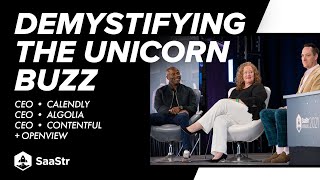
Steve Sloan of Contentful, Bernadette Nixon of Algolia, and Tope Awotona of Calendly discuss what it takes to reach unicorn status. They cover growth strategies, fundraising, and how to keep customers at the center as you scale.
Chapters
Hi, everyone. How's everyone doing? All right. Some good pre lunch energy. All right, with love. We were just saying, I'd love to get a show of hands. How many of you are CEOs and founders in the audience? Okay, great. How many of you are hoping to be a unicorn at some point? Perfect. All right, then you are in there. You are certainly in the right session. I would say so. I'm Casey Renner. I'm an operating partner at Open View Ventures. We, we love B2B SaaS, we love product led growth, and I love talking to people. So this is perfect. And I'm honored to be here with three of my favorite CEOs. So I'm gonna have each of you. I'm hoping everyone knows who you are at this point, but if you could just say quick one liner of what your company does in your own words and how long your company's been a unicorn for. Let's start there. Steve, you want to kick us off?
Sure. My name is Steve Sloan. I'm with Contentful. So Contentful is a content platform. Imagine you're going to find that pair of red sneakers online, that picture of those red sneakers. Everything about it has to live somewhere. It lives on Contentful for thousands of companies around the world. And so we have been a unicorn, I guess, officially as of this year.
Awesome. Bernie.
Hi, I'm Bernadette Nixon, CEO of Algolia. And those red sneakers that Steve was talking about, you would use us to find them. So we're a search and personalization platform, API first. And we've also been a unicorn since earlier this year.
Tope, you've got almost red sneakers on. So tell us who you are.
Hi, everybody. I'm Topan Watana. I'm the founder and CEO of Calendly. What we do at Calendly is we make it super simple to schedule, prepare, and follow up in your external meetings. We've been doing it for about eight years now. Our customers range from individuals all the way through large enterprises that, you know, do business with us to the tunes of hundreds of hundreds of thousands of dollars. And your last question was how long we've been on a uniform?
Forgot already. Come on.
I can be really precise with that answer. December 1, 2020. So awesome. Nine or so months.
All right, awesome. So, you know, researching, coming out. You know, we hear a lot of talk about unicorn. We're here to demystify the unicorn buzz. But, you know, when the coin was termed, I think 2013, there was something like 39 unicorns and flash forward to today, there's over three and a half percent of VC money goes into it. But only 0.006% of companies will become unicorns. It takes an average of seven years. So how did you, you know, we're here to tell these people how you did it. But I guess to start what are the traits of a unicorn company in 2021? And Tobe, I'll start with you.
Yeah, So I think there are many, many traits. I think, you know, the, the ones that I get, the one that I get the most excited about and I think the one that matters most is solving a meaningful problem for a large, at scale, for many, many different people. And so if you've created a product or service that is driving revenue for your customers, that is helping them make their customers happy, that is helping them keep their employees happy and successful and doing that at scale to the tunes of millions of users, or millions of dollars in revenue, or hundreds of millions of dollars in revenue, I think those are some of the successful traits of a unicorn.
Bernadette, what are your opinions?
I think the thing that I would add to that is disrupting so, you know, growth. If you're going to get to be the unicorn, you need to have aggressive growth. And so disrupting a marketplace, I also think is another important part and helping or making your customers think about their problem in a different way.
Yeah.
You want to tack onto that?
Yeah, absolutely. Maybe just to double down a little bit on something you said. So I think there is this separation. Like we all obsess about everyone here, right? About our business and our customers every day. Those are the things that we can control. The unicorn status is actually given to us from someone else. It is a valuation. So what does someone else think about our companies? And so the thing we want to obsess about is exactly what you are all talking about, which is creating a really magical customer experience. But the thing that really separates, I think from investor standpoint, the difference between companies who stay a certain size and companies who they believe can get bigger is the size of your total addressable market. And that's one of the things that I think is important, because when we're all launching a company, the first thing we care about is one happy and then 10 happy and then 100 happy customers. And at some point we have to assess whether or not the opportunity we're going after is in fact big enough. And one of the things that was so interesting to me about this last round of financing was how obsessed that set of investors was with how big this could be over the next five to 10 years. And that day to day we all probably have really hard things to go do. But it was that longer term view that gave them the conviction to invest in all our cases a lot of money realistically, but with the belief that it would pay out over a very long period of time.
The other interesting thing was when we were in our latest funding round, I agree the investors were interested in the size of your TAM or the service addressable market, but we had a very interesting reaction from one of them because we talked about how many customers we had over 100k in ARR and then how many customers we had over a million in ARR. And one of them interrupted me at that point and said, that's all I needed to hear. So you got a big TAM and you can capture it.
I want to go back a little bit. So there's obviously a lot of early stage companies here and we certainly have a lot to talk about on the fundraising and growth side of the house. But if these folks want to be on the 2025 unicorn list, what's sort of step one for them? Bernadette, what metrics should companies start tracking early on?
So I think there's some basic ones that apply to every type of company. Your ARR or mrr, depending upon your business model, the growth in that metric, and then also your ndr, which is your net dollar retention rate. Some people call it nrr and that's an important one. So best in class for your net dollar retention rate, which is a combination of your churn over the last 12 months gross churn, as well as what additionally you're selling into that set of customers. Best in class is over 130%. Nobody just jumps there, or very few, I guess. Snowflake has 169% right now, but if you think about it, if you have an NDR rate of 120%, your company is going to double in five years. If you've got 130%, your company will double in three years. So that's a really important one. And then I think once you get from there, there are certain metrics that you need around pipeline, around signups, if you're a PLG company and that sort of thing. But I think you've got to pick your North Star. And I think it's so easy for us to kind of get bogged down in so many metrics. You got to pick seven. You can't keep track of more than seven. My opinion, that's all from.
All right, so if you got your metrics from a hiring perspective, and Tope Open Views worked with you on hiring from the beginning. But what was your most important role? From 100 to 500 million, 500 million and beyond, or just even looking back, your first sort of big hire? What have been your key hires on your journey?
So every single hire that you. The hire you need to fill now feels like the most important hire. And that will always be the case. But as I. I guess maybe the way I think about it is what is the sequence of things you need to get right to have a business that is worth a billion dollars in enterprise value? And for us, the sequence really went like this. First, we really figured out the product, and it was really about building a product that could solve meaningful, important problems for our customers. Once you then have that, the next thing you want to do is get as many people in this world to know about that product. So the sequence I would think about it is, first, let me make sure I have a product that solves important problems for our customers. And I have the proof points to. I have the proof points to show that, and then how can I tell the world about it? And then the third thing I started thinking about is culture and values. Right. You'll find out very, very quickly that once you have a product and you have a. And, you know, a way to get it to the world, the next thing is you need people to help you advance that mission and people and you need to create a culture that attracts those people. So those are the three, I would say big hires and then obviously operations. Right. Everything quickly followed.
Yeah. Steve, what are your thoughts on that? Because, you know, you've been with Calendly from the, you know, very beginning and so have seen those hires through. And then, you know, you've not been at Contentful as long as Tope has been with Calendly. But what were your key hires when you came on?
Well, I think one of the things that I want to double down on that Tope said, is as soon as you start hiring, as soon as you start hiring dozens or tens of people, getting to a place where it's a bit more formulaic in that Tope mentioned values. And that's the one thing I've seen really break down at a bunch of companies. When you start to scale up, when we're 10 people or 30 people, you interview every single person. And the reality is that there's so much touch between the founders and the senior leaders every single day that the values are super organic there. Then Comes a place where other people are doing your hires for you. And then you need to know, as a founder, as a leader, that those people who are joining your company really do align with your values. And so one of the things that we did was to go back and get a little bit crisper both about how we articulated those values. We brought it down to just four. I don't think there should be many more than that. Everybody should be able to articulate them on the spot all the time. And then we introduced that into the hiring process as the first thing. So the values screen is the first screen, the skills screen is the second screen. And it was that combination that I think has been really important for us. We did a lot of hiring in the last two years and the culture hasn't fractured or broken or become multiple cultures within different teams. But it was only because we got really, really intentional. And the companies I've been most excited to be around, whether I worked with them or not, have all had that really, really consistent values and real clarity about the fact that they are a cost of entry. Like if somebody doesn't share those values, they may be incredibly skilled, but they're not going to join the team.
That makes sense. All right, you've got your metrics, you've got your values and your people. Next on the unicorn checklist, can you get to unicorn status in just one with a single product? You and Bernie were chatting about that, so I'd be curious. Bernadette, we'll start with you on that one.
So can you become a unicorn on just one product? Yes, you can. What Steve and I were talking about backstage was it takes a long while to launch that second product and for it to reach whatever you call it, lovable maturity, where you can replace most of your competitive products on the market. So there's a fine balance, I think, in terms of introducing it too early versus too late. There's a little bit of art in that. I'd love to hear from you, Steve, on that. But the one thing that I feel really, really strongly about is as you're thinking about introducing that second product, make sure it's a product that's applicable to your main Persona or the decision making unit to which your sellers, your go to market strategy is already aimed because otherwise they will have a hard time and they'll have to do what I used to call the up and over. You know, I join a company, there'd be great second product or a fantastic acquisition. And I'm like, yeah, you don't sell that to that person. So how are we going to navigate that? And it ends up being hard for your people in the field.
Certainly if you're Google, you can have one product, it worked pretty well. But for many of us there will be at least add on products. And a shorthand for what Bernie was just talking about is product channel fit. We obsess about product market fit with our first product so much did it get any traction. Wow, we've seen so many great products die on the vine. So because they didn't have good product channel fit, it's to a different Persona, it's a different sales motion, it might be in a different geography, et cetera. And so as you're thinking about other problems to solve for your customers, because I think there's a lot of confusion about second products, which is some people say, oh, you shouldn't listen to your customers, they don't know what you want. Or they don't know what they want, excuse me, or others would say, which was what we would say you actually have to obsess about your customers problems. Our argument is that actually asking someone, well, what do you want me to do for you? It's just not a very good question. But if you can find great ways to form that question, they can tell you what their biggest problems are. And inevitably there are problems wrapped around the core thing that you do. And then those become interesting add on products. But only if you have good product channel fit. Otherwise it is likely to both be distracting and honestly, we've seen lots of companies get swamped, particularly at that sort of 25 to 50 million dollars in revenue zone where they start to split their efforts and it really, really slowed the company down. And once that decelerates, it can be very hard to re accelerate and just.
To expand on that. On Steve's point, in our case, we have a single product and we will for a very long time. And part of the reason that we've been able to do that and still grow and become a unicorn and still grow at a pretty fast pace is really expanded the types of customers we can serve with that one product. So we launched the product and we initially had product market fit with individuals and we solved scheduling really, really well for those individuals. But it turns out as we're solving scheduling for those individuals, they also work in teams. Right. And they began to help us understand that team scheduling. And when I'm scheduling with my team and pulling my availability with my team, it's a whole different set of considerations there. And so we evolved from just being able to solve scheduling for individuals to being able to solve it for individuals and teams. And what happened along the way is we actually found that when we did both of those things, our ability to recruit, to retain those customers one doubled and it provided massive growth opportunities. Right along the way we also found out that just solving and scheduling loan for our users was not enough. They wanted us to help them schedule their meetings seamlessly and efficiently, but it also wanted us actually improve the outcome of those meetings. And that created a whole new set of revenue generating opportunities for us and value creation for our customers. So taking that single product, right, but solving it for, but serving many different Personas with it, whether it's individuals and teams and enterprises across the, across geographic boundaries, across different industries, is yet another way to grow before you start to think about a second product. Because there are more synergies taking that same product and solving it, using it to solve the similar problems for other users than it is going to a second product. So you want to make sure you maximize the juice from your first product before you begin to. Yep.
How many people here are calendly users? All right, good, good. Just wanted to make sure. Yeah, I'm like, are you a calendar user, Tope? Like occasionally, sometimes. Okay, perfect. All right. Before we move sort of on to the growth piece, what separates a unicorn from the rest of the pack? Early on, you know, Tope, did you know when you founded, you know, this company and you're like, I want to make scheduling easier, Were you setting out to be a unicorn, you know, or were you just like, I'm going to build this great product that solves a need for a pain point I'm facing and lo and behold, here we are. But you know, even from, you know, Bernie and Steve, when you've seen other companies, are you like, that's going to be a unicorn? And if so, why have you said that?
Yeah, I did not. I was not thinking about being a unicorn when I first thought about building Cal and I'm glad I didn't actually. I actually think that, you know, the responsibility of building a billion dollar company on day one, when you don't even have a problem product, you don't have a first customer, would have been incredibly daunting. And I think it is actually good to be a little bit naive about all the possibilities on day one. What I got really, really excited about is one first I had a problem with scheduling and I got really excited about. I spent a lot of time understanding the market and in those six months that I spent studying the Market I got really excited about what could be built and this great problem that nobody else seemed to kind of see the urgency around. And so just being able to prove that there was a better way to schedule and you could actually get people to adopt that product was what I was very excited about. And that's really what drove me in the early days of Calendly. Fast forward to, like I said before, we started with individual users. Along the way, as you begin to solve that problem for those initial sets, initial users, you realize that to retain these customers that you fought really hard to acquire, the best way to actually retain them is to continuously do more for them. Right. So those individuals, the best way for us to retain those individuals is actually be able to solve their problems with, you know, be able to solve their, serve them when they become teams and vice and so on and so forth. And so being able to retain those customers is ultimately what drove the desire to, to grow fast. And, and many, many years later it's turned into, you know, billion dollar plus market cap business.
Here you are. Yeah, talking about it. Bernadette, what sets the unicorn apart, do you think, early on?
Well, as we talked about, it's having the disruption, it's. But I think I agree with Tope. I think setting your sights on that on day one would be just so much pressure. Somebody said to me recently, and I think it's right, the amount of, you know, the likelihood of becoming a unicorn is inversely related to the amount you actually talk about becoming a. I really believe that that's true. I mean, I think to Steve's point, building the business, solving really meaty problems and so that you can grow with those customers is really where the focus is. And when you get to do that and you do it right and you've shown you can grow, grow consistently over a period of time and out into the future, five, 10 years, that's when you get the moniker. But it is a byproduct. I don't think it's the primary goal at all.
I agree.
Build a good product and they will come. Sounds simple, but not everyone does it.
Super hard to do.
All right, so the path to unicorn status is different for everyone. There's some people who, they just want to dominate the industry. They take a bunch of money and they worry about making money, you know, down the line. And then there's other folks, you know, Tob, I'd say, you know, you were, you know, you just built this great product, you spent less on sales and marketing, dare I say product led growth that we love to talk about at Open View and the growth comes. But you know, I think the thing you see across a lot of unicorns is they've all for the most part defined, you know, their own category. So how do you create, you know, this path to success and create a blueprint for becoming a category defining company when there aren't predecessors in the space to look towards? How do people think about that?
Yeah, again, I also, in our case, we weren't too obsessed with the category in the early days. I think now we are. Right. But some of the things I think that helps, some of the things that help are in almost every single thing you're looking to do. Somebody has done it before. Maybe not directly in your category, maybe not directly near space, but there's a, there's a very, very clear example that you can follow. And so I would look for those parallels. So for us in the space of scheduling, there are no scheduling unicorns. But if you look at what are other businesses that are out there that have taken what seemed like a really small problem and expanded around that problem and built massive businesses, there are many, many different examples. So digital signatures comes to mind. You look at Echosign, you look at Docusign. Right. You look at Dropbox, you look at Box, you look at what those companies have done. And I think following the oh oh party, they really love that answer. So I think following the examples of those companies is always, always really good. There's, you know, so even when there are no direct competitors or there's always these indirect examples you can pull from.
Yeah. Steve, what do you think? We did say we were going to have a dance party during. So I think that's our time to break.
Hope's going to start us off.
Yeah, go.
That's an inside joke.
So the thing from a category standpoint, I think there are maybe two topics that are really helpful if you're thinking about the category you're in. One is the topic is friends and one is foils. So if you think about a company like Salesforce that did a beautiful job early on in creating or in co opting a category, there was already a category known as sfa. There was actually a category known as CRM already. And they're an example of doing a beautiful job of finding a foil, someone else who is the anti hero to what it is that you're doing. So it was the famous no software thing. And so they executed that brilliantly. Obviously there's another, which is the friend bucket, which is, is there a group of companies who can be successful together if you get a narrative that you tell together. So in our world that's something called the jamstack. And so a group of companies came together to talk about the fact that there's this new movement in software known as the jamstack. This set of companies that are JavaScript, API and markup is the jam in that stack. And it was the alternative. But it was only through that really chorus of voices that the category that we helped to pioneer in the beginning, which was called Headless cms, it had a little bit of each, it had some friends in the jamstack and it had a foil because the content management system category was a big category, but this was the headless one. And so we had to then define what headless was, what why it was different and why it mattered. But it wasn't until those two things came together that the traction of the company really started to pick up. And so as you think about the category you're in, think about friend and foil. How can you use those in order to generate more attention and to separate yourself either from the mental models people have or from the narrative that the dominant players have established in your category?
Company's growth journey isn't typically linear. So you know, how do you think, Bernadette, about being flexible and continuing to evolve your go to market approach over time? Especially since you came in a little over a year ago to Algolia? How have you thought and you've seen crazy growth since you've joined? How have you thought about that iterating on your go to market model? Because it certainly just can't be one size fits all forever.
No. And I think it depends upon the nature of the product that you have. I mean, we started as a product led growth API, part of the Jamstack, the Mac alliance, so part of that, the FOE model, the friend model, I would say. And so when you look at it, we grew for a long time as product led growth, but because we also touch and that was through the developer. Our primary Persona is still the developer, but yet there are other roles in that decision making unit that come in when you start getting out of outside of search and into more of the personalization and merchandising kind of categories. And so that brings business people into the mix. And so therefore you need a sales organization to really have the translation conversation with the business Persona in that decision making unit. So it really, you know, for us we started this product led growth, we layered in sales led growth. And then as we have you Know, we're a platform so we can do search and personalization for many, many different types of industries. E commerce is just easy to get your head around. But you gotta then figure out, well, how do you make your salesforce productive? And that's around, well, you know, as you were saying, articulating different plays, different types of problems that those customers you have need servicing and then figuring out how you package that so that you can become efficient at it. And so when you. Because when you have a platform, you can do virtually anything for anybody. And that's great news. That's also the problem because where do you focus? So it's a constantly evolving thing.
Yep. All right. I'd be remiss if I didn't ask, you know, now I think a few, we've all mentioned product led growth and like I said, that's openview's favorite term to talk about. So do you believe all companies need that growth model to become successful and you know, in the case of this panel, become a unicorn or can they do it without it? Steve.
It'S certainly possible to do without it. So imagine you're selling a product and there are a hundred target companies on the planet. The product led growth model might not be the one that you need because you can say, hey, here's literally a list of the people we'd like to get. Someday we're going to find the decision maker within those companies and it's an easy hunting ground. Now, if you hope to serve thousands of companies over time, the product led model is one you might want to consider. And the reason is that you want to think about both the friction at the point of initial customer acquisition and then the friction that's involved in adoption over time. And so like, I mean, I love Calendly, I'm a huge fan if you've ever used Calendly, it's sneaky, addictive, right? Like it gets in and all of a sudden you realize, this is how I want things to continue to work. And you send it to your friends and then they get addicted too. Like, that model is so important. But the thing that's, I think even sort of a meta concept on top of that is the fact that for so many years there was this notion that if you sold technology, you sold to a CIO and her team and so you could go to one buyer really high up, you could look her up online, you knew how to find her for a lot of these other products where the users are acquiring, which is happening more and more and more. It's A different motion. And one thing I would warn against, and one of the challenges we find all the time is whether it's investors or advisors or people you're bringing into the company who are used to that other old school model, they're going to think that's the only way to do it. And I would, you know, to this room here, I'd ask challenging questions about whether or not that's true. You know, all that friction in the process is that really in service of our customers, is that really going to help us get more customers more quickly? And I do think most companies would be well served to at least ask those provocative questions more often.
Yeah, yeah. There's so much I can say about plg and there's no doubt that I would not be sitting on the stage of calendar to not, you know, build a great use the PLG model. There's no doubt about that. I mean we've grown really fast because of that. But the way I like to think about PLG is that the hardest part about anything is getting started. Like bar none, the hardest part of anything is getting started. And that's really what, that's the true value of plg. That every business, whether it has a problem that lends itself well to the PLG model or not, has an opportunity to really reduce the time and effort to value. Like what is the amount of steps, what is the amount of steps a customer has to take from the second they're interested in your product? How many people do they have to talk to? How much time do they have to wait before they can actually touch the product and get value out of the product? And if you're constantly looking for ways to reduce the time to value, reduce effort of value, you can get the benefits of plg. I'll give you an example. There's a friend of mine who runs a, who runs a very successful business that is sales led. And one of the things we were talking about with this friend's business is that they, a few years ago they made this push to convert most of their customers to multi year contracts. They found that when they acquired customers and put them on multi year contracts, they just retained them two, three times better. What happened in what happened inadvertently in the process is that it extended the sales cycle so they retain customers better, but now it takes them three times longer to acquire a customer. And as a matter of fact, they're actually losing some of the customers in the process. And so long story short, there's, they found an opportunity and something they're going to look into to see can we grow faster by going back to this shorter contract. That's what PLT is about, just reducing the friction to make it easy for your customers and drive growth in the process.
The interesting thing is if you look at all of our businesses, each one of us have disrupted the traditional players in the market. And one of the so you know, everything that used to traditionally be enterprise, we've all challenged the norms on that. One of the practical things that we found when we were sort of going from being pure product led to having tops down sales led motion as well was that we made a decision, this is a while ago, that our betas, our new products or new add ons would only go out to the enterprise. And it elongated the development cycle. And so we, you know, we, you know, I got with the co founder and we had the discussion, we said, yeah, let's scrap that. Let's make everything available through the self service channel. Product led growth and you innovate, you find the feedback loop is so much quicker and the pace of evolution is so much quicker as a result. So I've lived in both. I would only want to live in at least a hybrid of a PLG SLG now.
Love that.
You know the interesting thing about maybe going back to your previous question, the interesting about plg, if you do it successfully enough, you'll eventually have to introduce a sales side model. So the world eventually collide. But I think that guiding principle of no matter which model you're applying reducing time and effort to value is the North Star.
Yeah, I know. I think we don't. PLG doesn't hate sales. I think that's, that's right.
We have a very fast growing sales team at Calendly. Yeah, I feel like I cut Steve off.
Okay, Steve, sorry. We were getting so excited about sales and plg.
No, I think, I think actually you just hit on it.
All right, so you're perfect.
It's not anti. It's not. That's the thing, it's not anti sales. That's like the product led growth the part. And Blake and I have talked about this like the P in product led growth. Some people interpret that as like the organization, the product organization within your company is sort of like in charge. It's totally not what it means. You're actually saying the customer is in charge. And one of the things we found that I've been in now four businesses that had this dynamic, it does two things. One, it gives you this quick feedback cycle but holds you really accountable because in a Product led business. If you don't live up to that promise, they go away right away. And so your ability to create something on an ongoing basis that your customers really love is not just obscured by a three year contract. We just displaced a legacy player at a very, very big company because the customer had become disillusioned with them. They were on a three year contract, they were two months from the contract coming up for renewal. So that sales team came in to start talking about this very big company, about a renewal. We had been live for 60 days, so the software was shut down already. And it was because their whole motion at their company was wrapped around this three year cycle. It had a product led growth business. We think daily, weekly, monthly. What are those metrics look like? How happy are people? What does adoption look like? And so I do think it inoculates you from some of those challenges that you find as you scale, which is you get a little bit more distant from your customers and then you have that risk of you yourself being displaced.
Customer led growth. There it is.
There we go.
New term. All right, we only have 10 minutes left. So I want to talk about fundraising because obviously that's a huge component of becoming a unicorn. And the valuations, to your point, it's not really up. I think you said earlier it's not up to you. It's what investors essentially value your company at. So, Bernadette, how have you thought about raising and deploying capital? Because you came in as the CEO and raised the round that put you at that unicorn status. How do you think about that? There's some companies out there that just think we're going to raise millions and millions of dollars at this huge valuation and think about making money earlier. And then there's others who think we're going to raise this money, we're going to deploy it effectively. How have you thought about it since coming into Algolia?
So I think the first where I started was you want to raise the money when you don't need the money because then you can act financially independent because you don't need the deal. So I think that's sort of the foundation block. And then, you know, in preparation, you've got to make sure that you've got your story, you've got the tam, you've got the product proof points, all of that sort of stuff. And then when you get successful and you get evaluation you like, and then the most important thing is to get the investors that are right for you for your business at your stage. So, you know, in the early stages, it's got the VCs, it's the people that have the operating, not unlike Open View that have the operating teams that can really help you bring more than just cash to the table. And when your later stages you, you may look at different types of investors that can be with you on the path to the ipo. They can buy not just in the latest fundraising round, but also when you go public. So there's different things you have to think of at different junctures, different stages. And then at the end of the day you've got to grow, you gotta burn sufficient capital, but you haven't gotta go, you know, stupid. I don't know any other way of saying that, but I guess different people have different definitions of stupid. But.
You took my next question which was gonna be, you know, what was the most important quality you look for an investor and tope, I would love to ask you that question. Full transparency OpenView is an investor in calendly.
I have a general rule of thumb for how I approach big decision decisions. I almost always start with my own independent viewpoint of what I think I need or what I think is important in that. So whether it's hiring an executive or picking an investor or picking a partner and then I get really excited when I meet somebody who completely flips the script, right? So when I think, just when I think I have all the answers, somebody who goes and changes all the questions, that's a really good partner for me. Right? So very, very long winded way of saying partner with people who you can learn from and expand your thinking and broaden your horizons and get you in conversations that you otherwise wouldn't be able to get into yourself. So those are some of the things I think about.
Steve, is an IPO a be all end all for a unicorn?
No, no. We think of an IPO as a fundraising event. So it's a financial event, number one. Number two, we think of it actually as a marketing event. It's an opportunity for a broader set of people to become aware of the company. And if you look at the companies who have been successful over time, the IPO is a little blip along the way. If I could may just throw out one thing, try and purge from everybody at your companies vocabulary the phrase exit or the word exit. It's not an exit, it's the starting point. There might be some people who aren't in your company, some investors who need a liquidity event or they need to leave, they're going to go off and recycle. But this word of exit, I find it really strange because everyone here, we're all builders. We build stuff for a living. We're not trying to exit. In a perfect world, we get to build stuff for decades. And so I find that word to be really, really corrosive in terms of getting everybody to think about the long term, to Bernie's point, how we invest in a wise way and in a disciplined way. Because if you're thinking about the exit, which is 12 months or 24 months or 36 months out, you do build your business differently than if you think we want to be here for five, 10, 20 years.
Right. We've got a little over five minutes left. So, you know, for the people in the audience, I just want to kind of with each of you, if you had to summarize all the chatting you just did for 45 minutes into, you know, a couple of takeaways where you're looking at these early stage founders who want to just grow a successful business. What is your top piece of advice for them? Unicorn or not? Which I think we learned. Don't go ahead thinking you're going to build a unicorn, just build a great product. But what would your one piece of advice be for all these founders out here or your key takeaways?
Dare I say Bernie hit on something a little bit ago, which is thinking about investors by stage. I would think about your company by stage. What's right at 0 to 1 million and what's right at 10? And then there's this really, really funky sort of bermuda triangle between 20 and $30 million in revenue. That's a different one at 50, at 100. Get advice from people who know a lot about the stage. Either you're in the middle of or you're trying to bridge to. Because the advice is radically different. The investors are different, the questions are different stage by stage. And so I think sometimes the advice gets blended between stages. And much of that advice can be unproductive for the moment you're in.
Building on that, I would say that also bleeds into your hiring plan. So as you go through different stages, you want people that have been on the journey with you since day one to be there. As you go forward and grow as a business and as a company, you also need to blend that with people that have stage specific experience. So you're screening for values, you're screening for skills. Also screening for stage specific experience can be really, really important because again, you get that impedance mismatch.
Otherwise sometimes, yeah, I would say remain customer obsessed. Right. As the business grows. Your responsibility as the CEO also grows along with it. You have obligations to your customers, to your partners, to your employees, your investors. And it just increases to the public. It just, just increases every single day. And it's very, very, very easy to lose that closeness with the customers that really got you there in the first place and just want to make sure that you don't ever lose that. So for me, in my case, for example, till today, I still make sure that I have at least one customer interaction every single week. And it takes a lot of different forms. It could be an email exchange with an individual user of Calendly that I could have sent to somebody else to take, but I want to actually learn firsthand what that, you know, what it is, what the opportunities are, what the challenges are with using our product or doing business with us in general. So find those opportunities just to stay connected with your customers. And even though you have many, many people who can do it and you can get a report, there's nothing like that.
Have any of these people got an email from you?
Beg your pardon?
I said, have any of these people got an email from you? Has anyone got an email from Tope as a customer of Calendly? Oh, all right.
Nice.
Wow. Few. That would have been.
Well, I mean, yet another way to stay in touch with the customers is, you know, accountly link, and you can stay in touch with a lot of customers that way.
Yeah. All right, I have one more question for you, and this is, for those of you who know me, a very Casey type question. And I've talked to Tope about this or sent y' all an email, but. So, you know, unicorn was this, you know, magical creature, this magical status that nobody could really get to when the term was coined in 2013. But, you know, now it's. It's all the rage. So what do you think the next magical. What's the next thing people are aiming for? What's the next creature? And I think there's, you know, been some. Some animals thrown out there, but I would love to hear what you think that it should be. What's your next goal?
So it's. I actually, I think it's not a creature. Well, it's a creature.
Okay. Yeah. This is your answer. Whatever.
I do think as we think about the number of unicorns that have been built, if we think about the value that the people in this room are going to generate over the next 10 years, this is historically transformative in terms of how much wealth and value can be created by a Relatively small community of people distributed around the world. I do think we are due for a shift in the conversation, or in addition, in the conversation to this notion of more of like the giving tree, which is. If there's this book that was written in the 60s, it's a beautiful book about this tree. And first it gives the family mostly a boy, in this case, shade, and then the apple, and then it's used to make a number of things. And at the end of the day, it is used actually as a stump on which this now older man can sit. And so I think the conversation around giving and contribution has started. It's really a wonderful part of the community we all are a part of. I think it can be an even bigger part of the conversation even earlier in the life stages of companies, because we, I believe, are uniquely poised to transform our communities in radical, positive ways over the course of the coming decades based on the value that's created by all of these unicorns.
So the unicorns are becoming a giving tree.
Giving tree, done.
Burn it up.
Yeah. I feel very trivial with my answer now, or I'm about to. I was thinking of a shenu, which is a winged lion, because, you know, it had to still have wings for me because, you know, we need to soar in order to be able to, you know, continue to grow and service our customers. But I don't know that. Just the roar of the lion. Maybe it's the hair. I don't know.
That'd be what you would be if you were an animal right now.
My spirit animal. I don't know.
All right, what's your next.
You know, so I spent some. I spent some time on a safari trip.
You got 30 seconds, so you better be quick here.
Gorilla, maybe. I know they scared the crap out of me in the jungles of Rwanda a few months ago, so that feels. Maybe that's what.
That's your thing.
Possibly. I'm not a branding expert.
Okay. No, that. That is true. You are not. All right, awesome.
Well.
Just kidding. I love to. All right, To Bernie, Steve, thank you for sharing your insights. I hope all of you go out and build a unicorn and we'll see you next year.
Thank you.
Sa.










