DEPLOY STAGE
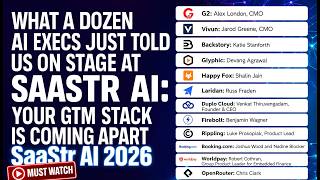
Five companies showed how AI is reshaping B2B operations: Firebolt's portable data layer for AI agents, Rippling's employee graph for HR insights, Booking.com's one-minute expense processing, Worldpay's embedded payments, and OpenRouter's AI gateway handling tool calls and token usage at scale.
Chapters
and the different buying journeys, Gemini, ChatGPT, that is where the search is starting and it's where you have to be present. So I think the next question is, well, how do you make that happen and what actions can you walk out of here today to have that become a reality for your brand and your messaging and positioning? And so no surprise, AI is completely disrupting this buying journey. The old school buying journey of where do you start your search, There used to be 49 different touchpoints, 17 different stakeholders. This was from a study done from Google and Bain a few years ago. Those stakeholders still play a critical part in your buying journey, but your shortlist is becoming condensed, meaning you appearing in LLMs is what's going to lead to that decision much faster than ever before. So how do you get on the shortlist? Because if you're not on the shortlist, you're probably not in that decision-making. And the old-school day one list is being condensed in this buying journey, which is where you have to show up. So the question everyone's wondering is, well, okay, we know the shortlist is in the AI buying journey. We know it's being condensed, but how do you actually appear? And with the noise and everyone screaming from the rooftops, we're AI native, we're AI first, we're AI powered. Well, how do you differentiate your brand and what do you actually do to make sure that you appear here. And the most important piece is that buyers are starting this journey already having a concept in mind. They're already knowing what intent that that prompt should have, what categories and brands that they're already putting in the prompt because they have an idea and they're asking, well, what's the best of? How many times have you started your search with, I want the best of. I want the pro list, I want the con list, I want reviews from trusted sources. And that's exactly what's feeding these models, because it's the human element and voice that still plays a critical role, and that authenticity and trust layer that we want to make sure is there. And so that's not being lost, it's just feeding into the LLM models. And the most important piece and where this is feeding in is actually reviews. And so G2 is the number one cited source for B2B buying right now. And it's above Reddit and YouTube and even LinkedIn. But all of these sources are critically important. And the reason for this is because again, it's the reviews. It's that authentic trust layer that still these models are feeding off of. It goes back to those prompts that you're putting in around the best of— I want X CRM for— here's my tech stack, what's the best next thing to put into this? You're feeding the prompt all this information, but the most important is you need to be on that shortlist, and it's based on this type of content that feeds into that. And so if you're not playing in all of these, you will not be cited today. And especially with G2, we've now acquired Capterra, Software Advice, and GetApp. And that's what's feeding these models even faster. And all of these are being crawled in real time, which means your reviews and the content that you put across all the sites has to feed in in real time and be refreshed. And so then what does that actually mean? What's the trust layer that feeds into all of these? And how do you make sure that your brand is showing up? So most importantly, again, it goes back to that review piece. Every chance you get, whether it is at a review trade show booth or in your product, you need to make sure that you are asking your customers their opinion, good or bad. All that content is feeding in. So make sure that you have the opportunity to engage with your customers in real time. This could even be in an onboarding process or after they've implemented your product. Gain that knowledge so that all of this can be fed back in. Because once this content is out there and getting refreshed in all the review component, that's what's feeding these prompts when you ask the pro and con list component, as well as also you understanding what content has to feed into the models in real time. Another piece that's important is Reddit. I had showed you earlier that it was G2, Reddit. Reddit is huge. You have to make sure that you're engaging in these forums and communities with your customers. This is a chance for your brand to show up, but also for you to get a sense of what your customers are talking about and engaging with. So this— in this example, and I'm sure we've all experienced to some extent, you are asking a very detailed prompt. Of a company of, of what you're really looking for. It's pulling from PR, it's pulling from the content aspects, it's pulling from Reddit, and then it's actually showing the forums and you're reading it in real time. You're not going to Reddit to read it. You can click through, but you're getting it in real time in the answers. And again, that shortlist component that I spoke about. So what's important here is that it's not just you going in and trying to fight the con negative, maybe comments that are happening and, and come in from a brand perspective, but understand what your customers are talking about because that data also feeds into what you're putting on your website. So I can't emphasize this enough that you really need to be making sure that these forum areas, which are being cited, you are engaging with, with your customers, and also understanding what content you need to learn from that to then feed back into your strategy. And so the other— really is important because these models are crawling it. And if it's not crawling it, you please turn it on. You have to allow them to crawl all the content and it will be agent to agent reading this content. You still are gonna be writing content for the human eye, but the models read it differently than we do. They need it broken out into very clear context elements that they can understand, read, and then cite in real time. It is a race to the shortlist because of the way that it is crawling and how fast it is producing. So if you're making it complicated for these agents to read it, it's very complicated to then show up. So one important thing that we focused on is the summarization across your page. We ran a test and at G2, we've been focused on AEO implementation and optimization for, I actually years now, which is why we are the number one cited, because we have been testing this in real time for a long time. The results that you're seeing right here actually led to a 44% increase in citations alone. This is taking all the content on your page, summarizing it, and you can see this is very similar to what you get out of an LLM. What are the pros? What are the cons? Again, I want the best of Or what are the negative reviews so that I understand what customers are experiencing and what's right for my tech stack? So it's important to make sure that you are feeding this together in a summarized viewpoint that the human eye can understand, but the LLM agents can understand. So it's really important to go through and make sure that you are creating that on top of your page because it is leading to higher citations. At the same time, it actually increased our SEO efforts too. And remember at the beginning I said 51% is using AI chatbots, but it's still the other 50% that are using the old ways of the way that we started to search. And so it's equally as important today. FAQs. I know you all have heard these. These have been in the SEO game for a long time. More important than ever with LLMs. FAQs is a chance for you not only to just answer the questions that your customers have, But this is your gateway to what the prompts are. Just like LLMs are crawling and feeding information, we took the same approach. We actually crawled all the forums and fed it into our FAQs. This led to a huge increase again in citations for us. What I mean by this is we took a very similar approach where we made sure what are our customers saying out there in Reddit, in forums. What are the questions they're asking that they might not be asking on our site? And how do we build FAQs to address that? These are the same prompts that are feeding into the LLMs that are feeding into here. And the last piece that I want to highlight around what you have to focus on, and most importantly, your AEO tool. All of this is only as good as what you can track and measure. And in the data-driven world that we all have to be playing a role in, You have to understand what this is driving for your business. So last year when we launched our AAO tool grid box, we had handful of companies that fit into this grid box. We are now over 300 in just one year of companies that you can go and see what is the best AAO tool for you. And not AAO tools are all created equal. And so you do have to make sure that it fits the the needs. But what's important here and what you have to focus on is what are the 4 main pieces you need your AEO tool to tell you. Benchmark. You have to understand the benchmark in the industry you're in and also benchmarking you in the citations and what you're looking at. The second is identity. What are those prompts? In the world where search engine marketing, we used to have search query reports. This is the same thing. It does not change. The foundation's the same. What are the prompts that people are typing in that you need to know about? And the answer, are you showing up? Because again, if you're not on that shortlist, you're not that decision at the end of the day. So you have to make sure that you understand where you're appearing in the answer. And these tools are helping you. And the last is the measure. How do you know if your content's actually working? How do you make sure that it is showing up where you need it most, but is the content doing you favors or harm? And does it feed back into the content you're putting on your site and your FAQ strategy? So the key takeaways that I want to make sure you all walk out of this room and that you understand today is how you win. And this is where you earn trust, be LLM friendly, and you measure and optimize. You have to build your authority and credibility. Brand to demand is more important than ever. The way that you are showing up, being on that shortlist and making sure that your site is readable for agents and humans, but mainly agents now, is how you appear. But you can't do any of this unless you have the right AIO tools. Now, we've created a partnership with Profound. And we measure all of our efforts. And it doesn't happen overnight. As SEO and AEO games, we all know that it takes some time, but you have to start now. And so if you're not turning on these models to read your site, if you are not building content for them to understand, then you will be behind because it is moving so fast and it has to be refreshed in real time. And most importantly, that review aspect plays a huge role in it. Because as we saw, it's the number one cited citations for B2B software buying. So it's a place that you're going and you're doing your research, and it's also a place that you have to make sure that your brand is showing up in this now condensed buying environment. And so with that, I do want to leave you that not all citations are created equal by any means. This one's very important and where to end with, which is A mention is your brand appearing. That's great. Great for brand perception component and measuring your citations there. But now having a mention and a citation then creates that branded citation, meaning how does it directly connect to your site? How are you showing a link that then links off? I think we all can say that the way that we appear is now we're seeing a decrease in our SEO. We all agree that's not going to change right away. Way. But measuring where these citations are does change things because you have to be able to measure what's— your buyer is savvier, so you have to meet them in that moment. But the most important is to win, you have to show on the shortlist, and that's the only way you're going to win in today. So hopefully that gives you some identity of where to take this next. But I hope you all have a wonderful rest of your day, and I'll be around if anyone has any questions. So thank you all. Our program is going to begin in a few minutes. It's time to find your seat. Please give a warm welcome to the Chief Marketing Officer from Vyvan, Jared Green.
Guys hear my voice okay? All right, two quick corrections. I'm Jarod Green. And the company is Vivint. All right, so we're all set to go. Thank you guys for joining the session. I only have 10 minutes. I want to be brief and quick and I want to tell you how an AI sales teammate went ahead and beat a stack of 20 AI sales agents. This is the stack we see so often from our customers and prospects before we have conversations with them. We went to a Gartner event last May and the analyst did a presentation and strongly advised everyone in the audience to evaluate agents for discrete parts of the sales cycle. So you have a task, you need an agent. You have a process, you need an agent. You have a thing that a rep needs to do, you need an agent. You guys get the point. We see no fewer than 15, 20 agents in some of the engagements we have, and I put the 20 tools, no judgment, to mean there's no judgment on the organizations making these decisions, but there is little judgment of the agents doing these discrete tasks. Every handoff between agent creates complexity, you lose context, and it often slows execution in a world where we need to be faster. Now here's where I think this comes from. In the desire to move very quickly and to drive sales efficiency, we've made investments in sales agents. But I would ask you all, if you're in marketing, if you're in sales, if you're in customer success, when your sales rep is on a call and a tough question comes up, Which agent are they supposed to turn to to get an answer to that question? There's 20 to choose from, different context windows, different levels of fidelity, different levels of input. Some are updated, some aren't. These are the moments that make or break a deal. And when an agent— or sorry, when a sales rep has to stumble to answer that, this gets very tough very quickly. We know most AI— or sorry, most search Starts with the I. Buyers come to these calls well-informed. So the only thing they need from the rep is information they can't find on their own. And we know that if you answer a question weird or if you say, let me get back to you on that, it's often certain death. This is why about 40% of first meetings end in close, no decision, often labeled ghosted. We just never heard from that person again. So if you're struggling with I want to ask you guys, or what I want to point out in this world, is that we've studied, Vivian, a lot about LLMs, and we've studied frontier models and foundational models. And what we found is that they're really good at working in a specific context window. So I can take a video, I can take a document, I can take my call transcript, I can take notes, I can put it to an LLM, and it can quickly transcribe, it can quickly summarize, it can quickly give me details and context about that thing in the single context. And it's phenomenal at that. There's, there's no debate or argument about its abilities to do that. But what we find is that context, when you're on a sales call, is often more than one thing. So when I get a tough question as a sales rep, the question behind the question needs context, right? I need to understand who's the persona that I'm talking to, What is the buying cycle for them? What level of power do they have? Who's the competitor? Who's the incumbent? What are the things that they're trying to ask me that I need to answer that I can't fumble on? And we call each one of those connections a hop. And oftentimes in a complex sales cycle, a hop is 8, 10, 20 things. And what we found in our research is that the foundational models tend to get wonky after about 3 hops. So again, they can have great context once or twice or even 3 times, but after that 3rd time, when new context, new information enters to the fray, starts to break down a little bit, starts to get weird, starts to hallucinate. And what we found is that our model does not do that. And what we've done is we've applied and understood the large language models to be exactly what they are. They are the map. They do a great job in breaking down the language. They are not the brain. They don't have the sales reasoning, they don't have the sales context that you all are providing to your human reps. They don't have knowledge of your process, your people, your platforms. Those are things that you are working to train and drive your reps to do. Foundational models have not done a great job of retaining that information. So again, Vivint is the company that works to establish this research. If you go to our website, you can read more about the concept of AI fundamentally not understanding your business, and you can also learn about how personality in your agents matters a lot more than you think it does. And so when we think about the concept of an AI sales teammate, it is one that has expert sales reasoning. It understands complex, high-stakes B2B sales. It understands the winning behaviors captured from millions of interactions in CRM. It understands everything you would need to understand to drive the deal forward. It would think and act like your best sales rep. We know a lot of you have put good time, energy, and money into sales enablement, and I think when I showed the AI agent slide, a lot of those boxes get checked in the realm of giving your reps the tools they need to be effective. I think one of the best methods you could do for enablement is sit down with your absolute bestseller, get an understanding of what he or she does on a frequent basis and work to model that. That's been the pattern for enablement for the last decade. But now with AI, we can do this a lot faster and a lot quicker. And so if you had an AI sales teammate or if you had an AI, single AI teammate that understood and worked like your bestseller, we think you'd be that much more effective. We know sales methodologies sometimes are a multimillion-dollar investment for companies. You spend a lot of money with these methodology providers and you You know that most of training, 90% of it, is forgotten if it is not applied in the first 2 weeks. And so what if you could simply give the methodology to the sales teammate, have that teammate apply, understand the methodology, and remind the rep of what to do, what to know, what to say, what to show in those moments that matter? And last but not least, it would need to integrate with your tech stack. I would imagine you've made significant investments into your tech stack, your CRM, your collaboration tools, even your conversational intelligence tools, I would imagine you'd want to keep those. And so making sure that the agent seamlessly integrated with those tools, I would bet, is important for you. So I'll leave you with this. This is what we find Gartner predicting about organizations and sales organizations who work with AI sales teammates. These can be ride-along agents, these can be AI sales engineers, they can be solutions that work alongside your rep at Harmony as the best team that they ever had. And predictions from Gartner talk about shorter sales cycles. You would imagine that if I didn't have to say, "Let me get back to you on this," and I always had the right answer or the right context, I could move through the deal cycle a lot faster. You would also imagine this would mean less training time on product. We know that a lot of the sales reps you guys work with, they get into it for sales. They get into it for the essence of salesmanship. They don't want to be product experts per se, and there is a associated with training your reps to be product experts. What if the teammate would act as the product expert and the rep can do what they do best? And so you would imagine there's less training time, and this is a prediction from Gartner. Organizations that work with these tools will cut training time by about 40% with regards to product-specific training. And you'd also see a world where shorter ramp time occurs. Now I can hire a more junior rep, or I can hire a more seasoned rep, that instead of waiting 8 months to first deal or 8 weeks to first deal. These things are now done in 2 months or even 2 weeks in some cases. So these aren't Vivint's predictions or Hero's predictions. These are Gartner's. And we've had customers who have seen better returns on this in working with the team. They, some of the power users have seen a 50% reduction in the sales time. They've seen higher win rates, they've seen higher deal sizes. And so I'm not allowed to demo, But I will tell you, if you want to see what we have to offer, we're just at the booth in the West Pavilion. We deliver one teammate, one intelligence layer, one platform to work with, not 20 agents. For our friends at SAS, we're providing an exclusive offer. We're very confident in what our teammate can do. And so just by the virtue of being able to hear my voice and see my face, if you're able and willing to sign up 3 to 5 reps who you believe need an AI sales teammate, they'll get that for free. And you'll get insights about what they're doing, how they're working and performing with the teammate, and see if there's an opportunity to provide that lift to a broader range. And of course, if you just want to see the product in action, we are over at the booth. I wanted to be brief. I wanted to understand that time is fleeting and attention all wanes. And so I will leave you with that. If you have any questions, we'll be around. Thank you for your time this morning.
Give a warm welcome to the Head of Customer Success and Digital Programs from Backstory, Katie Stamforth.
Hey everybody.
All right. Is this volume okay? Can you hear me?
Cool.
So I'm Katie Stamforth, and I'm here to share with you how we automated our executive briefings to go from taking about 60 minutes, which is honestly pretty conservative, but 120 2020 didn't quite have the same ring to it, to about 6. So a quick show of hands from folks. Anyone here ever had to create or fill out an executive briefing template? Couple folks. We'll see if this clicker works. Yeah. So me too. I've been in RevOps or CS for a little over 10 years now. I've worked with probably 20 to 30 different executives. Over the period of time, and one thing has remained consistent. I had slide decks and Quip docs, Slack templates. We've had Google Sheets that were 16 tabs but are somehow supposed to be the source of truth, right? I've had execs who wanted Arial font only, which I think we can all agree is not the best font that's out there. But one thing has remained the same. Even though the template changes, the grind to create it It does not. And this is what the grind looks like for the CSM or AE who's actually responsible for putting together this request for an executive. First, it starts by scouring internally to figure out what is the latest template that actually exists and hoping that the final one is actually from this current fiscal year. Then they go into the CRM. What's going on with our usage data? Do we have licenses that are under-provisioned? Are people not leveraging that? Could that potentially be a risk as well? They go into Slack because they wanna understand all of the internal communications. What else are our cross-functional stakeholders actually doing? Uh, do we have any support escalations that have been going on here? And then ultimately they go into LinkedIn because what executive doesn't want some type of stakeholder relationship map to understand who's involved with this deal? And so they gotta go into LinkedIn and they need to understand what are all of the titles of the people that they've actually been communicating with. Now, at Backstory, we couldn't afford for people to be spending all of this time on this administrative work. It's manual, it's cumbersome, and it's expensive. We are a small but mighty team. And when we think about the time that it takes for a CSM or of what are all of the things that they are not doing, what revenue-generating activities are we not doing, what risk are we missing, because we are wasting our time on this. So we had to ask ourselves a different question. And the question was not how do we make the template better? Because I think we can all agree they all kind of suck. But the question was more around what is the role of the human in all of this? And what if we change the role of the human to instead be to review it and not research? So how do we make the human in the loop and bring them towards the end of the process not have them compiling all of this stuff from the get-go. So we rebuilt this whole thing, and this is how we did it. We did 3 data sources, and we put them into one project in Claude. We started with our own People AI MCP. We have since rebranded to Backstory, but this is our AI revenue intelligence that's pulling all of our CRM data, all of our rich engagement data, who's attending meetings, what's happening in these meeting transcripts, what's going on from an email perspective, but pulling all that information, going through a revenue reasoning layer, and putting it through MCP in a structured way. Now, if you do not have Backstory, one, come check out our booth. We're in the next hangar. But also, you can use your revtech tool of choice. Whatever you're leveraging that's got an MCP connector, start there. Or worst case, use your CRM to get part of the way. The next thing that we brought in is our Backstory CSG MCP. Now, CSG stands for Customer Success Group, and this is a connector that we've built through Workato where we are pulling in all of the data from Snowflake on our usage and adoption. Again, tons of connectors out there, whether you're using Adobe Analytics, Amplitude, Pendo, use whatever you've got for your usage data and pull that in as well. The next thing we've got is Slack. So we have an internal customer channel for every single account. Same thing for prospects. Our ex— our enterprise customers also have an external channel where they can communicate with their account team. All of that gets read. And those are our 3 data sources. I put this bonus one in here for the purpose of the demo today, because if your revtech tool is not pulling in your email, that's an important connector that you'll want. So at least whoever is creating this brief, whoever is going to be the reviewer, you can pull all of their insights insights into what are their communications that they've been having with the customer as well. And we put all of this into a single project in Claude, which I'll show you now. So this is what, uh, the project looks like. Today I'm gonna be demoing with AFC Richmond for any Ted Lasso fans in the crowd. New season comes out in August. Uh, but it's pretty simple. I have a very simple prompt that I'm gonna be using, and there's only two files that are included in here. One is our branding guidelines, and the other is our executive briefing agent. And this is really the brains behind the operation. So if you are looking to recreate this, this is what it could look like. So our executive briefing agent, this is a Markdown file that, again, powers this project. This was something I didn't sit and type up. It's something I worked with Claude to go ahead and create. So I told Claude, hey, here's a project. That I want to build. Here's what I want the output to look like. Here are the connectors I have available. Help me create this. And then went back and forth until I got the output that I really liked and kept that markdown file. So it starts with a very simple connector setup. I think this is best practice. Go ahead and have something where it shows all of the connectors that are included in here. What do they power? What happens if you don't have it? Really great for someone who's new to the project. To have some understanding of what's going on here and what is it pulling. Then it's got the process. Again, this is all Claude putting together what is the process, what does it need to do based on what I ultimately asked for. And then it's got the visual brief. Now, as I mentioned, we did have the branding guidelines. That was that other file attachment. That's great. But Claude might reinterpret which accent colors it wants to use each time or how we might want to visualize using those, that branding. So if you have some specificity, if you want something that's standardized, I recommend going ahead and building it into the project. If you have an executive who, say, wants Arial font only, another place that you could go ahead and put that and make sure that you've got the same output each time. And then for each of ours, we include an HTML infographic. Again, if there is a different style that you would like, if there's— you want it in Google Docs, you sheets, a slide deck, what have you, you can go ahead and put that in there. For us, an HTML infographic works really well to screenshot or share as a link. And then most importantly, the brief structure. So this is what do your execs ultimately want to see to feel prepared for a call? For us, ours want to start with the bottom line. Give me the headline. What's going on with this deal? They want to understand account health across a variety of different dimensions. The revenue data, what's at stake, our top concerns, what's working, are we actually solving for the pain that our customers got? They want to understand usage, how are we trending, and then key stakeholders along with the sentiment of each of those stakeholders. Think about how long this takes for someone to manually actually create this if they were doing this on their own. It's incredibly cumbersome. And then finally, the human in the loop piece, The last piece here is, is leadership action needed? Our execs want a clear outline of, do you need my help, yes or no? And if so, what is that? Now, our execs could, and honestly sometimes do, bypass the human in the loop, and they can run this brief themselves. But I think the power here is when you have a CSM or AE doing this, Claude is going to go ahead and say, okay, here are the things that we're recommending action on, but the CSM or AE knows it better. They can say, that's not actually what I need help on. What I need you to do is go introduce me to this board member who happens to know this stakeholder. And that's context that Claude is not necessarily going to have. So that human in the loop is still incredibly valuable at this point. And then finally, the other thing that human in the loop, gets is we include data source tags for every single element that gets brought up here. Incredibly valuable because if you are the person who is reviewing it, you see something that looks a little off, this gives you the place that you can start to go ahead and dig into that. Where is it coming from? How do you understand? Why is it pulling that information? And this is what it looks like. So simple prompt. Again, I just want an exec brief for AFC Richmond. I go, I fill up my coffee, it loads, and it pulls all this information without me having to have any back and forth. So I've got all of that color coding I wanted. I've got the tags. And I'm going to scroll for the sake of time all the way to the bottom. And I've got an infographic that is included. So it's a quick couple of minutes and it's going ahead and giving me the standardized document. Looks the same no matter who runs it, who you're running it for. You're going to get the same level of standardization, the same 3-column layout, and the same quality of information. So Just a quick recap. Before, we're looking at 60 minutes minimum. You've got a CSM or AE spending a lot of time and a lot of tabs trying to research and compile all of this information. So after 6 minutes, you have better sourcing, better quality, a standardized format, and a CSM or AE can simply review. Now, if this is something that you have also struggled with, and you're looking for your next steps, really quite simple. Two things. The first thing you have to do is define what your execs ultimately want to see. If you are a leader in the room, you are probably the problem. Your team is spinning their wheels because they have no idea what it is that you ultimately need to feel prepared before a customer call, or you're holding up different formats of what good looks like. Spend 30 minutes. Take the time, write out what are all of the things that you would love to know before you walk into a customer account. Oh, if you are the person prepping these briefs, or you are someone like me and you manage folks who are prepping these briefs, pay attention to what execs are always asking. What do they ask on the account strategy calls? What do they ask in Slack regularly? Put something together that they can react to so you can go ahead and get a starting point here. And the second and most important thing is just get started. You don't need to have a perfect tech stack to be able to save your team's time. You can start with something as simple as CRM, email, Slack communications, and get part of the way there. But we've got to save our team's time and move them from this area where they have to research everything on the front end to simply being able to review and action on the back.
Thanks. Welcome to the stage, the Chief Technology Officer and co-founder of Glyphiq, Devang Agrawal.
Hello everyone, my name is Devang and I'm the co-founder and CTO at Glyphiq. Really excited to be here at SaaStr, at my favorite conference, to, to be talking to you guys about how to build agents with a brain. And before founding Glyphic, I was a researcher at Google DeepMind. So I do know a couple of things about LLMs. And the most exciting thing within LLMs right now, I feel, is that the capabilities of LLMs are just growing exponentially. So the, the last unsolved challenge to get to AGI is really about context and how do you give the agents the best context possible. So that's why what we're focusing on at Glyphiq is how do we build agents with a brain. And so what's the challenge right now? We have agents right now that are basically running blind. They have all of these capabilities, but they don't know anything about your business. They don't know about anything about your customers. They don't know why they buy your products. They don't know why they churn. They don't They don't know why you lose deals. They don't know who buys your product or anything. Even if you spend all of this time prompting them, giving them all of this data about like all of these things, but then the market is evolving so quickly these days that that information gets obsolete in no time. And then you just spend all of your time just tweaking these agents and just trying to get them to work. But that isn't really really a scalable solution. So we took a step back and we said, what are the agents really missing and how can we give it to them? So, whoops. So we came up with this concept of a commercial brain, which is connected to all of your user-facing touchpoints. So all of your conversations with your customers, all of the support tickets, all of the emails, calls, every Every single user touchpoint that you have, your CRM information, all of that is being fed into our commercial brain, which is learning why do people actually buy your product, who's your ICP, what are the personas who are purchasing your product, and what makes them actually buy it, right? And once it has all of that information, it doesn't just stay there. It is constantly learning and it is staying up to date with every single interaction you're having with the agent. And it's learning not just about you as a person, but also about your entire company and using that information to power the agents. And, and once you have your own commercial brain, you combine it with our, with our agent platform, and that is what gives you intelligent agents that can actually execute and solve business problems for you. So what I want to do— so we— so on our platform you can build a lot of different agents and which solve a lot of different problems for you. But I think I wanted to focus today on giving you something concrete that you can take away today. So we want— so we will build in under 10 minutes a prospecting agent which is not just sending generic messages to your ICP, it is actually learning every single thing in the commercial brain. It is using all of that information, leveraging it to understand and create really, really targeted hyper-personalized messaging that actually gets you results and conversions. So let's dive in. So here are some of the agents that I'm running today. And let's double-click on the prospecting agent. So within the prospecting agent, all you do is you define a trigger. So you say, what, what kind of trigger do you want this agent to run on top of, right? So here I have an agent which is running every time you win a deal. What it does is you give it a few guardrails, right? And then based on those guardrails, what the agent is able to do. It knows the task it needs to execute. It has all of the information already within the Commercial Brain. And then all it does— and it also has with the Commercial Brain, it also fully understands your GTM tech stack. So you don't have to go in and manually set anything up. You don't have to say use these tools or that tools. It automatically figures out what it needs to do to actually execute what you're trying to do. And you just, you just configure it and have it ready. So here is a deal we won earlier, and then we have the— so what did the agent do over here? It used the deal, it, it took all of the pain points, all of the decision criteria, all of the personas that were involved in in the decision-making process. And then once it was kind of powered by that information, it kind of truly understood why we won that deal. And then it used other things in the commercial brain to kind of say, who is our ICP, how related to our ICP was this deal. And then it uses other tools that it has access to. So if you use, let's say, ZoomInfo, Apollo, whatever, it is able to use those tools to find contact information. So we are not a data enrichment platform ourselves, but we are able to leverage whatever data enrichment platform you're using, and the agent just seamlessly goes there. It picks up the contact information. It can go— it can use web search to actually just go and find all the information it needs about who are the similar companies, who are the competitors that are most likely to know this company and this win, and then it is able to use all of that in an intelligent way to create an outreach campaign. But it doesn't just tell you, here is an outreach campaign, now go and take it to your whatever sequencing or campaigns tool that you're using. It knows which campaign tools you already have access to, and it will just go in there and automatically set the campaign for you. And now you can either configure it to run in a, with a human in the loop where humans are going in and like maybe reviewing the things once before fully activating it, or you can configure it to run fully autonomously where the agent is just running in the background and creating pipeline for you as you sleep. And, That's, and the results that we are, so we've been running this agent for, uh, so we've been running this agent at Glyphiq for ourselves and for a lot of our customers, and the results have been truly astounding. You're, we are creating 3+ meetings for each of our reps directly in their calendar with this agent. The conversion rate that we are getting with these agents for every single message that we are sending, because these messages are hyper-personalized, personalized, they're actually targeted to the people that they're going out to. It has— it is referencing a customer they're very likely to know about, for instance. Those things are really getting people to reply to those messages, and we don't have to spend someone's time every week just babysitting this agent and saying, our competitive landscape has changed, our value propositions have changed, the agent agent is just seeing how those meetings turn out within, within the commercial brain. Then it uses that information to actually just update itself and see and update the new sequences that it runs. But as I mentioned earlier, the prospecting agents is not the only thing that we do. We can run agents across the, the buying lifecycle. So we have agents that help With middle of the funnel, we have agents that help your customer success team reduce churn. We have a lot of coaching and performance management agents, and we have agents that are helping your teams always stay up to date for their calls. And what's been really exciting for me personally as a builder is because of the commercial brain, the building the agent Building agents on our platform within the first few days of them joining. And the creativity that this unleashes within our organization has been incredible because we have all of our SDRs running, running their own agents to stay on top of the messaging that they need for their cold calls. We have the AEs making sure that they really know how to handle every single objection. And we have their managers who are also building their own super personalized agents to make sure they fully understand how to best enable their teams. And seeing these agents across their tech stack is what can truly drive a full organization using agents. And it's not even limited just to the sales team. Within our product team, we are seeing a very high agent adoption where all of the PRDs are directly created with agents which have access to all of the information from the Commercial Brain. So if a feature is coming up repeatedly, the Commercial Brain picks that up and proactively sends it to the commercial— to the product team so that they know what to build next. And, uh, yes, if If you want to build your own agents on the Glyphic platform, drop by our booth, G115, and we can build some agents together.
Good.
Thank you. Please welcome to the stage the CEO and founder of HappyFox, Shaalan Jain.
Is my audio okay? Give me a thumbs up. Yeah, perfect.
Awesome.
So there's so much to learn at SaaStr. I'm so excited to be here. I'm going to talk about one of the most underspoken category, which is expansion in the whole SaaS space. Everybody wants more leads, everybody wants to convert more, but once you have converted, you have actually won a customer for life. And if you solve more problems for them, you have more chances that you can actually get more done for them. And this sales cycle is one of the easiest sales cycle. But to find how to actually know when your customer is ready for next is what I'm going to show. I'm going to give you a quick overview of the strategy. My suggestion would be to focus on the process. I will share some prompts, but mostly you can use these prompts or you can build your own. But the idea is to focus on the process of building these agents. So quick introduction, I'm Shalin, CEO of HappyFox. I've built a $20 million business with zero outside funding. We've been profitable every year of our business. We always exceed Rule of 40, trying to stay extremely efficient and financially disciplined. We have released our help desk product, which is one of our flagship. Uh, we help companies do their customer service, IT support, and ops support, all with 3 different use cases. So we have 3 different ICPs. We also build a full-fledged service desk product for companies that have a more complex IT requirement. And then we kept building more products as we found more needs from our customers. We also built HappyFox CRM, which we are providing to my journey with AI as a builder, as a founder. We built our first chatbot with AI in 2019. It was a very, very complex project to get it done right. But now rebuilding, we rebuild the fourth version of chatbot and our goal was We have great models, we have a lot of data, we have great knowledge-based backend for us. But now the goal is not everybody can go build a chatbot, but how can we make it efficient? And that's where our engineering team cracked, able to deliver that at $0.20 per resolution. And then we built our Copilot, which augments every support agent's workflow. And then we built something very interesting is we wanted to not just resolve customer issues, but take care of every chore a support team ever has to do. And we built Autopilot agents, and these are deployable agents within 30 seconds, and they cost as low as 2 cents per successful run. Now, coming back to our sales strategy, and we had all of these products to take to our customer. Typically, when customer came to us, they bought our help desk or service desk product. But our MO has been land and expand. We don't spend a lot of money on marketing. We only have 4 sales teams. And at $20 million, we were with 1 or 2 marketing people inside the company. Everything was focused around building more products by listening to customers and surface. Every account that starts with a help desk might need AI, might need workflow automation, might need a BI product. So we were always looking for that, but Not just that, we were also looking at if I sold to a customer service team in a company, I want to sell to their IT team, I want to sell to their marketing ops team. So when you think of your customer from not just an account that you deal with once, but an account you want to keep expanding, you realize as a SaaS company, you have chance to charge more to existing customer by providing them more value. But expansion was kind of broken at HappyFox. We were only doing reactive expansion. When somebody came and asked, hey, I would like to take a demo of HappyFox AI and how it can help me, then we would react to it, our A's be on a demo call and do that. Proactive expansion was hard without AI. So we asked this question, what if we have AI to unlock this? We have 2,200 customers They have different use cases. They belong to different industries. They have different type of conversation with our sales rep. How do I put this together and find who is ready for which product? It's just not that I have to go upsell the same product for the same use case to every customer, but it's more complicated. And a lot of the data for, for that lies in our ticketing platform. But support reps often focus just on the experience experience. They want to finish one ticket, they want to go to the next ticket. They're not touching base with marketing or sales all day long to tell them what they found. While sales reps don't read tickets, they're busy chasing their pipeline and they have no time to go and see what somebody said and read in between lines in a support ticket. And unstructured data— support conversations are messy. They are just sometimes very vague. They're going through a back and forth conversation. So it's very messy to find that. And so we solved for this. And I'm gonna show you exact prompt we use. But before that, you look at the process and you can do this either into your current support system. You can build this with any agent building tool which can look with an API or MCP and go find all, opportunity, and then you can also use Claude and MCP to kind of make this happen. So if your support ticket system actually has an MCP layer, you can use that and build the same thing in Cowork. Now, expansion agent at every ticket is what we did. We found expansion opportunities by reading every single ticket when it was closed. We built an agent right inside our support platform, and I'll show you in a live demo how we did that. We got amazing outcome and I'm going to share that in a bit. But we— what was, what was actually very surprising to us, we were instantly getting opportunities almost every day. We tried to focus on larger opportunities, so we didn't go after everything. We had a few false positives as well. And for example, customer says he wants something, but they absolutely have no budget. And then we have scored them scope for improvement. The total cost of doing that was less than $20 and we didn't burn too many tokens and we did it in a very, very efficient manner. This is the prompt we use. You can scan this QR code. If the presentation, this, the prompt will be available right after this talk. Now if you don't have HappyFox help desk, you can copy this prompt, build it in a Zap or build it with Claude as well. Result, we actually closed $1 million of opportunity. We started this in January, and March was our end of financial year. We closed $1 million opportunity. And we then were so surprised, we went back and wanted to categorize every type of opportunity that got us there. And in my experience running a SaaS company for, last 13 years, I have never had a million-dollar return on a $20 investment. And so we did seat expansions. A seat expansion was surprisingly low because we were selling a lot of AI, which was the product upsell that we were doing. But when people used more AI, they had no need to actually add more seats. So we saw some, which used to be one of our biggest categories. We did AI upsell. Everybody has mandate to implement AI. But we just didn't know who is ready and what is their story. That became easy. And this was the highest unlock, which we absolutely did never before, was when we sold to customer service asking for an intro to IT and selling to them. So we found a quick hack there. When IT teams came to us and asked for Workday integration or talked about an HR onboarding use case, we knew HR team is slightly involved. But they are not still inside the ticketing system. So we went to HR and actually not just told them how they can be in the same ticketing system, but what are the use cases we solve for them. And one of the biggest opportunities we closed in a cross-sell was a company getting acquired by an even larger company. And usually this is a churn risk signal for us, that the new company that acquires the current company will say, we're going to use whatever we use. And we are not going to continue with HappyFox. But this time, because we were proactive, we were actually able to go in and be— our rep went in and started early conversation, and this led to a 3x sale. And this was our single largest deal we ever closed in the history of HappyFox. So we asked the question, what next? Now, this was a crappy prompt in my opinion. It was like a very basic prompt which you can like build in 5 minutes. But where else is this unstructured data hidden which can give you a big lever? And when, you know, so when we looked at that, we went into all sales calls. We have Zoom history for at least last 5 years. Every sales call gets recorded. We have onboarding calls when we have closed a deal and they are getting onboarded. We're going through use cases. There's user stories in there. And then we wanted to do something different what we did with our support data. We wanted to build a flywheel where we actually have higher hit rate. We didn't want 50 expansion signals. We wanted 20 expansion signals of which 5 or 8 would close. And then we realized since we serve 3 ICPs and we serve different industries, education buys in May, June, and their budget starts in July. July. That's the best time to go after education. You cannot sell to e-commerce when they're having a Thanksgiving sale. So we had to make sure we are also timing all of this right. So how do we get all of this done? And I'm going to get into a demo. I'm going to share my screen real quick. And yep. So, so let me start with the support use case that we initially talked about, and then I'm going to go into what we saw on the sales side. So this is our ticketing system. These are normal tickets that we have, type of tickets we get. We have tried to, as much possible, emulate what we have. So these are my tickets. Now I have Autopilot agent working and it has flagged 65 tickets, which are potential opportunities for us to review. And they may not just be always expansion opportunities, they might be churn risk, and other type of Autopilot agents we have. So this is Autopilot. This is built into this, right into the support ticketing system. Now this is going beyond the typical resolution where you're just thinking about resolving, but not everything is all about resolution. This data is a goldmine of information. So we built about 30+ agents, I think 54 agents for just SaaS companies. We started with ourselves. We exposed it to a few of our SaaS customers and they started demanding all type of agents. And we— one of the basic design principles of deploying agents was to make sure they can— customer can deploy this within 30 seconds. They don't have to do much prompt engineering. They just have to give clearer instructions. So we built everything possible for SaaS companies from from finding churn risk to updating their CRM, to getting license data from Stripe. And the, the integration that the Autopilot agent that did it for us was basically our expansion signal scanner. So we hired this agent, named him Rex. It would go after every support ticket and find expansion opportunities for us. So if I go to this configuration, This is exactly what we have to do. We have to onboard the agent and I give it a name, a description, whether I want to run it in a supervised mode or autopilot mode. When you run it in a supervised mode, the agent will just tell you, hey, this is the output I found. If you think this is valid, I'll add the tags so that your sales team can then get involved. So initially we started with supervised mode. Our support team would look at it immediately and then say, okay, this looks is good and they'll allow the agent to do its job. And then sales team will get notified and they will jump on that and create an opportunity. So we— this is an example of what a typical support ticket looks like. And when an agent actually finds the opportunity, it flags it for us. So what if we took it to our sales data where we have thousands of Zoom calls We have thousands of onboarding calls. Sometimes our sales engineers or support engineers go on call to solve complex integration problems for our customers. Every conversation somehow leads to finding what the customer want, what problems they're trying to solve, and often there is a hidden opportunity. So we built a CRM tool that allows us to do that. Now we built, unlike our support platform, we wanted to do two very important things. Segmentation, because without segmentation you will get a lot of false positive and it won't scale. So, and the second thing is we wanted to ground it in truth. Sometimes in co— I love Cowork because you can ground it in so much truth, have all the files on your desktop and make sure then you are prompting it to give you the most accurate results. So we wanted to do this at the CRM layer. So first, we created the concept of agents where I should be able to create an agent at every sales process that I have inside the company. Everybody from our SDR to all the way to our CRO should be able to build agents and that does something for them. And what we focused on was basically our expansion agents, which, which basically focused on cross-sell, plan upsell, and product upsell. So we built about 8 agents which are operational for us in our production environment. And these agents essentially are looking at all calls, all support tickets, even a sales call where the customer says, yes, we want to implement AI, but not right now, right? And when they say not right now, we know this is an opportunity 3 months, 6 months after they convert as customer. So we want to make sure within 3 months this AI agent flags that and creates an opportunity for us. Now the second thing we did was we wanted to keep the human in loop. So we built, we built channels. So instead of waiting for something to show up in Slack, we built channels inside the CRM itself where if I have an expansion opportunity, I can go to my install base and look at expansion opportunities. And if it finds an opportunity, I'll see an ability to create a deal. So let's find an opportunity where I can actually turn it into a deal. So, yep, so I have two opportunities here which are Basically where this company wants to expand to Workplace Ops. So all I have to do now is review if this is a valid deal. If it's not, I can just dismiss it. And AI basically learns what it got wrong in the signal. And if it is a valid deal, I can just say create deal. It will create a deal. It will not just create a deal, but also have a right task to do as a next step in the process. So let's go ahead and actually, I want to talk about one more thing on how we ground AI. So we have something called memory. Now, every expansion signal that we have received and learned from, we are going to create a memory from it. So we have our expansion place and we have learned different type of expansion use cases and all of that has been saved as memory. Now across 2,200 customers and probably 10,000+ calls that we go through. We want to curate that and we want to see what is the right signal, what does customers say that actually turns into knowledge, and that knowledge becomes a memory for AI to use every time you're doing anything in the CRM. And so we build that, and I'm gonna build a live agent right now and show you how, how agents are built. So let's say we are launching HappyFox Autopilot agent, which I just showed in our support platform. Now we want to identify what autopilot opportunities do we have in our entire database for SaaS companies who are trying to reduce churn, find expansion, and have conversation how AI can reduce the support load. Now if this is the thing, then I can just ask AI. I'm lazy that I don't even want to write the prompt, so I just say this is my objective, this this is my goal. So I want AI to find a name, description, instructions, and scope and build it for me, find the right channel it needs to notify me, and find which is the best memory it can store all of this information. So the agent is now keeping everything in scope, is building an agent for me where I have the description, I have my instructions, and I'm very clearly defining my scope. It is limited to SaaS companies. This is not going to run on an education deal or an IT use case in a government institute, but it's going to focus on SaaS deals. So I've given my scope, and then I also have my channel. So if every time it finds an expansion or a task I can do in an existing deal where I have one more expansion signal, then it will notify me in expansion channel. It will also create a memory in churn and downsell reasons. If at all we find something negative in an expansion Expansion play, it will put that and then it will also update my knowledge. Now if I only have a play that every help desk customer who has 10,000 tickets coming per week really wants an AI agent, then it is going to just update and create a memory out of it. So when this agent— so I can just, uh, my expansion plays and let's say Autopilot expansion, Retail Ops want Shopify contacts inside Autopilot. If I click on this, it will tell me what keeps repeating, what this teaches us, what are the recurring threats, and which accounts do I need to go in and validate or actually learn what actually happened on the call. So it puts all of this together, and this becomes the flywheel for us to basically continue to sell. So our goal is to, we are, We don't have a very large marketing team. We have 4 A's. We want to make sure, and they at times hit 15,000 rather than spray hundreds of deals and work hundreds of opportunities at any given time. So with that, I want to lead to my key takeaways from this talk. I would say you can do this something really, really fast. Take that prompt and build something fast. Expansion is your lowest growth cost, low growth opportunity. And unstructured data is no longer a hurdle if you have the right tools in place. Thank you so much for being a great audience.
Thank you.
Give a warm welcome to the CEO and co-founder of Laradin, Russ Freiden.
Hello, I'm Russ Frayden. I'm one of the founders of Laradin. We are trying to build the company to help enterprises understand what's actually happening in their organization with AI, the value they're getting, what are their employees doing, what's actually driving productivity, what are the services that are valuable, what are the services they should cancel. So we thought we'd share some data from our clients today to help people understand as they kind of navigate the world of AI that's constantly changing. So about us, you know, we're— my co-founders and I have all started lots of companies over the years. I've been lucky enough to work with one of my co-founders for the last 25 years, and we've started a bunch of things together that have become large, selling into the enterprises. My general take on AI in the enterprise is everyone knows it's a big deal, everyone knows it's valuable, and if you talk to CIOs and CFOs, they really have no idea the value they're getting. They have no idea what the actual usage is inside their company. They don't really have any particular roadmap for what's next. And a thing you've seen repeated again and again and again this year, unlike last year, is, "Wow, this stuff is really expensive." So we don't for a second say this stuff isn't valuable. It's insanely valuable. It's also very expensive. You should probably understand what's happening in your org to drive more. So the way I really think about this world is, you know, 2, 3 years ago, people were all thinking to themselves, this stuff all seemed very cool. Last year, enterprises were experimenting at a faster rate than anyone's ever seen. You know, there's some people in the audience who look like you're my age as well, so this is certainly the fastest anyone's ever seen anything grow in any of our our careers. I guess maybe the railroads grew quicker, the steel industry, but nothing's grown this fast in, you know, anybody's lifetime who's alive right now. And yet when you talk to companies, they really have no idea what's going on. They have no plan to track. They have no plan to measure. And so we've done a nice job so far stepping into that gap at Larridan, and we think this year is really the year when people are going to start paying attention to cost. You actually saw it today. I think truly today the CIO or CTO of some ServiceNow came out and said, like the Uber CTO did a couple months ago, like, "Oh, whoops, we've blown through our entire AI token spend for the year already." How are you going to budget this? How are you going to drive organizational change? How do you get your employees to actually use these tools? Are all big questions. We all know this, and people deep in tech roll their eyes at the stuff on the left, but you all know this as many of you sell into the people on the left. This is the reality for a lot of enterprises. So we've seen this PwC data that, you know, half of CEOs report that they're not getting any actual value from AIs. Everybody rolls their eyes at this MIT study, but again, that's real and people read that and the people you're selling into read that. And, you know, very few percent of companies will actually talk about AI's impact on their earnings. Yes, they'll blame them for layoffs, but they'll really rarely talk about impact on the earnings. On the other hand, we all know how valuable these tools are, right? Everybody who bothered Shelby at this conference knows how valuable these tools are. And so we really take this head on, say to companies, listen, you should understand how to answer the questions your board actually cares about. So first of all, stop chasing some single ROI number about, you know, oh, employees are saving 4 hours a week. Every time you hear this, you hear this again and again. Every time you hear, oh, we're saving 10 hours a week, that's great. Then you're going to go to the CFO, they turn around and say, "Great, how many employees can we let go of or where else can we invest?" And say, "No, no, no, no, no, we can't, we can't, we can't. We're not that productive." Right? And so everyone understands this dynamic inside large companies and this is a huge driver of confusion. What we talk about for companies is you really just have to measure actual fluency. So, you know, Sam Altman's talked about this in different buckets, but you'd see this at Meta, at Amazon, at Accenture.
Yeah, people are using it.
Using it, but you see a 6x productivity gap between people that are using these tools well and people that are going in to see, you know, who's winning the Premier League this year. And if you roll out AI tools to 30,000 employees in your company, what you will probably have is a situation where 1,500 of those employees are basically supermen and superwomen, then barely use the tools, aren't sure what to do with the tools, and are frankly worried they'll get fired if they do the wrong thing. So we really think of this as how do you attack this from an organizational standpoint? How do you get it so that 20 of your 30,000 employees use these tools well, not just support the 1,000 that are hyperproductive? When we talk about what the winners know and what we see work really well for our customers, one, they really work on just flipping the default from not where should we deploy AI, but where isn't AI deployed well. So understanding— and these are where people people use our tools is to understand what are the workflows where we're wasting time today, objectively wasting time today, not, you know, hoping they emerge, but what are the workflows where we're wasting time today where we should be deploying AI? Number 2, measuring what actually matters. Yes, you can tell your board about all the tools you bought, but what you actually care about is who's using the tools, what are they using them for, what's the proficiency, and what's driving productivity. So when we talk about our tools, when we talk about people using our Scout tool and our kind of workflow management tool, it's really all about understanding what's actually happening in your organization with AI so that you can drive actual change. Again, think of this as I've got these 30,000 employees. It's great that 1,000 of them are super users. What I really care about is how do I get 20,000 of my employees much more proficient using these tools well? And so here we have just, data from our actual product for some customers before they launched and after they launched with us, of kind of as they use their tools to drive up actual AI adoption, actual proficiency across the organization, a big thing they saw is their usage shift just from simple kind of writing communication to real analytics, real decision support. And you can't do this without measuring what's actually happening at your company. It's why Laredo's done well so So far, so as we really— I'll leave you with the following message as you think about the world. If you're going to deploy AI in your organization, wonderful, there's a million tools. First of all, buy a bunch of tools. Experimentation is wonderful, but have some plan to measure what's actually happening, to drive real usage for your employees, to drive tools for your managers so that they can actually drive adoption, they can actually drive fluency. Track your own workflows across the company to understand what you should be automating immediately. And especially on the developer side where spend has gone crazy, it's wonderful to push people to, what's the new term, to token max, right? It's wonderful to push people to spend as much as you can on the tools, but if you don't really understand which developers are the most productive, where they're getting real results, and how much spend you're doing, you're letting yourselves down. And that's where Larodin has worked. Thanks, everybody, for taking the time.
Bye.
Please welcome to the stage the CEO and founder of DuploCloud, Venkat Thiruvengadam.
Hi everyone, my name is Venkat. I'm the CEO of DuploCloud. We are a DevOps automation company. We are based out of Silicon Valley. We have about like a few hundred customers. We were founded in 2018. We are a late Series B company, raised about like $75 million. And what we do is that we sell DevSecOps automation software to largely small and medium businesses. And if you haven't noticed, I didn't use the word AI yet. So, I mean, so what I'm gonna talk about here is actually not about AI, but my— not about DevOps, but my experience with AI. So you see, our business is such that we have to basically go and sell to small businesses. So it's really about like volume, right? So what we have to do is that we have to prospect into hundreds and thousands of people, go set up calls. It's to a large extent an inside sales outbound motion. Wherein people call and so on. Just to put things in perspective, we basically get about a lead list of about 10,000 accounts like maybe every month or so that we have to go and prospect and so forth. And these accounts could be like many of them may not even have a SaaS solution, so to speak. So a large part of our business is fundamentally around like how do we optimize our go-to-market engine in order to be able to reach out to all these people and then sort of like go from there. So this is like I just told you, the overview of our company. So I mean, we have done reasonably well in about like 5 years since we raised capital. We grew about like 20x. You know, we, like I said, we have like hundreds of customers, thousands of users, and so on. But just to give you a perspective, like how does our Let's say GTM Motion really works. So we get a list. Now there'll be about like 10,000 companies. We don't exactly know like how qualified or not so qualified those companies are. We'll put it into a software, like for example, Clay as an example. Then we will put our ICP. So what is our ICP? Our ICP would be like, so to speak, maybe people who have maybe around like less than 200 engineers. They may have just a very few set of DevOps engineers and they're based out of North America. Either they are large enough, like more than like maybe 100 employees, or they have enough funding to, so to speak, pay for a DevOps engineer. An ideal ICP would be someone who is actually hiring a DevOps engineer as an example, right? Because then we would go in and then make a pitch saying that, hey, you know what, you don't necessarily have to hire, you could use this software, which is an AI DevOps engineer, and it could double down and you'll save a lot of money. Now, this is our ICP. Now, when we go and put in this ICP into, for example, let's say a software like Clay or something else, it'll probably get like a few things right. As an example, like it'll get it right, okay, whether it's in North America, it'll get right the employee count, maybe it'll get right, you know, the, the, the, the composition of the team as in like, How much is engineering and whatnot. Then we have to sort of like take it out and then we give it to the AEs and then they would basically go and do research. They'll basically go to the website of the company and they'll find out, okay, whether they're a SaaS company, they're really doing, let's say they have an interesting cloud infrastructure like Kubernetes and whatnot. Would they potentially have DevOps engineers and so forth? Then they would spend that time, then they would basically go, they'll go to Apollo and then they'll basically try to pull leads and they'll say, okay, these are the people that I need to really go and reach out. So once they pull the leads out of Apollo, then they would basically go to outreach and then they will basically go and create a sequence to say that, okay, this is how I follow up. Then there is like, okay, you're trying to also find out that you send an email, then you want to know whether the email was opened or not. And then you also want to have the reputation of your domain such that, you know, a lot of emails don't bounce or go to spam and whatnot. You also want to be able to see whether people are visiting your website. Then maybe you use something like 6Sense or something, and then you want to sort of like go and monitor that. So overall— and then of course there is Salesforce, right? That's at the bottom of everything because that's your CRM. That's where your leads are and whatnot. Then you have to generate content and whatnot. So I'm showing you a go-to-market stack, but I tell you, this is like not even 50% of all the go-to-market tools that we ended up buying. Everybody promised us that they have AI and practically none of them worked. Basically, out of the 10,000 leads that we get, we probably best case would end up touching about like 2,000 and then maybe prospecting out of them. The 8,000 would go like untouched and 25% of the time our AEs and BDRs are probably doing research manually. And this is with all the latest and the greatest of AI that is in place. So what was the reason, right? So what was the problem? I think one problem that I realized is that the— in the go-to-market function, we really had, so to speak, 3 types of solutions. One is what I would call it as people did some sort of like attack on AI. They're in, okay, there is a traditional SaaS company. They basically gave an AI bot on top of it. And then people said that, okay, now you can go and use this. But that solution was only as good as the underlying solution. I mean, it couldn't— it never went out of the silos because my biggest problem was that there were just so many tools that you really had to stitch together. So the first solution that we got was tack-on AI. It was terrible. It didn't really work. You just basically take the same solution and you just basically put AI on top of it. Yeah, I could use maybe that solution better, but it didn't really help. Second category is that people just gave me some sort of a RAG and a chatbot, and that practically had like no workflows. They were like thin wrappers. Like, I mean, we churned 50% of those softwares during our renewal. So that didn't really work out. Then there were the third category wherein people said that, hey, you know what, we are going to reimagine the whole thing, the entire category with AI. Like, for example, they built an AI CRM, they built a new AI version of HubSpot and Salesforce and this and that and so forth. But again, there what we saw was that it was still not really cohesive in the sense that we couldn't cut across different functions. We couldn't really customize it, right? Because I wanted to add a new criteria into my ICP, which was like, oh, do they— are they doing a modernization project with their infrastructure? I mean, that was something that none of that solution was able to fit into that. So that was like a constant challenge that we sort of like had, which we were not able to come up with. So in summary, I think my biggest learning, and I'll tell you like eventually what really worked, But ultimately, the biggest problem that we had was that we had a lot of tools. We also had a lot of people. Everybody had their own favorites. But these people, or rather the tools, never really came together. And we never really ever built a process which could all sort of like cohesively work towards one solution. So what is the solution that ultimately worked for us? I would say that was cloud code, basically, right? So I didn't have to use any of the fancy AI solutions. We got cloud code running in the laptop, connected it to Salesforce, connected it to HubSpot, Apollo, Outreach, all the traditional SaaS software using their MCP server. And we could just chat our way in cloud.
OK.
Pull me all the accounts which has this particular ICP and change this and so on. And it just worked beautifully. And then suddenly our productivity went like really up.
Why?
It was like very, very extensible. It was very simple and we could work based out of all the traditional softwares that were existing. So, so this is really what eventually worked. But then finally there was like one problem. That I really had, and maybe I wanted to ask you, how many of you use Cloud Code? Okay, a lot of people. How many of you have wished that I could take my chat session and just give it as it is to somebody else and they could continue from there and you could continue to see it as well? Have you really wished there was a multiplayer Cloud Code? Right. So that was what I think was— what was it like initially when you had to do something new, it was great, but we really wanted something which could really be multiplayer. And that's where ultimately we tied it to our own product because we were trying to do multiplayer cloud for DevOps use cases. And then we ultimately repurposed it for a go-to-market wherein we could like, we had this concept of a ticket wherein you could basically start a ticket and then you could just share with the entire team. The ticket would have a report, the ticket would have a dashboard and all that kind of stuff. So that's ultimately what really worked for me. So in summary, I think a lot of tools, the biggest problem, they don't really interact with each other. And ultimately what really worked was just a personalized agent, Claude, OpenAI, Gemini, whatever that you use, because that was really most flexible. And what was the open issue that we had? It was not multiplayer. And that's what I mean. Eventually we used our own product to do that. This is how it's sort of like, just to give you a gist of how it looks like.
Hey everyone, today we want to show you the help desk ticket experience on the Duplo Cloud platform.
We asked the agent to find out our current cloud costs and optimize it.
Let's select the right scopes and let's create the ticket.
So this is like a multiplayer. The agent loads the right scopes, other people could watch, and then you just basically share with with it. And you can also connect to it using the laptops and so on. But this is the gist of it effectively. Like just in a very simple way, you take Cloud and then you just make it multiplayer and then you start using it. But yeah, that's sort of like the story. And yeah. And I'm happy to take any questions if you have. All right. Thank you.
Please welcome to the stage the Chief Executive Officer from Firebolt, Benjamin Wagner.
All right. Awesome. Thank you. Good to see you. Thanks for showing up. So we're a database company, so I spend all my day basically thinking about high-performance databases, high-performance access to data. And I want to talk about your data layer and what it means when there's agents that are going to hit it through your product and what we're seeing breaking, working with our prospects and customers. And All right. So I want to start with a few recent examples we've seen across our customers on how software is changing and how their SaaS products are changing. So for one of our customers, they basically suddenly had to launch on CoreWeave. So they were all on kind of the big public cloud so far. Then they got a big opportunity if they launched on CoreWeave. They're an AI-native company and all of a sudden they had a couple of months to shift their entire product to some of the Neo Clouds. Now they're also working on launching on EBS. Another thing we're seeing frequently, especially working in heavily regulated industries, is that more and more Fortune 100 or Fortune 500 customers do not want to kind of buy SaaS software where all of the data moves out of their own premises. I'm sure this is something you're seeing a lot as well. So what if you now have to change your product to make sure that all the data that you need for your product to operate runs in your customer's environment? Or maybe even worse, in their on-prem data center. The final part is what's happening when your customer's agents actually want to start working with your product, right? Kind of, I think you walk around the stage, you see headless CRMs, kind of agent-first CRMs, all of these things. Well, why are these products being built now? People don't just want to use your regular UX anymore. They want to use cloud code. They want to use their other agentic frameworks to interact with your product in a much deeper way than in the past. And this causes a bunch of challenges for your underlying data layer. Kind of quick context on my background and why I'm thinking a lot about that. Kind of Firebolt is a very fast SQL analytics database built for petabytes of data. It's Postgres compliant, so pretty much agents that generate SQL against it kind of work really well. And we really have a philosophy that we want a single piece of software, and when you run Firebolt on your laptop, it's exactly the same as when you run it across hundreds of machines in your data center. And we built it so that AI agents can read it, run it, and query it at scale. So basically, you have Firebolt as your analytical database, runs on your laptop if you wanna do a fast dev cycle with Claude, but then you can also scale it to clusters of hundreds of machines in your cloud, on-prem, as long as you have Kubernetes and object storage. And the first thing we are seeing break is kind of that where software runs is changing. For the longest time for us as well, we were a fully managed SaaS vendor kind of on the different cloud platforms. However, we've seen more and more working with companies that build products on top of Firebolt that they need to run everywhere. The example I gave of CoreWeave earlier shows just that. The second thing that's changing is, well, your data layer is probably at the heart of your product, and I'm sure all of your engineering teams are in their transformation, kind of on agentic coding and all of these things, which means the data layer of your organization is a big part where your team's agents are writing code against. The third part, and this is the most intense one, is is your customers' agents might actually also want to access that data layer, right? Your customers' agents don't wanna use your UI or your UX. They want direct access to the underlying data layer. And all of these things pose unique challenges for modern software. Let's start with part 1, where does software run? So as I already mentioned earlier, we are seeing that when you're a SaaS company trying to sell to large companies these days, Fortune 100, cyber companies, public sector, kind of, they want to run these systems inside of their own environment. What does that mean? Well, maybe today you're on AWS or anything like that, and I think this will only grow over time. You also have pullback from some cloud vendors, people moving back to partial on-prem deployments. And as you kind of go upmarket into these accounts we mentioned earlier, these companies are not buying traditional SaaS anymore. They want bring your own cloud deployments, they want air-gapped deployments, deployments. They want deployments, uh, kind of where they have flexibility of exactly what you're able to see as the vendor. And the more you deal with sensitive data as a vendor, the bigger that problem becomes. What does this mean? It basically means that if your data plane can't follow your product, you won't be able to close these types of deals in the future. Your data plane itself needs to be able to move through different environments. All of this— one thing we've been seeing in this world is that you basically get extremely fragmented backend architectures. So we've seen cases where someone on their dev laptop runs a DuckDB, on their AWS runs Redshift, but then when they deploy into a customer's data center, they run Trino. And that makes it very, very hard to kind of, A, have amazing developer productivity because you always need to figure out, okay, I need a schema migration. How do I do that on Redshift? How do I do that on the dev machines? How do I do that in my customer's data center? It also makes it hard, I think, to kind of give a good unified product experience because these systems all behave very differently. There are certain things that Trino will be great at that Redshift can't do. There's gonna be certain things that Redshift is great at that Trino can't do. And that means you basically get a very fragmented product experience depending on what data plane implementation you actually use. Well, what's the solution? I think, A, Building on open-source analytical databases, that's an important part. I think building on open-source core technology allows you to get deployment flexibility, right? And even when your database vendor is not able to offer something in a specific environment, you can sleep sound at night knowing, okay, in the worst case I can just take the open-source version and deploy into the customer environment. This is why we're making the big step actually away from being purely managed SaaS to open-sourcing pretty much all of Firebase Bolt in order to give our customers that deployment flexibility in cases where they can't work with us as a vendor. The other thing is, if you can really use one system across all of these, your life is going to be much better because you will not end up with these fragmented backend architectures, uh, and multiple different implementations of your underlying data layer. Moving on to part 2, your team's agents. So as I already said, kind of your team is now building code with Cloud Code against the all of these databases. Here as well, I'm a big advocate for actually systems moving to open source, which is why we're in that transformation right now. What we've seen is that when you— coding agents work with open source systems, they just work better. They're able to look at the code, they're able to look at the tests of those systems, they're able to actually go deep on the underlying GitHub issues. All of these things means that when you're building with Cloud against an open source analytical database system, you're going to have a better time than against a closed source one. The second part is something that can run locally, right? Kind of, you know, Cloud loves these fast dev iterations. It loves just kind of spinning up something quickly, playing around with it. Of course, you can imitate all of these things through MCPs and CLIs, but there's nothing better than Cloud being able to just quickly spin up a local binary of your underlying database. And playing around with it to figure out the dialect, to figure out kind of how to truncate tables, to figure out how to do schema evolution and all of these things. The final part is I think you're going to see standardization around the same languages. And in our opinion, MySQL is great as well. But you should not choose database vendors that basically have their own SQL dialect because it's going to be a nightmare when agents have to actually work against them. All right. So moving on to the final part and maybe the most extreme part of the changes we're seeing. And so far you've usually given relatively static UX experience on the— on top of your platform. Now your customers are saying, hey, okay, these 5 predefined dashboards that you're showing me around product analytics aren't good enough. I want deeper insights into my data. And then what we've seen is that many companies are basically exposing SQL-like interfaces through their product. So they are allowing, beyond the traditional static dashboards they've built, actually a SQL-like interface into their core data layer. And at that point, well, you've just become a database vendor, right? At this point, you're actually going through all of the hard things a database vendor is going through. How do you orchestrate these things? How you do resource isolation? How do you do auto scaling of these systems? And I think this is something where you will C, that over time your data layer has to adapt to it. A, agents are going to query that data layer directly. It's not going to go through these 5 static predefined dashboards that show you certain slices of the product. B, you need extremely clean customer isolation in that world. You need to make sure that the startup that's basically PLGing onto your platform doesn't take down your Fortune 500 customers because they're spawning an insane amount of agents. Agents on top of your platform. Same thing here around SQL language. And finally, easy operations, right? Kind of now if you're the one hosting that SQL interface and that breaks at 2 AM in the morning, will your team be able to kind of wake up and respond to that? So to summarize the kind of underlying thesis here, the data layer historically used to sit behind your product. When you were a customer kind of of any of your companies, you probably didn't know or care what database is running under the hood, right? Kind of, you were consuming the UX, you were maybe consuming some APIs. Nowadays, your data layer is becoming your product. Your data layer is how kind of customers are going to consume it in the future, how they will judge or their agents will judge whether user experience is good. And I think that coupled with the way SaaS is changing more towards deployment flexibility and all of these things, there's a lot of interesting challenges here. All right. So kind of to demonstrate all of this, I actually vibe coded a kind of small demo to show this. But this actually doesn't look very good. This looks like something is broken. On my end right now. This is awkward. So this is what happens when you actually let your agents just vibe code demos on Claude that you want to give in a live way with other interactive Claude code sessions. So I think I'm just going to skip this for now because I don't want to kind of like go through like 5 iterations now to get it back up and running. And then kind of, yeah, thank you for your attention. We're at the Firebolt booth. Send me an email, connect with me on LinkedIn, and I'll mention.
Give a warm welcome to the product lead from Rippling, Luke Prokopiak.
What's up, everybody?
I'm Luke.
I lead the AI product team at Rippling. And I, like many of you in the audience, have been wrestling nonstop with the question on how can we better utilize AI to transform how our businesses run. And I'm here to talk to you a little bit about how Rippling AI can help you do that. So what is Rippling? I hope you're all familiar, but if you're not, Rippling is your system of record. It is one platform to run your entire business. We have 25+ products ranging from payroll to HR, recruiting, performance management, benefits, IT, spend, you name it, we've got it. And what makes Rippling special is that it's not just a lot of products, it's how those products have been built together cohesively. And so over the last decade, we've been building up our employee Employee Graph. Our Employee Graph is our, our database underneath all of these different products. And what separates us from a lot of our competitors is that we built every one of these from the ground up. We haven't acquired anyone, whereas a lot of the competition has acquired a lot of fancy companies. They try to bring them in, their systems are disconnected, everything is patched together, and the data doesn't talk to one another. At Rippling, that's not the case. We have the perfect employee data graph for AI to actually do work on top of your data. But once we have all of this data, that's only half of the problem. How do you actually turn that data into actionable insights? And so we have over a million queryable fields within Rippling, and some of those are obvious, like your department, your title, your pay, your name, all of those things. Everything to the— less obvious, like how do you handle taxes for an hourly employee in Germany if they're part-time? Or how do you handle if an employee goes from California to Ohio mid-year, and how are their vacation policies handled? If you just dump a million columns of data and millions of rows into a normal LLM, it's going to struggle because of context. So what we've built is the system, uh, the layer on top of that to essentially help you understand all the relationships, to know who has the right permissions to see all of this independent data, help you choose which fields are accurate to give you the answers that you need. And all of that results in a very trusted platform with accurate answers and trusted actions. So that's the high-level Rippling overview. I'd love to take a minute now to walk you through exactly what this looks like in practice. And so I'm going to jump over here into Rippling. And now on the home screen, we've got our entrance into Rippling AI, and I can go ahead and start wrestling through a problem that we all go through. So how do you retain your top talent? Most important thing in your company is your talent. How can we make sure that we're focusing on the people who really matter? And so, uh, I'm just going to start off here by sending out a prompt saying, help me build a company dashboard showing our user our employee base based on department tenure. That off, Rippling AI is going to start going through finding the right fields, the right data underneath, and building out this dashboard. But since we didn't come here to watch it think, I'm just going to show you what this looks like when I ran it this morning and we can jump right into the good stuff. And so here is this dashboard that it builds. It gives you that high-level overview within a matter of seconds to minutes. Showing you how many employees you have, how many managers, departments, work locations, where your employees are actually concentrated across each of those, what your average tenure is, and how does that look? What levels do you use? All of this comes quickly as not only just an answer to the question, but this is also a shareable artifact, a durable, iterable, shareable artifact that you can send to the rest of your team. You can review weekly. Or monthly in your planning sessions, figure out exactly the high-level metrics of how your company is run. But that's really only a sliver of what we're talking about. We're trying to figure out who are our best, most talented employees and how can we keep them. So let's jump in again and let's start a new chat and send off something along the lines of, help me identify our top performers looking at their most recent performance reviews, who are high on the potential rating and overall rating, who, uh, and look at any other things that you see fit. Great. Um, I can send that off again. I'm just going to jump into what it looks like when it's completed, and we'll jump into the full screen mode. So in our first session, we were looking at a durable artifact, a dashboard synthesizing all of the information. This is more of an in-depth report on the specifics that you're asking. And so it's always going to give you a top performer summary at the top. So it's finding, uh, 17, uh, full-time individual contributors who receive the highest range in both of these. It's going to break it down by department, sales, customer support, engineering, break it down by level. It's going to break it down by tenure. And it's always gonna give you insights at the bottom. And so when I was looking at this and I ran it, I noticed like, oh, 71% of people at 6 or more years. That means our best performers are the people who stay around the longest. So what we really need is we need to make sure that everyone gets to that threshold. Let's ensure that these people who are excelling in that 2 to 4 year time span continue to stay at the company. And so not only did I recognize that, but Rippling AI did as well. It sent me this exact insight. The vast majority are top performers that have long tenures. So the next thing we want to start doing is, okay, we know who our top performers are. Now, how do we start to identify those who may be attrition risks? And how can you identify attrition risks? You can do something along the lines of, help me identify our biggest attrition risks. Look at people who rated really highly in the most recent performance review, people who may have not been promoted so far, who have had multiple managers, and have been here a couple years or more. So, I can go ahead, get that prompt out, send it, and this type of thing is really where you start to go from, hey, give me information about our company, to actually help me understand where are the things I need to be paying attention to. And so, if I look at our, our biggest attrition risks, it's going to go through, and it's going to find 9 full-time employees who meet that attrition risk criteria. Top performance, high potential ratings, they have multiple years of tenure, they haven't been promoted, then they've had more than one manager. 5 of those are in customer support, 4 in engineering. We've got a breakdown of different employment types, and again, those key insights, as well as these specific employees who meet all of the criteria here, along with their current manager, how many, how many managers that they they had, all of this information. So, this type of information, you can then go to each of the managers, say, hey, like, these people are performing wonderfully, help understand why they haven't been promoted, maybe understand what are the things that we can do to show them love to make sure that they know they have a future at the company. Those types of conversations can result in a number of different actions. You can give bonuses, you can just give them a little extra love, give them more responsibility. Or if you really want to go into it, you can identify someone like this, Brittany, and you can say, let's start utilizing Rippling AI to take action rather than just discover insights. So I can come in here and do something like, let's promote Brittany Taylor to IC7 as a staff software engineer effective Monday.
Monday.
I always capitalize the second letter of my words. But we're going to go ahead and now go from just grabbing insights to actually taking actions. And so this is some— a leader in this company, I'm able to take these actions and Rippling AI knows what those actions can be. It's going to go ahead and identify who Brittany is, what IC7 is, that's our leveling system. It's going to identify staff software Software Engineer as her new title, and it's going to choose when to do this. Other things that really are special about Rippling AI and make it more powerful than just using a traditional LLM to do this is that we have strong types. We understand every single, uh, data point within your database. So for Brittany, I can go in and make sure this is the right person I was looking at. She's a Senior Software Engineer, she's been here 2 years. With the level of insights and actions we can take because it's all built on this cohesive employee graph that I mentioned. And so it's going in, it's creating this promotion packet and understanding all the different fields that it needs to fill out. And, uh, in just a second here, it's going to, uh, this is her new position. Is this something you actually want to move forward with? And so, uh, one thing to note with every action that we end up taking on Rippling AI, as we're still in this in-between phase on feeling comfortable with AI taking action on our behalf is that we're always going to put in multiple confirmations for any type of sensitive information. So here it's gonna give me the before and the after. It's gonna allow me to proceed and move forward. Given we're crunched for time, I won't show you the, the full completion of that, but I do want to go one last level with this. So we've gone from insights to actions, and now you don't want to always have to come to AI and dig for those insights. You want those insights to actually be able to surface for you. And so I can come in here and just fire off one last prompt, and I'll say something like, create a workflow called the monthly high performance growth review. Each month, find the top related employees with this amount of tenure, certain attributes, and then send a review to the HR business partner, myself, anyone. It can be via Slack. You can be anywhere. And this will actually start to create a proactive system showing that you can not always have to do that digging. This is what it looks like when it completes. It'll show you a summary of what this workflow is going to be. It's going to run once per month at 9:00 AM. It's going to email the HRBP with the monthly high performer growth review and start to take these actions on your behalf. On this case, it's not actually taking an action, it's more notifying you of things that may be going on in your data across those million of queryable fields I mentioned that you may not have been able to dig into yourself. So, that shows you a little bit of this combination of starting with a high-level company overview dashboard, utilizing the wealth of data that Rippling has to make a shareable artifacts, allowing you to dig into the data that we have to help you understand insights, like your top performers and your attrition risks. You can actually go in and take actions and edit the data on that underlying layer in a safe, cohesive way. And then finally, you can start to create proactive insights utilizing workflows. And I'm sure you would expect the product lead of this product to talk about how awesome it is. I believe in it. I think it's awesome. But it's not just me. We launched just an early release about 2 months ago. And in this early release period, it is now in a full free trial period. Anyone can go, go try it for 30 days if you'd like. But in this period, we've already had 400+ people take to LinkedIn, post about how awesome and transformative Rippling AI has been on their workflows, running their businesses. And they're finding those benefits we started this talk with about how can How can you actually make your businesses run more efficiently utilizing AI? And Rippling AI is having that impact for them. And so just to close, we've always been your system of record and having this impressive employee data graph, but we are transitioning from being the system of the record— system of record in the past to being a system of intelligence moving forward. One cohesive workspace where you can find all of your data, ensure you have the proper permissions on all of that data, take trusted actions, and run your business. Thank you very much.
Please welcome the director of Booking.com for Business, Joshua Wood.
And Nadine Bloch.
Hello everyone, as they said, I'm Josh Wood. I lead Booking.com for Business. Prior to doing that though, I was a serial entrepreneur and took quite a few companies from zero to lots of millions and then had a couple exits. But what we do at Booking.com for Business is we help companies save money and save time on their business travel so you can actually focus on the things that are important, like growing your customers, solving their problems, and building a profitable business. It's been amazing. We've been coming here for 4 years now, and 4 years ago no one was talking about AI. Maybe you talked about machine learning. You go, my machine learning model is doing this or that. But there was no mention of GenAI.
AI.
And in many ways, coming here now where every single booth mentions AI, many of the companies have domain names in.ai, it reminds me of the dot-com boom that I was also part of, where every company suddenly said, hey, we have a website! And then fast forward 5 years, hey, we have an app, right? And now everyone is like, hey, we have AI. And if we fast forward another 4 or 5 I don't think anyone's going to be talking about AI, and it's not that AI will go away, it's that AI will be integral to everything we're doing, right? It's no longer that you go to a hotel and they say we have free HBO and free Wi-Fi. Of course you do, that's what we expect, and everyone in 4 and 5 years from now will be building their businesses and building customer solutions with AI at the heart of it. So it's not going going to be something that we talk about anymore. We'll be talking about the next thing, blockchain version 2. So, um, one of the things, uh, that, that we work on at Booking.com is really solving, uh, customer pain points and understanding friction. Uh, we've been using AI for quite some time, and as we went through that maturity curve, one of the things that really happened was that we moved beyond talking about what can AI do, right? We started off creating really cool demos, really cool presentations, finding out all the different ways that we could manipulate AI to give away company secrets that we weren't necessarily supposed to have access to on internal systems and those sort of things, and really moving to, well, how do we solve problems for customers? And so what we're going to talk to you about today is how we've used AI to actually solve key customer pain points and how that has then unlocked exponential growth for us. And with that, I'd love to introduce Nadine Blocher, who heads our sales and marketing, and she'll talk to you about how we deploy AI in a number of ways across our business.
Yeah, thank you, Josh. So when we talk about the pain points of our customers, we actually hunt for friction. And with friction, we mean those moments where users are like, why do I need to do this? Manually. Why does it take so long? Or what's the— what's the worth? Why is it worth the hassle? And these moments are super important, particularly in SaaS, because that's where your churn lives. These are the moments where customers leave, they go somewhere else, they slow down your adoption. And by focusing on these pain points in business travel, we actually found out that the biggest friction within business travel is not so much about booking booking and managing your business trip, particularly not if you have a tool to support it. It's actually with the admin and the messy admin that comes around it, the expense management. And we've all been there, probably. You're at the airport, you buy a coffee, you got your receipt, and you put it somewhere in your pocket. It may or may not survive, because at the end of the month you're looking at your credit card statement and you're wondering, what is this $42? Was it a lunch? Was Was it a taxi? And you're trying to reconstruct your, your trip from a couple of weeks ago based on all the receipts you may have or not have. Next, you need to manually add it, you need to categorize it, you need to maybe even itemize it in a Google Sheet or in your expense tool, and then you hand it over to your finance person. And this person next needs to chase all those receipts— missing information, missing the tax— and it's a lot of friction, and we hear it every day from via our customer success teams, particularly in small companies who don't have the budgets to pay the fees for an enterprise expense tool. So how do we go about it in the product?
Well, I can tell you what we don't do, which is rebuild the Concur experience, which is how we have to do our expenses at Booking because we're a very large company. So we have very large and complex processes. But our customers are small businesses, right? And they don't need to do it that same sort of way. So what we really thought about is how do we make expense as simple and as easy as possible? And with that, I'd love to show you a demo of what we built within 6 weeks. So here's our expense solution. You can quickly put in where your expense report is for. I think this one's for Amsterdam. Yeah, and so now we can add receipts. If I could do a live demo, I'd be taking pictures of receipts right now in front of you. I cannot because they didn't have the technology. So instead, you can see that we had some pre-arranged receipts. Right now we're scanning them. OCR has been around forever, nothing new there. But what we're doing is, as we do that OCR, we're looking at when the picture was taken, where was the picture taken at, who is the the vendor, and we're able to start to automatically categorize that expense. So it's not just was it a meal, but was it lunch, was it breakfast, was it dinner, because those things matter depending on who the company is. From there, the user is presented with all of the information to review. Again, here is a human actually verifying that the information is correct, right? We use that feedback from our customers to let us know whether our model is working or not. They're then able to quickly generate an expense report that includes all of those receipts, which they can then save to their phone or send off to their boss. So the days of manually copying receipts for small businesses and then filling out an expense report in Excel is over, and it takes like a minute. I can assure you, my expenses at the end of each month with Concur right now take longer than a minute. So Nadine, I showed them expense. Why don't you tell them how else we're using AI?
Yeah. So AI, we don't only use it to remove friction for the customers. We actually use it to develop the whole journey. So our product and tech team, they use AI-assisted coding, test generation, automatic bug detection to move as fast as they can, but not compromising on quality. So like Josh said, we were able to build this app within a couple of weeks instead of a couple of months with a very small team. We also use it in our go-to-market strategy, so we use it to segment our customers, to generate messaging messages, to do the design, all AI-powered, and to personalize the message so we talk to the reality of our customers. And last, of course, we also use it to analyze the performance and moreover to identify the customer feedback feedback to even remove more friction within the journey and hand it back over to product. So instead of only using it to remove the friction in the journey, we use it to cross-functional collaborate together faster. So what's the impact?
Yeah, so thanks, Nadine. The key thing here is you saw in our little expense demo, it wasn't a big flashy, hey, we We have AI everywhere. It's sitting there silently behind the scenes, actually just making the process better. And that's where we found the biggest enhancements with AI are, are, are that we just make things better for customers, make them easier, make them faster. It's the reason why Booking.com for Business is free. We've optimized all of the processes, so we actually have minimized our expenses and we're able to offer things like expense for free to every single customer. So we have millions of customers using it. We have thousands and thousands of customers that have already started using our expense solution within a couple weeks of launch. And what I would really encourage you to do, as well as Nadine would encourage you to do, is really think about what customer problems you can solve and take an approach of not what can AI do, but where are the biggest pain pain points for our customers, how can we solve this, and then use AI in order to help you take that to market faster. Because at the end of the day, it's really about solving problems for our customers, and AI is just one of the many tools that we use to do that. So thank you. I'm looking forward to having better products. Oh, and if you have any questions, you can stop by our booth. And you have 1 minute and 30 seconds back of your day.
Seng.
Joining us now from Worldpay for Platforms, Robert Cothran.
Hey guys.
It is awesome to be here with you guys today. Super jazzed to talk about all things embedded finance with you. May I ask in the audience, how many are here representing vertical SaaS platforms today? Good stuff. Awesome. So today I want to talk a bit about embedded finance, right? And from payments, loans, money management, and beyond. Yawn. So allow me to introduce myself. I am Brad, and I own an All-American Burger franchise, uh, 4 stores in fact. And as you can see, I use a vertical SaaS called Ketchup to run my business. For an SMB, it is a fantastic platform. So let me go ahead and get going here. So as you can see, Ketchup is effectively the OS for my business. I do everything here, right? So you can see all the cool insights, all the cool work streams. I can do everything from managing my sales and revenue to my order queue to staff and labor, all these really, really cool things within this platform. But one of the coolest features that Ketchup has surfaced recently is embedded payments. So embedded payments in the Ketchup solution, it's native to their platform, right? And again, for an SMB, this is a fantastic feature. It's lowered my cart abandonment for my online payments. It streamlined my POS experience. It provides me cool insights to help me manage my business and reconcile my payments activity, and it protects me from fraud and bad actors. But here's the thing. Ketchup didn't build this. They embedded it, right? They leverage an incredible payments ecosystem that has been built over many, many years by the experts at Worldpay. So with that, I'm going to kick off a prezo right within our catch-up experience here. So first, in honor of the fact that this is an AI-centered event and we're here talking about embedded finance and embedded payments, loans, lending, things of that sort, I thought it would be cool if I vibe-coded this entire experience using Lovable. So everything you've seen— keys, all the— so that's pretty cool. Ourselves in our vertical SaaS partners' shoes, right? How are they developing against our APIs? How are they developing against our React components? So we can see how they actually behave, how these AI platforms and AI coding agents actually react to those solutions. So if you haven't guessed, my name is not actually Brad, and I don't actually own a franchise for All-American Burger. I'm actually Robert Clowther, I am the Head of Product for Embedded Payments and Embedded Finance at Worldpay for Platforms. So we'll start with where most vertical SaaS start their journey, which is with embedded payments. And as you can see up here, in and of themselves, embedded payments are a big deal for vertical SaaS, right? For those platforms that actually embed payments in their front end. And when we say embed payments, what we mean is those payments payments to actually live natively within that platform. So we've all gone online, we've made payments, and they say, hey, wait a moment, we're gonna transfer you to a third party. Or maybe the point of sale lights up, but then it makes a call over to a terminal, and the terminal then lights up in turn. When we're talking about embedded payments, think of Uber. That's the great example, right? You don't even realize that you're making payments. It's just part of their native infrastructure. Infrastructure. The other thing we note here is that when you do embed payments within your platform as opposed to using third parties, you actually increase your retention rate by 2.5x as well. So you can see beyond just revenue, once you start down this embedded journey, there's many benefits for your platform. But today, I don't want to focus so much on the benefits of payments so much as what payments enable. It's what we call the payment data flywheel. So if you think about it, you're taking all these payments and you're collecting all this transaction data. And if you partnered with Worldpay, we see all that transaction data as well. We can leverage that transaction data together to enable better features like embedded fi— fiements, like cashback. Like money management, like payroll, all these cool things we can enable with transaction data. And what that's going to do, what it's been shown to do, is improve retention rates. Well, if we improve your retention rates, we're going to drive more payment volume, which is going to increase the transaction data, and now we've got the flywheel going, right? So to emphasize, embedded payments cool in and of themselves, but it should not be underemphasized that they power embedded finance and new revenue models. One of the things we deal with when we start spinning up embedded payments is from a SaaS lens, SaaS fees are high margin. Awesome, right? A lot of times with embedded payments, your margins are a little bit lower because of the nature of payments, right? As you move into embedded finance, Now you get back into more high-margin fees and revenue opportunities like capital fees, yields on account, interchange on card spend. A lot of numbers on this slide. It's really meant to make the point that embedded finance is a really big thing, and it's only going to get bigger over the next few years. A couple of cool things to call out on this slide is for those those vertical SaaS that take advantage of embedded finance, they can see 2 to 5x more revenue per user and 4x CLV, or customer lifetime value. So how do we do what we do? Well, what we decided to do is we built our solution as composable React components. So you, the vertical SaaS, you partner with us and we give you these components that you embed right within your front end. For the base experience, it takes one API call and three lines of HTML code. Typically, what we're seeing when vertical SaaS are embedding this experience or this solution in their front end, they can do it in about a day or two, so certainly within one sprint. Now, what I'm going to show you in a second is I actually did this same experience, but I did it using Viya code. So for example— One of the cool features we just released we call our bin event fabric. So one of the things you're going to face when you start leaning into embedded finance is how do you drive engagement? How do you drive activations? Well, one of the things you— one of the ways you do that is you create a surround sound around your merchant users, right? So imagine I'm Brad. I logged into Ketchup today to manage my business. Ketchup is listening to our bin events. CatchUp sees that I just got a new offer from our capital provider, and so they can do this. And listening to our bin events, they can celebrate me and motivate me. Now, if you're vibe coding this experience on top of our bin event fabric, this took me about 30 seconds. I literally just pointed to my API, listen for the bin events, I see who the authenticated user is, 30 seconds later I'm I'm able to celebrate them. So now you can imagine, you could extend this, so maybe I started an application, but I didn't complete it after 3 days, you could give me a nudge. Maybe I paid off a loan, you could celebrate me for paying off my loan. But what we want to do is we want to take you just beyond the tech, we want to take you more into the program side of things. We want to make sure that we're driving that engagement, driving those activations, so that we're driving that traction and revenue, and so it's benefiting the merchants as well. Because if you think about it, a merchant's not going to log in to Ketchup today saying, I need a new loan, right? They think about these opportunities in terms of problems. So maybe they don't need this loan today, right? Maybe they don't need it next week, but maybe 3 weeks from now, maybe their fridge goes on the fritz, and now they need to buy a new fridge. Now they have this always-on opportunity. They can take advantage of. If you're a field services ISV, or maybe you are an ISV that helps roofers, for example, maybe they don't need this opportunity today, but maybe 3 weeks from today their truck breaks down, for example. And so I just want to show you real quick, from a Vibe Coding lens, what does this experience look like? So here is the React component. And you get to do one integration. As I noted earlier, you do one integration with our React components, and you can surface any number of products without any additional lift by your engineering team. One integration, any number of products. How does that look from a vibe coding lens? It's two prompts. What you see today, I created with this prompt right here, which said, create some real estate for me to embed this widget. And then I said, here is the sandbox credentials, spin up my widget. So 10 minutes is up. It was great talking to you guys. We'll be over in the West Hall. Please come over and chat with us about all things embedded finance. Thanks, guys.
Give a warm welcome to the co-founder and chief operating officer from OpenRouter, Chris Clark.
Hi everyone, how are you? That's me. Nice to see you. I'm the, uh, COO and co-founder of OpenRouter. Uh, we are the world's largest AI gateway. So we work with about 70 different model providers, hundreds of different actual models, um, and help make sure that your agents succeed, that it's easy and delightful to build on top of AI. Um, we do things like automatic failover and rate limit management and unified billing and unified APIs. Basically, you can integrate once with OpenRouter and know that come what may in the world of AI, uh, whether it's this lab or that cloud, um, or this modality or that modality, it'll work if you integrate with OpenRouter. So we preserve that optionality for you through time, give you a single pane of glass for observability. And we process this week, I think we'll process about 28 trillion tokens this week, which is like quite a few more than I think Salesforce has processed in the lifetime of the entire company. So there's some real scale here. We are probably doing something like 1% of total global inference. And as a result, we have a great viewpoint all over the world about what models are being used for what. And a whole lot of institutions use this. And maybe some people here have actually looked at our data as well. We publish rankings data for all the different models and for all the different use cases that you can go on and look. It's totally free, um, to help customers and users of AI and even model labs do better and make better software and also build better models and help the AI ecosystem move forward. Um, about 50% of the business is in the US, 50% is the rest of the world, and we feel really good that a lot of the trends that are reflected on OpenRouter are in fact true global trends. Um, and they're coming from a lot of models. This is all of the models we launched in 2025. It's like totally insane. There are a lot more than this that existed. These are the ones we actually launched. So we configured these, launched them, set up the API. And a lot of these labs, a lot of these folks are sort of like building towards what's next, right? That's why all of the labs continue researching, continue making new models because they're trying to actually make AI a reality, right? We spent a couple of years sort of in the post-ChatGPT moment. With all of these companies, maybe some of the people in this room, maybe bosses of people in this room sort of pounding the table and say, go make AI work for your company. And then suddenly, and it's kind of hard, right? We were like chatting with things, maybe like had some custom data in like a project in ChatGPT. But suddenly in the last couple of months, it started working, right? All of a sudden, agents like, you're like, oh my God, I can actually ask an agent to do something. It's actually going to work. And we see agentic token usage taking off and all of a sudden overtaking human users. We can see this in our data, right? And this is a real trend. I think, look, even if we didn't have the data, everybody can feel this anyway, right? And you see agentic usage like totally taking off. And there's something else that's happening as agentic usage takes off, which is that like it's way more expensive and burns way more tokens than I think many people anticipated. This is an average turn from an Agentic request, which often has like a whole lot of context, right? It's not just somebody chatting with a little extra data. It's a whole lot of context. It might have a ton of tool call definitions or like MCP gateway definitions, uh, skill, um, front matter, right? And so you end up with a lot of tokens. You have reasoning and tool calls going back and forth versus, uh, what was happening when like humans were interacting largely in a chat modality. So what do agents need to be successful? We're gonna answer that question in a second. I'm doing a really complicated live demo at the same time. So I'm gonna start a demo in the background that we're gonna return to later. And I would say there's like a 30% chance this works. Okay, so agents are chugging ahead using all these tokens and they need a bunch of stuff to be successful. Um, one of the things they need to be successful is high-quality inference, right? So here is a benchmark, GPT-QA-16 against GPT-OSS-120B, which is a popular open weight model. This was done by the fine folks at Artificial Analysis, good, good friends of ours. And they benchmarked— I'm making them throw providers under the bus. We're not doing it. It's not OpenRouter. It's all Artificial Analysis. They benchmarked the same model, GPT-OSS-120B, against all of these different providers and it actually shows that there's variable performance on the same benchmark from the same model that varies by provider, right? So inference quality can vary depending on where you are sourcing those tokens from. And this is not quantization, right? That could be a factor, but that's generally not what's actually happening. What we see largely is that if you think about models as being like a pile of math and a bunch of numbers like running on a GPU, right, the model weights, There's a lot of software between the math model weights and actually serving a valid API, and there are a lot of ways to misconfigure or introduce bugs or parse tool calls incorrectly or do all kinds of wacky stuff that can create variability in the actual performance of that model, even when the weights are identical, right? And so we don't view this as adversarial. No one's trying to like— there's a lot of chatter on like, oh, people are trying to monkey with the weights so that the models don't perform as well. Perform as well. We don't really see that. We see a lot of clouds, a lot of providers trying to serve high-quality inference, and sometimes it doesn't work out because there's issues in the implementation. But for agents to succeed, they need high-quality inference, and they also need to call tools, right? This is the trend in the percentage of requests. This ends in, I think, March, but it continues through April, um, of just looking at Anthropic models, like, on OpenRouter What percentage of those contain tool definitions? Or sorry, there's a tool called finishers and actually use the tool. And you can just see this number is like inexorably marching upwards, which really maps to how agents are using these things. They need tool call definitions to work successfully. So we see in this case like 55% of requests asked for tools. The model used those 83% of the time. And so 46% of the time, the reason that the LM returned a result was because of tool tools. So models need high-quality inference and they need to call tools a whole heck of a lot. All right, now we're doing my really complicated demo. I'm gonna pause this, we'll go back, this all makes sense later. All right, and the tool calls need to succeed. So, uh, this is actual data from us. This is for GPT-OS-20B. This is sort of an obscure model I picked on purpose because it's going to demo a little bit easier. And I'm not trying to throw anybody under the bus, but if we look at how many tool calls were successful, right, so a tool call is like a JSON result from an LLM that says, please call the tool of these parameters. And if the JSON is not valid, if it made up a tool call name, if the parameters weren't right, then the tool call fails. And you actually see there's quite a bit of variability. Tool calls were, and then also the different, uh, uh, providers are actually asking for the tools a different amount of time, which generally is due to like, again, weird bugs in infrastructure. So we detect all of this and help agents route around it. So if you're using gbt-oss-20b, it should simply succeed and you kind of don't have to worry about it because we're going to solve a lot of these problems for you under the covers, right? Um, all right, so where does that leave us? Leaves us with a very risky live demo, which everybody's waiting with bated breath. All right, so what I've done here is we have made a ton of tool calls to gbt-oss-20b, the one we just talked about. We made 213 tool calls. We got 1 error. This is, uh, basically a, a sort of a demo environment we created, which has a— it's making, but it's making real live actual LLM calls. Um, and it's giving a prompt and it's giving some fairly complex tool call schemas and seeing how frequently these calls succeed and don't succeed. We managed to get 1 error. I was hoping to get a couple of errors, but one of the problems working with LLMs is they are not deterministic. So I can't make them cough up errors on demand. All right, so OpenRouter. This is a console application that is running through OpenRouter and it is running to a preconfigured preset that I have that says only ever send these requests to Amazon Bedrock and always use GPT-OS-S-20B. And basically you can use this as a model slug. This is my SaaS tier demo. So all of my code is pointing to this model slug and saying, hey, use this provider, and use this model and I can edit this, right? And so you can store your configurations here and I can say, hey, instead of using Bedrock, let's use Fireworks. I can save this and I can rerun the exact same code, but this time it'll route all the requests to Fireworks. And in an ideal world, we won't get any errors because Fireworks has an extremely low error rate. So you can see the provider is now fireworks, and we're gonna start jamming tool calls over towards fireworks, and we'll like see how many of them are valid, how many times the model actually chooses to use tools and not. Um, and in a normal environment, what will be happening is you just simply are sending requests to OpenRouter for this particular model, and we're gonna figure all this out for you, right? I'm trying to induce a couple of errors and then induce fewer errors the next time around. Um, but What we'll actually do in, when you use this live is we monitor all of this in real time across thousands of API endpoints. And if you have tool calls or if you have different parameters that your agents are using, we will help the, that agent actually succeed by not sending it to providers that are having problems, whether that's uptime or all sorts of other issues. So there's a variety of things that we do like guardrails or accuracy tracking or throughput tracking, cost management, normalizing tool calling across different API shapes that allows your agents to be successful on OpenRouter versus going directly to the underlying inference. So it has now hit, the clock is at zero. We've had zero errors. I'm gonna stop it quickly before something changes, but we saw a couple of errors from a provider that often coughs up errors. And then when we switched to a different provider, exact same model, exact same API, but errors sort of disappear. Because of the implementation of the underlying thing. So OpenRadar will abstract this away for you and your agents will be more successful. Thanks. That's it. Uh, we have a booth, go say hi, happy to answer questions, et cetera. Great to see everybody.










