Direct Sales Aren’t Enough: Why the Path to SaaS Growth Is Indirect with PartnerStack CEO Bryn Jones
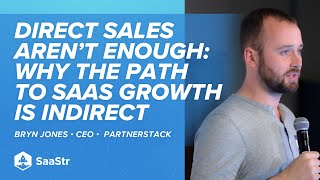
Bryn Jones, CEO of PartnerStack, argues that SaaS companies need indirect sales channels like affiliates and resellers alongside direct sales. He maps a partnerships pyramid from affiliate to referral to reseller, explains how B2B buyers now do independent research and take longer to decide, and walks through how to launch and staff a partner program for real returns.
Chapters
Great. Thank you so much. I'm so excited to be here everyone. Thanks for joining us. As said, my name is Bryn. I'm the co founder and CEO of Partner Stack. And today we are going to be talking about why direct sales they're just not enough. And why the path to SaaS growth is indirect. We are in the midst of a great go to market shift and Covid really only accelerated it all. The executives can feel it and everyone knows that. Well, 75% of folks know that in five years their business model will be completely unrecognizable. 90% of the executive team actually believe that the ecosystem is core to the strategy in navigating all this disruption. This has not been the case. We have experienced our growth inside of SAS for 15 years off of proven methods and methodologies. The idea has always been to achieve product market fit and then growth will follow by adding additional go to market channels. But the reality is you are giving up so much if you are not solving for distribution and it's really going to limit your growth as you scale. You can't maximize distribution through direct sales channels alone. SaaS distribution is shifting to indirect channels. Over the next 15 minutes, we're going to discuss three things. How the behavior of the B2B buyer has changed the difference between direct and indirect channels, and when and how to incorporate indirect channels into your growth market or your go to market strategy without spending a bunch of money on software. So first of all, the B2B buyers spent just 17% of their entire buying process actually meeting with vendors. They actually spend more time, 22% of their time meeting with internal stakeholders. The vast majority of their time. Of these B2B buyers is 45% of their time is actually spent doing their own independent research on what it takes to on their purchasing decision. And this is a trend that's only increasing in 2020. The B2B Buyer Behavior Survey from Demand Gen Report showed that 68% of respondents said their purchase cycle takes longer than a year. And 77% of those respondents said they spent more time researching these purposes. And 73% said they're now using more sources for their research. This shouldn't surprise any of us because what we've built and what got us here unfortunately won't get us there going forward. But before we kind of dive into that, I want to discuss what a direct channel actually is. Direct channels are the machines that we've been working on perfecting and there's certainly a lot more that we can get out of them. But it Is driven. Largely these go to market strategies are built around internal marketing and sales teams and the relying solely on them to generate interest for the product which comes through the form of leads. And those leads convert to sales, right? We all know them. Demand gen creating content to pull in prospects, lead gen converting interested prospects into leads and inside the sales function, converting these leads into sales. To be clear, all of these things are great and they're actually requirement that we need to go in and build in. But this presentation isn't about how you should replace any of those indirect channel or those direct channels, but rather how you can work with indirect channels to enhance your direct channels. There's some risk on relying solely on direct channels. One, they're incredibly expensive to scale. Every time that you want to go and add more revenue, you have to hire a new ae. That AE needs more support from the bdr. They really limit your reach. You want to expand into a new geography, new vertical, you're hiring more people. That's a lot of fixed costs that you're carrying to continue to scale up your direct channels. And it also limits your credibility. If you're the only one championing your business, your platform, your solution, your methodology, it's really hard to have the credibility with the buyers. Here you can see the B2B. You know where B2B buyers are actually turning to do their research and where the top information is actually coming for these B2B buyers in their use case. Do you want to flip to what's next? What we're really calling out here is that the majority of the go to market channels are actually indirect. They greatly outnumber the go to market channels. So what is an indirect channel? One indirect channel, simply put, is when a third party is selling for you. It's when they are promoting your platform, they are sending you leads, they are sending you referrals. Anytime somebody that is not inside of your organization, that is not on your team, you are working alongside them. That is considered a partnership. And partnerships really go a long way. The advantages of these indirect channels is that they're very affordable to scale. They're incredibly efficient. If you want to go global, you no longer need to go and hire folks on your team or build an office or come up with a unique strategy. Rather, you can go into different regions, different verticals and go to the specialists in the space and work alongside them to go in and reach these new customers. It expands your reach. When more publications talk about your products, customers have incentives to refer their peers and agencies pitching your products and their Clients, you're going to get immediate access to these audiences, which you never would have otherwise because you can actually meet these customers where they want to be met. And lastly, it really expands your credibility. Indirect is one of the best ways to get into enterprise customers. They're one of the best ways to manage long sales cycles because these partners have advantage of trust that they've already built with these customers that you're trying to meet, that you're trying to meet. And these buyers are increasingly doing their own research and defining their own needs before talking to providers. Indirect and these channel experts, they're the best way for you to get in there before decisions and conversations are even happening. There are three types of partners. There's an affiliate partner, which is someone that's really a content creator publication, somebody that's using links to drive you top of funnel traffic. There are referral partners, and these can be anyone from customers to consultants that are sending you leads that are often converted and managed by your sales team to go in and be closed. And then lastly there are reseller partners. And these reseller partners can be anyone from individuals to some of the world's largest software and distributors out there. And these people are the folks that are taking your product and doing the full cycle sale. They're actually even servicing your customer. Often in some cases, your customer may not even know that they're using your product, but they're incredibly valuable. We call this the partnerships pyramid. And as you climb the pyramid, the conversation, the pyramid is very interesting. At the bottom of the pyramid is the simplest form of partnership, which is the affiliate partnership. And as you climb up the pyramid, things become more and more complicated. The other thing that changes is that the conversion rate actually drops, increases as you go up, but the volume decreases on the affiliate group. You're going to have a lot of affiliate partners driving you lots of traffic, but they might not be as highly qualified. The referral group, you're going to have fewer, fewer referrals coming in, but they'll be much more qualified. And the reseller, that's really the pinnacle program that you want to be going and chasing after. My point here is that SaaS businesses should scale using the pyramid bottom to top. And we'll get into why at the bottom. The biggest reason why partnerships fail is because they never get off the ground. And at the bottom you have an affiliate program. Affiliate programs are very easy to launch. It's really just hanging a sign on your door saying that you're open for business, it's going out and talking to people that are talking about products and software in your space. Getting started with affiliates. What you want to be doing is you want to be looking at people that are linking back to you and reach out to them directly. You want to be building an inbound function that's going to help you collect affiliates that are coming onto your page and then you want to be responding to these requests as fast as possible. Unbounce, as an example, received over 300 requests from their partners over the years. Because before even launching their program, then you have referral partners. Referral partners are going to refer highly qualified leads to you directly and your sales teams are going to go in and take and close them. This includes everything from consultants to agencies. And this is about building one on one connections between you and your referral partner. The trust and credibility matters a lot here. Getting started with these referral partners can be tricky. Don't over bake your program. You need to figure out who these agencies are. You need to build a partner Persona to figure out how you're going to go and acquire them. You need to understand their needs and what sort of training and enablement they need in order to go and promote your partner. Some really interesting things that you can do like building co branded landing pages where these partners can quickly refer deals to you and get up off the ground. The trick again, don't overcomplicate the referral partnership. Get it up, get it launched and scale it. And then lastly there's the reseller partners. And this is where things get very tricky. These reseller partners are owning the entire sales process. So they're including these value added resellers, managed service providers, and they are the ones that help implement software across these different organizations. And if you want to reach enterprise customers, it's necessary that you tap and learn how to work with reseller partners. Reseller partners are incredibly challenging to start working with because you need to build out thorough training and enablement resources. You need to build one on one connections. You need to be creating specific commercial terms and agreements with everyone. It's why we recommend strongly that you start at the bottom of the pyramid. Because reseller partnerships can take, you know, years to roll out effectively. What matters most is that you're scaling something that you can ultimately show an ROI on. These partner types depend on like ultimately what you're trying to go on. What we're really showing here is that affiliate partners, you're going to have a lot of partners producing very little on reseller and generally it's going to be a low ACV and there's going to be very little effort for you to go and start seeing an roi. Most importantly, it's going to happen very quickly. The referral partners, you need a dedicated team to it. This dedicated team should be able to. These referral partners should be able to bring in a larger ACV and the resources required. Really hit around some training and enablement. And lastly, on the reseller side, you're not going to have many partners here and they're going to be incredibly high touch, but they should pay off big time. The challenge with reseller partners is as a channel, it's incredibly challenging to go in and build because there's a lot of resources required. Before you get going on building an indirect channel, the first thing that you have to answer to your or ask yourself is do you actually have product market fit? Product market fit is a requirement before doing any type of indirect channel building, whether that's affiliate referral or reseller. If you can't sell your product, a third party will never be able to sell your product. A second question that you should already ask yourself, that you should ask yourself is, do your customers already refer your products without incentives? If they're referring your product, if they're referring clients to you without any incentives, then an indirect channel should only enhance this inbound leads that you'll start building out. So turn to your customers, figure out are there people reaching out to you looking to sell your product? Because if there are, you're primed to build an indirect channel. And then you need to ask yourself, do you actually have assets that you can repurpose for these partners? One of the best areas to turn to look for these assets is the training materials that you're providing. Your marketing team, your sales team and anybody who joins your organization. Right when you're thinking of going after these referral and reseller partners, it's incredibly important that they know how to sell your product, what your value proposition is, who you go in and target. You can't expect someone to sell your product if you're not equipping them. And most importantly, if you equip them correctly, they will sell your product on brand. And the last question you should really be asking yourself is is there someone in your org who can manage the indirect channel? This is not something you do part time. Indirect channels should drive upwards and more than 30% of all revenue. You can't expect to increase 30% increment. You can't expect to add 30% incremental revenue. As a side project, you need dedicated Teams and resources in order to make this happen. It's the number one mistake we see folks going and do. If you're looking to turn on the indirect channel, you've got to put some bodies behind it because ultimately, you know, it's an incredibly scale, a scalable platform and an incredibly scalable program. But if you are unwilling to resource it, you will get nowhere. So here are the takeaways from the chat. Indirect channels complement your direct channels and they're very low risk to launch. This is not something that you need to invest tens of millions of dollars before you start seeing an roi. But there is a way to build it and that's deliberately moving up the pyramid. B2B buyers are looking to experts outside of your organization so they can understand how to best use your product. And in some instances, it's actually how to use your product alongside multiple products. Some things that you may not even are aware of. Most SaaS companies are ready to launch at least one partner program. You just need to get product market fit. And you know, at some point you will actually be able to launch multiple programs and scale up the partner pyramid from affiliate to referral to reseller. But in order to do so, you have to invest the resources and you have to know how long it's going to take to go on and pay off. So thank you so much. Thanks for, thanks for having me. Definitely interested in going through some questions. Hi, Brian, we have one question here from James. How important are performance targets and criteria and exclusivity in partner relationships? Yeah, I mean, I think it depends on. I think it actually depends. It always depends. If you're launching an early program, you want to make sure that your terms of service are very clear with what you expect out of your partners. But as your program matures, you want to start developing performance targets. We work with partners. Our own partner program, they actually have performance targets and those performance targets are generally in that referral and mostly in the reseller bucket. But don't over optimize it from the beginning. Just get it launched and then see how things are performing afterwards.
All right, so we are right on time. Thank you so much, Bryn, for that great presentation and I hope you all enjoy the rest of Saster. We have some great sessions today. Thank you so much.
Thanks so much, Sam.










