Don’t Sell SaaS Like It’s 2012 with Reprise and Glasswing Ventures -- Live from SaaStr Annual
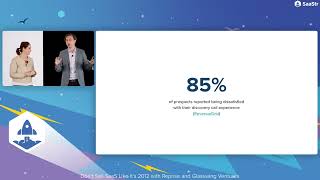
Evan Powell and Rudina Cesare argue SaaS companies are stuck in 2012 sales tactics. Buyers now self-educate for 45% of the buying process and spend only 5% with sales. Companies should ditch discovery calls, let prospects explore the product themselves, and give champions interactive ROI tools instead.
Questions this video answers
Approximately 45% (buyers do their own diligence).
About 5%.
Reportedly 4x and in places 5x (speakers used both 'quadrupled' and '5x').
About 80%.
Chapters
Foreign.
Hello Saster. It is amazing to be here and see so many people back in person again. My name is Evan Powell. I am one of the co founders of Reprise. We are the leading demo creation platform enabling sales and marketing teams to make and share demos that win.
And my name is Rudina Cesare. I'm the first investor in Reprise and managing partner of Glasswind Ventures, an early stage focused firm on AI and frontier tech for the enterprise and security markets.
And we're here today to implore everyone, please don't sell SaaS like it's 2012. And why are we here talking about this? Well, the main reason is, you know, going out in the market. There are so many companies that are still going to market using best practices that were taught to them 10 years ago and they were fantastic then. But the reality is that the market has changed, right? 10 years ago Saster didn't exist. And look around you now, right? It is clearly a very different world. And the fact is, if you are still using 10 year old best practices like so many of us unfortunately are, you're pissing off your buyers. And I know, Rudina, that is not vocabulary that flies in a VC's office, but I'm gonna say it out here, it's just true.
If you knew how much discussion went on what's written on this one slide. But fundamentally, Evan is right. You know, ten years ago SaaS was relatively novel. The salesperson was guiding the buyer through thought leadership. They were the advisor, they were helping them do market discovery. Today, the buyers are sophisticated. Let me give you two data points. One, if you think about the buying process for a a purchaser, prospective customer, they spend just about half of their process, 45% doing their own diligence. They may be looking to buy your product, but you don't know, they're looking at the space, live alone at you. So that whole window where 10 years ago you had interactions, discovery learning is gone. Even more worrisome in my book, your salespeople are part of that process for only 5% of it. Your tip of the sphere, 5% of the buying process for your customer, clearly the ability to do things the old fashioned way has been encumbered. And if that's not enough, think about this. In the last three years alone, customers quadrupled and in fact 5x their SaaS purchases. So one, they're sophisticated, they know how to purchase SaaS. Two, though, here are these empowered buyers, they know how to diligence, they're on their own and they are all complaining about how the Process is complex or too difficult. In fact, almost 80% of them are saying so. So the paradigm has to shift.
Exactly. We need to start and trust me, I'm a recovering salesperson, so I care a lot about that 5%. But, but we need to be thinking about the entire process and really architecting our companies and how we go to market around the way that the buyers today want to buy. And it's going to be the companies that figure this out that are going to be the ones that win over the next 10 years.
And that, and that's reflected in your traction. I mean, here's your VC talking, right? Boardroom, show me your AR growth and all the sales metrics. What market demand for your product and velocity of sales are critical outputs. Well, they are directly correlated not just to what you are building, but how you are taking it to market, how you are selling it. For those of you who have lived in M and A transactions, there is an expression. Products and companies are bought, not sold. Well, why is that different for customers? Stop selling to them, enable them to buy your product.
Absolutely. And so this is something. Adjusting to this process is going to take the entire company up and down. But today we're going to focus on three main areas. We're going to talk about marketing, sales and about your product teams and engineering teams and the way that you are building the product that you're selling. But let's start with marketing and in marketing, right. I could go this, this takes place across every channel. But I'm going to specifically talk about the website and the first interaction that these high intent, high information researching buyers are going to have with you. And look, marketers in the audience, you don't need me to repeat these stats behind me. The fact is prospects are bouncing off your website at a much higher rate than ever before. And that's because most marketing websites are designed around the don't know what I don't know buyer. Let me present thought leadership. And they're not designed for the buyer of today who is there to do research and understand. They know what their problem is. They want to know quickly how you solve it. So what do we do as marketers? Well, first of all, you need to make that first interaction with your product or with your website an interaction with your product where they clearly understand what you're doing and how you're solving it. Right. Within the first 15 seconds of hitting your website, I want to know do you solve my problem and am I going to enjoy the experience of you solving my problem? Because again, buyers are much more high information than they used to be and they've bought many more pieces of SaaS and they've had purchases go wrong. They've bought into a promise only to find that actually using that product is terrible. So put interactive experiences on your website where they understand that it is a joy to get ROI from what you're providing. Similarly, you need to put resources everywhere you possibly can across your website, across social media channels. Not just puff thought leadership pieces, but actual in depth pieces. Pieces on here's how the problem gets solved, here's how you're going to do.
This and if that's not enough and you care about your careers, well, your next job interview, whether you're a director of marketing or a cmo, this mindset on product LED and how you're incorporating that as part of your marketing toolkit and your organizational structure becomes part of your interview. So look forward both for the current products you're marketing and care for your career.
And Rudina really hit on it right there. Right? We're talking about product LED principles, but we're not necessarily talking about freemium models, right? If that works for you, that's fantastic. And I'm sure there are going to be a ton of excellent sessions this week talking about how to put together a product led growth freemium type model. What we're talking about here though is using those same principles for everyone. Even if you're not offering a free trial right away, buyers are still looking for that experience. Experience for what it takes to use your product. Give it to them. And so let's jump into sales, right? Once you've done this and you've got people excited about sales, the fact is no one has the patience to participate in a discovery call before or anymore, right? No one here in this audience has filled out a form and said, you know what I really want to do? Sit down for 30 minutes and answer 20 questions with the sales rep before getting a demo a week and a half from now, right? And on top of that, buyers are not putting you in the room with decision makers anymore. Again, they've bought too many things. They've been led down that garden path only to have it not work out in the end. And so they're trying to keep salespeople at arm's length and run their own buying process. And as a part of that, they trust their experiences, what they feel, what they see, what they can touch far more than anything you say to them as a salesperson. So again, as a salesperson, how do we go and deal with this first kill the discovery call and now you've.
Met Evan Powell and I'm serious about this.
Please kill the discovery call and note before all the salespeople in the room like jump up and try to strangle me. I'm not saying don't do discovery. I'm saying don't have a 30 minute call where all you do is sit there and ask the prospect questions. I'm saying give them what they came for. Right? And we're seeing this is annoying if we just look at some things from my LinkedIn. Right? This is just, here's my own LinkedIn feed. Your prospects hate this so much that they're making social media posts about how much they hate this. Don't do a call. That's just to fill in your CRM. And I think this is part of the thing where in sales we've inadvertently weaponized what I think is a good sales concept. It's give to get. And we've gotten too focused on the prospect has to give me information before they're going to get the demo. And in reality it needs to be flipped on its head. We need to give them what they showed up for and then we will get information in return. So one of the things we talk about a lot at Reprise is discovery through demo, right? Show them a piece of the product, what it would work, what it would look like. You've done your pre call research and you're saying, so is this how that would relate to you based on something you know? And they're going to respond to that far more than they would if you just sat and gave them a question. They're going to say, yes, you know what, that's me and here's how. Or no, you know what, we'd actually use that a little bit differently. And you're getting the information you want through giving them the demo that they showed up to the call to get. But that's not all we can be doing. We also need to be empowering our champions because again, they're not going to put us in the room with the buying committee.
And by the way, empowering your champion doesn't mean you give them a PowerPoint deck or that two page PDF that's over with. They're not going to use it, they're not going to open it.
No, they're not going to read it. Right. I can't tell you how many, how many PDFs are sitting in my inbox unread. And by the way, I used to send them out when I was a Sales rep. Right. So I'm seeing this now personally. And so what we need to be doing is turning the champion into a sales rep for us. Give them the materials that we would want to be presenting to that group. But again, interactivity is key. Right. Give them the demo that you wish you could give to the executives and make sure that they're trained or put on rails so that they have to highlight the value props that you know, matter to them. Give them sorts of, you know, be on the call, say, hey, I know that you really like that particular feature. I'm emailing a demo to you. You can now go and give that to your boss because you said that was the most important thing. Help make them the heroes.
Yeah. And then as you think about farther, do you want to talk about the roi?
Oh, yeah. I think the other piece is making sure that the ROI can be felt through the materials that you're given.
Yeah, right.
Not just that you give it, but how you give it. What does it feel like to get that? That's what you need to be baking into all of your sales engagement.
So Evan has just covered the tip of the sphere. You go to market, organization. Well, let's look at product and engineering. I mean, it's not a hidden secret that there is always bumping of heads for the most part between the geniuses in the product and engineering team that are dreaming up innovation and frustration with how fast sales is moving. Customer traction, finger pointing. Let's talk so and so. Let's change the go to market and maybe you need to do that. You know, most of us are in startup land and we need to hone in and iterate. But it's fundamentally important that this new paradigm shift around how products are being bought is incorporated in the product and engineering teams. How one idea, how about viewing sales as they corporate strategic piece of your product design? You know, having a great UX UI was the differentiation in 2012. Table stakes today do not. Do not send your sales and marketing people with an MVP and a list of features coming on the roadmap. Nobody will believe it. Buyers have been burned. Buyers have heard the story. They will move on. So how can you incorporate that mindset? That product interaction doesn't start once the customer has bought. It starts at the first moment that they see the product, whether you're sharing it through your website, whether you're doing a demo, whatever you are doing. And that's where your design process begins.
And that is so key. Right. I think in product it's tempting to think about users as customers or people actually engaging with and trying to get something out of the product. In product teams, we need to be incorporating the prospect into our user group. Not just what is it like to use, but what is it like. When someone sees this for the very first time, does it make them excited? Do they want to go and buy it? And that's what buyers are kind of expecting now, because they're not being sold dreams.
Yeah. And by the way, how about the other notion, understanding your customers needs? Yes, we have the product people, they translate. Yes, we have those facets of the organization. But in this day and age, you can incorporate features that track, measure and give you insight into your own usage. I mean, you know the code, get that data. Why should you rely on what someone says versus actually knowing what they do? For the set of customers that are already using your product, figure out your features, don't just sort of imagine things and continue to innovate in isolation. Don't simply repeat, rely on the other organizations. Create this feedback loop where you know for a fact how your product is being used. That's a mindset shift.
Absolutely. And I think part of that too is listening to the way that your customers talk about their problem before their customers. Right. I think we can get really worked up into how we're designing it for people who already understand what we do. Is it obvious, based on the language that our prospects are using, that our product is going to solve their needs? And so this is something, I mean, there are plenty of tools out there to go out, listen to sales calls and hear on the first call before a prospect has actually understood your product, how are they describing that problem and is it immediately obvious when they see a feature that it's going to solve it?
And then the third bit, just to wrap this section of organizational design around sales, is around fundamentally, how do you, as engineering and product and dev team, free up your own resources to go do what you love, coding, developing, innovating, and not get pulled into that sales engineering call. You get your code or you get one of your best developers. Now they have to go support the sales process on those calls. They don't love that. Or have you looked at your cloud build lately? How much of that your budget is being eaten by those heavy Demos? Welcome to 2012. I mean, how about thinking of automating some passes, parts? You can develop the tools in house, there are thousands out there. But how do you think about the role that development and product plays in sales and get it off your docket, automate it, leverage the tools and learn directly from your customers.
Absolutely. And this is where, you know, as we're summing all of this up, this really is a process that spans across an entire company. Right. We're not just talking about any one of these pieces. So in marketing. Right. We're talking about surfacing the information and resources earlier. In sales, we're talking about tailoring that engagement to make sure that we're answering questions. We're reacting to the new high information buyer. And all of this is being backed by product. And so everyone in this room has probably either bought or sold software. Yeah.
And so ask your question in that regard. Think about when you are buying software, how do you approach the process? And if you are the buyer of the software you are selling, marketing, or developing, do you love the process of how you're doing? So would you, if you were the buyer, enjoy buying your own product?
If not, come talk to us. I mean, seriously, this is. This is exactly what we think about all day, every day at Reprise. We'd love to talk about how to help this. We are over at booth 503. Please come ask questions. We're really excited to enable the sales process of today to meet the buyers where they are.
And if you think VCS don't help, some of us actually do.
Yes. Thank you so much.










