Driving Growth with a Solid Marketing Data Strategy w/ LeanData VP Growth Marketing Charm Bianchini
Charm Bianchini, VP Growth Marketing at LeanData, explains how to use marketing and sales data to drive growth. Start by refining your ICP and measuring KPIs at each handoff from marketing through customer success. Build a data management strategy: audit your records, automate enrichments, and map your marketing funnel to sales stages so leads route faster and more accurately.
Chapters
Year in 2021. So you know, following the data is one of their keys. So the ICP and target market, if you've not taken those steps to identify what your ICP and target market is, that is one of the first things you should do. But you need to understand that that's going to change throughout the year based on different market signals. So you really want to make sure that as part of this marketing, part of what you're looking to do for leveraging your data is understand that that can change based on market signals that are happening. You really want to diversify your go to market strategy. So there isn't, I don't think there's just necessarily one go to market, there's several. It can depend on the types of products that you have or the specific segments that you're looking to target, or the different industries that you're going after. Everything can be different. So you really want to understand how you can diversify your go to market strategy. You're designing an infrastructure built for speed and versatility, moving to a strategic end to end operating model around your revenue operations function. Investing heavily in community. You know, peer referrals are really the ways a lot of folks are looking to buy, especially in times of COVID Looks. I got muted there, sorry. One of the things you want to look at on the community side is I find organizations like Saster, organizations like Modern Sales Pros, Sales Hacker, there's a lot of different peer groups that are out there that if you invest in having a avenue into that, you find that you have a really good return on those investments. Prioritizing outbound targets based on their engageability. I think a lot of what we're finding at Lean Data is you just can't rely on inbound. There has to be a lot of proactive outbound as well. So you gotta make sure that that's an element of what you're doing. And then building a sales process around 90 day priorities. So looking at everything, segmenting everything within time base in a quarter rather than looking at the entire year and then lastly creating a sales enablement process to be able to change and make changes and react to changes in an instant. So these are the things that Topo has said. I don't know, does anyone else? Is there anything else that folks are working on or do they see something that's missing from these strategies that Topo has laid out?
John, we do have a question from Raj about point six here. How do you assess engageability? So I think that's something we could Address and then see if any other questions pop up from that specific question.
Yeah, yeah. Like one of the things that we've done, you know, I think engageability, and we'll talk about this in one of the later slides, but when we look at our marketing, our sea of marketing contacts, one of the things that I've done at Lean Data is try to bring the idea of stages within a marketing person. So folks that go through your whole marketing funnel that end up becoming part of an opportunity, but they don't close, are probably the highest, you know, have the highest engageability rate of any other contact in your database. Right. So if you could find a way to engage on people that you spoke to that had, from a sales perspective went dark, or they said they went to a competitor or, you know, told you that now wasn't the right time, you know, those are people that you've already made an investment in from a marketing perspective that have an understanding of who you are and are probably the lowest hanging fruit when you want to look at doing okay, hey, I want to now prioritize an outbound motion. Who do I go after first? It's usually those people that you've made it all the way through a sales process down to being part of an opportunity that just didn't close one. You know, those are generally the best people to go after when you're doing that outbound, outbound motion.
And one, one last one on this one, I think before we can move on, on question four, on point number four, what are some of the KPIs that you set and how often do you measure them?
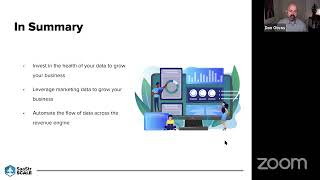
Yeah. So as far as, like from an end to end operating model for revenue operations, you know, you know, since we kind of own that customer journey from marketing through sales through customer success, there's a lot of handoffs that happen in that model. Right. So, you know, somebody gets handed off for marketing to a sales development team. It goes from a sales development team to a salesperson. It goes from a salesperson to, you know, maybe an implementations person once they're a close one deal. And then it gets handed off from implementations to a customer success. And then it even gets handed off from customer success to an account manager. Right, right. So each of those handoffs, you know, what we do on the revenue operations team is make sure that that handoff is as smooth as possible. And then also we also look very closely at what the conversion rates are when those handoffs happen. So what does our conversion rate look like when a lead gets handed from marketing to sales Development, what does it look like when it gets handed from sales development to sales and so on through the whole funnel, all the way down to renewals. We also get very involved with upsells. And a lot of what happens on the customer success side is things like how well engaged are your customers, how much have they adopted your product. So we do a lot of measurement there to know what is the likelihood of someone to upsell, what is the likelihood of someone to renew. So each of those handoffs is really where we focus in on what are the metrics around the success of those handoffs and as someone moves through that funnel. So I'll go to the next screen. So the first piece of this, we want to look at driving growth by focusing on data. So I think, again, I don't think anybody has a perfect world when it comes to data. One of the jokes that I make is that the second that somebody is in your database, they're stale because people change jobs, people change locations, they change emails, they change phone numbers. Once something hits your database, it's likely stale. So how can you really do, do the things to make sure that, you know, the data that you have is the most accurate and most, most valid to act upon. So, you know, the first thing is, you know, to not let, don't let bad data bring you down. Like, like everybody has this problem, you know, nothing's perfect, you know, but, you know, the thing that can happen if you, if you do have bad data, you know, is to understand that, you know, marketing and sales aren't aligned. You have missed opportunities, you have a weak pipeline, there's a lack of visibility throughout the funnel. I think there's a lot. There tends to be confusion if marketing is looking at one metric and sales is looking at another, or customer success is looking at something different than marketing. You know, you want to make sure that you homogenize your metrics and your data across your whole organization. You know, if you don't have good data, you're going to have, you're going to have really a hard time driving success for first, for marketing campaigns and how you're segmenting those, you're not going to have really good roi. And then the worst thing for me from revenue operations perspective is a suboptimal customer experience, right? So making sure that you have good data allows you to target the message to the right Persona, to the right industry that they're in, and then really improve that experience for your prospect. So what we've done at Lean Data, when I first started earlier this year, we took a step to really say, okay, we really want to have a data management strategy. And what does that look like? So we have a data committee. Data committee is made up of folks on our marketing operations team, our sales operations team, as well as our customer success team, as well as our sales team. Because I think one of the things that we find is if you do have a challenge with data, the first people you hear it from is your salespeople. Like, this phone number's not good. This email bounced, right? So we include sales team members on that data committee as well. You know, we've taken steps to go through and audit our data. You know, we want to really understand, you know, where do we have duplicates? Where do we, you know, how do we. How do we make sure we avoid those duplicates? How do we make sure that assignments are correct? How do we make sure that, you know, things like employee counts, that we have a single source of truth that we're relying on for when we assign something to a rep, that we have titles, you know, things along those lines. You know, you want to make sure and understand where those gaps lie so that you can rely on data providers to help enrich your data. To plug that hole, we created a plan. I think when I started, we determined that the data provider that we had wasn't sufficient. We needed to look at changing who our data provider is and how we ran enrichments through our database. That was one of the first things that our data committee did. Then we went through, and also, again, we went through and cleaned and purged our data. You know, where we did find that we had duplicate accounts, we got those merged where we had issues where employee numbers were wrong, we got those updated and then got the accounts reassigned to the right person. And then we've also taken steps to purge data. You can only have so many people in your marketing platform, right? I think a lot of the marketing platform vendors charge for data storage. So, you know, one of the things that we did is looked at our data and said, okay, hey, we've had a salesforce instance for, you know, more than five years. There's a lot of data that we have that we know. We have bounced emails. People aren't at that company anymore. Well, let's just go. Let's go through and just kind of streamline what we have and just make make sure that the data that we do have is accurate. So, you know, we've taken those steps, and then we've done as much as we can to automate the process. At the end of the day, the more that you have automation for making sure that your data is enriched. And that's a key early step of when someone enters your system, everything else you have tied to what you're driving from that data runs a lot smoother. So these are the steps that we did. This is the plan that we put together at lean data in 2020 and what we've executed on and what we, what we're finding a lot of success in. So once, once you've kind of taken those steps, you know, now, now how do you leverage that data for growth? Right? This is really the key, the key is like once you've, once you've built, once you have a data committee in place, once you've executed on your plan, you've purged your data, you've, you're automating as much as you can, you know, what are the next things. So the next things, and really we did this early on is really to get alignment between your sales and marketing teams. So for us, you know, it's our revenue operations team, you know, as I said we, you know, it's our responsibility is not just sales operations but it's marketing operations as well. So a lot of the data points that we have, it's very easy for us to go hey, is this an apple and does it stay an apple as you do reports through sales down to customer success. So a lot of the data points that we have, we make sure that we have alignment on through the entire, through sales through customer success starting at marketing. So that when we have reports and we have dashboards and everyone has an understanding of what is the metric that we're looking at. Sales is response. At the end of the day, sales is responsible for driving closure of pipeline. But marketing is really where that starts. And so the way that we go, our demand gen team is looking at how many net new logos have been for new business have been created in a given quarter. So where sales maybe looks at the total pipeline at the beginning of the quarter, demand gen is really focused on new business and what new is being brought into the pipeline because that's just one piece of the pie, of the pipeline pie. But it's a very important one because obviously if you don't have a new business target, you know you're really going to end up having challenges with your overall pipeline over time. It's not something that shows up right away but you know, several months down the line if you're not, if you don't have a focus on that new business piece of it, you know, you will have challenges and then you know, once you're there, you have, you know, you know, we have that we have a blessed data to run the business. Everybody knows, you know, if there's a specific term like ARR or growth or upsell or whatever the term is, everybody knows what that means from marketing through sales down to customer success. And that's really key to getting that alignment. And these are the things that we've done at Lean Data to help drive this. One of the things we did this year, this was a project that I worked on with our demand gen team. As I said earlier, I wanted to bring the concept of sales and an opportunity and opportunity stages to marketing. Because I really think that if you look at a marketing funnel, at the top of the funnel you have everybody, everybody in your system and those are all your known leads. And then within those known leads you're going to have folks that cross over thresholds to become what I call marketing qualified. Where marketing goes, okay, this person falls into an icp. They're part of our addressable market. They have the right Persona. This is something sales should probably go after. Once sales has taken action against that lead, we say that that is now a sales accepted lead. Sales has now added that person to a salesloft cadence or an outreach sequence. They made a phone call, they reached out to them on LinkedIn. There's some action that they've taken that has now made had that person crossover from a marketing qualified lead to now a sales accepted lead. It stays a sales accepted lead until there's some disposition. So once sales has a conversation, I am the right person, yeah, let's have a meeting or no, I'm not the right person. Let me refer you to somebody or no, I'm not interested. Once you have some disposition of that lead, we then call it a sales qualified lead. And then someone can say a sales qualified lead and not become an opportunity and then you leave them as sales qualified. But obviously if you have somebody who is sales qualified in a positive way, you have a positive disposition. Where there is a meeting, there is an opportunity, they're now part of an opportunity. And then we track that as an opportunity stage through the rest of the funnel as you would on a sales funnel. So we've really brought this concept of like a sales funnel to marketing through this funnel here. What you see. So you know this, we're finding a lot of success here because, because it helps marketing decide, you know, like the, like the question that was brought up earlier about like, you know, how do, how do I know what the engage ability of a lead is? Well, people that have made it farther down your, your funnel without becoming a closed one, you know, customer, you know, those are going to be your most engageable leads because you've already spent the money and the effort around marketing to get them to the point, you know, you've done the sales effort, you know, they just haven't converted. Right. So really those people that are kind of at the bottom of the funnel here that have not become customers, are you going to be your most engageable leads where you might want to spend more time and more effort as low hanging fruit for any outbound effort that you're looking at doing? And then you know, as part, part of, part of this as well, you know, we do everything we can to automate as much, as much of this as possible. So everything I described in that funnel is automated based on the actions that a person takes or that one of our reps take against that lead. You know, we want them to leave as little up to chance as possible and automate as much as we can. So you know, obviously, you know, by using lead to account matching, by leveraging our own, our own platform lean data, you know, we're able to take these leads that come into our system immediately know, you know, what rep should they be associated with. You know, if they're already a customer being worked, if they're a brand new account, if they're an existing customer, if there's someone going through an upsell, there's someone going through a renewal, you know, we have that lead to account matching that can bring that drive that person directly to the right rep for follow up, you know, and by routing that data across, you know, the entire revenue engine, you know, we support all the go to market motions, you know, whether it's an upsell or a renewal or a brand new sale, you know, that that automation brings that, we have that benefit of that automation across every one of those motions and then we do all this in real time. There is no lag in making sure that a lead gets assigned right or that an opportunity gets created and is assigned to the right person. So in summary, invest in the health of your data to grow your business. I think at the end of the day, having a solid data strategy is really the foundation that, that drives the rest of your success. And that's always what I've tried to espouse to my team. And it's a lot of what drives a lot of what we do is that the accuracy and the Validity of our data is really important. It becomes the way that you can grow your business by leveraging it in the right ways and then automating that flow of data across the revenue engine. With platforms like Lean Data, you'll be able to see a lot of success in that speed to lead and then increasing the accuracy of having the right folks assigned to the right people that come into your database. So I think that's all that I had. I'm happy. I think I have another. Oh, no, I mean the last piece of it. You know, obviously this is the lean, the lean data piece. Right. This is my sales pitch. You know, as I talked about the lead to a account matching piece of it. You know, Lean Data does continuously match all the leads with target accounts surfaced within engaged accounts. So when you have leads come into your system, they get routed to the right person. You know, we have an engagement platform so you can identify, you know, within your opportunities and within your accounts, you know, who is engaging with sales, who's engaged with marketing and how they're doing it. So there is, there is a window within, within Salesforce that allows you to see exactly when and exactly what your prospects are engaging with. And then the routing piece of it, of course, of being able to automatically route those leads, contacts and accounts to the right people on your sales team, automatically create and route the opportunities based on whatever criteria that you have in Salesforce and using routing to optimize the flow of demand throughout your system. So load balancing, inbound leads, load balancing, how things get assigned round robining to your sales team, however you want to set up those flows, Lean Data supports it.
Thank you so much, Don.
That is my last thing.
Thank you. We have a couple minutes here to take any questions. We'd love to hear from you as well. If you want to drop them in chat as well as if we run out of time, you can join the BRELLA Networking where you can have these one on one conversations as well. I'll drop that link in the chat, but in the meantime, if you have any questions, please feel free to drop them or shout them out.
I got one real quick. Yeah, thanks. Thanks, Tammy. Thanks, Don. So do you have any stories of SaaS, companies that have like an average price point of around $99 a month successfully running stuff like this? Oh, on the low end, I don't have any, not direct experience myself. You know, I think if you have, if you have that lower price point, I mean, do you have a lot of inbound. I'm presuming you have a lot of inbound, if that's the case. Inbound and outbound. Yeah, inbound and outbound. You know, a lot of what Lean Data does to support that. I think the best example that I can think of for one of our customers is Zoom. Zoom is one of our customers. Obviously, when we hit the pandemic, they had an enormous influx of leads, and our platform supported everything that their inbound team was working on. We were able to route them to the right people, we were able to load balance those leads to the right individuals, even if they were a low price point, obviously the very entry level.










