"Early Gains, Early Pains: 5 Lessons for Surviving Hypergrowth" Harry Stebbings and Robert Vis
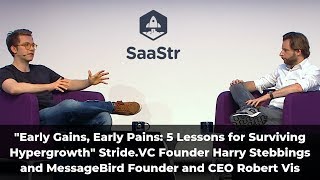
Robert Vis built MessageBird after SMS failures at his previous startup Zepay. He bootstrapped for six years, then scaled by prioritizing multiple early customers over one big deal, hiring slowly with a "when in doubt, there's no doubt" rule, and enforcing three-week phone-free breaks to prevent burnout.
Chapters
Well, thank you so much for joining. Such a terrible British accent for half an hour. You're listening to the 20 minute VC with your host, Harry Stebbings. The official SASTA podcast with me, Harry Stebbings. And joining me today, I'm so delighted to welcome.
My name is Robert and I'm the founder and CEO of messagebird. Communication with end users has become more complex than ever. Businesses no longer dictate the way they talk to customers. Your customers dictate the way they want to talk to a business. Businesses have to reach their end users on a growing amount of endpoints. Our platform abstracts the complexity of a really difficult experience and makes it simple.
I mean, my God, I wish I had an entrance like that every time I came into the office. Robert, listen, I've been looking forward to this for a very long time, so thank you so much for joining me.
Likewise.
So let's kick off today a little bit about you. How did you come to found messagebird and really one of the fastest growing and most exciting opportunities in SaaS in Europe today. What was that aha moment.
So I was working on my previous company called Zepay, which was an API to pay for virtual goods on your mobile phone bill and we ran into this problem where we needed to use text messaging as a way to verify users phone numbers and we were using this provider and every single and they were like market leader back then and every time we tried to send a text message because we were doing this in like 50 countries, a lot of times the message wouldn't arrive and, or they would arrive, they would arrive late and then we couldn't process the payment. So it was like an incremental part of our business process that we needed that we needed to run our business and we weren't able to fix it through a third party provider. So we built it ourselves and that sort of kick started the entire company. I ended up selling Zaypay and interestingly enough, the vendor that we were using back then became my very first customer.
Love it. What a start and what a journey it's been since then. I do want to start on something that you said before and we constantly hear in Europe, which is kind of the think big mentality which we need and absolutely agree with it. I had Mathilde Colin on my podcast from Front the other day and she said actually organizational discipline is more important than this think big mentality and grand vision. I'm intrigued because you've spoken before about the importance of it. How do you think about that and what it really means and embodies to you today.
I mean, look, I agree with both, right. I think you need to start off with a vision. You need to think big about your ideas. I think especially if you're founded out of Europe, you know, if you look at the demographics, the US is like what, 400 million people. You know, that's like 40ish countries that you need to cover when you're in Europe. So the idea of like starting a company in Amsterdam and then having to go global is kind of, kind of natural to you because just winning Netherlands isn't probably going to get you anywhere. But obviously you should always make sure that you have the right foundation to scale. And in that sense, organizational discipline is super important.
No, I totally get you. In terms of the thinking big, do you have to hat switch actually between who you're talking to and what I mean by that is when you're speaking to investors, absolutely. It's the grand vision of how this can be a billion dollar company. And then when you're talking to customers, say large enterprises, it's this is the product roadmap for the next six months. Do you have to switch your mentality on thinking big according to who you speak to?
I mean, I would say that you basically need to do it all the time. I think investors and customers both want to deal with a company that's focused on long term growth and has a long term vision that they think that, you know, they're the company, you're the company that they can, you know, trust and build their builder for an investor, invest in and make a lot of money probably and for a customer that they can work with and that's going to provide them into like digital transformation or, or things like that. So I think it's both providing the vision as well as showing how you are actually going to execute on division, both short term and then how you're going to get there long term.
Yeah, I mean actually going back to something you said earlier about kind of the first customer that you got, a lot of questions that I get from early stage SaaS founders is do I go for that Hallmark logo branded customer or do I just try and get as many logos on the board? How do you think about that kind of quality versus quantity in terms of logos in the early days?
I mean it's so, you know, it's so company specific, I guess. I mean, I think at the very early days you want to speak to as many customers as possible. You know, you should be very customer centric trying to figure out what do they want, you know, are there certain features that they're looking for? Are they willing to pay for your product? And the more feedback that you can get, the better. I would probably go more on the side of having a few more customers than just putting all your eggs on one customer and then building everything. Because if that customer ends up being unhappy or leaves, your business is screwed.
Yeah, then you're in trouble.
Probably not a good idea.
Now, I did hear that you spoke to a group of founders at an event or kind of workspace in Amsterdam and it related to ambition and something that one of them said struck you. Talk to me about that event and that experience and your takeaway.
Yeah. YC invited me to Y Combinator to host an event for founders in Europe. So we did it in our offices. We had a couple hundred people show up. It was quite good. And, you know, it struck me that I spoke to a lot of Dutch founders and I was like, so what are you. They were pitching me. Or like they were trying to tell about their business. I'm like, so what are your missions? Where are you going to go? And like, yeah, we're in Amsterdam, now we're in Netherlands. And yeah, next up, we're going to go to Belgium and then we're going to go to Luxembourg. And I was like, really? You're gonna win the Benelux? Like, do people even know what the Benelux is? It's like the three smallest countries in the world. It's like Netherlands, Belgium and Luxembourg. And you know, I think that's one of the things that Europe has to sort of get over, like think big, go global, you know, think outside of your country to really start winning. Because, you know, that's the advantage that the US has that, you know, one state to another state. You have 400 million people, same language, same currency, same regulations in most situations.
That's the last question I have before we move on to more granular elements of scaling and hyper growth. But it's just when you do a comparison and think state, we always hear that now is the time for Europe. And it's often pumped, in many cases by the VC community, where there is incentive for that to be pumped for you on the ground. As a founder, do you definitely see that scaled ambition in Europe or do you still think that we have quite a way to go in terms of scaling that ambition in Europe?
I mean, I'm from Europe, so I'm going to side with Europe on this one. You know, I read this Bloomberg article the other day and it Said, why can't Europe do tech? And I'm like, really, Europe can't do tech? I mean, I think we have a bunch of really, really good tech companies out here. I mean, very proud of Adyen Dutch company worth over $20 billion. You know, there's a ton of others, Spotify, etc. So I think Europe is catching up quite quickly. The US Might be a little bit ahead, but it's not necessarily the first one that wins.
So you mentioned some of the kind of hallmark names of Europe there who've had incredible scaling journeys. And I want to talk about scaling because when we chatted before, you said something kind of relatively counterintuitive to me, which was, don't try to scale. What do you mean by don't try to scale? And what's your thinking around that?
Well, you know, I think your approach to building a business should be the same as you would build a house. Like, you want to have a good foundation before you build the rest of the house, right? Because otherwise the house sort of collapses over time. And I look at the same way in building a business, you want to have the right team, you want to make sure you have a good culture, basically have the basics set up well, and then you really have something that you can sort of execute on and scale. But just going around hiring folks and like going, going ballistic probably won't build you a very good sustainable company.
Okay, so ensure the foundations are stable. How do you know when the foundations are stable and you are fundamentally ready to start that kind of inflection scaling point? What are the leading indicators of that kind of foundation stability?
Well, I think first it's your people, right? Like, you need to have a good team around you. You need to make sure that, you know, as a founder yourself, but also like, you sort of like a good middle management and maybe some executives around you, they can sort of help you to scale. So you're not doing everything by yourself. You know, probably need some money coming into your business at some point just to make sure that, like, you've proven out your product and that people are willing to pay for it and customers are coming to you, hey, can I have more of your product or, you know, can I? Yeah, I think those are the two fundamental things that I think you really need. You need good people and you need a fundamental good business in that sense. I like Europe. Traction is more attractive in Europe where in the US people are more about ideas.
So if we take that, though, and then kind of align it to the message bird journey, you Waited six years before you raised funding and you had great people and a great business before then. So I'm intrigued. Why did you wait so long to raise financing and what was the thinking behind that for you?
Well, I mean, we were very fortunate that, you know, we bootstrapped for six years. We were profitable. We still had, you know, 100% growth rates year on year. So we didn't really need the money, first of all. But I think when we decided to actually raise the funding, the key decision was we basically had the things that I just talked about. I mean, we, we had a great team, we had a good product, customers wanted more of it. So we had a good foundation that if we would raise money that we could really go and execute on the opportunity even faster.
So you have this kind of great opportunity in front of you. The business is stable, the foundations look great and you have a lot of offers in terms of financing. Intrigued for founders maybe raising today. How do you think about investor selection? What advice would you give in terms of finding that right partner for you?
Well, I think the number one mistake people make is to go for brands. You know, having a board member is like a marriage that you can't get out of. So you should be very careful who you select as your board member. You should make sure that you really gel with that, with that board member. I think that's really the most important thing. And then obviously, you know, try to go for like an A list firm. If you have a good company, you want to go for like more of an A list firm than some of the smaller firms just for, you know, they'll probably have a better network and better surroundings. But the number one thing is choose your board member, right? And it's something that I see a lot of companies do wrong and then they end up being disappointed or not getting the help they want it. But like spend time with that board member or go to dinner, have coffee, make sure that you have a relationship because those are the people that are going to be helping you out when things aren't going so well. And mostly when you're raising funding, things are going great and at some point you might have an issue or something that you need to solve for and that's when you want somebody by your side that's really going to help you.
I'm so pleased you said about the board. There I was with a 24 year old founder, his first time starting a company and he's just got a board and he was like, it's great, I've got all this wisdom now on my side. But I've never run a board before. I have no idea about board management. What advice would you give in terms of effective board management? And you have Excel, Atomico behind you. How do you think about effectively running your board?
You know, I found it very challenging in the beginning. You know, first six years, my board meetings were very lonely. You know, I would sit there, I would, in front of a mirror, I would have a glass of whiskey and like talk to myself for a while, trying to figure out what I should do next. No, in all seriousness, I read a couple books on it. To be really honest. I would say the title if I remembered it, but I don't. But it was something like how to run an Effective Board Meeting. Very efficient book. You want to focus on metrics. I think, okay, a couple things that I think are really important. One, you want to send a deck before the actual board meeting. What you don't want to do is start your board meeting and in that board meeting start discussing about your business. You want your investors to be prepared and ask the right questions. Two, you probably, if there's big topics coming up at your board meeting, you probably want to tell them beforehand. So you might want to give them a call or maybe have a coffee before and sort of explain, hey, these are some of the things that are going on just so you can spend the time in your board meeting actually making decisions and not spending an hour going off topic on a discussion on something that you should have probably prepared for. And then the actual board meeting itself, the way we run it is, you know, we always send the metrics beforehand, we go through some of the high level metrics, we discuss the issues at hand, and then we take one topic that we do a deep dive on.
I hope it's not too personal to ask, but I speak to a lot of founders also who say they feel this intense pressure once they raise external financing, especially maybe if it's from the tier one brands that maybe, you know, everyone wants to have on board and you do have on board. Did you feel that pressure in terms of suddenly taking on external funding and actually having that now kind of imparted on you?
I mean, if you can't stand pressure as a founder, don't become a founder. I mean, there's pressure everywhere, right? You know, there's pressure from your customers that always want more. There's pressure from your team, there's pressure from your family. So I guess as a founder you sort of get, you get used to it. But for sure you Know when I was spending, you know, when we were bootstrapped and we owned the business and we were just spending our own money. It's, it's, it's added pressure when you, you feel more responsible when it's somebody else's money for sure. But at the end of the day, don't get caught up in all these other things. They're completely unimportant. Just focus on your customers. Only thing you should worry about as a, as a founder is focus on your customers. Your customers, your customers, your investors will be super happy if you focus on your customers because you'll build a very successful business.
How do you think about competition? It's one where I speak to a lot of founders who kind of obsessively focus on competition, track them through every dimension. Should it be a row, your own race, or should you actually be quite cognizant of what your competition are doing, how they price their go to market here, what are your thoughts?
Again, focus on your customers. If your customers will tell you what they want to pay for the product that you're selling to them and you should sort of find your path. There's, I mean, I believe in knowing what's going on around you, but if you're checking your competitor's webpage every day or every week, you're doing something completely wrong. I mean, maybe that's something you look at directionally, what are they doing? But you should always focus on yourself, your own company, your own customers, and try to differentiate yourself from the rest. For sure, you don't want to be a copycat. That sucks.
You said about kind of sending the metrics before board meetings. In terms of the decisions that drive metrics, how does the decision making process change as you scale, say from the early days to maybe where you are today? How have you seen what drives your decisions change and kind of what part of you does it.
Yeah, well, look, I think in the early days we didn't have a lot of data, so it was a lot of gut feeling, gut feeling for me, gut feeling from the early team and people just, we had an idea or sort of somewhere we wanted to go, we would build it and we sort of find customers later for it or. And I think over time, as you progress as a company, you try to be more data driven. So you try to have more of a data driven process around the products that you're building. Again, listening to customers and then trying to use data from the customers to actually drive the decisions of your growth. But I think at the end of the day a little bit of both is probably over time. It's a little data driven and a lot of gut, and that sort of switches with where you should still have a little bit of gut. Henry Ford famously once said, if I ask people what they wanted, they would have said a faster horse. As a founder, as a team, you still gotta focus on where are you actually driving your company. And that's probably a little bit of gut as well.
Yeah, no, I totally agree in terms of gut. And this is unfax, it's off schedule, but I am interested by it. I asked someone the other day, when it comes to letting go of people, they said when there's doubt, there's no doubt. When you think about kind of a stretch candidate versus a stretch too far and then maybe not suitable for that role, would you agree with that? When there's doubt, there's no doubt. And how do you think about determining between a stretch and a stretch too far?
I would agree with that.
You'd agree?
Yeah, I think, I think, I think you. I mean, people see not being a fit with a company as a bad thing, and I fundamentally disagree with that. We live in such a good economic time at the moment where there's jobs everywhere, luckily. So if something isn't a good fit, both sides are way better off cutting it than staying. And I think in that sense the US has done a better job at that, where it's a little bit more common to do that. Whereas in Europe people are a little bit more tight and they stay a long time at a company that they don't actually enjoy or they go home and complain about their work. If you go home for a month or two months and every single day you're complaining to your friends and family about work, quit your job, there's so many jobs out there. But I think as a founder, there's just something about that you probably instinctively have a feeling, but I've been wrong. So you shouldn't over. You should always give people a chance, have people figure it out. Give people three to six months, but if after three to six months it doesn't work out, you should end it.
Do you believe often in the segmented stages of SaaS, be it naught to 1 million, 1 to 10, 10 to 50 and onwards, people often think that people are destined for certain stages, so to speak. Would you agree with that or do you think actually people are kind of flexible and able to move throughout stage? How do you think about that stage versus flexible?
I guess partially. It's true. There's people that just like a startup environment more. And once you're 100 or 200 people, it's less of a startup environment, so they like it less. But I think as a company you can do a lot in order to make people grow. I think the best. My view is that the best people always want to achieve the best results, both professionally and sort of personally. So you can do a lot from an HR perspective around education, training, explanations or what you see a lot in engineering is that, you know, you make your best engineers, managers, which necessarily they don't want to be managers, but that's like a natural thing you see in every company sort of happening. And what we've done, which is sort of taken away from what Spotify and Google and companies like that have done, is also we have a lot of individual contributors. So for example, in engineering, you know, engineers that don't necessarily want to become a manager, but they're just super good. So just being a team is hard and they help other teams and they go around, you know, work two months on a project and then move around. And that's almost like a startup type feeling. So I think you can always find something for somebody if as a company from an HR perspective, you're willing to invest the time in it.
Yeah, no, I do agree with you. I do want to talk about one thing that I'm very passionate about and we hear a lot of, I'm not quite sure, I think it's anti hustle porn, which is kind of the work life balance discussion. Because when we discussed burnout before, you said burnout is real. I'm totally with you. So I'd love to hear how do you think about the balance between really just being at the grind, putting in the hard hours versus this work life balance discussion?
I mean, founder life is hard and it should be hard. You know, when I speak to founders and they're like, I'm starting a company, but in two months I'm taking a three week, nice relaxed holiday. I'm like, that's not how this works, dude. Like, that's not how you build a company. Like so, you know, the first couple years you got to grind and grind. It's hard. And you probably have very, very little work life balance over time. You should try to figure it out somehow. I think the things that are super important is to just focus on your health a lot. You know, try to eat well, try to go to the gym or do some sort of exercise. And these things sound logical, but it's like you're Basically performing all the time. It's like being a sports person where you need to keep your body and your mind in shape in order to be able to perform. And then I'm not good at this, but a lot of people have said things like yoga and meditation work really well. I don't have the patience. I wish I did, but I tried.
To meditate the other day. I fell asleep. I woke up like three hours later. I felt great. I do want, in terms of being disciplined around actually still having some time off and having some time to decompress. I heard from some members of your team that maybe it was forced or instilled upon you at a certain point. Tell me, how did your COO enforce this kind of rest and relaxation break on you? What was that and how did that come about?
You're well informed, Harry.
Great messages.
Yeah, it's interesting. I mean, we grinded for about eight years, didn't take a lot of breaks, and we just raised the Series A funding. This was a year that we had massive growth in employees and revenue and like, obviously raising our first outside funding. And basically my coo, Micah, was like, okay, Robert, you really need to go take a break right now. And she said, I don't want you to take your phone either. So she bought me this little old school, like 3311 Nokia, and was like, you know, two people can have this number, your mom and me, and I'll call you if there's like, seriously something wrong, and your mom will probably call you a little bit more. But. And I did. I went away for three weeks and I came back, and one of the learnings that I had from it, that actually, you know, as a founder, you should take some breaks. It's really good. The clarity of mind that you get, the bandwidth that you sort of get back in terms of, like, where you want to go with the company, actually rest in peace is something that you really need in order to perform. So it sort of changed my perspective.
Sure, absolutely. No, I get you. There's the final element, though, that I want to discuss before my favorite, which is the Quick Fire round. But it's kind of culture. And culture is such a loose term that we all hear today. And so I'd love to hear, especially from your perspective, kind of in hypergrowth and scaling the team as fast as you have done. How would you describe your personal relationship and attitude you to culture today?
Culture is a driver in every decision that we make, but it's a moving part. Something interesting happened not so long ago, which was one of my engineers who was back then relatively new. He came up to me, and we had this poster on the wall when you walked into our office. And. And it's a famous quote that Peter Thiel told Brian Chesky of Airbnb, and it said, don't fuck up the culture. Can I swear on stage, I don't know. I did.
Cut. Done. Now cut.
It wasn't me, it was Brian. And he said, I really disagree with that comment because it makes me feel that as a new employee, that I can't contribute to this culture. That, like, it's something that you've set in the past with your early employees and that now I cannot mess it up. And that really made me think. And one of the things that we did is we set up a group, which is the nest, which is basically our first 50 employees. And we work together with them in, like, collaborative sessions and, like, teaming them up with newer employees in order to sort of, like, together come up with our new culture and what that means and what our values means and how that. How that should sort of improve. So it's super important for our company.
Yeah, No, I was speaking to a founder yesterday, and they were like, I get that culture is important. I actively do things to try and make mine better. But unlike every other element of my business, I have no way to measure it. How do you think about kind of analyzing the success of culture and measurement of culture internally? Is there a way to do it?
So there's a great tool that I'm just a huge fan of that we use. I didn't invest in the company. They don't even respond to me. And we're a big customer. It's so unfair. But it's called Office Vibe, and I love it. It's actually a tool to sort of measure employer happiness. And it does in a very intuitive way. So I have no benefit in saying this, by the way, but we use it all the time, and it's a tool. Look, you can use tooling in order to do surveys or ask questions to make sure what sort of your satisfaction scores in your company and also what the satisfaction score of managers are and sort of peer reporting and things like that. You should use technology for everything. So including culture, you should just try to figure it out somehow. I think if you have a bad culture, you'd probably score very low. And if you have a good culture, you're probably more on the higher end. And if the culture is bad, in a certain team, you'd score low. And if it's Good. In another team, you'd probably score pretty high. So there's things that I think you can do, but I also agree with the founder. It's super hard.
Yeah. Okay, so I want to do my favorite, which is a quick fire round. So I'm going to ask you a series of questions. You have sub 60 seconds for each rapid fire. Ready to go. This is an intense pressure round. Ok. Ok. Favorite book and why.
Book? I just read Drive Doubting now between the hard things about the hard things. Oh, I can only say one thing. Drive. Because the book speaks about what really drives people and how people this day and age are looking for purpose in their lives and in their work. And I just find it psychologically very interesting to figure out what drives me and what drives our employees and how we can be a better company.
What do you know now that you wish you'd known at the beginning of your journey?
That my business scales, but I don't. And what I mean by that is that like the beginning, I tried to do everything myself all the time, and that's just completely not scalable. So I had to learn that, go through it and figure out a way to make my business. My business will scale because it's doing great, but now I had to make myself scale by getting the right people around me and not having to do everything by myself.
What's your biggest weakness and what are you doing to work on it or improve it?
Pretty impatient. I'm like, I'm a person that likes to go 200 miles an hour every single day. Seven in the morning, 12 o' clock at night. And that's not always good. Sometimes you should be a little bit more patient. So what I'm trying to do is be more patient.
What keeps you up at night? Is there a recurring challenge that you.
Constantly think about customer problems? That's just something like, you know, we have this vision where we think the way that customers talk to a business is fundamentally broken. And at the end of the day, I'm a consumer. So I run into that all the time, whether I'm talking to my airline or whether I'm talking to my Internet provider or whether I get a package to delivered all. Every time I need to change something or do something, it's like a super hassle. And I'm on the phone for 20, 30 minutes and nobody wants to hold online and spend their day on bad customer service. So how you solve that problem with all the technology that exists today is still really hard because there's all sorts of systems within big enterprises that are just old school and legacy and you sort of have to figure out how you get through that. That's a really hard problem to fix. And that keeps me up always because that's just something I really want, that as a legacy.
Move fast and break things. Agree or disagree?
I agree. I mean, if you're. It depends what stage of a company is. I think Facebook changed it to move fast and build stable infrastructure, which is fine. I think as a startup you need to go quickly, get a lot of opinions. You need to, you know what, fail fast and learn, I think is a more appropriate one. If you're starting a company, you need to be able to accept failure and you need to experiment a lot to figure out what you really need to do. But you need to learn from it and then don't make the mistake again.
Final one, next five years for you and for Message Web. What do the next five years hold? Paint that picture.
So in an ideal world, in five years time, I never have to waste my time on bad customer experience anymore. And Message Bird plays an incremental part in building the technology on the back end to enable that.
Robert, listen, it's been such a pleasure. I've wanted to do this for a long, long time. So thank you so much for doing this.
Thanks Harry. Thanks.










