Finding Product Market Fit in SaaS with Truework's CEO, Ryan Sandler
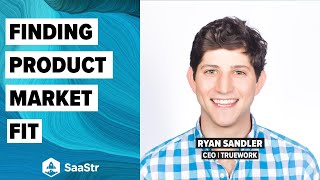
Ryan Sandler, CEO of Truework, walks through finding product-market fit in enterprise SaaS. He describes a staged approach: discover painful problems, validate willingness to pay, build prototypes with pilots, then expand. Truework launched in spring 2018, ran through 50-100 beta customers, then hit an inflection point driven by product alignment and SEO.
Questions this video answers
December 9, 2020
Spring 2018
About 50–100 customers (beta period indicated)
2017
Daredevil
Chapters
So you guys can go onto social and bother him if you want or follow him. But in the meantime, I do want to go through a few housekeeping items. I'm sure this sounds like a broken record to you guys, but this is a 30 minute session, give or take. We want to keep it interactive. So I see some of you have your cameras on, but the more cameras the merrier. We encourage you, like I said, to keep your cameras on audio muted, which you guys have been doing great at. Feel free to use the chat if you have questions or if you know, you really, really want to say anything. Brian is okay with you guys being super, not super vocal, but interactive and fun. So please keep that in mind. Or you can raise your hand and I can personally call on you guys. And that button is in the right hand corner of your zoom. Another thing is, I'm sure you guys have heard these sessions are recorded, so don't do anything you don't want permanently living on the Internet. And they're on YouTube if you also do want to see them later. And then another thing not to forget is throughout the next two days, today included, we're running a networking app called Brella, which I'm sure some of you guys are familiar with. That's kind of one on one meetings for us as industry professionals. So I will link that in the chat if you guys haven't already gotten started. But without further ado, I'm going to pass this over to Ryan. Ryan, thank you for joining us.
Thanks so much for having me and thanks everyone for joining the session today. I'm excited to talk about finding product market fit in SaaS. We're going to use some examples from Trueork, the company I founded and some others in the industry. A little bit about me and my background. I grew up in Georgia, originally in Savannah, Georgia, went to Harvard for computer science. I launched my first startup in college called Daredevil. First experience looking for product market fit and unfortunately not finding it. And can you share some good stories from that? And then I went to LinkedIn and decided to go via PM and learn how to identify product market fit a bit better. How to find products that people want to pay for and that are big markets. And so I worked in the Talent Solutions business, LinkedIn's biggest business, and then left in 2017 to start True Work. And so a little bit about TrueWerk We Are Employment and income verification platform and that gives consumers more control and transparency over their sensitive data that is shared when they're applying for loans, apartments, other major transactions in life. And we're taking on a legacy space where they were prone to data breaches, very little privacy and transparency of where all this information was going. And so at a high level, our mission is to become a system record for people's professional financial information. We're empowering individuals to own and control their personal data. And to make that happen, we have three different audiences and three major products that service this platform. We have a product for what we call verifiers. That's banks, landlords, anyone verifying information of consumers. We have a product for HR departments that automates this process on their end. And finally, we have a product for consumers who are applying to these transactions and giving them control and insight into this data when they're going for loans and other transactions. And so through the whole platform and each side of the platform, we had to find product market fit in the early days and understand are we really servicing a need for each audience? And by no means am I an expert at finding product market fit, but I wanted to share learnings from my own experience, from others that I've observed, in case it's helpful for other folks that are starting entrepreneurship. And so let's start with definition. What is product market fit? You know, I don't think there's one perfect definition. And I listed three of my favorite quotes here, and I think each person can kind of take their. Take their favorite or kind of aggregate, but I think it's something like an aggregate of these three quotes. Mark Andreessen defined it as being a good market with a product that can satisfy that market. Really, really vague, but pretty poignant. Andy Radcliffe goes a little bit deeper and says, once a company has achieved product market fit, it is extremely difficult to dislodge it, even with a better or less expensive product. And so there's this idea of barriers to entry and dominance in the market that at this point, it's actually really hard to displace you. And Michael Seivel goes even further and says, you're drowning in demand. Your product is being used by so many customers that you can't handle all the people knocking on your door. And so there's also this concept of inbound demand is so strong, people are talking about your product. They're strong word of mouth. And so, you know, I like to, you know, again, define it as an aggregate of these three. For me, it definitely definitely requires a sense that there's strong barriers to entry and also that there's really, really strong impact. And what we'll talk a little Bit about markers that help, but then the day there's, there's a few different signals that you need to take into account together and make an intuitive call as a founder of whether you've reached it or not. And I think one really important point about finding product market fit is that it can really happen at different stages in the, in the startup journey. You know, I think, you know, it's a pretty big myth that you can only find product market fit post launch, post beta. You can, you can find it at different stages. You find signals of it definitely at different stages, stages. And so, you know, for us, the process kind of laid out here at a high level and again, different processes might work for different people. But in enterprise, in SaaS, what we're really lucky is that we can go and talk to customers and get a lot of really great qualitative feedback really early on in the process. And so, you know, first step in my startup journey was find something that causes pain. Really finding that painkiller, not just a band aid, and finding the right idea in industry, that thing that causes pain is the most difficult part. It's where you should really spend the longest. When in the early days and for me, I had a list of, I think 20 ideas that I found were painful and I started talking to a lot of customers and trying to invalidate every one of those ideas. To do that, I would just cold email, I would just email different people in those industries, whether it's fintech, edtech, healthcare, start talking to folks who are deep in these problems, understanding different pain points. When I identify a pain point, start talking to more customers and more customers. And then at some point you might be hard to invalidate that idea and you might want to go test the hypothesis. And so at this point you spec out, you mock out a possible solution. You don't go and build anything yet. And you go and talk to those same customers, maybe others, and ask them, if I want to build this, would you be willing to pay? How much would you be willing to pay at this point? You can also sign contracts if you have something that's really, really in need. Customers will be willing to sign an LOI or a contract even before you go and build the product. This is a really strong signal, product market fit, if you can get them to do it. And then once you've found a validation of your hypothesis, you actually go build a prototype, hopefully with those same customers, those ones who were in demand from your research, and you can start seeing there is engagement. As expected. What would happen if you took that product away. Other signs of product market fit. And then once you've seen really good signals from that prototype, you grow your customers, you exit beta. And there's other signals that you want to be watching. How quickly are customers growing? How are customers learning about the product? Are they coming inbound or learning it from other customers? And so I posit some of the questions here that help you identify product market fit, but really driving the point that it doesn't need to be on stage four where you identify it. There are examples of companies, many, many deep technology companies who have found really strong demand in stage one and two and have signed a ton of contracts much, much before they launched and built the product. And so how do you know if you have product market fit? What are exactly those identifiers? There are both quantitative and qualitative identifiers, which is really important to remember. And when it comes to qualitative, I mentioned earlier, that's where it does come come to this feeling. It comes to listening to your customers and understanding just how strong are they, passionate and excited about the product that they're using and what would happen if you took it away. But there are also quantitative measures that you can look at now. What's difficult here is that there is no exact number for revenue for engagement that is going to tell you that you have product market fit. You might hear metrics of a million dollars in revenue, 100,000 MAUs for a consumer company, that you need to reach these specific milestones to say, yes, I have product market fit. But that's not necessarily true. It really matters what company you're starting, what industry you're in. That number for revenue, for example, might be $100,000 in revenue, it might be 500,000, it might be a million, might be 5 million. You need to sit down with your co founders, maybe your investors, advisors, and understand what slice of the market, given our customer segment, is going to tell us whether we have product market fit or give us that signal from a revenue standpoint. But there is no exact number. There's engagement metrics you should be looking at with how is engagement looking within your cohorts that you've launched to how is NPS score? Is it higher than the industry average by significant amount? Are people recommending the product? Are you getting inbound demo requests? Even from early on is a really important metric to show organic demand. And then you have your qualitative on the right. I mentioned before, we have customer excitement. It's really the feedback you're getting from customers in Those early days, how strong and excited are they really about your product? And filtering through the noise and your own biases to get that signal is really difficult sometimes. And word of mouth can be example of shaum customer excitement when they're going home, talking to their family or their friends about your product. This can be really difficult in SaaS. It can be really difficult for someone to go home and talk about some new B2B software that they're using at work. But you do see it and if they're doing it, it's a very strong signal of product market fit. And so how did this look for us at True Work? I included some high level growth numbers from True Work in the early days. We launched our product in the spring of 2018. You can see in Q2 2018, very little to no revenue. And then we started growing customers outside of our pilot set. And there was this moment where things really flipped, where it went from purely going outbound to starting to get a rush of inbound interest, starting to see really high NPS scores, really high engagement, and that led into really high growth numbers. And we've seen that growth sustain, which has been great. But there's really this discrete moment where it was a few of those metrics that we discussed on the previous page as well as the qualitative metrics gave us that confidence that we knew we had found it after about a year at working on the startup. And please dive in with questions at any point if you have any else. We can jump into some at the end. So another question people ask a lot is can product market fit change? It absolutely can. And it's something that's really important to remember and really important to remember to be nimble and to be humble once you found that product market fit, because it can change. Some examples that are notable, you know, platforms can change, platform shifts might happen outside of your control that change the demand for your product, customer behavior can change, new entrants can come in, new technology can come in. And so there are many examples in history of companies that have hard market fit and lost it. You need to remain nimble. And some of the biggest things that you could do is starts with talking to customers. You'll be able to tell early signals from customers if their excitement is changing, if they're talking about other alternatives in the market, if they're mentioning any things around platform shifts, you'll start to see those signals earliest from your customers themselves. And so having that feedback loop is incredibly important to make sure you retain product market fit and you need to iterate constantly. You need to be continuing to build products features. You can't get comfortable given what that original product market fit afforded you. And finally, you need to find ways to disrupt yourself constantly asking a question, is there a way that we ourselves can be disrupted? Maybe we just went and disrupted an incumbent industry, but how could we get disrupted ourselves? And if there's any time an answer that is yes, should really consider building a product that prevents you to get disrupted, acquiring a company or making another offensive move to prevent that from happening. But all in all, if you aren't nimble, you can absolutely lose product market fit on the way. So a few myths that you know, we talked about today around around product market fit. There is, there isn't. You know, some people say there's a magic number for revenue engagement. That's not true. People say you can only find signals for product market fit after launch. Also not true. And you know, people say that if you, if you have a cohort of pilot customers that have strong engagement numbers, product market fit also doesn't always, isn't always true. You might, you might have customers are very representative of one industry or one type and it might not scale once you, once you grow outside. And so top takeaways from these product market fit can really happen anytime. It's usually observed post launch, but it's possible to find product market fit pre launch as well. There's no magic number. You should come up with what that milestone is for your own company and you should really test with a large group of your target audience. Really be careful of getting a pilot customer segment that is really indicative of just one industry and trying to have as much diversity of customers in the early days to really test your hypotheses. So with that I'll open the floor if there's there's any questions from, from the participants.
Looks like we have a few questions coming in. Also guys, if you want to speak up your or raise your hand, you're welcome to do so. One of those is can you tell us more about your startup Daredevil and why that may have failed?
Sure. So Daredevil started senior year of college and I think was a really great example of building a product for yourself or for a pain point that you might have. It was a pretty college fun idea of crowdfunding for challenges. You would challenge someone to go run a marathon or chug hot sauce and pay them and raise money to go do that task. And I think we learned the size of the market wasn't very big. You have other platforms that can enable that type of behavior. And it wasn't a great business. Even if you got to high engagement, it was hard to build a real business off of. And so I think, you know, really early learnings around, doing much more research, more upfront to understand both if there's very, very large potential engagement and a potential business, you build on top.
Perfect, thank you. Someone wants to ask you on your number three in your slides, what is the definition of large? Is it large group of testing audience or is it something else?
Yeah, great question. So, you know, it depends again, depends. But I'll give some examples. If you're, if you're an enterprise, if you have an enterprise product, you're only selling a very large companies, it might, it might only need to be a handful, might only be six to ten companies that you're, that you're talking to researching in the early days may need to be less or fewer if it's a very, very large enterprise product. But if it's an S and D product, if you're, if your potential market is thousands of companies, yeah, I would, I'd recommend getting dozens in those early days, you know, I think we were technically in beta until about 50 to 100 customers. To give you an idea.
Perfect. Good to know. Stuff Stefan wants to ask you say you're getting positive feedback across several sectors early on. How do you balance that versus specific requirements for each segment?
Really good question. Yeah, you know, I think you do need to focus on one at a time. We, for us, for example, we have our HR product, we have our verifier product. We didn't launch both of them at the same time. We started with one basically finding product market fit with that product and then launching the other and finding product market fit with that. So I will say having a focus on one segment, finding your fit and then moving on to other segments is most wise when it comes to a specific audience or customer size.
Perfect. One up here. Wanted to ask, when did you hire your first marketing person? And what are your, and when are your. Excuse me. And what are your thoughts on when to build marketing in relation to finding product market fit?
Yeah, that's a great question. I would say ideally bringing them in around the same time that you find it. It could be a little bit before, but I think in terms of things like paid acquisition, you don't want to start spending money until you found that product market fit. For us, we brought marketing pretty early, fifth or sixth higher around that time that we started to see that demand really Start to come in. But yeah, I would say, I would say around the time.
Okay. Because another question we have is what would have been marketing's role? And if you said you brought it in close to the beginning, they asked what is marketing's role in determining product market fit in your opinion? So based on what you just said, it sounds like you kind of established product then brought in the marketing.
Yeah, I mean, marketing can play a major role in finding the product market. Especially, you know, it happens all the time. If you're extending your functionality and entering new markets, marketing might be driving that customer discovery and research. And so, you know, if you do have a marketer on your team, it could really powerful, be really powerful still in the early days, you know, playing more of that product marketing hat and understanding what are the customers needs exactly are and are we building towards it?
Perfect. So in one of your slides, you have a graph that shows a steep change when you found a fit. So the question here is, was that a new feature or were you testing a lot of features and one just kind of popped? Or did you hire a new marketing person that restructured incentives?
Yeah, it wasn't a new feature. It was the same product. And we started seeing a strong lift, I would say is a mix of the product starting to meet that really meet the needs of customers and distribution. So finding the right distribution channel for your for your product can be just as important sometimes. For us, just be specific. It was. We were finding a lot of inbound demand from organic sources, from SEO, from Google, and that was contributing strong to that increase as well as the product really meeting the demand.
Perfect. Wonderful. Those kind of wrap up our questions unless anyone has another that they want to get out there or off their chest before moving on to another roundtable. But again, this has been terrific and we love hearing from people that have tried and get to try again and then make it a success. So we definitely appreciate that. Again guys, if you want to give out your handle again on social media or anything else, we'd love to hear it. And if not, we would be great to see you guys around at our next roundtable.
Awesome. Thanks so much for joining everyone. My Twitter is Samlarian and yeah, enjoy the rest of your day.
Thanks so much for joining us, Ryan. We appreciate it. Have a good one, guys. Bye.










