From 0 to 400M, 10 Mistakes the CEO of ZoomInfo Made on His Journey to IPO | SaaStr
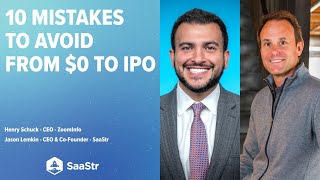
This transcript is a SaaStr session (Apr 1, 2022) where Henry Schuck (CEO of ZoomInfo) answers Jason M. Lemkin about the top mistakes he made scaling DiscoverOrg/ZoomInfo to an IPO-scale business (~$400M ARR). Major themes: early over-allocation to sales and under-investment in product, marketing, and customer success; being late to M&A (used debt; cited ~$200M debt and major acquisitions in 2017 and 2019); under-appreciating go-to-market as a strategic advantage (claims ~10x LTV:CAC and 30-day average sales cycle); hesitancy to change margin/growth tradeoffs; under-investing in management/upskilling versus automation; culture integration following mergers (name change from DiscoverOrg to ZoomInfo); process discipline for product releases; account segmentation (signal at ~100 clients); and the importance of clear internal communication (Schuck writes long memos). Schuck offers 4 key takeaways including: evaluate risks of not making decisions, remove fear from decisions, and take bigger long-term bets.
Questions this video answers
$25,000 (on credit cards) in 2007.
First outside capital about seven years later, when the business was at roughly $25M ARR.
Approximately $200 million.
An acquisition in 2017 (named in transcript as 'Ranking' / possibly Ringlead) and the ZoomInfo acquisition in 2019.
~10x LTV:CAC and ~30-day average sales cycle.
Chapters
Every company, big and small, is realizing that high quality data is a necessity to go to market. My name is Henry schuck. I'm the CEO of ZoomInfo and DiscoverOrorg. There's no platform out there that's brought together the breadth, the depth and the accuracy of of business information. The way that we have business information is constantly changing. What we built is this core AI and machine learning engine that takes literally millions and millions of unique sources so that we can deliver 95% accuracy to our clients. We have data scientists who are embedded into our go to market motion. We're looking at every single metric and figuring out how do we convert that A little bit better. A little bit better. A little bit better. I really want to build a that in every single department, whether it's sales or marketing or product development. I want every single piece of that business to be literally best in class. I think the culture of continuous improvement at our company is a big part of our success. We're just going to grind this thing out. We're going to work harder, we're going to care more. You have to be paranoid when it's good because I want to make sure that it's repeatable. I want to make sure that if there's something that we did last week that made it the best week ever, that we keep on doing it. Whose idea was it to IPO in the middle of a pandemic anyways? It's not a celebration. It's really just a launching point for the next thing.
So this is a special session. First of all, we will try to do some Q and A. So click on Q and A at the bottom. If you're watching this on Zoom rather than on social media, click in there. We'll try to get to some of these questions, and this will be a fun session for two reasons. First, I think as a case study, zoominfos, a super interesting company. We've obviously all used the product and I think. But when it IPO'd, I was shocked at the scale of the company. Right. I didn't know there's a lot of vendors. I knew it had broken out. So we were shocked. And Henry will share some stories as we went through this of how folks maybe underestimated him on the journey. Right. And what it took for him to build a deck of corn. And it's so interesting to see one of these products that we know are like, oh, my God, this scale of the product and why. And why did ZoomInfo break out? And it is a competitive Space and how does this really work? So I think it's super fun. And Henry pointed out the company did not raise 1100 million dollar rounds from Sequoia and Andreessen and had its own sort of path through private equity and other things. And in some ways, as a company, not a product, might have flown under the radar a little bit until it kind of exploded this year. So a lot of interesting things. And Henry asked what he could talk about at Saastr and he did us a gift, which we're going to go through is he laid out his top 10 mistakes getting to the first 400 million or so in revenue. So I'm going to ask him about these 10 mistakes. And what's great is so many of these are themes that we've all talked about in our community in Saastr for years. And I think it's special to get his time to sit down quietly and write them. And it's so interesting when a CEO or founder does this because you can hear their brain and their heart. The number one mistake probably was the number one piece of scar tissue you have and then you can just peer into their brain. So with that, let me kick this one off because this could mean so many things. But mistake number one being risk averse in investment outside of sales. A lot of founders might have the opposite experience. But what does this mean? Where did you hold back too much?
Yeah. And I think you could probably replace sales with like your area of expertise if you're a founder or a CEO. And so I felt really tied into sales. I understood how it worked. I did all of the sales for the first, not all the sales, but I was on the front line doing the sales for the first five years of the company's existence. Like I was. I had regular quota carrying sales rep on top of everything else. And so I had. So every time it came to spend the next dollar, I was much more likely to spend it in sales than really anywhere else in the business.
Yeah.
And when I was thinking about this mistake, I was thinking about like, why was it that I wanted to put all the dollars into sales and I was much less likely to put it in marketing or HR or customer success. And really I think sales was easy for us because you could see a direct line to rep. You put a dollar in sales, you saw it turn into money and everywhere else in the business that line was less clear. So you can put it in marketing. And do you trust the reports you're getting about attribution and where the leads are coming in you could put it in hr, but do you really believe that they're going to strategically grow your talent? And when you think about not making the investments in all of those other areas, what you're really telling yourself is either you don't trust the people in the department and so you're going like, I'm not going to give that money to marketing because I just don't really trust that they're going to be able to execute with those dollars and that. So go fix that. Don't not make the investment in marketing because you don't trust the execution of the team or the leader. If you're not going to make the investment in product, you have to ask yourself like, why would I not be making that investment in product? And it's probably because either you're chasing the wrong things, you don't trust the product leader, you don't think your customers are going to engage with that side of the product. And so I think on this one we always wanted immediate payoff. And so we never looked to like for the early portion of the business didn't look to making investments that had long term payoff. And a lot of that is because we didn't trust or I didn't trust the leaders in those organizations to deliver me the results that I trust the leaders in sales to deliver me. And so the learning here is if you don't trust a team and you're not making investment in that team because you don't trust them, you have to fix the underlying issue there because these investments go a long way.
Well, that's an interesting point. You took it a slightly different place than I was expecting. I thought you were going to say I trusted sales. So I just put, with limited capital, I put it where I knew. But you're really saying I didn't know these other areas and I'm not sure about the leaders I hired. Did you hire the wrong first generation of management team because you, you hadn't done those functional areas before? What was, why are you not able to trust them? Did you just make the classic Ms. Hires?
I think I made the classic MIS hires. And then after I made the classic MIS hires, like if I took marketing for example, after I made a classic MIS hire there what I convinced myself of was what I was getting from them was better than what I would do myself in the limited time that I would have focused on marketing across all of the other things I was focusing on instead of am I getting what I would in just a vacuum, what I would expect from a Fantastic marketing organization. And I wasn't ever getting that in the early days. What I was getting instead was something better than what I was able to do on my own. And it was just the wrong lens to look at it through.
And what was the first, like, VP you hired outside of sales? That was your aha moment. That changed the game, that moved the needle. How did you. How are you able to change this? What was that game changing? Vp?
Yeah. I hired a great sales leader, revenue ops, and now he's our chief revenue officer. And what you saw when he came in, and you've written about this too, Jason, is the minute he came in, all of we thought we were really good. And he was immediately making impact all over. Like, why aren't we doing this? Let's do this. And not just like a lot of leaders can come in and just like poo poo on everything. I can't believe you guys are doing it this way. And, oh, it's an embarrassment that we're doing it this way. The great leaders go, hey, we're missing this opportunity. Then they execute against that opportunity and give you results against it. And they're able to do that over and over and over. And. And so when we hired this revenue operations leader, all of a sudden you could see like every. Everything he put his hands on turned to gold. And you're like, okay, leadership can really turn around really any area of the company.
Yeah, one other one on this. I want to get to mistake number two first, but when you focused on sales because of this, looking back, obviously it's ended up being an amazing journey, but did you end up with certain types of product feature gaps and technical debt because it wasn't an area you were focused on? Did you miss some investments in the product in those first couple years because of this?
Yeah, totally. We missed investments in the product along the way. We missed investments and building like a great engineering team early on. And then I think maybe more so than anything, we missed investments on the account management and customer success side. We were so focused on the sales side that we didn't invest the same sort of vigor around talent and training and onboarding and just getting the right people and continuously giving them feedback in the account management side. And so in the early years of the company, we really struggled from a net retention and logo churn perspective. And that was another area where when we hired somebody good and you saw the numbers turn. Yeah, it's just magic. And you actually kind of convinced yourself at some point, like, my business is different, you know, my Business is different. I have SMBs. My business is different. You know, data and software together are just more complicated and less sticky than other things. You just convince yourself of all of these. You have this very special thing. So it can't be best in class. And that's just like not true. You just don't have the right leadership or structure to get there.
That's a really good insight. You hear that a lot from data focused companies. That high churn's okay, right? You hear it from a lot of HR focused companies that NPS is going to be low because employees hate using those tools. Right. They hate doing self assessment. They hate it. And that is true. Probably true historically. Right. If you went into G2 and look. But you shouldn't settle for that, should you?
No. And I bet you asked WebEx users and Citrix users how they felt about their conferencing solution. Like early on they might tell you like, oh, I hate conferencing. And I think like what you saw Zoom Communications do was make that an enjoyable experience. And that was a big differentiator. You didn't have to settle for low NPS scores and video conferencing. You could be a lot better.
Yeah, it's a super good insight and I want to hit the next number too. But especially in data. So many folks make so many excuses, right. It's ephemeral. It's a marketing tool. Of course it's going to churn if the asset doesn't perform. If the data is not great, just leave and try another one. Right. This isn't like Salesforce. It's not sticky. But don't. Your lesson here, I think is a profound challenge to founders, which is don't settle. It's not okay. You can have a 30, 40, 50, 60 MPS in any field, right? Not just okay, this one is niche. But it's interesting not doing mergers and acquisitions sooner. I don't know that every founder would put this as mistake number two, but it's interesting because you put it, you put it second here.
Yeah. So maybe I'll give a little bit of a lineage. I, I bootstrapped the company with my co founder in 2007. We put $25,000 on our credit cards and went to market. We built a really profitable business that had high margins and we didn't bring in our first outside capital until for seven, seven years later, the business was already at a $25 million ARR. Run rate. And we're doing that profitably. And when you have a profitable business, you have the Opportunity to do M and A and actually do that M and A with. We did M and A with debt. And so if you built this growing, profitable business and you're able to loan against your balance sheet to go buy, go out and acquire competitors in your space or other technology, tuck ins in your space along the way, like that is absolutely, in my opinion, a play you should run. And we were always kind of late to this for everybody. You know, our big acquisitions that we did along the way were a company called Ranking in 2017 and ZoomInfo, which we were. I founded the business as a company called Discover Oregon. You changed the name to ZoomInfo after that acquisition. We made that ZoomInfo acquisition in 2019 and both of them, we had looks at those businesses a year or a year and a half before. And if we had done the acquisitions earlier, we would have saved $700 million in acquisition M and A costs. Now it's hard to go, oh, you know what a mistake that was. It's a mistake in that like the cost of capital was higher. Things ended up working great. But part of the reason why we didn't do that is, and I think probably a lot of founders feel this way, is when you're looking at your business that you've grown up inside of, you start to feel like you're just like a kid pretending in like an adult world. Like people who do M and A don't feel like 30 year olds who started their companies. And like, we just didn't have the confidence that we could pull something like that off. And so we're always like a year behind getting the confidence to be able to actually do M and A successfully. And it just cost us money along the way.
Yeah. The first point is interesting because we're all kind of. There's been a bunch of talks already at this event. We're all a little bit woke to the power of debt in SaaS. If you do it right. Right. It has to be for leverage. It can't be in lieu of equity on its own because then you'll spend it and you'll get into trouble on the service. Right. But if you're at 25 million ARR. And it's predictable. And how much did you borrow to do the first acquisition?
Like 200 million.
Oh, okay. Well, you did take advantage of the growth in multiples that we've had over the last few years, right?
I did take advantage of the growth in multiples and we protected equity. And you protected equity.
But you were able to somewhat confidently say Hey, I can service that debt. Right. Given the repeatable cash flows. Right. Yeah. And that's something that, whether it's just to take a little bit of debt to hire that extra VP of product that you wish you'd hired back in the day, or whether it's to do something we should all, if we have strong metrics, strong revenue retention, we should be confident to do this. It's sort of what you're saying. Be confident, right? Be confident to do it a year early. Because we were going to. You were going to get there, right. You saw it already in the numbers at 25 million, an error. You were going to get to 100. Like the odds of going from 25 to 100 approached 100% at that point. Right. It's just the resolution was unclear. Right.
Yeah. And if you're confident about, from an M and A perspective, if you're confident that you could put two businesses together, get synergies out of it, grow them faster, and make them more efficient in the process, you have even a bigger pot of sort of cash flow to make, to service the debt.
And did you. It's niche because I want to hit the next one, but, but it is interesting. Did you feel like you had to get a discount that, like they had to have a lower multiple than you? As you build up your confidence from an A, is it. Is it hard to pay up versus having to pay down?
I did feel that way. It just, I don't mind having some room to make mistakes on execution along the way. And so, you know, you do look for, you know, today you get some companies who will tell me, like, well, Henry, you're trading at this multiple, so why shouldn't we get that multiple? It's like, well, we should get higher.
We should get higher.
We're growing even faster because we're more strategic. And the truth is, like, a lot of, there's a lot of execution risk when you, when you do M and A. And you have to be organized and focused and, and so leaving you some room to, you know, slip somewhere is a useful thing to have.
Yeah, It's a good lesson for founders because, I mean, from the other side, it's confusing. Right. Like zoominfos. Great. But whatever you're trading at, you're growing. I don't know what you're growing that you're public, but let's say you're growing 50%. 40 doesn't matter.
60%. 40%.
But Henry, I'm growing 80% and so, like, I deserve 40x ARR. Because I know, I know, I know. But like, it's not fair. Henry, just draw a line. Like, and you're and founders are in this. It's just, you just need to be aware of it. Right. You just need to be aware of it. And it's in every situation. I remember back in the day when Salesforce wanted to buy us, in the beginning, the biggest acquisition they'd done was 16 million at the time.
Wow.
And they'd met with us and they're like, we really want to buy you, but like 16 would be too much. Then you look at Tableau and Mulesoft.
Right.
And then you look at like Jeff Lawson at Twilio. He's like not messing around. Like, I'm not buying an itty bitty male company. I'm buying the best thing Sendgrid and I don't care what. Even though the multiple was a little, was a little off, he's like going. And it's a spectrum and companies evolve at different rates. Right. You were kind of in the middle, I think. Right. You didn't want to mess around.
Yeah, I didn't. I think the way that, like, if I was, you know, if I'm thinking in Jeff's shoes, one of the things that I'm thinking is like, when I bring this asset in, what am I able to do with with it? When I put it in the product, when I give it access to my go to market team, how much faster can I grow it? Where are the synergies from that perspective? And that was always really important. Actually. That takes us to mistake number three, which is not appreciating go to market as a strategic advantage.
What does this mean?
So this means like when we were doing first, when we were doing M and A, when we were growing the business, I never thought of how valuable it was to have an incredibly efficient go to market engine. We have and we have a go to market engine that drives a 10x LTV to CAC. It does a 30 day. There's a 30 day average sales cycle. It's super efficient in generating leads and driving them through the pipeline with automation. And what I didn't appreciate was when you look at a business and you're like, what are the key assets in that business? If you. And if you're a founder or you're a senior executive at a company and you're thinking about your business and going, what are the strategic advantages to our business or the strategic levers here? If go to market is just something you don't even think about as part of that, that's a major mistake. Because go to market how you generate leads and find new customers and upsell and grow your customer base, that is a major, can be a major strategic advantage for your business. And it's so often that I see companies where you have two companies, their features and product are in parity and one is just running circles around the other one. And when you see that happening, it's because one figured out go to market in a more precise, more efficient way and that gives them an incredible advantage along the way.
But okay, so I get that. That's what I've observed. But what do you mean by leveraging that? You've got two companies, right? Both have the same product, maybe even the slower growing one is, is better. Right. Sometimes that happens because they're inwardly focused. But once figured out, their go to market motion. Right. But okay, if that's you and that's what you were right. But what do you mean? How do you take that to the next level? Why was it a mistake? That's the piece I'm missing. What, what, what's the, what's the investment or the action you didn't take here when you had that advantage?
So, so along the way when we were looking at acquisitions, especially when we were looking at acquisition bolted in Bolt. Yeah. And when you would look at an acquisition, you would go, oh, I have an opportunity to take what is a company that didn't focus on go to market as in such a focused way as we did. And if I can take this team of 20 sellers who are doing $10 million a year in ARR, what if I can take that team and make them do $20 million by just bringing in our go to market motion into.
That oh, on top, not get rid of them, which you would, you know, but actually just add your expertise to their team, take the same talent without training and tools and people and just leverage up their revenue per lead. Just increase their revenue per lead. Right.
Increase their revenue per lead. From an M and A perspective internally, the way I think about it too is like if you can make go to market incredibly efficient, incredibly effective, then that gives you a strategic advantage to be able to take dollars that you would be spending there and spend them in product and spend them in account management and spend them in customer success and marketing. The more efficient you make your go to market motion, the more dollars you have to spend across the company. And I never really, I actually when people would tell, people would say like, hey, ZoomInfo is a sales first company and I'd be like, no. Like, no, we're a product first company. We're a customer first company. I hated hearing that. And it took a while to just realize that's okay. Like that is a strategic advantage of the business. We shouldn't be embarrassed of it.
There's something really interesting you said, which I think goes against some typical Twitter advice, which is that if you have an efficient go to market engine, right. The classic advice from VCs and others is pour gasoline on the fire. Right. If you have an efficient. If you have 50 great reps, hire 500. Right. Go raise 200 million. And you're saying an insight, which is what I believe philosophically, although I don't know if it works in the world, which is if you have an efficient engine, that means you can free up resources in other areas, it's a weapon. Right. Because if you're inefficient, you end up having to spend every nickel in sales and marketing. Right. Every it consumes. It's not just. It consumes all your oxygen. So you're saying if you're sales focused but good, put the money elsewhere. Right. Don't give in to the fuel and the fire mentality. Necessarily. Yeah.
And then, and then, by the way, if you're putting money elsewhere and you're making those investments in a smart way, that just should drive your ability to continue to invest in a disciplined way inside of your sales organization. So if I take the dollars from that strategic asset and I put it in other places and then that's driving reinvest, that should drive reinvestment back into the sales team.
Yeah, makes sense. So this one we might have hit and I like the fuel to fire at the end. It's a, that's a good tie to the last thread. We might have hit this a little bit in the higher in the beginning, but what does this mean? Hesitation stopped you going even faster.
Yes. So I think that we did kind of hit this in the beginning. But I think the way that I think about this was we've always been a pretty high margin business, but one of the things that we didn't do is really think through prescriptively, where should the margin in the business be and how should we trade? How should we think about growth versus profitability? And what does the market actually prefer here instead of doing. And the reason why we didn't do that, I think is we had like hesitation around, like trusting where that investment would go to change the profile of the business. And so if today we're 40% growth and 47% margins, then saying like, hey, in the Future, what does 60% growth and 30% margin look like? It was tough to have that conversation along the way because we didn't trust that the dollars invested downstream would turn into that result.
I got it.
So being convicted about making those investments and how it changes the face of the business and trusting your ability to put the next dollar in marketing or put the next dollar in sales and to have it grow, I think we got comfortable with who we were and how we were operating the business and then didn't take risks on that type of growth.
So whatever your own version of the rule of 40 is, it took you a while to believe it at a gut level that that would work, right?
That you could maintain that version of the rule of 40 is like a rule of 80 today. But yeah, it was hard to. It was hard to.
But it's true. Whether it's 80, like it's hard. I didn't believe that was true. I thought that was a silly ism. Right. The rule of 40 or 80. But if you have a well oiled machine, it is true for a while at least, isn't it?
Yeah, absolutely. If you have a well oiled machine, you should be able to like continue to invest and continue to grow in those areas. And I think we were just not convicted that the additional dollar would net the same return.
And there's particularly this moment where on the sales team you go from, you start, you have to believe that it really is bodies in, bodies out, assuming quality. Right. And it's a tough transition because in the beginning you're like, Linda, Bob and Henry are so good, I just need more of them. And then your sales leaders like, no, I need 40 reps. And you don't believe it. You don't believe that it's capacity. But you're doing capacity planning for 2021 right now. Right.
You know, you need in 2021. I think one of the interesting things here is, I think a lot of people say, you hear a lot of people when you ask why is your company successful? They say, well, it's because of the people. And early in the, in the, in the early days of ZoomInfo, I got really frustrated with that answer. So I'd be on a, on a webinar like this and the CEO would say, hey, we're really successful because of the people. And I'd be like, come on, you're really successful because of the product.
It's got to be the product sounded like a platitude Right.
You didn't believe it Sounds like a platitude. Totally. But then I found myself often to that point saying, like, man, if I had 10 of this guy or 20 of that guy or 30 of this woman, how much faster could I grow the business? And that's really just saying, like, growth of your business comes down to the people. Like, if you can look in your business, and I know everybody on this call can, and say, if I had 10 more of him or 10 more of her, how this business would grow exponentially faster, then you really do believe that talent drives your business grow. And that's an easy way to get to the core of what drives it is to go, if I clone this person 10 times, would the business grow faster? If the answer to that question is yes for any number of folks in your organization, then you really do believe talent is the driver to success.
That's a good insight. If there's someone, I say, if I had 10 of her, I'm a hundred percent confident, then you got to find the VP to go find that person for you. Right. Can't be you going to your first point because you can't recruit ten yourself. Yeah, but go find the VP to do it. Now, this one, this one is probably a little more later stage focused, I would imagine. Mistake.
I think it matters. I said investors here. I think this is. If you have a board, this one applies to you.
But we all have board. I mean, we all get to point. We're bored. Yeah. So what does this mean that your voice was important? How are you not being heard? Or what were you. How are you not being distinctive?
It wasn't. It was. It was more like I wasn't trying to be heard. You know, you start this business, it starts growing, you put a board together, and when you get that board together, like, I'm a public school product, I went to public high school, I went to public undergrad and grad school, and all of a sudden I have a board. And it's filled with these guys from Harvard and Penn. Oh, I see.
It's intimidating in a way.
And they just stroked you a big check. And so you have this feeling like that when that happens that you should be deferring to these folks, like they're the smart, smartest people in the room.
You do, right? You fall into this mode almost like it's parental relationship, don't you?
Yes.
I hate it. I hate it. I will never be that person. But you, you default into the. And they act that way toward you. They treat you A little bit like their older son, don't they?
Yeah, a little bit like their older son and they're respectful of it. But I think you let yourself fall into that older son role too because these guys just gave you a bunch of money. Now there's a board, they invested in all of these other businesses. You trust them and they went to the best schools in the world and now they're sitting in your conference room at your like little company and telling you like, hey, what about this? What about that? And so I remember after my first board meeting, I grabbed one of my, one of the guys on my board and luckily he was an investor and an operator. And so he had started a business and grown it. He sold it to S and P. And I said, look, Randy, his name is Randy Lynn. I go, look, Randy, like, you guys just tell me what to do and I'll just go do that. Like, you just tell me what to do, I'll go do what you want me to do. And he was like, whoa, that is not how this should work, Henry. Like, this should not work like that. We're not in the day to day the way that you are. We don't understand the inner workings of the company. We're going to give advice, but it's your advice. It's your job to like listen to that and then decide what you're going to decide internally at the business. But don't just like, it can't work where we just tell you what to do and you go do it. Like, don't view your board relationship like that.
I got you now.
Yeah, yeah.
This is, this is a super important mistake and we've all been through it. I certainly, I'm not going to live my life this way now. But you know, especially the first time as a founder and even the second time, this deferential relationship to your investors, it is, it can be subtly toxic if you let it go on for too long. It can be, they don't know and they will even, many of them will even encourage it. They're used to it. They're used to this slightly imperial relationship. And today it's almost worse. I was working with a company that, you know, because people write big checks today into early stage companies, right, where someone came in very early and, and gave an early startup $50 million too early and just started telling them how to raise the company. Immediately told them to go buy competitors which were they're not ready for, right? Immediately told them to hire 50 reps in a different city, in a different city. And they did. The CEO was differential because that was 10 times what he'd ever raised before and did all of it. And what happened to all those. Guess what happened to all those mistakes? They were terrible.
Right?
50 reps in a new city that you've never met in hired in 60 days. When you're in the low millions. ARR, what's that going to do to your company? Right. And starting M and A when you don't even have time to hire the vp, when you don't even have a VP team. Right. And that's destructive. You lose years. Right. So balancing this is hard, but if your founders don't be too. Be respectful, but not differential. There's some sort of ism there, isn't there?
They want to hear that voice. Actually, they're good investors. But if you don't take the opportunity to share that voice, you just take what they say and go run doing it. Like in that situation, Jason, the founder has to be able to go like, whoa, wait a second, like, I don't have a vp. I've never been to that city. It's far away. Like, how am I going to do this? It's going to break all of this stuff. And so often when I think about the business today and I get like, you know, advice from the board, I'll say, like, I totally get that. I will tell you right now, if I go try to do that now, it's not going to work. Like, for all of these reasons, it's going to break. I hear you. And I think we can get there over the next six months or over the next year, and I'll work on getting us there. It's just not for today.
Yeah, that's the answer, right. To anyone listening to this that's struggling with that, with sort of an imperial group of investors. That's what you say, right? Say you can yell or argue, but that doesn't accomplish anything. If the point is valid, but not today. People want to hear that. They want to hear that's a good idea, but not now. Like, we're not ready. Like, give me time. Right?
The number of times I've had that conversation. And then they, you know, the board will go, got it. I totally appreciate that. You should go fix that so that you have the opportunity to make these types of investments along the way. But totally get that it's not for today.
Yeah. So number six, thinking you're getting away with under investing in management, upskilling and hr. We might have touched on this one too, on the hiring of the people. But what was this real mistake? Where did you we all under invest? But what was that? What are the painful memories here? From under investment.
I had this really valuable experience in that when we acquired Zooming, it was a company that was in our space doing something similar, but doing it in a completely different motion. And so it's as though like all of the things you think thought you might do along the way, you got like an open book case study to your competitor doing. And in this way like we under invested in middle management along the way, especially in our go to Market Motion. And instead of investing in managers, people to like manage a group of people and get them motivated and keep them focused on metrics, we invested in a bunch of automation. And so instead of like investing in a manager to manage sales folks, we built a lot of automation. So our sales team would never miss a follow up, would always see what's going on in their accounts, would be alerted if their account like logged into a trial and took a bunch of action. We basically automated managerial functions and that made for a, you know, high margin business. But then we acquired Zoom Info and what you saw was a very opposite approach. Instead of investing a bunch in automation, they invested a bunch in managers in that go to Market Motion. And you saw that when you invested in great managers, the outcome was in a lot of places much greater than just investing in automation all along the way. And they trusted people, they hired good people, they hired good managers, they created good structure. And so when we went in there we're like, okay, well that works like you can invest in managerial talent along the way and it scales the company. And you know, at the time we acquired Zoom Info, Zoom Info was growing faster than us. And we're like, well this is why they've took it. They've taken a different approach, invested in management along the way, invested in HR and strategic HR and upskilling their employees and we just invested in automation. But combining those two things is really incredible. But I think the learning for me here is if you hire great managers, you can outperform any investment in automation.
I think that's a profound takeaway, especially today because so many founders want to maximize automation at every level. Not just an engineering product, but in every level. How can I do this through tools and systems and how, how can I run this in Notion and do this in Slack and automate it? But I don't think it's a replacement. I think it's an addition. You have to do both. That's where the magic is. When you do the tools and the people, then you pull ahead.
Right? 100%. Yep.
But it's not a crutch. That's a good challenge. All right. Yeah. The whole DiscoverOrg, Zoom info thing, rename the company. A lot of stuff going on there.
Maybe I can talk about why we changed the name, because I think it's an interesting case study for.
It's a big deal to change your name.
It's a big deal to change your name.
It's a big deal. It's a big deal.
Now, it was made slightly easier by the fact that DiscoverOrg is just not a great name. And throughout the years, it got messed up, like, in every different way possible. But we made the acquisition. I remember being. Being in a meeting with our senior executives, and it was like, okay, so should we change the name? And no one wants to tell me that we should change the name. Right? No one's, like, ready to go, like, yeah, Henry, that name that you picked while you're in law school, like, it sucks.
It doesn't work. It's got two different things going on in it. The uppercase O. It's all very confusing.
So what I told myself in this process was, look, if it's better for the business, I'm going to change the name. So just let's convince me that it's better for the business or that, you know, contrarily tell me that keeping the Discover Org name is worse for the business. Cause I'm not gonna be able to live with that decision. Like, I'll never be able to live.
With a good way to put it.
Yeah, that I put some weird personal feeling of mine associated to the name ahead of the success of the company. And so we went out and we did a study, and everything came back that it was really clear we should change the name to Zoom Info. It had much larger brand awareness in the market. It was a better name. So we switched the name. About four months after we made the acquisition, we announced the teamworks changing the name. And I was pretty sure actually we were going to keep the Discover Org name when we started that process, because DiscoverOrg at the time was the more premium brand. People were spending more money annually on a Discover Org contract than they were on a Zoom Info contract. But the awareness just wasn't even close. And so we made that decision. And then as part of the sort of putting the two companies together, the big learning for me is. Or the big learning for me was culture. The culture we had built was really important and valuable. And I think we went into the acquisition going like, well, that company's growing faster. It's doing all these great things. Let's not like upset the apple cart much here.
That's an interesting topic, right? Yeah, yeah.
And so we just sort of sat back and let the two organizations kind of have their own culture. And then after six months or nine months, we're like, nope, let's unify this thing. The culture that we built at DiscoverOrg is a great culture and we shouldn't like, be embarrassed about it. Like, you know, if you come to our offices, there's no ping pong tables, there's not a game room. It's just not something we believe in. We believe, like you're doing important work and we want you to come in and be focused on that work. And zoom info was like ping pong tables and game rooms and shuffleboards. And the minute I didn't do anything about that, Everybody back at DiscoverOrg was like, well, what the heck? Like years of you telling us we're not that company, and all of a sudden you're okay with it over there.
Yeah.
And so it had like, those guys have wine Wednesday. Right, Right. So you know, I did. It hurts you both ways if you don't have a very clear culture across your company. And then once you have it, you should feel really good about it and convicted about that being part of your success.
But let's just dig in there for one second, because culture, it's a complicated topic. What does it even mean? It has so many. So when you decided you needed one culture. Right? But what did you do? Did you take out the ping pong tables and the colors or what is that? What is. Just give us one or two steps that you did because easier said than done to blend two cultures, right? Easier said than done.
Couple things. One, I did get rid of the ping pong tables and shuffleboard things, but I donated them to a children's charity or a children's group in the community. Kind of hard to get mad at me when I donate arcade game to a children's like a boys and girls club outside of Boston. And then we took people from the DiscoverOrg offices in Bethesda and Vancouver and then we stuck them inside of those offices.
That's important, right?
And once you did that, it just changed, like nearly instantly. You saw an uptick in aspect and ACV across the go to market teams. It molded.
Oh, I see. Because they have the experience. Right? So they brought that DNA in of the higher acv.
They brought that DNA in and people saw them Succeeding and went, oh, oh, I get it. That's the way we should do these things. Or that they are really successful when they do it that way.
Yeah. And it was there a little bit of sadness when the. When the. When the. When Pac man went out the door. Did people watch? How did you manage that little piece?
We did it on a weekend, so I don't know. Maybe a little bit of sadness, but I think everybody was okay.
All right. Yeah. It's a change, right? We laugh, but it's a big people. These small things, people pay attention to them. Right. All right. This one almost looks like something I would see on the wall at Zoom Info. So I want to know what the story is. The power of positive thinking, everybody. I'm ending the all hands meeting with this slide, folks. Great job in Q2. But this. This means more than it looks, right? What is this mistake?
I think this mistake is interesting because along the way, if I had a disagreement, especially when you're not in control, if I had a disagreement, like, with the board or really, like, at the board level, or if there was something that I wanted to do that the board wasn't supportive of, you can get into these, like, situations where you're like, you know what? You know what? I'm just gonna. What if I just leave? Everybody will be screwed if I leave.
Put the keys on the table. I'm gonna leave the keys on the table to the.
And there's just nothing good that comes out of, like, getting to, like, letting your mind go to a place where you're like, I. I'm just gonna leave if they don't trust me.
Oh, I get it. Yeah.
And instead of doing that, I think. And I had good. I, you know, I had a good senior VP of revenue. And he would tell me, like, well, that's not good for anybody. So let's just, like, kind of like unpack here. What you're like, why you're upset about this or why you're not getting what you want from it. And then you don't have to be a martyr about just, like, one little decision that you guys aren't in total alignment. And so the positive thinking part about this is, I think, really important too. And I'm kind of coupling two things in here. Not everybody is, like, well trained to tell themselves apart. Positive narrative about what's happening in front of them. And it's really easy to have some negative thing happen and then spin around the drain around that negative thing over and over and over and over again. And there are two Narratives you can tell yourself about any situation. And so I work really hard to constantly tell myself a positive narrative about the situations that I'm in. And that really like, helps you get through, I think, a lot and not get focused on the most. Here's a good example. We're, we're having, we have a six month lockup right after their shares go public. And I'm friends with all of the different employees at ZoomInfo and some of my friends will come over and they'll like, share what their plans are with their shares. Like, some don't want to sell anything forever. Some want to share, sell some of their shares and then sort of have a balanced approach after. And, and my wife was like one night she goes, she's like, well, why is that guy doing that? And I was like, listen, this is not a thing for me. Everybody can choose how they, how they sell their own shares. It has no, like, it has no. There's no story around how they feel about me or how they feel about the business. Everybody's got a unique situation and how they think about how they think about their shares in the company. And, and I'm not going to like, impart their decisions on like how they feel about the company or how they feel about me as a leader. I just can't do that. And that's a drain you could spin right down on. So, like, giving yourself a good narrative along the way is incredibly important.
Did you have. Because we all go through this feeling until a certain point of time, especially until you have a good management team of once in a while thinking, I'm going to put the. Leave the keys on the table. You don't really do it, but it goes through your mind because you're the VP of sales and marketing and product and people let you down or the board yells at you and you don't really do it. But you know what? I could just. You guys, Your investment would be gone.
This is the martyr part of that whole.
This is the martyr. I've still, I still struggle that myself. What does this. Did you have any. And so you feel that way and sometimes you feel this way when someone great leaves.
Yeah.
You know, you feel so bad. Like, you know, it was so great doing this with you, you know, Jane or Lori. And like, how do you. Any learnings? Maybe it's not quite this mistake, but how do you handle when the great ones have to move on? Do you struggle with this? Have you gotten Zen about it at this scale?
No, I haven't gotten zen about it. At this scale, though, when the great ones leave, it's very like, you know, I spend a lot of time trying to convince them not to.
Yes.
And if that doesn't work, then, you know, it's just a business. And I'm thinking about, like, I remember I had a senior person leave about a year ago and when he left, and actually I kept him here for like two years longer than he had wanted to. And he was a single guy and wanted to go find his wife and travel the world. And I spent time making sure the business was ready for his departure, which was the most important thing, because I think when the great ones leave, one of your biggest issues is like, oh, my God, what am I going to do? Like, they're so important. And so once you take that piece away, it's a lot easier to like, focus on everything else so things are not in a panic. So if someone's going to leave, I think my first conversation with them is like, got it. Let's talk about timeline. It can't be like a week from now or two weeks from now for your senior executives. Let's have a transition plan here and let's kind of get to a place where the business isn't going to realize you left. And if we can get everybody to that point, it's just a lot easier to handle those situations.
Yep. Yeah. I still get sad when that happens. But it's good if they have the. If you've the best ones with your help, sometimes we'll leave their replacement behind. Right. But sometimes you just have to help. Right. Sometimes they don't. They don't see it.
Right, Totally.
So mistake number nine, this is maybe I'm thinking you're going back in time, but it could be today too, which is not having a process around product releases for too long. It was willy nilly. You didn't have story points, you fell behind. Engineering always told you it was impossible. Every release was 90 days late. Is this the kind of thread we're getting into?
That's not. All of that happened to me. That's not this mistake. But yes, like, engineering told you it was too hard, it was too complicated. And then at some point you just go like, oh, wow, that thing is really. But around. Around not having a process around product releases. You know, historically we were very good at spinning out an mvp. And then we got it out. It worked as an mvp. And then we ran off and chased the next thing. And what.
When you grow multiple products, you didn't finish multiple products you didn't finish they.
Were out in the market and our sales reps were demoing them and customers were kind of using them. And so building a process around, when you get to maturity, you should still get MVPs out. You should just keep the resources on that project so that it can go from MVP to something much, much more mature. And we didn't do that for far too long. And it actually feels really great when you get this right, because you're releasing products that are like 90, 90 plus percent bug free, 99% bug free. They're really thoughtful, they get the nuance and the edge cases, they solve a full suite of problems and then you keep resources on them because for the next three to six months you're taking feedback from customers and feeding it back into that new functionality or that new product. And that's super valuable and something we didn't do along the way.
Well, it's interesting. We won't have enough time to dig deep on this, but let me ask you a follow up question because it's even more interesting to me than I think it sounds even. I was at Adobe my brief time as a VP there. I saw this too, because at Adobe you have 15,000 employees, right?
Yeah.
So you can build anything you want, but when it scales, you can't support it because you need 10 people to launch a competitor. There's plenty of great engineers at Adobe, so you can launch any product you want. If you give yourself even a year, there's a roadmap, you just go copy, go copy zoom info, go copy anything and 10 great engineers will do it. But then you need 30 people to support it. And even at Adobe you could never maintain the resource growth that if it grew unless it was instantly material. Right. Unless it instantly did mass amounts of revenue. So it sounds, what you're saying sounds simple, but it's more nuanced. Right. Because this is a multi year commitment to something.
Potentially, it's a multi year commitment. And I think the other piece around this is great. You launched a product, what does everything else look like? What's the go to market motion look like, what the sales enablement motion look like, what pricing and packaging look like, you know, what is the product marketing look like and the battle cards look like and you know, what's the website page for this and are we clearly messaging it? And so there's this whole area around product releases where historically I released a product and I got into sales all hands and went, check this out, this is how it works, this is how you demo it go. And when the organization grows. It's just. You can't do it like that.
Yeah. All right. Mistake number 10. This could mean a lot of things. Not having the right account structure, whatever this means, it's probably true of everybody. But what does this mean? What does not having the right account structure.
Not having the right account structure for us meant we took customers on and we just spread them across like account managers. And we were never really thoughtful or we were thoughtful too late about how do you look at your accounts, or do you segment enterprise and SMB? Do you treat them by, you know, usage together?
I see. Not segmenting early enough.
Not segmenting, cohorting early enough. And the way that hurts you is every time you spend a little bit more time. Here you go, oh, you know, we really should have done it this way. This way is a way better way. And then you go, okay, let's do it that way. And that means you're handing accounts off kind of like constantly. And so someone builds a relationship with their account manager, and then three months later you go, oh, actually, this is your new account manager. Because we decided this wasn't the right way to organize the accounts. And so being thoughtful about how you structure accounts and account load and segments is important. Not just because if you get that right, it drives higher retention in your business, but also because you can. You can really ruin a customer's experience with you if you're constantly shuffling accounts.
Yeah, it's a good. I mean, we know that. But it's interesting. I hadn't really thought about it that way. Which is when you think. When you think about how to staff as post sales, have a mindset of how can I make sure that. That their account manager will always be the same. Right. Unless something happens. Right. Unless there's someone quits or leaves. But am I thinking about this the right way? Am I 100% sure that it won't switch from Linda to Larry? Right. And if you're not sure you haven't made the right investments here. Right.
Yeah.
And what's your gut? I want to make sure we have a few minutes for our key takeaways. But when is it. I think I have a thesis. But when is it not too early to start segmenting post sales? Like, when do you think it's. It's not too early. When should you. When do you know you're late?
When do you know you're late? I think 100 clients is when you should be really thinking about how you're your.
Yeah, it's statistically significant at 100. It's already segmented out organically at 100, hasn't it?
Yeah, it's kind of. Yes, it's segmented out organically at 100. Yeah.
Yeah, that's a good. I was going to say five people, because then you have enough to put to segment. If you have one person, there's no point in segmenting, isn't it? But 100 is the right number. 100 is when you see the pattern. Small, medium, and large verticals, whatever it is, you've got 20 here and 30 here and 50 here. And, you know, 50, 30, 20. You know how to allocate your resources, right?
Yep.
Okay, we got a bonus mistake, number 11. I'm sure there's bonuses 12 through 100 out there too, but undervaluing communication and messaging internally and externally. Yeah, we all make this mistake. But what is this? What does this mean specifically?
So specifically for me, this means, like, getting your message right on any number of things can really mean the difference between success and failure, between getting your team behind you or not. And that goes from everything from, like, your sales deck and your pitch deck to the messaging on your website. But for me, where this happens most is internally, where I'm trying to get the team excited about some direction I'm going. And at this level, I think the somewhat naive view is I come in and I go, hey, do that, do that, do that. And everybody goes like, yep, we're gonna go do that. And it's just like, it's way more nuanced than that. It's not like I just go like, I can't just go to my CTO and go, like, do that. And he goes like, yup, okay, I'm gonna go do that. Like, I have to be persuasive about it. I have to tie a story around it. I have to explain why it's important to our business, why it's important to his business. And I have to get people around the idea so that everybody is convinced that this direction from a product perspective or go to market perspective is the right one. And how you message any of those different directions is that it really makes the difference between, like, everybody being really excited to run through a wall for you and, like, a couple people getting it and a couple people being like, y' all do it. It's just, like, not. It's. Henry's wrong. And so, yeah, sorry, go ahead.
And tactically, besides the classic all hands meeting and now the all zoom meeting or whatever it is, this is challenging. You don't necessarily want to send an email every single day with product advice. What are the hacks or learnings? How do you. Once you realize you need to communicate more internally? Took me a while to figure that out, too. I'm still learning. But what do you.
What's.
What's actionable? What have you done in the last two years or whatever to improve things?
So I. On big things, I write memos. And that might feel pretty, but I will sit down and write a memo that goes like, here's the direction I'm going. Here are the reasons why. I'll answer the like. And I know what the, like, negative pushback to things would be. And so I'm answering those in the memo, I'm laying it all out, and then I'm.
Who do you distribute this memo to?
So I distribute to VPs and above and basically senior directors and above. We have like a senior management team, and then the executive team and I share it with everybody. Yep.
That's an interesting one. And are they lengthy or is it almost like a speck in words, like, here's the vision, here's how we might do it, here's what our goals are?
Yes, they're lengthy. They're like, you know, 10 to 20 pages.
Oh, wow.
And it also.
That's a good. That is a good tip. Every time I don't write a spec for something, it fails. Right. Even if it's the smallest thing in the world. But this is next level, Right. This is. You're writing a business plan almost for the initiative, right?
I am. And then it also. I'll get halfway through some of those and go like, this is a bad idea. This is a bad idea.
It forces you to do the work right. Forces you to do the work right?
Objection. Well, yeah. And if I can't answer that objection. Well, how am I going to answer in front of my team? Well, and then I'm just going like, that idea. We're going to move to the next.
All right. Because we're at the end or almost over, depending how you define it. And thank you for all this time. You've got four key takeaways, but there's one point related to all this. Let me just ask you, for the founders out there, some of the things you've said, the slides. I feel like one reason you made some of these mistakes in terms of conservatism was being bootstrapped. Right. And when you. It is bootstrapped. It's not always a lot People on the Internet act like it's a choice. Oh, I'll raise Money or bootstrap. It's rarely a choice.
Yeah, you're coming out of law school.
You'Re investing 30 grand in the business. Back in the day, in 2007, maybe no one was going to give you 10 million in a seed round. It's probably, it's probably wasn't your choice. You probably didn't turn away 5 million before a line of code. Right. So some of the hesitation I hear here, if I was, I would say, don't beat yourself up too much. I hear bootstrapping scar tissue, but there's overfunded scar tissue, too. Is that a thread in here? And yeah, totally. Yeah, it's part of the evolution.
I didn't have a choice, right, Jason? Like, I didn't. I didn't know what I was in Columbus, Ohio. I grew up in Los Angeles and I went to college in Las Vegas. We launched business in Columbus, Ohio. I knew there were people who gave money to businesses, but I didn't know, like, how to go get those dollars. And so what I knew was I could. If you ran a business that was profitable, that felt like a business that you could continue to run for a long time. And that was the only thing I knew how to do. And so that was the choice. And yeah, along the way, because of, you know, because you have to be so precise with your investment decisions that carries through. And at some point you got to go like, okay, I'm going to make decisions that are, like, objectively right for the business, and I'm not going to let my fear about, you know, execution or, you know, the unknown really keep me from making those decisions.
Got it. So since we're at the very end, if I could beg a favor, Henry, can you read us your four key takeaways so that the hundred thousand people on our podcast will hear them in your voice? Because we won't be able to dig into these four points. Let me just hear you, as a mentor, give us these four takeaways.
So the first one is look at the decisions you're scared to make and evaluate the risk of not making them. And so take like the fear of not making the decision out of it and then, and then evaluate what happens if you don't make that decision.
Remove the fear from your decisions.
Remove the fear from your decision.
Yep.
Ask yourself why you're risk averse in certain areas and whether your decisions are based on fact or fear. And on this one, often when you ask yourself why you're risk averse in a certain area, you'll get down to you know, leadership issue, a product issue. You don't trust execution. So get to the why of why you won't put the dollars there. Consider what trade offs you're making. You know, am I investing in. Go to market at the expense of product or engineering or something else and take bigger bets, even if they're long term and don't have an immediate payoff along the way. We didn't invest enough in brand awareness and content creation to have a voice. Those were long term things that would pay off, and we didn't invest in them up front. And so we should have taken bigger bets along the way here.
Awesome. Henry, this was amazing. This was one of my favorite sessions of all time. These are the same mistakes we all make and keep making, but I think you've given us an incredible set of challenges to just make fewer of these 11 stakes. Right? That's the trick, isn't it? Just. Just make a couple fewer and then watch how much faster you grow. All right, so this, this was a 10. I'm sure everyone is quietly applauding in cyberspace during this global pandemic, but I'm deeply appreciative for the time, as we all are. So thank you so much.
Thank you, Jason. Thank you, everybody.
It.










