From Slooooow Growth to Hypergrowth with Insight Partners and Collibra | SaaStr Software Community
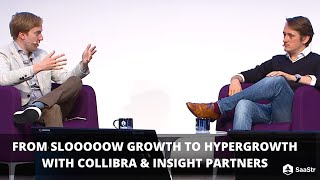
Felix from Collibra describes how the data governance company pivoted from semantic technology into financial services, then scaled from Europe to the US while switching from perpetual licenses to subscription. The company spent four years finding product-market fit before hypergrowth, and had to rebuild its executive team and go-to-market strategy for the American market.
Questions this video answers
June 2008
August 2008
About four years
One million euros (Felix said this was equivalent to what would now be considered seed)
About a week
Chapters
We specialize in data governance and data cataloging. We help companies understand what data they have, where they can find it, and then ultimately that they can really trust it. Product market fit has been really important. We've been growing like crazy and you really feel when you find it, it changes everything. People make the difference. You can't do it alone. The people you hire, the culture you make, the first 10, 20 hires really make the rest of the culture of the company. If you would compare the before Culibria world and the after Culibria world, what's the big difference? Well, I can sleep at night now.
Felix, welcome.
Thank you.
First time Saster.
First time Saster. Exciting.
So we're going to talk about today, about the Collibra journey and how you're an 11 year overnight success. So you just raised your series E, one of the European software unicorns. Congrats on that.
Thank you.
But a lot of hard work and blood, sweat and tears have gone to that success I assume. So let's start with the origin story of the company. When did you guys initially founded and what was the business you started with?
Yeah, sure. So we started in 2008, June 2008, I think. In three days we celebrate our 11th birthday. So it's been a while. We raised our seed funding in August 2008, just I think the month before everything almost broke down and we started very small, very humble, like probably most startups actually we started as a spin off from the University of Brussels where the four founders were doing research on semantic technology. So out of university, purely academic. My first job at a school, 23 years old. But we believed that data was really important. The problem was that we were one of the few people that actually believed that data was important at the time. It's interesting to see how much has changed over the last 10 years. But in 2008 it was a very different time. I think I remember talking to Belgium investors at the time and everybody said, look, enterprise software, it's dead. There's no opportunity, no investment, there's no way to be successful with enterprise software. The term SaaS didn't even exist yet. There was no big data.
There'S no Saster.
No Saster. Right. I mean the lack of resources and Playbooks was just so very different. I think was still the Web 2.0 era where it was about Flickr and Twitter and that was like the hot thing at the time. But we were really convinced about, okay, data is important and we want to do something there. So we started a company out of university I think not a best practice, but we really had no idea what problem we really wanted to solve. We had interesting technology, a lot of background, a lot of research, like what problem did we really want to solve? And so ultimately it took us four years to really kind of find or prove the idea. I would say. I think that's how I think about it in stages. So it took us a long time. Initially, we started focusing on semantic technology, semantic integration. Nobody had any clue what we were talking about. So it's really hard to raise money as well. But then as we kind of worked with customers, we really kind of pivoted more towards data governance, which is all about how do you help companies truly trust and get confidence in their data? And in that sense, the financial crisis actually was a good thing for us because that was really kind of our beachhead in the market because suddenly all of the large banks needed to comply with a lot of new regulation. Ccar, bcbs, all of those things, which ultimately are all data regulations. They had to be able to prove to the regulator that it could trust the numbers and so they understand the lineage, the quality, all of that. And so that's really when we started to see kind of initial success. It was initially compliance focused, but as I said in the beginning, I think all over the last 10 years, I think everybody today realizes how important data is. If you've read the report from Mary Meeker recently, it was all about data. And so it's interesting to see how that has changed.
And also we've seen the BI market. There's been acquisitions in the last.
Very interesting.
Data is very exciting right now. So he said it took like four years to kind of prove out the idea. And now the company is a leader in the field of data governance. How did that kind of come about? You mentioned customer problems. Did you just work with customers on their first kind of idea and then you found out there's a problem, or did you come up with something and try to find a market for it?
No, I think we've always been extremely customer focused. So it's really by listening to our customers, listening, understanding what problem they really had or wanted to solve. That's how we learned actually just focusing on the business users, because suddenly data became a business problem, not just an IT problem anymore. I think that created the opportunity for us. And that's where we kind of dropped everything that we did for a year because after a year we had literally zero customers and zero revenue. So we were, I mean, in a good place. But that's why we shifted, we pivoted, focused on data governance, focused mostly on financial services. And that's when it started to kind of grow. It's interesting because we were a very small company and we were working with the largest companies in the world. So it still takes a long time, hence the four years. But I think what it has enabled us to do is to really become almost a market leader and build like a mini brand. And I think Jason's talked about that as well in our very small market. The other good thing is that nobody believed that this actually was a market. It made raising money a lot harder.
I was going to ask, like, was it the usual case? It was easier to convince customers than investors.
It was a lot easier to invest to convince customers than investors. And so we actually, I mean, more of the European way of scaling a company. We grew the company to like over 10 million in revenue and we were profitable, growing at 200%. And so that's not typically what you see today. But that was just out of necessity because there was no way we could raise more money. Nobody really understood we had to prove it with customer demand. So I think that's something that we've really, really done. Listen to our customers that constantly adapt, and that's been ultimately our success.
And you also executed a. Again, like when you said you started, there was no SaaS. So you also, during the last 10, 11 years, you did the pivot from license and maintenance to SaaS with a lot of moving pieces, I assume.
Yeah, we thought, I mean, you can't innovate on too many dimensions. And at the time, again, Salesforce was just starting, really. I think SaaS wasn't as obvious and standard as it is today. And so we said, okay, we have a very new kind of technology idea that nobody really understands. If we combine it with a business model that nobody really understands, there's just too much I don't understand. So we started with traditional perpetual software, which made it easier to actually get money because there were a lot of cash up front and get the profitability. And then as we raised our series B around where we said, okay, let's try to build a really good and successful company, that's when we shifted to 100% subscription.
And I guess you were also selling into sectors and verticals that had been used to buying software. License and maybe a little bit slower to add, you know, the subscription.
Yeah, exactly. Financial services. But again, at the time, SaaS wasn't. Subscription wasn't the norm at all. And so again, you just. We would just have added more kind of friction in the sales cycle. And there was a really long sales cycle. So that's how I'm rationalizing it now. We should have changed sooner, but it.
Makes sense to sell in a way that customer wants to buy. That's a good starting point. And of course that has changed completely last five to ten years.
Yeah, absolutely.
So this word hyper growth is mentioned. I think it's mentioned in a couple of sessions here today. Was there a certain point in time that in the Collibra journey that you just. Things just kind of fell in place and it was kind of inflection point that you woke up one day. Now we're a hypergrowth company. Did that happen or was it just kind of a smooth transition?
Not really, unfortunately. I mean, I think there's a lot of different points and it's like pushing a really difficult like ball or something. It's every push that counts. And it's not like suddenly everything goes easy. It's like you have to keep pushing. And again, if I think about the stages we went through, I think it's first proven the idea and that took four years. Then it's about proving a product. Can we really build a product? So that's when you start to actually get more customers, get a bit more repeatability and kind of proving the market. That's when we found product market fit. And again, that's not just a binary thing. Like one day you haven't and then the next day you have. I think we found first product market fit in financial services, which was great because that's where you start to see deals going quicker. You build a brand in that industry. But then we were always convinced, look, this is not just about compliance, it's about every vertical. And so we had to do the same thing in other verticals. And that took a lot longer. And then the value proposition changes because it's not about regulatory and compliance, it's all about now it's AI and machine learning and analytics and so on. And so it's a continuous thing. But you do see there's different phases. And every phase, that's why we talk about it internally at the company as well. Every phase almost requires you to build a different company. And it's really interesting to think about it as well. And I use that as an analogy to talk about a lot of the change that we have in the company because that's absolutely the hardest thing. If you think about hyper growth, everything just starts breaking to really say, okay, as we prove the product, what is the Thing that we now need to prove and accomplish, it's all about proving the product, proving that we can actually build something that people want and not sell the idea. Improving the market is all about proving the product market fits. And then the next one that we pass now is proving the business model. That's all about proving that your unit economics work. And so at every stage, it's a different kind of milestone.
And on the investor side of things, like you said that it's really hard to raise money in the beginning. I mean, in many successful companies, there's this switch actually happens that first it's super hard to get anyone to invest, and then at some point there's so much supply and investors are showing up at your office and trying to get in. Was there a clear point in transition there? Was it a Series B or when did it get easier?
Yeah, I think the series or Series A was our hardest to raise. We're almost running out of money. We were still very early. We were still kind of. Nobody understood the market and the problem we were solving. So it was really betting on us as a team, as a founders. Although Series A at that point, typically, especially today, although the names kind of change over time.
Although Series A in Europe, like today.
Okay, we raised a million euros for Series A, so that's probably seed right now. That was really hard. Again, we couldn't go international because it's too early. And so we were restricted to Belgium and there's very, very few investors in Belgium. So that was hard because there's probably like three or four potential investors. And then Series B was a lot easier because that we were profitable. We were growing really quickly. We clearly had market fit and traction, and that became a lot easier. And then I think the other one was a bit harder because we made a transition from perpetual to subscription, which kind of screws up all your metrics. And so you have to explain that to investors, and it doesn't kind of easily fit in their categories. And then the other thing we really had to overcome, like I said before, is proving to investors that it's not just a compliance and financial services play, but it's really across every vertical. And again, we had to prove that with the data. And now that we've done that, it became a lot easier. And again, now everybody understands the value and the importance of data.
So how long did it take you to race the Series E?
Series E, I think a week.
Yeah. You mentioned these different phases of building a business, and those phases being pretty compressed when you're in the Hyper growth mode. What does that mean for the management team? I'm sure as many founders growing really fast, you've had to upgrade the team. Has there been some kind of methodology to that or how have you approached it?
Yeah, and that's what I tell every founder and I'm sure you've heard it many times over the last two days and before. I've lived through it. I think building your management team is the most important thing you need to do. And it's super, super hard. It's probably the hardest thing you need to do. And for us it was really in 2015, we had to go to the transition. And I call that transition moving from a founder led company to a management or executive led company. And that's a super difficult transition because in a way it doesn't mean the founders aren't there anymore, necessarily important anymore, but that's where you hire a CRO, cmo. And so the majority of your management team is external people. And that's really hard because you have to make really tough decisions that only you as a CEO can do and need to do. I think if you don't do them, you're not doing your job. But it's super, super hard. I mean, I remember I was waking up during the night for months on end and in one way I knew what I had to do. I just don't want to, I didn't want to do it because these are the people that brought you to where you are. You've worked so closely with them, they've done so much for the company and sometimes you have to make these really difficult decisions. Until my wife told me, like, Felix, you have to do something. This is not sustainable. And I think that's really, really difficult. But it's frankly, if we wouldn't have done that, there's no way we would be where we are today. And really, and I live through it now, your life as a CEO becomes so much easier. Like I had to, I was the only one going to board meetings. Like I felt like I was the only one doing all of the raises. It felt that a lot of weight is on your shoulders. And like at a certain point in time, again, we were almost, we were doing it for eight years, like you almost burn out. And so it's so important to be able to kind of spread the weight and the pressure a little bit. And I think that's where really that's, I think one of the real values that a great investor can add is by showing you what great people look like. Because Frankly, I just had no idea. I thought the people that we had were amazing and they are amazing, no question. But it's just a different stage. And so you start in Belgium. That's your context that once you talk to like CMOs, CROs, CFOs of valid companies that have scaled to billions of dollars, I think that's when you really see there's a difference and they need to.
It's about first defining and understanding what great looks like. If you don't know that, then how can you evaluate the vpn?
Exactly. Then how do you really know? Why should I do this? And I think it's still a difficult decision, but I think that is really important and really helpful. And I think one of the really good things that I did is hire a chief people officer early because again, in hyper growth, people problems are the majority of our problems. And that's where everything starts really breaking down. And so I think first I hired the wrong chief people officer, which would typically make these mistakes. You just got to fix them quickly. And then we hired somebody great who's seen high scale, who came from Yahoo and LinkedIn. And that has been really, really transformational for me and the company. So I think that was in hindsight a really good move. So I would definitely recommend focusing on your people in the HR department really early thinking more than just recruiting like HR business partners, org planning, executive recruiting, I think is really, really, really important.
You also moved the company headquarters from Belgium to New York.
Yes.
Can you talk us a little bit about why New York? How did you decide, like when was the right time to do it and any, any views of what went right, what went wrong in kind of that initial setup.
Yeah. And so legally we're still a Belgian company, so legal headquarters is still, is still Brussels, but operational headquarters where management is commercial perspective. Commercial perspective.
All your VPs, CXOs are pretty much as New York.
Yeah. So again, going back to kind of our belief, follow the customer, be really, really customer friendly, focused. And it's one of our values. We just follow their customers. We are profitable. Said should we go to Boston, to the Valley. But most of our customers at the time were in New York financial services. So we follow the customers, we open a small sales office and we work. And that's one of the things I really believe. I think you have to have a founder or quasi founder move as well because you need to be able to transplant some of that DNA. Otherwise I've seen companies, they stay wherever they are in Europe and they hire VP sales and Then it doesn't work out, you lose a year and that can really kill the company. And so I think you need that DNA because in the beginning, the selling is an art. It's not a science yet. It's too early. And so two of our founders moved. I was actually the last founder to move because I ran product for the longest time. So that's how we did it. And it started to build like really small team. 3 people, 10 people. Ultimately we had 50 people and we work and we had our own office.
But how Many today total?
500 and about 150 or 170 in New York. Something like.
And how was your experience? And you know, you finally also moving to New York. Did you see any issues of, let's say the Europe region starting to fall back if there's no founders longer there or not enough attention? Because like that's what I often see at Europe US companies that the region that gets the most attention from the founders is the one that does well and then the other one is kind of falling in behind.
It's not easy. It was a big thing when I moved. It was like emotionally for the team in Belgium, a big thing. Now one of the founders moved back to Brussels. But we are very kind of spread around. We have still a big engineering, most engineering team in Brussels. We have a big engineering team in Poland. Sales and marketing firm is mostly in London where we have about 35 people people in here in Paris. So it's spread around. And I can tell you US salespeople versus European engineers, very different. And so you have to manage that, right? I think be really thoughtful and explicit about culture, values. Again, that's why a chief people officer can really help. But you have to be, you have to be prescriptive about everything. In the beginning, everything kind of works. But now it's like how do you actually do communication? How do you town halls or all hands meetings. All of those things you need to be really thoughtful about. And it's still not easy. I think our biggest challenge still today, I mean, I think it's great to have engineering in Europe and so on. I think that works well. The challenge for us is still how do you make sure your engineering team has also that customer intimacy because they're not as connected and you need to solve for that. So we've made a bunch of mistakes there. Not hiring or product managers, for example, Concrete example. We waited way too long to have product management. Also partly in the US we're too much too close to engineering team.
So you have PMs in the US now.
We have product manager in the US we have product manager in Belgium.
No engineers. Sorry, no engineers in the U.S. not yet, no longer. So you're saying that's often a question that companies who move from Europe to US are talking about. Like can you actually have PMs in one geography and engineers in another one? So it sounds like you kind of made that work.
Yeah, but it's pretty recent. So recently hired a chief product officer in the US and I think it really depends on how you define the product management role versus product owner. So there's a lot of details there. But we believe ultimately we do enterprise software. Right. Again it depends on your go to market model and so on, but it's really enterprise software. It's large deals with biggest companies in the world. So having product management really close to our customers like a white glove and a white glove way is important. And you felt that problem and the sales or sales team was really struggling because they it wasn't fair competition to some of our competitors that actually had product managers be able to visit the customers. That makes the biggest big difference. Because if you think about how customers trust, they don't trust the sales rep, they trust the pre sales a little bit, but they really trust the product manager and they really trust the engineer. But it's hard to get your engineers there.
And when you were ramping up the US operation and getting the first large customers in the us, did you feel was there any gap that large US enterprises didn't trust the European vendor and they would prefer locals or is the world flat?
Yeah, I think it was a world flat and we had to really convince our initial investors that we wanted to go to the US from the beginning. I think the good thing about starting in Belgium is that you realize the country is so small that there's no way you can stay there. But we did it over the phone initially. So we just take our first or third or second customer globally was the US customers on the west coast. What we did is we went to events and most of our events around our topic were in us so our leads were US leads. So we stayed up late at night calling the leads, qualifying the leads, doing the demos, the webinars, and then as we went to events we tried to stay a week longer to be able to visit customers. And we actually closed quite a lot of real enterprise customers just over the phone from a small 15 person Belgian startup. So I mean that works. It's not easy but it works. And that's when we actually Once we had like five, six, seven customers, we actually opened an office.
You mentioned competition earlier. So Collibra is operating in a market where, you know, instead of having a couple of startups on the same stage, you're rather competing with like really, really large incumbent software vendors that have been around for, you know, decades. How do you operate in that kind of environment? Like how do you approach category creation? How do you outmaneuver these larger companies who have seemingly unlimited resources to put into things like field sales and solution engineering and all these things?
I think it's a lot easier to compete with IBM than to compete with well funded Silicon Valley startups. So I think that was a good thing. Like having a really boring subject or being boring. Market data governance, not super sexy, it's really important. But so we only in the beginning mostly competed with Informatica, IBM, SAP. And I think our focus makes all the difference. Given that we came from academia, we had a lot of credibility at authenticity because the only reason a big bank is going to buy from you, a small Belgian startup versus IBM, is because IBM absolutely cannot do what they need to do. But they really trusted us and so I think that made it easier. We were able to build that mini brand in our very initially small market. I think that was really valuable. I think what we did is also we involved like thought leaders in our space. We made them our channel. So for free, we did webinars, they spoke for free. But again, Collibra was like ultimately the only vendor that actually did that. The big ones say they do it, but everybody knows it's just slideware, it doesn't really work. And so it actually was relatively easy for us. I mean, I don't want to say relatively easy. It was hard. But I think I prefer competing with IBM than competing with a well funded other startup.
Makes sense. And in terms of the marketing that goes into this, a lot of European software companies that I work with that go to the U.S. they say that hiring a CMO is like the hardest thing right after. With CRO being the second one. What's your view on it? Was it hard to kind of get the marketing right, especially in the us or was it something that somehow came naturally to you?
No, it was hard. No, it was hard. I mean, so we're on our second CMO right now and I think a cmo, it's really important that you know what you want.
Well, you're stage, to be honest, if you're only on second one actually like you're probably better than most of the Companies in this cohort.
Yeah. And I think it's important to know what you want and what you need. I think a cmo, like a product marketing CMO is very different from a branding, corporate messaging cmo, very different from a demand gen cmo. So I think it's important to know what you want. Also based on your go to market model, is it transactional, more enterprise, but it's a super difficult hire. I think for us our CRO was in a way more important because it's a very high touch sales model. So it's not a transactional sales where it's all about creating huge amounts of inbounds. So that might change what you prioritize versus the other. But a CMO is CMO is hard also.
There's often a lot of discussion for companies operating across US and Europe. What are the global roles, where are the global roles and how do you structure the regional leadership? So it seems like all your global leaders are in New York. Do you have VPs under them? Let's say you have a European VP of sales as well or how is that structured?
Yeah, we're completely functionally organized. So we have chief revenues, chief marketing, cfo, people officer, chief product officer, engineering. And then we don't have really country managers. It's just functionally we have a VP, presale VP post sales, VP demand gen. So VPs underneath and they have their team's going to spread around. It has pros and cons. I think the benefit is that you can go really fast and execute really quickly. The challenge that we found is that people by being really functionally organized, they tend to work in their silos a little bit more. And so that's then what you got to compensate for. I think as certain teams start to grow in certain locations. Now we're thinking like should we have country managers, GMs? I don't still try to figure that out.
Yeah, I guess the org chart is always evolving. Was this the approach you went from the beginning or did you transition to this? Did you have this structure from the beginning, from the moment you went to the us?
Yeah, I think from the beginning we were very functionally organized and just kept splatting up. That's kind of. We have VP Sales emea, VP Sales West, VP Sales east and kind of aligning to that model right now.
So you've been selling in both continents for quite a while. So there's this saying that people, people often say that deal sizes in Europe are smaller than the US in the same sector and, and you know, sales takes longer in your market. Have you seen any kind of just behavioral differences of selling Europe versus US.
Deal size from a sales perspective? Yeah, a little bit. I think most of our largest customers are U.S. customers. Our first million dollar deal was a big thing for us, was a US company. So we see that we do bigger deals, mostly financial services at London. And you could argue whether those are really UK companies, European companies, US companies, global companies. But we do see a little slightly smaller deals in Europe. And actually we first gone to the US and actually gone back to Europe to start expanding in Europe. So in beginning was just we had the US and we had like UK like the big markets. And that's when we, after that is only when we started to go at France. I think we're just starting in Germany. So we actually, we found it easier to actually expand in the US than to start expanding in different countries in Germany or in Europe.
So reflecting on your kind of story with Collibra, like the really slow phase, the idea search phase, and then in the first four or five years and then the last three, four years of real hypergrowth for founders who feel that they are in the slow phase. Do you have any frameworks or tips on how to kind of recognize is success just around the corner? Should you just keep doing what you're doing? Should you try to pivot or should you fold? Any tips on how to think about them?
Yeah, and it's really hard.
It must have been tough when you're at the year three or four mark.
Yeah, year three, year four. I mean, it felt to us that we were constantly making improvements and things were improving. And that's, I think what you really try to understand why you, you might not be like the hockey stick that everybody expected to be one. It's typically never the case. So I mean, don't panic if things take longer. They do take longer. I think for us what we felt was that this is a really new and early market. I think it's different if you, if you go in existing market where you have a lot of competitors, and if your competitors are growing quicker than you are, then you gotta ask yourself, okay, why is that? But for us, it was really about, okay, the market is not mature enough. And I think for us what we saw is that the market kept maturing pretty rapidly. I think now looking back, I think the big proxy there is, we sell typically the chief data officers. I think the first chief data officer that was ever hired was at capital one in 2002. In 2008, we started Colibria in 2010. So two years after we started Colibria worldwide there were 15 chief data officers, 1 5. And in 2014 there were 400. In 2017 there were 4,000 and now there's 10,000. So you see how the markets really blew up and I think that's for us been able to continue that growth. And we saw that happening and so we were always confident, look, we're on the right path, it's just taking longer, let's keep going.
And I think timing is everything. But you saw movement in the market, that the trends are like going in the right direction and that gave you confidence that you're kind of working on the right things.
Exactly. Like our hypothesis around data is really important. If there's a new role being created, it we saw that playing out of course, like your sales are lagging because it's again, it's a 12 month sales cycle in the beginning and so it takes time. But we saw the market maturing. More and more interest was coming. AI, machine learning was happening, B, data was happening, analytics was happening and now it's privacy. So we saw all these tailwinds improving for us and that gave us the confidence to kind of keep going. And I think that's how you figure it out, understand the why as much as possible. And it's always easier looking back than if you're in the middle of everything. It's super hard.
And on the fundraising front, again, like when you started, it was like right around financial crisis and you know, you were in a region, small region in Europe. Seed rounds back then were like to be talking about hundreds of thousands of euros versus now. Seed rounds are in the millions. What's your sense of, you know, having raised very little money in the beginning, was that a, was it a good thing in a way because it forced you to be very scrappy and kind of find a way or let's say if you actually had raised a much, much larger amount of seed money, do you think you would have ended up in a better place or same place?
No, I think it was a good thing ultimately for us because finding the product market fit, market maturity, you cannot solve that money. And the last thing you want to do is spend more money because it's money down the drain. You create all these expectations that you then can't fulfill. It's really not a place where you want to be money going.
To actually kind of create this future, you have to prove something much faster so you can.
Exactly.
It's hard to get investors to give you like a four or five year exploratory window of trying to make something work.
Exactly. We only raised like a million and a half. We were profitable, so we actually had the time to prove it out. And then when we saw, like, look, this is taking off, then raised a Series B, and that's when we kind of hit the gas. And now we've raised 230 million. It's incredible to see once you go to the us how expensive things work and scaling is expensive. Starting is not necessarily expensive, but once you've found product marketing, you start scaling, it becomes really expensive.
Thank you, Felix.
Thank you.










