High-Velocity Techniques to Maximize Sales with Gusto's CRO and Head of GTM Ops
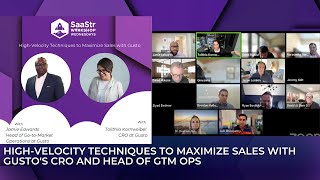
Jamie Edwards and Trilithia from Gusto explain how they replaced fixed sales territories with dynamic 'books' that automatically reassign accounts based on rep capacity and skill. They use a tool called Gradient to manage this, built a next-best-action system to coach reps in real time, and measure impact through holdouts rather than statistical tests.
Chapters
Head of GoTomark. They have an amazing presentation. They're going to be going over high velocity techniques to maximize sales. A topic I know again, we've all been covering a lot of and always looking for new tactics. So as always, we're going to have plenty of time for questions. We want you to join the conversation, so please make sure that you're dropping those questions throughout the presentation in the chat and I'll work with you to get those queued up so you have a chance to ask your questions live. So, Lydia and Jamie, welcome.
Hi. Thanks for having us.
We are so thrilled and we're already getting a lot of folks tuning in from all over the world, so thank you so much for being here. As always, we're going to get kicked off with just a couple quick fire questions and like I said, we're really excited to have two amazing experts with us today. So to get started, we'd love to hear how each of you define your role day to day and also to learn more about how you guys separate what you do at Gusto. So Jamie, do we want to start with you first?
Sure. Jamie Edwards, head of GoToMarket Ops and Tools. What I traditionally say I do here is your traditional sales operations role. So everything from making sure that we have the right systems in place, whether we're talking about our CRM or our telephony tools or everything in between routing, just all the things. I also support our marketing operations team and a systems and tools team which handles all the connections and integrations of those tools and that marketing ops tools, making sure that those leads get to the right people at the right time. So I kind of span a few different teams making sure that things hopefully run smoothly.
Love that. Tweedy. You want to give us a little bit of background for your role?
Yeah. So I have the privilege of empowering our revenue teams at Gusto. So that's sales marketing, revenue operations, customer success, partnerships, and I think pretty standard and expected organizational structure for a SaaS business at our scale. People are always surprised that I got this role after running our marketing team and being a lifelong and recovering marketer. And we, the reason we came together is because we really think of our revenue operations capability as sort of the brain center. I think lots of SaaS companies these days are kind of embracing that model. And so we look to revenue operations to be the brain and the engine builders to enable all of our revenue professionals to do their best work. Awesome.
Thanks so much for going over that. And something that's been a big question and we always love to hear kind of insider information on what everyone's tech stack is and how they're the tools that they need to do day to day. So we'd love to hear from each of you, what is your current favorite SaaS tool or platform forum? Jamie, it sounded like you had a good one teed up.
Yeah, I think TK was thinking the same one. I will say Asana right now. Asana keeps us organized. It gives us the ability to kind of share what we're working on when we're working on there, working on things, prioritize. Just have it in an easy visible place that's not really tech heavy like a jira.
Awesome.
Awesome.
Yeah, that was gonna, that was gonna be. Oh yeah, I hope we do. That was gonna be mine because, you know, I, I'm lucky to empower 450 people. And then obviously we depend on a lot of cross functional things and it's when you, when you're a leader, you have to be really cautious about where you we. I say swoop and poop. And so being able to look and see transparently the status of things and not having to bug someone, distract them, ask them questions is great. We also, we've been leveraging a SaaS product called Gradient. That actually is the underlying tool of what Jamie's going to walk us through today, some of the tactics. So this is not, we're not, we don't get paid. This is not a paid sponsorship or anything, but it's really helped us create more dynamism in our accounts.
Awesome. Well, we can't wait to hear more about it. So without further ado, Jamie and Trilithia take it away.
Cool. So we kind of did our intros, but I'll do it again here. My name is Jamie Edwards. I'm head of go to market operations and tools here at Gusto and I'll pass it over to tk.
Yeah, so when we were granted this opportunity, we really were thinking about are there things that we do that could help other SaaS revenue professionals grow their business. And I think folks know that Gusto serves small and medium sized businesses, but we really are a high velocity, high scale acquisition and expansion engine. So that's what we're going to share with you today and you can go to the next slide. So hopefully you might find tidbits interesting. I think particularly if you are trying to sell to SMBs. And so you know, we depend on a lot of inbound web leads, but you might also find some of our content interesting and thought provoking if you're kind of in one of these categories, you're sort of using round robin to assign accounts, but you're not really sure if that's the optimal way to do that if you're stuck in the the world of geographic territories, because that's just the most logical way to assign your accounts, or if you're spending a lot of time, and statistically a lot of people spend a lot of time sort of manually building territories. And that was something that we really were struggling with. So, Jamie, tell us how to fix that.
Yeah, absolutely. So, as a lot of you have probably dealt with, building those account books and thinking about how you're going to do your territories is the one thing that probably keeps a lot of you up at night. It's one of the worries to start a year or to start a quarter, depending on how you're designing your books and how you're building out those territories. When you think about that, one of the words that never really gets said is dynamic. We think about our books as static. We think about how long we're going to let a rep hold that book and work that book. What does penetration look like? We want to give stability to that set of accounts and to those reps. And stability is definitely not a bad thing. It's something that we all like in life. But one of the things we've seen in business is that sometimes stability isn't just stable, it's stagnant. So what we wanted to do was make sure that we were putting the right accounts in front of the right people at the right time. So we started working on a process called dynamic territory management. But then we started thinking about that and we realized that the thing that was really holding us back was that word territory. So we started thinking of it as dynamic books. And so I'm going to walk you through a little bit of what we decided to do with our accounts and maybe some of you will find this useful. So here's an interesting quote that I've been seeing for a while, and I love it. The old fashioned way of dividing sales territories was roughly by state. Progressive firms have found that this is unsatisfactory because as a rule, a state has no bearing whatever on sales situations. Now, the reason I love this quote is because of when this quote was said. This quote is from 1919. Effectively, we've been trying to solve for the exact same problem for over 100 years how to divide up territories outside of doing geographic, which at the time and still today feels logical. Hey, we're going to say someone is an expert in the Northeast or the Midwest or Europe or Asia or wherever. And what we found is that that really isn't true and it hasn't been true for a really long time. Some would say over 100 years now. So we started saying territories kill rep productivity. Bad territories can reduce revenue by 10%. 76% of sales teams use geographic territories. 83% do territory planning manually, meaning they are every month or every quarter every year reassigning these accounts in a spreadsheet. Google sheets sometimes just out of your salesforce system one at a time as you go through or whatever your CRM of choice is. And 64% aren't satisfied with what those territories look like now. Just looking at the screen now, I'm pretty sure some of you are feeling that pain or have felt that pain as we're at the start of the year for a lot of folks. So if localization and in person doesn't matter, what does? As we think about account segmentation, you start to figure out things like scoring, assignment, all of these things. So as we started breaking down these questions, we looked at account potential. Well, you know, it doesn't really denote what the likelihood that this client is going to buy. We looked at industry. Industry is great. It really doesn't tell business model. An industry is very general term company or revenue size doesn't tell us whether or not it's going to fit our engagement model and whether or not they are a part of that engagement paradigm. As we think about account qualification and engagement, we start thinking it doesn't really solve for incrementality when you think about rep capacity and performance and this one is a big one for me, it doesn't solve for rep skill. I will also say when we start talking about rep performance, especially when we start looking at geographic territories or just account ownership as a whole, depending on your business and depending on how your tool works or your system works or your product works, you could have a system in which a potential customer can work through that entire flow without ever having to talk to a sales person. So what then we start doing is assigning performance to the owner of that that account without actually accounting for how much. Should have been just self serve. How many of our clients would have gone through the flow without having to to work with any rep at all. What you're really looking for is a good mix of those clients that are needing that extra hand or the folks that maybe haven't heard as much about Gusto or your company so that you can Give them that additional information and help them make the right selection at the right time. So as I move forward, what we started doing was breaking it into these buckets. First you got to prepare your reps. You have to make sure that they understand how to attain what their comp plan looks like. Making sure that you have the right talent in place, making sure that your enablement fits, meaning your training, your, all of your documentation, everything is ready to go on day one. Prepare the data. So I put here like best clusters, but really it's understanding how your data fits the situations and the circumstances that you're looking to empower your teams to go and succeed. So making sure that you have the right accounts, they're grouped together in whatever way best fits your needs. That first assignment is also going to be crucial. That first assignment is your opportunity to test your theory. But you can't be married to that first assignment. Consider it dating. You're not even engaged yet. It's that very first date. You're making sure that you kind of get along, you know what the right mix is, what the right feel is. You're asking all the right questions. That's that first assignment. V1 recipes. So you want to codify for how your reps engage. So I think about this as you're going to have some folks are power dialers, so maybe you give them more accounts than you do those relationship sellers. Relationship sellers are probably going to spend more time on the phone with their clients. They're going to deep dive before they actually make that first call. So giving them 100 accounts may be a bit too much for them because they're not going to reach out to all of them within the timeframe that you have kind of set aside, track everything. If you have the ability to track as much information as you possibly can. You want to make sure that you understand how emails are going out, when they're going out, how many phone calls your reps are making, what a connect looks like, what a meeting looks like, the types of meetings. So everything from this is a demo meeting to this is a follow up. You want to understand how your accounts are being worked and how your reps are working those accounts. This will be key information for what you want to do with it later. You want to make sure you have the right coverage. So activities are going to be key, but they aren't everything. So you want to make sure that you have the ability, as I talked about in tracking everything, that you have the ability to show what the productivity looks like, what the right production Levels are. All of that will be crucial to making that final step, which is your dynamic retrievals. So what we decided to do with our accounts on the dynamic retrievals piece kind of goes back to what I was saying about one rep having 100 accounts and maybe another having less. So the dynamic retrievals part is you get the amount of accounts that you can sustain working, so you never have too many, and you should never have too few. With that, you have a rep, you kind of have this rep assignment line. You have your new rep assignment, and then you have these unmanaged accounts. Unmanaged accounts are accounts that can go through your flow without actually having to talk to a rep. They come in, they fill out. They may have filled out a lead form, but then once they're on your website, they realize, hey, what I need is right here. Everything that I need. I can answer all of my questions, I can sign up, and I can get started tomorrow with your business. Whereas you have others that may get stuck in stage two or step three of your process. Those are accounts that you want to make sure are assigned to your reps, but you want to make sure that they're assigned to the right rep. You don't want to assign it to a rep that's overburdened with too many accounts because that rep isn't going to get to them in a timely manner. And if it's. If it takes them too long, they've probably looked at one of your competitors at that point. So assigning accounts to folks who actually have the capacity to get to those accounts in a timely manner. So as we start thinking about that dynamic assignment, we think about kind of coverage and production. So for your reps, making sure that you have the proper amount of coverage for the amount of production that they are providing, you want to replace any account that they've gone through, They've called, they've set up meetings, they've maybe run a couple of meetings. It doesn't feel like this account is going to be going anywhere. There's a timeframe in which you have to say, this account is no longer worth the rep's time and energy to go and continue to work. Those accounts go through our automated retrievals process. So we grab that account, we'll put that into kind of our holding bin for a while, and after a certain amount of time, it will move into our unmanaged account bin. At an unmanaged account, it still will get service. If that person calls in and has another question, one of our unmanaged pool reps will take that account, answer all the questions that are needed and help facilitate whatever the next steps are. But they won't have that dedicated rep servicing them, following up on a daily basis for new rep assignment. What we're doing there are all of the accounts that maybe fit our our strategy for what a owned account would look like. We have those accounts ready queued up for any of our new reps that start so that all of those accounts that may have been sitting in an unmanaged queue now get assigned to a dedicated rep and those reps get to go through and work those accounts and then again going to that unmanaged. It's not saying that those accounts aren't getting any coverage. It's just that we understand that with our business model being very reactive to what customers are looking for, we want to make sure that we're not overburdening them. And we give them a place that if they do call in, they have someone that will service their needs while also not needing maybe that everyday hand holding to either add a new product or onboard for the very first time. So real world examples, if you have two different reps with 70 accounts, we look at this and we say, well, rep1 can go from 70 to 90 accounts. They had 10 retrievals because maybe they were working those accounts, but there just wasn't any movement there. We've onboarded 30 new customers and those customers do need to have an account owner. So we're going to move those to rep A. Then you have rep B. Rep B had 70 accounts. They've worked those 70 accounts, but they've not worked those 70 accounts in a way that gives us any signals that says they've overproduced in those accounts. They've done any of the things that we would say leads them to being lack of a better term board. So those reps are working those accounts. They're doing all the things. We're going to do 10 retrievals. We're also going to do 10 assignments. We're going to move them back to the 70 accounts that they previously had. We're only replacing the accounts that had no movement or that have shown or they that the reps themselves have marked to say, hey, these accounts just don't fit what we're look what Gusto has to offer at this time. Or they've decided that they just aren't going to work with Gusto. And that kind of runs us through what we did with our dynamic books. And we did all of that, as TK previously mentioned, through a tool called Gradient. And again, not a paid sponsorship here, but Gradient was just a very dynamic tool that allowed for us to take all of our preconceived notions around what account assignment should look like, how we wanted to do a weighted system. We used, we use the system saying if a rep has worked an account and we use worked as have they had a meeting with that account, have they had a connected call, has there been an opportunity created if any of those factors haven't been met, we can then retrieve those accounts as part of our retrievals process and then move that into kind of that waiting area in order to reassign that to another rep.
Thanks Jamie. One thing I'd offer just, you know, because I, I would love for folks to avoid pain that we inflicted upon ourselves like anytime you're introducing new logic and models as we know, change management and helping your reps understand the why and embracing the change. You know, it's, it's, you can never invest too much in that in my opinion. And I think that it took us, if you plan on doing something like this, depending on your sales cycle, it probably took us 3/4 to get to the point where the reps were really feeling it and they're there now. And they feel it because they actually see the constituency of their books change in a way that helps them attain, that meets their skills where they are, that has familiar repeated patterns that they can leverage within that book and they don't have to hang on to non producing accounts. Right. Reps all the time are grinding, grinding, grinding against some accounts they just can't get to move. We shouldn't let those stick with that rep. That's not going to help them be successful. So now that we have that in place and I would have loved if I had a time machine, I know some things I would have changed in the change management and the rollout. But so if anybody has follow up questions if you go down this path, we'd be happy to share some of our scars. Okay, so lots of folks are familiar with next best action. We can go to the next slide. But just in case you aren't, you know, we'll describe a little bit of what we have done so far and plan to be scaling out to a lot of our different teams. So a lot of inbound leads at gusto. They, they arrive on the website. We have a team of pooled reps. You know, they may be SDRs, they may just remain with the customers if they're a smaller size business throughout their acquisition life cycle. Those folks, they would Go. And they just pick up a lead and work it. And you know, all of our training and kind of enablement of those reps in their process was you get onboarded, you go through classroom training, you got to remember everything you got to do. We coach you on what you're going to do. And it takes a long time, therefore, for a rep to get good at what they're doing. And so to speed up that goodness, but also so that we could apply some optimization science behind the leads that were getting worked in priority, but also what the reps were doing, we now have. As those web leads are arriving, the system actually prompts the rep to you to work this lead. So there's no rep choice in which lead they're going to work. But they're also prompted in real time with how to work that lead. What's going to be the most important thing to get across to that customer in a voicemail or in a live conversation. And that is all fed by a system of rules, rule sets behind the scenes that our revenue operations team can actually optimize, can test against each other, and that we have a QA program against so that we can really understand. Did we ask the rep to work the next best lead? Did we give them the enablement so that in real time they could have the greatest effect? So we still do the traditional version of enablement, but the tool being able to prompt that rep in real time means they don't have to rely on their memory. They're going to be giving a better customer experience. The pitch is going to be dynamic and customized based on the data we have about the lead. And we've been able to really shrink our ramp time of performance and role. So that I recommend that. What tool do we use for that, Jamie? I don't even know. Did we build it ourselves?
We built it ourselves.
Oh, okay. Maybe we should make that a SaaS product company. Okay, cool. And then the last little tidbit we wanted to share with you is for some reason, if you go to the next slide, projects that we've initiated, we've started to name after Fish. This was not by design, it was just, I think Project Salmon was the first one swimming upstream. And then we needed a bigger one, which became Project Halibut. But one of the things that, that I think we have discovered is the traditional breakpoints of how we consider high velocity motions more effective than mid market and enterprise motions. The best solution is going to come with some nuance under the hood. So I think a lot of lead scoring and Particularly like industry lead scoring products out there, in my opinion, overly simplify. They don't necessarily, they're kind of conceived of by almost by like financial outcomes we're trying to achieve, which are legitimate inputs, but don't necessarily set us up to work those leads and close the most sales with the biggest ACVs. And you know, a lot of our models are kind of tops down. We're like, well this is our ACV against our icp so we can afford this ote. And so then we're going to match all that together and like boom, boom, go. But in reality, the more you can get to the sales motion that's going to incrementally increase conversion and acv, the better off you're going to be. And so one of the things we realized is that the way we had segmented our different sales teams according to like the size of the prize was a problem because so many of our customers were new companies on the verge of growth, growth and so they were already thinking ahead of the expanded needs they were going to have and the complex questions they needed to ask. And so we have really found that complexity matters more to potential revenue in terms of conversion. Can the rep engaging with this lead help the customer understand why gusto is the best choice for them? The other thing is if you have any amount of inbound leads, there's a lot of cost that goes into acquiring that customer. Or even if you're mid market and enterprise and you have, you're investing a lot in demand gen and events, etc. So the thing about under, you know, the conventional wisdom of I can't afford a sales team when my ACV is too low, we would say is overly simplified to the point of being very dangerous. By the time you have inbound leads, they're going to close at a particular rate. It doesn't matter if you have the best growth team in the world, you are not going to have 100% conversion in your webflow. And so as you start to think about what can I afford on the sales side, you shouldn't be thinking about it as an increase to cac, but a lowering of CAC because you have so many sunk costs already to get those web leads generated. And so what we have been doing is AB testing basically inbound leads. Instead of just assuming that, you know, the bigger potential leads or higher lead scores go to the assigned mid market reps, for example, we actually have gone the other direction and taken what used to be assigned leads with quota carrying reps and kind of round robin or AB tested, sending them to pooled teams, to teams that don't own books of business, teams that we can high velocity optimize. And we have been surprised in a pleasant way with how we can see those reps incrementally lift close rates without a sacrifice to acv. Quite honestly, that's been pretty cool. And we've surprised ourselves with how high up kind of the potential, the account potential chain we can apply those techniques. So I think that the breakpoints that we found, they surprised us a little bit. They're intuitive in hindsight. And obviously with all things in this kind of model, you need a certain amount of volume to be able to like, really kind of administer something like an A B test. And the faster the sales cycle, the faster you can kind of figure out if you're onto the right track. So maybe just three takeaways like we believe at least this applies to our business, might apply to businesses similar to us. But we really are kind of advocates for thinking of alternatives to traditional territory, assignment book construction. And anything we all can do to help our reps know what to do and how to do it, obviously is going to increase the velocity of our sales and our conversion rate over time. And then I would just recommend to question what you think of as your traditional breakpoints for sales segments. We've just found that a lot of those don't apply in the way that we thought they did.
Awesome. Thank you guys so much. Jamie, if you want to stop sharing your screen, we've gotten a few questions throughout, but thank you guys so much for kind of giving us a peek into how you guys set it up. We do have a few questions, so thank you so much for going in and answering some of these. I want to make sure for the folks that are tuning in on the live stream or catching up on the recording, that they have plenty of time and an opportunity to see some of the questions we're chatting about. So we'll give a few minutes for vote for questions that you may have already covered in the chat. But, Jason, I think you had a question first up about just core audience at gusto and how it may be different and work different than other potential companies. So I'll let you jump in.
I did, but I was lucky that Talia answered the question about localization. I just think it's. The localization in person is just an interesting topic when I look at folks that are, you know, it's all a new world. Right? And not only is a new world, we're actually trying to get More efficient. If Nothing else, in 2024, we're trying to get more efficient, more automated revenue per employees way up across the board. Right. Average public company is over 300,000 per employee. It was 200,000 in 2021. And so we're trying to automate and do these things. But it's interesting. There's, it's just I hear when I talk to different companies that are not at, I mean, Gusto is pretty far along, but folks with tens or 100 million of revenue, I see very divergent approaches. I see folks doing more in person, banging on the doors of small businesses in sort of old school ways. And I see tons of localizations. I see folks not for tech. This is my question. Not for tech folks, not if I'm selling to Gusto, but folks selling to normal mom and pop businesses. I see them opening local offices, opening international at a higher rate. Because normal people not like us, the couple hundred folks watching right now or later. Normal folks don't buy over Zoom. Normal folks want do like these localized. They like someone that speaks my, that is in my neighborhood, that speaks my language. So anyhow, rambling because you answered the questions, but I just see it, I see so many threads and so many approaches and yours. That is no localized. No in person. It's obviously working. It's just interesting.
Yeah, totally. Totally. It is. It is interesting. I, you know, and it may just be like sequencing too because we are realizing that we actually are at a competitive disadvantage in some regional areas that have, either because of the type of business that has been, the new businesses created in that region, or because our brand and our market share is disadvantageous compared to things like where we are on the coasts, etc. So I think for us it's, it's a luxury that we can add in at our profile and our scale, more local strategies. What we have invested in first though is more sort of like event based and marketing led localization. And then also of course, expertise can matter at the local level because there are regional, you know, regional, state and even municipal things that make it hard for people to hire and pay taxes, et cetera.
Actually, that's interesting. I'll let other folks ask questions. I love the way you put it, which is, it is interesting because Gusto is such a strong brand, although it's, you know, not everyone's brand is universal in every market, in every segment. But you could see it as a luxury. In other words, you're not saying it's not even for Gusto, that these are bad ideas. Right. To localize in person. It's just we, there's only so much time. There's only so, so many motions today. It's not a top five ROI for the sales team. But you're not saying don't do it. You're just saying it's a luxury versus maybe for some others, it's a necessity.
Totally. Could very well be. The other thing is, like a lot of businesses, you know, everybody's gotten comfortable doing things over Zoom, you know, yes, it's, it's cheaper for the prospect too, to have a digital sales engagement.
Yeah.
So I think maximizing those makes sense for lots of businesses. But yeah, certainly there are going to be some more localization matters.
It's funny, it's not SMB and then I will stop talking. But when we did SAS Europa last year, the CEO of Braze came and Braze is pretty enterprise. It is pretty enterprise. But they were in Europe and he said, yeah, we exploded, especially in France when we launched. Like, we got all these customers and then it kind of stopped. I'm like, well, what happened? He's like, well, we got all the cool tech customers, but LVMH and the fashion houses, we had to show up in person. Like, they would not buy. They didn't know Braze. Like, I mean, Braze is not a Gusto level brand. It's not at the edge of consumer. But, you know, it's well known for enterprise marketers. But no, but in France, they just could. They were, there were zeros outs, but tech, they were crushing it. Right. So that was kind of an aha moment where he's like, yeah, that's why we have 200 people in France now. We had zero and we did okay up to a point, and now we have 200 people.
Yeah, yeah. And if anybody doesn't know, Gusto is only us based. So, yeah, we know that in other regions of the world, localization is.
But even as you said, you're stronger on the coasts. Right. You're stronger in tech. Right. Where we, we.
This.
We don't want someone to knock on our door. We don't want, we don't want to take the in person meeting. But. All right, I'll, I'll, I'll, I'll, I'll let you go. But I just thought it was such an interesting insight that I wanted to do a deep dive.
Thanks. Jason Garrett, you've had a couple of great questions, but I think you have one about getting started with go to market ops. So I'll let you jump in yeah, sure.
You know, series A company growing towards series B later this year.
And you know, sales team is growing.
Customer success team is growing, marketing is growing.
I'm curious if you have any advice on when to invest into a more formal version of RevOps and how to get started.
Resources that you found helpful along the way would be great insight.
You want to take that, Jamie?
Sure. I wonder if my answer will be different than TK's answer, but I also think my answer will shock some people. As a Revops person, I would say don't do it too early. I think a lot of people think about investing in Revops super early from like a sales operations mindset. And I don't think that's always necessary. I would look at what it is that you do as a business and what you're selling and how you're selling it. If you have a particular CRM that you're using currently or if you're not using a CRM. I think as you start to have a more complex selling cycle, as you start to have more complex needs for the business, as your reporting needs grow, that's when you start thinking about bringing in someone on the Revop side of the house. More specifically, closer to that, go to market sales operations, marketing operations piece. For me, the way that I think about that is bringing in someone who can maybe multitask, someone who can be that salesforce expert who can go in and help you with setting up your salesforce for the first time, making those changes. So definitely having some admin certifications, things like that. But also someone who can maybe be that jack of all trades and transition to helping your, helping your sales teams with maybe some simple reporting and things like, things along that line. So that's probably, hopefully that was helpful. But I would definitely say holding off and it not necessarily having to be one of those first month, first six month, even first year hires.
Yeah, I support that message, Garrett. I would say it probably also depends a little bit on how standardized your process and your pricing and your packaging are. Because you know what, what RevOps can do is act as an intermediary to tell you as the boss how well your sales folks are performing against your expectations. So making sure that you have good visibility. There could be make or break depending on, you know, how big, high, how high stakes and how complex your deals are.
Really helpful, thanks.
Thanks guys. Next question we have is from Josh. Josh, you stay with us.
Hey, thanks for doing this guys. I actually want to double click on the, I think you were calling it next best action Tooling to help reps get better, faster.
So would love to hear more about.
The journey to like, stand that up and maybe as part of that, how the Revops team knows when a tip or a thing that you're testing is a winner or a loser. So probably two parts, the first one being more important, the second being more specific.
Yeah, I can take this second one. It's a holdout group. I mean, that's the. Or just random rotation of different strategies. A, B, and then, and then notice the difference. You're not going to get. And even in our volume of business, you're not going to get statistical significance. It's not about that. It's just about optimizing it as you would a campaign over time. And then maybe. Jamie, you can take the first part.
Yeah, absolutely. So we started being honest. We didn't start from scratch on this. We actually had a process that had lived within our system for years and honestly, we just outgrew it. It was kind of just loading the next lead into the system for the rep and we realized that that just wasn't optimal for our business. It wasn't optimal for our volume. So if you're in a volum, you do want to make sure that you're optimizing for, like, who is the very specific customer that you want to be working with. So for us, we ended up taking a look at all of our accounts, all of the leads that were coming through and saying, let's start to do some reporting around who's buying what those cycles look like. And from there it started to kind of explode. One of our, one of my PE looked at the analysis that we originally did and he had the brilliant idea of can't we tie this back to our website? Can't we tie this back to the full customer journey? We want to make sure that what customers are seeing on the website and what we're suggesting there, our reps are suggesting. And then when they come through our internal flow, they're being suggested the same thing. So for us, we just took that mindset of let's give the customer the exact same journey across all of these spaces. People in power. Yes, sorry, I, I said that. Thought about it after the fact. We don't typically use the term managers in house. So we took, we just took that mindset of how do we make sure that the customer has the exact same journey and are getting very similar suggestions across the board. And from that, next best action was born.
And Josh, also to your, your question in the chat, which was also about like how much volume do you need, how long, you know, like really get down to the next sets in bolts. I would say like it if you have a next best outcome that you're trying to achieve with that, you can get pretty precise about the talk tracks without a lot of, without a lot of volume or over the course of time. So think about is there a, is a next milestone that you can measure either maybe in your pipeline dev or in your staging that you would consider a successful outcome of that conversation? Of course you want to look back at the full close rate when you can. But again like these are not going to be statistical tests so you really are just optimizing the campaign on the fly. The other thing Josh, I would say is like don't never underestimate the power of a ready rep. So even if we just even taking the like the burden of trying to figure out which lead to work and how I'm going to work it and giving them something that's prompted, will it be perfect 100 of the time? Absolutely not. Will all reps do it perfectly? Of course not. But even just helping them that little bit means that they're going to be more powerful in real time. If it's a voicemail, I love a voicemail. If it's a voicemail that they're going to leave, they're going to. It's going to be much more articulate which means it's going to be legible in your text messages and it's going to have some keywords in it which is really important. And then if it's actually a live engagement, if we're able to connect, then that rep is going to have a starting place. Right. They're not going to be cognitively going back to their training of like here's the discovery questionnaire I got to go through and all the questions I got to ask. And then that remembering my if this then that you're just giving them a way in to build their confidence and their flow on the, on the connect.
Thanks Josh. Thanks. Jamie and TK Brinton, you're up next with question about efficiency.
Yeah, thank you so much.
Yeah, I'd love to hear some feedback on how to optimize the balance between efficiency but also giving realistic targets, especially for a newer group. Right. Could be a startup with five salespeople, could be a bigger existing company that's.
Looking at serving a market like SMB.
That maybe wasn't part of their go to market before. We know the finance teams typically want like a 4x or bigger quota to OTE ratio. But they need to balance that with.
You know, setting people up for success.
And not having a lot of churn after nine months. So if you have any guidance or.
Feedback on that topic, would love to hear it.
Yeah, I mean I, I mean my advice is specific kind of to my, my responsibility in the company like first is it's an always on job of a CRO to be educating finance on exactly those. Dyn, as you all know, Brenton, like you, I mean every finance person understands intuitively that attrition, uncontrolled and regrettable attrition is not something that's going to result in good performance. But the devil's in the details of exactly how they. What finance people aren't familiar with is how stinking hard it is to actually set targets when your business is changing or new or your sales cycle is developing or you're entering into a new market. Number one recommendation that I have comes from our former head of sales comp. Who came into the business. The first thing he changed was he moved us from commission to attainment. And I'm a really big fan of attainment because you can still incentivize on the upside through acceleration. But what it allows you to do, and you and your financing will see this every quarter when you do it is like set a target that's based on a bottoms up forecast of the trends in the business and the expected performance on historical trends. Right. And so you can use actual live data just you would do the same thing in a commission model. But what it is, is it gets you in the habit of meeting reps halfway to say, we understand what should be possible in our business every quarter when we set a target and that's why we give you that target and then we incentivize you to go over it. And then that also normalizes for you know that, that conventional wisdom which is like, like one way to grow revenue is to stretch your. Is put stretch targets. Right. You have your board plan, then your sales plan is a stretch above that. But that is the path to the last 24 months of sales teams attaining, you know, 25, 30% of their targets. So that would be my number one rack. I don't know Jamie, if you have another.
No, I think that's. That was perfect.
Thank you.
Thanks for your question. Brendan, Jamie and TK we have a question related to SDRs. Just for background for you guys. Our whole session last week was about SDRs and hiring SDRs and evaluating them. So again, we've been talking a lot about our go to market teams, but Chloe's asking, what tools do you recommend for increasing SDR efficiency and AE efficiency?
Yeah, tk do you mind if I go first on this one?
Do it.
So this one is one I'm actually super passionate about mostly because I think we use the term SDR interchangeably with like BDR and mdr and those are totally separate roles. If we're talking about truly the SDR function, that first person who is touching a lead as it comes into your business. I think that there are a couple different things. If you're in a business that does a lot of inbound calls, I would invest in a high quality telephony system. You want to think about the reliability of uptime. You want to think about the advanced features. So not just call recording, but does it have an AI component that will help with scripting? Does it have a component that will summarize a call at the end? Does that summary go into your CRM of choice? Do you capture all of this data? Can it feed into any of your other tools? Like Absolutely. A must have a high quality telephony system. I would also say if you have an SDR role where you're doing a lot of outbounding, a lot of your messaging is going to be very similar. I would make sure you're using some type of tool that allows for you to control that messaging, how it's sent, when it's sent. Especially with a lot of the new rules that have been changed with Google and Yahoo around, how many messages can go out at a particular time, who those messages can go to. You want to make sure that you're not, for lack of a better term, bastardizing your system and saying, we bought Marketo, so we're going to use it for everything. Don't do that. We bought this tool. We're just going to use it for everything. Like, you want to make sure that you're getting the right tool for the right reason. So I think outreach is a phenomenal tool for folks who are doing traditional SDR work. They're going to go into very specific cadences. You want to track those cadences. I'm going to use, use TK's favorite phrase. You want to make sure that you're a B testing. You want to make sure that you know what those holdouts are doing when. When you're doing them. So I think outreach is a phenomenal tool. I am not partial to a telephony tool. Just find one that fits the needs of your business.
Yeah, I would say two More things. I think a QA program is vital and so like I think we've all I'm not about to throw shade on GONG in Canada case we have anybody from GONG on the call. But I think we've all gotten like really into GONG and the the gong's analytics can be quite powerful but a QA program is a different thing and the our team at Gusto has done a really good job of making it of positive benefit to rep performance and efficiency because a QA program allows you to get some scale and also to have consistency across your different sales teams. What we have found and I don't know if this resonates with other folks but when you're using a tool like GONG as as much as you try to standardize your different sales managers tactics of GONG scorecards or I'm gonna sneak in and sample on my reps calls or etc like it's really hard at scale to get the lessons cross pollinated and it's really hard to make sure that you're consistently coaching to the things that really work work. The last pro tip for SDR efficiency specifically is hire the right sales manager for that team. I know that sounds silly but like we have gone through different models of that and the top performing folks are worth their weight in gold. What I observe about their behavior is that they are it's like hashtag always be recruiting. You know they sit with their teams. If they have the ability to do that, even if it's a virtual ride along, they are they embrace volumes like 100 calls a day is something we like at Gusto. Nobody's afraid of that and that takes a lot of strength and cultural commitment and so your leaders are really going to be important.
Amazing. Thank you guys so much. We, I know we're getting close to time and we have a few more questions in the chat but we're going to close with with one Jason and something that's on top of everyone's mind and I'll send you guys these other questions and then you guys could maybe post about them later just so you guys have them for future content too. But Jason, you want to jump in with your AI question?
Oh me again? Yeah, I just think practically, practically we're from in sales ops or sales overall. What do you think AI will really change in the next 12 months? Not the Sony baloney, not creating cartoons or other things on the Internet but where is it? We're all trying to figure this out. Some stuff's really far like on the on post sales, on contact Center, a lot of stuff's already been automated. Right on support, Right on sales. I'm confused. Like, I'm confused. So what are you guys thinking about? You have the resources. What are you thinking about AI and ops and sales?
Well, we're making a bet on a co pilot for real time engagements. And you know, while a lot of us know that sales and onboarding can be two discrete kinds of things, you can lose sales with bad onboarding experiences.
Lose a lot of them.
And so especially Copilot, that is like, is a, is progression oriented. Right? That's like step one, do this, here's why. Step two, do that, here's why. But we think keeping the human in the loop first before, for example, just like exposing, you know, a virtual onboarding clippy direct to our customers. We, you know, we're making it bet, but I don't think that we have any lessons learned yet. The other thing, so I don't even remember the name of the tool, but the thing that I'm super geeked out on that our L and D team is looking at is like, like a deep fake customer is how it was described to me. And so like you can tool a virtual deep fake customer, you can use it for training. That's what the company is pitching on. Right. So you can do role play with a conversational gen AI bot. But I'm already thinking about how do I use that as qa, like as going out there and calling my reps or being a number accessed by my reps and being able to observe and give scenarios that are basically habituating them on the fly. I don't know if my team sees that, if they'll be a little bit creeped out, but I think it's super cool.
Yeah. And I, I add from, from the sales ops perspective, someone asked the question earlier about like when to hire your first sales ops person. I, I think a chat GPT or, or one of these AI tools that are out there gives you a little bit of time in not having to do that. You can ask it. So you can create so many different prompts to help you with kind of setting up and establishing your salesforce or your CRM of choice. So it allows for you to maybe buy a little bit of time. If you're not super keen on how to use your CRM or do some of these things, you can use this bot that allows for you to kind of buy some time and having that sales ops person. I will tell you that the one cautionary piece that I have is everyone talks about AI as if we are talking about the T9000. Like we are not. These are large language models. These are repetitive tools that get things wrong. It's based on how much information is pushed into the system and what you get out. These are not these self learning organisms that will take over the world. So I think kind of separating the real from the fake and really thinking about like how I need to use it for my business and that's more realistic over what's going to happen over the next 12 months. These tools are going to get a lot better with answering those day to day questions that maybe you may feel like I have a specific question for my business and you'll realize that no there are a lot of businesses that are similar to yours that can help you answer that specific question.
There's also, you know, internal help desk is a great use of AI so you can offload a lot of the inbounds to your own OPS team if you can set something like that up.
Awesome. Great tips. Well, thank you both so much. Jamie and tk. It's been such a pleasure everyone. Thanks so much for joining us for another great sales session. We are back next week with a VC session. So we've been on a little bit of a hiatus from those. But we have a great venture partner, a Creedi Dakana. She's partner at Ridge Ventures and she's going to be joining us for an amazing session next week. So we will see you next Wednesday at 10:00am Pacific Time. And as always, the recording of this session and the slides are available on our YouTube and on our SlideShare so please make sure that you're subscribed there. And Jamie and tk, thanks again so much.
We appreciate it and thanks for helping Saster. We run Augusto makes my life a lot easier. So we appreciate that.
Thank you for your business Jason.
Thanks guys. Have a good one.










