How AI Is Rewiring Sales: Quota, Retention & Follow-Up with Agentforce, Momentum, Mangomint + SaaStr
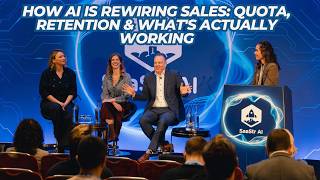
Greg from Salesforce, Ashley from Momentum, and Marshall from Mangomint discuss deploying AI agents in sales. They cover data quality challenges, tool stacks like Claude and ChatGPT, and how AI reshapes quotas, follow-up, and retention. Success requires data hygiene, CRM integration, and overcoming internal resistance from legal and sales teams.
Chapters
Welcome to the official Saastr podcast where you can hear some of the best Saastr speakers. This is where the cloud meets. Up today on the Saastr podcast.
Look, the rollout is bumpy, right? It's not like at day one everything worked. It's not like your data was in a perfect place. It's not like the processes we were trying to enhance were all there and also ways of working. Yeah, that is constantly being rewritten. So to your point, it is not about Again, if you run a call center, yeah, you probably do want to cut heads and there's an absolute ROI. It is about revenue growth, right? And if you look at most of the AI that's out there, people tend to focus on service-related, tend to focus on operational-related. Why? It's easier than sales, in my opinion. But why is it easier? Just because it's operational? No. Usually your data is in a better place. Usually your process is more advanced because you're already doing that service activity with humans today. On sales, what are you relying on? For the most part, you're relying on your sellers. Relying on new people to go out there and, and sell.
Hey everybody, Saastr Annual will be back May 2026, the world's largest SaaS and AI gathering for executives with 68 VP-level and above attendees, 36% CEOs and founders, and 25% were AI-first professionals. It's the very best of S-tier attendees and decision makers that come to Saastr Annual and AI Summit each and every year. Lock in your spot today. Use my code JASON100 for exclusive savings. Get your tickets at podcast.saastrannual.com or just use code JASON100 when you check out. See you there. Saastr Annual and AI Summit 2026. It will rock.
Hello. Hello, friends. Come on in. Thanks for coming. I know Jason is still speaking. I think so. We're flattered you came to sit with us. And learn a bit more about how AI is rewiring B2B sales. We're going to cover things like quota, we'll cover retention, we'll cover a bunch of different topics. We'll try and keep it fluid so that we can also answer questions for you guys, because I know it's already been a long day of a lot of agents and content and things. But let's start with intros. So I'll, I'll start with you, Greg, if you want to give a quick intro and then maybe also In addition to AgentForce, what are your favorite AI tools?
Got it. So it's interesting. I came from financial services, and so when they say CCO, I think of Chief Compliance Officer. That is not me. That is not me. Chief Customer Officer for AgentForce for Salesforce. So all things AI. What are my favorite tools? Look, I'm Anthropic on day one. I always have been. Mainly for ethical reasons as far as I like the stack. And then from a CIO standpoint, which was my job before this, I think that they're best when it comes to coding.
So those are good ones. And then we'll go to Ashley.
Hi everyone, I'm Ashley. I'm one of the co-founders at Momentum, and I would say one of my favorite tools, of course, is Momentum. I also use a lot of, of course, Cloud and ChatGPT, and we've recently rolled out Gemini to the company and kind of are moving the company to that. And I have been really impressed with some of the just like built-in agent behaviors, even asking a question, writing up a memo and having my Gmail right within there. And I think that's such a great way to kind of make AI more accessible in the organization. And I'm excited to, to keep using that tool at our company.
I'm Marshall, VP of Sales at Mangament. We are vertical SaaS in the like very SMB space for salons and spas. I run our revenue organization. So everything from outbound sales, full cycle AEs, onboarding, implementation, and, you know, favorite AI tools. The stack— when you asked this question, my list was like, well, I mean, pretty deep.
Yeah, yeah.
But I would say that the surfaces I work on the most, I'm really quite committed and dedicated to Notion. Notion is AI. If you asked me 4 years ago, I hated Notion. Today you could not pry it out of my cold, dead hands. I also really like using the way I think they're like editing. All of that is based on Claude, which I also love and use quite heavily.
I feel like the whole day too, and I know this is about sales, we'll get back to sales, but like the whole day we've been talking about like sales and quota, which we're going to talk about more of. But maybe just really quickly from each of you, like, that's like one of the most creative things I think we've done where I've seen like AI get creative. And I know somebody like a lot of the speakers today have been like a little bit anti-AI when it comes to creativity. Like, just what is your guys' hot take on that? Because I do feel like it ties into sales and the motion of like, you know, how creative you get with your sequences. Like a lot of that used to be, okay, we're going to hire for the— I know, like companies I used to work with pre-Saster, where I worked, would be like, okay, for the SDR team, we're going to like find the most creative people out of college and those are the people we hire.
Yeah.
So now that the AI can do a lot of that, like, how do you balance that? Maybe we'll start with you, Marshall.
Yeah, I mean, the one that pops to mind sticking on the idea of like photos, images. So again, I mentioned we worked with a very SMB customer. So salons and spas, many of you look like you've got a haircut. At least once in your life, that business you went to is who we sell to. So everything from booking to payments. Early on, 2021, we really pushed into like a PLG motion so customers could go to our website. We were the first SMB salon and spa software that you could start a trial, literally be set up and using the product in days. And over the years, we've allowed for the product within it, customers to upload their logos. Customers to add their colors. Well, we realize our customer is not sophisticated enough to use a dropper tool and to figure out what their brand color is anyway, and they have no idea what a hex code is. So one of the things we rolled out this year during a hackathon was our engineering team, again using quad code among other things, was able to take that process, which currently when a customer would upload a logo and it was like the wrong format, it was like horizontal where vertical looks better on our online booking, rather than a designer on our team having to take that and completely transform it, it is now all completely done automatically using AI. And then the designers just check a box, you know, manual, make that happen. What's really beautiful about that is we don't use PLG in the traditional motion where it's like you get in, you sign up, you're all on your own. It's really a tool to tell the sales team How quickly and how engaged this customer is so we can score that quickly and get that in front of a rep to reach out to them. So within minutes of a trial starting, somebody uploading a shitty logo, it is now fixed and that rep can text them the link to their online booking that shows their logo done properly with the right colors within minutes. So that's like one of the ways that we really like pushed on the creative side. To make things like minutes, not hours, not days.
And it's instant value though, for your customers.
They— it's actually still a little— they're a little freaked out by it. Magic.
It's too good.
Yeah, it's kind of like the Disneyland effect. And I like that.
I like that.
Craig, I know.
So you're at Salesforce. There's obviously— you guys have a massive, massive workforce.
Yes.
How are you tackling this at your scale?
Yeah, I mean, so look, I think getting your Salesforce. Get it? To be agentic is easier said than done, right? It's interesting. The word tools keeps getting brought up and people automatically assume just because it's AI, it's an easy tool. It's not, right? Like the first time I used a chainsaw and I tried to cut a log and it didn't cut, I was like, well, this is a piece of shit. I didn't take off the COVID to the chainsaw because no one there I obviously didn't read the directions. I mean, what, what man does? But it gets to the same point. You have to get seen culture when you're trying to make your workforce or your folks to be agentic. It is not just about turning on a license for, for Claude or OpenAI or whatever it is. It's actually about making sure they understand the tool and its possibilities and how they can use it in their daily life. At Salesforce, obviously we have to eat our own, our own dog food as far as what it, what it looks like for us. What I've seen from a Slack perspective of how the sellers use it is transformational for them. But again, I think, I think the point that I would leave with is sellers want to sell. If you give them the tool that's going to help them, they will figure it out. But don't leave it to them to figure it out. Have a strategy around it. Make sure you're getting the right training, making the right education.
Yeah, we've been saying that all day. And then Ashley, I want to get your take on that because you are an AI-native company. You are newer, your sales team is still doing a lot manually, actually.
I was going to say, it's— there's no like holy grail that you just get to. And I still think that a lot of the workflows are human-assisted. And I think that's probably where it should be right now, because I think in your talk this morning about all the training that goes into it and the time. Also, we're in a unique position where some of our team is non-English speaking. So our SDRs are in Argentina and some of our AEs are in Argentina. And so it's been— this is one of my, I guess, favorite creative uses of AI to kind of democratize language and to make these folks be supercharged folks who are right out of college, but not— they don't live in San Francisco. They didn't go to a US college, but they're smart. A lot of them are actually coming from technical organizations, technical universities. They want to break into SaaS. And so the fact that we are able to empower them to do that, we as a company, but really because we have AI to make them able to write sequences and they still have to do a lot of the manual work though, because I think that's where to break through, you got to personalize, you got to be human. Our SDRs send a lot of video messages on LinkedIn and that seems to kind of break through the noise of just all of the inbound that we tend to get. From people in those roles. And so I really look at it as human-assisted, start to just like knock off the manual tedious tasks that we could do. And I do think eventually we'll get to agents, agent force, like the world will be run in the next, I don't know, maybe 5 years, 10 years, who knows when it'll happen. Like so much more things will be powered by AI and run, but I just don't think we're there today. So it's more about like, bring it in and start with kind of some basic use cases so your organization can also feel like it's a win.
Yeah, those are, I think, something you've all brought up and something it was also at the, I was at an Oakland event with Salesforce before literally getting on the plane to London. And it's, you guys have like this tagline, it's like humans and agents working together. And part of the talk too is like, you know, we're, again, I don't think, Mark or Salesforce is saying to fire anyone, but you definitely are retooling people, retraining people, pivoting them to new roles, right? Putting them into FDE roles, putting them into SE roles if you can. So I feel like so much of this is table stakes right now on the rollout. So let's start with Salesforce because you guys have had one of maybe the most public rollouts of AI. Like, just walk us through it.
Yeah. So I know this is not recorded. I see the camera right in front of me and no one's actually on social media. Look, the rollout is bumpy, right? Well, it's not like at day one everything worked. It's not like your data was in a perfect place. It's not like the processes we were trying to enhance were all there. And also ways of working. Yeah, that is constantly being rewritten. So to your point, it is not about— again, if you run a call center, yeah, you probably do want to cut heads and there's an absolute ROI. It is about revenue growth. Right? And if you look at most of the AI that's out there, people tend to focus on service-related, tend to focus on operational-related. Why? It's easier than sales, in my opinion. But why is it easier? Just because it's operational? No. Usually your data's in a better place. Usually your process is more advanced because you're already doing that service activity with humans today. On sales, what are you relying on? For the most part, you're relying on your sellers. You're relying on your people to go out there and sell. And so, I think as we looked at our, our evolution, which we're not evolved, so we're not there, but it is to think about rethinking roles, rethinking the tools you're making available. For us, some of the low-hanging fruit and what we publicly expressed was, guess what? Salesforce gets a ton of webbound leads. Most of those leads are pretty low quality and they're very pick and choose on which ones are being followed up on. It was very low percentage of those are full on one. Again, that's a great thing for an agent. Let's, let's turn that over to an agent. Let's go ahead and get those curated, get those to be enriched, get those to— we can actually get a human to pay attention to them yet or just get them out of the funnel. Just let's just get them, get them out, get them done, say that we did it. And that percentage is probably the most that's led to direct revenue that we would have not had because nobody was working those incidents.
It's funny, throughout the day we've been talking about this of like you guys did that. We did a similar thing where we had a bunch of leads And then I was like, okay, because we're going to deploy agent for us, I'll put it on that agent. Yeah, we have all these leads literally even at— I mean, we don't have the level of inbound you guys have, but like me, trash, because it is like, it's not to say it's a whole bunch.
It just makes the problem worse.
It makes the problem. But yeah, to your point, it makes the problem worse, right? So it's like, okay, we have everybody, everybody. When we've told the story today or like Everybody think, you know, like, I don't know who can honestly raise their hand in this room and say, I think every lead has been perfectly followed up with. Like, maybe if you have a, a, then like, then be up here next year. But like, I feel like everybody today was like, no, I feel like I probably should double check with my team because there probably are some leads that we haven't thought about. Or if you haven't checked, like, you know, your, your org or your RevOps in a while, there's probably a bunch of leads in there. Like, everybody has this use case of Everybody has leads they never followed up with. And it's honestly, it's embarrassing for all of us. I'm like, it's embarrassing for Salesforce. It's like, okay, we have all these like big brands, right? And it's like, okay, we should, we should be getting back to people instantaneously. Maybe.
I don't know. Maybe.
Maybe. And it's like, for me, I'm like, I find it so embarrassing. Like when I found all these leads post-annual that I'm like, okay, our sales team is not that big and I get it. They're like, they don't have, you know, maybe infinite time. I'm like, but they do have time post-annual. Like, this is the best time to call people, right? Like, our event just happened in May. These people wanted to know about annual. You didn't call them yet. Maybe call them now. Like, the event just happened. Maybe they came. You can sort that way. And so for me, I was like, this is just like— I was like, we have to fix this. I'm like, we have to just do it with AI so that it's consistent because Part of the problem beforehand was, you know, we were giving these leads manually to humans and they would just, like you said, they would just cherry-pick, like they'll just cherry-pick the ones that they want to work and the rest will either say, oh, not a fit, or they'll come up with some like phony baloney closed loss reason. And then you go back and you're like, there's no notes. Like there's literally no notes in the record. So I have no idea why this like got lost.
I think, well, it's important to, to like start that process now. So we are about 80% inbound, 20% outbound. I just spun up our outbound team with our director of outbound this year. So beginning of this year, no outbound. Now we've got it. And what I've noticed is, yes, within— like, we started with how do we layer in AI from the top of funnel to make outbound at our ACV make sense? So it has to be data first. So we ingest all of that lead information, enrich it in Snowflake, that gets pushed out to our BDR. So it's already good data there. But when it comes to inbound, we're like, okay, we want to keep all trash out of the AE's hands. So we actually have a team that, like, human team that actually looks at every single lead. Because if you're thinking of a salon or spa, well, Amelia could open a salon or spa tomorrow and she's using her SaaStr email to sign up for a trial. And we're like, DQ, that's definitely not a salon or spa. But if a human actually calls you and you're like, oh yeah, Bay Area loves getting injections. I'm opening a med spa tomorrow. Then we would actually want to talk to you. So there's these like so much nuance, but what we're doing is cool. We now understand the nuance on a human level. As soon as we can do that with an agent, we will.
Yep. The agents do take a lot of training and I feel like I want to hear your guys' quick perspective though on like resistance to the rollout, right? Because we are all at different stages right now. Maybe actually we'll start with you. Like any resistance with your— I mean, you're an AI-native company. Maybe they can't resist AI anyway.
That's why they joined.
Yes.
Yeah.
Not in our organization, but we are selling to companies that are dealing with their own internal resistance. And I think it's been really interesting to see. I mean, I was on the stage earlier with Contentful and we talked to them twice over 2 years before they became a customer. And it was just a matter of internal teams getting on board. You had someone like Ashley who was championing it from the beginning, but they're European-based. They have a German works council. Their legal team was very, very reticent to bring AI into the organization. And so I think that what we see is that it's great that we've moved beyond like note-taking. We're like, okay, we can have bots on the call, we can take a note. So, I feel like it's easier to sell AI to organizations than it was 2 years ago. But I'm still kind of amazed at the internal resistance when you bring in legal teams, CIOs, like it, it is so dependent on the personality and the mindset. And I do believe that we will eventually push through all those barriers over time because it will be so obvious who's leveraging AI and who's not. And I think the companies that are will be so far ahead. But I, I've come to just appreciate that some things really come down to timing. And another angle of that is that the company that's going to adopt AI internally needs to have a strong team championing it because you can't just give these tools to your team and expect them to just magically use it all day long. I think there's some crazy stats out there about how many people are actually using AI in their orgs, and they probably all have access to ChatGPT or Claude. And it's just, it's very hard to get people to change their behaviors. So, I think that's equally important is that there is just somebody raising the flag internally and who's really committed to the cause of saying, this is going to be transformational, but it's going to take time and you have to have buy-in.
Well, it's, it's, it's the psychology. Like, as humans, we will do far more to avoid pain than to gain pleasure. Like, it's just what we do. So, like, I noticed we rolled out Momentum with our team, started with our onboarding team, worked backwards to AE, soon BDR. Um, and what I noticed is I could quantify that we were going to save 15 minutes per deal. For our AEs, that's 16 hours a month. They, their 20 wins is their quota. I can quantify that, but what I didn't teach them at first is how that will change their workflow. So they are literally 30-minute demo, closed the deal, immediately have to get off of that call, build notes for the onboarding team, get that into Salesforce. Well, what we learned immediately was we don't have that readily available. It's going to take 15 minutes to get that information back to them. So the workflow changes. You're now stacking demos and then you have an hour-long break where you're going through your momentum tasks in the Slack that you're already in. So, you're not having to change surfaces, processing them much more quickly than it would to do it manually, but actually like implementing that and being very explicit about the way you work is changing. It's going to look different, but the net gain is going to be so much greater. You have to like be ahead of that. And so, you've mentioned a couple times, like, I'm really active in the onboarding of Momentum into our team. I wanna build, I wanna be in the tool. If I'm not, that's where the resistance bubbles up.
Yep.
Because it's like the, the greater than they, like, I'm, I'm here, I'm in this, I, I know how to use it. It won't be that way forever for every single tool, but I think you have to, like you said, have that champion, that leader that is in it.
And then anything you want to add from the Salesforce side?
Yeah, I mean, look, throwing CIOs under the bus, I'm a former reformed CIO. And the problem with AI is not just AI, right? It's not just saying, oh, I'm anti-AI or not. Again, there are, there are data to be concerned. What is your company IP? How are you going to turn that over? I mean, there are other concerns that technology experts have of why we are perceived that way. It's just, it's dangerous. By the way, the CIO that, you know, gets a data breach, like, that's going to be fine. That happens. The CIO that gives their data away to AI is fired, right? Like, that's a big difference. And also you got to think about the psyche of those folks. So I'm just a little defensive. Got thrown under the bus. But you, at Salesforce, look, several things. Number one, we have a product, right? So there's a product that they're want to learn and use because they're going to be selling it. And if they're not a seller of AgentForce, yeah, and they're going to need to know it because that's the questions asked. So, so you did have that buy-in. But I also think that when you're talking about, is AI going to replace humans, you know, that's the fear. Maybe that's part of the adoption or maybe the tool doesn't live up to the expectations. Maybe that's part of the thing. But your analytics is, is your best friend. Right? Like you need whatever your agents are, you need to make sure you have defined analytics. Now KPIs, ROI, I could probably go a little off on that. I'm not, not as big a fan on that, but the analytics around it, you need to be able to prove that it's actually is working, what you're getting out of it, because you're going to want to improve it. I also think that's pretty lacking in the industry as far as when you look at your agents that are built, getting those level of analytics to say, why is it dropping out in process 3 at 21%? Is that because it's bad data? Is that because there's latency and the customer's not waiting around? Like, what, what is, what is causing this to happen? It's been a big part of Salesforce's roadmap since, since Dreamforce. But I also think it's something you need to have in mind as you build out your own agentic layer.
Yeah, it's interesting because I was like, okay, pre-May, right before we went on this agent journey and a lot of other folks did too, like, I don't think the data is that bad. And I started to onboard some of these tools and agents and I go, oh man, like, our sales team never put half the stuff in there, right? Like there is no close, it's just those lost. I'm like, well, where are the notes? Okay, no notes, no calls, no nothing. They just, you know, never did it. And why that sucks for so many reasons now is because you're now— your agent can't go back to those things. So like if it never existed as like a record previously in your data, it's not going to exist there now magically with AI.
Not going to find it.
It's not going to find it. So I think there was like a little groundwork we had to do, like when we first rolled out all these agents to say, okay, what should we implement? And as part of how we picked some of these tools, it was like, okay, well, what should we implement so that going forward— I obviously can't change the past, so that is what it is. But like going forward, what can we put in so that we make sure everything is always in Salesforce as it should have been? Like we've had this, we've had this system of record since I've been here like 9 years now, like alongside our marketing automation platform. But why does my marketing automation platform have like 10,000 more data points than Salesforce? I was like, Salesforce should have more actually, because our, our marketing automation pushes to Salesforce, but then the AEs are pushing to Salesforce. So it should have more, but it didn't. They were like almost even. And so part of this process for us was making sure we could implement the right tools in the right ways to say, okay, What are we going to pick so that everything goes back to at least one source of truth? So right now that is Salesforce. Like we use Momentum and like that goes back into like that was why like after annual I told Ashley, I was like, I need your help because I went into Salesforce. You're like, yeah, I was like, close the lid.
But I think you don't always know what you don't know. I think we're starting to wake up.
In the back of my mind I was like, well, you think it's being handled.
And then, and then the, the old way of working is you would go to the reps and ask what's going on.
Yeah.
Then you realize, oh wait, you could go to the data it sell and make your own decisions. And I think that's just the change now that AI is unlocking for us.
Yes, that's a, that's a big call out because I feel like to part, it's not that I don't trust humans anymore, obviously. Like we've worked with a lot of humans to make this happen and I've gotten to know a lot of humans in this process, right? Like all these people here, I'm like, I've met so many really great humans in this process. So don't take this the wrong way, but like a lot of our humans also just didn't do their jobs. Like the basics of put your Like, I think it's, you know, AEs are 101. Put your contact and notes in Salesforce or your CRM.
It's also like the personality.
Yeah.
Like the, the top seller has a persona and that persona at my organization at least is a whatever forever. You know, anything you've got to throw at her is going to roll right off and she's closing that deal. But there's no notes.
There's no notes.
She could screenshot her text messages all day and send them over, but it's like that. It just is what it is. Another one of our reps, I love him, but he shared with me after working for the company for a couple months that he basically had to— he'd been in sales for a while. He was like, I had to explain to my wife why I had all of these women in my text messages because he had never sold to salon and spa owners. No wonder you have no notes and like everything's in your phone and you're having to explain yourself to your family. So you're not going to explain it to me. But this, the, what shifts when you do get something like Momentum and you get everything into Salesforce and these fields filled out is like the signal-to-noise ratio shifts so quickly that then you have to, because again, like I notice even for myself that you become addicted to the noise or sifting through it, and then you have to like stop, regroup, and go, it's all here. Like, we're okay. Now what? What now? Like, how do we then level up and do more with the team you have?
Yeah. Yeah. I mean, that's just such a big unlock for most people, right? It's like, okay, once you finally deploy your first agent, one agent, whatever it is— sales, support, retention— like wherever you're going to deploy, it's like, okay, getting it to work is one. I know it sounds like a big hurdle. It's a hurdle. But then once you get there, I feel like everyone has this like aha moment where like, even for me with AgentForce, I was like, I filled out so many agents of duty. I was like, I have to now do another one. But then, like, we, like, we started, like, going through the process together. And then you guys brought on, like, an FDA, and I was like, well, that one, that helped a lot. And then two, once I, like, got over this, like, mental hump, I was like, I don't know, like, it looks kind of complicated, to be honest. And then I got in there, I was like, no way I understand this. I was like, I just couldn't, like, I was like, I just need to sit for like 10 minutes and read it and read the prompts and like how I can train it. And I was like, okay, never mind. Like, I get this. It's like not that different from a lot of things that you prompt and build into. And like some of the— so once you learn how to do one agent, like a lot of the core principles you learn are actually transferable, like vendor agnostic, are transferable, which I feel like is a big thing for folks. And then before we run out of time, I want to talk about two more things, which is One, because it's in the title. Let's talk about quota for a second because a few people have asked me about this today of like, what's the quota of your AI SDR? I was like, well, it's more than what the human quota was. Also, it doesn't ask for, you know, a percentage of the AE's commission when the deal closes. So that's nice. But let's open it up to you guys. Whoever wants to start on quota?
I'll tell you about quota all day. I actually, I just announced to our team last week that we are not raising our quota in 2026, and I could have.
Yeah, that's interesting.
Yeah, I could have. You know, you know what I learned is what I've seen happen this year. This year was like the proving grounds, right? So I've been in 2024, I implemented AI using a tool called DemoDesk for my team. So I was able to analyze— they're based in Munich. Great company. Unfortunately, we're no longer using them because we moved to Momentum for some other things, but I can't help but shout them out. I think they're fantastic. I almost cried canceling that. That was weird. Like, it's, it's rare to feel emotional about a company, but I think what they've done was so good and they rolled out AI early, but the Red Queen's race gets everybody, right? Anybody know? Like, you're running at the speed you've always been running, but suddenly the trees are running with you. You've got to run faster. And so when I think about that, this year we roll out Momentum. You know, my team, like I said, we're very SMB SaaS. My team closes 20 logos a month. When we roll in our payment processing, this is very SMB doing up to the like 7x, you know, ARR to OT ratio. That's crazy in very SMB, but it's, it's good. It feels good to us. What I learned is we've got these top performers that are almost those like overperformers. There's usually, you know, a couple boxes you could check that make you realize, oh, that's possible for you. And that's great. So you're closing 35 logos in a month. Absolutely wild, but good for you. Like to make that OTE in your area, SMB sales creates an absolute like raving champion of our team. They wanna run to RepView and put a review on there and say great things about the company. But I am pleased as pie, as our COO always says, and I love with that person who's running at quota because you're still incredibly efficient. What I'm going to do is spend this next year really making AI allow you to push up into those top performers. Very curious to see what happens with those top performers once we're like, once things feel truly native, but we're not there. And so when we talk back to like, how do we make these people feel safe in this new environment? That's it, is like reap that benefit and that reward to where it's so like an intrinsic motivation that it feels like part of you, and we move up. And we will get there. And it just felt right.
I think that's interesting too. It's making me think about when we were writing our, the book, where we interviewed a bunch of leaders, Kyle Norton from owner.com. He, he talked a lot about the, the systems that he's put in place to support the team. And how they have a lot more RevOps folks and ops folks than a traditional team would have. And that theme actually came up 4 or 5 times from Demandbase, some other companies that we interviewed. And our takeaway was that we're going to have a lot more operational folks running the agents, running the data, which will allow the teams to be more efficient. And I think that instead of thinking Okay, we just got to like double quota now because everyone's going to be a lot more efficient. That will only happen if the business is supporting those folks with all the underlying, hey, do my SDRs have enough accounts? How do we get accounts? Where does that come from? It's like you need to orchestrate and architect all those systems from top of funnel on down to post-sales. And so, and I don't think we're in a like industry-wide place where we've all like proven that out. I think we're all much more like you guys, us as well, where we're saying let's start to just build, bring in more people on the system side, add the headcount as needed. But I, that's why I don't really buy yet into, okay, we're gonna have 2 reps and we're gonna get to $100 million. Like, sure, that works if you're lovable. Like, it, that can work with the right business, but a lot of us do not have that business. So to hold ourselves to that standard just feels impossible and unrealistic and better to think about, okay, what are the underlying systems we can put in place?
And I just said I'm not raising quota this year, but I was just talking to a CEO of a native AI company and he's telling me about his company and how his head of sales is like, oh yeah, well, we've got, you know, this particular quota and everybody's hitting it. He's a new founder. He's probably 26, 27. You know, he's whip smart, but this whole world of building a revenue organization is new to him. So, he is listening to this head of sales that's like, yep, that's, that's industry standard. This is the standard playbook. This is where we leave quota. And I said, you got the wrong person. Like, that's, that's not it. What you don't wanna do is take the old playbook and try and plug it in. Like, you actually have to strip things down to, you know, first principles. Like, what is your business doing? And that's where it's like, he could probably double his quota And people would be motivated by it. Like they feel like they're reaching for something.
So from a Salesforce perspective, it's Salesforce is always going to raise quota. That's just what they do to the salespeople. But I think it's interesting when all of the panelists, and I'm going to echo it, didn't focus on raising quota and increasing sales. It talked about what happens when you do that. And I think I can point back directly to your, to your story in that fine, we're, we're, we're selling the shit out of AgentForce and that's great and it's wonderful. But again, in some of these situations, it's not just click, click, click and you're done, right? Like some of these flows are actually very complicated. They involve a lot of pre-work from your data perspective, maybe your workflow perspective. Can you actually service your accounts afterwards? Is your operations also scaling? So It's not just a sales issue itself. For us being the forward-deployed engineers is what's helping us as, as a band-aid, because it really is a band-aid until product makes it where it is just quick, quick, quick. Right. But to get quick, quick, quick, it still has to have a lot of maturity. So yes, you can, you can definitely increase your quota if you'd like. You can set different ones. I've seen everything at Salesforce, but you also need to make a holistic view. And I think that's what all three panelists wanted people to think of. It's not just about sales. You need to look at your business holistically, right?
You're not doing that. You're—
yeah, it's just—
there's going to be repercussions.
All right. Well, and on the topic of retention, just because we have a CCO here, so I know a lot of people aren't using it for retention. I've— we've kind of mildly used it for retention in the sense that, like, because we're so seasonal, right? If you think of SaaStr as I mean, we have sponsors like these guys out here for like SaaS Annual, then some of them do London, some of them do year-round stuff because they have like bigger partnerships. Well, most of them do one at a time. And so we have this like seasonality that's just natural to us, right, with our event cycle. And then we have media, which is like a little bit different because that's year-round. But for that, like the event cycle is very seasonal, right? So we have this seasonality. And so one of the first things we've done for retention is load them up into the agents Because I was like, I'm, you know, because one, we had new people who raised their hand for those last SaaStr and said, I wanted to sponsor literally one of these booths out here. We never like replied to them. But I also had, you know, 200 existing vendors who had just done this like last SaaStr in May. And I'm like, you know what? I know the team says they're gonna follow up with all their current customers and current accounts. Let the agent do it anyway. Like, like no harm, no foul. Like, it's not going to take credit. It's not going to sell, you know, whatever, you know, these booths were out here today, like, uh, I don't know the ACV on this, but let's just say $50K, right? It's not going to sell a $50K booth, but at the very least it can keep emailing them if they want to be emailed, get their feedback from the event, check in on them. Maybe, you know, half the time I'm like, hey, did you talk to all your sponsors and your accounts? And they're like, Oh, I saw some of them and then I got busy. I'm like, yeah, I get it. But like, but like, what are you doing tomorrow? Now that the event's over, I'm like, are you, are you, are you reaching out to your accounts? Are you doing things? And they're like, ah, you know, some of them were, some of them weren't. And so I was like, okay, enough of the like 50/50, some yes, some no. Like you'll find this with your sales team no matter what happens. Like you're always gonna get a mixed bag of results, right? You have top performers, you have low performers. That's just how the bell curve works. Like, And so for us, we were like, okay, we're going to load these existing accounts into one of our agents. Some of them are in AgentForce, and I'm going to like, I literally, that's why it has such a high open rate too. It's a mix of, you know, people we ghosted and then people who are customers. Yeah. Are, are getting into this sequence where we're following up. And I'm like, in some cases they're like, oh, hey, I actually didn't get to connect with my AE post-annual. And I'm like, man, they told me.
The gig is up.
The gig is up. But Greg, just any quick thoughts on retention with AI?
Yeah, so it's interesting. There's this stat from McKinsey deck I saw, which was 40%, and this was in financial services, 40% of financial services customers want increased outreach from their firm. But I think when you looked and you got the certainty, it's like, okay, fine, yes, they want to be talked to, but they want to be talked to on their level about products or services that interest them. So it's, it's not just about creating a traditional, like, marketing campaign where you're dripping. Like, that's not what an agent is for. It's not— you can, you can use plenty of off-the-shelf software to do that. It's exactly what she said as far as mentioning about getting some kind of action, and you're trying to build that relationship digitally so that your human can close it. That's all they're doing is trying to build a little bit at a time. Maybe it's a survey, maybe it's a question, maybe it's thought leadership. Doesn't really matter, right? But think about an agent in that standpoint of being able to continue to keep the relationship fresh. Because as a human, you can only talk to so many people a day.
I mean, until— this is specific again to my customer— until there's an agent that texts with the blue bubble, like, it's just, it's not going to happen. And the bias on email for us is so extreme because salon and spa owners don't open emails. Like unless it's like I'm booking a haircut tomorrow at 3 PM or, you know, need my nails done. So I think that's the biggest piece we've run into there. We have like incredibly high net revenue retention to begin with. Like our customers, our product is so sticky. So to me, the way I think about it is more like it's the, it goes back to like how quickly we need to move it deep into our vertical to make the hard decisions for them. That's what drives retention. And so, yes, we do that through AI, but it's not through an agent reaching out.
Ashley, any last closing?
Yeah, I think what's been interesting, I mean, because we have some customers that use us much more heavily post-sales, and I think CS has tended to be underserved in terms of tooling and process. And I think the expectation has still been high on them getting data back into Salesforce or get the data in Gainsight.
And it's still down.
Yeah.
So it's—
there's like a lot more opportunity actually on post-sales, I think, in disrupting and not just the customer support chatbot experience, which is like great starting point, but actually again, to help CSMs and CS leaders have a better pulse on the business. The moment that somebody is expressing dissatisfaction, it's— we all know that it's a slow I mean, unless you're like egregiously messing up your product, it's kind of a slow drip to churn. It's, hey, I didn't get this answered. Hey, this is not working.
And it's—
I think it's really hard for CSMs, and I oversee customer success, so it's like a close thing to my heart where I'm like, it is hard to know in the moment what needs to be escalated unless somebody is being like, I'm going to leave. Yeah, that kind of soft, slow dissatisfaction. Now that I have momentum listening for those moments of dissatisfaction, which almost sometimes swing the other way where you get on, you see a clip of the customer saying something and you're like, what is going on? And they're like, it's actually kind of fine. Like, it's not a big deal.
I had to mute mine since I've been here.
Yeah. So it's like, but I think that on the CS side, I'm very excited for what AI can do for retention and keep doing. Not to mention something like You know, we have a customer that does 3-hour support calls in another language, and then they had to go write that into Salesforce. Imagine the time savings and the ability now to bring that all into a common language, English, in the CRM. I think that we should all be orienting ourselves to thinking about AI for customer retention and CS just as much as on the sales side. And I think it's all going to have such a huge impact on our businesses.
Okay, we're out of time, unfortunately, but we'll stick around and answer questions. But thanks for joining.
Thank y'all.










