How Dialpad Leveraged Its Own AI to Achieve $300M ARR at SaaStr AI Day
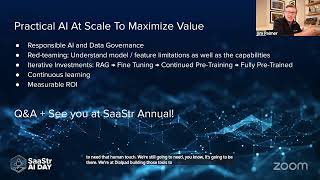
Jim Palmer (Chief AI Officer, Dialpad) presents Dialpad’s AI journey: acquisition of TalkIQ (2018), launching real-time ASR (2019), continued symbolic ML for conversation intelligence, building a Dialpad LLM variant in 2023, and deploying generative-AI features (AI recaps/summaries) to scale. Dialpad has processed >8 billion minutes of conversation, serves ~70,000 customers, and focuses on domain data, cost/throughput planning (real-time vs batch), data governance, red‑teaming, RAG as an entry point, fine‑tuning/continued pretraining, and ROI measurement. Customer anecdotes report time savings (example: ~20% efficiency gain). Emphasis on responsible AI, privacy/locality (GDPR), and tools to assist—not replace—human agents.
Questions this video answers
Over 8 billion minutes.
Over 70,000 customers worldwide.
2018.
2019.
2023.
Chapters
But it's hi, I am Jim Palmer and I'm jumping to the next slide here. I am the chief AI officer here at Dialpad. We've been at Dialpad over seven years. Over 10 years ago I co founded a startup called Talk IQ that was in the conversation intelligence space, as in applying and natural language processing, natural language understanding to business communications. And here we are over 10 years later doing the same thing at a much greater scale. So I, I really want to try and tell the story and maybe even just give some tips along the way, some common pitfalls, some just basically try to give some guidance on how you might be able to do essentially the same thing, building from scratch or you know, where what's a good starting point to basically try and you know, own your AI story with your company or your side project or anything in between. So a lot to share here, way too many slides guaranteed. But we're gonna just try and dive right through. Hey, I always like starting with a little bit of what are the things that I wish I knew, haven't gotten into it or what are some of those common, common pitfalls. And I'll have a couple of recurring themes throughout my, my quick talk here, but just basically where do you start? Do you dive right in using a third party? Do you just dive right in trying to build an AI story from scratch and doing your own model development all the way through? But honestly, just here's a couple of things I liked along the way. Don't overestimate the power of third party APIs, especially in the sense of using like generative AI. Not to name names here, but there are some amazing, some amazing technology right at your fingertips where it's just so accessible via an API and more. So just don't overestimate the power of it in the sense that you want to be able to test it. And I'll come back to this because it's a really great cheat code I like to call it, that kind of helps you to understand better where the limitations and the power is with a lot of third party APIs or even your AI development that you're doing in house, understand when to use generative AI and ultimately when not to. So just understanding where the accuracy is good, where the accuracy might actually build something like where if a false positive or a false negative might be a make or break kind of situation. So there's a lot of really good examples. I won't have time to talk about all of the intricate, you know, examples where we have seen or you know, my team has seen being a really good successful use case for generative AI. But I think a lot is already happening in the space where we're seeing, hey, this is really high value and it fits very, very well. Plan and manage the cost, plan and manage the throughput. Like do you need this in real time? Do you need this for a massive number of operations at the same exact time or in the same second or minute or interval, and then also helping manage risk. And that kind of folds into what my position as a chief AI officer is. It's really just, it's risk management. You have to know where it works, where it doesn't work and be able to help guide your customers or your users and your users users to be able to use this appropriately and also setting expectations. So you plan your real time and your deferred as in, hey, this can happen later at some point and your batch. So if you want to do a lot of operations at once, start to plan around some of those features and functionality where you're, especially with generative AI and anything more, even using something more old school symbolic AI classifiers, predictive models, just worry or think through what some of those use cases are ultimately going to be because the cost and the throughput and the risk components of doing real time versus deferred versus batch is drastically different. So also the last tip here is just own the quality of your data ultimately to be able to manage model drift, for instance, but it's also just being able to own that accuracy. And especially in the case of when you're using a third party or if you're doing it in house, you as the one who's building AI for your customers, ultimately needs to have an understanding where it works and where it doesn't work. All right, jumping to the next slide here. Let me talk a little bit about Dialpad because I think part of the story is here is, hey, how did we go from 0 to 300 mil in a very short. Well, yeah, very short period of time. And Dialpad is really this, this fully integrated platform. Part of our kind of value prop is that it's all in one. Another part of our value prop is you've got all of the different channels. There's the digital like messaging and text. There's the voice component, which is obviously huge. There's a, we have a meetings component as well, but it's all coming through the same platform. So it's the ease of setup and integration and you know, that's really our value prop. But it's also the AI that We bring that's directly integrated into our platform. So we have our sales specific AI features and contact center, UCAs, CCAs, all these features that are just really in the platform and you get to be able to access it totally seamlessly. So that's been a huge value add for us. You know, are being able to have this in multi cloud, whether it's you know, on prem data centers, multi cloud, you know, just it's. We've got this great flexibility in our, in our platform and you know, current kind of stats. We have over 70,000 customers worldwide. We're on the 400 best cloud companies in 2024. Great. So let me tell a bit more about the story and some of those investments that we've made. And I love this graph, it's a good old hockey stick. But if just looking at the top right, we've already process well over 8 billion minutes worth of conversations via our or through our AI pipeline. I want to talk a little bit about some of the accomplishments along the way as we've gone through time. But back in 2018 we acquired my company that I had co founded and was a CTO of called Talk iq where we brought in a lot of our natural language processing. That's where our big investment was and that was, you know, classifiers for a lot of things. Sentiment was a really important part of that, but it was still early in terms of scale compared to where we are right now. 2019 we launched our first, you know, real time ASR stands for automated Speech Recognition for Business Conversation. So transcript was kind of that, that first step, I like to call it the keystone to being able to build the rest of the arch here with AI where you need as accurate of a transcript and real time was a really big value add for us, but accurate real time transcription to be able to do the other insights on top of that. So that was a huge investment on our part. And in 2020 we're adding and continuing to add more AI enabled features into our core product across all of our different verticals. And then in really I want to jump ahead up into 2023 because we've been doing a lot of symbolic AI classifiers, predictors, building up this, hey, how do, how are we helping? How is Dialpad helping our customers? Look at their calls, look at their communications, look at their customers story, the way that they're communicating with them at scale and then ultimately generative AI coming into the story. So we had done a significant amount of work, you know, thanks to Google and attention is all you need and there was a significant amount of work, but obviously things just got accelerated. The, the gas pedal got hit to the floor in 2023. So what we had invested in was our own variant of Delwell Dial Pad GPT, a large language model that is powering a lot of our AI functionality now. And we're continuing to build off of, and then more recently last year, just making this, we call it our AI recaps. So it's a series of generative AI features to basically be able to distill what's been happening in a call, summaries, dispositions, you know, extracting meaningful information at all of our calls at scale. And so we've got this, we've been able to scale this, we've been able to get the throughput, we've been able to do it in real time and we've been able to help, you know, really control costs. But it's been a really amazing buildup and we're very excited for what's coming. I wish I could have time to talk about what's coming, but I think the really great part about our story is that we've been making the right investments at the right time to be able to get the right value add in place for our customers. So I'm going to very, very quickly run out of time, but I just want to continue telling a little bit more of this story as well. So this is a fun, you know, what weekly active users just hey, what's our adoption look like across our AI suite? And we've had some significant jumps and you can see it kind of plateaus and then bam, jumps. So a lot of those larger jumps were really, because we've had this new large piece of functionality being released and where like in March 2024, you see a little bit of that, that actually massive jump here. We had some significant new generative AI features that were deployed at scale while controlling cost and throughput and real time access and seeing our users just absolutely loving and adoring this feature and functionality and ultimately can't live without. And I think that's that as you're measuring accuracy of potential AI features as you're building it out and deploying it, whether it be, you know, beta, alpha, early access or full ga, you're going to be measuring all of this, you know, how are users using it, where are they finding issues, where are some of the, you know, the pitfalls ultimately of that? But a little bit of a highlight of a, of our story with AI adoption. So jumping ahead here real quick here's and I'll get into a little bit more of the hey, where do you start? And one of the big advantages for us again is this 8 billion minutes that we've processed. And it all, I think the huge advantage is in domain data and we're not the only company that's got in domain data. And what I mean by that is we have a lot of business conversations, business related conversations. We have a lot of different verticals, we have a lot of different, you know, use cases, UCaaS versus CCaaS, selling teams that are sales teams versus customer support teams. And what that gives us is a lot tighter corpus, a lot tighter lexicon. It gives us the ability to kind of narrow the accuracy gains that we're trying to give to our customers through our AI. And that gives us the ability to optimize, it gives us the ability to improve drastically in several cases the accuracy for those specific use cases for our customers while maintaining generalization, which is very important in the generative AI space right now. So you'll see and this is, there's a, you know, quite a bit that's going on right now. There's so much work going on in the public space right now with, with public data sets. But it's, it's how our companies responsibly using the more private or in domain data for a company in their AI models. And it's something we take very seriously. And I have a couple more talking points with that specifically because you need to be owning your data and your data story and being responsible with it as well. All right, so hey, what are a couple top AI priorities and I call them kind of perpetual priorities as well. So did data governance. That's chief AI officer. We need to own our data story ultimately. You know, like the data is the one thing that is going to persist regardless of the way that the technology improves. And it's, it's the kind of thing that you can even start even if you don't do model development in house. It's something that you can start and continue to build off of and take advantage of as, as you grow, as your machine learning or your AI story grows. And then ultimately it's that, that training, training doesn't mean you in, in every case, it doesn't mean that you have to bring in a whole team of expertise. You can actually start smaller, start to build up your data governance story and your training story as you start to scale. And I got another slide to kind of talk about a couple of examples of where we found some Good success. But I want to go back to the data governance and I found one other cheat code and it kind of came from more of the security realm, but it's red teaming adversarial testing. And so a lot of folks, especially what happened in the last year and a half or if not two years, was ultimately looking at oh my gosh, look at what this technology can do that we're looking at the, the happy path. But adversarial kind of flips that and red teaming flips that so that you're looking at what can it not do and what happens when you're looking at the things that these systems or these, these even third party systems, open source systems, whatever it may be can focusing on the what it can't do first. You almost get for free what it can do and it starts to building this in house effort of understanding, you know, hey, how do we test this adversarially you can start to build up almost a program to be able to say hey, I'm building up a test suite and we're building up a harmful, you know, test suite that can help us then outline the guardrails that we then need to instill or build or develop or you know, bring in to our process as we roll out especially generative AI processes. So this was just like one going in with this kind of mindset to start that even manual testing and red teaming has really given us a dial that a significant advantage. So just one quick cheat code on that. Here's I want to go back to also the training and there's tiers to this as well. So I still think there's an, a significant investment where even just starting with RAG or retrieval augmented generation where that's it's not specifically training but it kind of is because it's helping you to create these data sets, it's helping you to create this. How are we managing and manipulating and building something on top of existing AI systems or models as well? So, so it's a really good entry point and it also is at least for the time being, something that could live in perpetuity just like these guardrails, these, these AI parenting systems. It helps with the privacy story. There's just so many wins with starting with that. And then as we expand things like fine tuning for specific tasks where you can drastically improve your accuracy, but also understanding that your, your, your overall generalized accuracy might be adversely affected. But fine tuning is very approachable right now and kind of expanding that sphere a little bit more. The concept of continue pre Training off of foundational models does allow you to bring in more of that in domain data while maintaining good generalization. That means it can answer questions that it wasn't trained on originally. And this is, I think, really exciting because it doesn't mean you have to start from the ground up with a full foundational model build or a very large, large language model, but it's in between. It's almost like the ability to kind of customize it without losing all of the accuracy for general use cases and for specific use cases. And then there's obviously the fully trained models, which is a very significant investment as I think we're all seeing at least in many of the headlines over the years as well. So it's a very light, high level view, but I think there's training in multiple levels and start from the bottom up. Ultimately, you know, really looking into that. How can we own that? If it's rag specifically or if it's parenting or if it's guardrails using systems out there that can help you with that, it really helps teams, you know, get started and it is still again, something that you can persist over time. So I want to talk about a couple of examples of customers that basically are saying, hey, here's AI functionality that we've used with Dialpad that we can't live without. And I think that's one of those stories is do they trust what you, the developer or what you, the company that has this AI functionality, can you trust? Can you build this into your workflow? And we've got some great use cases as I think a lot of companies that are, you know, building out AI in house and even leveraging third party too. We're figuring this out together. These really good use cases that are saving companies, saving teams, saving users time, saving them money and helping just increase the efficiency and being able to basically better communicate and better run their businesses. So just even in the case of Custom Inc. Improving their workflow delivered a 20 for 20% efficiency gain. I love boiling it down to numbers. Ultimately, how much time did they actually save per week? And this is a coaching feature that we at Dialpad have built out with generative AI with more classic symbolic ML with predictive models all together to provide this suite of being able to help them coach their sales, coach their support teams as well for efficiency sake, not to ultimately automate and replace them out of a job, but just to help them, you know, be more efficient. So it's a really great story. And one more here with Sun State equipment as well. So really, just again, it's time savings. We're reducing times are spent on the calls with AI, increasing productivity with our recaps. Summarization is one of them recordings or transcription. Being able to come back to those calls and, and build up a workflow that helps them save time and save money and create more consistency through their business. All right, final slide here and I'm going to kick it off to qa, but I just want to hit on a couple of points here just to kind of keep the ideas flowing a little bit. But responsible AI and data governance is something you do it from day one is ultimately our recommendation. You want, you want to have that data governance story. What data do we have? What data can we get when, what can we do responsibly with it? How can you get your users to help you build value for them via AI? Red teaming is one of those cheat codes ultimately, but it helps you understand the limitations of what some of the technology or some of the use cases are. And it helps you really kind of own that, that story with your users and be able to continue to test it. And, and it helps you figure out what it works well with at the same time. So it's not all purely adversarial and then the iterative investments over time. So if it is the starting point, rag is the starting point ultimately just purely red teaming, starting with your data and figuring out how you can manage AI with your data and with your use cases and that being kind of a growing stack. And then it's ultimately continuous learning. This landscape is changing so fast. I mean, even just look at what's been happening with Deep seq, which is very exciting in so many ways. And then ultimately, just don't forget to measure your roi. If you're bringing in AI features, how, what telemetry, what observability, what, what tools can you put into place to help you measure the accuracy, to help your customers give you feedback, to help, you know, ultimately, is it time savings? Is it helping semi automated process? Is it, you know, just how are you helping your customers when you're building this feature and functionality? So don't forget to, you know, observe that along the way. All right, so a couple minutes left here. That was a lot. I talked really fast. I want to give a couple of cheat codes, but I'd love to jump over to Q and A. Yeah, you've.
Got a few questions. Oscar does saying it's 1:54 in the morning for him and he's still watching.
Thank you for staying up.
That is Very cool. People are watching from different places. Okay, Nicholas, I'm gonna bring you up to ask your question of Jim live here. If you're, if you're on the zoom still. Let me see. Here I am.
So I was interested to, for you to discuss. You have all those conversation recordings and now you can also build synthetic data. So how much do you think this is a sustainable note or is it going to be replaced by synthetic data? There's so much to talk to on this. I think there's a bit of both. What's really amazing is obviously what's been happening with Deepseek is almost kind of proving, and I don't want to turn this into us reviewing the paper and everything, but I think they've, they've kind of shown, or at least they're starting to show the potential with synthetic data and synthetic data training. I've always thought there's a little bit of a paradox involved here when you're using synthetic data, because then we start to get in this almost like an endless for loop as well as a paradox. I'm not sure which one to call it, but it's basically we're using synthetic data to train more synthetic data, to train more synthetic data than to use model other models to do evaluation. So having the legitimate real training data while mixed and interspersed with synthetic training data is still a very valuable starting point, a very valuable tool. But it's also something we need to be careful of as we start to continue really to expand. There's so much more just with advancements, obviously with machine learning architecture, there's so much that's coming with like reasoning capabilities kind of another, you know, call out to what I think is part of Deep seap's claims. And, you know, it's just where do we find that balance? So it's something that I would say as long as we're using that responsibly is synthetic data even and real data. And even for Dialpad, we go through a significant amount of effort to use real data as efficiently and as securely as possible as well, because you're starting to see a lot of changes with, you know, as we're coming in with, with, you know, like government, we're coming in with regulation, we're coming in with that. We're not the only ones thinking about this. So being a company or those, you know, practitioners of AI being responsible is saying you can easily manage that data when it comes down to locality, like the EU versus America versus other countries. Right. You have to treat and then and own or not, you know, manage that data differently. So that's another thing that we've put a significant amount of effort into where if we have data that we can no longer use, we no longer, you know, like say it's a GDPR kick. We have to remove that from our models ultimately. So having that continuous management on the actual data sets and the downstream models is, is very important from a data governance standpoint. So it's be responsible. It's the ultimate walk away from the conversation.
I think we have time for one more question before we're out of time. So I'm going to bring up Taha, if you're still here.
And while you're bringing that up, happy to take questions after this. And again, as mentioned earlier in the call, I'll share email and LinkedIn A couple different social ways to send me questions.
Awesome. Taha, do you want to ask the last live question? Can you hear us? Okay, I got one.
Can I slip one in? Amelia, are we out of time?
Of course. No, yeah, you can let me.
I'm just at a higher level at dialpad in 24 months out, how much of like complex voice communication in the contact center can be done by AI? How much of the hard stuff with voice, how much replacement do you think humans are replaced by AI? Even 12 months aging. Pick it, pick a date in the future. How many seats are gone and replaced by agents?
Can't speculate. I'm probably not going to be able to give a number. But we're ultimately building the tools to not replace, but to improve, to speed, to assist ultimately. Right. And yeah, there's been this classic historical chatbot use case where it's all about digital deflection and, and time savings and the better way to look at it, it's a little less, like I said, adversarial is that there are questions that are being asked that don't really need to be answered by humans. Right. Like how do I fix this? And then it's an answer that's in your knowledge base. So such amazing use case for those simple, non complex. But what I definitely see is, you know, I couldn't speculate on numbers of how many people is this going to replace and you don't need a call center anymore. But there's some amazing work being done in the agentic and you know, we're obviously not the only ones thinking about this and trying to build out functionality. But it's, it's almost, there's still, there's still this, this even in the next 24 months. We're still going to need humans, we're still going to need that, that human touch. We're still going to need, you know, it's, it's, it's going to be there. We're at Dialpad building those tools to make it as easy for them to get to that, whether it's a complex workflow and we're in a call center working for a solution. But it's, it's, we're just trying to help improve that. We're trying to give those, you know, training tools. All right, I got a thumbs up. There's a lot of different answers to it, but it's, it's, it's, we're not trying to replace people. And I think that's a little bit of a.
Actually that's probably the most. Because you've got a lot of check out. You're not trying to. So that's good. All right, thanks, Amelia.
You got, of course.
Yeah.
You got it.
Okay, so for folks that want to reach out to you, Jim, that didn't get us live. How can they do that?
All right, very easy. Email is jimilepad.com J I M@dialpad.com There you go. And then my LinkedIn, I have a very common name. You might find a Hall of Fame baseball player here in the United States if you were to search for Jim Palmer. But I should be prolific on, on LinkedIn if you want to grab chats there. Otherwise, you know, email is probably the easiest way.
Awesome.
Send some links out.
Yes, sounds good. Yes. We will also see you and the team at Saster annual. Thanks for, thanks for joining us today. I know it's super topical with everything going on, on the socials this week and just in life, but yeah, great to have you. Thanks for doing this again.
Exciting time.
Thanks, Jim. Thanks everyone for joining. We'll see you at the next AI Day session.
Thanks everyone for joining.
Thanks, everyone.










