How Do I Develop Allies in my Company and What Does That Really Mean with Workplace Change CEO
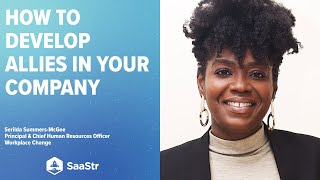
Serilda Summers McGhee, CEO of Workplace Change, defines allyship as repeated action by people with privilege to stand with marginalized groups. Real allyship means fixing systems like inaccessible websites and homogeneous leadership, not charity or tokenism. Start with training and culture assessments, interrupt microaggressions in the moment, and amplify marginalized voices instead of taking credit.
Questions this video answers
Serilda Summers McGhee, founder and CEO of Workplace Change (Portland, Oregon).
September 3, 2020.
1979.
Chapters
Going to hit broadcast now and mute myself. Give yourself 10 seconds and then start.
Okay. Hello everyone. My name is Serilda Summers McGhee and I'm the founder and CEO of Workplace Change, which is a human resources firm located in Portland, Oregon. What makes our firm unique and different is that we integrate and embed diversity, equity and inclusion tenants throughout all traditional human resources functions. So for folks who are not always in the human resources kind of arena, that means employee relations, labor relations, compensation, how you get paid and how much you get paid, recruitment, training and development. We just make sure that there's an equity lens on top of how those processes are administered and we make sure that diversity, equity and inclusion is at the center, center of that work. Alright, so today we're going to be talking about how do we develop allies in our companies and what does that really mean? So what does allyship really mean? That's what we're going to be exploring today. And I want to start first before we jump into that content by saying a couple things. Number one, I'm excited to be here with you today for the Sester Annual 2020 Conference. But I'm also excited to hear your feedback and your questions along the way. All right, so if I say something, you're like, serilda, I question that one, or how does this apply to my particular industry? Or how would this work in my ecosystem? Or even if you have a personal example or experience that you've, that you've had to kind of endure and you want some tools to overcome it, let me know about it. We want to hear about it. On the side here we've got Hannah. Hannah works for workplace change and she'll make her video and audio live at the end of the presentation and, and start to go through the chat feature or I'm sorry, the Q and A feature and the function to figure out what questions are out there for folks. Okay, so make sure you jump into some of the questions along the way. There's no question that's too hard. There's no question that's too simple. I've been in this game for a long time, so I'm excited to hear something new and I doubt that I'm gonna hear very much new because again, people are pretty, pretty consistent and the challenges that you've experienced, others have experienced and I've likely helped to coach them through it at some point in time and my career. So again, we're talking about allyship in the company. We're talking about how to move the dial and really establish allyship in your work environments to root, to like to start the discussion out. I want for us to think about this statement here. All right. This is going to center to ground our conversation moving forward. And I'm actually going to come back and forth into this statement a few times throughout our conversation today. And I do hope it's a conversation. Systems will change when those benefited by them oftentimes at the expense of others, repeatedly stand up. That's what allyship is. Allyship is that repeatedly stand up piece. Right? And the part that really gets people off their square is when we say you benefit at the expense of others. Because some folks are like, no one's being sacrificed for my benefit. Like, I earned this. I worked hard for this. You absolutely did. But there are some other folks who did not get those opportunities along the way and didn't get an opportunity to earn it and work hard for it. Right. We're going to talk about that today. We're going to give a variety of examples and illustrations of how this really works, how allyship works, and why it's important. I believe you can only be an ally if you become aware to aware of the inconsistencies and open your mind and your heart to understand the systems that can be harmful to others based on prejudices, based on implicit biases, based on ignorances. You have to open your mind to these things in order for you to be a true ally. All right, so what is an ally? Let's talk about it and then I'm gonna give you a lot of examples. And this is where I hope you really do jump into that Q and A feature. What is an ally? An ally is a person of privilege. And by the way, we all have privileges, right? If you're able bodied, if you've got vision, if you can hear, if you can, you know, you got, you know, two legs to walk on. If you've got, you know, a working, solid heart. These are privileges that not everyone is afforded. Right? I know we've heard about this before. So an ally is a person of privilege who consistently acts in solidarity with others in a marginalized group to seek an end to oppression and promote equality. Allyship is continuously exploring and reexamining privilege and seeking changes through actions and words. It's the action component. Right? Let's just give a few examples. Right. What if there's a situation in your workplace and you become aware that there are pieces or portions of your website that are not accessible to people who are blind or visually impaired? Right. Sometimes PDFs, if you don't like, do them properly, they can't be read by the software that supports folks with vision impairments and who are blind. What if you become aware of that? What do you do with that information? I can't tell you the number of folks who are aware that their websites are not accessible to people who are blind and they don't do anything about it. Well, that's not being a true ally. What about folks who. Some people in their organizations, they do focus groups or they're in government and so they have to engage with the community or they do press conferences or they, you know, they have to communicate with different stakeholders pretty consistently. Well, is there someone who's there to provide sign language to folks who can't hear? Do you even invite folks from hearing impaired or deaf communities to participate in those environments? Do they not need your services? Do they not need your resources?
Right.
Allyship is recognizing when those things are occurring and speaking up to do something about it. How about gender neutral bathrooms? Folks who are non binary, folks who are trans and they just want to be able to go to a bathroom in peace and be comfortable and feel safe. Are you aware of that? Does it apply to you? And see, with allyship work, it doesn't. You know, you are privileged. You are benefiting from a system because it was designed for you. It was designed for folks like yourself. But what about those who identify differently? What about those who have challenges that are different from your challenges? We can do the same thing about black executives and board members. People who are on executive teams and the entire executive team is racially homogenous. The entire board is racially homogeneous. Why in today's age should there be any team at all that is racially homogeneous or gender homogenous? Why? Right. How important of it? How important to you is it? And then I just want to use another very subtle, you know, kind of microaggression y situation where, you know, maybe you're at a. There's a particular meeting that occurs and there are some particular players at that meeting and there are folks who are around the table and every time they speak, they get interrupted. Every time they, they have an opportunity to talk, they are talked over consistently. And it cuts down gender lines or it cuts down racial lines. When we become aware of those trends, what do we do? Right. The what do we do piece is the allyship. That's where you identify. That's where you will either activate as an ally or you will be a bystander and just a witness of things that are not fair, that are Inconsistent. That is what ally is. The list goes on and on. I just gave you a few illustrations, but there are millions of illustrations out there. So what's the value of being an ally? One of the outcomes of allyship in the workplace. Well, number one, it promotes civil rights and equality, both of which people will constantly say, I am in support of civil rights and equality. People have an affair, shake at things. Okay, well, allies help to make sure they promote and foster that feeling. It challenges prejudices and discriminations, and it also challenges systems. Right. It disrupts allies, disrupt the status quo. The status quo where certain groups always benefit and other groups consistently don't benefit. It interrupts that. It includes those who are underrepresented or marginalized. Right. They get a voice. Those who have been historically voiceless, they get a voice, and they get access to a table to share their voice and their perspective, to hopefully affect and enact change. And then you can reach people who don't agree. So I have access to rooms that many of you will not have access to, and you have access to rooms that I may never have access to. But when you're in those rooms, how will you show up? What will you say? What will you say when something ignorant happens? Will you just go along to get along? Or will you say, uh, gang, that's not cool. What will you do? It also can, and I have to put this, you know, in here. Although it's not the primary right, it improves service delivery and products, which means that it impacts your bottom line. Well, why do I put this in there? Because there's a. We're talking about businesses here, right? There's a value to it, but it's not number one. It's not the number one bullet. Six months ago, it would have to have been the number one bullet, because six months ago was not okay to. People would say, business owners would say, dominant culture. Folks would say, why is this important to me? Why should I focus on this? This is expensive. This takes time. I just want to find the most qualified person. I just want to do da, da, da, da, da. And then you would have to basically say, this can help you in your pocketbook. And folks are like, okay, this is going to help me personally in my pocketbook, my bottom line, then maybe I'll sign up for it. Well, I think gone are the days where that, that, that line, you know, folks can get away with that line publicly. They have to kind of go underground with that line nowadays. And then the final one is that it provides a healthy and positive work environment. I Wish I could see you. Because I would ask you who in here has ever worked in a toxic work environment? I would ask you that, right? And I would say most people would raise their hands, of course not for the company you currently work for. I'm sure everything and that company is copacetic. Things are great at that company. But at some point in time you have likely worked in a business environment and if you're too, you know, either you've been blessed and highly favored to not have experienced it, or you're too early in your career to have had a, you know, couple rounds of dating different corporations to really have to have that experience. But most of us have had that experience and we know that it has a pretty significant and detrimental impact to not only our mental health and our and well being, but also it can have a physical impact. It can impact our skin, it can impact our mood, it can impact how we show up in the house, it can impact how we parent. It can impact so many things, right? So many things. I was speaking with, I do work in the hospital industry. I was speaking with the gastrologist and I asked him, have you ever seen the physical manifestation of a stress environment on people? He was like, oh my gosh, it's the number one thing that happens to people that leads to us having to go in and do gastric things to them. I don't know what the things are. I don't fancy myself a doctor. But he had seen on numerous occasions the physical manifestation of these psychological challenges that people experience in the workplace. So when you have allyship opportunities in the workplace that can promote and move the dial on establishing a truly inclusive and inviting environment, these are some of the outcomes you get. These are some of the benefits, which is exciting, right? If you are excited about these benefits, I would ask you to ask yourself, why are you excited? Because the why behind your excitement is arguably just as important as the excitement itself. Your motivations guide your commitment and approach. Become aware of the strengths and limitations of your reasons for diversifying and developing excellence allies in your organization. This is an important step that a lot of people, a lot of people miss, right? A lot of people get these, you know, they have their awakening. A lot of folks are having an awakening, you know, because of the civil unrest and you know, the media coverage about, you know, just the unfairnesses and the inequities that exist in the world and in America and in the workplace and in all these systems. Folks are getting like super woke out there. Great, great. I love it. I'm Excited by it. I am hopeful as a result of it. But let's also explore what is motivating you to get to that place where you're like, I am ready to accept more diversity, equity and inclusion. I am ready to accept conversations around why diversity, equity and inclusion are important to my company, to me, to other human beings. I am ready to accept that there's a why behind it. And I'm not here to judge the why. I want to be very clear about that. The purpose of this exchange right now is not to say, shame on you for having that reason why you're interested in having an equitable and fair work environment. No, no, that's not what's happening here, but the why. Your motivations can guide your commitment and your approach. Unintended consequences. Let's talk about it. So maybe some of the reasons why you are motivated to help develop allies in your organization are. Again, these are just a few examples, and I'm interested in others. Jump into the Q and A. Right. Again, I just want to remind you there's something I'm saying here that you. You want to wrestle with. Bring it to the Q and A. Hannah's going to be joining us here in about. In about, you know, 12, 13 minutes. So what's motivating you to develop allies in your workplace? What's motivating you and compelling you to be a more diverse, inclusive and equitable environment? Possible reasons. Right? Number one, to make your company more competitive. Great. You believe diversity, equity and inclusion is going to impact your bottom line. I've seen this a thousand times. I have most certainly seen this a thousand times. I'll give you some examples of where I've seen it. But, you know, it's going to make your company more competitive. Great. No problem. Maybe you want to create more innovative and creative staff. Right? You want a staff that is more creative. You want a staff that is more, you know, nimble and responsive to current events, to client, customer demands. Perhaps maybe you're responding to white guilt. Maybe you are feeling guilty by some of the things you're seeing in the media. Maybe you read a book that made you say, like, oh, my gosh, I think that maybe I have been complicit in some of these designs. Maybe those things happen. Maybe it's, you know, the right thing to do. You just feel like it's the right thing to do, which can also be charity.
Right?
Maybe it's like, I want to help. I want to help move the dialogue. I want to help make this no longer be the Case, I want to do my part. That's fine too. Again, no judgment on the why. I'm not even judging guilty white folks. That's not what I'm doing here. That is not what this is. I'm just saying let's be aware of the why. Take a moment and reflect and be introspective about your why. Maybe it's a mandate from your supervisors. Maybe they're like, look, we need to do this because, you know, they've gotten woke up and so now they're like, hey, I want this. I want this. Everybody to change how we've been doing certain things. That's fine. Maybe you want to better serve customers. You have a brand new demographic of customers you're trying to appeal to, and so therefore, you're trying to establish a work environment that, that fill in the blank. And there are probably others out there as well, possible reasons why. Okay, here's the reason why. You need to be aware of the why. When you become aware of the why, you can avoid some of the unintended consequences behind your why that are implicit that you're not even aware really, truly exists, and that can impact people's lives. All right, so if you're looking for a competitive edge, here's some of the negative outcomes that can come as a result of you saying, I want a competitive edge. And therefore I'm trying to get more diversity in the organization. I want more allies to help us create this more diverse environment. Great. Well, if that's what's fueling you, it may tempt you to only allow allow minorities, historically underrepresented folks to hold certain positions, thus limiting their professional growth. Now let me show you some of the. Some of the places I've seen this, right? So when Rihanna made. I'm gonna make a super current event. I'm gonna go back about seven years. When Rihanna made fenty, fenty makeup, she made like 40 shades and she made them relevant for us. Like, so we didn't get all ashy. Sometimes we would get some makeup and our skin became, you know, we looked ghostly. You know, I'm a dark skinned black woman, so I would be looking like, you know, I lost all of my pizzazz and my zest when I put makeup on, it's like, okay, so what's the point of me wearing makeup? It's gonna have me looking ashy, grayed out, and like a corpse, right? So Vinny came out and she made it hot, right? And then she became nearly a billionaire overnight because she responded to a market that had been completely overlooked and over appreciated for such a long time. And we have been hungry to get relevant makeup. Well then l' Oreal and Maybelline and all the other folks are like, oh, we can do those shades too, but we need to get those scientists that she hired to come on board to help us get, you know, get some, some, some these, these products that are going to compete with her competitive edge. But what if you only allow folks to come in and get those types of scientific roles or marketing roles, but you don't allow them to move about your organization in other ways? It can feel oppressive. And I've seen it happen in health care when Affordable Care act occurred and all of a sudden people who have been uninsured or underinsured were going into the market the first time ever, most of whom were racially diverse. So they were a lot. There were a lot of black folk getting health insurance all of a sudden, A lot of Latino folks getting health insurance all of a sudden. And to a certain extent more Asian folks were as well, as, well as many other folks. But those were some swaths that were going to be highly represented in new insurance holders. So the health insurance industry all of a sudden became very interested in culturally competent care, very interested in more diverse nurses and you know, health providers or healthcare providers, medical providers, and a lot more interested in marketing to folks in Spanish, specifically with black, what is it, actors and with people who can make the marketing feel and look authentic. All of a sudden not working in hr, you know, or, you know, or working with HR firms in the healthcare industry. And I'm like, okay, there's a huge influx of racially diverse folks into the organization. Great. But then after a few years, they wanted to see like leadership roles. They wanted to come into human resources, they wanted to go into places outside of sales, and they were falling, coming up flat. They didn't need them for those positions. Right. What about guilt? If guilt is leading you to be more diverse, to establish more allies, you may lead you to tokenize, right? May lead to tokenizing highly skilled people of color, leading to exclusivity and conflict. Right? So, so, so your guilt is making you now put them on all of your images. Your is leading you to, you know, have four people and make them feel like, you know, they have to be everywhere, all the time, every committee, every board, you know, it's over saturated you. You're putting so much attention on them that the dominant community are feeling like, you know, underappreciated, disrespected, et cetera. Maybe you have a poorly planned mandate. Maybe, maybe your mandate to you must find historically underrepresented people. You must get people who are veterans, which was a huge push a few years ago. You must get people who are X, Y and Z, whatever it is. Okay, but if your managers haven't been brought along on the journey. Right. And they don't understand what allyship looks like, they don't understand what diversity, equity and inclusion looks like, they feel like it's reverse discrimination. They feel like it's disrespectful for folks to be challenging the status quo and these norms that have always existed. Yeah. That leads to a lot of conflict in the workplace. Maybe you think it's charity. It may mean that, you know, if you're moving from a position of I want to do, you know, I want to do good, I want to, I want to help. But then you put people in positions that they're not qualified for. You put people in positions that are not ready to hold those positions. A couple things can happen. Number one, there's a high likelihood they're going to crash and burn. Number two, people are going to start questioning your leadership. They're going to start saying, like, what are you thinking? You just gave this person this job. Because they are feeling the historically marginalized title. And if you want to innovate your services and your quality, it may mean you seek other perspectives when may mean you seek other perspectives when you deem them to be valuable exclusively. Right. Furthering the agenda of dominant culture. So, you know, like invitation only. You only come in to talk about this very specific, this very specific body of work. I've also seen people, you know, put on the shoulders of the black community, the Latino person that they brought on board, all the responsibility of developing a brand new client or customer base, but nobody else has that responsibility. And this is an organization that has historically not had a great deal of presence with that community. And it's exclusively on the shoulders of the historically underrepresented person to go and find all the folks, cultivate it, bring them in. And if they don't bring those folks in, they don't hit those numbers with that particular demographic, they're fired. But nobody else has that kind of burden. They can just go out there and just do their jobs naturally. Right. These are things that we need to be aware of. So how do you move the dial on diversity, equity and inclusion and foster a sense of allyship in the workplace? How do you do it? How do you do that? Well, number one, you have to elicit the support by sharing your vision. You got to get other people to be on board with you. You can't do it alone. Your leadership team has to be involved. If not, it's gonna. It's gonna sink your battleship. So if you're by yourself, basically saying, I'm gonna move the dial. No, you got to go to the folks who are the owners and the maintainers of these systems and get them to buy into these concepts. And if you are the owner and the maintainer of the system, you cannot just unilaterally say, let there be light. And all of a sudden, everything changes. You've got other stakeholders in the ecosystem. And I tell folks this all the time when I'm advising them on HR matters. If your middle managers and your supervisors are not on board with your initiatives, they're gonna sink your battleship. They are not. They're going to actively. Pardon me. They're going to actively push against your initiative. And you're like, why are we moving the dial on this? Well, that's because they never bought into it from the beginning. So they're just. They're just going along and get along, but they're not really moving the dial in the envelope. And then you must complete the pre work with stakeholders. Right. And that pre work with stakeholders can look like facilitated discussions with an actual professional facilitator to help them understand and go along in their journey. Everybody's on this continuum of understanding. People are at different places and spaces in their lives on their journeys. So bring people in to help educate and help to help people along in their journey. You can do trainings and workshops where people are actually wrestling with topics and concepts. I'm excited to be here today because I know that I'm at least touching, not physically touching. I'm in hr. Like, that's not appropriate, but I am connecting with someone having an aha moment right now, like, this is the journey. Bring experts in who can help move the dial on these things. All right. And again, because I want to help you in your journey. If I'm saying something to you where you know, where you're trying to make sense of it and it's not quite jump into the Q and A, I want to hear from you. I see that there are a couple questions in there now, but we're getting close to the end, so I want to make sure we definitely have time to respond to your Q and A and then create a work plan of how to move it forward, like how to cascade this environment of allyship, this environment of diversity, equity Inclusion. It's really important to come up with a plan and then work the plan. It's like, story of my life. Make the plan work the plan. It always works sometimes. All right. Build a coalition of allies in your organization. Develop allies by promoting knowledge, aligning purpose and driving action. Let's go deeper into that. Right. Practicing allyship by becoming knowledgeable about the systems. You have to understand these systems. I had a conversation with. I don't even remember which the group is. There are a lot of trainings that are going on right now, but I asked them if they knew the history of why the bar was created in America in the 1800s. The bar was created in the 1800s because after HBCUs, historically black colleges and universities were accredited and recognized in the US which took a long time to establish Howard university in around 1863, created a law school and started and produced its first six attorneys in D.C. about four years later. Four or so years later. And before the bar was established, you could just become a poly, get your poli sci degree and then go and practice law. Right. So about seven years after the first six attorneys were established and accredited, like got out there and started practicing attorney, and they were black and they were supporting black folks with the legal system. That's when Massachusetts said, yo, it's too many people. Too many black folks are getting. Literally too many black folks are getting clockeries. It's going to erode and corrupt our legal system. So why don't we establish a bar? Okay, great. Well, the bar was essay based. The bar was essay based and highly selective. And they determined even though folks were getting their law, you know, education and took all their tests and were prepared to become lawyers, they couldn't become lawyers because there was a. There was a gatekeeper there who was basically saying, I pick you, I don't pick you up. Then it passed throughout the rest of the United States to pass the bar. It was essay based and highly subjective until 1979. 1979, less than 40 or about 40 years ago, 41 years ago, 41 years ago, it became consistent and administered what you can, you know, circle the boxes. And there were some very established and consistent bodies of information you should know. You have to know these systems and understand the origins because it impacts the way that they currently are utilized today. And there are a million systems that were constructed somewhere at some place. What's the why behind it? Was it to systematically keep certain folks out? You should know this stuff, become knowledgeable, understand the purpose, understand the why behind why you're being an ally, right? Become knowledgeable about some root causes. Do your work, understand the reason why you are drawn by it. Because there can be some unintended consequences and Lord knows I've seen them. And then get to action, get to work, right? So let's, let's even, let's go even deeper into this allyship strategy and let's talk about, like, what the action looks like, right? Each of these actions can happen one on one in daily moments with individuals or larger events. Like, just be smart about how you start to engage with your allyship supports and efforts. So number one, one of the things you should do is when you see something, when you see it, say it instead of being there afterwards. I've seen so many people come and pick up the pieces afterwards. Oh my gosh, I saw what happened to you. I'm so sorry that happened to you. That wasn't fair. Well, you witnessed it happening. While it was happening, you were silent, which means that you were completely in support of it. I mean, if you're silent about it, that means that you are complicitly in support of what is occurring. And now after the fact, you want to help pick up the pieces. How about not break me apart to begin with, right? Lord knows we've seen these things happen. We've likely been at different times. I know I have. I've been that person. Normalize a culture where interrupting is not okay, right? Where interrupting is not okay. Allow someone to finish their statement. Put in some time parameters around it if you need to. Sometimes people can be talkative, sometimes they can be, you know, they're saying things that are absolutely pointless, not value added, right? And then you can pull them to the side after the fact and give them that feedback. But when you just swat them away and make them not feel great about themselves, it's. It's not okay. Be an active bystander and intervene. I was in a meeting. This is when I was still on the inside, right? I'm thankful to be on the outside now. But when I was still on the inside, I met, I was, I went to like my first month in, my first month on a new job. I was on the executive team. The president's there, all the execs are around the table, and there's one particular person who. They're two people. Like, I don't know what the dynamics are at all. I'm HR though, right? So my responsibility is to kind of be the conscience of an organization and to establish like, what is the culture? How will we treat each other here? And I take that responsibility very seriously. So there are two people who are talking. One is talking. And the cfo, who is a woman, she basically says something that is just rude. Like. Like, not even subtly rude. It was like, this is the most ridiculous thing I've ever seen. And why would you even. Da, da, da, da, da, da. So I'm sitting there like, clutches, pearls. Where do we do that at? Right? Like, why are we talking to each other this way? So after a couple moments of berating, or from the CFO berating this person and really shutting them down. It's nine of us in a room. Nobody's saying anything. And I'm brand new, and I'm the only black person there. I'm like, ah, what am I gonna do? So I say, hey, gang, I just want to just, you know, I'm new here, right? You can use that for a little while. I'm new here. I just want to ask. I've noticed that, like, there were some statements that were made that were pretty loaded. You know, we called a person ridiculous. We called somebody stupid. We called somebody. And, you know, I'm learning your culture. I'm learning the norms. I can play in that game too. We can just call each other stupid and say very mean things to one another. Or can you just point me in the right direction of, like, if that's not okay, let's talk about it, and if it is okay, you know, just. Just let me know. Like, that's just how we do it here. So that when I do it, nobody can say I'm being aggressive. Let's not do that, right? And then everybody jumped in, was like, no, no, no, it's not okay. It's not okay. Now, the CFO hated me until the day she left, which was like, 60 days later. But because I am HR, but she hated me for. For that entire 60 days of, like, I can't believe she would say such a thing. I can't believe you walking around calling people dumb. What are we doing? What are we doing, gang? I stood up in that moment mostly because I don't want it to happen to me. You know what I'm saying? I don't want it to happen to me. So notice and speak up about underrepresentation. If we see that there's a whole lot of sameness happening right now and we're at the table, then that's a table that we have a voice at. Let's speak up and talk about who's missing from this conversation. Champion the ideas of others, right? And don't own them. Don't own the ideas as if they're your own. Please don't design policy and decision making frameworks. Right? Or, I'm sorry, redesign policy and decision making frameworks. Because some of these policies, when we ask why was it created and for whom was it designed, we begin to see that they actually were not designed in a very inclusive manner. And that's something that we have to be be aware of. Okay, so we're gonna go into our last two slides, which are the do's and don'ts of allyship. Let's talk about it. Let's have a little bit of fun with it.
All right?
So, allyship. Oh, press the button. Got it. Allyship dues number one. Do learn the history of the struggle in which you are participating. Do learn about the history of the struggle in which you are participating. Right. Learn about it. No one's responsible. You want to be an ally. Your job, the way you become an ally is not just by burdening people who are historically marginalized to teach you. It's about going out there and doing your research and investigating what is going on here. Do acknowledge how you participate in oppressive systems.
Right.
If I'm in an environment and I know that the website doesn't, you know, it can't be read by the software that supports the visually impaired and blind, then I'm participating in an oppressive system where people can't get access to information. And I know it by the way, I can play that game all day about the systems that exist, even people in wheelchairs. And there's no off ramps off the sidewalk. They literally cannot move about the city, the county, the neighborhood, because they're not off ramps and we know it. Again, I won't do that all day, but I could do it all day. Do be aware of your implicit biases. Like, how am I aware of my implicit bias? Here's how. Ask yourself, why are you having this thought in this moment? Like if you're in an interview, for instance, and you start asking follow up questions like, I just think that there may be something there. Based on what? Why do you think there may be something there? Could it be an implicit bias? Likely. Likely. You have to ask yourself why you're doing or thinking some of the things that you're doing and thinking. Do amplify the voices. Do amplify the voices of those without your privilege. Right. If you've got access to a table, don't take over their voices. Right. For your own, but to bring the perspective in and then invite them into a discussion so they can speak for themselves. Do figure out how to change the oppressive systems that exist, right? Figure out how to change these systems. These systems are owned and operated by you. I remember I was talking to a procurement department. So if you work in government, there's a procurement department where they administer the funds that they get from the contracts from, you know, vendors out there. And they were trying to get more diverse vendors at this particular organization to provide services, culturally competent services to a community that they were trying to connect with. And they were taking like six, seven months to release the funds. So these nonprofits had staffed up their workforce, right? And then it was taking six months in order for them, for the. For the funds to drop. But they had to cover the payroll. All that time they were going out of business. So I've always been involved with the community. So they reach out to me. I'm hr, right? They reach out to me and they're like, hey, we need some help. And I'm like, I know some people. I will talk to some people. I mean, I don't know procurement. I go and I talk to the procurement team, and they say this to me. I'll be brief. They say this to me. They say, yeah, no, our system is super slow. Takes forever for people to get paid. So I ask, who. Who's in charge of the system? Like, who operates this system? They're like, what do we do? Well, who could change the system? Like, who should I talk to? Who could change the system? Well, technically, our team. You see where I'm going with this? We know that these systems are not fair, and yet we just go along to get along because we've always done it this way. We've got to do better. And then the last one is, do be open to listening. Listening and not being defensive. Listening and not being too proud to acknowledge that there are some areas where you could. You could likely do better or be better or make some improvements, right? That's important. And then allyship don'ts, right? Don't expect to be taught or shown. That's nobody's responsibility. Your responsibility is to go and figure it out, right? Do some research, take some classes. Don't strive to be viewed as the best ally, Right? It's not a competition. Just. Just be a good. Just be a good ally. Just. Just do the work. It's important to highlight. Don't behave as though you know best. That's paternalistic, right? This is. This is what the oppressive got to do in order to. Da, da, da, da, da. You I mean, really, have you ever been in these people's shoes? Why don't you just allow them to tell you what would help them be better and do better and be different? Don't take credit for the contributions of those who are marginalized.
Right?
We've seen it happen. Take only the things. Take credit only for the things that you have, you know, created and that you have, you know, really put a lot of brain power into. And even if you are at a table and you can represent somebody else's work, give them the credit for that work, gang. It's so simple. It's like, so simple that it's evasive, elusive for many people. Don't assume that every member of a marginalized group feels oppressed, man. People aren't monolithic. Every person in a wheelchair is not expressing, is not experiencing life the same way. Every black person is not experiencing life the same way. Every Latino person is not experiencing life the same way. Just because you've got one black friend doesn't mean that, you know, you can speak on behalf of all the black community. Like, it's stuff like that that people continually, constantly get. They mess up for. Like, that's not allyship. And don't make the efforts about you. I was on a call with, like, a parent group community, something that I couldn't get my husband to do, so I got caught in it. And this lady says in the thing in the conference group that. And by the way, we were the only black family in the group. And she said something like, you know, don't call people freshmen and seniors and juniors anymore. That's oppressive. So I'm sitting here like, I actually do this work. I'm googling. I'm even Wikipediaing, like, where is this coming from? You can't call somebody a senior anymore. Like, is this. Is that a thing? People will literally take this space of being an ally as a way to dominate on top of other people, right? Like, oh, I know something that other people are comfortable with, even if you don't even know anything. And then they weaponize it in a way to just be like, total domination, not cool. Don't make the effort about yourself. That's not allyship. That's something else. All right, so those are the. You know, that's our general overarching training. I'm going to have Hannah jump on and make sure that she can go through the chat and see what's in there so we can have a brief conversation. We've got about, you know, 10 minutes. Ish. And if something is on your mind. Please do jump into the Q and A. Let's have the conversation. I'm excited for it. So, Hannah, what do we have?
Hey everyone. So our first thing that came up, someone said that they are in a small industry and want to share the realities of sexism and racism that they've experienced and seen with other employees that they've been with or other companies they've been with. But sadly, they still need their relationships with those companies, especially within their industry and their current role. Do you have suggestions for navigating this? They're thinking about speaking to women and people of color in the industry individually as a way to start. But they, they would love to share it with others as, you know, like a wording.
And are they, I mean, so I'm going to ask you a follow up that you may, you may be able to answer. You may not be able to answer. Hannah. Yeah, they work for a company and they provide services to other companies that they feel are engaging in sexism and racism or their company, their personal company that they work for, that they're part of the culture that company is engaging in sexism and racism.
It looks like it's companies that they've worked with in the past and other employers that they've worked with in the past. But in their current role, they still need those relationships to succeed.
Right on. Right. I mean, so I would tell anybody, I tell people this pretty consistently. Proceed with caution. Right. Understand that there are infractions that happened in the past that informed you, you learned from, et cetera. If they're in the past, you can proceed to make an impact and an influence in your current ecosystem.
Right.
To learn from like what the signs were, what the impacts were, and then say, I'm now in this particular ecosystem, I can impact and effect change where I am and just take a proactive, forward, progressive approach. I definitely don't recommend unless it's with a friend who's considering going to a company that you formerly were at and you're like, oh, I don't recommend you doing that. But actually just talking about disparagingly about a company that was you formerly worked with doesn't look good for you. And as an HR person who does a great deal of executive head hunting and recruiting, that can backfire on you very quickly. So what I would say is focus on the future, focus on being a good ally in your current work environment and ecosystem so that you can start to affect change there that can probably have a lasting impact because you're present and you're able to sustain it. All right, Hannah, what else we got?
Awesome. The next comment we got that came through was talking about, you know, awareness around motivations. And this person said, this is awesome. And they want to know what are some of the best first steps that executives and managers can take to be allies in a largely broken system. And that unfortunately, software is lacking in diversity and all kinds of. And diversity of all kinds. And so, you know, what are the first steps that they can take?
Well, I get that question a lot from a lot of different clients and prospective clients, like, where do we begin? And I think the, you know, one of the. There are two different places that I've seen as a best practice to start from, and one is with understanding how people are currently experiencing your ecosystem through a culture assessment, more than a survey, but like either focus groups or one on one interviews to hear in a confidential environment how people are experiencing your work culture. I tell folks this all the time. People have a personal relationship with your work environment. Every single person, they have like a girlfriend, a personal relationship with your work environment. And so you have to understand how they are experiencing that relationship. And then you can start to make tweaks for the current folks that will only make it better for people, the future folks to come. If it's already currently broken. And then you try to bring more diversity inside your organization, whether it's gender diversity or racial diversity or ability diversity, and they have to become immersed in a broken system. It only exacerbates the broken system. Right. So start by understanding what about your system is working for people and what about your system isn't working. That's one area you can begin in. The second area where you can begin is through training. You have to let people know what you want them to know inside your company. Right. We want you to be aware of, you know, non binary. And you know what, that what's going on with the LGBTQ community, what's going on with the black community, and the fact that there's a huge debate going on right now about bipoc. Huge debate. Not a big BIPOC supporter. I woke up one day I was black, next day I was bipoc. I'm like, nobody asked me. And so we're really trying to figure out what the root of this whole BIPOC concept is from. So just, you know, teaching people, educating people what you want them to know and understanding the terminology and the language to you so that people feel comfortable engaging in conversations instead of just shutting down. Those are the two starting points that I Would that I would recommend. All right, Hannah.
All right, our next Q and A that we got is how do you differentiate and educate on performative allyships versus meaningful allayship?
So good. Who said that? Is their name there?
Excuse me? If I pronounce your name wrong, I think it's Sanjaya. Yeah.
I love you, person who made that question. Sanjaya, I love you. If I'm saying your name wrong, I apologize for that. But there's a whole lot of performative allyship going on out there. And here's the thing. The way that the primary way you can identify what performative allyship is is a combative, right? They're like, they want to know everything. If you ask any follow up questions, they're like super defensive very quickly. That's performative. Like, you don't, you don't really want to have a discussion. You don't really want to bring people along. You don't really want to lend a voice to the voiceless and help make systems better. You really want to, you know, dominate through, you know, something, information that you feel nobody else knows and that you're. It makes you more powerful as a result of it. So that's one telltale sign when people are super defensive. Another telltale sign is when folks, you know, aren't like, they're allying. They're being an ally for people from historically represented groups, but they never bring those people forward. They never diversify on their teams. They never, you know, are trying to bring in contractors who are historically underrepresented. They never do anything that's really outcomes oriented. But they talk all the time. Nobody's got time for that. So that's just a couple, couple of illustrations. I can go on and on about performative allyship. Really frustrating. What else we got, Hannah?
All right, we have two more things. The first is, do you have any recommendations on programs or tactics to employ as a company to foster allies?
Well, program, like no specific program, right? Like, I'm not here to say like, oh, this one particular program is, is better than other programs. I wouldn't do that. But what I would do is say, you know, the best ally is informed. The best ally is educated. Not just passionate because they don't really know what they're passionate about. They don't really have the language to be able to articulate the why behind something changing. So they're super impassioned. And then they go and they say, you shouldn't do this. And then somebody says, well, why? And they're like, because it's bad. Not helpful. Right. Like, nobody, nobody's gonna buy that. They're not gonna change just because unless you're very, very powerful in the organization. Even so, if you cannot justify it, people will performatively change. Right. But not actually actively change. And so what I would say the number one way to become a really strong ally is to get educated. That's why that box of knowledgeable was number one. Right. It's so important. And then you have one more question, and we have three more minutes.
Yeah. The last one that I had come through, you kind of touched on with your last answer, which is, what is one simple thing that I can do today to develop allies in my company?
One simple thing you can do today to develop allies in your company is number one, bring training into your company. And I'm not caping for trainers. We are a trainer. Right. Like, this is something that we definitely do. But you can bring a. I don't know where you are in the country or in the world. But training is so important because training at least gives everyone a level understanding and terminology to use. But then, number two, it allows you to see who wants to go deeper in their understanding and do better and, like, who wants to, like, really activate on the information that they have understood and then connect it or the information they've newly learned and then connect it to previous information that they had. So that's critically important. So, Hannah, thank you so much for jumping in to the Q and A gang. I want to thank you for putting questions in the Q and A. I was very nervous that we wouldn't get Q and A. And I want to also invite you all to connect with me on LinkedIn. I love to stay in contact with you, and you should all try to connect with each other as well. That's a great professional platform, and that's really important for us to continue to kind of build momentum behind being strong allies and being knowledgeable about what's going on. Thank you for your time. I'm Serilda Summers McGee, and it's been my pleasure.
Thank you, Syrilda, and thank you, Hannah, for fielding those questions. And thank you to everyone that submitted those questions. Those were great. As a reminder, this session will be available on demand, and we will see you all tomorrow.










