How Strategic Partnerships Fuel Growth with HubSpot VP, Corporate and Business Dev and Vidyard CTO
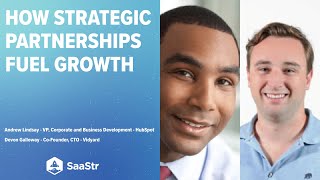
A recorded discussion where Andrew Lindsay (VP, Corporate & Business Development, HubSpot) and Devin Galloway (co-founder & CTO, Vidyard) explain why and how strategic partnerships drive growth. They contrast partnering with building or acquiring, give tactical steps to create and operationalize partnerships (stakeholder alignment, partner selection, organizational mapping, detailed MOUs with reporting and contingencies, and post-signing execution), and present the HubSpot–Vidyard "HubSpot Video" case (core video features free to ~80% of customers; Vidyard monetizes the top ~20%). Andrew cites market examples and CAC trends to motivate partnerships. The session ends with audience Q&A on org-mapping and stakeholder buy-in.
Chapters
Good afternoon, everyone. My name is Andrew Lindsay. I am the vice president of corporate and business development at HubSpot and really excited to be with you all here today. This afternoon, Pacific Time, I'm in San Francisco. I'm joined. I'm really honored to be joined by Devin Galloway, a good friend of mine and co founder and CTO of Vidyard this afternoon. Excited to share with you our thoughts about how do you make partnerships successful? How do you drive growth for your business through strategic partnerships, something that we spend a lot of time thinking about, something that we've made real between our two businesses. So again, I lead corporate and business development at HubSpot, so that includes all of our strategic partnerships. And really it's been a key part of the growth for HubSpot as a company. Three things we're going to cover with you today. One, broadly, how to think about strategic partnerships as a path to growing better for your business. Two, we've enumerated five steps for how to build strategic partnerships very tactically. And then three, we're going to walk through and Devin will share a little behind the scenes of our partnership between our two companies. And then we're going to save a little bit of time at the end for your questions. So first, why do strategic partnerships. Well, I. At its core, strategic partnerships are about growing. And at HubSpot, we think a lot about growing better. We're a growth platform focusing on organizations of all sizes helping grow through marketing, through sales, through service. And we spend a lot of time thinking about what does it take for businesses to grow in this economy, to grow in this market, both broadly and especially in the last several months. And, and we keep coming back to. It's not easy, right? It's never been easy to grow. But in some ways there's a whole series of different challenges that keep coming up for businesses. As you're trying to grow your customer relationships, as you're trying to grow your product, as you're trying to grow your brand. And that kind of growth is very challenging. Customer acquisition growth. You're trying to bring in new customers and make your company better known. CAC has gone up 50% in the last five years. It's more challenging in many ways than ever. What worked in the past doesn't work today. And that's why strategic partnerships should be a key part of your toolkit as you think about growing your business. And when we look at strategic partnerships, what makes them really key is that they are about contributing value to a partner and contributing value to your customers by Working with another company, it's that quintessential one plus one equals three. We've made it work at HubSpot. But there's countless examples in the broader market around strategic partnerships that have proven to be successful. Just last month, Google and ADT announced a partnership for ADT to be distributing Google nest products. Overnight, ADT's star share price zoomed 65% and he went on to grow 100%. It grew from a $6 billion company to a $12 billion company. On the announcement of that strategic partnership, the street recognized that there's a huge opportunity by bringing those two companies together, their competitive advantages together. Another interesting example, a year ago, Avaya and RingCentral partnered for bringing RingCentral into Avaya as their exclusive UCAAS system. Analysts recognized that there's a huge opportunity there and they thought that the share price should grow 50%. The share price grew 54% in the next four months. It's a sign that there's value being created by bringing these two companies together in some really interesting ways. So there's a huge value there. How do you go do it, why do you do it and how do you do it? The first step is figuring out, do you need to partner as you're looking through growing in any way. You could grow by building more products, by going to market on your own. You could grow by acquiring, or you can grow by partnering. And that partner should be one that you constantly think about. But think about it as part of your holistic set of opportunities and your holistic strategy. Paul Graham, who many of you know, founder of Y Combinator and Hacker News, said many startups, business development is a distraction. And I completely agree with that. Most BD opportunities that you think about that come across your table that somebody recommends aren't worth doing. This is an example where you're going to say no a whole lot more than you say yes, because it takes a lot of work. It takes a lot of effort to make a business development and strategic partnership work. So you have to be very clear about the rationale going into it. Recognize what those substitutes are. For HubSpot, we have about 500 plus API partners. And as Paul says here, APIs are like the self service BD. You've got 500 of those. That's 20 times the number of strategic partnerships we have because they are much easier to do than think whether or not you need to have a deep strategic relationship with the company or you can solve that same need through APIs more efficiently. And then number two, after you decide, yes, you want to do a partnership, you need to engage that internal set of participants of stakeholders across your business to be bought in as well. This is not something that just a CEO can go do. It's not something that just a BD person can go do or the salesperson. You need to have the company cross functionally bought in. A lot of the greatest partnerships require product and engineering, and those teams need to be committed to working with the partner. If you have a deep not built here syndrome inside of your business, you have to encounter that and decide whether or not it makes sense to partner and you can have that team bought on board. Sales and marketing issue brought in very early. Whether or not the story and the narrative you'd be telling to your customers makes sense with this partner. And then critically important are having the GNA functions committed as well. Finance to do the necessary modeling to make sure that the accounting works and legally spend a lot of time with your lawyers, internal or external counsel, to make sure that the terms that you set for your agreement match the expectations and match the liability that you're willing to take on. And then three, so you've got the internal parties brought in. Identify what that opportunity very specifically is. Identify what you're trying to solve with that partnership specifically and who it is you're partnering with. And so you're going to be looking at solving for your needs, but also finding that partner where you're committed and you're willing to also solve for their needs. The best partnerships are those where both parties leave feeling like they're the winner. And you're trying to identify which companies and which people inside those companies will feel like that. So you want to make sure that that company that you picked, you have a great relationship with them and you can solve for their needs as well. And then you found the company, you started identifying who the right people are. You need to build those relationships. At HubSpot, what we do is we actually map out the organizations of our key partners. Some of these are very large companies and we work with multiple teams inside of those companies. We have an organizational chart across all of the key functions we have. One for their marketing organization, one for their BD organization, one for their product organization. And as you know, they change dramatically, they change quickly, and they change frequently. And we constantly are updating them to figure out who are the key people we need to buy in to our partnerships. And so that's how we identify who the key relationships are. And you should recognize that as you're building up that initial Partnership idea and you're working with that company, it's a little different than going out and trying to drive a sale. The idea of a sale is you're trying to get to. Yes. You're trying to find that person, that decision maker inside of the company who is going to be your champion and sign the dotted line and getting committed. Partnership's a little different. A lot of what you're doing is avoiding that. No, you're looking for the. The key person who might be putting up a roadblock to your partnership, the key person in a different function. Again, you may have a champion who's in sales, but the roadblock might be in product and engineering. And you try to make sure that you don't get that. No, that person is going to veto the deal. For you, it's avoiding. No. For a lot of partnership success. And then after you got that done, you've got an mou, a memorandum of understanding. You need to get very detailed around the terms. You need to get very detailed around all the key requirements, the key elements of an agreement. I'd say if you're going to take a screenshot of one slide here that I'm sharing today, it'd be this one. I'm not going to go into all of these terms in detail, and this isn't a fully comprehensive list by any means, but you should at least be thinking about all of these considerations for most of your partnerships. What I'll call out is that reporting is an extremely important one. As you're building up this relationship and you're signing an agreement with the counterparty, how are you gonna measure success over time? What are your key metrics? What are your key goals? Share those. Be transparent with the partners so they know what you do to find a success. And then how are you going to actually measure them? What's the report card actually have that report card and share. You can actually put it in the agreement as an exhibit. And how often are you going to share notes and how often are you going to reconvene with that partner over time? Is it going to be a quarterly meeting? You do monthly meetings? Are you going to have key individuals who are identified in the agreement who are going to meet weekly? That should all be spelled out. What I always say to my team for partnerships is hope for the best, prepare for the worst, but be unsurprised by anything in between and have contingencies for almost anything in between in the agreement. So anything that comes up, you already have something to cover yourself for it. Now you've got that done. Sign the agreement. Celebrate. Right? You're good, you're happy, you have gotten to the finish line. Well, sort of. You should be celebrating. You should be happy. But the real work begins because this is now where you take that partnership from just being something on paper, being something that you have a press release about, to creating real value for your customers, real value for your ecosystem, real value for your investors. That's where the real work begins. Devin is very familiar with that. HubSpot and Vidyard have put together a partnership that has been a great, great success for us. So I'll turn it over to Devin to share a little bit more about how we make this real.
Thanks, Andrew. Good afternoon everyone. So, as Andrew said, my name is Devin Galloway. I'm the co founder and CTO of Vidyard. Vidyard is a video platform that focuses on marketing and sales professionals and partnerships have been a really key part of our growth. So I hope to tell you the story here from the other side of the table. So as the startup, we're about a 200 person company, but as a startup partnering with a larger organization like HubSpot, I hope the story here can be helpful for some of you who find yourself in the same position. And if there are questions or comments along the way, love to continue the conversation. You can find me on Twitter Evangal. So let's jump in. When we think about partnerships at Vidyard, we think about four really critical wins. Why is this a win for our partner? Why is it a win for us, for our customers and for our ecosystems? So let's jump in and talk about HubSpot Video. So the partnership Andrew mentioned is called HubSpot Video. Vidyard and HubSpot launched this about two years ago. It was basically, I think it all started with HubSpot recognizing the importance of video to their ecosystem. Vidyard had been a partner for a long time. We were one of the many API partners Andrew talked about. But the reason we ended up doing this kind of deeper strategic relationship, I think from HubSpot's perspective, were these three things. First of all, it was a much lower workload for the product and engineering team. We kind of came with an off the shelf product that they could integrate. So ideally we were able to bring something to market much quicker, a really high functionality product. We were integrating the full suite of what Vidyard offers were, as I said, a full fledged video marketing platform as opposed to the simple video hosting use case that was kind of originally considered. And then lastly, no Direct cost. We kind of approached this partnership as a let's take something to market together, but not charging one another or having a financial relationship here. So a great quick win on the HubSpot side of things. So jumping forward, why was this a win for Vidyard? I think most importantly, Andrew talked about some of those metrics around customer acquisition cost and trust. We really felt that HubSpot's customers were Vidyard's ideal customers. And if we could use this partnership to get in front of those folks, it was a win for us. And then ultimately we would look to kind of sell a premium solution to them beyond that original partnership scope. So the next obviously the most important folks in the equation here, why is this a win for our mutual customers? We felt like we could build a partnership together where 80% of the customers, the majority of HubSpot's customers, would get all the video functionality they needed for free. So I thought that was a great win. And then Vidyard would build the case and monetize that top 20% of customers who want to go further, want to do more. So kind of a good mix for both sides. And of course HubSpot could deliver a great high functionality product to their customers. Again, free for the customer and free for HubSpot. And then finally, let's talk about ecosystems. HubSpot has long been successful selling through agency solution partners, as has Vidyard. So really great win for these external companies that are implementing HubSpot Solutions and Vidyard solutions. It gave them direction on where to specialize. As Andrew mentioned, through the kind of API direction alone, we have hundreds or thousands of partners in an ecosystem versus by going a little bit deeper here, they knew where to focus. They were able to specialize on HubSpot and Vidyard and how those work together. So nice win for the ecosystem and let them go out and frankly sell a new joint solution and grow additional revenue streams. And lastly, kind of in review here, the partnership has been awesome, I think been a success for on all sides. But from a user perspective, from a videos on the platform perspective or a revenue perspective, this has really worked for us. And then finally all this stuff was pre Covid. And so in a world where everything's remote, this has really continued. So obviously great to be partners and it's driven, I think, a lot of collective growth for both of us. So I'll turn back over to Andrew for some key takeaways.
Yeah, I couldn't agree more with you, Devin. The growth has been phenomenal for us and it's been tremendous for our customers, for our ecosystem, for our partners. It's been a real win. If I were to encapsulate the three major takeaways for today, right, it's one, strategic partnerships are big growth opportunity. It's not easy, there's real challenges and it's real work to make it successful. But when it does, it can fuel tremendous growth for your business across a number of different fronts. Two, to make it work, it requires a cross functional commitment to the success of the partnership. It is not succeeding when it's done in silos. It is not successful when it's one person who is doing it solely. You have to have it across multiple different functions in your organization. And then number three is the best partnerships focus on the success of both that company, your own company and on your partner's success and the success of their customers. That's how you create real value is when you feel like everybody at the end of the day is the winner in this agreement and that that one plus one does equal three in that everyone walks away better off for the partnership. Those are the three key takeaways. I'm going to turn it over now to open it up to questions. We've flown through this pretty fast but would love to hear if there are any questions around anything that we have shared today. Let's see here. First question from Joy. How do you go about building up your client's org structure and key stakeholders? Do you ask your main contact to share it with you? Are there tools you use to do it? It's a bit of both. It's a great question, Joy. It depends on the partner, depends on the stage of the relationship. Very early when you're having initial conversations, we can't quite go and ask them, make draws of your org chart. So we just talk to people one on one and ask them who they report to, who their peers are and we start drawing it out and over time it starts to take more form as relationship becomes more well known and as the partnership matures then you can actually ask and just say like hey, this is our org chart that we have for you. Is this accurate or not? You'll be amazed. A number of times, especially with big companies we say well wow, that's really helpful. Like I haven't quite seen it that way before or that's not quite right. But I can understand why you think it is. Those are the ways that we do it. We don't rely on third party, we don't really buy org charts or buy that data we do it based on the relationship. Relationship alone. Next question. Devin, how did you approach getting buy in from the different stakeholders in HubSpot?
That's a good question. I think there are obviously differing opinions when it comes to these types of relationships. And as Andrew said, it's important to have everybody involved. We really approached it a little bit of a ground game of each stakeholder and understanding what was important to them and their part of the business. So it certainly took a lot of time just building those relationships, but I think at the end of the day, that starts the process. But to Andrew's point, once the partnership's formed, we're just getting started in the work. So having those relationships continues to pay off over time.
And I give a lot of credit to Devon and his team for doing the hard work there and speaking to members of HubSpot across the different functions to identify what each person's individual needs were. Challenges were where they saw opportunities inside of the partnership. So when I have a conversation with Devin and I can represent the needs of HubSpot, he's also often spoken to those people directly as well. And so there's a level of trust there and there's a level of confidence that what we're representing is fairly transparent and comprehensive. I know we're up on time, unfortunately. I wish we had more time to answer more of your questions. I see lots of great questions come in today. We can continue the conversation in different formats through social media. Best way for me is on LinkedIn. That's where I spend a good chunk of time. Message me directly on LinkedIn or start a chat on that. We can do it there. Devin, what's the best way for you?
Yeah, LinkedIn, Twitter, anything along those lines. Thanks everyone for your attention. It's been a pleasure.
It's been great, everyone. Thank you so much. We appreciate it. Andrew and Devin, thank you so much. As a reminder to everyone, this session will be available on demand and we will see you in the next session.










