"How the Fortune 500 is Buying AI" with @unusualventures Anthropic, Glean and Contextual AI
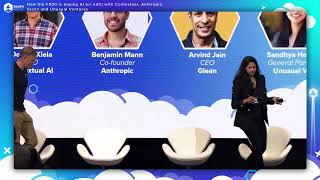
Sandhya Hegde, Ben from Anthropic, Arvind from Glean, and Dao Kila from Contextual AI discuss how Fortune 500 companies are deploying generative AI. They cover customer support automation, information discovery, and developer productivity, plus the barriers holding companies back: data governance, hallucination, and cost. Most enterprises run pilots first, then move internal before launching customer-facing tools.
Chapters
Please welcome to the stage dao kila, CEO at contextual AI benjamin man, co founder at anthropic, arvind john, CEO at glean, and sandaya hegde, general partner at unusual vc.
I read everybody's names but mine.
Thank you for the scattered applause. Much appreciated. Hello everyone. Welcome to Sasta's Enterprise AI panel. I'm Sandhya Hegde. I'm a partner at Unusual Ventures, which is an early stage fund exclusively focused on enterprise software. And one of the things I have been doing is working with startups that are trying to figure out how to sell generative AI software to some of the biggest companies in the world. So really excited about the topic and would love to kick off by having our really incredible panelists introduce themselves. You want to kick us off, Arvind?
Yeah. Hi, my name is Arvind. I'm the CEO of Gleaming Glean. Think of Glean like a. It's a search engine for work, so think of it like Google or ChatGPT, but for your business. Really excited to be here.
I'm Ben. I'm one of the co founders of Anthropic, which is an AI safety research and product company. We have partnerships with Google and Amazon to sell our models to all of you lovely people. We hope to be the safest and best models out there, so hopefully we'll have a bright future ahead of us.
Hi, I'm Dao. That's how you pronounce my name. Can you hear me? That's my mic. Yeah. All right, yeah. So Dao Kila, CEO at Contextual. I'm also an adjunct professor at Stanford. Before this I was the head of research at Hugging Face. So this new company, Contextual, is about enterprise large language models. So how do we get this technology to be really ready for enterprise deployments? We think language models are great first generation technology, but they're not quite ready. We see a lot of frustration in the market around that and we're trying to solve those problems.
Awesome. So you know what, what is really kind of the hook of this discussion, if you will. And you know, in my mind, the way I think about it says as early stage investors, we're always looking for like, what is new technology and where it in the adoption cycle in the world, right? Like, has it crossed the chasm? And while GPT has become a household acronym, there are probably over 200 million people in the world who have at least kind of signed up for some generative AI software. The reality is that some of the big companies in the world are very, very early in their adoption. Right. Perhaps, you know, Google has started rolling out generative AI. Sure, but what about Wal Mart and Procter and Gamble and UnitedHealth and JP Morgan? And so that's kind of the big discussion today is, you know, taking advantage of the incredible wealth of experience and perspective we have here on this panel to understand how are these big companies thinking about leveraging AI? Where are they in their buying cycle? What are the barriers to adoption for them? What can we learn from people who are already taking steps, making these investments? And last but not the least, you know, some predictions for where we might be in four or five years, like what would still be really difficult and what might be more achievable by then. So with that, I kind of kick off with our first big question. We'll have about 15 minutes for audience questions in the end, so please make sure you think of really tough questions to ask these guys. But we'll kick off with a really good context setting question, which is, you know, what are big companies most excited about using generative AI for? Or, you know, modern AI for? Whether that's language models or diffusion models, you know, modern speech synthesis, like, what is it that in your experience, big companies are excited to use this for?
Yeah. So as we work with enterprises, we've seen a level of excitement that I think has never been seen before. And so I would say that enterprises have two big themes. One, they want to use AI to improve the products that they sell to their customers. And second, they want to use AI to transform their business and how, you know, they work, their employees work. So some of the big use cases that we have seen are across customer support. Like, how do you actually make your agents be a lot more productive? Like have AI automate the process of resolving a case or actually bringing AI right in front of your customers so that they can get quick answers to their questions. That's one of the big use cases. But also say the use cases are actually across. Across Personas, like for sales and marketing, like helping marketers create content using AI. And for engineering, helping their developers sort of write unit tests, testing code, as well as just general code, troubleshoot issues using AI. Those are some of the big use cases that we've seen.
Yeah. Kind of building on what Arvind was saying, we've been really impressed at how even the largest companies in the world, and not just in tech like Salesforce, but, but also banks, retailers, et cetera, are moving with this technology where, for example, one large bank that we were talking to, they came to us and they said, we've talked to everybody in our company and we have 500 different use cases that we want to apply large language models to. That's really incredible. And they don't even know where to start. So working with us to say, well, what are the capabilities of these models? What can they do today that's really high quality? And what might be more of a stretch, where do you think the biggest value add for our business will be? That's been really important. And then beyond that, how can they make AI sort of the expert at their company, both in what they do as employees, as you were saying, but also an expert in what their product is so that their customers don't have to go learn about what the product is and read all their documentation, but instead the AI, they can just talk to the AI as if it was a solution architect or forward deployed engineer and be able to use the thing immediately.
Yeah. So I was saying just backstage to Ben that we probably talk to the same bank. So there's a lot of excitement everywhere. And so you can really feel it like everybody just knows that, that this technology is going to change the world. But at the same time, I think you can see in a lot of these enterprises that people aren't really sure how that's going to happen. So there's a lot of excitement, but what it's actually going to look like, I think we don't know yet. So we are trying to discover this. It's all a very experimental phase. We're doing a lot of piloting, trying to figure out where exactly is this technology going to matter the most and where is it already ready and where is it going to be ready soon? And so I think if you look at the landscape of use cases that we see right now, there are roughly three big buckets. So one is around information discovery and information synthesis. So companies like Lean, I think are doing a really good job at that. But there's this whole synthesis problem. How do you get deeper insight so not just the data that's there, but the information you can derive from that data. Then there's a lot of hierarchical summarization use cases. So how do I really turn it into something I can act on? And then there's a lot of kind of support chatbots, but just kind of chatbots in general where you have some script that you want to follow. So I would say 95% of all use cases we hear fall in one of these buckets. There's a bunch of other exciting stuff too, but I think those are really the main things. But then within those buckets, I think many companies are still trying to figure out what exactly they want to do do. So exciting times.
I'm curious when you are advising these folks on like, what are the right use cases to focus on? How do you help them understand, you know, what are the use cases that language models tackle extremely well? Like well enough that, you know, an enterprise can adopt it successfully versus what are use cases where they should, you know, probably look again in 12 months, two years as opposed to try to make it happen now and kind of, you know, find signal in the Twitter noise if you will of excitement. Would love your take on, you know, what is your personal take on, like what are the best use cases right now.
So for me, the best use case is one where you can define what success looks like.
Right?
And we see surprisingly few of those kinds of use cases actually. So it's like, oh, this technology is great, like I want to try it on my chatbot. But when we ask people, how do you define success, how are you going to measure that this thing is actually good enough for a production deployment? Very often they don't have a good answer. So that's really one of the things that we're looking for first. It's just, do you actually understand what you want?
We often help customers along to get to that stage where we say, here's what we've seen work for other people. Here's how you can construct an evaluation set where you can continuously improve. If you think about books like the Lean Startup that talk about the most important thing is to learn quickly and to reduce your iteration cycle time, that's where we're trying to push especially the large companies that have kind of let this slip out of their DNA. And so not only figuring out how do they try things and measure themselves, but also try a bunch of things. So take a portfolio approach. Try some less risky use cases like where knowledge extraction or summarization might be involved and maybe some more risky use cases like tool use, where it's using that company's tooling. Private function calling.
Yeah, and one of the things that we suggest to our customers is, I mean, if you think about use cases, you know, there are many which are actually low risk. A lot of companies have decided to like again, bucket like your use cases into internal focus. You know, where your employees are actually going to be playing with this technology and make use of it. And then the external one where you're actually directly exposing your customers to use it. So there's right now, I think like these are still very early days and so we're seeing a lot, lot, lot more focus on first building some internal use cases. So again, like, you know, thinking about customer support, like that's an example that everybody brought. Customer support has two elements. One is you can actually bring the AI right in front of your customers. And the second is that you actually only have your support agents that are actually going to be helping your customers use AI. So that's sort of one, one distinction that companies are making and, and work first on internal applications.
Makes sense. And now maybe coming to kind of the meat of the topic. What do you see as the biggest barriers to adoption in enterprise? Whether that's kind of like just at the pilot stage or for a company wide rollout. And you know, I mean there are a lot that have been brought up in the general ecosystem from you know, data governance to reliability, security, safety. But I would love if we could go kind of a few levels down and share some examples of what are the things that have held up sales conversations and product rollouts for you all where people really wanted to adopt something but got stuck. And where are they typically stuck?
Well, one thing that actually when the market is so early, everybody's confused. Like people actually have this fear of like, okay, like I'm seeing this tool right now from you and it looks good, but what if there's something else that's better than this? And so I think that sort of actually, I think holds up, I think sales for us for sure sometimes, you know, where, you know, like, you know, like customers want to do a lot of research. There are hundreds of companies building hundreds of products and they won't actually go see it. So that's just like, you know, just a basic limitations of sales process. And I think one other thing which I would also just add. So security has been big, but most of the security questions, at least in the media have focused on that. Companies are worried about having their data leave their environments and going to the model companies like Anthropic and then your proprietary knowledge actually becomes public knowledge at that point.
Being trained for the next generation, that's.
Been like the focus of worry. But there's also like a big issue internally. If you look at any enterprise, they have lots of knowledge and that knowledge is actually not available to every single person in the enterprise. Like, you know, the governance is actually a big part internally. And so when you have these, you know, like tens of different AI tools coming into the company, all of them need to work with Knowledge, your enterprise knowledge. And so if you start to just, you know, copy your enterprise knowledge from wherever you know it exists today into all these different AI tools, then you sort of lose that governance. You have no idea. Now, like, you know, is that information being used safely, like, and only being delivered to people within the enterprise that had permissions to use it. So that's actually another big concern that companies are grappling through and figuring out, you know, should they have a more centralized sort of procurement strategy for AI tools.
Yeah. To underscore something Arvind said, we find that having Bedrock Amazon's foundation model hosting program available to our customers is extremely helpful. The most sensitive customers want things like FedRAMP certification and things that take multiple years and a ton of effort to implement. And so when we can just send them there and they're like, oh, you already have everything, all the corners squared, the I's dotted and the T's crossed, that makes them much more comfortable and those conversations are much easier. But even for those conversations, it's still a question, as Dao was saying, that we need to help them figure out how do they actually use these things, where often in their earnings call, their CEO will say, oh, we need to have an AI strategy. But underneath them a lot of the departments are still thinking about, well, I have the OKRs that I had been planning from last year and I have all these maintenance and tech debt projects that I need to complete. And there's just not a lot of extra bandwidth in the organization to explore these brand new things and figuring out how it will transform their company and their products. So in our cases, for example, Notion, I think is a great example where we worked very closely with their CTO and everybody, all the way down to their engineers on the front lines to deeply integrate anthropics AI into the Notion product experience. And we think it's extremely good. But it needed a lot of dedication to make that happen. And I think a pithy way of summarizing this is a lot of people think about this new AI technology as something that's going to just come in and work from day one, but actually it turns out it's still software. And with software you need to do the work of doing the user research, iterating with all your different teams from marketing to design to your engineering. And hopefully in the future it'll get easier. But that's where we are today.
Yeah, yeah, I agree with that. I would say about this particular question, one of the big things we see is that there's basically Nothing preventing pilots. So there are lots of pilots, but then how do you move from the pilot to an actual product deployment? That's still something that we're trying to figure out kind of as a world right now. And so for me, the main things that are really preventing mainstream adoption are I think very familiar themes to many of us. So hallucination, these models that make up things, we don't really know why or how we can fix that. These models have attribution problems, so you want to be able to trace it back to something in the training data. They have compliance issues, they can't really forget things easily or you can't really update them easily. They have data privacy issues and they don't have the right cost quality trade off for many enterprise deployments. So very often they're just way too expensive to be actually useful in enterprise setting. So I think these things are all getting fixed and so I think all of us are trying to solve these problems and you can solve them in lots of different ways. And then once that happens, that's really gonna. What is it? Unleash the floodgates and then, yeah, this stuff is gonna be everywhere.
I'm curious, especially since you brought up notion as an example. So obviously a lot of the early adopters in the enterprise have been software enterprises, right? So like software companies that are now big and have some of these problems, like they do care about data privacy and reliability, but they are early adopters of all good new technology. I'm curious kind of what patterns you are seeing in terms of what are the types of companies and who amongst, who are the people in these companies who knock on your door saying, hey, I need your help getting tools like this adopted. What have been some patterns that have worked well for you in terms of enterprise wide rollouts?
Well, I think the interest in generative AI is actually, I think it's universal. And we're actually seeing companies that are still using mainframes for their technology, but they want to take that leap and go directly and embrace AI and be the number one adopters for AI mainframes.
To generative AI is a pretty big leap forward.
Exactly. Yeah. So and I think like, and I think partly like, you know, like folks are actually seeing, you know, I think, you know, digital transformation, like, you know, has, you know, like, you know, it's taken a lot of time for a lot of companies and companies, you know, that took longer, like they feel like this is the way, you know, where I don't want to be behind right then in terms of like just like who's, like for us, you know, the CIOs, we're seeing a lot of interest from them, you know, in terms of adopting generative AI. And of course, like if you think about the role of a cio, they represent like, you know, the demand coming, you know, you know, in aggregate from, you know, from the entire company and the generative, that's, that's how it is. Like salespeople want, you know, the technology marketing people want it, you know, HR folks want it, it wanted for automation. And so I think the CIO has become like the natural focal point, you know, for us at least to actually go and bring our product.
Yeah, I guess tying to the more dinosaur type companies. We're talking to some of the largest banks in the world and they're very small things, or maybe they seem small to us that are critical for them being able to use this technology effectively. And that's just doing arithmetic. And so you could, in Unix there's bc and if our language models could use a calculator program, then they would suddenly be extremely useful for all these large companies. And the fact that tool use is still hard, I think is kind of an open problem. And then also what Arvind and Dao were saying about hallucination, also very well known problems, companies like Perplexity are figuring this out of the how to make not just citation work, but also in a user experience that people can understand. Because at the end of the day you can't rely on your users to click through every single link and verify everything themselves. So we need to have some kind of deeper understanding of where is the language model confident and where is the language model not confident. And I think once we've covered those things, we'll see more early adoption from a wider range of technology companies, not just the newer ones, the Silicon Valley ones, but everywhere in the world.
Yeah, so, so for us, yeah, we're seeing the same interest I think that you two are seeing. And so there's a lot of possibilities, I think for working with interesting companies on interesting use cases. The early adopters, you tend to have very tech forward companies that are basically just ready to go, but very often they think they can do it in house. And so I think that belief is probably going to go away in the next couple of years where people realize that this stuff is a little bit more difficult than they initially thought. But, but so, so aside from that, I think one of the interesting things that we're seeing is that there's really a mandate from the CEO down where it's like we have to do something. And so to me that's exciting because it's a business opportunity. It's also kind of scary as a startup because that money is temporary and it's going to dry up. So it's like we're going to have a couple of cool pilots and demos and then at some point it doesn't work and we'll move on to the next hype train. So the kind of collaborations that you want to start, if you're an AI company, you really want to figure out like how are you going to get a real ROI for your downstream customer and not how are you going to build a cool gimmick that they can showcase to their CEO and get promoted and then disappear.
I want to actually dig into one of the dynamics you brought out, which is especially in software companies, while there's kind of universal desire to adopt the technical leadership, might want to build more in house because they are probably like way cooler projects for them to work on than most of the things on the OKRs on their roadmap. What are, how does that dynamic play out? And you know, I'm sure you have probably had to like talk to multiple stakeholders when you are doing, you know, kind of supporting a big plan for a CEO. I'm curious any, you know, any anecdotes on kind of how that dynamic plays out and where do you think actually companies should be, you know, going to hugging face and like rolling their own versus they really should be working with experts and like third party providers.
Yeah, I mean I can go first. So the, I think like you mentioned the core point there, which is AI technology is new, it's exciting and everybody wants to learn it and therefore like you know, building them, you know, building yourself is actually a big thing and I think as vendors like you should not be trying to fight against it. We don't actually. So in our case we have a search product. We also have a chatgpt like conversational assistant and we have customers who've been using our search product because they felt that that was maybe not exciting enough for them to build themselves. So they were okay with us selling that product to them.
Probably too difficult.
Yeah, maybe, maybe too difficult too. But now they actually want to go and build, build the assistant themselves. They don't want to actually use the one that we have built. So we let them use it. We have an API. Go use this API, build experiences. It's fun for you and actually it works for us. You're still using our product. So that's the strategy that we choose is that I think customers should just figure out themselves how much of the product that they should be building themselves versus using vendors for. But we see it all the time. AI is really, really exciting and internal teams want to build stuff themselves.
Yeah, I like Arvind's discussion of core competencies. Every business needs to understand where is it going and what's its core strategy and where is it trying to build things up. We talk to a lot of customers who ask us, can we scrape your models so that we can train our own and then not need you anymore? But actually they will always need us because this stuff is constantly changing. It's not static and the use cases, their customers have, the data, it's always changing. So by us being on the frontier, that's kind of where we'd like to sit. And then if we can help other companies build small models with smaller latency and lower cost, that's great. We want to work with them on that. And if, if they want to have a bake off of can their specific model do everything that our big models can do, that's fine. But usually there will be cases where small models work well and where teams can build that in house effectively. But there will also be cases where you just need that more powerful tool. And for those cases they'll come to us. So makes sense.
Yeah. So the way I think about it is the ecosystem is kind of like a pyramid basically. So at the top of the pyramid you have these frontier models. They're amazing. There's only a few of them. They're really high quality, but they're also very expensive. And then at the bottom of the pyramid you have all the open source models. You can just take them from hugging face or wherever. You can do cool stuff with them. You can solve very niche use cases. But very often that's not going to give you much of a, a competitive edge because everybody has access to the same models. So the sweet spot I think in the AI ecosystem for very interesting companies is kind of in the middle of that pyramid where you have the right trade off between the cost of serving the model and the quality that your customers expect. So that, that the middle part of the pyramid, that's where I think a lot of these next generation kind of foundational companies are going to come from. And that's where we're trying to be and I think where Glean is trying to be and Anthropic wants to be at the top of the pyramid.
I think I'll take it.
Next up is product roadmap. How have you invested in making your product? Kind of enterprise grade. Arvind, you were saying backstage. First as a startup, you build a product that does a good job, then you have to build twice as much to make it something an enterprise can buy. So I'm curious, what have been the most important investments that ensured that, you know, future like Fortune 50 company can actually adopt, you know, glean, anthropic, contextual, etc.
Yeah, well the first thing like, you know, just, you know, working on security aspects and compliance. So getting your SOC 2, you know, certification, you know, HIPAA compliance, GDP, FedRAMP, as Ben mentioned. So that's sort of like one stream of enterprise requirements which is you just need to sort of work on all these compliance matters. Then in terms of product, depending on what your product is, there are going to be a lot of demands that enterprises are going to place on you. For us, we actually ask enterprises to actually give all of their data to us so that we can make it searchable for them. And so now imagine like, you know, a large company like Nike, you know, talking to a small startup like us, which is in stealth and saying that, oh yeah, you know, I'll ship all my data to you. That's just not feasible. Like that's not an acceptable answer. So you have to sort of figure out like how you can actually work through that. So some of the things that we had to do were basically support running Glean within the customer's cloud environments so that they can have the peace of mind that no data has to leave their premises. That was one of the things. And then I think ultimately as you sort of start to gain some momentum, as you acquire some customers, then things become easier for you because now you have reference customers, you have actually other customers who have placed trust in you. So get some trust by transactivity. And so those are some of the things that we had to work on.
Yeah, I guess we talked about the Amazon and Google partnerships and a lot of companies are already on those clouds and being able to not have to go through procurement because any service just works for them is a big thing. But more than that, I think the future of these large language models is going to be just to beat the dead horse hallucination, citation, being trustworthy. And also probably something Glean is thinking about also understanding your brand voice and understanding what is your company about and how do we become sort of the uber employee that represents your brand. I think that's going to be really important. So we'll be figuring that out. We've been working with partners on making that work really well. Maybe a good example is, I guess, notion again, they. Or maybe Robin. Yeah, Robin. AI is this lawyer. Try to augment lawyers to understand legal documents. And when they write briefings and case reports, people need to be able to understand the outputs and trust that they're correct. So, yeah, working closely, I think that's the answer.
Yeah, so I think there's an obvious answer around sort of like SOC2 compliance and all that kind of stuff, or working with partners who can do all of that for you. Because as a company, often you're not fully certified for everything quite yet. But I think for me personally and for contextual AI, how we're approaching the problem is going back to the drawing board, essentially. So we're saying language models are great. Ideas like vector databases are great. All of this stuff is definitely very promising technology. But because it's not quite ready yet, we need to fix all of these problems still. So we need to fix hallucination and citation and attribution and all of these different things. And one way to fix them is to go back to the drawing board and think about what does the language model really look like if you want to satisfy these enterprise requirements. So if you want to have something that doesn't hallucinate and that has attribution, what does that look like? And so we think that that's not what we now call a language model. So it's not one big parametric monster. It's something a bit more elegant that has the retrieval kind of built in. It's a retrieval augmented language model and is trained end to end so that it can rely on information that's external. And so that means that it will hallucinate less, it will have attribution, it will stay up to date, it will not have compliance issues. You will have a very clean separation between the data and the model plane. So I think making language models truly enterprise grade might require having a different kind of language model in the first place.
I wanted to bring up maybe a couple subtopics we didn't touch on, which is fine tuning and training data. I know you're probably getting a lot of questions about fine tuning and model training from people who have never done it in their life. And I'm curious how you, what are the concerns and expectations people have from this, because I think maybe this is also more relevant in the diffusion world. But there are a lot of copyright concerns over training data. And even with LLMs there are companies being so sued about like having used copyrighted data in the training models. And I know that there's some hesitancy from enterprise BIOS on even if we didn't do this, is there a liability for us if we use these, if we use the output of those models? And does fine tuning protect us? Is it enough to give us a layer between what the original model could do and what we would do for the enterprise? So I'm curious, how does that topic come up for you and what are people wanting to do with fine tuning or having custom training data for models?
Yeah, well fine tuning comes up all the time from people who don't really know or understand how these language models work. But there's so much, I think when the media covers AI so much, everybody is coming in with a lot of assumptions or, or like things that they think they need. So it's a lot, you know, we have to like we end up actually doing a lot of sort of training and level setting with our customers on like, you know, like let's not talk about individual pieces of technology like fine tuning or training models. Let's actually focus on, you know, back to you know, a business, you know, you know, use case, like what are you trying to actually solve? And then think about like, you know, like yeah, maybe it will require you to fine tune models, maybe it won't. And there's alternate approach, which is what you were saying, which is use knowledge engines as your retrieval layer and combine them with the power of LLMs. And so that's our approach as well at Glean. And I think you just have to spend time with customers and work on their use cases. And for us it's easy because we are very much internal focused. So therefore those other concerns you mentioned around like am I using copyrighted information and all that hasn't really come up that much for us.
Does it come up for anthropic?
Oh yeah, definitely. So one thing that recently happened, I think Maybe yesterday is GitHub said that they would take liability for all copyright suits against GitHub copilot usage. That's a really interesting legal precedent. We'll see what happens there. In our case we do the best we can with the data where we respect things like robots Txt on websites when we scrape the web. So we try to do our best to make sure we're not taking data that people haven't said. Ok, said is okay to take. There are also websites that let people register to say don't train on my data. And we Respect those. In terms of the fine tuning concerns, I totally agree with Arvind that a lot of people don't understand what they want out of fine tuning. They just hear about it and they think that it will be a way for them to get an edge over competitors. Because if we have a specialized model with only our data in it, then maybe we'll be safer from our competitors. However, I think there are better forms of technology that are coming out like retrieval, augmented generation that Dao mentioned and also just long context. So for example, if you can take all the data that you might be interested in and put it in a single context, then you don't need to do retrieval, you don't need to do fine tuning, you just have all that data available for the model to make use of. And over time, for example, OpenAI announced that they expect to have 1 million token contexts within a year or so. I think that's going to be a more and more common thing where the capabilities will be evolving so quickly that even the people who are experts don't necessarily know what's possible. So yeah, I'm excited to see see what comes out of that and how people end up using it.
Makes sense.
Yeah. So we see this a lot actually, where customers just go, we want to fine tune our model. Can you help us with this? And so what we tell them is you've probably been lied to, you don't have to fine tune your model. It feels very intuitive. Like we have this great data set, we own it, it's our data. So we need to do something useful with it. So we need to fine tune our own language model. And so the companies who are offering that service, they would like you to think that. But I just think that's plain wrong. So you can just solve that problem through retrieval, augmented generation, or you can do it by having a very long context window. You really shouldn't need it. The only case where you can need it is if you want it to support a use case where you have a lot of data that nobody else has. And it's really specific to that use case. So it's not kind of continued pretty pre training, supervised fine tuning sort of things. It's really like, I want to specialize my model. I don't want artificial general intelligence, I want to add artificial specialized intelligence. And if you want to do that, then you can use fine tuning. But that's a very different approach than what people usually think when you say fine tuning. And this problem of training data and sort of the data governance questions and things like that. I think the solution to that is actually also. And I'm biased because this was so retrieval augmented generation was my idea at that fair in 2020 with a bunch of colleagues who are now at Anthropic, Ethan and Cohere, and a bunch of other places. So this idea, I think, is just a way to overcome a lot of these different issues where the training data that goes into the language model can be different than the training data or the inference data that goes in there during inference. Right. So if you have questionable data that you're not sure about, then you can just expose the model to it during inference. But during training, you make sure that you know exactly what is going into your model. And so that's just a much more elegant way to solve that problem.
Awesome. All right, well, we'll do a very quick round of predictions before we take audience questions. Who wants to kick us off for a great 2030 prediction? I'd love to learn what is something wild that you hope will be true in 2030, and then also what's like the more realistic likely thing that will be true.
You want to go first?
Well, I mean, I don't know about something really wild, but I think what a more practical sort of hope, you know, And I think. I think it'll happen. I think all of us will have a truly smart, knowledgeable personal assistant that we can. That will be, you know, always, you know, be our companion and do, like, most of our work for us. I think today that luxury is, you know, is, you know, limited to executives, you know, in the enterprises. And I think, like, you know, for in the future, it'll be true for all of us. You know, that's my hope.
I guess my big, bright future is that language models understand us better than we understand ourselves. And when we ask it to do things for us, it will not just do what we say, but do what we meant or meant. If we were 10 times smarter and had 10 years to think about it, that's what it would do. And it would make us all better people and improve our relationship and help us be the best versions of ourselves. That's my big, bright future. And then for what it will actually be, I mean, I'm pushing for it to get as close to that as we can. Maybe we'll fall a little short, but, you know, in okrs, they say 60% is success, so I'd take that.
Yeah. So I think the technology has a lot of potential to do good, and I think it's really going to be A very different place. And so what I think is going to happen is that there's a couple of CEOs on the stage here and I'm sure there's a couple of CEOs in the audience. So we will all be our own CEO of our little company of AI co pilots that are going to be doing a lot of very boring, mundane stuff for us that we don't want to do, which is going to free up a lot of our creativity and a lot of time for us to do things that we really enjoy doing. So I think, yeah, we have a bright future ahead of us, hopefully.
Audience questions? Yes, please. I think there's a mic in case you want to use it. Right behind you.
Can you comment on how AI and the language models will address something like climate change? It sounds like the, the AI will be able to do breakthrough research and solve energy, energy limitations and so forth. How does that work? How does the AI do that work and what's the output and how, how. Paint me that picture if you could.
You're look, you're looking at me. I have no idea. I'm just trying to concentrate on my question. No, so, so I think what it could look like and so that's still a bit further out. Right. But I think in the not too distant future, scientists are going to be much better scientists because they are helped by AI. And the more we keep doing that, the better and better AI is going to be doing a lot of the science for them. Where all of these scientists who are now doing a lot of the actual experimental work, they will just be the CEO of their own science team and say, okay, how do we solve this problem? And then those AI copilots are going to hopefully help solve these problems.
What does it mean if AI is doing research?
Is it telling you what to do?
The question was what does it mean if the AI is doing research? I think there's a continuum that was pointing to where today there are things like Elicit, which is a company that helps people, people understand research papers, retrieve research papers that are relevant to a topic, digest them quickly, understand how high quality each of the papers is compared to each other. And that's a place where for example, climate change scientists or engineers could get value immediately and then going forward there's actually doing the building. So there are a lot of different ways people talk about climate change. Some is in coordination in terms of political coordination, trying to get countries to reduce emissions or adopt self driving cars. Others are more future looking of could we have carbon capture technologies And I think AI will help with all of those things in the way that AI can help every one of us do our jobs faster and better and at higher quality in general. In most industries, I would say there just aren't enough great people doing the work. So to the extent that as Dow said, we can have a thousand CEOs of companies where all the employees are AIs, that would be amazing. Maybe we would improve a lot better on our climate change goals that way.
This is less research, but there are some good papers around people using diffusion models to generate new molecules and do analytics on weather data that is extreme, extremely dense and was hard to do short term predictions on. But it's still like early days in those industries, right? I mean it all started with a really good autocomplete. So it's going to take a while before I think we see results from that. Yes please.
Hi, hear me Venkat from Scribble Data, I have a question. So when we are talking about 500 use cases or this personal AI, how do you see the landscape? Do you see a small number of mega models that will be there and a long tail of fine tuned models or mega models with just rag? Or how do you see the distribution in terms of the nature of the models or the nature of solutions?
I guess from Anthropic's perspective we intend to be on the frontier for many years and we expect there to be a small number of companies who can stay on the frontier and then there will be a huge continuum. We're sort of seeing a flowering of open source models from places like Hugging Face and Fair Publishing, things like Vicuna and Llama and all the different derivatives there. There's also Falcon from the UAE and I expect that this will just increase and increase. Asia is also starting to train more models like HyperX from South Korea. So yeah, I think the open source stuff will probably lag behind the frontier by two to three years depending on how you look at it and what the specific use case is. But yeah.
Yeah, so maybe I can add to that. So I think one interesting thing to watch in the ecosystem right now is what Meta is going to be doing. So when LLAMA came out I thought, okay, this is really good. They're probably not going to do this again for llama 2. And to my surprise they did. And with a commercial license that can really level the playing field. And right now they're working on the llama 3 and that's going to come on soon and there will be a llama 4 and 5 and they'll be commercially licensed. So what that means for the ecosystem, I don't really know. So as I said earlier, I think about it as a sort of pyramid where you have these frontier models at the top and open source at the bottom, and then a bunch of interesting companies in the middle. And so that frontier will always stay there. But if a place like Meta, with a lot of resources, if they keep pushing out these very good models, then it's going to be a very short pyramid.
I think maybe if you see kind of what's happening in the world of diffusion, where the status quo was open source from the start, the way enterprises are trying to adopt the tools, they literally, like if you're a gaming studio, you might have a custom model for each game that's fine tuned for that particular game artwork and aesthetic. If you are a big manufacturer that's using design tools, you might want a model for each specific model of a car that you are manufacturing and doing more designs of. So definitely, at least in the diffusion, we're seeing kind of a, you know, huge long tail of, of models that have some proprietary work on top of like a base model that most people have started from. Go ahead.
Thank you for the great panel.
Many of us are building products whose success eventually is going to depend on.
The problems of attribution and hallucination getting solved.
What is your best ETA for when.
Those problems are going to be solved?
I have a language model to sell you.
Are you selling yet?
Well, not quite yet. Do you have an eta?
Well, certainly there's a huge prize for people to capture if they're able to solve this problem not only monetarily, but also good for the world. I think it's bad when people get the wrong medical advice, for example, and hopefully we can make that better and better. I think similar to software security, it's not a problem that will just be solved. It's going to be layers of things that are added on top of each other. So the base model will get better. Retrieval, augmented generation will make it better. Using tools like search will make it better and over time will become more and more reliable. So I would kind of push back on the like there's an eta. But maybe I'll make an analogy to speech recognition, where before the word error rate fell below some critical threshold, it wasn't actually that useful and it wasn't a deployed across the world. But Google made a breakthrough in like 2007ish that made it suddenly very useful. And now it's basically everywhere. And the Question I would ask is when will that threshold be hit and what even is that threshold for language models? How might you measure it? Maybe for some domains we'll hit it earlier than others. But yeah, I guess I'm curious for Arvind's take since probably that's a big problem for glean.
Yeah, I mean I think like you know, for us the like trying to sort of like work with whatever models we have and their capabilities and you know, using like rag based approach and constraining the models, maybe doing some like some building some technology on top of the model to, to verify like you know, is the model actually producing answers which sort of matches like you know, then you know, the knowledge that we asked it to use. So we sort of like, you know, we'll keep working on those things like until like you know, we don't have to. So that's our approach.
I'm curious, do customers expect 100% or is it, you know, because even humans. Of course, yeah, humans don't give 100% accurate.
That's actually a very good point. Like yesterday I actually made a CIO of a large health company and they gave me advice like after I was actually presenting to 20 CIOs came out, everybody was sort of hitting me hard is it 100% accurate, can you make a mistake and all of that. And after the meeting he pulled me aside and said that hey, you need to actually first ask them how accurate things are for them to today with their humans and with the teams. You know, like you know, do the people actually always answer questions correctly and can you actually make it better and maybe you know, pitch it differently. So I think there's also that like, I think like there's some unreasonable expectation like you know, for you know, from AI, for AI to be see it.
In self driving car technology. Right? Like the expectation is if it's technology it has to be 100%, not just better than humans but that.
So that's a good analogy because I think a lot of the use cases that you see right now for the current generation of AI systems, they're all internal facing and there will be a human there to check it. So it doesn't have to be at 100%. So you just need to make sure you give people the tools to double check that the answer is sort of correct or then to rewrite the answer or things like that. So I think the next generation of models, starting like a year from now, those models are going to be so good that you can also deploy them more confidently in external facing deployments.
Thank you all for your perspectives. My question is for Anthropic, should we be investing in TPUs to ship models like Cloudy 2 for example, or just use cloud solutions.
For our models? In particular, we're going to be hosting them for you on all the clouds that you probably are already on, so you shouldn't need to get TPUs. And in general I'd like to save you the pain of that because I can say from experience that doing all the planning of capacity and acquisition, like arguing with the cloud providers of where should the GPUs and GPUs go is pretty complicated. There are other companies like Mosaic and Hugging Face that also figure that out for you. I think you have to think about again, what's your core competency for your company and is it really such a high cost center for you that getting your own hosting is going to improve things for you? Maybe depends on the company.
But yeah, we'll do one last question since we are over time.
Thank you. I mean wonderful session, thank you for that. You guys have been spending so much time building these models. You have a list of things that you can say that AI can never do so that we as early stage startups can focus on things like that.
I think there's always going to be some data moats. There's going to be the customer relationships. I think that's where there's a lot of moat. For most companies, if you look at, just to take a random example, Zendesk, they have all these customer support relationships and like it or not, those customers depend on Zendesk every day for getting the answers that they need from your company support. And that's not something that Anthropic is going to do ever. Maybe, but we can maybe augment Zendesk. But similarly they're not going to go build language models. So I think that's a good partnership. And so for your own company, thinking about like what's the data that you have that's special to you, what are the customer relationships? What's the trade secrets? Yeah.
Yeah. So I don't know the way you phrase the question with this sort of talking about what AI can never do, I in principle it can do anything I think. But I think if you look in the near term about what the opportunities are where AI just isn't mature yet, I think there are things like situations that require an embodied understanding of the world in the same way humans understand the world. So you can learn a lot of this from the Internet and you can read a Wikipedia page and you can read that a cat is a small, domesticated, carnivorous mammal, but it doesn't really give you the feeling of a cat that humans have. We're getting closer and closer to that. But if you really want to get to that feeling, then you're probably going to want to be much more multimodal and you want to really be embodied in a world with humans, maybe. And when we start seeing that, then these systems are going to make another leap.
Thank you.
Thank you. Thank you so much for coming. Thank you so much.










