How to Build a Product-led Sales Engine Through Hypergrowth | Dooly's VP of Revenue Michelle Pietsch
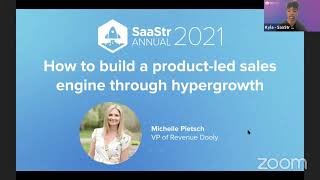
Michelle Pietsch explains when and how to layer sales onto product-led growth. Before hiring SDRs or AEs, verify your product is frictionless, map user journeys to find the Aha moment, and use product signals to decide where sales fits. Datadog uses a 14-day trial for enterprise; Drift shifted from one-call closes to formal qualification after churn spiked.
Questions this video answers
14-day free trial.
2013.
"We've been selling at Dooly since March" (speaker did not state the year).
About 85% (speaker framed this as a team-specific figure, not a universal metric).
LinkedIn: michellepeachuly.
Chapters
All right, let's get started. Welcome to Sasser Annual 2021. We are thrilled to have Michelle Peach, VP of Revenue at Dooley, here speaking with us today. She'll be discussing how to build a product LED sales engine through hypergrowth. There will be some time for Q and A at the end, so be sure to drop your questions. Be sure to drop your questions in the Q and A portion at the bottom menu bar. Please join me in welcoming Michelle. Thank you, thank you.
Thank you for having me. Today I'm going to be talking to you about how to add a sales layer on your already PLG engine. So the buying experience today has changed. Your prospects wanted the opportunity to experience your product before they actually buy. They don't want to go through a cumbersome sales experience. Think about today's world. With one tap of your phone, you can order a cab. With one tap of your phone, you can have groceries delivered to your home within one hour without actually having to step foot in a grocery store. You can browse luxurious vacation homes on your phone and book a vacation within minutes easily without actually having to speak to anyone. That's today's world. And it's these types of experiences that are starting to make their way into the B2B SaaS buying experience. But there's still something businesses are missing for their consumers and that's letting your customers try your product before they buy, giving them an easy, seamless way for them to experience your product. Yes, I'm talking about plg. I'm talking about product LED growth. The prospects are owning the buying experience today. They want the opportunity to explore your product, get to the aha moment, easy, fast and seamless and identify the areas that they can see value that will meet their needs. They don't want to have to go through a cumbersome sales experience where they're going through a full discovery method with your sales rep. If at any given point they're in your product and they see the value, they want the opportunity to buy. Think about it. You walking into a store, you grab the product that you want and you walk up to the register and purchase. It's really easy. And that's how you should make your experience for your prospects. That's what prospects are expecting today. Most businesses want to do plg, but they're not necessarily equipped to do so. That's because they fall into one or two buckets. Now think about your product first. Your product isn't necessarily built to support a PLG motion. Your users want to buy without friction. If I'M a user and I sign up for a trial, do I have to go through a bunch of hoops to figure out how to get through your product? Is your product easy to use? For example, do I have to go through hundreds of tutorial videos to actually figure out how to use your product? Do I have to go through your support team to figure out how to get questions answered? Or how about a sales team to walk me through a demo for 30 minutes just to show what the product actually does? And more importantly, can your users purchase on their own? So if I'm a user in your product and I'm going through a free trial and I like what I see and I want to be able to buy, can I actually go and put my credit card information in and purchase easily and quickly? And the other part is if you're not actually staffed to support a PLG motion. And today I want to talk to you about that. So if you have a plgmotion today, your product should be selling itself, which is great. You have an easy revenue stream. You don't have 50 sales reps adding more cost to your actual process. The product selling itself, it's a self serve model. You have a freemium model where people get to try it and then they can easily upgrade to a paid plan. Do your users have autonomy when they're in your product? And do your users need any help from you? If your users need help from you, what does that look like? Do they have to go through support? Do they have to wait 24 hours for support to turn around a ticket? These are some things that you need to start thinking about as you start to staff your team and be prepared for a PLG sales motion. So if you already have a successful PLG motion, it's time to add a sales layer on there. It's like throwing gasoline on a fire. Some people will think we're already getting all of the revenue in a freemium model where we don't have to add a bunch of sales reps, that's great. Imagine if you can actually add more revenue with the right type of sales mechanisms that you put in place. So you go into the board meeting and they say, revenue is awesome, Everything's to the right, you're growing, your customers love you. Go hire 50 sales reps. Before you put in any type of sales motion, you should be listening to your customers. It's important for you to understand before you implement any type of sales motion what your prospects like about your product. So how are they using it every single day? Think about it. Watch their user journey when they sign up, what are they doing? What are they saying on the sales calls and customer calls that you're having today? What do they like most about your product? Do they get to the Aha moment? When do they get to the Aha moment and what is it? Tie the needs to your customers back to the value of your product. Now, asking yourself these questions, you should be able to start to think about how you're going to implement a sales process and layer sales reps on this PLG motion that you already have. Now, more importantly, how easy is it for them to actually use your product? Do you have to walk them through a demo multiple times for them to actually get to the Aha moment? What happens if they have an issue with your product? What does your support look like in your PLG motion today? Do they have to go through support tickets or chat? If they do go through a chat, do they get a response within minutes? And then actually looking at those support questions. This will give you an idea of how you're going to arm your sales team and what type of sales reps you should be hiring. And then what obstacles do they have to overcome when they're in your product? Are they overcoming any obstacles? This is where you work with your product team to identify areas where you can improve the product workflow and the user journey. But before you implement any type of sales motion, listen to your customers first. I do this by listening to all of our call recordings and I'm simply working with product and engineering, identifying where areas where we can improve in our product and then working with my sales team to identify areas where we can make it easier for our prospects to buy. Now, typically you hear an SDR motion, we'll hire a bunch of SDRs and they'll do the old school motion of outbound prospecting where they're going to outbound. They'll qualify through pain funnel in medic and then they'll flip that lead to an AE. When in PLGmotion, you don't necessarily need that. First, you can look at how your users are engaging with your tool, especially once they sign up. One example is if you have users who are signing up and they're not activating right away, identify areas in that user journey where an SDR can focus on engaging the users who sign up and getting them to the Aha moment faster so there's no rocks that they have to jump over in the product. Now, with a PLG motion, you've probably already closed a couple of larger enterprise Deals through a self serve no touch sales mechanism where they put their credit card in Adobe closed for 10 seats. They purchase on a credit card. That's amazing. Well, you have the entire other suite of Adobe individuals and organizations to break into. That SDR motion can focus on those high value accounts that you haven't already broken into. For example, you take what you have seen the value of that Adobe account you already have, have your SDRs take that value and bring it into the other parts of that organization to flip to a sales team. Now odds are you probably have a good amount of smaller organizations already paying and using your tool. You don't necessarily want to put account executives on those smaller organizations because it's costly but they're still customers and those customers also need to be serviced. So you can have your SDR motion focus on these smaller organizations. That will also provide you opportunities to expand into those organizations as they grow. But also it reduces churn. So you have the SDR motion on the plg. Now what about hiring dedicated account executives? Odds are someone's going to tell you to go hire 20 account executives because your revenue is going to the right because of plg. Before doing that, need to identify what does their day to day look like. With a PLG motion you already have a lot of data and ideas around where you can add benefits. From an account executive perspective, are they going to be more consultants and more product focused? Once someone raises their hand to have a product demo identifying areas where that account executive can add value through a proper discovery motion, they need to qualify them. But not necessarily going through your standard qualification because they've already tried the product. It's identifying where they're seeing the value in the product early on. So making it a Persona based or value based questioning for their day to day and where they focus their time. Then how do they interact with the prospects? Are they doing outbound prospecting to mid market to enterprise companies to bring them actually to your product. So once they're in your product they're already viral and you have it in with those mid market to enterprise companies. You want to identify how your dedicated accounting executives can break into some of these larger organizations that may have already raised their hand but haven't actually purchased yet through the self serve model. One thing I want to point out though, with this PLG motion, you don't want your accounting executives doing one call closes one. The product's already selling itself. So an account executive shouldn't just be flipping a deal to close, but you're also doing your account Executives a disservice in the long run because they're not going through a proper qualification, they're not learning the ropes of how to actually go through a typical sales process. And I'll touch on where the one call close actually fails in my next slide. So my PLG stories, I've added a sales team on three PLG organizations. Datadog was the ultimate PLG story, the most successful one that I've seen. It's PLG to a t. Back in 2013, Datadog was just getting started. We had a 14 day free trial. People were able to sign up for Datadog and use it without actually speaking to a sales rep or going through a demo. And at the end of the 14 days there was a gate and it said, you trial is over. Click here to buy. We had some of the world's largest enterprises vying for a few servers to continue to use it without actually talking to a sales team. Then we had organizations who didn't buy but raised their hand to learn more. So what we did was have our sales team focusing on those individuals who wanted to focus on a demo or contract negotiation and the account executives focus on those mid market to enterprise organizations and an SDR motion that actually focused on the smaller organizations who were buying two to three servers. Now that could have been a really small company regardless and then they just closed them and moved on. Or it was a larger enterprise company and they actually focused on breaking into that larger company. But at the end of the day we didn't want our account executives just flipping really small deals because it wasn't worth it. We wanted the account executives focusing on these mid to enterprise companies who are raising their hand after seeing a demo or after completing the trial. Now Drift was the opposite. Drift was the one call close strategy. Now we didn't have the option to try to buy. What happened was small to medium, really small businesses were coming to Drift and we were showing them a demo. At the end of the demo they were sold on the opportunity to use Drift and drive conversational marketing leads to their website. My sales reps, we had a very large sales team. We're just flipping them a credit card link and after a while, when you don't do proper qualification to small to medium businesses, they churn. So we had to completely shift our entire sales process to our proper sales qualification to mid market and enterprise, the old school medic approach so we can actually qualify and discover the pains and needs our our prospects actually had. Now at duly we're just getting started so we've been selling at Dually since March and our AES are focusing more on an outbound model because we are selling to account executives. So our account, our account executives that are signing up for duly are champions and they're using it and they're buying it on their own. Now the thing is we have really small companies that are buying dually or a few seats. So I have an SDR team focusing on those smaller companies and making sure that they're being serviced and we have that expansion play on the SDR side. Now on the account executive side, we're going outbound to these VPs and CROs because we already have traction with their account executive team. Now we need the buy in on the manager side. We also have a lot of traction for mid market to enterprise organizations that we see the value of actually touching them and actually having conversations with these individuals. So key takeaways. You want to make sure your product is ready. That's the biggest thing. Is your product ready to have a PLG motion on top of a set with a sales team? Is it frictionless? Do you have an easy way for someone to actually try your product before they buy? If I go to your product, can I understand the value as I sign up or do I need to go through multiple demos and know when to hire your sales team? It's never a bad idea to add gasoline to the fire when you're already starting to see success. It's just a matter of understanding what resources that you need to put in place and what your customers are saying before you actually hire and put that sales process in place. And you want to remove any friction from the buying experience. If at any given point you go and try your product and there's friction and you can't figure out how to buy on your own, then you need to fix that. And you need to fix it for your customers so they can get to their value and their aha moments faster. Thank you. We will open it up for questions.
Thank you. Michelle Ryan has a question that says who owns the Land and Expand motion to grow current customers?
That's a great question. So with plg you can create an account management team or have your sales reps do that. It just depends on the size of the organization and what the actual Land and Expand is. Today I have my account executives focusing on Land and expand because they're the first touch for that customer. But we will be building out an account management team. Once you close that deal, you add an AM there that manages that relationship.
Great. Richard asked any suggestions on removing the friction from the buying trial process when your product involves integration with a CRM.
That'S a good question. So you want to understand what's actually getting in the way of the purchase. So if it integrates with a CRM, then how can you remove that gate to make it easier for your customers to buy? Is it security issues? Is it something that they're worried about from integrating their CRM? Or is it just the overall aspect of maybe their customer data? They're worried about it, that you need to build their confidence of actually connecting to the CRM and purchasing.
And then we have time for one more question. Kenneth asks how big of a conversion difference do you see between freemium vs demo? First within note saying freemium conversion counted as upgrade to paid version.
Sorry, I have to read this one. I don't have any specific conversion differences today, but if my team is on a premium versus demo or the conversion from demo to lead was pretty high at like 85%. I don't think that answers your question though.
Let's see, we have time for one more Are there any metrics to know when to bring in sales on top of self service?
Sorry, what was the question?
Are there any metrics to know when to bring in sales on top of self service?
Depends on the customer base, how large your customer base is and how many how large the client base is for the customer. So how many employees? I look at it as if we're starting to get a lot of traction with mid market to enterprise. Then you start to add layer on AES. Also look at the support and how much support is needed because you might not necessarily want to go the AE route but more SDR route where they're handling your customer questions and customer support issues before you layer on an account executive model.
Amazing. We are right at time. I appreciate you for joining us today. Michelle. Do you have any contact information to share with our attendees?
Yes, I'm on LinkedIn michellepeachuly and happy to answer some of these other questions that we didn't get to Amazing.
Thank you so much. Have a good session everyone. We.










