How to Build Top-Performing Sales Orgs with OpenAI's GTM Leader Maggie Hott
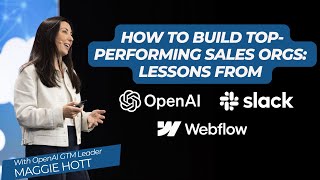
Maggie Hott, OpenAI's GTM leader, shares how to hire and scale sales teams. She's built orgs at Eventbrite, Slack, Webflow, and OpenAI, and covers the mistakes founders make when they try to grow too fast.
And at OpenAI, we held and we always hold the line, even when it slows us down. Because one exceptional hire is better than three average hires. And exceptional people tend to know other exceptional people that they can refer in. Hiring mistakes early on are incredibly costly. A MIS hire can cost over a million dollars. And this is because if you think about it, it takes time to hire them, time to ramp them, time to get them in front of the customers and then probably not close the deals and then you have to start all over again to hire. So let's look at some of the common hiring pitfalls that lead to mish. The first one that I recommend is avoid the logo trap. Don't confuse a big company brand with startup readiness. You need to understand, if they were at a big company, what did they do?
Hey everybody. Saster AI is coming to London December 2nd and 3rd. It's Christmas with Saster and thousands of the best in AI and B2B will be there. The biggest names, the best networkings and most importantly, the best playbooks to scaling in AI and SaaS. Early adopter tickets are selling like hotcakes. Use my code jason20pod for exclusive savings. Get your tickets now at podcast.sasterlondon.com or just use jason20pod at checkout. Hey everybody. The best.coms are taken or overpriced. I was literally looking for a domain name the other day. It was $10,000 just to make an offer. So you settle on a workaround domain for your website. Don't compromise. Get a clean, sharp tech domain that instantly says is a tech startup. Grab yours at get tech slash Saster. That's get tech/SA or on domain registers like GoDaddy. Stop compromising. Get the domain you need tech.
Please welcome GTM Leadership OpenAI. Maggie Hod. All right. Hi everyone. Thank you so much for being here. I come to Saster every single year and it has always been a career goal of mine to be speaking here. So being up here on the main stage is a little bit of a pinch me moment. But that's not what we're here to talk about today. What we're going to talk about is how to build top performing sales orgs. I have had a really lucky and fortunate pleasure of working for four different unicorns, helping to build their sales team at all four of them. I started my career at Eventbrite as the second SDR, spent five years there scaling it until about 2015 and then I made my move over to Slack as the very first sales hire out of headquarters where I spent six and a half years in a variety of different roles. Then I made my way over to Webflow where I was Director of Sales, overseeing Sales, Dev, SE, SMB, Mid Market Enterprise, helping to take the company from 40 to 140 million and a $4 billion valuation. Couple years ago I made my way over to OpenAI. They hired me on to help build out ChatGPT Enterprise. So what I am going today to do today is to take as many of the lessons that I have learned from scaling these companies over the past 15 years and distill them into a tactical playbook for you. My side hustle is that I run a small venture fund alongside seven other amazing women and we have collectively invested in over 30 founders and these are some of the top founders of this next decade. So I'm also going to take all of the lessons that we've been learning from mentoring and coaching them and distill them. So this entire talk is meant to be no theory, but all tactical. We'll cover four key areas. The first one, hiring. How do you build your A team? The second one, how do you build teams that thrive? So you've got your A team, but how do you create alignment and accountability? Then we'll move into scaling. Scaling is one of the hardest things that a company can do when they're going through hypergrowth. So we're going to look at some sustainable growth strategies and then finally we're going to wrap it up with a rapid fire playbook of some of the most common mistakes that I see founders making as they build out their companies. I'm excited to jump in. You'll be able to take all of these takeaways immediately. And a small disclaimer. These are my personal views, not those of OpenAI's. Let's jump in on how to build the right team as fewer things matter more. It was early 2023 and OpenAI had just released the fastest growing consumer app the world had ever seen, ChatGPT. We were about 200, 250 people and we had reached a pivotal moment. We had to scale quickly. We had to end the year at somewhere close to a thousand people. And this wasn't just growth for growth's sake. We needed to meet the demands of our market and quite frankly, we needed to service our customers. Sam often says that hiring is the highest leverage thing that you can do and great companies will always have great people. But for us, it wasn't just about finding the great people. It was about finding and hiring the right people. So let's look at three key principles that we follow at OpenAI as we hire. The first is to hire for clear, measurable objectives. A mission alone isn't enough. You need people who can explain exactly how their work and their skills will help you achieve that mission. So we looked for candidates who could clearly articulate how their skills would move us closer to our mission, which is to create AGI, artificial general intelligence that benefits all of humanity, not just those who are excited by the vision. The next is it's important to build teams, not just talent. You can have 50 top performers, the best 50 people out there, but if they can't collaborate and they can't work together, you're going to get bottlenecked and stuck. So the most simplistic way to think about hiring teams is to think about them as a puzzle. You need multiple different pieces that will all fit together and everybody will have something that they bring that is distinct and complementary. Their skills, their roles and culture all need to fit together because trust and collaboration matter just as much as individual excellence. And then finally, and maybe most importantly, and one of the hardest things to do, especially in hypergrowth, is maintain a high bar. When you are growing fast. I know it's tempting to compromise. I know it's painful because you just need a body in that seat. Sometimes it feels like a warm body would be the best and quickest possible outcome. That is not the case. And an open AI we held, and we always hold the line, even when it slows us down, because one exceptional hire is better than three average hires. And exceptional people tend to know other exceptional people that they can refer in. So these three principles help to scale with clarity and conviction. So let's shift gears a bit. Let's get right into the tactical. And what I think will probably matter to many of you go to market hiring. Hiring mistakes early on are incredibly costly. A mishire can cost over a million dollars. And this is because if you think about it, it takes time to hire them, time to ramp them, time to get them in front of the customers, and then probably not close deals. The cultural disruption that a mishire brings, then you have to pit them, then you have to severance them, and then you have to start all over again to hire. So now you're looking at about a million dollars and probably a year of wasted time. So let's look at some of the common founder hiring pitfalls that lead to mish. The first one that I recommend is avoid the logo trap. Don't confuse a big company brand with startup readiness. I'm not saying that you shouldn't ever hire someone that comes from a big company because big companies have great people. But you need to understand if they were at a big company, what did they do, what did they build, what did they sc? So that way you can really understand if they can bring these skill sets over to your thriving startup. You don't need someone who can just operate the machine. You need someone who can build it. The next one that I see founders do very often is they promote too early. Your first AE is very likely great, but that doesn't mean that they should be your first head of sales. You must give them mentorship, but you also need to be thoughtful about how and when you level them up. And to go on this a bit further, what I often see is founders. If they end up promoting someone who doesn't have management experience, they will have to spend a lot of time coaching them, which is just time they don't have, or they will not spend the time coaching them, and this hire will flounder. So neither of those are great outcomes. On the flip side, I also see founders trying to hire someone who's senior way too early. They come to me and they say, Maggie, I have two AES. I think it's time for a CRO. No, it is not time for a CRO. You need to make sure that you have clarity on how the repeatable.










