How To Gain 30K Leads Every Month Like Clockwork
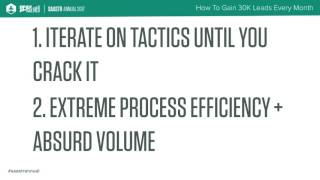
Lars Lofgren breaks down how to build a repeatable lead generation system instead of running one-off campaigns. He splits the work into two games: volume (SEO posts, publishing velocity) and quality (A/B testing homepages and opt-in flows). His method: brainstorm headlines as a team, test them cheap on Facebook ads, then build the winning asset.
Chapters
Ready to get 30,000 leads every month. Lars Lofgren, director of growth at I Will Teach youh to Be Rich, is next up. Please welcome him to the stage. Hey, everyone, how you doing? So with that, we are going to talk today about how to generate or how to build an engine to drive 30,000 leads each and every month like clockwork for your business. And first, the proof. This is a slide of our lead goals and actuals from the team that I ran last year at I Will Teach. Our goal was about 408,000 leads. We hit 480 by the end of the year, just short of half a million. I was really disappointed I didn't hit that milestone. But, you know, it is what it is. The main thing I want to call out on this slide is that we were above goal in January. We came out swinging, and then we just widened that gap super consistently all year long. Very predictable, very sustainable. This is how you build a high volume lead gen engine for your business. Now, we also averaged about 40,000 leads last year. When I pitched Jason Lemkin on the title for this talk, I was actually too pessimistic. So that's what we did last year. Now it's not the last time or the first time that I've done this. I actually quadrupled lead counts at kissmetrics, which was my former gig before the company that I'm working at now. So when I tell folks or the big takeaway that you guys are going to want to walk away from this is you want to stop thinking in campaigns. That's the big mistake, the big philosophical mistake that most marketers make when they're trying to figure out how to get these lead engines really moving. It's not about the campaign, it's about the system behind it. And these days, I'm at the point where I really just hate marketing campaigns. I hate the word, I hate the framework. And when some marketer comes up to me and starts talking about their campaign that they're going to run, what I really hear is it's going to take them three, maybe four months worth of work. They're going to get a brief spike of leads, and then the month following, it's all going to go away and we're back to where we started. So to build a true high volume inbound lead flow, you got to get away from those campaigns. You got to start thinking in systems. And I'm going to show you how to do that. So there's two things. There's really like all these inbound lead gen Engines, they really just boil down to two items and you're going to be able to zero in on those two items. If you ask yourself this, are you playing a volume game or are you playing a quality game? If you answer that question, you'll know what to do next. Now let's walk through example of where people make a mistake or they don't play the right game. This is the PDF content mill, which I see a lot and I made this exact same mistake. People start building their inbound lead gen engines, they'll crank out a couple of PDFs, two or three the leads start coming in, they get excited and then the next thing they try to do is hey, let's go build a PDF every month, let's build a PDF every week. When in reality that's completely wasted time. It's not going to help you guys at all. And this is exactly what we did at kissmetrics for a while. And all this stuff ends up on a resources page, usually of some kind. And it doesn't move the needle. And the reason stuff like this doesn't move the needle is because how are those 50 PDFs really going to drive any extra traffic for you? Where's the traffic coming from? Google's not going to rank them. They know that you just have an opt in page. They're not going to rank it for any traffic of any consequence. So you're playing, you have the wrong strategy in the wrong game. Not going to get you where you need to go. What I'd rather have, I'd rather take that exact same amount of time, go build 49 blog posts and just focus on having one amazing PDF, same amount of work, you'll get much better results. It's because each of these things, blog posts versus a PDF, they're actually two different games, they're two different goals and you need to build them in two different ways. Here's another example of where we got this game kind of, or we were playing the wrong game. At my current company, I will teach, when I joined they were getting really excited about mini courses. And mini courses are essentially just a PDF but more complicated, right opt in up front, content on the back end and they were cranking these things out or starting to build an engine to crank these things out once a quarter, once a month, super regularly. I am very proud to announce that we have not shipped a mini course in over a year because it doesn't help us, it doesn't focus on the right lever, it's not going to move the needle In a major way. Here's the rule of thumb on how to figure out what game you're actually playing. If your goal is conversions, you're playing a quality game and I'm going to walk you through what that looks like and how to play that game. If your goal is traffic one step further up the funnel, then you are in a volume game. Go for quantity and play accordingly. The first thing I want to walk through or the first system that we really need to walk through is the volume levers. How to really ramp these things up and some examples of the types of content that really play into this category. First one is SEO blog posts. Very, very typical. A classic volume game. Does there need to be quality there? Yes. You kind of have to hit that minimum threshold to get ranked for any given keyword. But once you know how to play that game, then the primary constraint is just volume. The more SEO posts you have, the better and you're really just going to try to maximize sheer volume. Another example, and this is something we did really heavily last year at I Will Teach is we didn't just build SEO posts and go after specific keywords, we built entire mini sites to go after highly competitive keywords. Quality bar was a little higher. But fundamentally the main constraint on our lead flow is how many of these things can we crank out in a given year. We were doing one every other month. I'd love to figure out how to get to one a month and then one a week. If I can do that, my lead funnel is just going to start expanding. So when you're working through these and you've established the fact that you're in a volume game and that's the key, you're really going to double down on a particular medium that is very volume based. The first thing that you're going to have your teams do is just iterate on the playbook. Right. Iterate it until you dial it in and you've perfected it. Don't just take a standard set of best practices that so and so says this is the key to making it work. The game constantly changes. When we were running kind of an inbound funnel at kissmetrics, what worked for that blog and on that team and that lead gen engine that does not work for my team anymore. Right. I can't use that same system. We're constantly having to re engineer and figure this stuff out from scratch. So this sounds basic. Of course we'll all get the tactics right, we'll all make sure it works. But it's actually a big mistake that a lot of people skip. And they don't dial it in nearly as tightly as they need to, especially for smaller SaaS businesses. A very common story I hear is they'll start a blog. They'll have some interns, some entry level marketer, crank out a blog post, you know, once a month, once a week, something like that. They'll do it for a year. And their lead volume hasn't budged an inch. Right? They're trying to scale the volume before they've actually dialed in the tactics. So whatever volume game that you're playing in, make sure you really have your team, figure out the playbook, dial it in, then go scale it up. And when you're thinking about scale, you really want to push it to absurd volumes. All right, this is what we did at kissmetrics. It started with two to three posts a week back in the days. This was like 8 years ago. Scaled that to once a business day, then so five a week, then seven a week. Then we actually tapped out at 10 a week. We were doing the same thing with infographics, Twitter syndication. At KissMetrics, these days we're doing stuff with highly targeted blog posts on keywords, very elaborate mini sites, that sort of thing. Now let's talk about quality games. Right? These are when your primary goal is conversions, that's what you're focusing on. You're one level down in the funnel. And the key here is really to find your lead choke points. Every funnel has them, every business has them. And you guys, there's a lot of SaaS businesses in here. These lead funnels are pretty simple. There's a couple of choke points that, that if you spend a lot of time on, really push the quality, you're gonna be able to ramp up your lead volume pretty significantly. And how you do that is not by building new stuff. This is the trap we ran into with that PDF content mill. What you really have is a single CTA on a blog or somewhere on your site and you're trying to add additional content to that same cta, but you only have one CTA placement. More content for doesn't help you. However, if you ab test against that CTA and you really push it to the absolute limit now without any increase in traffic, you can actually ramp up your lead volume significantly. I did this at kissmetrics and I've also done it. I will teach. This is kind of my main ace in the hole. Whenever I'm looking at some pretty scary lead goals, I just go back to this and we just hammer Those choke points over and over and over again with relentless AB testing and and double and quadruple conversion rates. Couple examples. Kissmetrics November 2013 Our homepage had a 2.85% conversion rate from visit to free trial signup. By August 2014, we tripled it to 8.71. That was basically 9 months of back to back a B testing on a core choke point of that lead funnel. A homepage. Your homepage is one of the most influential assets that any of you have for a SaaS business. Spend a lot of time on it. Another example at I Will teach. For us, we're driving email subscribers and every single one of those opt ins is going through a double confirmation before they can get on our email list. So we have hundreds of thousands of people hitting this page every year. When I started, a little after I started July 2015, double confirmation rate down to 63%. Got that up to 82. That's basically almost a 30% improvement across the entire business just by working on one page. Took about a year of AB testing to get there. Another choke point. And if you're building a blog, if you're trying to build a deep inbound funnel, this is the primary choke point or CTA that'll move more leads than anything else you could possibly include on your blog. But it's the popup. August 20151800 leads coming from this pop up off of I will teach August 2016 7100. Right. And that is without like the increase on traffic over that year was very minimal. The vast majority of that increase came from just AB testing that pop up over and over and over and over and over again. So the key on the a B testing program is find those choke points, find a few of those core assets that really drive the business and just a b test them endlessly for at least nine months. And the rule of thumb that I give people, because I've done this multiple times now, is if you're looking towards the end of this year, the end of 2017, you're looking at your lead gen plan or how to really increase it. You can double that lead flow from a single asset, any of those individual choke points by the end of the year. That is absolutely possible. As long as you have a halfway decent amount of traffic and you have a team to do that back to back AB testing. But a lot of us don't have that data or we don't have the team or we don't have the data driven culture to really do a lot of relentless ab Testing or we're just too early? We haven't gotten to that point yet. We only have a couple people in the business. What do you do then? So I want to walk you guys through a process that my team has developed over the last year to make sure that when we're building a new offer, when we're trying to optimize a given choke point for the very first time to make sure that that headline, that hook is maybe it's not perfect. You only get it to perfect with a lot of that relentless AB testing. But at the very least, on day one, it's pretty solid, right? It's more than good enough. We're starting from a good place and we've weeded out all the bad stuff ahead of time. So let's walk through this. This is the same process that we use to find our highest performing hook or headline right now. It's a quiz called what's your earning potential? Every time I offer this on any cta, on any of our ass, across any of our channels, it just destroys whatever we had before that. And we had some really solid headlines that we've been using for a long time. This thing dominates every single time. In fact, we just found another win off of this. It's going to increase my lead flow on one of my assets by 17%. And we just got statistical significance last night. This thing continues to deliver over and over and over again. But this, we didn't get to this headline. We didn't get to this offer by accident. We actually used a process to come up with it. And it's now the same process we use for everything now. The reason we built this process and the reason we spend so much time focusing on the hook, the headline, the offer. Well, there's a couple reasons. The main one is that when people come up with headlines, the first one is generally a pretty bad one. Okay. I worked with some world class copywriters, guys with deep experience in the direct response space. And even for these guys, they built their entire careers off of copywriting. They still need a couple cracks at a headline before they come up with something really solid. And they still have duds that just don't convert. So even for world class folks, it takes a while. And for lots of SaaS companies, the copywriting talent is generally not that great. So we definitely focus on it. And then on top of that, when you're thinking through everything that you can test, everything that you need to perfect, everything that you need to really focus on to rise that quality level as much as Possible. The one item that always delivers for me is the offer, the hook. That's the big lever on any given landing page, signup page, homepage pricing page, whatever it is, that headline, that offer, moves the needle more than anything else. At kissmetrics, we did a lot of headline testing and I could swing my free trial sign ups by 30% up and down just by either getting a great headline or getting a bad one. So we put a disproportionate amount of our time on the headline because of how big of a lever it is. Don't worry about layouts, don't worry about design button colors, even CTAs. The rest of the copy, you figure out the offer, the hook, everything else will flow nicely from that. So how do you actually get this offer? How do you actually get that first amazing headline to build the rest of that choke point from it? Well, step one is take. You usually want to get five, six, maybe seven people from your team. Pull them into a group. You are going to do a brainstorming session with that group and it's going to last seven minutes. It's going to be a silent brainstorm. Okay, pull up a Google Doc, a blank Google Doc. You guys will just put all of your answers into that same Google Doc, but you want them to go for volume. Come up with as many headlines as possible. It doesn't matter if these folks are marketers. They can be designers, engineers, project managers. I've had a lot of success with people coming up with great headlines, regardless of the discipline. But have them focus on. You want to give them one constraint. If you give them a completely blank page, they won't know what to do. It'll be a deer in headlines and they won't be able to brainstorm at all. Tell them to focus on a key target market, a key segment. Give them the asset or choke point that you're trying to optimize for. Like we're building a PDF for this target market. Give them at least one constraint that'll get the brainstorming going. And then tell them to go for volume within that seven minutes. Once the seven minutes is over, have them pull all of their answers, all their headlines into that Google Doc. You'll probably end up with 50, 60 headlines at this point. 50, 60 hooks. Then tell your team, give them maybe five minutes, read through all the headlines and have them vote or upvote three of their favorites. The reason that you're going to do this is you're basically doing, you just did this massive brainstorm. You have A ton of ideas. You, you want to do a quick filter so you know which headlines, which offers which themes to spend a lot more time with. And what you'll find is that there's always a couple that get a bunch of upvotes that your team is already getting excited about. This is actually a screenshot from one of our Google Docs where we did exactly this. We were brainstorming a PDF offer for the freelancing space. Now you have a couple of really core themes that your team upvoted. You know what direction to go as a whole. Now you want to spend some time and really dial in the headlines, really focus them. So take two or three themes, build it out into 10 or 15 different headlines. If you don't know what that looks like or what a great headline looks like, or what your options are, and you need some kind of direction on how to work through this, I highly recommend the book graphics. Great leads. It's probably the single best crash course and overview on direct response copywriting that I've come across so far. So this will get yourself and your team headed in the right direction. But really spend some time on this. Do not rush through the 10 to 15 headlines. Really dial them in. Now you have 10 to 15 headlines. You're going to get budget. 500 to $1,000 is all you need. And you're gonna go run a Facebook ad test. Now you're not trying to get leads from this test. You're not going for leads. You don't need any landing pages. You don't need to build anything for this test. All you're doing is buying some data. Okay. And you want all the ads are gonna be identical. Pick some audiences, some interests in Facebook that overlap with your target market somewhat. Just get in the general area and you're just looking to see what the difference in click through rates is. That's all you're looking for. And what you'll find is that a couple of those headlines, a couple of those themes will really stand out. They will get much better click through rates than anything else that your team or yourself put together. Now you have your winners. And the trick is to go build whatever the winner is. When we went through and came up with that quiz when we worked through this PDF, make $1000 in the time you'd spend watching Netflix this weekend, we had no idea how we were going to fulfill that promise. We had no idea how we were going to build a quiz that would actually tell someone what their earning potential is. We thought it was a great Idea like, wow, if someone had that, it would be amazing. We went and tested on Facebook. People also totals through the click through rates that yes, they want that. Then we went and built it. Right. I still don't know what's in this PDF. I should probably figure it out. But my team came together, we figured out, we put together a really great PDF to fulfill this promise. That's pretty much, that's the approach that we do every time we need a great offer. And if I joined a B2B SaaS company and I was their head of marketing tomorrow, so the first thing I'd go do is like, let's figure out what's the real promise we really need to put on our homepage. Let's go get some data on that promise to figure out what resonates with folks the most. If I don't have any traffic to test directly on our site, that's fine, I'll go buy some traffic off of Facebook and then you have your team go fulfill that promise. Same thing with building PDFs or mini courses or quizzes. Anything you're trying to do to optimize your conversions for traffic you already have. Go focus on that offer. Go focus on that hook. Buy some data that'll get you to not necessarily a perfect conversion rate, but it'll definitely get you to a solid conversion rate straight out of the gate. And you can do this inside of a week with a very reasonable budget. Everyone in this room can have this done by the end of next week. So quick recap. First, make sure you're playing the right game. Building these high volume lead engines, they take a tremendous amount of time. We're all constrained on resources. You need to make sure that you're pushing your team in the right direction. So if you're playing a volume game, really dial in the tactics. Once you know you can get something to work consistently, just scale for absurdity in whatever channel or medium you happen to be playing in. Then on the quality side, one step down in the funnel, go find your core lead choke points. If you have enough data and resources, just start a B testing them relentlessly. And if you don't, or even if you do and you just want to come out, you're building something new. Need a strong hook, whatever it may be, definitely do the Facebook test to figure out what headlines are worth spending time on. And then whatever wins, go build that. So 1. Thank you guys, I really appreciate it. I know we're not set up for Q and A. If you guys have questions on this or anything else in marketing, I'm more than happy to help. My email is Larsarslofgren.com hit me up on Twitter. More than happy to help. And then I have one last item, which is we are building a really solid team of people that want to play on the cutting edge. Real top performers of marketing, direct response, education, and tech. I got a couple of marketing positions open. If you're looking for a new gig, come talk to me. We're also looking for a VP of product. I'll be around. Happy to help however I can. All right, thank you.










