How to Get Better at Recruiting. You Have To.
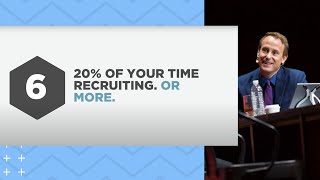
Jason M. Lemkin argues that from early-stage to growth (1→10 scale), the single most important driver is the team founders build. Key, explicit prescriptions: founders must spend 20% of their time recruiting and interview ~30 candidates per open role; continuously meet potential VP-level hires (build relationships even before hiring); hire internal recruiters as soon as ROI-positive so senior execs can focus on their jobs. Financial rule of thumb: maintain roughly $1 on the balance sheet for every $2 of ARR to fund 3–6 month hires/investments. Emphasize bizdev/partnerships early and assign dedicated owners to manage partner org charts and enterprise customers. Customer marketing and retention: allocate material marketing effort/post-sale spend (example: 30% of marketing time/budget on post-sale programs), dedicate a full-time customer marketer at ~100 customers, and prioritize net revenue retention. Finally, invest in brand earlier than founders expect—mini-brands often emerge by $2–3M ARR and can be protected with events, uptime/operational investments, and targeted brand spend.
Chapters
This one is torture to founders. You have to do this. You have to do this. You're not, you think you're doing this, you're not doing this. All that matters from 1 to 10, certainly 2 to 10, is the team you build. Nothing else matters. If you have a hundred customers, it's going to be the team you build that get you from 100 to 1,000. And what you're going to do because you're tired, because you don't have enough money, because you're overloaded, because you're also the CEO and the VP of product and the VP of sales is you're not going to spend enough time recruiting and you're going to jump on all these bombs yourself. It's better to miss a quarter and hire the help, okay? It's always better. It's okay that you came up a little short this quarter. If you find that you're VP of sales, your VP of marketing, your VP of product, and how can you force yourself to do this? You need a quota, okay? You have to measure it. And the best way to measure it is twofold. Force yourself to spend 20. It's the recruiting, stupid. Force yourself to spend 20% of your time recruiting. And if you're not going to track your time, do this second bullet, if nothing else, because no one does this, no one does the second bullet. Force yourself to interview 30 candidates for every position. Who wants to do 30 interviews in the next month? Anyone raise their hand. Are you excited to go back from Canada and do 30 interviews? If you say, for this, I'm going to go hire a VP or director, a direct report, whatever the level is, I'm going to hire a direct report. This report matters, whether it's through hacking, through LinkedIn, through network and use recruiters. Recruiters are cheap. If I'm going to say I'm going to force myself to interview 30, you will get, you will hit this 20% quota because it's so much time. If you're even recruiting two positions yourself without an in house recruiter, that's 60 interviews you're going to do over the next two months. Think how much time it's going to take to do those. Schedule them like even if you use calendulas here or Mixmax, whatever, it's so much effort. It's so exhausting to do these interviews right? You will come out, you will get it done. But if you don't give yourself a budget, a quota, you're going to look back and you're going to be honest. I met Four. And you know what you're going to say it's hard. It's too hard to find a vp. I'm in Montreal, I'm in San Luis Obispo, I can't find anybody good. Cry me a river. It's hard in the Bay Area too, let me tell you, because there's 10 million startups. So force yourself to hire 30 and Magic will happen and you'll also find new paths to be do it. And then usually you'll find you'll get there halfway. Everyone will tell you this recruiting science, but if you force yourself to, dirty magic will happen. The next one, if you're going long, is meet all the good VPs. Even if I know I probably convinced you, you should hire them in any order, but you probably can't hire six VPs tomorrow. Maybe you don't have enough money. You're going to need them later. Okay? You will need them later. So meet anybody. Great. You can. Any great potential VP can. You know that VP of sales you just hired and you love her. She might not work out. My first, my second VP of sales, who I loved, I met him recruiting my first sales rep and I tried. He was at LinkedIn at the time. He was the first head of sales at LinkedIn and I loved him and I tried to somehow recruit him from LinkedIn. I couldn't get him. So I hired this other guy from Salesforce that didn't work out a year. 14 months later I needed this guy. And 14 months plus one day he text me, any chance you're looking for a head of sales? Oh my fucking God. Thank you. It was the greatest thing in the world. But I had met him, I sought him out like a heat seeking missile because I did these reference calls on my first sales rep and he was the first reference call I did who was like, Jason, whatever you do, don't hire this guy. And I'm like, this is great. And I drove out to meet him and I built this relationship and I should have done 40 of them. I should have done them for every position. So constantly be recruiting the VPs you need today. And you may be like, I don't need a VP of engineering yet. You know what, you may not be able to recruit her in 60 seconds. Like go meet her today. You will need all these VPs in the coming months, quarters or years. And your life will be 100 times easier if you've already met these candidates, even for 20, 21. Right? Things are just a little. If you can raise money, you can raise a Little more. So if you have a little more money, hire an internal recruiter earlier. Do you really want your CTO spending all of her time setting up engineering meetings? Is that really. It's bad enough if you're head of sales, do it or you do it. But I can tell you, if your best engineer is spending hours a week setting up meetings, you want her or him writing code. You do not want them doing administrative tasks. Right? That's just the most painful example, is when you need to hire like four or five engineers and they're all doing the administrative side itself. It's bad. So that becomes super accretive. I said 1.5 hires a month, but it might even be like half a hire a month. If you have money, like, do it right. As soon as you're hiring, even one a month, you're going to find it's ROI positive to have someone doing this rather than have your most important executives being distracted with the administrative side of recruiting. Okay, next one. And this one will make less sense to folks that are bootstrapped. But even if you're bootstrapped, this will become true later. This is my best. This is a hack from going from 1 to 10 is to have less stress. Okay? And this is a trick I learned. If for each. If for each $2 of ARR, you have a dollar on your balance sheet, you can invest. So what does this mean? If you're at 3 million in revenue and you have a million and a half in the bank, whether it's from equity, friends and family debt or whatever, you can start hiring everybody. It turns out if you're at 10 million and you have 5 million in the bank, if you're at 4 million, you have 2 million, you'll start to see that that math that's accretive, that, like, yeah, you know, I can pay $180,000 for my dream VP of Marketer, because I have a million and a half in the bank, and if she makes me 200,000 in the next six months, does it really matter? I can fund it through cash, but if you don't have basically a dollar in the bank for every $2 an ARR, everything will seem expensive. You'll hold back on hiring, you'll hold back on the people side at the worst possible time. What you want to do from 1 to 10 is hire every single accretive human being on planet Earth, right? You don't have enough money from 1 to 10 to hire 50 unproductive reps. But if a rep can take 20 of your leads and she can turn it into 3 times her salary. You want to hire her tomorrow from 1 to 10. Any money you have in the bank is to invest in accretive resources. But you need at least a little bit of money if you're fortunate enough to be able to raise money from whatever source. Think about this number. If you don't have 50 cents for every dollar of ARR, you will underinvest, I guarantee it. So find a way. And that may mean if you're able to raise more money, raise a little bit more, right? But you will make this investment, you will hire that extra E you will hire. What will happen if you have half your ARR on your balance sheet? What will happen is, let's say you get in Google and Google says, well, I need this integration that you don't have today. But what if you hired an engineer and in three months she could ship that product, that feature, Is it worth it for Google for 100k or 20k or for logo? Of course it is, right? But Even if you're 3 million in ARR, if you only have 100k in the bank, you're not going to hire that engineer, are you? You're going to say, you know what, the team's got to decide. But if you have a million and a half, you will hire that engineer, you will close Google and you will ship this product. So it'll go through all of this stuff, all these investments that take three to six months to pay off, you want to make after a million in revenue. But if you have nothing in the bank, you won't make the three to six month from two to three or four million ar, you can't make the two year investments. Like you can only do those when you're huge. But you have to find the capital to make investments that pay off in three to six months, month. So a buck in the bank for every $2 an AR is the magic here. So yeah, if you're bootstrapped, you may be like, how's that going to happen? Well, mailchimp was just here. They did 600 million last year. They're bootstrapped. Okay. Eventually this math will work out for you even if it doesn't work out for you today. Okay, in brief, this is another one that we all screw up to save money. It's a huge mistake. Do bizdev and partnerships earlier. Okay. What tends to happen in most SaaS companies is, you know who does partnerships in biz dev? The CEO. Right? Somehow the CEO builds a great relationship with mailchimp or Zendesk or someone at Salesforce or someone at AWS or someone at Datadog or someone you're a great many of you will be a great partner to some bigger company, okay? And that will be great as CEO. And you will build this relationship and that company will be delighted to meet with CEO. You may be CEO of a five person company, but customers and partners always love to meet with the CEO. Okay, leverage those three letters. I'm the CEO. Okay? People will take that meeting. So CEOs are great to build BD relationships. They are abysmal at maintaining them. Okay, you met Bob, who runs this division at Zendesk. What about the 38 people that were reported to Bob that actually make the partnership decisions? How many of them will you meet as a CEO? None. Okay. And all that great goodwill you had with Zendesk will just evaporate just when it gets good. Because none of the rest of her team will have ever heard of you. Right? And if you've built this magical relationship with Zendesk and your competitor hasn't, lean the heck in. Like lean in on that relationship. And you know what? That may only get you two leads this quarter, but that competitive advantage and differentiator will last a decade. Right? So as soon as you have I broke this up into enterprise customers and partners. But on partners, if you have a partner channel that's working a Shopify, a Salesforce or Zendesk, as soon as you have any traction, somehow find the money to hire someone to manage it full time, to learn it left and right, to bring them cookies, to be at every event, to map out the org chart, to always be there. Because this is how you win when you go long. It will work this year. And if you don't, your competitors will win. And the flip side is to go from 1 to 10 faster. It's a similar point. As soon as you have big customers, if you're a startup, you have to shower them with love. So if you want to get this word of mouth going, if you want to build these references, account as soon as you even have two big customers, have someone just do nothing but manage them full time. That's how you'll grow faster. Not in a week. But take those big customers that you worked as co so hard to close and make sure someone sweats nothing. But from Dusk and Zoltan, making them happy again, you can't own this yourself. So just in brief, one last thing. That like we were a little late to figure out how to specialize sales, something that A lot of us just really figured out in the last couple years is that customer marketing is the most important part of marketing. So what is customer marketing? Well, think about it for a minute. Customer marketing is marketing after you close a deal. Like how? I don't know how many of you even have a marketer on your team, but go back and ask how much of her time she spends not getting leads, not working the funnel, how much of the time does she spend after closed one in Salesforce, it's usually nothing or a little bit. Or if there is some time, it's here or there, managing maybe a drip campaign, maybe a program. Remember what took us a while to figure out in SaaS, our best customers last a decade or longer. Okay? They last forever. If you have net negative churn, if you have positive retention, if your customers grow more than 100% each year by revenue, that means as a corpus, your customers will last until the 23rd century, until Picard is here. So you're spending all your marketing budget on that little period of time to build awareness because you're stressed, you don't have enough customers, you're not growing fast enough. Give me revenue, give me revenue, give me new names. But what you really want to do is say, hey, I'm going to spend 30% of my marketing budget on my time post sales. And if you do that, you'll start doing things that you wouldn't think to do earlier. For example, you might have a customer event this year, even with 30 customers, if customer marketing's your priority, right? But if customer marketing isn't your priority, you would never have a customer event until you're big enough to fill a room like this. But it turns out if your customer event is 10 customers and you just have two hours of content and a steak dinner, that may be magical. Those 10 customers maybe get you 10 more customers. They may buy more from you, they may buy more of your product, et cetera, et cetera. So I said, After 100 customers, dedicate someone 100% full time. That's a simple rule. But bear in mind, probably almost everyone in the room gets an F on customer marketing. And if you think about going long, this is an easy course correction to make. How much of my time do I spend on customer marketing? Not enough. 20, 30? A full time person at 100 customers, that's what you want. And your marketer's core goal is, is probably going to be something on the funnel. It could be leads, it could be an opportunity commit, it could be MQLs, whatever it is we all have different metrics on the funnel. We'll run out of time to talk about them. Today, your marketer and customer marketing, her number should be probably like CS numbers, net revenue retention. Okay, I want you to do enough customer marketing so that this year. Great. Last year we had 120% net revenue retention. Your job this year is 130. So I want you to spend a year building a series of programs, events, communications, webinars, not just for leads, but webinars for existing customers. If you even do webinars, which most of you don't do, how many of them are for leads versus existing customers? Okay, they're probably all for leads. So if her goal is either is to drive up net revenue retention, these magical marketing programs will come out of the woodwork to retain and grow your customers. And so remember, it's a 10 year journey. And we all get this wrong. We all get this wrong even today, even at the biggest customers. But the very best marketers I work with today that are doing this the third or fourth time in SaaS, we talk about customer marketing, customer marketing, customer marketing again and again and again. Because this is how you go long is doing customer marketing. And this was just me, this was a slide I did. I started what is AdobeCoSign in 2005. And then Adobe wrote this press release. This was a couple years ago. All these great Salesforce companies, they have Groupon, Netapp, Tivo, Ceridian. Like I closed all these myself. I closed these like a decade ago. Like if you close a $100,000 customer this year and that customer grows to 500,000 over a decade, and you keep them for a decade, how many millions of revenue is that from that customer? 1000-001000-00200,0004-000005-00000. Some of these customers that I closed a decade ago probably have generated 10 or more million dollars over a decade now for Adobe, not for me, but for Adobe. So this is where you don't invest enough marketing dollars in this, this magic. And this is how you build $100 million. This is probably how Amy Pressman pushed through that 20% growth year at 20 million and built a $5 billion company. So very last point, which you know Nick Mehta, who was here early for Gainsight, I don't know if you heard him. This was, we were talking years ago about how we all got this wrong. All of us old timers, we didn't realize how powerful brands were in SaaS. Okay. And what we didn't realize, even five, eight years ago, certainly not in the earlier days of SaaS. Is that as soon as you get past the early adopter phase, no one has time. Okay? No one has time. Early adopters, like that's probably most of your customers in this room. Bless their soul. Okay. God, what a mitzvah. These people are. Okay. Instead of buying the market leader, which is fine, folks, I know you think these market leaders, I know your team says their software sucks and it's old and it doesn't do these things, but you know what? These are pretty good apps, these Salesforces and these old ones, they work pretty good. Salesforce is doing 120 billion in revenue. It's doing just fine. Yes, it is. Not as slick as it would be today, but they're just fine. Don't drink your own Kool Aid. They're fine. Brands matter. And there is this small group of early adopters and either because an existing market leader just doesn't work for them because they're doing something different so they will literally seek out a new vendor or that's the most common way you'll get customers, or once in a while someone wants to take a risk. They want to see what's out there. They're bored of the 20 year old vendor. That's how you're going to get them. And then you're going to, you're going to. That's like 5% of the market. And don't forget after that, everyone's going to buy based on brand. Everyone, Everyone. And it's going to happen to you. You will have a brand far earlier than you realize. And I wrote years ago this piece, this is too much text, but I wrote this piece years ago on saster that by 2 to 3 million you will have a mini brand. Okay? And it is true. I didn't feel that I had a mini brand at 2 to 3 million ARR. I talk with founders. I just worked with a startup that just crossed 3 million ARR. And we had this board meeting a couple weeks ago. He's like, I have 5% market share on Shopify plus like 3 million. Doesn't feel like it's such a huge startup, but it's like I have 5% of the customers in this segment of Shopify. Like he has a frigging mini brand, right? And if he doesn't screw that up, if he keeps shipping features, he's now getting pulled in as a default vendor at 3 million in ARR. People are now realizing, hey, if I want this particular vendor, these are the vendor of choice. It doesn't feel like it around the office. Okay. I mean, it's, it's kind of an OK office. It's sort of a junky office in the Mission in San Francisco. But he has a mini brand and we don't invest enough here. So as soon as you have an inkling that you are even number one and two in any, the smallest niche in your industry, I'm number one and two in my app, but only for gymnasiums or only for Shopify or only for Pipedrive, or only an intercom. That's here. I'm number one, but only in the intercom ecosystem. That's magic, right? Like lean in on these brands because that word of mouth thing will just take off once you have a brand. And whatever you can do, protect it religiously. Like have a customer conference. Do billboards. You think billboards are stupid? Why do you think Zoom had them everywhere on planet Earth? Has anyone not seen a Zoom billboard in an airport or anything? It's great that actually Eric read Saster and learned about billboards and did them himself and then brought his marketing team. But he realized he had this brand and Zoom was magical. Even at a few million revenue, he wanted to spend every dollar he had reinforcing that brand, that thing. And so look, Bill, if you get a billboard tomorrow, it probably ain't going to get you too many raw leads. It might, but I will tell you, it will reinforce your brand. I heard about Zoom. I heard about mailchimp. You think everyone's heard about these apps? They haven't. It's early and you see the billboard and your friend at another company uses them. It works. So whatever you can do. We can't all afford 100 billboards, but you can go to the top events, do the customer marketing, do whatever you can. Because if you look at these, this chart on the right. I did this post a year ago. A lot of these top SaaS companies we know are getting into their third decade, right? Look at the top. Salesforce is turning 20. I mean, that means it's on its third decade and it's still growing almost 30% a year. ServiceNow15 Mailchimp. We just talked about, we think Mailchimp came out of nowhere. It's 18 years old, right? And so as soon as you have these brands, just lean in and go forever. And so, you know, there's nothing more frustrating as a founder when you have 10 customers, you meet a marketer and he talks about brand, brand, brand, brand. You got the wrong person. Okay, I need leads. I got 10 customers. Okay, but as soon as you're at 3 or 4 million, it's good to start talking about brand in those marketing meetings. What can I do to protect my brand? What can I do to invest in uptime? Is your app going down? Okay, maybe in the early days when you go down, nobody knows. When you have 1,000 happy customers, your app goes down for two hours, your brand is destroyed. If that happens three times, okay, it's destroyed the third time. You know, it's bad enough for Slack when Slack goes down and it lights up the Internet, but Slack is not a mission critical application. I love Slack. Probably a third of your room is somehow mission critical. Like, people rely on it constantly. If that goes down three times, you've lost them forever. So that's a brand investment that you might not be thinking about thinking about your brand. But brands last for decades. We all thought this stuff was ephemeral. A lot of us that especially that came out of like B2C or Web 1.0. We all thought these things would just like go away like a poof of air, like, you know, whatever. MySpace was killed by Yahoo and Google seemed to kill Yahoo. And like they keep killing each other and there's all these ephemeral things. But in the cloud and the web today, everything lasts. Google not who killed Google. Like, Maybe Yahoo killed MySpace and Google killed Yahoo, but who killed Google? Nobody, right? Who killed Salesforce? ServiceNow, Mailchimp, Guidewire. Guidewire's on its third CEO. They just announced in 18 years Workday who killed any of these SaaS companies going, Nobody. Okay? Nobody. So if you're ephemeral, of course you don't want to do these brand investments, but if you're selling for 30 years, you want to be the default choice, and you will be a default choice for somebody at 4 to 5 million in revenue. So whatever you can do, think about brand earlier than you ever thought you would be. I think that's all I got. So thanks everybody, and let me know how else I can help. I need some traction. You need some traction? Let's get some traction.










