“How to Hit $20m ARR in Just 2 Years” with Secureframe’s CEO and Lightspeed Venture Partners
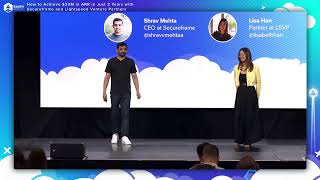
Shrav Mehta of Secureframe and Lisa Hahn of Lightspeed Venture Partners discuss how Secureframe hit $20M ARR in under two years. They focus on four pillars: pick one or two North Star metrics and track them in real time, hire commercially-minded leaders, align product to revenue goals, and make customer happiness a company objective.
Questions this video answers
Shrav Mehta — founder & CEO of Secureframe; Lisa Hahn — partner at Lightspeed Venture Partners.
Going from $1M to $20M ARR in less than two years.
Chapters
Shrav mehta, founder and CEO at secureframe and lisa han, partner at lightspeed.
Awesome. Thank you everyone for coming to our talk. I'm Shrab. I'm the founder and CEO of Secure Frame. We help companies with their security and compliance. But today Lisa and I are here to talk a little bit about lessons from Secure Frame's journey and going from 1 to 20 million in ARR in less than 2 years.
Thanks, Rav and hi everyone. Thank you so much for making it here today. I know it's super busy today and we really value your time. My name is Lisa Hahn. I'm a partner at Lightspeed Venture Partners, a global venture capital firm headquartered in the Bay Area. I focus on early stage SaaS investing. Excited to dive in with Shrav.
Awesome. One of the first things that we think a lot about at Secure Frame is our metrics. If you don't know what your key company metrics are or what your North Star metrics should be, talk to your investors folks like Lisa. They'll definitely know what they should be. At Secure Frame, some of the metrics that we consider core to our business are ARR, acv, net revenue retention, gross revenue retention, nps, cac, Payback, and a bunch more secondary metrics. We like to think about all of our goals on a monthly basis versus a quarterly basis. It helps just increase the pace just a little bit more.
And I think as Shah mentioned, there are a number of metrics that a company can track, a myriad of them in fact. But at the end of the day, there are in our experience, one to two key metrics that really define the business and set the North Star goal for the company to become aligned against on and some of the best SaaS companies that we've seen in our portfolio with a culture of execution and a pace that's incredibly fast. There are ones that are not just maniacal about defining these metrics, but also tracking them with specific targets in mind on a consistent basis and manner and really at the end of the day evangelizing them to the end customer, customers also as well as their employees. And that could be in a form or fashion of weekly all hands or even in a digital forum so that employees can also check on a consistent manner whenever they want. In terms of live metrics today, one.
Of the things that we do at Secure Frame that we've scaled from the very early days is we have a dedicated Slack channel for every metric, every net new sale, every expansion, every turn, every expense. Thanks to things like Ramp, we can actually use to calculate what our CAC looks like in real time. And why do we do this? It's so that we could take action on the metrics in real time if they're going in a direction that we don't like.
In alongside metrics. Another important thing to really remember and not lose sight of is talent in people. And we cannot stress this enough. Keeping the bar high on talent is incredibly important, especially in hyper growth. It's not just in the early stage, because one thing that we like to say is that talent compounds in both directions. It can compound for the better and it can also compound for the worse. And that can only take one to two or even a few key employees to do. So I think it's really important for us, even as investors and also operators like Schrader, to take a step back and slow down in terms of executive hiring to make sure that you're working with third party providers to really find the right talent. Because especially on the go to market side and technical side, those roles are incredibly hard to fill and also incredibly hard to refill again if the talent doesn't work out. And that's one of the key things that we really want to harp on.
One of the other things that we think a lot about at Secure Frame is investing heavily in employee onboarding. Your typical employee takes about three months to get ramped, probably more like six months, maybe even a year to be really hitting their stride. That's a lot of time. In startup land that does not work. We think a lot about how we can compress these timelines so that employees are hitting their stride much, much quicker. Now the other thing that we think a lot about is making sure everyone understands the business equation. What do I mean by that? So a great example of this is, is net dollar retention, net revenue retention. That's a fairly hairy, complex metric to calculate. Not everyone understands it. So we have everyone on our customer success team calculate by hand for their book of business what their net revenue retention is. And that way they truly understand what goes into the calculation, what impacts it and better, how to take action on it. The last thing I'll kind of say on this topic is work with great executive recruiters. I think the first time I saw an invoice for an executive search, I think I had a heart attack. But the reality is if you're scaling from 1 to 20 million in ARR, you're going to need to become best friends with your executive recruiters. There's a lot of great firms out there like Riviera, Diversa, Cole Group tons more. And partnering with these folks is critical to bringing on great executive talent. A great executive can be a game changer for your business and a not so great executive can. Can truly be detrimental to your business. So as you're thinking about hiring your VP of Sales or VP of Engineering, do find a great executive recruiter to work with and just eat the bill.
As we zoom in on talent, one of the core functions to really keep in mind is engineering and product engineering, product and design specifically. And why does that matter? It's because when you're going through hyperscale, it's actually really, really important to just make sure all teams are aligned with focus. And for epd, that is aligning engineering and product to go to market. How do you do that with very similar revenue goals in mind? Part of the reason is also hiring and the types of people that you want to hire at 1 to 20 is also going to be consistent with the early days in the sense that oftentimes people think that, hey, in the early days we want to hire generalists across functions. I think it's also important to understand that keeping in mind hiring at a later stage as well in terms of scale, is to hire engineering folks, product managers, product designers that have a commercial bent to them. So it's not just really deep in that technical function, but they can also flex on the revenue side. Because when you're hyperscaling, taking your product and company from one, a one product company to a multi stage, multi product company is going to be incredibly hard. And those are the folks, those technical talent folks with a commercial bent are the folks that will step up and help you actually release product number two, product number three to really expand just beyond act one of the company to act two and act three and beyond. And that's what really pushes the company's revenue from just 1 to 20, all the way from 20 to 100, 100 and beyond.
So your VP of marketing and your VP of sales are probably already aligned to a revenue target. Otherwise they're not a real VP of Marketing or VP of Sales. Just have to say it. But one thing that we do at Secure Frame to take it a bit further, is we align engineering and product to our revenue goals as well. So a great example of this is last year actually at Saster, we launched a product called Secure Frame Questionnaires. What most people would be surprised to learn is up until launch, we only had three people working on that product. We had an engineer, a product designer and a product manager. And those three folks were responsible for closing the first 10 customers as well. And why did we do this? It's because the engineers, the product folks, need to understand what it takes to sell your product. What does it take to get XYZ dollars out of the customer? What features do we need to build? And and we believe strongly in keeping engineers as close to the customer as possible. This way we can iterate very quickly on the feedback and get it to launch. Now, another thing when it comes to scaling the go to market engine that we like to talk about is investing early in your marketing. So at Secure Frame, one of the first things that we did from day one is invest in content marketing. Now, content marketing is something that typically takes, you know, over a year to get working, even if you're doing everything right. And for Secure Frame today, it probably represents about half of our organic traffic. So this was a very early on investment that we made that has paid a lot of dividends, you know, over the years. The other thing, you know, I'd highly recommend, if you don't have any big constraints around it, is expanding internationally. So for Secure Frame, we already had a lot of customers coming to us from Europe, Australia and these other territories. And we had to do some work around localization, data residency. But beyond that, that was a very justifiable investment for us to make, just given the demand we had. And over the years, it's really helped us increase our growth rate substantially. So if you don't have any big constraints around expanding internationally, I highly recommend doing it as early as you can.
I think to Shahra's third point, I just want to double click on international markets. Sometimes there might be any wariness in terms of, hey, I don't know if it's going to derail us in terms of focus. But to his point, if the lift is actually minimal and you're still focused on that core product, it actually is quite. You know, there's a lot of potential in exploring international markets. How I see it for our portfolio companies is that international markets can oftentimes equate to greenfield opportunities, especially in category creating companies. And part of that is also one being first to market so that you build brand and also gain mind share ahead of the competition. And I think that was actually something that Schroff and Secure Frame really demonstrated beyond, you know, some of the other competition in the market to grow and have that trajectory to inflect really quickly. The last thing that we want to talk to you guys about is about customer love and advocacy. And so specifically to that, when we look to make early stage investments and also growth stage investments. One of the first things that we look for is customer advocacy. I'll pick up the phone, call their customers and ask them, hey, if they charge double or triple the price, would you still stay with the company or will you churn? And if it is a resounding yes and they'll pay an arm and a leg for it, or they think that it's absolutely critical to their tech stack and that specific product is critical relative to the audio other competition, it's actually a very strong signal for customer love. Why does that matter? At the end of the day for hyperscale, I think people really, really, you know, forget about the presence of word of mouth, word of mouth marketing and word of mouth referrals from customers. It's not just for the early stage series, seed series a company, but really it is a flywheel effect that compounds and is incredibly helpful when it comes to hyperscale in terms of thinking about selling not just one product but also new products because those customers can help you break into net new customer segments and also markets that you otherwise would not have the forethought to actually look into. And they can also help lead you to some other interesting areas as well.
And echoing off of some of what Lisa said, At Secure Frame we believe that customer happiness is not just the responsibility of our customer success and customer support teams, but it is a company level objective. It is my responsibility, it is engineering, it is product's responsibility, it is legal and finance's responsibility to make sure that our customers are happy and engaged. And to that extent I really recommend folks to implement a customer success automation platform early on. Something like a gainsight, a vitally catalyst. There's a lot of these platforms out there and these help you keep track of your customer health, engagement and any opportunities to increase revenue from your existing customer base. Which gets even more important as you start to scale from 20 to 100. Now this is the secret sauce or what I would consider the secret sauce. It's just a lot of hard work. There's no secret about it. Startups require a lot of work. If it was easy, everyone would do it. A good example of this is at Secure Frame for the first few we basically decided for the first 5 million in ARR we were going to work a lot of late nights and weekends, the entire team. Now this was during COVID so there wasn't really much else to do and we got a lot done. But the reality is there is no substitution for hard work and relentless execution. The Best startups just always move faster and they find a way to just get it done.
Just to quickly cover the key takeaways from today. One is metrics. Defining your metrics so that they can set your company and align them towards one or two North Star goals is incredibly helpful to promote focus during a time of hyper growth and also just chaos because everything is growing so fast and also probably breaking a lot too. Second is investing in people. At the end of the day a company is built from folks like you, executives, startup founders, etc. Who are going to determine whether or not that company becomes a multi billion dollar company or not. And so really slowing down to make sure you're picky and keeping the bar high can help you catalyze and move faster for the long term. The third point is scaling gtm understanding that once you feel that pull from the market in terms of product market fit, that's time to really lay the foundation and also just invest not just in product and eng but also in key hires on the go to market side, be it on VP Marketing or VP of Sales. And then finally execution is king. As Shahav mentioned, relentless execution, especially in markets where sacrifice SaaS products can be somewhat hard to really differentiate from a technical perspective is actually incredibly important. And so what we've seen for our portfolio companies is just hard work goes a long way.
Awesome. Thank you for taking the time to attend our talk. We'll be over at the Secure Frame booth if you have any questions or want to chat. Thank you again.
Thank you guys.










