How to Make 1,000,000 Customers Happy: Small, Medium and Enterprise with Shopify, GM Loren Padelford
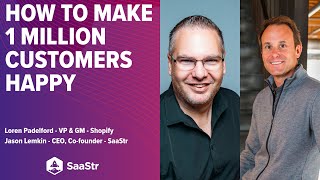
A recorded interview (July 30, 2020) where Jason M. Lemkin interviews Loren Padelford (GM, Shopify Plus) about Shopify's pandemic-driven acceleration, enterprise strategy, and the broader retail/e-commerce shift. Key points: Shopify experienced dramatic growth (discussed as ~100% YoY and ~$3B run rate); COVID accelerated e-commerce adoption—characterized as pulling a decade forward; Shopify Plus (five+ years old) grew as enterprises rapidly deployed digital channels, often in days; Shopify deliberately resists bespoke custom work and heavy services, preferring an ecosystem of partners; security/compliance (SOC 2) and enterprise conventions (SLAs, RFPs, long contracts) were addressed late or avoided where unnecessary; many enterprises 'boomeranged' back to Shopify after initially rejecting it.
Questions this video answers
About five and a half years (as of the interview).
About 29% (as announced during the public statement mentioned).
Shopify Plus ~700 people worldwide versus ~6,000 people at Shopify overall.
Loren said Shopify did SOC 2 'last year' (i.e., prior to July 2020).
Fewer than five deals lost over six years (per Loren).
Chapters
And today now because we can talk about the intersection of two interesting things. Lauren among other things has spearheaded Shopify plus which is Shopify's enterprise platform from the early days to now announced today almost 30% of the revenue. So that's like a slack esque going up market which is fascinating. And Lauren's also a long time like many of us that are here, a long time scholar and student of enterprise sales and what works and the tactics and came in as applied that at Shopify. And so every conversation we did an incredible podcast you should listen that was one of our highest rated ones. But talking about how to become more enterprise, what trade offs to make when you can't do it all when you don't necessarily have started there when you've started. Always one of my favorite thought leaders and I wanted to thank Lauren for coming and talk about this and leverage us to talk about a million customers at Shopify. A million, right. Maybe I don't, I don't know. Was announced today. Maybe 1.1 million. It does really doesn't matter, does it? It's a lot.
It's a lot. We didn't announce any new customer numbers today.
It's probably gone up.
Thanks for having me. It probably has gone up.
So yeah. So Shopify today we'll touch into it Announced just kind of the jaw dropping numbers that all that are the. It is the archetype of the COVID beneficiary. Shopify was on fire before which is one of the first things I want to talk about. But just today announced essentially 100% year over year growth at essentially a $3 billion run rate and we just have never seen this in the cloud before. So I want to talk about that and I want to talk about what we can all learn about going up market and serving customers of all different sizes. And please again, if you haven't before, click into the Q and A, ask questions. We're lucky to have Lauren and we will get to a bunch of them toward the end of the session. But Lauren, I wanted to tease on a couple things. This was a tweet you made the other day. Aaron, who's the next and final speaker? Amazon's a 1.6 trillion dot com. We live in Amazon. Not if we can help it. I want to talk about that exactly in the third point. But before we talk about everything that's changed in March 15th. Step back for a minute. I want to talk about one thing like why has E Commerce exploded? I almost get it but my first job at Internet was in E commerce. And I get why that was terrible back in the day. But what's changed in the last two years? What really has gotten better in terms of tools, technology, software? Why have we finally reached the age of E commerce? I don't totally get it. What's changed? What's the tech stack or awareness that's gotten us to this next level finally?
So I think that's a really good question and I think it's part of the reason why the enterprise is changing so fast, which we'll get to if you go back to when we started Shopify, Toby didn't want to build a software platform. He wanted to sell snowboards. The problem was is he couldn't find a platform to use. There wasn't something for entrepreneurs to just start an online store and then go sell things. You had to spend a million dollars, you had to have developer experience, you needed all this infrastructure to just get yourself online. That became a gargantuan barrier to entry, which meant the sheer amount of choice we as consumer had was very limited. So when you went online to buy, there wasn't that many options. Well, technology comes along, SAS comes along, Toby comes along, starts building a next generation of online platform. Shopify, in this case built on a newer stack, built in SaaS and built for entrepreneurs to rapidly start up. So the whole game here for us is lower the barrier of entry to bend the proverbial curve down so that starting something is very, very easy. As we've done that as you alluded to, a million entrepreneurs jumped on that bandwagon and started to launch online stores. Well, these two things of consumers got more choice, entrepreneurs launched more things, hit each other, and boom. E commerce became what it is today is I can go online now as a consumer and find a huge variety of options to buy for products that I want. And if I have a good idea, I can start it overnight. These two things drove both aspects. Entrepreneurism and the proliferation of online stores and consumers getting more and more comfortable purchasing online. I think that's why you have the last two years is just both are spinning together to create a more accessible market.
And we probably won't talk too much about Amazon through this discussion. Although your tweet's very interesting is some of the acceleration last two years. Is it a reaction from vendors to Amazon's monopoly? Is it wanting to control their brand? Like there's something in here that as an outsider, it's a little bit hard to see. It seemed like Amazon might crush everybody. Not from a Shopify perspective or an Outside perspective. But a thousand blossoms bloomed out of this Amazon growth. What's the interaction here with owning your brand and owning your channel versus a third party?
Yeah. So I think as an entrepreneur, you start a business because you want to interact with customers and you want to provide value. And so this idea of having a one to one relationship with your customer is very attractive. And it's what we're trying to support and it's bi directional consumers. I want to know who I'm buying from. We as human beings love stories. We love underdogs, we love the little guys, we love Main street, we love this entire idea of entrepreneurism. Our economy is driven by entrepreneurs. So. So there's this innate desire as a society to have more and more choice. And entrepreneurs have this innate desire to have a one to one relationship. These two things meet in the middle. And so it isn't about a competitor, it is about satisfying. What is our natural desire as a society and as humans and as entrepreneurs is to create one to one relationships and one to one stories. And you can't do that on central marketplaces and these kind of central clearinghouses. That's not what they're designed for. They might be seemingly cost effective or time effective, but they erode at the fabric of what is human nature. And so my tweet there is kind of like society can't let our choices be consolidated into a single option. That has never worked historically. It cannot work in the future because that isn't how society functions. We, we need more voices and more choice. And so Shopify is on the side of entrepreneurs trying to support their one to one relationships with merchants or with their consumers. And I think that's an attractive proposition. And why you see this proliferation and this move towards more entrepreneurs and platforms like Shopify, because it is that you and I can talk as a consumer and a brand without this middle in the way. Right. Taking the money, taking the relationship, taking the leverage. And I think that's a valuable proposition for a merchant and for the consumer on the other side.
Yep. And I want to talk about digital transformation and then enterprise. But let me hit the second point on traditional retail because you and I were having a backstage conversation before we talked. And let me skip. This was a. This was a bit of data that we need a few more weeks on, but this was one that circulated across the Internet on the. Right. Right. Which our jaws dropped and then showed up in Shopify's public announcement today. And you see it on those data and E commerce, you know, our jaws dropped Right. It's, it's, it's literally almost one to one with Shopify giving its market position. I want to talk about is it a bump or permanent? In a second. But let's talk before about will retail recover? And when I look back, like maybe the fourth Saster post I wrote in 2012, I was walk bumming around downtown Palo Alto and the last boarded up retail reopened. It's now West Elmo, but. So it was four years the last time. When the cloud was smaller. Right. When commerce was different. It took four years for retail in Palo Alto, which is pretty bougie. Right. It's pretty upscale. Took four years for the last retail. Will those boards come down? What are downtown's gonna look like? What's retail gonna look like? Because this is. We've seen five years pulled ahead and will retail recovery?
Yeah. So I think that I've said this, I think I said this on the podcast and I've said this before. I'd actually go far as say it pulled 10 years forward. Covid is a time machine that pulled 10 years.
10 years. All right, well that's the insight right there. 10 years.
But if you go back before COVID we were in digital transformation already. There were headlines constantly about how shitty. Pardon me for swearing on a live broadcast about how shitty retail was over. It was just done. Like no one wanted to go to a crappy retail experience again. So people were going to have to focus on the experience and customer behavior and all that kind of stuff. There was a lot of talk about physical retail being consolidated. We just had too many. I heard a great quote, I can never remember who said it, that basically said there are 300 great malls in the United States. The problem is there are 1400 malls. And so you had this. This was already happening. And so this consolidation, this refactoring of what retail and commerce was going to be was already underway. Covid hit and just dragged 10 years forward. So everyone thought they had another five, six years to sort themselves out. Now they realize they don't and they're all trying to refactor now. Physical won't go away. So let's just be clear. It was never going to die in the sense of just disappear. E commerce was never going to be the only way you were going to shop. Humans still value tactile interaction and so that will still exist. It will just be less so. So you can look at brands now who even as we open back up are saying, I'm not going to open all the stores, I'm going to open some of the stores because I don't need them all. You're going to see that, you're going to see a real focus on that optimization of location and optimization of experience. And because of this chart, and there is an updated version by McKinsey just a couple days ago which shows it over three months. And it's even more stark because of the acceleration online. You've seen a whole lot of brands, the ones that will survive and thrive in this market really refocus on how to create that digital experience the way that consumers want it and that's going to become a more dominant channel. So where it used to be, physical retail was number one by material level and E commerce came in under it. We're seeing this equal itself and then it's going to tip the other direction, which was the E commerce and online. The digital, whether that's mobile on your online store, whatever it happens to be, will become your dominant interaction style with your consumer. And your physical locations will, will be that tactile real world experience that a consumer may encounter once in a while. But it won't be for most retailers it won't be their dominant anymore because we're just, we're getting too used to the phones, our computers, our tablets. Being isolated inside has kind of pushed us back there, but also the technology gets easier and better and so those experiences can be great. But I want to stress again, it's not that physical goes away, it doesn't go away. It's just the change that was already happening is now just going to happen a lot faster and going to force a lot of physical first retailers to become digital first retailers that have physical components. And that's going to be a hard start.
That's interesting. The ten year, I mean you have the most, but the data is there, right? As is the Goldman date and the others. But 10 years pulled forward, right? So it's just inverting that ratio. And I think that means overall, when we talk with other cloud leaders and executives and CEOs today, the answers are more guarded. They're like, it's faster but we're not sure. But E commerce is at the, because of the nature of this little global pandemic, it's at the cutting edge, right? And this 10 years, it's crazy. It's really, it's unprecedented rate of change.
And it is, and it has been challenging for some folks because they were not prepared. They thought they had 10 more years. And so you saw major retailers go from hundreds of millions of dollars to zero In a day because they had to close the stores and that was their only line. There are still major retailers who have no online presence today. They are still transacting at zero. This is not a winnable solution. You're going to have to either innovate or the other option. And the other option is non existence.
And let's talk about that. It's interesting on this next slide on pull forward customers and what you've learned because if Shopify plus, which is the enterprise segment, the largest segment, already grew to 29% already like as announced today. That's a public metric. Right. And it's, and it's increasing like it was 20 something percent when we did the podcast. Right. So that's, that's huge change. That means customers deployed much faster. I mean they deployed overnight. Shopify plus, you know, they had no choice because their revenue went to zero. But what did you learn? What were trade offs that folks were willing to let go or how did they change their teams and how did they implement? How do they actually implement this level of change? Right, because business process change, even using Shopify, it's not easy for big companies.
Yeah. I think if we go back, so plus has been existence now for about five and a half years. So I started it five and a half years ago. And we started it because you had Shopify customers who were growing up and we wanted them to stay. We couldn't understand why you'd have to keep re platforming just because you got bigger. Why can't you just start on one platform and stay on it forever? So we created plus for that. And so the whole premise was what do customers actually want to do versus what the market has created for them. And so I mean that in like, you know, I'm not a huge fan of legacy enterprise software because I think it created a set of realities that is not true anymore. But everyone believes it's true. And so one of them is it takes a long time and lots of money to deploy software. It's fundamentally false in a world of SaaS, it is just not true. And so what we started to go to customers and say was, why if you want to launch, let's just launch the store. You don't need to have this 12 month engagement with some consulting firm and all this work and you don't have time for that. Don't you just want to be a brand? That I think was our fundamental question. Do you want to be an IT company or do you want to be a brand? And if.
We chatted before on the podcast, we had a fun conversation about the high end of the customer and some of them might want a lot of custom functionality and maybe even things Shopify didn't do today. And you were okay for now letting them go, right? We may hit that in the next slide. I suspect things have been different since March 15th because your priorities have changed. I'm willing to let an esoteric integration with SAP R4GO because I need. I need to. I need my business to run.
Right.
And so were there examples like that where customer parties just change? Like, literally. Examples that you can think of?
Yeah. So, like, I mean, I think you. I'll give you three kind of real world examples of things we saw move very, very quickly that we wouldn't have seen before. So, you know, Impossible Foods is a good one, but like the CPG spaces, all these folks who are selling food and selling things traditionally through grocery stores and stuff, like, suddenly realized these channels were not available to them or were competing directly, direct, directly against them. And so they said, okay, we want to go direct to consumer, but like, oh, I guess it's going to take us two years and look at all these systems we have. And we were like, what if it takes you seven days because you just want to sell stuff? Right? It's not that hard. It's like we're going to put pictures online with a price and you're going to start marketing it. And that's the thing. And what the trade off was, was almost philosophical. It's like they couldn't understand how you could move that quickly. And so we showed them. And so like, we have a whole bunch of examples of these massive CPGs launching in under a week, right from contract signature to launch. And that transformed their ability to innovate. They could just now start experimenting. So then you go and you take a much more traditional retailer, like a Staples as an example. And they had foresight. They came to us before COVID and they said, hey, we want to transform the business, but this thing makes us nervous. We don't know you, we don't know this thing. It sounds too good to be true. But we're willing to make trades. And what we focused on was outcomes. What do you really want here? You want it to be fast, you want it to be nimble, you want people to change it. You don't want to have a big team supporting it. Okay, great. If that's what you're into, that's what we are. So we're going to give control to the business. This isn't an IT driven process. We're focused on outcomes. And most importantly, your consumers don't want all this crazy customization. It's not a thing anymore. Like hyper bespoke environments no longer convert. They just annoy everybody because we're too lazy to go through it. Right. I just want to get to a store, see what I want to see, be able to buy it fast, not have to type in a bunch of stuff.
Right.
Not have to go through 15 screens to do it. And big enterprises were so stuck in that model, they just, you know, before COVID we were like, okay, fine, we can't help you. If that's what you want to do, call one of the legacies. They'll gladly take your money. When Covid hit, they all came to us and like, okay, we give up. We don't even know what to do anymore. But we've got to get off of this thing that costs $100 million. We've got to get back to talking to our customers. I don't have an online store that can transact. You saw in Covid, so many of the legacies just go down. They just broke. You'd go to their websites and it was like, we can't help you right now. We're busy. And it's just like, what is happening? I saw one retailer literally tell you to call them to place or they gave you a phone number. I was like, we're going backwards in time. And so I think what we said is, let's get back to basics. You got to sell. You got to sell fast. It's got to be fast. It's got to be extensible. It's got to be scalable because you are big. So you have to take a lot of volume, but you can do this much faster. You just got to give up a lot of this, like, stuff that doesn't matter anyways. And Covid forced their hand. Even if they didn't want to, they didn't really have a choice. And what they all learned very rapidly was, oh, wow, it actually does work. You actually can do that and you're going to end up getting what you want. It doesn't take the massive amounts of infrastructure investment that it required before. It doesn't take a huge IT process to drive. You can move a lot faster and still get the outcomes that you want. You just have to think about it differently.
Yeah, when we chatted before COVID on the podcast, we. I may, I may be misrepresenting or misquoting a little bit, but we definitely talked about how Even in the high end of Shopify. Plus, a lot of your buyers were line buyers. They owned the business model and they were going, whether they were literally going around it, they were making their own decision. I suspect since March 15, your relationship with the CIO and it has changed radically. And instead of. And they've become your ally much more or much more of a stakeholder in outcomes than before March 15th. Maybe that's wrong, but I suspect you've had different conversations.
It's totally true. So before COVID we were heavily in the marketing department, right? We were talking to the brand owners and they were just sidestepping the business and they were taking over. And that was great post, Covid. That's still happening. And still brands are important, obviously, but the CIOs are definitely at the table and the CTOs. And I think in large part this is an opportunity for that organization to help their companies transform where before they thought they saw it as potentially a threat. It's like, oh, the size of the organization is going to get smaller. You don't have to own the infrastructure, the security or all that kind of stuff. And they saw that as like, oh, you're encroaching on the area I'm responsible for. I think they see this digital transformation now as their next opportunity to support and lead a transformation of their companies. And that has changed dramatically and to the better. And I think the CIOs and CTOs have become huge partners in this and can play that role for their companies. They just have to kind of. It's not the same, right? I think that's still the thing is like, it feels so different that they're a little hesitant. But, you know, you're not alone. Like, you know, now plus there's 7,000 plus customers around the world and you know, a number of them a billion dollars or more online, like these are big businesses. It's, you know, this is no longer bleeding edge. It's the other way. It's. It's like if you're still on the other system, I don't know, you're in trouble. I don't know what to tell you.
And let's tease on this second point. Folks like you and me and others, we've been talking about consumerification of the enterprise or whatever version of that malpropism you want for more than a decade, right? We like the idea of easy to use products with great design that would consumerify the enterprise. And it's true, but it hasn't been totally true, right. There are other issues in the enterprise, right? There's workflows, there's integrations, there's dashboards and analytics. And just because some app we can find, Product hunt is easy to use, it's not enough in the enterprise. But maybe this is the era when you are the CIOs you're talking to, are they using Shopify themselves, like, touching it, playing with it in a way a CIO or CTO might not before? And does that kind of validate how we think about user experiences?
So, yes, so they are using it themselves. What was always interesting before COVID as an example is you would talk to the CIOs and they'd be like, yeah, my cousin uses this for their sweater store. Right? Like, I know who you are, but you weren't built for us. There was this stigma associated with size. And what we've seen now is now when they get into it, they usually call after building a store and they've built after.
Even the CIO is after. Even. Even in the enterprise.
Yeah, they've quietly built it in the background, and then they've been so stunned, they thought they did it wrong. And so they call us and they'd be like, so I built this thing. Is that it? Do you just turn this on? And we're like, yeah, it's. I mean, sure, turn it on. Like, see what I like. Whenever, when I talk to them, they're like, well, how do we. How can we test and play with it? I'm like, shopify.com Enter your email address. Build yourself a store. And that is so hard for them to understand. Like, you can have this easy to interact with tool that also scales to this level and supports this complexity that you end up in a lot of conversations just trying to explain to them how that's possible. And it's possible because we built a platform to manage the scale of millions of merchants. So by default, it can manage the scale of any individual large merchant. And we built a platform that was API first. And so this idea of headless, which is brilliant marketing, but total misdirection of reality, is just. You want to plug it into other things in your ecosystem. Yes, well, we built an ecosystem and so you can do that with Shopify. And it's like, that's the thing that ratchets them down. It's like. And it's SOC 2 compliant, and it's all these things. It's like, security check, size check, integration check. And they start running out of the check boxes. And then they're like, holy crap, this thing is so much more usable. I can now move faster. I can actually innovate rapidly in the system, which allows them to showcase the capability of their, their organizations. Instead of being an anchor, they now get to be an accelerant to the business. And they start grappling onto that. And they're like, oh, man, we could do this and this and this and this and this. Because retail is experimentation. And their CEOs are saying, we got to experiment. I want to try this, I want to try that. And Shopify becomes that thing that allows them to go experiment. And so it becomes what feels like a consumer app and an enterprise experience. And that's such a powerful tool for these businesses.
Now, as the CIOs are deploying themselves, like literally, I mean, that's sort of every founder's. That's what they want to build in the beginning. Right. Is the cio any customer goes and builds and then they inbound. Right. That's the original dream. Are you finding maybe quietly in the background, you need a little bit more services, a little bit more onboarding, a little bit more of the things that maybe weren't anathema a couple of years ago. But as this torrent has happened, you do want to make this even easier for folks that maybe are still firing up ie, or are struggling a little bit or have other systems. Right.
Firing up ie. It's amazing. Yes. So I think for us, there's some core. As we stretched up market, and I use that term intentionally, Shopify has never moved up market. We stretched up market. We took our current platform and pulled it up market. We have not moved Shopify in that sense. We are still heavily oriented to SMB and to entrepreneurs. The large ones are just a unique kind of entrepreneur. But as we've gone up, as we've gotten bigger. So like when I started plus, the largest merchant on Shopify was 10 million annually.
Yes.
Largest merchant today is over a billion annually. So these are materially different customers, much more employees, much more breadth, global, all this kind of stuff. So as we've gone up, we've tried to hold a few principles. One, we don't custom build software. So I don't care how much money you have, you can't get us to custom build you anything because that doesn't scale. And this is a trap companies fall into all the time. Is a big company with a big brand shows up and says, I got $10 million. Just build me this thing. You build it, and now you're their software company instead of your own software company company. So We've really held on to that. We've held on to the idea of not everyone's a fit. I'm not good for everybody. We still say no to a huge number of customers every year because we just can't do what they want us to do. And we're okay with that. We're here for a long time, we'll get them back later. I also intentionally said I never want to be a services shop. I don't want to be $10 in services for every $1 in software. However, as we have gone up market, we have had to think about services more and more in a where do we provide ultimate value that moves a customer from pre sale to launch as fast as we can versus consult with them on BPO and process optimization and all that kind of stuff. And we just keep drawing the line. It keeps shifting slightly. But we have an amazing ecosystem where we push most of the services too. And say you want to build the store, that's the ecosystem for that. We don't build stores. You want to customize an app, that's the ecosystem for that. We don't do that. What we do is help you pick the right partners, help manage those partners with you. We will do some support work, some aggregate benchmarking, things like that that we can provide. But we are. And that gets more and more as we get higher and higher because the expectations get more. But we are still constantly trying to hold this line saying do not become a consulting shop. We want to be a software company. But it has expanded as we've gone up market just because we see things where we have the data. So we're the best position to support the merchant in that space. But I ultimately am trying to build an ecosystem that does it instead of having Shopify do it.
I mean even Salesforce, which is obviously very powerful software but much more byzantine than Shopify, I mean they've struggled with this from the early days as we know. Right. They needed services much more. But to outsource it, right? To build the period and PWCs and train them. So it sounds like it's the same process. You just don't, you don't want to own it. You want to have best of breed partners. But there's more and more to do this 20 you say that Shopify is an SMB customer. When I see 29% I think slack. The majority of their revenue is enterprise even though their roots is. I think it could happen to Shopify. Shopify could have a majority of its revenue be enterprise even though Its roots are slack, like.
And so that's true. I would say revenue is a terrible proxy for what a company's trying to do. It just happens to be the thing that everyone wants to talk about. It's like, I've always thought employee base is a terrible proxy for success. Having lots of employees doesn't mean you're actually successful. It just means you have lots of employees. So there are very large companies in the world with tons of revenue who have no customer value. And so, like, I just don't see this. I'm not arguing your point. I think our perspective would be the merchant mix is a better indication of, like, our interests and what we're doing than where our revenue comes from. Because revenue is mathematics. In our space, there's monthly fees, payment fees, that kind of stuff. By mathematics, the large ones will overshadow the small ones. But when you have a million small ones and 7,000 large ones, ask me what the company's doing. We're doing both. But no one could claim we're not doing the small market just because of where revenue comes from. So I think that's a nuance I'd suggest is revenue's an interesting indicator of where some of your cash comes from, but. But it doesn't tell you necessarily what the company cares most about.
Yeah, it's a good insight and it's a fun. As all of us have been doing this and as founders, too, it's a fun tension to watch. Right. And watching Stuart Butterfield start wearing a tie more often. I haven't seen Toby wear a lot of ties yet and suits, but I will. I am going to tweet at you if I see one. If I see the Kangal hat come off and the tie, just one Bloomberg interview at 10 billion run rate, and then we're gonna. We'll have a laugh about it. I'm not saying it's going to happen.
But I'll tell you, I'll tell you that, like, I would be more shocked than you if that were to happen, because I think he'd get more internal chirping than he would external and so like it. But it. This is the. We are okay to say no to things. This is who we are. We say no constantly. And so I've said to my team, and we say to Shopify all the time, we're not trying to become the market, we're trying to get the market to become Shopify. And so it manifests itself in that kind of way. It's like, yeah, if us showing up in A suit is the reason you will or won't talk to us. Let me help you with this conversation. We're out, right? Because like, it's just not like that. If that's the thing you value, we're having the wrong conversation. And it's not about disrespect or anything. Like, I'm sure if, you know, I'm sure there's a scenario under which he would wear a suit or I would wear a suit. But when you think about it from a market perspective, this is the same as like the CIOs is when the CIOs were like, well, you know, we have to have all these things or we're not doing business with you. Okay, great, don't do business with us then. I'm sure there's a bunch of software companies who will comply with this ancient way of doing things. We aren't one of them. So when you figure out a different way or want to talk about a different way, we'll still be here. And I think that's been one of the keys to our success as we stretched up market is not falling for the brands or falling for the money and just saying, look, we're trying to build something that not everyone's going to believe in and a lot of people will say no to us. But we're here for a long time and we're gonna do this. And we think this is the right way. And it is a bit philosophical more than it is logical. But like, if you're gonna try and do something no one's tried to do before, like it is a little bit philosophy more than it is standard business. And you know, I don't know. I mean, Toby's tweet this morning was I think indicative of if you're into this kind of thing, I think we're doing okay.
I just one follow up that and I want to then talk about boomerangs we talked about before. But then I want to make sure we have time for questions so. Because there's usually at least a couple good ones. But just it's a super interesting idea of 29% of the revenues from plus from enterprise. But we can't let that. You can't let that be your North Star. It has to be the corpus of customers, right? The million and what they want. But at some level, when you're doing resource planning and Shopify is a big company now, it's a tiny company, it's a rebel, but it is a big company. Do you have to do some of it that way do you have to allocate 29% of engineers and 29% of the team meeting at some. How do you. Because I find that a useful exercise. Even if you don't follow it, it's a useful paradigm to think about because if you don't, the distribution can be, can be, can be based on passion or emotion and not data. So you divide anything up based on that 29 versus 31 or 71 rather.
No, no. So I think that the better way to think about how we make those kind of trade offs is the way I use the mental model I have is Shopify is a flotilla.
Yeah.
And the big central cruise ship in the middle is that core merchant. And what you have outside of it are all the other ships in the flotilla. Plus is one of the ships. Retail is a ship. Shopify money is a ship. We're all ships. We're all tethered to that middle and we're all building along a continuum of merchants. It's like there are small plus merchants that are doing half a million dollars in revenue that are still on plus because they need some of the features. And then there are big Shopify merchants that are on a Shopify plan and not on plus because they don't need some of the plus features. So we're building on this continuum and the flotilla is pulling all the time. Like we're each pulling in slight directions. And there's this near constant discussion about resource allocation based on opportunity. But isn't financial opportunity, it's how do we make commerce better, how do we support more merchants, how do we give more flexibility and more extensibility? It's never a financial discussion where, hey, I can make you a whole lot of money if you just give me all the resources. Because again, money is a BRAD proxy for success. And so we are in a constant discussion as a flotilla about course alteration. Right. It's like, oh, we're going to nudge a bit this way this time and a nudge of it this way this time. But it's not nearly as pragmatic as oh well, X amount of the revenue comes from over here. So we'll dedicate X amount of the resources shop. And to give you the example of that plus is about 700 people worldwide against a 6,000 person company and is 29% of MRI.
That's sort of the question.
Yeah, Right. And so it's just like it's disproportionately small, but it is amazing what you can do with small teams with just.
700 with just 700. Imagine one more I want to do and then I want to make sure I get. We had a couple questions offline and a couple questions online I wanted to get. But when we chatted before, you chatted about letting customers go where you weren't the right vendor, having the confidence to do that, having the confidence about your mission and that they might boomerang bank later. And that's great. Right. I assume there's been a lot of boomerangs since March 15th. Maybe not. Maybe it's all actually been folks that weren't that had different solutions or different. But has boomeranging changed since March 15th? Have you learned about any lessons on how to handle boomerangs? Because if you go long, they will come back if you have a great solution.
Yeah. So this is a core belief of mine, is you have to be able to say no to customers. They're not all good. Right. I mean, statistically impossible. That every customer you talk to is going to be a good one. So you have to know what you're good at. We're optimized for success, not money. So I need customers to be ridiculously happy. So they go out and tell all their friends, and all their friends come to us. And so we say no a lot, and we still say no. But the premise is gracefulness. Say no gracefully.
Right.
It's not you, it's me. Conversation like, you're a great business. If you want to change. Here's the things we don't think we can complete either. It's a, you want to do the thing this way, and we want to do it this way. But you always leave the door open. Never close the door, never burn a bridge. You leave it open. Hey, if you want to keep talking, we're here. We'll keep talking. So when they come back around again, you're gracious. It's not we told you so. It's not, oh, look at us. We were the right. It's hey, great, what would you like to do? We're still. It's the same discussion. We're still here to make you successful. If things have changed, let's talk about it again. But I see so many companies who just say yes to everybody under the auspices of any money's good money. And the problem is it's not because it's a resource distraction. And ultimately what you need is happy customers more than you need the money, because happy customers will lead you to the money.
Well, that's the real answer.
Both.
Right. Sometimes I think you should take the customer if you can make them happy if you don't want to do it. But it's the happy customers that matter more than the money. The money. You're going long.
Totally. And so I think that's what we've done. So your boomerang question is 100%, right? 100%. We've had boomerangs that three years ago. We're like, we're never talking to Shopify. You can't do what we want. Who are back in our pipelines. And I think that's great. We've developed a lot. The market's developed a lot. They've developed a lot. Toby has a great saying. He says we can all wake up tomorrow smarter. And so if we woke up the next day and we were smarter, great. We get to make new choices. And so those boomerangs I think are just, we all woke up smarter. New choices to be had. Let's move on and figure out how to make people successful.
One question, because I think this is interesting to founders, even though it's going back in time. But Adam asks what customer number or revenue. But it may be more milestone based for you. Did you take the steps to do the SoC2 that you referenced to do more enterprise grade security and compliance? How did you think about that? And sequence it as you. As you grew? Plus.
I don't think we'd sock two until last year.
Yeah. So that's late a lot. Shopify did a lot of things late. Well, and here's the reason has done pretty well.
So I don't have an SLA. Okay. We have no SLAs at Shopify, right?
Yes, the CIOs, I bet ask since March every time. Where's your SLA?
And so when we first got asked that, everyone was like, oh my God, you're going to have to have SLAs. The number of times I got told, when you get to the real world and sell to real customers, you're going to have to change all these behaviors because no one will buy it. That real world place sounded like a terrible place to live, so I just refused to go there. And so SLAs as an example of enterprise y things that we just have avoided. When they showed up, I was like, why do you want one? What do you think is going to happen if we go down?
Well, nothing. SLA in some ways is the stupidest thing. If you think about it, it accomplishes nothing. Even if you got $6, there's nothing to do with it. And it doesn't make the app better. But they want it.
Okay. And so I had that exact conversation over and over again. And so I can count on one hand the number of deals we lost because we didn't have an sla.
Yeah, see, I would have made one in a Google Doc, but I'm with you. I'm with you.
But like to be. No one has time for. I don't have time to make you an sla. Right. So I think we have avoided a lot of the enterprise Y standards by just questioning the standard. By being like, why? Why is that important to you? What is the thing you think you need here? And then what we found is no one actually had good answers. What they were used to is just like the big five legacy software companies would show up with this standard package. It became the norm. They asked everybody else in the world to comply to it. No one ever pushed back because they were big companies. And so all small companies adopted what those five legacy platforms created. And we just refused to adopt it. We just kept asking why? Why do you want that? Why do you need this thing? Why do you need that thing? And so that applied for contracts. I have a one year contract. I mean, I don't actually care if you sign it or not. I mean, I kind of care. Right. But if you sign it, in many.
Ways contracts are just as stupid. Let them go.
Let them go. I want you to let them go.
Let them go.
Greatest platform in the world. Not because I have you locked into some five year agreement you can't escape from. It's an incredibly. It's backwards. I'm here to make merchants better, not to lock them into things. And so there's so many parts of enterprise which are fiction, they don't actually exist in reality. It's just been created by organizations to make themselves more money, which. Okay, I mean, you want to make more money, that's fine. But there's better ways to do it. To lock in customers to platforms with crappy outcomes so they couldn't escape. Right. Once you're there and it didn't work, you can't leave.
Any three year contract is powerful.
Yeah. And so my advice to everyone is hold off longer than you think on. Just keep asking your question, your customers, what they expect to get from you in those things. What do you want? Right. And you'd be surprised. Most of them, they don't really want that stuff.
Right.
What they want is the outcomes. They want to sell more stuff. They want to use your platform to get to some end goal of theirs. There's a lot of lawyers, maybe that ask for things, but I don't know.
Don't be. It's a good challenge. No one agrees with you more that an SLA and a contractor. Stupid. They're literally stupid if you think about them. They're stupid and they're even antithetical to building a great product because you want to be held accountable every nanosecond. Right. Having said, it is interesting that you say you lost some deals to it. Right. And so in the end you want happy customers and it's okay. But it's an interesting comment on both sides. There is a trade off. Right. And that trade off doesn't necessarily work for everybody at every stage of their life.
Sure. But let me clarify. I lost less than five in six years.
Okay, fair enough.
I did not lose customers over this. Right. And the amount of time and effort it would have taken to comply to that would have far exceeded any money I was going to make on those six customers.
Well, that's the more analytical than the ethical or moral example. The juice wasn't worth the squeeze at the time, right?
Totally. And it still isn't. And so SoC2 look, great thing to have. I'm glad we have it. We avoided it for a long time and again, we never lost deals because of it. It was just, it's one of those questions Security shows up and asks, well, look, we built this giant platform. We have an amazing security team. They talk to merchants all the time, they convince them that we are doing it and they get off this idea of needing this certification that is 99% of customers. Now we did it because we're also at scale and you know, we have some government customers and stuff like that. And so like there was a good reason to do it, but we avoided it for a long time. The vast majority of our customers never ask if we have that kind of stuff. You're talking about super outlier scenarios. So I think enterprise startups, and I really hate that term, we got to come up with a better term. Startups who serve large, complex customers get convinced they need all these things in order to win. And what I'd suggest is that's not true. Sit down with your customer, ask them what they're really trying to do, what they care most about, what the outcome is, and then walk them through how you operate. When we were early, it was like, well, you need all this stuff because what if you go down, Mr. Customer? Look, my entire business is SaaS. My entire business is about being online. If I go down, I have much bigger problems than talking to You.
It's what I think about every moment of the day. It's logical. I like the pep talk here. I'm feeling better about this approach.
And most customers will just be like, yeah, okay, I get it. Let's move on to the thing I really want, which is your platform that helps me do what I want to do.
I'm with you. Let's break. And I think we've all just been through those brutal security audits, those 500 page documents that come through, procurement that come through, and that department is still here in July, July 19th. And we've all lost a deal. Maybe it's only five. We all lost a deal for not responding to that questionnaire or not checking the boxes when we've been in a multi vendor situation. So a good challenge. What's that?
Don't do RFPs.
We all want to not do the RFPS too, but. And I'm with you, I'm aligned with your values. But sometimes as a small startup, when you're building your brand, when you don't do the rfp, you don't get to go to the dance. And it's going to be if it's a game changer deal, if it's closing a Shopify or a Microsoft or a Google, sometimes, sometimes you got to do the rfp, I think. But I'm not saying you're wrong.
No, I would agree. I just. What I'd say to all the founders is do the math. 80% of RFPs are decided before they ever send them out to the public. If you aren't talking to the customer already before you get an RFP, the odds that you win are less than 1%. And so like, is it worth it? Like, sorry, it's just math. It's not an opinion, it's just the math. This is why we don't do them. It's like, you can't win. I didn't write it, so I can't win it. If I wrote it, I can win it.
That is the art to the RFP. All right. It's good. I know. We're exactly at 150 where we've got to end. Lauren, this was amazing. Anything you want to add at the end that we didn't touch or anything you want to hit? Anything, Any, any, any book tours or any new channels or anything, you know, anything you want to hit? Shopify plus you want to, you want.
To highlight before we break everyone in the enterprise space. Stop acting like the enterprise. Right? This was a world created by five software companies that worked perfectly for 50 years. It's over. It's over now. They're big. It's going to take them a while to wind down some of this stuff. But that world is over and it's over the more we push on it. So don't just, like, comply to a world, like, to a world created by others. Let's create a new space. There's enough. You're going to talk to Aaron shortly. There's another. It's like there's a new version of enterprise in the world led by everyone probably listening to, to this call and everything else. Like, we all got to stop acting the way that the enterprise software space has acted for the last 50 years because, like, it's just not, it's not, it's not working.
I'm going to try to quickly ask them about SLAs and RFPs, but I am with you, Lauren. It's always more than a delight and a learning experience being with you. So thank you again for joining us and this was terrific. And stay safe.
Thanks, Jason. Appreciate it. You too. Bye.










