How to Scale at Warp Speed While Staying Innovative with Totango and Zoom
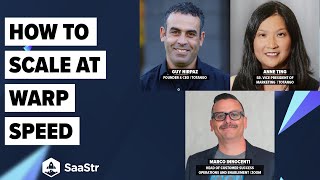
Guy Nirpaz and Marco Innocenti from Totango and Zoom discuss scaling customer success without losing innovation. Totango's survey of 1,600 companies found that tech-touch models and health scores let teams handle 1:50 to 1:100 customer ratios, while customer success increasingly works cross-functionally with sales and marketing to drive expansion and upsells.
Chapters
Session with Saster Enterprise. We're excited to have you here today and be with us as we are with Totango and Zoom as they talk how to scale at work speed while staying innovative. Just so you guys know, if you want to have any questions, feel free to throw them in the chat for our speakers here today. And at the same time, don't forget, as always, you're being recorded and launched. But without further ado, I'll pass it over to you guy to kick us off.
Thank you very much, Caitlin. Hi everyone. Welcome to our session. We're going to talk about how to scale warp speed. What we missed is to say how scale customer success and business and warp speed. We've got two great speakers with us today. I'm going to be your host, Guy Nirpas, CEO and founder of Totango. And let's get our speakers to introduce themselves. Marco, why don't you start with introducing yourself?
Perfect.
Thank you, Guy. Hi, everyone, Marco Innocenti. I am the head of customer success operations and enablement at Zoom.
Hi everyone, Anne Ting. I am at Tatango and I run marketing and vice president of marketing at Tatango. Very glad to be here.
All right, great. Great to have you guys. Thanks for joining. We are going to start with going to move the slide. So since I guess very early in 2012, we started to tango start running annual survey about the state of the customer success market. And we would love to share with you today the key findings and validate those by asking Marco, who has been on the probably the fastest rocket ship last year and still going with Zoom, of whether he validates these findings or does he see the world differently. So Ann, can you talk a moment about the survey and what were the questions and what did you find? Or before we jump into the key topics.
Sure. So we've done this survey for the last eight years. This one was our largest yet. We've had about 1600 people who answered the survey. Survey, it covers all sorts of topics. Obviously it's kind of changed as trends and customer success has changed, but really focusing on where the key challenges, what are the areas that are the biggest goals, how are customer success teams organized, what are some benchmarks for how they're using technology, how they're kind of organizing their teams and functions, and what are some of the compensation trends as well for the industry.
All right, so drum roll. Three key findings. We're going to talk about them. So what's number one here? I'm flipping to the slide. Here it is, Here it is. So what's top of mind for customer success circa 2021.
So obviously we're here to talk about scale. So I don't think that it's a surprise to everybody here in the audience that scale actually jump to be the most important challenge. I do think it's a surprise because in the past years this hasn't been as high, but last year it's risen to the top. I think when we see that so many companies are growing and there's an influx of customers, that it's become more and more difficult to manage them and to have very personalized customer journeys at scale. So you know, you don't want, when you have customers of that volume, you don't want to be queuing them, have a CS person assigned to them. That just doesn't work and it's a really bad experience. And so the focus is really on how do you deliver these cost efficient personalized experiences that's repeatable, consistent and also measurable. And I think if you unpack this a little bit, what's really interesting is two things. One is that the importance of data, I think in order to scale, when you think about us all becoming more and more so digital citizens, in the last year, the volume of digital signals and digital interactions has grown tremendously. And being able to really see and find that data, identify, categorize and then look for patterns of behavior so that you can engage properly with them is critically important to deliver those experiences we talked about. You'll see here that for the most part people think that they're kind of on the scale of like 4 and 5 in terms of reactive. But people who have data, who have a technology platform, they see themselves as being more proactive and how they're engaging. I think the second interesting thing here, if you look at the kind of 1 to 5,000 that's listed on here, we took a look at all the different kind of models in terms of how people are engaging. So people who have one customer success person dealing with 15 customers, a CS person dealing with 200, all the way to one customer success person dealing with 5,000 plus customers at a time. And you see that, I think those companies who already have systems in place to handle higher volumes, the kind of one to many approach, have been more successful last year in being able to deal with the growth and to scale with the growth. And you see that on this scale here. The other takeaway, I would say is that oftentimes people may feel that a one to many approach is a downgrade in experience. And the data shows that it's not that those who have that type of approach and have systems in place have been doing that is actually delivering a better proactive experience for their customers.
So who's better to kind of educate us on this than Marco? So, Marco, can you talk a little bit about the challenges of scale? Just give us an order of magnitude, what do you guys have been dealing with during last year and what were kind of the key components that enable you to scale so effectively?
Yeah, I mean, without going into hard numbers, of course. But, I mean, you know, obviously Zoom was pretty much drinking from a firehose last year in terms of what was coming in. And thankfully we did have a tool in place that allowed us to scale up to even thresholds above 1 to 5,000 where we needed to. We already had a model in place that was blended though. So we already had had what we refer to as a tech touch model that was very similar to that. And then we kind of went up and up the line of where we started to blend the reactive and proactive or high touch, low touch model within the tool. But where we were able to scale with, with how things came in last year was we could adjust those levers based on the volumes that we were seeing so we could make our low touch tech touch segment at a higher threshold really quickly to be able to hit those targets and even actually turn on more kind of proactive but automated campaigns higher up the chain, up into even a high touch model. And, you know, to Anne's point around the customer journey, where you still use that is you start dialing levers around the data on health scores and things like that, and you kind of start to triage what's important. The onboarding is huge. All the customers coming in, making sure timely information is being sent there, but you can't lose sight of those that may be experiencing a problem. So you kind of use the tool to help you adjust both of those at scale and volume.
And can you talk a little bit? I mean, clearly you didn't start thinking about scale in 2020, otherwise you wouldn't. Wouldn't have been able to meet the demand that you had. So can you talk a little bit? When did you guys start thinking about the model as a scale model? What are the principles that you put in play? When did you do it in order to think about the scale model?
Yeah, great question. I would say we started working and partnering with Tatango on that and how we would build that out in the tool. Probably just about five years now, roughly maybe a little bit after that so about five years ago is when I actually started at Zoom. The CS team was rather small. So it was a csm I think like there were six of us or so at the time. But you know, Zoom was already on a growth trajectory which was great. And we saw the need to develop the scale because you know, CS while incredibly valuable to the organization and you know, it is important around the customers, especially call it five or six years ago, it was still a harder sell and often seen as a cost center. So you can't continue to throw bodies at the problem and so you have to find other ways to get the outreach.
Got it. And did you have any kind of debates whether to scale or when to scale or you do like a automated scale first technology driven approach or versus people driven approach or. It was very clear from the get go that you know, adding more, more as they say, more bodies of the problem will not be able to support the position you were in.
Yeah, I think we went with an experience based approach. Right. So when you kind of are lower in the market, the automated emails, you know, are work just fine. But again there is a body there when they want to reach out. It's you know, but they don't need that long term relationship the same as you go up market. So as we were starting to move more and more upmarket, we didn't, you know, we still had a very strong base and so that's where we had to develop the scale was the down market side where it is still a CS engaged customer. And when they come back to us, it may be a different CSM that they end up engaging with, but we do have the ability for that person to reach out and have a body work with them. But the you know, kind of continuous automated comms check ins. Would you like account review? Here's how you're looking in your product. Those, those you know, at a 1 to 5,000 or greater scale or even much lower, you know, it's not, it's, it's not possible for a single human to get through that. But there were still bodies they could get to and you develop a pooled resource. And so we went to that pretty early on in our growth pattern.
Got it. All right, great. So drumroll point number two of the what's, what's top of mind for customer success these days? So I guess the second question is who's in customer success these days. And.
So when we started looking at our survey eight years ago that customer success is really small. It was just a customer success team. And I Think as you have seen that team evolve, it started to work a lot closer with support obviously to handle customer questions and any kind of tickets and risk areas. But one of the big things that happened last year was this jump in looking at the rest of the organization really being involved in customer success. So as you see on the type, I think it's definitely where customer success is grown up to really get to the point where every part of the organization, the entire company is involved. Marketing and sales you see here now has jumped, particularly with the CS team saying that they spend about 44% of their time, 44% of them saying that they spend over 50% of their time working with marketing. And for sales, 47% of the CS team respondents said they spent over 50% of their time working on sales. I think what this means from a takeaway standpoint is that we really need to start thinking outside in from a customer perspective on how they're engaging throughout their journey with the customer. Customer, it's not about marketing handling, you know, working with the customer when they're evaluating and having that first touch and brand impression. And then sales working on the part of the journey from purchase and then, you know, customer success coming in post sales. It's about kind of breaking all of those silos from a department standpoint, looking at the customer from their first contact to the end and enabling really a much more holistic, kind of orchestrated experience across the board. And you see that in terms of the team starting to work together. But I think a lot of the data technology and communications also have to come together as well.
Yeah. So back to you, Marco. So Zoom was always very customer centered. I remember a conversation that I had with Eric Yuan, your CEO. I think it was back in 2016 or 17 with a lot of emphasis about the success of the user and the customer. How has this thinking have been developed at Zoom? What do you guys think about the customer journey and you know, cross functional customer success?
Yeah, I mean I would, I would echo these trends pretty strongly as well. So early days, CS is very, very close or customer success is very close to customer support. The marketing has really become a crucial element of it because you do want that consistent message all through the journey. Right. So from the handoff, we want to understand what messages they're sending after they become a customer. Because marketing never stops. Right. They continue to do their nurturing programs as well. But when we're ratcheting up our comms at scale, you know, thinking at last year, it's really important for us in marketing to be aligned, to know how many comms are we actually actually sending out to a customer because you know, too many and you start to lose attention and some customers just, you know, it's not, it's no longer the delight experience around that. Right. And again, if it's not consistent, marketing might send an email with a different form and format that we do or it has a different type of call to action that doesn't lead back to the csm. So us being really tied in on the types of communications all through the journey have become something that's really important. So that alignment for us, I would say has grown quite a bit over the last year. Sales as well. We've always been really close to our sales counterparts but I think we did see a greater alignment coming out of going into last year. Like, you know, it was kind of one of those situations where it was all hands on deck and everybody helped with everything with, with where Zoom was. And that really did build a good partnership and a better partnership than we already had with sales. And we're continuing to this year. You know, the renewal is probably the key example around that. You know, everybody is responsible for the renewal at Zoom. So sales, marketing, support, whatever organization it would be. The renewal is very important to us, especially with the volumes we brought in last year. So making sure you're working with your, you know, your account executives is crucial for that experience for the customer.
Yeah, this is to me this is so exciting to see that organization are adopting outside in customer first, you know, revolving around the customer experience and the customer journey and not tied to their functions. That's really great to see of customer success is company wide mission. All right, so last point and we've got a few more minutes before we open it up for questions. How is customer success driving growth? Ann, back to you.
So I think this, the data here aligns I think nicely with what we just saw previously. Which is that part of the reason I think with the increase in the collaboration with marketing and with sales is because in terms of the customer journey, the areas that saw the biggest jump in where people were focusing the market has turned to is really around expansion advocacy. In the past I'd say that kind of churn reduction areas earlier in the journey in that piece may have been more of a focus. But now last year I think the recognition that the growth element of the whole customer success chain is around advocacy and around expansion advocacy I think throughout the experience, but also in terms of referrals as customers are getting value, you see on the right kind of the success flywheel where, especially for product led growth companies, PLG companies, where you're opening access people, people are coming in, you're trying to quickly get them onboarded, getting value, they become customers or they still continue to activate. Ultimately that's great, that's delivering outcomes to them and value to them. But the growth cycle comes when they become advocates, referrals for you, for new customers from acquisition standpoint, or they're expanding the relationship with you in their business. So I think that's a, that's an interesting thing that we're seeing. Definitely growing, will continue to grow in the market.
Marco, is this also true for you guys? Kind of where the mission has shifted to focus on business growth, kind of customer success, customer success activity to drive growth, or is it still, you know, more the front of it, which is kind of onboarding new customers and you know, managing the, nurturing them all the way through?
Yeah, it's so much more the latter with a lot of it. And there is an expansion element, of course, of being aware, you know, and this is where again, a technology comes into help, you know, being aware what tools a customer does and doesn't have and how much they're using whichever tool they're having. And you know, then working with an AE to best fit that customer, whether it's up or down. To be honest, the advocacy piece, I think is what's really interesting to us. You know, again, last year, just with what was coming in, I would say that was a lower, that was probably, that became a lower priority through, through how we were functioning. But this, we are actually coming back to this, to this now as a key element for Zoom. We, you know, we have a lot of great stories that have come out of last year and, you know, building in the mechanisms to share those with the customers and everyone else or prospects, whatever it may be, so that they can understand how they're using. So this is actually something that we've recently started to refocus on as we've kind of stabilized our engagement model around our base.
Got it. All right, great. So I think we're just at the mark and these are great insights I think we've got here the, I guess the three takeaways for scaling growth when it comes to customer success. I think we've talked about designing for scale and preparing for scaling and it was great to see that Zoom was able to actually absorb the growth because they've had the necessary design and systems in place ahead of time. And that customer success is company wide. And I think for those of you who still, I don't know who still needs to sell the idea of customer success in their business, but if you still need to do it, remember that customer success is a model for growth, right? That's. It's not about reactive, it's not about, you know, putting off fires. It's about a model for growing the business, a very efficient model to grow the business because you drive value to your customers, cross functional and you get the benefits out of that. This is, this is awesome. I think we've got around five minutes for, for Q and A. And so let's see, let's see what we've got here. So there are a lot of questions here, Marco, asking more specific numeric questions for Zoom, but answer whatever you can. So how many customers? One person supported Zoom.
So that's very, it's a great question, but it's pretty variable. Right? So, and we have our structure to align with sales. So again, connecting on that partnership as we talked about earlier, so how the sales teams are constructed, we've got enterprise CSMs, major CSMs, you know, down market CSMs. And then as we talked about the at scale, kind of one to many tech touch CSMs. And within those, that coverage can be different. Right. You might have a 1 to 50 model or even less as you go to enterprise, and maybe 1 to 100 within kind of a mass market space. So there's a lot of different, I would say, theories about the best ratios, whether it's account driven, whether it's MRR driven. There's certainly a lot out there. But what we found very effective was a tiered model that maps very much to how your sales team sell. And then you talk about what that customer profile usually looks like and the demand from that type of customer profile and bandwidth and capacity that can be handled around that.
All right, I need to move the screen here one second so I can see. Okay, sorry. Here we are. All right, so another, another question was, so how do you guys think about. You clearly had a huge demand last year and you signed a lot of new customers. How do you think about keeping them as we're kind of coming out of the, coming out of 2020 into a new world in 2021, where the vaccine is available.
Yeah, I mean, big question. I think that's something that everyone at Zoom is invested in answering and being a part of. I think there are a lot of different motions around that. But also, you know, we do believe that things will kind of be in a hybrid environment for at least quite some Time to come. You know, some states going back, some not some offices, even if they open, some people not comfortable. So they'll continue to be a mix of what that is, you know, what that model looks like. And the flip side of that is a lot of that reality was kind of where Zoom was playing before. Right? It was, you know, remote workers are remote offices or hybrid environments for, for people in how the different offices function. So we're still very much concentrating on this and. But at the same time, right, we know for some customers it won't make sense and that's okay, right. Like, that doesn't change the story of, of what they needed last year. And at the end of the day, we don't want to hold customers that, you know, no longer have that need for Zoom, if the need's still there, we believe we can work with them and make sure they're still happy and comfortable with the service. But, you know, it's a big question that, you know, everyone at Zoom is very focused on.
Absolutely. I can tell you I will not replace my home office that I built with all the setup. I'm sorry. So much in love with this, with this experience.
And a lot of people moved around during this time. Right. To be able to capture that. So I think, you know, the, that environment, the office environment has changed, you know, to a degree forever. And, you know, Zoom will continue to support it.
I think there's a thing. Thanks, Marco. This is, you know, inspiring and a question for you. I think there's a question of what's the role of customer success in this new modern digital world? Or I think I would refine it. The question was about customer success. I'll refine it and ask what's the role of customer success technology in the new digital world?
I think it goes to the point of customer success is really expanded to be more of a cross company effort now. I think when you think about the tech stacks that people are using and how you need to make sure that you're delivering a consistent experience, that data has to be available to every single or part of the organization and not just one team. So I think that the role is really being able to provide that access to the information, the data, and then to be able to take that data signal and help orchestrate your engagement across the board. And I think that's really the important part to think about because I don't think now we think about customer success as a team thing. Customer success is a company like initiative now in a growth initiative and the.
Importance to orchestrate all of those engagement to create this amazing and inspiring customer experience. Yeah, I agree. I would like to thank you both, Ann and Marco, for sharing your information. You've seen I've been pretty disciplined. I didn't put and push my opinions. So I was a gracious host here. And I'd like to thank Saster Enterprise for giving us the opportunity to share these insights with you. Just for everyone that may want to check in the. Check in the survey results. I think they're coming up in a few weeks, but you can pre register.
At what's the URL tatango.com2021report.
Yeah, exactly. And thank you, Marco. And thank you, Zoom, for helping us going through all of last year. And with that, I'd like to turn it back to Caitlin. Thank you very much for having us.
Thank you guys. You guys are always a pleasure and guy. Marco, it's great to have you everyone on this call. Just so you know, Tatango has a booth and they have a lounge right after the session for about a half hour. And we would love for you to visit them in the sponsor hall. So I am dropping their links inside the chat. But again, guys, please make sure to visit all the sessions. Visit the sponsor hall and Totango, Zoom and Marco, it was great having you guys and we will see you at another event shortly.
Thank you very much.
Thank you everyone.










