How Treehouse Increased Their ACV by 67x | SaaStr Software Community
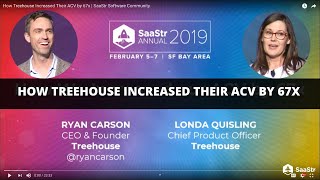
Treehouse moved from a consumer coding school to a B2B business by launching Talent Path, an apprenticeship program that increased ACV 67x. Ryan Carson and Londa Quisling share how a cardboard prototype tested with Nike and Mailchimp became their most profitable product, and why they had to separate their consumer and enterprise offerings.
Questions this video answers
2010
Raised about $12 million in equity and $3 million in debt
About 80 employees (≈30 in Portland)
In the 70s
2015
Chapters
Hey, everybody. It's good to see you all. Thanks so much for coming out today. As Mr. Announcer said, I don't know where he is. I'm Ryan, the founder of Treehouse.
And I'm Londa, the chief Product officer of Treehouse.
So we're gonna tag team it today. You're here because you want to know how to increase your ACV by 67 times. Trust me. Just take notes. You won't have to do any extra work. And like magic, you'll turn your ACV into 67 times. It's gonna be great. That's not gonna happen. So I'm gonna tell you a little bit about what Treehouse is, and then we're gonna dig into our story about how we've grown and changed and learned. Lana's gonna talk a little bit about the product journey we've been on, and then we're gonna share some final lessons learned. So I founded treehouse back in 2010. So we've been doing this for eight years now, which feels like an eternity. And the reason why I founded it is because I graduated from college with a computer science degree, and then I got a job, and I did nothing in the job that I learned in college. I thought, something's really broken with the system. Why did I go to college for four years and I'm using nothing that I learned? And it bothered me so bad that eventually we started a company to build a better school. So the idea was make this school affordable, make it accessible, make it effective, and then people get jobs. It was 100% online, so we did zero in person. It was about 25 bucks a month, and we bootstrapped it. So I actually used, ironically, like, a conference events business like this to bootstrap the company, and eventually it worked. So I remember I showed a friend of mine named Kevin Rose, who happened to be an angel investor. I said, look how like, look, we're making money. And he said, I want to invest in that. And I was like, I don't know how to do that. So let me read a book and I'll come back to you. We eventually did raise money. Not a lot, about 12 million bucks, and we raised 3 million in debt. So we're extremely capital efficient. I'm proud of that. We're about 80 employees now, and we now have a B2B product we're going to talk a little bit about, which is part of this journey. It's called Talent Path, and we help companies build and retain diverse and balanced teams in engineering. So that's a Quick kind of background on us. I think we were successful early with Treehouse and I'm proud of our MPS now. What is our MPS now?
It's in the 70s.
Yeah, it's in the 70s. We're extremely proud of that. But the reason why the school is so good is because we focused on having full time teachers in house that worked on the curriculum. We don't have guest teachers, we do have some, but we have full time teachers that iterate on the curriculum. They make the curriculum better. It's a big part of who we are and I think that's reflected in the product. We're very friendly and our approach is that when you go to school you just want to feel like you are talking to a friend. Learning. And it has worked. The user base grew really quickly. So launched at really the right time and in the right conditions. I think it was us and Codecademy kind of at the beginning and we saw a lot of success. Early on we expanded to 10 core languages. We actually just started with HTML, CSS and a little bit of JavaScript and the consumer product got really mature really fast. And then we were rated number one online school a couple times. So the consumer business was growing and working, but then we had more to learn.
So over to Yolanda and so I'm going to share kind of the next phase of our journey. So as we were gaining momentum as a top rated online tech ed school, we started to notice that businesses were coming inbound and they were asking to purchase licenses for their teams. Turns out that developers and designers had been using Treehouse at work and they liked it so much that they were recommending us to their colleagues and when their licenses came up for renewal, they were asking their managers to purchase them. So we thought we were onto something. And in 2015 we formally launched our B2B business. We hired a small sales team and had some quick early wins, as many of us do. But it wasn't long, as you can imagine, before we started to encounter challenges and really cracks in our business model. And the first of these challenges was competition. But it wasn't the competition you would expect. We, when we looked at who we were losing most to, it was actually to our own consumer product. You see, we hadn't done enough to differentiate between the business and the consumer product. And we had to subsequently spend several development cycles kind of building out additional features that were critical for businesses. The common things you'd expect, things like license management, tracking and reporting, single sign on. And one of our most popular custom tracks was which allows a manager to create a custom learning path and assign it to an employee for onboarding or to close a skills gap. So the lesson we had to learn there, and one I want to pass on to you, is that make sure you have clear delineation and value proposition between products as you expand your portfolio. Another challenge we faced was pricing and packaging. Who all here has done pricing and packaging with your products?
Just a few of you.
Yeah, well, it was very common in the early days. Kind of our pricing was all over the map. We customized it to each deal and it was heavily discounted. And we knew that this wasn't sustainable or scalable. So we went about experimenting with some different pricing models and we finally settled on what you all would really know AS a common SaaS three tier model with kind of an entry level basic package with additional features and services layered on as you go up in tiers. But the real pain came for us when guess what, those earlier customer contracts came up for renewal. Those were some really kind of uncomfortable conversations to have with customers to try and move them to the new pricing model. And suffice it to say, we had some churn, unexpected churn, and that was a bit painful. So lesson learned, make sure you tackle pricing and packaging early before you kind of have too big of a mess on your hands. Another lesson that we had to learn was that you can't be all things to all customers. For us, it was learning that we couldn't compete both in breadth and depth and content from larger competitors with deeper capital funding. We had to do some serious navel gazing to learn what we were better at than anybody else. And turns out we're better at teaching beginners how to code. So that is our guiding star right now. We use that and that's what we execute too. So at the same time we were building this B2B business, we were also developing an upmarket consumer product that was focused on outcomes that we call our tech degree. You can think of the tech degree as an alternative to a computer science degree. So we went to market with a beta launch in late 2015. And we really had overwhelming interest. And the feedback we were getting from our beta students was super positive. We were onto something. We had a lot of discussion about that internally. And so what did we do? We went all in. Within five months, we had developed six very robust tech degrees and we publicly launched those to the market in 2016. And then we waited. First problem, we couldn't get enough press to pick up our launch. We've been so internally Focused that we let our social and press network atrophy. So our lesson that we learned is always be networking. The problem number two is that we went out with too many tech degrees. Now I know that might sound counterintuitive, like isn't more better? Well, in our case, more just meant more expensive and time consuming to change. You see, we hadn't learned everything that we needed to in our beta launch and our students were still giving us very valuable feedback and we were continuously iterating on the program. So in hindsight, we really should have launched with just one tech degree and kind of iterated till we got to product market fit before expanding that product line. Problem number three was again around pricing and packaging. This time we went out with three price points. And that had kind of two fallouts. The first is it really confused the students in our market. Imagine you got six tech degrees, three price points, that was 18 choices that we had to explain pre paywall. And the other fallout is that we hadn't really nailed down our costs yet and so we would have been better off to collect months of usage data before layering on expensive services. The fourth problem that we encountered was that it was around our market strategy, which was mainly to upsell our existing customer, our consumer students, to the tech degree. Now that was and is a fine strategy, but it shouldn't have been our only strategy. You know, in hindsight we shouldn't have relied too heavily on upselling existing customer base to a higher end newer product. But you know, I've been talking a lot about the challenges and the lessons we've learned, but I'd be a little remiss if I didn't share the bright spots and the things we're starting to get right the first time. You see, we have a motto now. We really build things out of cardboard first to test our assumptions and then we iterate quickly and cheaply before investing too heavily in product development. We've also learned to look for what we call reaching demand versus aspirational demand. And I'll give you a perfect example. In the early days, our tech debris students were asking each other in Slack, hey, can you review my project before they submitted it for professional grading? And this was really kind of a time consuming and clunky and noisy process. Yet more and more of our students were doing this. So when we dug in to try to understand why, we really saw the true value to the student. First, it was giving them a huge confidence boost. But second, it was an ideal learning opportunity because the more you see others code the more you learn. So we actually set out to build a peer project review system. We built it first out of cardboard, and then once we'd nailed down the workflow and the process, we built it for real in the app. And it's one of the most valued parts of the program today. So that's a journey into B2B and up market into consumer. And I'll turn it back to Ryan to share our current journey.
Cool. Thanks, Londa. I want to emphasize Lana's point about doing things in cardboard first. I think the problem with this industry is that all we talk about is scaling. It's all about scaling, right? I want to get to 100 million now. If I'm not doing what's not scalable, I'm not doing it right. And I think that the brutal truth is, all of us who are in the trenches doing this stuff is that actually the first thing you do is totally not going to be scalable. And it probably means you're onto something if you're doing something valuable and it's not scalable, and then you figure out how to scale it. So I just want to encourage you, if you feel like you have a feature or a product that is working, your customers love it, it's profitable, but it's not scalable, then that's okay, and it's okay to start there. And don't feel bad that you don't have some sort of unicorn exponential graph going yet, because you can't get there until you figure out how to do something valuable. So just want you to hear that, and that fits into what I'm saying next. So Londa, I think, is being a little kind to me as a CEO, and there's a couple things that I was not doing early on, so I'll touch on those real quick. So the reason why our B2B product was basically our consumer product is because I didn't do my job of going out and figuring out what product market fit was for B2B. Kind of thought I was a consumer CEO. Didn't really feel like I understood B2B and kind of ignored it, didn't want to deal with it, and what happened in the end. And the reason why our B2B business is really working now is because I did find something that was needed and we built it in cardboard first. So it's a interesting journey. So we were trying to figure out what is our B2B business. It's. It's clearly not this thing where it doesn't. Where people buy a couple seats At Treehouse, they hope to upscale their team. They kind of use it. That doesn't work. There are companies that are using Treehouse in an effective way, and that does work. But by and large, that's not a business that's going to help a lot of people or scale. So we're trying to figure this out. And I was going out talking to big businesses and saying, maybe we could create courses for you. Maybe we could do partnerships. And nothing was really working. And then I signed this diversity pledge. And we live in Portland. We have about 80 people on our team. I think about 30 in Portland. And I felt as a CEO, it was my moral obligation to build a balanced, diverse team. So, of course I signed it. And then I looked inward at our own team and realized, wow. I basically hired mostly white men, and that's on me. And what I decided to do was essentially a passion side project to try to fix Treehouse. And so while we're trying to figure out what is the B2B product, I decided I'm going to will a change into my company because I'm the CEO, and it's on me. So I started learning a ton. I listened to a podcast called Seeing White. I read a book called New Jim crow. I watched 13th. I started watching for sexism in every meeting I was in. I really, like, dug in, and I learned a ton. And just as a side note, if you're interested in learning about those things, those resources are a great place to start. And what I realized is that I had benefited massively from my privilege as a white male, and that had affected our pipeline at Treehouse. But what do I do about it? And so what we decided to do was partner. So we went to the Boys and Girls Clubs in Portland and said, we believe in you. You don't need charity. We want to invest in you. We want to actually use our own product. We have this amazing thing called a tech degree. It's one of the best online boot camps in the world. We'll create a scholarship, and we'll mentor you and support you through the program. And then at the end, we'll hire you as an apprentice. Not scalable at all, right? Pure, like, will and passion, right. To do something about this problem. I mean, I was literally doing, like, zoom calls with apprentices at, like, 6:30am you know, trying to get people through the program and support. And then as this program began to work, I thought, gosh, I wonder if another business would also hire these apprentices. They're amazing. And so I started doing biz Dev and getting meetings. And Nike said yes. And I just said, just pay us something. I need you to pay me something to prove that this is not just some sort of handout to you. And they paid us a tiny bit of money. And what I realized is, okay, a business, a big business called Nike is willing to try this solution. Holy cow. I think there's like something to this. And then the Apprentices came out of the program and they were extremely talented. The most hard working people I've ever met. Kind, friendly. I mean, it was just everything you dream about. Talent, right? And they came from our neighborhood. So as soon as that program began to work, it hit me like a bomb. Wait a minute. This is a problem every business has. Everybody needs talent. Nobody's team is diverse. There's talent literally in their neighborhood and they don't know it. So I thought, okay, I wonder if I could actually sell this as a program and actually drive sustainable revenue out of this so it's not just grinding passion which we'll burn out from. And so again, I used my ability to kind of network to people. I got a couple meetings and I got a meeting with mailchimp and I said to them, I know you care about diversity inclusion. I know you're trying to change your company. I know you care. Will you just try this program? Just try it. But I do need you to pay me a decent amount of money so we can actually put people on this program. And it's not me doing Zoom calls at 6:30. And they said yes. And I think as soon as they said yes, this is where the 67 times comes from, right? This is what this talk is about. What I realized is we had created something tremendously valuable that solved a real problem using our own products mixed together with some services. And we could charge sustainable, profitable revenue. And our customers were hungry for it. And at that moment we realized, I think we're onto something. So can we do it again? And then we signed up mindbody. And then can we do it again? We signed up Adobe and can we do it Airbnb. And it started rolling. And now this was not easy. And this was literally me being a salesperson trying to figure this out. But the ACVs truly increased to a sustainable, profitable level. And we were solving a real problem. Problem. And it was amazing. So the story is, if you are seeing a problem that you believe your customers have, it's okay to cardboard something. It's okay to grind it out out of passion and will and solve a real problem. And if you can Get a customer to pay you for that. Great. And then see if you can do it again and do it again and do it again. And then figure out how to scale your leads, how to close the deals. And you can build a business that way and you can solve real problems. So that kind of goes to just the heart of look for a problem that you believe exists. Build the minimal cardboard solution. You can go talk to real customers, cobble it together, and then try to repeat it. And you can end up solving amazing hard problems. So that's how we ended up finding product market fit for our B2B product. I hope that is an insight into the fact that no matter how much speakers make this seem like magic, or they act like they have it together or they pretend like everything's easy, it's the opposite of all those things for everybody. Right? Even the slacks and, you know, and the other people. If you actually talk to people on the inside, they say everything's on fire. We don't know what's going on, and we're pretty sure we're gonna die. Right? So it's okay and you'll get through it. A couple small things that I want to share that were kind of fascinating to learn who's in kind of the sales revenue side of the business here. Raise your hands. A lot of you. Cool. Why would you go to talk about acv? All right, so what I also learned is that you can scale your lead funnel all sorts of interesting ways and they may seem not scalable at first. So we do a lot of outbound and we actually get on people's radar by creating content, by doing kind of hard grinding work like that. And if you have an account based model, I would encourage you to consider something like that. Don't wait for leads to come to you. Don't think that people should know about you. Don't think that anybody cares about you. They don't. And I just would encourage you to get into an extreme ownership kind of mentality that probably nobody knows you and probably nobody will unless you as whatever role you're in, I mean, I'm the CEO, go out and literally tell people about what you do. If you have to walk up to people on the street, do that, it's okay to do that. And then eventually you figure out a lead model that works. The last thing that Londa talked a little bit about was pricing and packaging. We did not do that with techdegree very well in the beginning. Thankfully, with Talent Path, we did. So the idea was I asked Nike to pay Me a tiny bit of money. They did. And then the next customer, he said, okay, this is actually how much money we have to charge you to make this profitable and sustainable, will you pay it? And they actually said, that's cheap. Which was like, the best answer ever. And then we did that. And then, since then, we've been saying, well, maybe we should add this. How much would you pay for that? Okay, what about this? You know, and it's very experimental, and I'm talking to our customers literally face to face about these things. In fact, I had a conversation yesterday at a coffee shop, hey, so I think we could do this. You know, would you pay for that? Is that valuable to you? Yeah, that's valuable. Okay, I'm gonna go back to Londa, chief Product Officer, and say, can we do that? So the overarching lesson here is, if you're not sure how to increase your ACVs, if you aren't scaling as fast as you want, take a step back and breathe for a minute and realize that's okay, and that's actually normal. And then look at what you do offer customers, and then go literally get on the phone or get in person with them and say, we have some of these things. I don't know if any of them are valuable. I think this is some problems you have. But actually, can you just tell me about your problems and your biggest threats and what keeps you up at night? And, okay, I think we solved some of these things. Can I have another meeting with you? I don't want to sell you right now. I want to help you. That kind of mentality really works. And if you don't feel like you're a Salesperson, that is 100% okay. I literally hated sales two years ago. I thought sales was kind of slimy and just not great. And now I understand that sales is the work of just getting out in front of people and saying, we do this thing. Can we help you? And if you believe in that thing, it's actually really, really fun. So that is the long, winding story of how we went from a consumer business to majority B2B business, and how we scaled our ACVs so they're actually profitable and scalable, and we're solving real problems. We still have, like, 40 years of work to do, so it's not like we're done, but it's been a fun journey. So that's it. I think if you want to get in touch with me, I'm just RyanTreeHouse.com.
And I'm Londa@teamtreehouse.com and if you want.
To know about Talent path, just Google Treehouse Talent Path. Love to help you build diverse, balanced teams and retain people better. So thanks for listening. Take care.










