Hypergrowth, No Office and $100M in ARR with Invision's CCO Seth Shaw and ARM Holdings
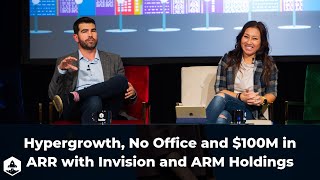
InVision's chief customer officer explains how the design platform scaled to $100M in annual revenue and 800 employees with no office. They hired globally, simplified compensation, and used structured two-week onboarding and tools like Slack and Asana to keep a fully remote team aligned.
Chapters
Ladies and gentlemen, welcome back from lunch. At this time we have Joyce Kim, ARM Holdings Chief Marketing Officer, and Seth Shah, Envision, she's Chief Customer Officer. Please welcome them to the stage. Hello.
Wow.
Right after lunch, we thought this was gonna be a smaller Q and A, so this should be exciting. Welcome. My name is Seth Shah. I am the Chief customer officer of InVision. InVision is a software platform that's built for design teams that are building remarkable digital applications and digital experiences. And it's used to collaborate with product and engineering organizations as well. Just by show of hands, anybody? An InVision customer in the room. Cool. You guys know what the deal is then? Awesome. And the reason that I was invited to speak here is because InVision as a hyper growth company is really interesting just as a general SaaS business. But we also have a fairly unique aspect to our business which is that we are entirely work from anywhere. We don't say distributed or remote, we actually say work from anywhere. And it literally means we don't have any physical offices. Everybody either works from home, potentially goes into a shared office space like a WeWork or something along those lines. But we are in 200 cities around the world and 50 countries at this point. And it makes it a unique challenge to be able to build an organization in that type of environment. So I'm happy to talk about all things related to how do you hire a team and make them successful in this remote environment? How do you onboard them and shorten the time to them being successful? What types of tools or technology do we use? So any questions along those lines are totally fair game. Feel free to. I think there's a, an app as well, but I'll kick it over to Joyce to introduce herself as well.
Hi, I'm Joyce Kim. The way I like to ask about how many in this room have ever heard of arm?
Nobody.
There's like three or four. How many of the people in this room have a cell phone, smartphone? Okay, you're all using ARM technology. So ARM is the CPU design processor for all device compute. And what most people don't know, we are actually a wholly owned subsidiary of SoftBank Group. We also have a very large SaaS business that does device and IoT data. So. And the reason why I'm actually sitting here with Seth is because Seth and I are old calls, colleagues and good friends and I thought I would moderate him talking about the work from anywhere phenomenon that he has so embraced. Before we get started, questions, we're encouraging questions. This is for the audience. If you go to slido.com and Saster Annual 19. You can submit the questions. I obviously have some questions that have been pretty determined, but I'd love to entertain everyone asking the questions. So please go to slido.com and submit them. So as the questions come up, you guys can vote it up so that if you want me to ask it, then it'll continue to be higher. Before we get started though, the question that I have for you is the phenomenon of work anywhere. I can work from home, I can move my family. Like, it all sounds great, but there has to be sort of specific things that you have to look for in order to make someone successful. Like what do you do to make sure that they can thrive in that kind of environment?
Totally. And it's a work in progress. So first things first, there really aren't that many work from anywhere companies in, you know, it's kind of a new phenomenon. So there's not really a playbook right now.
Not a full work from anywhere.
Correct? Right, yeah. That's the key difference. Like we have a fully work from anywhere culture. And so for us, it's totally a work in progress. We're learning as we go. But one of the key learnings early on. I've been here for about two and a half years. The challenge is really finding folks that have that strong social network that are kind of tied into a work environment that doesn't require them to physically come into the office to be able to have friends. And that's tough. And it takes some time to be able to find those types of people. And so we spend a lot of time screening for how connected are they at home, how connected are they to their local community. Because if you're working from home and you actually don't get out, it makes it super difficult to be a productive member of a team like ours. So some of the things that we're screening for in our interview process will be literally ask these questions around, what do you spend your time outside of work doing? What are your hobbies? What do you enjoy? What are your passions? We spend a lot of time talking through that. We also use some software we're recently coming using something called Insights site. And if you're interested, just ping me later and I can give you some of the details. But this actually creates a few different parameters that we evaluate inbound candidates from. And this might sound obvious or maybe not, but one of our biggest problems is we have a lot of people that want to work for a work from anywhere company. And so one of our biggest challenges is Figuring out how do we separate out all the folks that want to work for us versus the folks that are going to be truly successful. And so we've got a big battery of not only questions, but also tests that we run folks through.
So, I mean, one of the questions which sort of relates to this is, what's the tech stack that your team uses for both internal communication, collaboration and that whole thing? Right?
Yeah, totally. So we are huge users of technology. In fact, I would say that's one of the really unique aspects about our business. Because it is fully distributed. You can be much more purposeful when it comes to communication to your team. If you kind of think about the typical way, if we were in an office, we would exchange ideas, we'd be walking down the halls. All of a sudden, it kind of becomes known corporate culture. You don't really have that opportunity to walk the halls here. And so you have to be very explicit around communication. So we try and replicate the water cooler in Slack, as I'm sure everybody does. Our primary means for having literally synchronous conversation is Zoom. We are huge users of Zoom when it comes to more kind of work line of business specific platforms. There's a lot of use of technology like InVision for communicating around specific projects. We're big users of different project management technology from Asana and Wrike and Smartsheet and others. So a wide gamut of technology for creating communication and opportunities for intersection.
Yeah. What about processes that sort of align everybody? Do you find that being part of a fully remote makes it more taxing to do that?
Yeah, a little bit. And I'd say that's like the one skill that I've personally had to improve the most at is the process of having a constant cadence of communication. And so for the team that I'm responsible for, which is like sales and customer success and support, clearly a weekly note out about what's going on with regards to the business is something that kind of done in the past at other companies, but it's like a ritual here. Like, we've created this ritual that, like, literally everybody expects on Monday morning they're gonna get a note from me that says, this is what's going on in the business today. In addition to that, we have a whole battery of team meeting cadences that feel a lot like engineering teams with regards to standups and making sure that everybody is connected to what the mission is for the day, and then a circle back at the end on a Friday to be able to kind of come back to that and Then from a broader company level, every two weeks we do a company all hands where we'll go through everything from business results to product results to marketing campaigns and those kind of individual reach out touch points, team based reach out touch points and then company based reach out touch points set up that cadence of communication that's been successful for us.
I mean, you're one person to the question here that says, how do you measure and manage performance if you're not physically together people? I mean, it's good to have people manage their own time, but how do you actually make everyone productive?
Totally. Well, first of all, it's really hard to make people productive. You have to. Exactly. There is no kind of carrot in the stick thing that we have going on. We literally screen like crazy to find folks that are super aligned to our culture. We have an awesome set of screening questions for culture that helps us to be able to find folks that are just the right people in our type of environment. I think the most challenging part for a sales leader in this type of environment is like there has been this huge push for inside sales teams, right? Everybody's like, oh yeah, tilt up your inside sales team bdrs inside sales guys. Those folks need coaching. They want coaching. How do you replicate that kind of in person, like coaching centric culture in this work from anywhere environment? That's been one of those areas we've been spending a lot of time trying to figure out, figure out. One of the breakthroughs that we had in the last 12 months to really accelerate that call coaching culture is we use a technology called chorus. And if you haven't used chorus before, I mean, there's a few different alternatives out there. We really like chorus. They've been great partners for us. But it's literally the process of creating an environment where folks can request coaching and our managers have an expectation that they will be coaching on a regular basis. And that allows us to be able to calibrate the kind of quality control system with regards to the, you know, how do we make sure people are having the right types of conversation when it comes to activity metrics, our sales ops team are awesome ninjas with regards to dashboarding and trying to create that air of competition. And then on top of that, just a rigorous review process. You know, this year for us, as I mentioned, two years into this and we're scaling like crazy and it's got all its own problems. I'm sure all of you can appreciate that it's really difficult to triple a company in a couple years. The area that I'm most looking forward to this next year is really around more active performance management. And so we've put in place some really interesting systems for continuous feedback. One technology that I'd encourage people to take a look at is a company called Zugata. It's basically short form, kind of quick feedback cycles that are prompted through email to managers about individual contributors and vice versa. And it just creates a small little kind of feedback loop that keeps the coaching conversation going. And we pair that iterative process with a more holistic annual review process that's also facilitated through Zugata to try and create this kind of culture and performance management environment within our company. And I think it actually works really well. But one of the more challenging things about the remote work environment is just trust. It's tough to get folks to be able to take coaching if they don't have a deep personal connection and like a trust connection. And one of the challenges is always how do you build that trust in a very short amount of time. And our managers, I think, do a really good job of kind of breaking down those trust barriers. Because if you think about it like a manager will be on a call with an individual on their sales team and they'll be literally seeing each other's homes. They'll be seeing like the people that are in their lives. They'll be seeing their dogs, their pets, their whatever. And that creates an environment where folks actually start to kind of break down some of those natural walls that you don't, I guess, typically get to very quickly within the work environment where it's like you kind of put on your work face and you come to work. They have that in our environment. So we've done a really good job of creating a trusting environment. And like, one recent piece of validation to that, we're rolling out our annual plan. We have a February 1st start to our fiscal year. And I did a dry run on our hey, this is what we're going to do this year talk. Everybody's probably been a part of that talk. And it was pretty funny because I asked everybody within the team that we were doing the drywall run on. Hey, give me some feedback on areas where we can improve. If I were to ask that same question a year ago, I probably would have gotten five or six responses. Now I ask the question and we get 100 responses and it's just like, yes, we are getting somewhere. People are actually taking down their guard. They're actually participating and creating this coaching culture. And that's been like a lot of heavy lifting and A lot of work, and you don't appreciate that until you, you know, you need it.
Yeah. You talked about the social sort of network that you need. Is there anything specific about the people and their characteristics that you look for?
Yeah, absolutely. So there are some things that you would think would be really strong signals of great work from anywhere. Employees like personal organization. Turns out personal organization is like an anti signal for us. Personal organization typically goes with folks that need to have very structured environments. And we are by definition, pretty fluid. Things change pretty rapidly. So we both have signals of what works and we have anti signals of what doesn't work. Some of the things that work extremely well for us, number one, folks that are excellent communicators, specifically written communicators. So much of the benefit of working in this work from anywhere environment is that we can document process better than I think any company that I've ever worked for, because you don't have that opportunity for it to just become folklore and be adopted as a kind of thing that we do. We literally write down all of our processes and having folks that are excellent written communicators, they tend to just be great within our business. Weird. But there are a number of other aspects that are similar to that.
It's interesting. One of the questions is, do you fly in employees routinely? And it's like, where to where? Yeah, I mean, I remember Clark, your CEO, had mentioned you guys do IRL events. Like, is that the only time you fly in employees?
Yeah. So two years ago, we started with this idea that we wanted to actually figure out how tall people were that we worked with, because that's one of those random envision experiences that nobody else has. Like, literally there's Ciara Peters, probably somewhere in the room. She's right there. First time that I'd ever met her. She leads one of our product teams.
He's like, you're taller than I thought you'd be.
It happens in every interaction. So we decided to get everybody together to figure out kind of who's smallest to tallest. And it went really well. I mean, the type of people that work in a company like ours are just really interesting and unique folks. And so we had an opportunity to create this environment where we brought everybody together in Los Angeles and had this kind of blow it out week where we set the stage for the year. Works so well that we're doing again in Phoenix at the end of this month. But that's basically it. Now when I hire folks on my team and there's a couple of people that one person in particular that's on my team here, my power move right now is like going to where they are and sitting down with them and their significant other. And the reason that I like to do that is because quite frankly, if you're going to be working at an executive level within a high growth SaaS company, there's an expectation that you're going to be putting in a significant amount of time and it's super trying to be the significant other of somebody that's working in the home and not asking them to just go and pick up the kids or just go and run to the store, just do those types of things. And so having an opportunity to have that conversation and kind of figure out, hey, are you both into this? There's a lot of benefits, right? Like I tell people that I've seen my kids in the last two and a half years since I've been at envision that I had in the previous eight years. Sounds like a terrible thing to say, but it's completely true because we're at home. But are you okay with this person being here and being present for work? And is that going to be a good thing for your family? And having that conversation openly at the pre offer stage is really important for me. It's helped me to avoid some.
How many potential challenges?
Like one or two. Not too many. But you know what's the most refreshing thing is so many significant others tell me this is the first time that they've ever talked to somebody's boss through the interview process. And it creates a different type of dynamic. I think our employees think so. I think as well.
So next question is sort of about the sales. You talked about it inside sales, the energy and sort of being able to have the bells ringing and sort of the like, how do you, you can't replicate that in your scenario. How do you keep that energy going with a fully remote team?
Totally, totally. And it's definitely a thing. We just went through our year end at the Thursday last week feels like ages ago, but it was literally just Thursday last week. And it's amazing because at the end of a quarter, just like in a traditional sales room, everybody's ringing the bell and it's crazy and it's exciting. And for us the bell is slack, like virtual bell. We have a team channel. Everybody in the company is in there. You see these deals firing through and it's just like people are piling on and the whole Giphy thing goes nuts and then folks are responding to those slacks and it kind of creates this Weird type of momentum. And I talked to our leaders on Friday last week and I was just like how fun was that? And to a person they were just like this was fantastic. This is the type of environment that feels a lot like an in person environment, even though it's not. But there is a flip side to that. And one of our biggest challenges is, is this concept of suffering in silence. Everybody knows the concept of you can see from the faces of your team, like how are they doing and how are they feeling? It's really hard to see the faces of our team when they're all remote. And so we spend a lot of time through the onboarding process talking about the obligation to make sure that you reach out and that you're not suffering in silence. And from a managerial perspective, to make sure that folks are doing well, we do a regular series of just like random reach outs where we'll slack somebody a zoom link and get on a call and have that opportunity just check in and kind of virtually walk the halls like Steve Jobs would do. It is a big part of our management DNA here and it works really well.
So with that sort of in mind, does the comp plan for salespeople change in that environment or is it roughly the same?
Pretty similar. Like when it comes to like all good organizations, we tune our comp plans to be able to maximize what are those nearest term objectives that we want to drive folks to. One good example of this is for instance we have a. A new logo sales team which is focused on kind of more of your traditional Inside sales motion. 28 day sales cycle, $5,000 average order value. We were having some challenges where folks were, people were maximizing for kind of land ARR and that created a slower sales cycle for us and ultimately put us in a position where we weren't landing as many customers as we wanted to. And so we made some adjustments there to focus these folks just on landing logos with an expectation of a minimum ARR and get as many of them as you can. And over the last two quarters since we've rolled that out, we've seen a tremendous amount of success just in keeping it uber simple and helping everybody to know this is your goal post and like run. And you know, we have examples that we've learned from that specific scenario that we've been trying to make move into some of our larger deal sales as well. But I think that the biggest thing for us is simplicity, right? It's how do you take the time to think about how do we make it just drop dead simple to be successful at your job. And the comp plan is an example of one of those areas where it's like strip as much out as you possibly can. The more factors that they have to optimize for, especially in this remote environment, the more difficult it is for them to be successful.
But that could apply to non remote.
Totally. It totally could. I just, I think you don't see as many people, I think, taking the time with comp plan design because it's just like, there's some models out there. Let's just run this model for us. We actually have to take the time to figure out how do we strip out those complicated pieces.
So the next question is sort of the biggest pro and con. I'm going to ask it in a slightly different way.
Yeah.
So what is something completely unexpected that is good or bad that you found from sort of a work from anywhere team?
I'd say on the good side. And an unexpected thing is like we're all speak pejoratively. We tend to shape teams in our image. If you're like a leader of an organization, you tend to seek out people that have similar ideas to you, kind of think like you do, and that's super dangerous. And in an environment like ours where you're literally finding people anywhere around the world coming from very diverse types of backgrounds, we don't have a lot of people from the Bay Area. We don't have a lot of people from Silicon Valley that are on our teams. It's just not a thing we do. We have people from Montana and Florida and those types of things. These people have different sets of experiences and it's created, I think, a much more diverse set of kind of thought partners for us to continue to grow this business. I didn't expect that to be the case. And it's been really refreshing and really helpful for us.
So diversity is good.
Diversity is much better than it's been in other companies I work for.
Okay. Is there anything specific about your online process that you have to do? I mean, there's no office for them to go to. There's no, like, what do they do?
Yeah, yeah. It's an excellent question. The first two weeks, we have a heavily branded onboarding program called Zanya and it's literally every day for two weeks. And they'll spend time on a Zoom meeting. Zoom's got all these great functionality for breakout rooms and being able to do little micro kind of learning environments that happens in teams of typically 10 to 12. And we'll do it two weeks of Xenia and then start a new class with a week in between. That two weeks typically comes down to all the cultural components. And we spend way more time talking about the culture that we have and how you have to have, you know, you have to be courageously candid and how you have to have, you know, passion for our customers, you know, be a go getter and a go doer. A number of different aspects of our, of our culture. And I've never been a part of a company where we spent so much time talking about culture up front. But I think it's just this idea you got to be indoctrinated because if you're not sitting there physically with folks from day one, it kind of breaks down and it leads to some challenging situations. So first two weeks, kind of culture, company competitors, products, all those types of things. And then from there we get into very structured onboarding, which we call develop and roll, where we put people with their managers for the next month. And then we have a rigorous system that allows us to be able to evaluate how are those folks doing against Those core cases, APIs that we expect to evaluate them against. And we provide that out to the management team. And then we have kind of a check in process after two months to figure out how are people doing?
Is there some sort of early warning signs that you know of that basically says, hey, this person might not be a great fit for this model?
Yeah, people that are silent, people that are quiet.
So not you.
Well, I mean, sure, sure. But you know, pretty quickly like folks get the message coming out of onboarding that you've gotta be visible and you've gotta be communicating and you've gotta be asking questions. Because we set a very clear expectation that if you're not asking questions, then you're probably not gonna be a good fit.
Whether it's one on one or in.
A group setting, especially in a group setting, but definitely in one on one situations as well.
Okay, next one's an interesting, interesting question. Do you save money in real estate? Do you spend it on tools? And is there sort of an ROI on that?
Yeah, so don't expect this to save you any money. I mean, seriously, we spend a ton of money on software and travel. Not like significantly more than any other company. But I think the place where the money goes is that we tend to hire people that are really good at their jobs. And those people, regardless of where they are, have a global cost associated with them. I think the ROI on this isn't like super positive. If that's the reason that you're doing it. It's probably the wrong reason. The reason to do it though is to be able to get that talent regardless of where those folks are at. Our timeframe to fill recs on jobs is. Is shorter than any company that I've ever worked at because we literally recruit everywhere. Everywhere and anywhere. Which also has some drawbacks because if you're everywhere, you're also nowhere. It's kind of a weird dichotomy, but it's put us in a really strong position to be able to get a very quick turn on pipeline and that's the biggest opportunity for us. You think about how long your typical wreck at a company sits open. I would try guess that we're a third of the time at InVision. Just because the interest, the inbound interest, the pipeline associated with that and our ability to literally have a global talent pool that we can go after.
I mean, it's interesting because I think we were talking about the fact that because you guys are fully remote, most companies have hybrid. But do you think that's part of the reason why it's working?
Yeah, I. I think you would have a really tough time being successful in the sort of. You've got the home office and then you've got the remote folks and trying to do sort of like that hybrid model. The reason is because you get this stigma of the other. Right. You've got these three people that are sitting in a conference room and they're having a conversation and then there's a bunch of people that have joined remotely. The people that are remote are always looked at as never doing their jobs or slacking off at home. The people in the conference room are having a conversation amongst peers. But no acknowledgement of the people that are on the phone. That's a very common behavior and we don't have really any of that here. And so Joyce and I were talking about this before, but I think there is this model where it's like you're either kind of co located as a team or you're fully remote as a team. And in both of those scenarios you're kind of maximizing for employee happiness. But anywhere in the middle you get this kind of trough of disappointment or trough of disillusionment because you always just feel a little bit sort of fish out of water. So it's been really successful for us to find those completely remote environments and just lean into them.
So as a final note, do you think this great experiment is working?
I mean, yeah, look, you know, we're zooming past 100 million in ARR right now, and we got 800 people, and the company is, like, taking off. So it's one of those components that's really worked, but there's a lot that goes into the secret sauce and the recipe for making a successful SaaS company. And this is one that's been super successful for us.
Awesome. Well, thank you, guys. Very nice to be talking to.
Sweet. Cheers.










