Investing in B2B Fintechs with Upfront Ventures Partner Aditi Maliwal
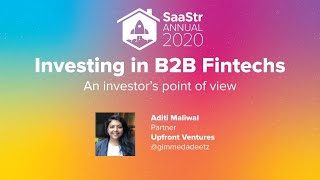
Aditi Maliwal (Upfront Ventures) presents investment themes in B2B fintech: (1) rise of B2B cross-border payments driven by remote/freelance work; (2) SMB/B2B lending as a way to improve access to capital (Kabbage cited); (3) electronic B2B payments opportunity against a large global payments volume (~$120T); and (4) the API economy (bank connectivity, clearing/custody and payroll APIs). The session includes audience Q&A covering fintech-as-enabler for marketplaces and gig platforms, payroll APIs and Pinwheel, wealth/robo-advisor strategies and advisor-facing software, and go-to-market/adoption advice for niche fintechs (e.g., tax compliance). Contact: aditupfront.com / LinkedIn.
Chapters
So in the past, if you were to send a payment across from the United States to the United Kingdom or to anywhere else, it definitely was quite expensive and logistically pretty complicated. And especially businesses sending money back and forth to other countries, there's a higher level of regulation you have to deal with conflicting bank accounts and conflicting processes for, for clearing the cash as well. And so there's been, across the board, I'm starting to see a rise of B2B cross border payment solutions. And I think the first example where this is most relevant, especially in the time that we're currently in, has been in hiring and sort of the freelance workforce in general. And so what a lot of these cross border payment solutions are allowing people to do is for business to be able to pay agencies or freelancers or businesses that are in different geographies to where they're based. And so I think a lot about it as we are mostly all remote and will continue to be if folks decide to choose to work in different countries outside of where their headquarters of their business might be based, getting paid can be really challenging. And so this has been one application, but it's definitely been an interesting category in general. And there have been a lot of early stage companies that are starting to come up in this. The second thing, the second theme that I've been thinking more about and that folks have been definitely talking about is the B2B lending space. So I think a lot about the fact that Kabbage obviously was acquired by Amex and has obviously been in the business for a long time. But funding is definitely, and this we see as investors a lot is that funding is definitely a roadblock in a lot of ways for many companies as they're starting to grow. There are plenty of businesses that will not be venture backed and hopefully don't give up equity to run their businesses and you know, take more traditional routes, whether it's debt, whether it's sort of bootstrapping and becoming profitable. But traditional lenders do require just like just as most as they do for consumer, for SMBs, they require a pretty rigorous application process and the requirements are pretty high in general. And so this in turn sometimes can prevent businesses, especially those led by different demographics, making it more challenging for them to gain access to funds and to invest in their own business and to help their businesses grow. So this has been a category where I've definitely been looking for more investment or more opportunities to invest in. And I think across the board VCs are spending more time thinking about this. I would say the third Theme that's come up a lot more for me as well has been the electronic B2B payments. So this is, I would say almost like a subsect of cross border payments. But you know, for many, many years banks and traditional financial institutions have had a monopoly on B2B payments and the estimated global payment volume is something like $120 trillion. So this market has a massive opportunity for there to be digital payment solutions. Now Obviously we've had PayPal, there's Braintree, there are so many different players who have been doing this for a while. I continue to believe that there will be space for many players in this. This is definitely not a winner take all market. And so that is definitely another theme been thinking more about and I think, you know, as the, as I think especially about where one of the, I guess the largest conversation topics that most of us are having, which I haven't really touched upon is I would say the final theme, which is the rise of the API economy. I mean we've obviously been talking about this for a long time, but given the Plaid exit or impending Plaid exit amongst other such opportunities where folks are building an API to get people access to help you basically build the pipes and transfer data capital, be able to sort of secure decisions in a more efficient way, this has been a very interesting category to watch for. And so I would say the one thing that's really come up in this for me has been not just thinking about. So I think what Plaid has done has been incredible to get people access to the bank, to get fintech access to bank accounts, to be able to help them better understand their user. But users have many different, there are many different use cases. Now I think a lot about. I've been spending time recently with a company that is basically developing an API for clearing and custody. And so there's obviously players in the space such as Apex and DriveWelp, but there is a space for other such companies to build in that category to basically allow for any financial transaction to go through, you need to be able to go through the clearing and custody process. And so how do you make that completely efficient through an API? So that's just one example, there are so many others and there has been a great opportunity to go and meet a lot of them and talk to a lot of them right now. But that's I think sort of thematic. The areas in which I think B2B fintechs are heading and sort of have already seen a lot of growth and will continue to do so. I would love to obviously hear more from other folks in terms of categories that they're excited about or things that they're seeing in the market. But that was sort of my presentation, part of this, of today's conversation. And you know, I would love to open up to any questions or any things that folks might be interested in discussing. I think someone just raised their hand, Sanjay.
We have someone raise their hand, Sanjay. And then also we can pop into the chat after that from Emil.
Cool.
Yeah. Hi there. So I'm Sanjay Gol. I'm CEO, co founder of Nacho Nacho. We're a San Francisco based B2B SaaS Marketplace. We help businesses manage and control all the subscription spend using virtual credit cards. And on the seller side, we help SaaS vendors acquire new subscribers. So we're a new user acquisition channel. So listening to you. And by the way, sorry I missed a few minutes of your talk, so if you have already referred to this then please excuse me. But a lot of fintech that people talk about is actually fintech for the sake of fintech. So whether it's payments or you know, infrastructure like Plaid or whatever else, but there's the whole other space where fintech is an enabler to something else. So an example would be, you know, companies like Uber use fintech to pay their drivers or Instacart where they use credit cards, single pay credit cards to empower their drivers and delivery people to be able to make purchases, et cetera, et cetera. NFX wrote a very interesting article called Fintech Enabled Marketplaces. For example, there's another article written about another vc. I forget the name, but they said that every brand today is a fintech company. So what are your views on where FinTech is actually an enabler for something else, whether it's a marketplace or whether it's a brand but not fintech for the sake of fintech or payments, but something else?
Yeah, I mean that's a great question. I actually read that NFX article too. So thank you for referring to that. That was definitely a great piece. So I think that, I definitely think a lot about the use cases of where today fintech is basically increasing access. And so we think a lot, we talk a lot internally within my firm about X access. Whether it is giving people access to their capital, whether it's giving people access to time, whether it's people giving people access to payment. And I think the, the Uber use case is an interesting one where you know, giving Uber drivers their, these prepaid, whether it's prepaid cards or whether it's debit cards or whether it's credit cards to get them and then actually helping them with Uber cash as well to set up bank accounts so that they get paid immediately is one that I think accessibility continue to be really relevant there. I mean I think a lot about, and you definitely will probably understand this a little bit, but I think a lot about E commerce businesses or sort of businesses in general that have running tab of payables and receivables and I think a lot that has been kind of been coming up quite a bit recently is just where access to capital would be much more would help a lot of these vendors and help a lot of these small businesses on the payable side and on the receivable side. And that's sort of where you know, we've obviously known about factoring forever and ever, but sort of I think of lending and obviously fintech in that category for helping them to smooth out their payments, helping to make sure that the business is sustainable and viable. So that's another one, that's another space in which I think if you were, if we were to so called use the word fintech is sort of enabling that industry. I do think of it as purely how to run an E commerce business or a commerce or an even a retail business more efficiently and effectively and make sure that they're sort of staying afloat and giving them access to that capital allows them to do that. I would say that sort of. And the consumer use case of that is flattening out payments for you know, whether it is to your point of the Uber drivers or to your point of anyone in the gig economy, any freelance worker giving them the ability to get access to capital in advance of perhaps their paycheck or in advance of when they will likely or in advance of sort of any payments they may expect smooth that out, allow them to make the payments that they need to, whether they're paying out rent, whether they're paying out any of their recurring payments. That would be I would say the most, the most interesting B2B use case that I've been thinking more about is on the accounts payable side. Great. And I think Tammy, you'd mentioned there was a question in the chat, in the chat box. Yes. Great. What are some, so the question is what are some examples of API use within the B2B space? What are a couple of different use cases are any more attractive than others to you? This is, this is a great question. I mean I briefly alluded to this where I had mentioned that I'm Definitely spending time with understanding the custody and clearing space and specifically understanding how there are APIs to do that, how there are APIs that are basically allowing you to make faster decisions in the money transfer process. I would also say there's been an interesting category of we're calling it API for payroll. And so one thing that I've been finding more in that specific trend is that a lot of these human capital management platforms, such as your gustos and your workdays and ADPs and rippling whatever they may be, have so much information on an employee and so much information on where an employee is. And obviously they get access to the employee's paycheck and have enough information on the employee's sort of background and data that could there be a way to sort of anonymize that data and be able to make better. Say, for example, one of these employees was looking to take out a loan. Is there a way to get access to some of this payroll data? Is there a way to make better decisions on lending? Is there a way to make better decisions on assessing what this user's profile looks like? And so that's been another category that's been pretty interesting. And at Upfront we've actually made an investment in the category in a company called Pinwheel that is based in New York that is doing something similar. I hope that was helpful in answering your question, Emil. So there's another question in the chat from Van that says, how do you keep yourself updated, stay relevant in the fintech space? Great question. I would say it is. So to some extent, if maybe this is a blessing or a curse, fintech happens to be one of the most interesting spaces that people are spending time in right now. And so it definitely is a very hot category, I would say, and there's a lot of dollars being poured into it. I would say the way to stay the way that I keep myself educated on the category is there are a couple of blogs that I follow. There are a couple of people who I sort of have long conversations with a couple of them. I give a few names. You know, I can definitely share some links too, but Money Stuff, which is a Bloomberg blog, is actually great. It's like definitely an opinionated piece, but it's one where you just learn a lot about the way someone's thinking about things. I also obviously read a couple other fintech focused blogs. And then I would say just generally in terms of staying relevant in the category, I've started to spend a lot more time with founders, obviously, who are building new companies, but a lot of them came from payments or they came from other fintechs. So getting to know folks at senior executives or even managers or junior executives at many of the fintechs has actually been a great way to educate myself and learn from them. I personally was a product manager and have worked on a fintech product before and so have had experience building. And then I would say from that experience of building there were definitely parts or things that we needed to build out ourselves versus software that we wanted to use. And so in that evaluation got to know a couple of other businesses around that around the category. I would also say staying very there are definitely a lot of people who are talking about it right now, but there are a couple of thought leaders who I think have really had an impact more on me specifically. And I would say Ben Thompson obviously is one that I just continue to believe has such a great depth of knowledge on marketplaces, on infrastructure, economy, on just the API industry in general. And so he's somebody that I also definitely look to learn from. Okay, there are more questions and the chat. All right, following your comments. So Alan has a. Oh sorry, Yara has a comment or a question. Which trends do you see in the fintech space that is tailored to investors? If it's VC, PE, real estate, etc. Do you have a hypothesis related to this space? I don't know if I completely understand your question. I'm going to try to answer it as best as I think I understand it. So which trends do you see in the fintech space that is tailored to investors? Look, I think there's a ton of people who think of themselves as a fintech founder. Now I don't know if there are specific ones tailored to investors. I would say you've heard it 15 times in this conversation already. Anything with the word API in it definitely is getting a lot of attention. Not necessarily to say that those are great businesses yet. I mean Plaid is an example of a successful business in the category. But it doesn't mean to say that every everybody knows how to sell to developers and everybody knows how to get developer adoption and then sort of grow. But I would say specifically, I can speak specifically to venture. I would say especially on the early stage venture side, people are looking for founders who have a deep knowledge. Whether you've either built something or if you have a thesis and you really do believe it and you've gotten enough user validation that this is a thesis or this is a product that does need to exist, that's probably pretty important. I spend Quite a bit of time with founders from some of the payments, some of the consumers, some of the fintech, some of the B2B fintechs that I've mentioned already. But I would say if you're asking me as a, at a high level what's hot right now, it would probably be things in the, it would probably be cross border payments, it would probably be SMB lending and probably stuff in the API economy. Okay. Alan has a question. Following your comments on financial decision making, do you see the services market primarily going in the direction of robo advisors or do you see opportunities in the wealth management space to make financial advisors more effective? That's a great question. So I do think that financial decision making, I mean I think that the robo advisors have been great and I think the robo advisors are great for particular demographics. I think demographics where people are willing to say that hey, I'm actually okay letting most of this be algorithmically managed and I personally don't need to have a ton of involvement in the actual management itself or I generally trust that I have like these sort of return levels that I want to achieve and if this trading algorithm can kind of give me that or this advisor is sort of giving me that, then I'm fine with it. I also think it's a demographic that has a decent amount of trust with technology with the ability to get the certain returns that they're looking for. I actually do believe that there is a real opportunity for financial advisors in that there is, I would say the entire demographic that doesn't believe in robo advisors or isn't looking for just the robo advisor but is looking for the high touch plus robo advisor. There's been quite a few companies in the last few months that have actually been funded that are doing this on the B2B side. So what they're doing is it's selling financial advising as a benefit to employees. And so basically if you're selling to say for example a large tech company, you want your employees to make better financial decisions and you sort of use it as I would think of it as like an HR benefit that they provide to their employees and so you provide them. And so I think the original company or one of the original companies that was doing this was Learn Best and they were basically providing employees with a financial advisor and helping them to make financial decisions whether it's saving for a house, whether it's saving for their children's college and whatnot. And that's where I think financial advisors for the demographic that isn't dependent on Robo or that isn't looking for Robo advisors. There's actually this B2B play that is really interesting and that's been a category that I've been quite excited about actually. Shiloh has a question. We are a non.
Sorry to interrupt as well. Before we dash, we do have Shiloh and then Anand has also raised his hand. Oh, I'm sorry. As a participant, if we can run through these last two questions, that would be fantastic.
Okay, great. So Shiloh has a question. We are a non traditional fintech startup in tax compliance. What can startups like ours do to open up subcategories that are beyond payments and financing? So you're in a very important category. I definitely think of tax compliance as one that most people probably don't know very much about and are probably leaning on others or leaning on an agency or leaning on an advisor to help them do this. And so one thing I think a lot about when startups are starting to think about how to sort of establish themselves is education. So it's education of your customer. And I especially think your customer oftentimes this is gonna sound weird, but they don't know what they don't know. And so by you explaining to them and sort of showing them what in sort of whether it's putting out medium posts, whether it's putting out blogs, whether it's creating a newsletter, whether it's putting out content and customer testimonials of like how people have used your product or your software and how they've benef from it. That's actually such an easy way of being able to create a category. I think a lot of times people assume that you would know how to use an API for or software for customers don't all honestly have or don't always know how to use it. And so educating your customer is something you can do really easily by starting to put out pr, starting to put out your own content. And that in itself will help you to open up some of these subcategories. So highly recommend doing that. And then Anand.
Hi, thank you for doing this. The question I have is, I guess you know, Alan here is also addressing the wealth management space as financial advisor. So Alan, I'll share my email. We should probably connect. I'm also in the wealth management space, but from a VC perspective. I know private equity has been going into the wealth management space a lot, but what about the vc, you know, do they think that there is a lot of value creation in the wealth management space and then I'm in the advisor tech. So it's kind of like fintech wealth management or wealth Tech Advisor Tech. Right. What's your thoughts on that space overall?
Yeah, so I would say, you know, within. So I think, and this is sort of going back to the question that Alan had too, which is the one question I suppose that VCs would consistently ask is scalability. Right. And if you're sort of working with Robo advisors, one thing that people, people have benefited from is robo advising allows you to scale. It allows you to scale your strategy, it allows you to scale advice which is something that in person or individual advisors maybe struggle with to be able to. How do you address 100 customers needs or 100 clients needs. But I think that sort of going back, one thing that I do think is really in favor of is being able to provide this. I think when I think about consumer businesses versus B2B businesses, I think building a wealth advising company specifically for consumers, the challenge always is like how do you acquire? Right. And are you going to spend a ton of dollars on acquisition? Hopefully there's true ROI in the product and most usually there is when you are getting financial advice. But that's why I think that the actual strategy of like a B2B2C or finding channel partners is probably more interesting. I do think that it's interesting. This is a category in vogue right now with venture capitalists. I do think people are spending time looking at the wealth advising space. I would say personal finance management specifically is a little bit. There's so many different players and people will constantly come back to. But why not Mint? And I mean if you look, Mint is an amazing product but also it hasn't really changed very much in about 15 years. So you know, there's definitely opportunity for there to be a breakout consumer social product in that category. But I think on the. More on the wealth advising for individuals, for families. I think that there is really an opportunity there to think about how do you, if you have a unique go to market strategy, I think that is actually, that actually makes it a very compelling business. I think go to market is something that we all just keep coming down to because otherwise you're going to end up spending millions of dollars on customer acquisition, which just means you have to be a great fundraiser. Right?
Yeah, sorry, I think I probably didn't make it clear. But more on the wealth management B2B space, you know, rather than going to the consumer side like for example, I'm from Pulse 360, we're building software for advisors so that they can scale their practice to deliver the advice to the consumers. But what I'm finding when I'm speaking with different VCs is like, that's so niche that it's like, oh, wait a minute, never mind.
Right.
So what are your thoughts?
I actually don't know if it's that niche. I think there are so many wealth advisors in the world and ultimately your software is, is enabling them to, I guess, another value. I mean, going back to sort of being able to get validation from your customers is sort of showing like, what the ROI is for the customer and in terms of, like, how much better that wealth manager is able to scale themselves and how much better they're faster, they're able to make decisions more efficiently, like hopefully show higher returns because they're not spending a ton of time because maybe there's like some sort of way to help them make better decisions. So I would say that is actually a really interesting category of software to be building. And I would push the VCs in the direction of looking at your TAM, because I can imagine your TAM is pretty, pretty large. Because ultimately the question also is, is there a way to tap into the AUM that the wealth advisors are actually managing too? Maybe that's something you sort of extend into, but I do think.
Thank you.
Great. And I feel like there was another question, but I can't. I don't know if Tammy that has disappeared.
Yeah, we do need to wrap up, but we'd love for you to share how attendees can get in touch with you and connect with you after the session as well.
Yeah, absolutely. I'm on LinkedIn. Feel free to add me or you can send me a note@aditupfront.com.
Fantastic. Thank you so much for joining us. And thank you for a wonderful, wonderful session. And these will be recorded and ready for your consumption. Post events as well in a couple days. Thank you so much.
Thank you.
Thank you. Aditc.










