Jack Altman, CEO of Lattice: Things You Think as A First-Time Founder That Just Ain't So
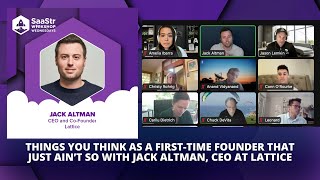
Transcript of a live discussion (May 2023 upload) between Jason M. Lemkin and Jack Altman (CEO of Lattice) covering lessons for first-time founders, Lattice’s business (employees, customers, product suite), market dynamics in 2023, and a tweet-thread “Things you think as a first-time founder that just ain't so.” Jack gives pragmatic advice on multi-product strategy, customer pull vs. feature requests, fundraising timing, hiring, burn-rate smoothing, tech debt tradeoffs, competition analysis, coaching, processes, and culture.
Chapters
Him and tragically we have not added his at at Twitter. What's his at at?
It's Jaltma Jolt.
Of course it's Jaltma or it's Jaltma. And he really, he's. He's clearly at a reflective stage of his career at nine figures in AR and sharing some of the best learnings on social media. There's no angry politics. He's not worried that the world's going to end. He's not. He's not shouting at the world. He's sharing great learnings and he had this one things you think as a founder, that just ain't so.
That had.
Hold on. If I can get this to scroll a little bit. Hold on. Had a stunning 1.1 million views. Right? This is up with a great TikToker. 1.1 million views. 2631 likes and this is one of Elon's big ones. 2,660 folks, almost 2700 people want to come back and see this tweet storm. So. So we had to do it live. Things you think as a first time founder is pretty great. I want to go through it. Some of them. I've actually had slightly different experiences but they're pretty aligned. But before we get there, I want to talk. It's just for folks that haven't gotten to know Jack. So tell us about Lattice today. How many employees. Oops. Can you guys hear me? You guys hear me? Okay? How many employees? I know you're at about nine figures in revenue. And what does Lattice do today versus like when you started it?
Yeah. Well thanks for having me and that. Such a nice intro on a tweet storm. I'm so honored. That was so nice. Yeah, we're about 550 people today. We started in like 2016. So coming up on seven and a half, eight years in, we have about 5,000 customers. So we serve like the mid market is kind of like our range. Like most of our customers are sort of in the hundred to a thousand sort of as the central location. So we're not serving mega enterprise. It's not super SMB. So that's kind of like our zone. And we basically build a suite of HR applications around people management. So we started with performance management. We then got into engagement surveys which was sort of like our second product. And then from there we've kind of kept building. So like career management, compensation management. And we basically built this bundle around modern people management. So yeah, that's kind of what we do.
And we could spend the whole Time talking about Lattice. Maybe we'll do a different one, but I want to get to this. But just a few things that are so topical, going multi product, obviously it's somewhat common in your industry, but did you do it right? How did you decide to build a whole suite in, you know, in your first six to seven years?
Yeah, I. I think this is what. This is one of my views of things that not enough startups do often enough, early enough. It's obviously not the right thing for everybody, but I think this is maybe one of the canonical pieces of startup advice that I maybe slightly disagree with of most people will guide startups to stick with one product and just really focus. And I think that often works. But I believe that we are in a sort of phase of the software deployment life cycle. If you look over like a couple of decades where it's become really cheap to build software, where there's a mass proliferation of products, where integrating becomes hard, where buying from 100 vendors becomes hard. And so I actually believe in more categories than not, consolidated bundles are extremely valuable and have like a structural advantage. So that, that's kind of like a philosophy I come to this with. There's obviously exceptions, of course, like, you know, Zoom, which we're using right now, is a great exception to that. But generally speaking, that's kind of how I see it. So we did it early and it kind of worked for us.
Was it intentional or do you just figure out from your customers that having a suite was the way to go?
It was intentional. So we were at like two or three of ARR. We had like set. We had like seven engineers and we put like five and a half of them on a second product, which was the engagement service product, while our performance product clearly still had a humongous amount.
Of work to do. Yeah, it must have, right? It had two. Two engineers working on it. It seems a crazy. It seems crazy to do unless it's a total tilt, but it wasn't.
Yeah, exactly. And you know, it was basically. And it wasn't like our customers were asking us for it. It was just that we knew they were also paying for this thing, that it was the same buyer, the same segment, the same sort of mindset in which it was bought. And so we sort of went for it. Obviously, we then staffed performance back up massively. But no, we went for it early because it met a set of criteria that we thought made for a good second product.
Yeah, it's funny, I think today what we finally learned is this suite versus point solution, like the answer is probably yes. Yeah, they can both work depending on the DNA of the team and the market. And it's not so binary, is it?
No, absolutely. And to that point it's, you know, you see a company work and it's not like the way that it worked is the only way it could have worked. Like if Lattice had just said, you know what, we're going to take all of our energy just on performance management, we would have had to do some things differently. We would have had to really push up into the enterprise to make it work. But I believe that could have worked. So, you know, there's multiple winning paths. It's not like just, it's not like the one thing we did is the only thing that could have worked.
And give us a sense, one last one on Lattice and then let's dip into the things you think is first time founder. That just ain't so. What, what are you seeing in the field? What are you seeing your customers? Because Lattice is, you know, you're not at the, you're not, you're not at the post IPO Monday whatever level, but you're not a scrappy startup anymore. You're having conversations. The brand's well established. What are you really seeing in, in 2023 in the markets and how much harder is it? Like, is it impossible? Is it a little bit harder? What do you, what are you seeing right now? Give us a, give us a real time sense of the markets.
It's not impossible, but it's a lot harder. So like the thing that was noteworthy to me in the last two years, like let's say 2021 and the first part of, you know, and late 2020 through early 2022. Yeah, what was noteworthy was the, the lack of discretion from buyers. And so if an HR leader wanted something, the amount of pushback that they experienced inside their org from finance or ops was, was dramatically lower. And so we kind of lived in a world where people got what they wanted. And that's different today. Now what you experience is really clear. Budgets that aren't like, oh, you can go over, it's fine. It's like this is your budget. Like this is your budget. And you get a lot more pressure internally for buyers in all categories to be really scrutinous. So you're sitting there, you know, you're looking now you've got CFOs who probably monthly or just pulling up a list of all their vendors and saying, can we consolidate this? Do we really need that one? Could we get half off of this because there's eight similar products and they're just going down the list constantly. And that pruning didn't used to exist. What I'm not sure about is how much of what we're experiencing now is there was a drastic pull forward over the last two years and now we're going through a normalization period and then we'll go back to something normal. But it's, I would say it's not like impossible, but it's a lot harder.
And do you think to boil it all down because I just put up on Saturday what Ring Central said, what they're seeing. A lot of public companies say what they're seeing. Are you seeing longer sales cycles but similar nrr? Are you seeing, are you seeing increase in churn or grr. Do you have a sense of the metrics? A lot of folks are saying sales cycles are longer but other metrics are less impacted.
Yeah, I think this is where it really. So I think everybody's sales cycles are longer because of sort of that phenomenon we just talked about. I think where the NRR matters or where it's impacted is very related to your pricing model. And so if you sell per seat you're going to experience a lot of pain relative to what you experienced in the last two years obviously because instead of abundant hiring and VC fueled mega growth, now what we're all experiencing is our customers are shutting down, having rifts, et cetera, not hiring freezes. So if you sell per seat, which used to be like, you know, in 2021 every VC thought this was like the best thing of all time. Now it feels different versus if you just sell a platform fee and your price is your price or perhaps if you sell, you know like based on a transaction model and your customers are not particularly impacted. So I think the NRR question then goes to what's their pricing model?
Yeah, it is interesting. I hadn't really thought that the classic site license type model or or bounded site license used to be seen as a sucker bet. Right. But maybe in 2023 it's a good model to have.
Yeah, exactly.
You're not betting on, on. On organic seed expansion to hit hit the plan 12 months out. Yeah, that's right. Yeah. Okay, I would love to we could do more of this one because it's super interesting to have such a thoughtful founder at scale talking through these issues. But let's talk about the things as a first time founder that you think so that just ain't so. Okay, now this one. Boy, I really wanted to know what's in your head. You got a lot of engagement on this one, and I mostly agree. Yet I've had a few personal experiences at the margin, but good traction of growth. It's just a couple more features away. And Jack's also a pretty good investor with Altman Capital, so he's seen it across the board. But what does this one mean?
Yeah, so obviously it's a tweet, so I didn't capture the world of nuance. I would say I agree with my own tweet here, 90% of the time, not 100% of the time. But, yeah, more often than not, I think if you are. If you're not getting pull on your product, whether it's your first product or your fourth product, it doesn't really matter if there's not real pull. Yeah, most of the time it's not because you're missing, you know, a team's view and, you know, the ability to integrate with one more, you know, system of record and the ability to get one more cut of analytics. And often we can think that because what you experience in a customer conversation is, oh, I'm not really that into it. Maybe if you had this thing, I would kind of like it. And so we take that back and that tone, we somehow translate in our hopeful minds and our happy ears to, yeah, like, they wanted this feature. And it's like, no, when they want the feature, what it sounds like is, I need to deploy this thing in two weeks. I will sign, but you need to release the teams feature. Can you commit? And I'll sign. And you actually can hear that sometimes from customers, when you have something that is almost there but not fully there. There's gradients in between all of this. But directionally speaking, I'm a big believer that as a founder, you so badly want to listen with, like, you know, happy ears. You want to. You want to hear what you want to hear. You're really looking for validation. And you should almost take the opposite, where you're like, I don't believe a word you say until you sign something or pay me. And I think that, like, when you've got something people directionally want, they. They make it really known to you. And once you've felt it, it actually becomes, like, hard to mistake when you don't have it.
Yeah, it's really. It's a great. Now I understand even better the. If you get this extremely strongly from prospects in the funnel, such to the point they'll. They'll sign a contract or close to it. That that's actionable. Right. Your gut, based on losing deals or not even being in deals totally can take you can take you the wrong place. Right. That that mythical feature on its own is probably not going to solve your problems. Right.
And people are nice. This is the other thing. Most people are nice. Most people don't want to tell a founder or a product leader who's coming to them what you're doing is not interesting to me. So they try to find a way to couch it. And that couching can translate into sort of like missed signal. This, this is also why I kind of like put in my like sub, sub bullet here of like when you've got something that people want, you often can show them a design mockup, convince them that you will in fact build the thing and they'll really pull from you. So like with Lattice, when, before we launched performance reviews, we actually had this like OKRS product for like eight or nine months that just like went nowhere. And then when, and like we, we had the thing built and just like we couldn't get it really going. And then with reviews it was like we showed them, you know, like at the time it was envisioned, but we showed them like Figma mocks essentially. And it was like, okay, we'll take it. When can, when can we launch?
Yeah, so you're, so that's interesting. As you're expanding the FIGMA box or wireframes or design mockups, you felt that was. And I'm not disagreeing, it's just good learning that you could get strong enough feedback from your customers to pick between the OKRs and the reviews. You knew exactly from the mock ups what they wanted.
Yeah, yeah, exactly. Versus and with the OKR mocks, at least the way we were doing it, we couldn't. And we had a product there, but just even from any of it we could get, we all we could get was people to be like, yeah, that's cool, I'll play with it. But like, I don't. Versus with reviews we could get people to be like, okay, I'm going to launch, I need a partner for this. For my next cycle we'll go with yours, assuming it has X, Y, Z. But they had this, it was a need and somebody had to serve it. And they believed that our version did something that the other versions didn't. Even if our version was janky, which it was obviously janky, but we had a difference in our thing that no one else provided and that was how we got it done.
Yeah, let's hit the next One, I'll tell you, there's a company I invested in this just coming up on 20 million air and they lost a big deal. They lost a big deal. They didn't know exactly why. And I just listened to a 50 minute loss call gong call and it was epic. I've never seen one done this well. And if folks can get good at this and what I the reason he did it is this. Customers just love the CEO. He's like you. Like, maybe you don't want the compliment, but I suspect a lot of customers love you if you have that. And listen, I didn't. My customers respect me, but there wasn't that, that cuddly affinity. If you have it. What I learned is leverage it. Really talk to them, thank them, don't be critical, don't make them uncomfortable. But if you can get them in a comfortable mode where they're not nice, right? And I watched them walk through every reason and why they lost and how AI changed in the space and pricing. They even talked about they knew the pricing per dollar per seat and how that compared and what the CFO thought when they just like you said, this is a category where last year they didn't have to take it to the CFO or two years ago, now they had to and the CFO wanted to use the dol competitor that had a different perspective. And anyhow, if you get really good at this at loss calls. Right. Most companies don't even report details on losses. But there can be magic if you build relationships.
There is. And that requires a certain confidence to extract the critical feedback, which is also, by the way, really important interpersonally. But that requires the confidence to say, hey, I want to hear why this product isn't right for you. Like, like it's okay. You're not going to offend me. Like really give it to me. Like you're doing me a favor. Not by like telling me it's kind of interesting. Tell me why it's not interesting or why it doesn't work for you.
Yeah, that's what was epic in this. It's a great, it's a great learning. Okay. Two, I love this one. Oh my God. This, this one I kind of want to shout from the roof.
I actually thought of you when I said this. One, I knew this would drive. I knew this is the kind of thing that drives you crazy.
I didn't actually used to see this and now I see like I see this in like 40% of investor updates is our burden rate was only this. Other than the one time cost, the 800,000 for legal in the round or this or that, maybe it's obvious, but dig in here a little bit. What have you learned on these one time costs?
Yeah, you know, I used to have the same thing when we were small. It's like ah, this quarter, you know, we had, we had closing costs and it was 75k. Next quarter we had like our new office lease and there's a big upfront outlay. Ah, the next quarter we had the one time thing. But we use these like design contractors to get this product across the line or like whatever. Like. Yeah, the thing is we all think in software companies, like startups in general, we're all like, okay, the only real costs are the people and everything else is sort of like these pretend blips. And the reality is the people is like 70 or 80% of it. But the other 20 to 30% that come in sometimes stable and sometimes lumpy ways like that is just part of the costs. There's always going to be something. A lot happens in startups quarter to quarter. And just think of it as your burn. And also, you know what, if you, if your real burn's a little lower than you thought, great. Like over, over communicate and overthink of what your burn is and like be delighted when the one time costs don't come back. But like they're going to come back.
Yeah, they, it's like sales cycles. Like once you have more deals in the hopper, they overlap. You're going to have one time costs every week as you, as you scale. Right? They're going to be every week. Yeah, this is a good one. Just don't, don't, don't let this. The real issue here to me is, is you could think you're doing great and run out of money, right? I mean that's the underlying issue here, right? You can think you're doing great and your burn rate, your 0 cash date is far shorter than then you think you're sustaining burn says, right? Totally. Yeah. My only, this is a good one. And yeah, I think I might retweet this one a hundred times. If nothing else, my only advice to founders is at least do a last four month burn analysis. Always average the last four months. If you do it on a rolling basis, my burn rate this month was 800, but on the last four months it's 422. Hooray. Like if that's the average. Right. But always, if you always do everything L4M, it cuts out all this subjective crap, right? For. Yeah, Right, Yeah, totally.
And that's probably actually the best, that's probably the most accurate way to tactically talk about it is. Sure, one month, you're right. Sometimes like a, sometimes you do indeed have like a big expense over one month, but over four months it's pretty normalized. So like if you're gonna think about one time costs and if you want to try to pull them apart, at least look over a period of three to six months and think of it in those terms. I think that's enough to smooth it for most startups.
Yep. Okay, this one and this like just changes every six to nine months these days. But fancy venture firm X email me and wants to talk. They must be interested. Even, even, even and even not. It'll be a good learning for me. So it's. But, but now we're in 2023, like not only are there no series F rounds, there's almost no series A round. So what, what do you, what do you, what's, what's the advice here, man?
This is one where I've, I really updated my thinking and over the course of Lattice and, and my conviction in this point grows constantly. I'll make a caveat because again it's a tweet. So this one maybe instead of agreeing with a 90, I agree with it like 95 or something. But I used to think about, because this is, this is what VCs will say, oh, you should get to know us ahead of the next round. And like, kind of like there, there is something to that, right? Like there is something to like just world completely cold. Like yeah, that is, that is a little bit hard. But the, the thing that a founder has to remember is as a founder you have a lot of jobs. Your jobs are to build a product, get customers, stand up a marketing function, manage a team, run an all hands, manage your burn fundraise, get an office space. Like do all of these things. And the fundraising bucket is this relatively small bucket of the work that you actually have to do for the vc. It is their whole bucket. Like that's their whole job and not just is it their whole job. There are even people at the VC firms who have this specialized job specifically of reaching out to you. And there's a CRM somewhere and there's an associate or a principal or whatever at these firms whose job is to talk to you and it's going to get logged and that's part of the job. And so it is their job to hound you to until you talk to them, because that's what sector coverage looks like. That does not mean that they want to invest in your company. It means that they want to do their job, which is to talk to everybody. And so for founders who are not in a position, who are ready to fundraise, which, you know, most of the time, most companies aren't. Like, you're ready to fundraise in discrete moments most of the time. Obviously, there's great companies doing well at any stage. You could always raise, but, like, they probably just don't need to. But so that's where you are. There's somebody who's coming at you with just a different set of work. Like they have different, different goal than you. And the problem when you go and do that is it distracts you. I just. I now know that when you're fundraising, it is the top idea in your mind. You wake up thinking about it. When you're on a walk, you're thinking about it in the shower, you're thinking about. It's just like, what is the top idea on your mind? And you're not ready. So you're going, you're having this casual chat with them, but it's not casual to them. Like, whatever you talked about is going to get logged somewhere. And like, if you didn't come buttoned up and you didn't have your story down and all the rest of it, and it's not competitive, like, you're just not doing it the way you should do it. So doing it on your terms looks like when I'm fundraising, I'm fundraising and I'm going to have materials prepared, I'm going to have practice the way that I communicate the story. I'm going to go out and I'm going to talk to a lot of people in parallel. I'm going to release an information sequentially to everybody in the same pattern at the same time. And, and it's just different. And this was so unnatural for me because when I started, like, you know, you called me cuddly. I am like, I am spiritually cuddly. And so I just wanted to, like, be nice and I wanted to say, oh, you want to chat with me?
Sure.
I'll tell you about everything. That's just like, not objectively. It's not the right way to do it.
Yeah, for, for sure. The only thing I might add on is that I came up with the rule a long time ago and I think it made no sense in 2021. But I do think it's, it's, it's, it's rebounded. In 2023, which is CEO, your fundraising is this little slice of what you do, right. Takes up way too much time on social media. But I say take one meeting a week for an hour. If. Unless your business is destroyed, like don't. If you're shrinking, don't do a meeting today. Right.
Unless there's some other.
Unless your mouths or wows or gals or cows are good. But if your business is decent, you don't have to do a data room, you don't have to do the follow up. You can do one meeting and, and it's one hour. Right. And not all of us are have the kind of networks that others do. Right. Not all of us know people. And I think one hour is not the worst use of your time if.
You'Re talking about it.
Right.
I agree with you. And so that last piece. So I totally agree with you. And that's where the tweet is the tweet. But then there's the reality. The thing I think that's important there is to have a certain thoughtfulness about it of if you're at seed and you're like, okay, I need to get to an A in 18 months and like here's my universe. Just like put at least as much discipline around it as you would put around the way you think about like product or sales strategy or something else where you at least like here's the universe of 40 or 50 people that are possible and I'm going to try to like have a chat with half of them over the next, you know, 12 months or something like that. So put a little thought around it. But I agree you should do a little bit.
Yeah. The only. And that one other little thing I would say is if this is. This took me a lot like double digit, you know, years to learn the best VCs. If you get to know them, like, yeah, that's all their business. You're just a product to them. Right. Especially as you get mid stage and later stage. But they don't go away, they're persistent. Mark Andreessen is still out there. Byron Dieter is still out there. And if you get to know these folks and you go really long as a founder, there'll be some other connection that comes out of it. It might be a startup to buy. It might be a something you want to a CXO summit you want to be at. That's really important for Lattice that like hey, whoever batteries doing the leading HR summit. I found these over a decade are always worth it. Like getting to know that it's like anything for sure, the top people is worth it, right?
No, you're right. And by the way, that's actually one of the awesome things about fundraising. So like when you do fundraise, when you are. So you have these meetings periodically, but then when you fundraise, you usually have like three, four weeks where you kind of tell your internal team, like, I'll kind of answer my email. But mostly I'm fundraising right now. And in those periods you do really get to meet and get to know firms. And like, I remember like at Series B, for example, we like talked to everybody in the world. We like could not get a term sheet to save our lives. But I actually built a lot of really great relationships then that I'm like investors who I'm still friends with who passed. But it was like a gracious experience and I got to know them and it like, it, it shows up down the line. So the fundamentals do. When you're in the fundraise, if you can, as the founder, don't be transactional about it. Like these relationships are long and there's a lot of people who can have impact at multiple places. And you could talk to Sequoia, they could pass it your A, you could just crush and then they can do a C. So like there's or like a million other sort of overlaps. So I think thinking long term as the founder too is really important in these.
Yes. Okay, this one. Boy, this is like the whole Zen of everything. You can hire someone pixel perfect if you just wait long enough and meet enough people. This my entire life I'll be struggling with this question, you know, how to hire great people in a, in a prescribed period of time. And I might have screwed up the little tweet below, but let's talk about this one. You might hire someone pixel wherever. You just wait long enough and meet enough people. When, when do you call it a day and hire the vp if this is what you're getting at?
Yeah, totally. I've struggled with this one like a million times. We all ask ourselves the question, I need this role so badly and no one's perfect. Everyone's got some fatal flaw, like, what do I do? To me, I think what this starts with is a mentality and that unlocks the right sort of decision making. And the mentality is the acceptance of the fact that as a startup, there is no way that you're going to get somebody who is perfect on every dimension. If you are a seed stage company with 475k of ARR. And a cool product and 8 people and you need your first head of marketing. Why would you get them ahead? Like just rationally, you know, clinically speaking. Why, why would the head of marketing from a company that just went from zero to ipo, who is like critically acclaimed by marketers everywhere and just made a bajillion dollars and like all the. Why would they join? And if you actually, and you know, and they're going to join something that is unproven, you're going to, you know, you're going to give them a nice equity grant. But it's, you know, it's, it's going to be, you know, highly risky still and all this other stuff. So you have to internalize the fact that there is rationality in the market and that like stripe's going to get that person and that's okay. And I think starting from that mentality helps you then say, okay, now I'm, now it just becomes a matter of I know what I need is a diamond in the rough. And not just that, but what great recruiting looks like for a startup is being great at identifying diamonds in the rough. And I think when you reframe it that way that I'm not looking for pixel perfect, I'm looking for diamonds in the rough because that's going to be my competitive advantage. I'm going to see things the market doesn't that then you can do a good job on this stuff and maybe.
Just two follow ups. One is, I mean there's probably a thousand startups saying hey, I can't compete with Jack and Lattice, right? But Jack and Lattice might be thinking, hey, I can't compete with Notion or Retool or what's the hottest or whatever the hottest or hugging face or I can't get that. They got an offer from, from, from, from. They got offer from all three. How do you, how do you approach competing with the hotter company?
Yeah, I mean this is the challenge, right? Is like you always, and we experienced this in 2021 where like we were doing well. There were some, you know, there's always going to be a bigger fish. There's always some company that is doing five times better than you who can literally blow the comp bands out of the market. And we saw this, we like, you know, you look at like comp bans then you see like I'm not going to name names but you see a private, late stage, well funded company who's just like saying screw those compounds, I'm going to pay double or triple. And you're just like, all right, we can't, you know, they're, they're literally matching like Fang or whatever. What is it now, mama? They're literally so, you know, there's all there. There's always, there's always that dynamic. And so this commentary I think is evergreen commentary where everybody is looking for their version of, of this. Of yeah, as lattice. We can get people with more of the dimensions sort of proven than a seed stage company. And by the way, what a seed stage company and what lad should hire for head of engineering are completely different. So we shouldn't even be competing for the same human generally speaking. But there's all this dimension always exists. I think even if you are, I would hypothesize that even if you're stripe, you're probably thinking about ah, well there's, you know, Google's going to have something they can offer and so, you know, maybe there's an end of the line somewhere. But more or less this advice I think always applies.
And just one follow up. When you, when you coach your team and your managers, how do you get them to not settle two to three months into a search? How do you, how do you get, how do you avoid that exhaustion and that fatigue of I need a, I need the body.
You know, this is, this is one of the hardest things is where as a, as a CEO with an exact or as an exec with one of your direct reports, there's a balance where you are trying to hold the bar high and be a real accountability buddy to them while also giving them discretion on their bench. And so to me, the role of the manager, of the hiring manager is not to never veto. Sometimes you just say, I'm really sorry, I don't think this is right. But that is a big, that's a big step to say like, you know, hey, this person wants to hire, I'm going to say no, those are to be used sparingly but to really question and remind them of these dynamics and say, I know you're tired, I know we need this role but like this is a multi year thing. Are you sure? Are you sure? Why do you believe this? And you just keep prodding and hopefully you're working with people who will either stand up to that and help change your mind and help you see something that they see and say no, you, this is a diamond in the rough. Trust me, I'm going to polish this and it's going to be a diamond or says, gosh, you're right, I've been tired. Thank you for this push. I'm going to not be lazy. I'm going to, I'm going to keep going for another, you know, 60 days. And so I think it's a conversation, it's a managerial relationship dynamic thing. But I think the role here is to be a pusher.
Yeah, I really love, I use it in other contexts, but in this one, asking someone on your team if they want to make are you sure? We all make mistakes, but are you sure? Are you sure, you know, Jane or Jack is the one for this role and that will surface all the good, good LinkedIn but not great. Might be a little lazy, might be checked out because anyone good is going to have a tough time answering yes if they're sure of this. Totally.
Yeah.
It's a great question.
I don't, you know, you can also do things like something I don't do enough but I think is valuable is almost like pre morteming, like what went wrong? You know, ask somebody, hey, 12 months from now.
Yeah.
Do you think you would enthusiast. Do you see yourself being in a position where you're going to enthusiastically rehire this person? Do they feel that good to you? This role is really critical for the company. This is one of the most important roles. Do you feel like this is this person meeting the mark? Is that our bar? Does this meet your performance standards for what you expect for your team? Is this is it? You know, you just keep pushing kind of and sometimes they'll stick with it and they'll have their convictions and maybe you harden it through that process.
Yeah, I like it. Okay. Five boy. Because we all have so much experience here. Right. So I liked how definitive you are. Even though this one is still an enigma, we should invest to avoid tech debt that will cripple us later. Right. I've had near crippling tech debt, but yet I can't argue with your point. It's a champagne problem that startups don't get the privilege to deal with. So dig in what you've learned here. What, what, what, what, what, what's, what's the better lesson here? Yeah. Okay.
And so like on this one, maybe if on the other ones I, I agreed with 1 90. I agree with 195%. Maybe I agree with this one like 80%. There's like a lot of nuance here because there are debts that are so big that you can't repay or that even in the wind condition this is going to be so crippling that it's actually going to prevent your win condition from being worked through.
Yep, that's a good way to put it. Yeah.
And so I think that is the question to ask of like this can be really bad because like, you know, so like tech deck can be really bad and you still work through it. You know, like every great company that you can think of, or most great companies, let's say that you can think of at some point later in their S curve. You know, 500 of ARR, 800 of ARR was like, Geez, we really have to replatform or whatever. And at that point though, you have to think forward into the future when you say, okay, right now I'm a small company, I'm doing this thing wrong. But in the world where we win and where we have this tech debt problem, I'm going to have 50 spare engineers to deal with the tech debt problem. And it's hard to even put yourself there when you have seven people at your company. But that's actually how these things play out is you pay it down when you have so much more ability to pay the thing down. And the spirit behind this in a lot of ways to me is that startups in general are what like one reasonable metaphor for startups in general is taking on humongous amounts of debt of all flavors in the early days to hopefully get something across the line that compounds in a way that you can actually just like pay it all down. And there's, there's debt of all flavors. I mean like, like venture taking venture money is a form of debt. I mean we call it equity, it's not debt, but it's, it's debt in the sense of now you have a preferred stack, you've got people that you have to, you know, sort of work with and that you're going to need to like get over these hurdles. It puts value, you're not really ever worth it.
Whatever your valuation is in venture, you're never actually worth it.
That's totally true. There's organizational debt, that's a big type of debt that doesn't get talked about enough where you're like, you know what? This is a weird ass org org structure. It doesn't make sense. But these are the players I have at hand and this is the best I can do. I'm going to take on organizational debt and I'm going to pay it down later. Or I have like just like interpersonal debt where like something got weird with somebody and like this is a, you know, this is not a sustainable dynamic. Their expectations in the role like this is you Know something that if we were at a big company, we would just address it tomorrow and deal with it. But at a small company, you say, you know what, I got to get. I need the next eight months with this person. Yeah. And so there's a lot of these forms of debt. And it's just my general view that it is so unusual and so special to get the wind condition to happen at all that you need to just be swiping every credit card you can to get it working and trust that unless the Apr is like 90% and will in fact crush you later, like swipe the cards.
Yeah. Let me ask you a very specific point here. I wonder if you've experienced it. My rule, when you go to hire your first VP of Eng, when your CTO says, Hey, I need some help, I'm at 6 million, 8 million, 4 million, 12 million, I just, I can't be doing this all the minutiae anymore. Right. My rule is when this is the number one goal of the first VP of Engineering, there's 100% failure rate.
Yes.
That number one goal has to be increased feature velocity, but also solve some tech debt. When you bring your VP of engineering, they should be spending 25, 30% of their time on debt. On debt. But when I hear this as job one, I've never seen that VPN work out. I've just literally never seen it.
I completely agree. And I, and, and it's, and it's not necessarily the VP of Engine's fault there like that. That, that in many cases is just like bad direction. And it's, it's, it's usually too early. And I think part of this stems from when you're at 4 of. I remember being at 4 of AR and I was like, whoa, we got some. And now I look back and I'm like, oh, four of our are like, that's just, that's still, you know, I actually. Your model of like what, like early product, you know, 1 million, 2 million is like early traction, early product, market fit. But I would say in the 4 million range, we're still all figuring it out and we don't know if we've got the thing that can scale to 100. And one of the crazy things that you end up realizing about a SaaS company that's hard to internalize early, but like it's okay later. Like this is going to. This sounds scary, but it's okay. A SaaS companies to be worth a lot, you need like hundreds and hundreds of millions of ARR. Like the four like you're at four. Like you four, eight, eleven. It's just like, not like the math doesn't work out. There's too many fixed costs, there's too many competitors. You need to get, you need your boat to get bigger, to like make it through the water. And four is not enough. It's not time to start paying the debt down. You're still on your shopping spree, so I, I completely agree.
Yeah, it's a good one. Okay. Six is fun. I hear this one ringing in my ears when one of the smartest people I worked with used to say this, but our big competitors are terrible. You hear this a lot? We do hear it a lot, right? They're terrible, right?
Yeah, all the time.
Especially like Salesforce. Everyone thinks Salesforce is terrible. The most successful SaaS company since, since the, since the, the era, the, the middle ages, right? Terrible. Terrible.
It doesn't seem terrible. It's extracting a lot of dollars per employee per month, like an insane amount. It's a lot of value system in the world. It seems to me like they have an ecosystem of like all these Salesforce trained professionals whose whole job is to deploy and implement. It doesn't seem terrible. Yeah, seems like a good company.
It's funny, when I, when I got going in SaaS, I had an engineer actually say that to me about Salesforce. And this is, this is clunky software. And then, and then I talked to an old school CRM guy at Fair, Isaac. He'd been doing CRM, I don't know, since the 70s or 80s or something, right. And he's like, Jason, no, no, no. Let me tell you how this works. This is the most extensible product I've ever seen. This is the first time I don't really care what Salesforce cost me at 2 million. It's the first time I can get a CRM to do what I wanted to do. Right. It was like an eye opening moment. Right. And what we think is terrible sometimes is the new guys is not what customers think is terrible.
That's right.
Right.
Also, what we think in tech is terrible is very different than what people outside of tech who are coming off of Oracle think is terrible. And there can be a confusion in products specifically around what is a good product. And I think often one of the places where I think I've seen Silicon Valley mindset be misguided is we think about delight, the visual ui, you know, the experience going between screens and that, that's what a great product's about. And it's not that those things aren't important, but those are more what I think of as, like, UI versus, like, what I think of as ux. Maybe I'm using these terms slightly wrong, but, like, what does the product accomplish? Like, don't think about user delight all the time. Think about, like, user success. And if I'm a Salesforce customer, I need to log all these things. I need to integrate with these systems. I need a robust database that does X, Y, Z. I need everybody, you know, at these different levels to be able to see these different. And that's the baseline. And if I can do those things, then great, like, make it pretty, make it like, you know, make it like, fun when I move around it. But a different product that is fun and pretty, but doesn't do those things, that's not a good product. And so I think this is one of the areas where, like, Silicon Valley product mindset, when it goes too deep into the, like, love of the craft of the build, that can go wrong. The love of the craft needs to be about solving problems for customers.
Yeah. When I hear this from founders specifically, I love to just ask them, okay, but what are they great at? And at least they can tilt and answer three things they're great at. Then did I, did I give them a pass on this at this point? Right. The other challenge I would ask, let's go to the next one. And then here's the other mistake founders make. Our big company's terrible. Okay, but let's say your big comp, your big competitor, let's say it's not huge. Let's use simple math. Let's say they're at a hundred million and you're at 10. Okay. And they're growing 80% and you're growing a hundred percent. Well, they're adding 80 million of new bookings and you're adding 10. They're actually. Except it doesn't. On a percentage basis, it seems like you're going faster, but you're not. They're out accelerating you. Most of your bigger competitors are out. You have to be very thoughtful about understanding if you're really out accelerating them and not get confused in small math. Right. The big guys Monday is at 750 million. An error. They just announced yesterday they're going 50%. Think about the new bookings at 750. Oh, you think you're better than Monday? They just, they adding HubSpot's growing 30% at 2 billion. That means it's going to add 600 million in new bookings this year. And you're adding 6 and you're better. Totally.
And, and, and by the way, this math is exactly right where what you need to be thinking about as the, as the 10 million, as the big founder, you know, you're thinking about like, this is great. As the, as the founder who's coming up, you need to be really precise in the way that you're thinking about your relative growth rate. Like, you need to look at competitive win rates closely and understand are we like losing to them most of the, Are we seeing a lot and losing most of the time or are we, when we're in, do we win but it's only in a certain segment or do we always win and we actually have like a brand problem? But this is where, this is actually something I know you're, you're friends with or know well to Doug Pepper, who had worked with Lattice when he was at Shasta, this is one of the things he really pushed us on at around sort of, you know, 10, 15, 20 of error when we did have done and still do have all these really big competitors is get really clear about the way you're competing with them and understand what segments you're in, how your competitive win rate shakes out. Are you, are you just not seeing most of the field? And I think that inspection of taking it down a level to the details is extremely important.
Yeah, we know you never see it everywhere, especially if growth is decent. No one even wants, they don't even want to know, do they, if the growth is decent. You know, it wants to do the work. Oh boy. This.
No one wants to say we're growing 100 at 10 of arrows, but our win rate against HubSpot is actually only 20% in the head to head. No one wants to talk about that.
Yeah, you know, you got it. You do have to celebrate the wins, but you can actually be losing, growing at a decent rate and losing market share. In a dynamic market. Yeah, right. In a dynamic market, it can. In a stagnant market, we, you know, if you haven't worked in. I have. You're automatically stealing share. In a stagnant market. Right. But in a dynamic market, you, you know, you could blink in five years down the road, you're, you're, you're, you're much smaller than you thought you were. Even though the growth was. Okay, that's, that's just sort of the, in the crying shame of founderisms. Right. To not recognize that. Yeah. Okay, this one, I need coaching on how to be a great leader and advice on how to Build a strong processes and systems. I worked with the first time sales leader a little while back and he wanted $400,000 a year for a coach to help him learn these processes. When do we need these coaches and what's going on here? Everyone wants a coach today.
Yeah, I love coaches. Just, I'm going to disclaim, I love my. I have a coach. She's unbelievable. Lots of people have coaches who are really important for them.
Yep.
Coaching is valuable thing. My, my, my point this one is that early on there are only a couple things that matter. It's getting traction, building a product that customers want and assembling a great team.
Yep.
And focus. This is like, you know, Steve Jobs said, but you know, focus is about saying no to a pretty long list of things that are really good to do. And it's about there are a hundred things you could do. The top 20 of them are really good. The top 10 are really good. And you can only do three. And there's only so many hours in the day. We each only have so many hours of productivity we can have. And if I spend, you know, 11 hours a week of my time and attention thinking about these valuable things of how do I become a better leader, how do I get better at managing people, how do I design systems of communication? It's not that those are 11 wasted hours, it's just now you have 11 fewer hours for those three things that are the only things that are going to make your company work or not. It's so binary. And so this is to me largely about a, a ruthless prioritization of the only things that give you a chance for, you know, your coaching skills that you're going to build to go into practice. Because you can get great at like these sort of parameters, these accoutrements around a great startup that make the thing work. But if it's all on a thing where the business isn't good enough to get to exercise those wonderful skills you've built, it's like, well, you know, what are you doing? So this to me is about maintaining an unbelievable amount of focus on the very few things that matter. Saying no to the things that sound really good. I would also put like there's a bunch of other stuff I would put in this bucket of good but not worth your time and later you come back to it.
Yeah, yeah. And when, if you, this processes and system stuff now that, now that you're, now that you're late stage, when did it really matter? When did, when did processes and systems start to become Truly impactful. Was it, was it based on number of employees or when did you see this really matter?
I would say it is when. Approximately. I would say it's when you have managers of managers. That's probably my best. That's probably my best heuristic for when to start thinking about it. When you just have, man. When you just have, you know, the founder and seven ICs, obviously everybody knows it's one team, so you'll know what you're doing. I think even when you have, let's say, five managers and 30 employees at the company, I actually still think at that point, like, yeah, maybe sometimes a few things are getting lost in the muck, but I don't think the overhead is worth it. I think when you're 80 people, you've got a few true execs, it's not worth over indexing. But at this point, the cost of not doing these things starts to get outweighed by, okay, the first 10% of process systems. You know, management thinking is in fact starting to be worth it. So it's probably managers of managers that are not the CEO where I think this stuff starts to turn.
I like that. That, that sounds right. Okay, last one. Then we'll open it up to some questions. Boy, this is one. I, I think I'm terrible at culture, so this one really resonated with me as well. But I'm still trying to learn what culture is. Culture is created on day one. I need to, I need to spend time here to be intentional up front. I even see intentional as a flag for early stage founders when I hear the word intentional. But what's your thinking here?
It's actually funny you say that. I've never thought of it and I totally agree. And I love being intentional. I say the word intentional sometimes, but I, I think this is a flag for. I think there's a way it can get used in which it is a flag at any stage, actually. So that's actually a fun one to talk about. But what I mean here is. Okay, so what I, what I just said on the last point about like, it's all about focus. That was the charitable version of the way to say it. There's an uncharitable version of what I could have answered on the last one, which I think there's also an uncharitable version of this, which is that there is a whole group of founders or execs or anybody where we're more interested in playing house than in the thing itself. And what we wanted when we started A startup was to do with, you know, I want to be a leader. I want to have teams that do this. I want to show up at conferences. I want to be in the press. I want, like, these other things. And I think there is a. There's a ver. There's a. There's an allure and a trick to it all, by the way. That stuff's, like, not even fun by comparison to, like, what's really fun of building great products, having customers delight in them. It's a thousand times more fulfilling. But I think this is another one where, you know, maybe we're feeling like, oh, God, I can't get, you know, the product's not there, the build's going a little bit slow. I need something to do today. And calling customers who are going to say no to me is annoying. I'm going to read a blog about culture, and I'm going to do an exercise, and we're going to get our values down. And we're. And we're, you know, and we're a tiny startup. And it's. It's not just in this one. It's not just that it's a unimportant use of time. It's more that it's not what actually makes culture. Basically, all you can do at the beginning is you just are. You are who you are. You hire people who are who they are, and your culture is kind of going to just be the average of the personalities and dispositions of the first 10 people like you can. I actually think it's scale. Having clear values does matter, because now you're getting to a size where you can kind of guide, hey, this is, you know, when you're in a meeting, we want you to be more like this than that. And when you have a decision, it's more like this than that. And it does. Actually. I'm a huge believer in this. And Lattice has values. And we have since we were 50 or 75 people. And I think that's.
That's.
That. That there's a place for it. But when you're small, if you want to impact your culture, just hire the type of people that you want to be around and that you want to spend time with and that you want to build with. That's all you need to do. And I think anything more than that actually detracts.
I love the insight. Okay, we could spend a whole one on culture, but I want to make sure we take a few questions before we run out of time. Caitlin, are you managing that, or.
I can Hop in. If you want me to.
Or. Or you want me to pick some. Hold on. Do I pick. Pick in the chat window?
Yep.
We have a bunch coming in through the chat. A lot of conversation points, too, on some of these elements. But let's see. How long before you start fundraising do you start having these conversations? Obviously, this was one of the earlier points on fundraising.
I think Jason's point was pretty much right about, you know, periodic, like, spending a little bit of ongoing time knowing people. And then the other thing I would add, like, ahead of a fundraise, I think there is some value to, like, one to two months ahead of the fundraise, having some informal coffee chats where you kind of get a feel for the market and you kind of, like, you get your head in the zone a little bit, and you start to feel like, what are investors gonna be asking you about? When they kind of poke at you about, like, well, how are you thinking about competition? You know, in a casual coffee a month before the raise, and you hear that a bunch, you can kind of say, okay, they're going to be skeptical about xyz. And I think there's some. There's some utility to those early coffee chats. Less to get the investors pumped up and actually more for you, as the founder, to know, like, kind of here's what people are going to be poking at. Like, maybe they're going to be. Maybe they're going to be worried about that I'm too SMB. Maybe they're going to be worried about competition. Maybe they're going to be worried about market size, like, whatever. But I think a month or two out doing like, five, six friendly chats is. Is valuable.
Great.
Yeah. So go ahead, Caitlin. Sorry. You go ahead.
I was just going to add that we have another question that is on the founder's demeanor in some of those conversations and how much of these conversations play into the vibe of the founder and investing in the founder versus investing in the company. So the diamond in the rough perspective.
Well, I'd be curious to hear Jason's thoughts on this, too. As somebody who has been doing investing a lot longer than me, and I've thought about this a little bit from both sides, but I guess what I would say on the demeanor piece is maybe if I had one point to change. I think over the last few years, a lot of founders learned a habit of. I'm in unbelievable control here, and my goal is to create crazy FOMO in the most competitive process of all time, which you can kind of do if you really, really got it. Like, if your company just went from like 1 to 7 last year, like, sure, go for it. But otherwise, I think bringing a demeanor of curiosity, partnership and humility mixed with confidence is a much better mindset to have and will give you a much better shot at finding a partner. But I'd be curious what Jason thinks.
The question was on how aggressive to be on fundraising. Was that the question? Sorry I missed the detail.
No, no, not a problem at all. More on the. How much are you investing in the founder versus the company? And this diamond in the rough of who this founder is. But Meredith actually said she would hop in and ask this question out loud.
If you have any detail, please join us.
Great. So how are you, Jack? My question is this. So when somebody. I have an abbreviation that I refer to this as, which is a little bit crude, but I don't know if I can say this here. So you tell me if I can say it or not. But I have. So I've ended up doing quite a bit of speaking to VCs just because I talked to everybody. I mean, I picked up like a lead right out in my front yard and my CEO was like, because we actually do coaching software and intelligent coaching software. And he's like, why isn't it in zoom? And I was like, well, because I had dog poop in my hand that I was outside, because I talked to strangers, because it's all about the conversation that's going to get you something else, right? And I value that. And everybody I talk to. So it might not be money right now, but I'm always in my head making money, connecting the next thing, saying, how can I help you? How can you help me? And I think that a lot of times like that definitely the genuine interest and engagement with somebody, I think when people can become like, they're almost humble to a fault where it's lack of confidence and. And that shouldn't be the case, or they are just not matching the vibe of a VC that's, you know, like laid back, California. Maybe they have their shirt unbuttoned a little bit and you roll in and, you know, you're all buttoned up or something. I don't think that that makes for a good dynamic of, like, if you can't react to that. Right. I like to ask questions to people that I'll be like, you know, skulls and bones or, or Spanx. And then I just watch their. They're like, you know, or I say something really weird and then. And then that's memorable, right? And it's at least my personality. And I, I don't know, I, I feel like I'm not the founder of the company I work for. But I, I do feel like that that should match and that the best person should. Who's like interested and wants to know what people are looking for, should, should ask those questions to the person who's most personable and can kind of react on their feet to certain questions. I don't know. I mean, you guys are the experts, you tell me.
Well, look, I'm sure. Let me just follow up because Jack asked me to. I would say two things. One, to your point, look, there are no laid back VCs. Okay? There are VCs that don't work that many, seemingly work that many hours per week. But it is, it is a heat seeking missile profession. The only way you can make any money at vc, in vc, if somewhere between once a year and once every three years you invest in something insane, that's the only way you can make money. And I learned this first in my first job. I was with a VC flying down one of his port. This is a long time ago. His portfolio company was being sold for $6 billion. Okay. I was a kid, right? And I'm like, how do you manage all these meetings, the hundred meetings a week and all the stuff? He's like, Jason, when I find one deal, I drop everything. I drop. I don't talk to anybody. I'm a heat seeking missile. And the way VCs get there, some of them do it kite surfing, some of them run a prominent SaaS company. There's different ways to do it, but, but, but there's all different personalities. And then. Look, I want to get another question for Jack before out of time, but going to that the point Jack made of like how aggressive to be with vent vcs not to spend all of our time on it. I think just be super thoughtful. Today I get so many emails and people are just running. It's still running a 2021 playbook, right? It's too aggressive. And I accidentally recirculated a tweet yesterday asking for inbound emails from founders. I didn't mean to actually my social media tool reposted it and I got like 80 yesterday.
Okay.
I almost cried. It was so many. But I loved a couple of them that were like really good and they're like, you know what I loved about them? We want to close June 30th. Okay. We want to close June 30th. Not tonight, not. You have six seconds. To look at our data room. I want to close June 30th. That is such a smart thing to do, you giving people time. And here's the wonderful thing. If you're doing well, you're going to get another card on June 1, right? You're going to get another look. So I just think this aggro thing, just, just be careful. But let's get one more question for Jack before we have to break.
Great. We do have a lot of comments about the culture point. So we have some disagreements in the chat, but also I think the main question that comes out of it is if the culture is hiring your first 10 people, then what are you looking for culturally in those first 10 people?
Okay, so this one got disagreements also online. And it's funny because, like, we sell like Lattice sells culture. And so, like, I'm not trying to say don't invest in this. I'm more talking about the way it happens is, is natural. And that naturalness is your friend in the early days. That's, that's really my, my key point. But I think to me, the, the, the part, maybe one of the concepts that I think is most important here that like, kind of helped unlock this thought for me is there's no such thing as a correct culture. There is a culture that works well for your market, your customers, your product. And the idealized culture in the long term is one that sort of feels like a highly authentic, highly coherent unity of everything that you do. And so you think about like, let's take like Apple. Apple has these like, beautiful, sleek products. They don't have a lot of them. And everything they do is absolutely perfect. They've got this certain brand, they've got like this whole thing. And then the culture inside the company matches and works for that. They have really clear teams. They don't do, like, lots of flowing between. Even inside Apple, things are like, information's a bit more precious. It's a really different culture than a Google. And Google has a different business model, a different product, a different breadth of things that they do. And it, and it all makes sense. And it's all coherent in the early days for, for a company too. It makes sense. Like Lattice's culture is like, like Jason said, it's like we, we early, we had like a cuddly, you know, it's like a fair way to describe it, like high care, high empathy, a lot of focus on people and management. And that made sense for what our product was. But that would be a less authentic and valuable culture for Stripe you know, where it's a different product, it's a different type of build, it's a different type of customer relationship. You need a different set of attributes that would be idealized there. And so to me, this is where trusting sort of your own instincts as a founder of the kind of, you wanted to start this company for a reason. And either you're going to have good founder market fit with this thing or you're not. And so, like, if you're not, it doesn't matter. So, like, you should almost just like, trust that the types of people that you are drawn to and want to work with and believe will be great partners to you over time. That that set is going to be what the culture has to be, because otherwise it's not going to resonate for you as a founder and you'll never stand behind it anyway. So I think that's, that's my point, is that it's, it is an authentic build around the central tenants that made the founder want to do the company in the first place. And like, that's kind of, in my view, that's kind of all you can do at the beginning.
Great, great.
No, totally aligned. And thank you for that clarification. I know we are at time, so thank you so much, Jack. Thank you, Jason. We really appreciate the time here today. Great session and lots of lessons learned. Next week, tune back in for Bessemer Venture Partners what you need to change at 10 million to scale to 100 million. So see you then.
Okay, thank you, Jack.
Thanks.










