Kevin Dorsey, VP Sales at PatientPop Shares Cutting Edge Techniques for Building Trust in Sales
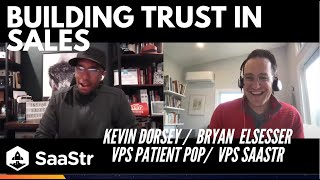
Transcript of a 2021 YouTube conversation (Cutting Edge series) between Brian Elcessor (Saster) and Kevin Dorsey (VP of Inside Sales, PatientPop) about modern sales practice. Key themes: building trust by demonstrating understanding of prospects and showing how a product will work (the “how” vs the what/why), using available public information to personalize outreach, focusing on human conversation rather than “salesy” pitches, the role and limits of personal branding (build with intention and go where your market is), and practical tips for process and coaching (use customers to demonstrate product how-to, prioritize security/status-quo concerns, involve prospects earlier). Tone: practical, candid, coaching-oriented.
Chapters
Hello everybody. I'm Brian Elcessor, VP of Sales at Saster. And welcome to the Cutting Edge. The place to find the best and most up to date tactics and tricks to help your sales team stand out today. I am pleased to welcome my friend Kevin Dorsey from Patient Pop to the Conversation.
Welcome kd, my man. You know I'm excited to be here with you, starting the day off with my dude Brian. Like, let's go baby. I'm ready.
Let's rock. And rol. Katie, do me a favor. Why don't we take a minute, Just introduce yourself to those that like, you know, lived under a rock and have no idea who you are.
I mean, not people shouldn't know who, who I am. I am, I am nothing special. I am a man, I'm a brother, I'm a father, I am a son. You know, lovely, lovely wife. Two daughters, Lily and Louisa. I'm the VP of Inside sales at Patient Pop. You know, so I lead the SDR and inside closing org there and honestly man, like I'm just. I think I try to view myself as a teacher and a coach, right? You know, like I really try to share what I'm learning. I'm sharing my flaws, I share my failures as much as I share the things that work and really just kind of sharing the journey as I go. So that's who I am. And I'm a student of this game. I'm passionate about it. I'm passionate about sales, I'm passionate about people. And I think that's why I think you and I connect so well. Because I think we share very similar passions.
I couldn't agree with you more, my friend. I couldn't agree with you more. I think that's exactly right. And I think that, you know, you've done an incredible job. Even just, you know, as someone that I look up to, I watch a lot. What you put out there and the content you produce and that sharing element, that caring element, it's just huge. And I know that's a big piece right now. So. So, dude, I'm excited to chat with you today and get into a little bit of the meat and potatoes here. You know, the conversation, the cutting edge, it's like, what do sales, cutting edge sales teams need to know in order to be seen as trusted or stand out? So there's our theme. Maybe we want to dive in. Where are we going today?
Oh boy. Okay, so trust. We'll start with trust. Start with trust, right? So there's this, there's this old quote said people don't care how much you know. They want to know how much you care. And, you know, it gets thrown out there, and people love to rah rah around it. Like, yeah, see, it's not about what you know. Well, I think they forget how the rest of that quote needs to play out. People don't care how much you know. They want to know how much you care. The only way you can share how much you care is by sharing what you know. That's the only way. You can't just sit there, right? Like, the way you show that you care is by show sharing what you know that can help them. And that's where people are still missing so much in sales is. It's not truly coming from a place of helping the prospect, right? Because most salespeople don't even understand the problems that their product solves, right? So we're talking about how to build trust. The ways you build trust is that the person feels known. That is like. Like, we gotta be honest here. Like, as a salesperson, we already are. Coming from, you know, behind the eight ball of it. We're a salesperson. No matter how much we say we care, do you think the prospect sits there and goes, oh, thank God. I thought you were one of those salespeople. Didn't care. But you just told me that you care that you're here for me. That doesn't do it. People feel trust when they go, okay, I feel heard, I feel understood. And then what's being offered to me is actually helping me get what I want. That's how you build trust, right? And I think that's something a lot of salespeople are missing. And we'll talk about where this goes next with trust as well.
You know, real quick. Do you think, you know, a person feeling known is easier right now or harder?
Oh, man, it's so much easier. So, like, there again, people have talked about how, like, the buyer has changed, right? The buyer has changed so much. They have access to so much more information now than they did before, which is true. So do salespeople. We just don't leverage is not that hard to learn the inner workings and inner days of your prospects either, because that information is out there too, right? I was talking to a company the other day that sells into hr. I used to sell into hr, right? And so I said, all right, how many of you subscribe to shrm? Have you subscribed to shrm? They're like, sure. I'm like, how many of you are members of the Human resources association? On LinkedIn, how many of you have signed up for the Employee Engagement Podcast and Employee Wellness Podcast? How many of you have read the book Culture at Work and How Work Works? Like, there is so much information that you can learn about the prospect that we don't do. Like, where people have taken this idea of personalization, and it only focuses on the person, which is great, but you need to know the problems that person has, and if you know their role, getting information on what are the biggest struggles of that role is out there, too. Right. And we as salespeople don't tend to leverage that nearly enough. We lead with the product and that's all we got.
Yeah. And I think that's a major problem, too.
Right.
Cause when the second we stop listening, we stop asking questions, That's. And we want to go into our pitch, we've already shut it off. We're not even there. Right.
I.
It's curious, too, because the cloud's exploding right now. Right. So I'm going to take this a little bit of a direction, but the cloud's exploding right now. We have a lot of new companies coming out with a lot of major money that's. That's being dropped. Right. So there's major expansion happening with new teams. You know, new teams can mean a lot of people that are maybe even new to our profession. So I'm curious, like, in thinking about, the person is changing, the buyer has changed, the salesperson has changed. Like, how do we even find a process for each of those to help those teams feel like they're successful?
So it's looking at the flip side of it, right? So Jeff Bezos gave an interview. I think this might be like, eight, nine years ago now. I talk about it enough, I should probably just go find it, like, put it on my LinkedIn or something. But they asked him a question along the lines of, like, you know, how do you innovate so well? Like, how does Amazon stay ahead of the game and kind of see what's coming and, like, change before other people change? And his response was so great. Like, it's just. It's phenomenal. His response back was, well, really, we pay attention to what's not going to change, and then that's where we try to innovate. Right. And he goes, so what's not what we do? What's not going to change? Are people ever going to want slower delivery? No. Are people ever going to want to pay more for a product? No. Are people ever going to want to trust the product less? No. Right. And he's like these are things that aren't going to change. And so that's where we drive our. We can't predict the future, but we can't say what isn't going to change. And so I think that correlates over to buyers and sellers, like their tools are changing, the environment is changing. Let's talk about what hasn't changed about people. Because that's who we're selling to and that's who's doing the selling.
Yeah.
Okay. What do most people crave more security or return? Which do they crave more security or return?
Return. Security. Security.
It's security. Right. Because the. We are risk averse as a species. We are. That's kept us alive.
Status quo. You don't want to change the status quo.
Right. So we know that, we know that. But so much pitching is about the future.
Right.
It's not about the status quo in the now. What else isn't going to change? People want to know if the product's going to work.
Yep.
Is that going to change?
No. And it's information overload right now. Right. Like we're putting more out there on our products than ever before. You're seeing even the demo world, right. Just explode with new tech that gets all the new product out in front and put in front of the information.
Information is not proof and information is not experience. Right. If information was experience, I could just tell you about a vacation and you'd be like, oh, that was nice. I just, I just went on a vacation. You have to experience. So again, let's think about that. Is that going to change? Are buyers going to not want to know if something's going to work for them? No. But that's not how the sales process is being built. Are buyers going to want to ever pay more for something? Not really. Unless they know the return is going to be there. How are they going to know the return is be there? Is that they experience it. Right. And then look at salespeople. Same idea. Salespeople are people which we tend to, I think, forget. We dangle that carrot in front of them all day long. Right. Like this idea that salespeople are coin operated is not true. And even if it was, even if it was, people seem to have forgotten how a coin operated sheen works. Yeah. If I walk up to a gumball machine, do I turn the knob, get the gumball and then put the coin in.
What comes first?
Right.
It'd be nice if it worked that way. Right?
It would. But what. How does a coin operated machine.
You gotta have the coin in, you gotta put the coin, the coin goes first.
That's not how we pay our salespeople. So then we wonder why salespeople come across as pushy or aggressive or commission breath is because that's the culture that we've created. And so I think I'm trying to also pay attention to what's not going to change about people. And then that's where you start to innovate the process more to allow those things to actually come.
You're talking, you're talking about humanism, right? Like you're talking about bringing, you know, just regular everyday conversation back into what we've turned into sales conversation. It's like, yeah, ho, there's no sales conversation in non conversation. In non sales conversation, there's just conversation. That's all there is.
It's when we make it salesy that it goes bad. Right? Like I don't know if this is going to be a video or not, but I have this sales hat behind me, right?
Right.
I don't have the sales hat to put on. I actually use it as an example of to take off, take off your sales hat for a second. Talk like a damn human being. Right? Because this is where people like, you know, my salespeople and definitely sales leaders should really study more like consumer psychology, economics, right. How people buy. Because we are not logical buyers. And sales still tries to take this very logical approach to things. Learn how people actually buy in the real world. Simple enough. Pay attention to how you buy. Okay. If you go on Amazon to buy a sponge, a sponge, would you buy one that has low reviews?
No, of course not.
You wouldn't. What do you read then? When you go to the reviews, right? When you go to the reviews, do you only read the 5 star reviews?
Got to read them all, man. You got to read the most.
You got to read them all. You know what's interesting about reviews? If there's only positive, people don't believe them as much. So what do. But what do product companies do and teams do? All their case studies are what? Positive, Perfect. Yep. So then people don't believe, right? Right. So like people don't just pay attention to how people buy things. Right? Because again, like these are going to be the buyers and this is when it is going to get very interesting over the next five to 10 years, when then you truly have Millennial and Gen Z in buyer positions.
Of course. Yeah, of course. And that's all that's already starting, right? It's already happening. And you know that for those that aren't on that are those that are listening to this and maybe unaware. I mean, that there's a lot of extra emotion added into those extra generations. So the emotional purchase is even more prevalent. How does more information about a brand or a product influence emotion?
Ooh. So there's two different things there, actually. I'll make this easy. Information on a brand and a product rarely evokes emotion. Information about people does. Right. And this is why every CEO should be the base of their company. People will attach to that. I think I just saw a post the other day, like how many followers Bezos has versus Amazon, Elon versus Tesla, Gates versus Microsoft.
Yeah, I saw that post too. It's up on LinkedIn, right?
Yeah, yeah, I think it was on LinkedIn. So people follow people. That's where emotion comes from. But then also too, when people look at what they're posting about their products or their company, it's so watered down. It's like the opposite. People are so afraid of creating emotion that they just water it down. Actually shoot, we can do this live real quick. I'm just gonna jump, I'm gonna jump on. I'm gonna find a product post.
Here we go.
Here we go. Okay. Adaptive is the new agile. This forester report learn why adaptive mindset is critical for teams to drive speed and growth. What emotion does that evoke?
I didn't. I'm not that emotional yet.
Nothing. Nothing at all. Your SaaS can roar with usage based pricing, but is your sales operation ready for ubp? Learn more in our guide. Any emotion there really? Right. Like people, like, there's no emotion in any of this. Right. And so if people paused for every post, every product, every case study, every infographic and said, how do I want this to make people feel the messaging would get better. Yeah. Right. But they don't. Right. Like, and that's. Information doesn't do it. It's not enough. Right. I think you and I talked about this a while back. Information used to be why salespeople existed. You wouldn't know what was out there without a salesperson. Yep.
Correct.
We were the information conduits. We brought the information to the market. So we were the what's.
That's right.
Well then, then information started to get a little bit more commoditized. Right. So then we were about the why. Well, here's why you need this. Right. You know what it is. Here's why you need it.
Yep.
I think the next big shift is now to the how. Right. The what is out there. The why the buyer is, in a lot of ways, convincing themselves of, yep, here's how it will actually work for you. Yep, that's, that's the next step. And sales teams and people are still too focused on the what. They still don't even do the why enough. And they're sure as hell not getting into the how enough. Because also too. So it makes it hard. Most salespeople don't use their own product.
Yeah.
So how can they be a how expert when they don't even use.
They use the own product. It's a great point. It's a really great point.
Right.
Um, I love that, man. I, I, I want to, I know we have limited time. I want to take this one other direction that you weren't anticipating today. Because, Because I think there's been a lot of over, especially over the past year with everyone remote, there's been an, I would say, added. I don't know if you feel this way too, but at least from my perspective, there's been this added pressure or even expectation of personal brand and influence. And as someone, Katie, who has built an enormous personal brand and done so in just a really unique and authentic way, I'm curious, right? So what thoughts do you have about the development of personal brand and sales? And I think, like, my question is, when do you think it starts diluting?
Oh, it's already happened. Already happened. Because you have a lot of people that are doing it without a reason.
The wrong reasons, Right.
Most of them, like, why are you building a brand? Well, because people said to build a brand, or I want a brand, and they're not doing it for the right reasons and they're not doing it with intention.
Right.
Most like, it's so funny, man. Very rarely do I get asked why I built a brand. I get asked a lot about how to do it. Very few people are asked, well, why did I do this? Right? And it was access. I wanted access to people. I wanted access to people smarter than me for help, and I wanted access to people to work for me. And I felt if people kind of had a feel for who I was, it would attract the right type of person into my world and into my tribe. On the flip side, if I didn't know how to do something, if I had access to people smarter than me, I could learn fast, Right. Like, I could learn faster and be in that position. When people are building brands for exposure or building brands because I think will help them sell better. It can. But that's not what people are building brands around. Right. You have so many people, especially salespeople, trying to build salesperson brands. Everyone out there right now is trying to be a goddamn expert. Everybody, right? And it's like, we can't all be experts in this. Right? Like, and so that's. That's where I think it gets very diluted. So funny enough, and we're talking today. I made my first post this morning in three weeks. Wow. And this is coming from someone who has posted daily. Yeah.
You're posting for a long time. Yeah, a hundred percent.
I took a break, man. I stepped back because I was feeling that. But then also when I take some of these breaks, I step back and I Try to view LinkedIn as a user, not as good, not as producer. And I'm looking, I'm going, jesus. Like, man, this is garbage out here right now. Like, how do. How would someone stand out? What do I do to continue to provide value? Because it's all getting watered down. And then you even start to see some of this pushback on, like, influencers, Right? Whereas, like, just because people have a following, they're like, oh, no, that person doesn't know what they're doing. You don't know me.
Well, I mean, here's my question, right, though. So going back to how the buyer has changed, the salesperson has changed. There's been some element, at least that I've seen, even my. In my own side of this, of, you know, people reaching out to me to engage with me on things that I've been, you know, representing simply because of whatever has been put out there. So would you say that having a strong personal brand has a direct tie, that their ability as a sales with. Not ability as a salesperson, but their ability to reach their market?
Yes, but most people aren't going where their market is. Okay. I just gave a presentation on this the other day. Like, I called it Bubba Bass. I get to make up terms now because that's what I do. And BUBASS stands for Brand Building as a Skill.
Okay.
Okay. If you know how to actually build a brand as a skill, you will be incredibly successful in whatever career. If I had to start over from scratch in a new market, a new world, I know exactly how I would do it. And it may not be on LinkedIn. Right. If you're selling to it, LinkedIn probably isn't where to build your brand. If you're selling into hr, it may not be the place to build your brand. People are focused on building a brand on LinkedIn. They're not focusing on building a brand. Right yes. Can it open doors for you? Absolutely, it can. 100%. But you gotta go where the people are. Right. So I walked through exactly what I would do if I were starting all over again. Give me any market, any market, any prospect. Exactly what I would do to build up a brand again in that market. Right. It would take probably six to nine months to get momentum.
And after that, it's underway.
It's there, and it's rolling. It's a skill set. So I do believe it needs to be done. I think it's very important. You gotta do it for the right reasons, and you gotta do it in the right place.
Dude, this is. This has been so solid. So let's just. Let's just surmise this with one thing. So how about we do three key takeaways and a piece of advice? You want to throw that out there for the audience today?
Yes. Yes. All right, so let's. Three key takeaways. Let's talk about trust. Okay, the first part is you have to proactively build trust by showing you understand the prospect. And part of that, too, is knowing what's out there about you. People are looking up the reviews on your company. Right. That's the beauty of all these communities. Right. Saster, Rev Collective sales pros. These communities where people are talking about you with you not involved. So you need to be proactive around those things and truly build trust by showing you understand their world and how the product can help them. If it can't help them, walk away from the deal. The second is pay attention to how people act and buy. If you wouldn't buy the way you are selling, that should tell you everything. How do people like to buy things? Pay attention to that and try to build that into your process. And the last part I'll talk about here is the process is we need to be better with the how. Need to be better with the how. How does your product solve the problem? How would the prospect use if you can get their hands on it? The earlier the better. And here's like, a bonus tip for y'. All. The people that know the how best on your product are the customers. Get them involved way earlier, way earlier. Because they can speak to the how better than any salesperson will ever be able to. Right? So that how is what really is starting to matter. Now. I think those are the top three takeaways. And the last piece was advice. Ooh, advice about what, though?
You got a piece. Let's go, man. Throw down what's top of mind for KD right now. In the advice world, here's.
Here's where I'll go with advice. And it'll have, you know, it kind of can trickle down into a lot of things, but it's. Take your life and your job serious, but have fun. Like, take your job serious. I'm gonna start with that. And, you know, it's your job, it's your career, especially if you're in sales. And this can make you multiple. Multiple six figures a year.
Yep.
But salespeople don't read books. Salespeople don't like to practice. Salespeople don't always hit their activity. Salespeople will not, like, dedicate themselves to their prospects world and signing up for all the things that their prospects consume. It's like, we don't take it serious. Right. But then because we don't take it serious, it makes it so much harder on us, which then takes out the joy. And you have to have fun with sales is hard enough. Y' all have some fun with this because back, you know, to what we're talking about before, what won't change. Most people do like to have a little bit of fun, and most people do like to have a chuckle here or there, and most people do like to vent about their problems, and most people do like to share things that they enjoy. Bring that into your sales process. Right. And so that. And that's where I say, like, you know, sales, we don't tend to take it seriously. But then even on the life side, take it serious. Y', all, like, take care of yourself. Right? Like, ask, like, am I really living my best life right now? No. Learn how. Learn how to get the most out of your life. Life is long and short. Right. Like, I don't like when people say life is short. Right. Like, I got at least 50 more years on this planet. You know how much I can do in 50 years?
It'll be fun to watch, buddy. It'll be fun to watch. I'm happy to, you know, got your digits to be able to be connected as you go.
I might be a Baker in 20 years. Who the hell know?
Let's go.
You like, so that. That would be my party.
No, you know, honestly, it's. It's a solid. It's a. That's especially the second piece, too. Right. Like, it's a solid. It's really solid. You're 100% right on the sincerity piece, but you're even more right on the fun piece.
Right.
It's a. It's even a hashtag. I've. I've used before. Have fun on purpose. But on purpose.
Don't.
Don't accidentally have fun. Oh, wow. This was fun. No, go have fun. Go do it the right thing every day. Have fun on purpose. That's what we do, man. And when you can align your passions, that's where the magic happens. I'm with you. I'm with you on that. Yeah, yeah. Solid, dude. Awesome. All right, so folks that want to connect with you, where. Where's the best place for the find you?
So you can find me on LinkedIn. I'm at the stupid connection limit, so I can't actually connect. You're only allowed 30,000 connections, so you can do a follow there. I have, like, my Patreon group. That's where I do, like, more like, in depth trainings every month. So, like, you know, hour long training. It's not just 1300 characters. So that's called inside sales excellence on Patreon. And then I have a podcast as well. Live better, sell better. I'll have to have you on it next, my man. We'll just swap this up real quick and get you on there. But that's where people can find me. I don't have, like, Twitter or Snap or Instagram or anything like that. So find me on LinkedIn and on my podcast, baby. All.
All good, man. Katie, dude, this was great. I really appreciate you taking the time. It's always fun to connect with you, and I look forward to doing again soon.
Hell yeah, my man.
All right, dude. Awesome.
Sam.










