LIVE from SaaStr Europa 2023: Stage A - Tuesday
Jason Lemkin, Bill Magnuson from Braze, and Parker Conrad discuss SaaS market pressures: CFO scrutiny is killing deals, public multiples sit at 6-7x (down from 10x), and marketing cuts threaten future pipeline. Magnuson details Braze's vertical integration strategy and 5 billion monthly active users. Conrad presents the compound startup thesis: multiple integrated products around shared data unlock deeper customer value.
Questions this video answers
2011
About 43%
Almost 5 billion monthly active users
Over 2 trillion messages
Over 11 trillion data points processed
Chapters
Is now a partner at Founders Fund. Some of you, anyone follow him on social media now or anything like that. He also does our podcast Zero Confidential which is pretty wicked awesome with some of the best revenue leaders. And Sam's going to do this great session on 10 hacks scaling from 0 to 400 million. But I just wanted to introduce him personally as one of the best humans and best sales leaders I've worked with. Sam, just by context, joined me at my last startup very early called Echo Sign, Adobe Sign. He came in, it's just a great story. Came in as our first SDR. He'd been at Intact, a SaaS company before and learned so much from him. He immediately went from SDR to just single handedly took over our smallest business segment. We had $99 customers and back then all of our sales team was too good for $99 customers. Back then they weren't worth their time. I don't want to get on the phone. It's not worth it if I can't do a big deal. Sam said heck it, I'll take them. They're inbound. There's like 30 a day. Why is no one calling back 30 SMBs and within 60 days he was performing rap just by treating people as humans and doing it and put energy in listening and being thoughtful. And then he went from SMB to mid market to enterprise to director sales to head of sales for all these folks as we went through a multi year journey then I may be missing a step but joined Zenefits as like single digit employee for head of sales with Parker who will be here later is now CEO of Rippling, went through a crazy journey, did another journey and then joined Brex as a single digit employee too. Right in the very beginning as Croatia through 400 million. That's pretty good. Built out that entire team twice again and can't think of someone that's inspired more leaders, scaled and done it at so many levels. And so it's just a treat to have someone here that has done it all, that still has passion around it and someone that if you're also is now will be one of the next great investors in SaaS. So let's welcome Sam Blond for top 10 learnings here. Thanks Sam.
Thank you.
Thank you so much Jason. Thank you all for being here. As Jason mentioned, I had the privilege of working with him at EchoSign for the first six years or thereabouts of my career and learned just so much from Jason as an incredible founder. Jason's of course famous today for running Saster, which I'll mention momentarily, but when I first met Jason, he was the founder of EchoSign and one of the most incredible SaaS founders ever to do it. And so it brings a really unique perspective as both one of the greatest founders of SAS all time and also now running the greatest community in SaaS. And to that end, this is the first session of the day, so I have to give a big shout out. I've been part of Saster as a speaker, now several times as a sponsor, and in both of those capacities. This is just the greatest tech conference in the world. So incredible job to the Saster team. Maybe a quick round of applause for another incredible event with Saster Europa. Today I'm going to talk about the top 10 hacks scaling Brex from 0 to 400 million in ARR. I'm going to try and do this sort of sequentially from the time that I joined Brex. So it makes sense logically as we progress through the slides, instead of too much jumping around from hack to hack with that, let's jump right in. And when I joined Brex, we were about 18 employees, so not quite single digits. But we hadn't launched yet. And when I joined, I Googled Brex and the website said coming soon. Everybody's LinkedIn profile said stealth. So there was no publicly available information about us online. We hadn't launched yet, but around that time we were trying to acquire customers in this beta that we had. And what I see many early stage companies do incorrectly is the way that they do outbound in the very early days. And the story goes something like we purchase outreach so that we can do email sequencing, we purchase zoom info or a product like that so that we can add a bunch of contacts and see the information and then we just blast the universe. And the expectation is that some folks reply to this outbound email, but the reality is that rarely happens. It's super inefficient. You get a very low reply rate. And it's because what happens is when you cold outbound email someone, the first thing that they do is they Google the company and they look at some sort of web presence. How large is this company? What is their brand? And in Brexit's case and many other early stage startups cases, if you are a company that has no web presence, you have 10 employees, maybe none of them are even listed online, the probability of that person replying is just super low. And so what we did and what I recommend to others, I'll first talk about what Brex did specifically and then maybe give a few other examples as as well. But we leveraged the personal networks for Outbound very early on. With Brex specifically we were a YC company and when we did Outbound before we had launched, we were outbounding to Pedro and Enrique's YC batchmates and then we were outbounding to previous YC classes. And even though the previous YC classes had never heard of Pedro, Enrique or Brex, we were able to leverage this YC community network reference point. And that allowed us to convert many more of those outbound emails into eventual beta customers. And so many folks aren't with companies that were NYC or another accelerator that they can leverage. I'll just give two quick examples. Recently I had Colin Zima, the CEO of a company called Omni in the United States on a podcast and I asked him, how did you acquire your first set of customers? He was a former product leader at Looker and what they did was either he had personal connections with former Looker customers or he leveraged his network within Looker to introduce him to other Looker customers. But again it was this sort of like warm touch point that he was referencing. Former product leader at Looker. I know you're a Looker customer, having people introduce him. And so it was this much more curated form of Outbound than this sort of like blastoise the universe. The last one that I'll reference is Brendan Cassidy who is my VP of Sales at EchoSign. He was the first advisor at Gong, the sales tool. And when he was an advisor he did outbound to folks like me and other sales leaders that he knew and was able to acquire Gong's first set of customers. And so the takeaway here is in the very early days, do things like leveraging your own personal network, leverage advisors, leverage investors before you do this sort of like spray and pray method of outbounding. Because that only becomes more effective once you have an established brand and a web presence that suggests that people might have a higher probability of replying to those emails. We'll continue along. So that was pre launch. Brex launched, as you can see on this slide, on June 19th of 2018. And we had this objective to go from a startup that you almost couldn't have heard of as I referenced, we didn't have any web presence. Our website said coming soon, everybody's LinkedIn said stealth mode. And we wanted to go from this unknown, no name brand startup to a startup that everybody in our target market would have heard of. And on June 19th we did a number of different things. We ga'd the product, and so the site switched over to our marketing site, and we tied a big PR campaign to both the launch of the product and, and all of the fundraising announcements. And so it's hard to get people to care about launching a product. It's easier to get people to care about launch, excuse me, fundraising. And so we did a campaign in TechCrunch, we did a campaign in Forbes and a bunch of these other publications that announced all of our fundraisers. Again, same day that we ga'd the product, and you see a spreadsheet on this slide. One thing that we did was everyone at the company, and there were something like 25 of us at the time, added names of reputable people in the tech community that we wanted to get to post about the fundraise announcement. And so we had a spreadsheet that was several hundred rows long of people like Sam Altman, Max Levchin and others that you can see on the slide that we wanted to make sure that we were tracking that they posted. This was a list of advisors, investors, in my case. I added Jason, I added Parker Conrad, who's now CEO of Rippling and several others. And each employee had this personal network. And I think what gets lost sometimes is when you do have the opportunity to get PR, very seldom do people go to TechCrunch and just sort of peruse the postings that exist on the site. What really matters is the distribution. And so we were very methodical about making sure anyone that we knew that we felt was influential in the tech community community was posting about the PR that we were receiving that day. And again, spreadsheet, sort of like red or green, depending on whether they had posted or not. And by the end of that day, we tried to make sure every single person that was on that spreadsheet was green. At the same time, we did a big billboard campaign. The exact same day that we launched again, June 18th. Excuse me, June 19th, a bunch of billboards were posted around San Francisco. I'll talk about that on the next slide. We also did lots of podcasts, and so we sponsored podcasts and we did more. And leading up to this, the methodology here was something like May 19th. So a month in advance, we got a group of people together in a room, late night whiteboard session. What are things that we can do to make the launch of our product most effective? We did a bunch of lists. It was like PR campaign billboards was an idea, the spreadsheet was an idea. Sponsoring podcast was with an idea, we just threw stuff up against the wall and we did most of those things. And the idea was that we wanted to be as effective as possible, as many people know about us as possible. And the key here was repetition. So what we envisioned was a world where somebody would sort of wake up, they would scroll through Twitter or LinkedIn or whatever they do when they wake up and they'd see several prominent people that had post about this startup that had launched on the way to the office. Maybe they're listening to this Aster podcast and the advertiser on the podcast is Brex. Again, on that same walk on the way to the office, they see a bunch of billboards that are Brex billboards. And so the key here is repetition that we were trying to go for with this shotgun approach to launching the product. I referenced billboards and I'll go a little bit deeper on this one. Brex became sort of famous, at least in San Francisco, for really creative billboard campaigns. But the way that it started was again we were launching, we wanted to do things that were really creative. What was very common at the time, and maybe still to this day is paid online advertising. We wanted to be different and so we did paid offline advertising. And Brex was a really good candidate for billboards because we had a geographically concentrated target market that was or is other startups. And startups are oftentimes in the Bay Area. So the folks that would see these postings would be a potential customer. The other thing is that we had a really simple messaging that we could deliver in the format of a billboard. And you see the very first one that we posted was simple and literal. It's the first corporate card for startups and we posted these all over San Francisco. It was expensive. So unlike much of the things that I'm gonna talk about today in this presentation, the one thing that could be sort of unattainable or out of reach for a non well funded startup is billboards. And I wanna be sort of explicit about that. Most of the other things that I talk about today, actually any sort of like series a tech startup would be able to do from a cost perspective. I wanna talk just a little bit about the evolution of how we did the billboards and I'll talk about the benefits of the that we received. So the first billboard that we did was this really simple literal messaging. The first corporate card for startups. You see it on the slide. And once folks knew who we were as a company, we were able to start to get much more creative and so you can see we actually won an award for this one that's in the center on the bottom where there was a billboard by a gas station that nobody wanted to buy. We actually just got it included for free in a purchase that we had. And there was a big tree right in front of the billboard. And so we had the idea of let's incorporate the tree into the billboard. And so you can see Brex rewards better than a money tree with like money flowing out of the tree that's blocking the posting there. And again, we received like billboard awards for this creative messaging, which is like the holy grail of billboards, getting some earned media out of it, and then something that may be applicable for. For the audience today. We, of course had the name Brex at the time, Brexit was a big thing that was happening. And so we put billboards all over San Francisco that said don't charge it Brexit. And that was effective. And then lastly, the key here was repetition. If you're going to do something like billboards, don't just buy one because folks will walk by it, they won't notice it, and they'll sort of move on. But we were everywhere. And so because of that, that constant reminder was really effective. And then just one additional application that may be not as intuitive. So the sort of obvious benefit of something like billboards is somebody sees the billboard, they see something like all the rewards that we were giving in cash back, and they go to your website and sign up. So we had tons of inbound demand that existed from these billboards. Oftentimes when we asked, how did you hear about us? Billboards was the thing that people typed. But what you don't sort of factor in is the second order impact through things like outbound. And we were very deliberate about outbounding to companies that were headquartered in areas where our billboards were located. So we ran reports who's headquartered in downtown San Francisco, where we had billboards posted. We sent emails to those people, and we measured the reply rates of the people that were in the areas that the billboards existed and people that weren't. And they were exponentially higher for the people that were in the areas of our billboards and again, had heard of our brand when we we sent the outbound. I remember early on we would get responses to emails that were like, I see your billboards everywhere. We'll take a demo continuing along. So the first event that we sponsored actually was Saster Annual, and we're gonna talk about sponsoring events the right way. We Launched in, as I said, something like June of 2018. Saster Annual was about six months later in January or February of 2019. I talk to folks in marketing all the time and they say something like, well, events just don't really work for us. And I ask them, okay, well, like, tell me a little bit about your event strategy. And the common response is, well, we purchased the $50,000 gold level sponsorship. It got us a booth, it got us like two lead scanners and maybe some branding. Throughout the conference. We sent our four, four best sales reps, and we gave away an iPad. We were scanning people's badges that let us scan their badge, and we gave away an iPad at the end of the thing. And then they're sort of surprised that there wasn't a line at their booth of their target buyer, just ready to sign up and write them a check like manna from heaven. And the reality is you need to do things that are differentiated and allow you to stand out. Because the same way that you purchased that $50,000 gold tier sponsorship, there are like 40 other companies that did the exact same thing. And if you go in the expo hall where all the sponsors exist, it's like a sea of vendors and booths that you can stop by. And so, again, similar to what we did when we launched, we got in a conference room, let's call it 30 or 60 days prior to the conference, and we started whiteboarding. What are things that we can do to differentiate ourselves, stand out in this crowd of $50,000 gold tier sponsors? And so we did a number of different things. When you checked into the hotel that was like, associated with the conference, when you got your key card, it was a Brex credit card. And we were thoughtful about that because Sastra at the time didn't have that sponsorship as an option to pay for. And so we actually brought it to Saster as an idea. And because it was like free money for them, we were able to get it at a very low price. We just basically paid for the cards, whatever the cost of the cards were, and we maybe gave them like a $10,000 bump for allowing us to do this. The second thing that we did was we bought some billboards around the venue, and I think we spent something like $3,500 on the postings that were nearest the venue. And so you walk from the hotel to the conference itself and you would walk past sort of like shelter ads that were Brecht's first corporate card for startups. The next thing we did was we had task rabbits that we were paying $15 an hour, something like that. They were standing on the public street right outside the conference and they were decked out in Brexit year. And they were handing out burritos that we called breakfast burritos. And they had like a wrap of Brex branding wrapper on it and maybe a Brex sticker. And these burritos were like $3 each. So maybe we gave away 1,000 breakfast burritos for $3,000. And so again, you can imagine so far you've checked into your hotel, your key card that you use several times a day is a Brex credit card. You're on the way to the conference. You see Breck's billboard posted before you get to the conference. The first thing you see at the conference is TaskRabbit decked out in Breck's gear, passing out a breakfast burrito. And you haven't even gotten to the event yet. The next thing that we did was to stand out at the show. Rather than getting the iPad that people raffle, we got a magician. And you can see that there's a picture here of this magician, or our booth is full of people as it always was. And we cycled through a few different magicians where we tested their skills. And this guy was unbelievable. And he had a mic and a speaker and he constantly attracted people to the booth and he incorporated our offering into his magic show. And so when I was at the conference very early on, I would hear people talking about, did you get your breakfast burrito? Like right when we would walk in? And then I would also hear people talking about, did you see the Brex magician? He was like, unbelievable. And so we just wanted to stand out from the crowd. And once again, the key here is repetition. And as I mentioned before, all of these things, if you're paying for a $50,000 gold tier sponsorship, you can afford $3,000 for burritos, $3,000 for some billboards. I think the magician was like 250 bucks an hour. And so these are things that if you're already paying for the sponsorship, just enhance it in a way that makes so much sense. And you want to be differentiated as you sponsor these types of events. You don't just want to show up with some tchotchkes and an iPad to give away. One of the first outbound campaigns that we did was now dubbed the Champagne campaign. And we sold to early stage startups. As I referenced earlier, we ran a report of 300 Bay Area startups that had raised financing in the last Six months. And we automated the process of writing a handwritten note from our CEO. His name's Enrique. And the note said something like, congratulations on your recent fundraise. I'm a fellow early stage Tech founder and I know how hard it is to build a big business. We're cheering you on. And we sent a bottle of Veuve Clicquot in this handwritten note to 300 Bay Area startups that had raised financing in the last six months. And when we did this campaign, we would follow up shortly thereafter after they had received a bottle of veuve Clicquot, like $40 bottle of champagne, with an email also from Enrique just confirming, did you receive the bottle of champagne? Would love to tell you a little bit about Brex. Let me know if you have 30 minutes in the coming days, something like that. And our response rates to the outbound were 75%. So that email, that was the follow up to the handwritten note in the champagne. 75% reply rate to those emails and then 75% conversion rate from demo to closed customers. So out of that 300 person initial list, we signed up 169 new customers in the campaign. The total cost was around $20,000. So it was something like 12,000 for the champagne, we had to pay for the delivery fees, we had to pay for the automating the handwritten note. So again, fairly reasonable cost, something like $20,000 to acquire 169 customers. And just super effective outbound campaign, thinking outside the box and not just sort of blasting emails to folks. Continuing with this theme here, which is outbound and maybe worth flagging, there's a fair amount of focus in this deck around demand gen. And the reason for that is in my experience, the primary bottleneck to growth for early stage companies is almost universally demand gen. And a way to test for this is you can look at reps, calendars and if they aren't busy with multiple customer calls every day, you do have a demand gen bottleneck. And if you can increase the number of demos that folks are giving, you've just increased and everything else remains constant. You've just increased your sales by that same amount. And so if you're able to do something like double the number of demos that you're giving, conversion rates stay the same, you've just doubled sales. And so for me, lots of focus when I join a company like Brex is on demand gen and that sort of manifests through this presentation. And the same is true with the early stage startups that I work with. And so that's just a bit of qualifying why there's so much focus on outbound and creatively generating demand. Let's continue along that path. Yes, AES should do outbound. When I left Brex, 50% of our revenue had been sourced from AE outbound. And there are a number of different startups where AES don't outbound. They have support for marketing and they have support from sdr. And then they sort of focus all of their efforts on, on closing opportunities. Had Rex done that, 50% of our revenue would not have existed because again, it came From AE outbound, 30% came from SDR outbound. And so total sort of outbound contribution was 80% of Rex's revenue and 20% came from other channels. That's not necessarily the right mix. There is no right mix. It's just whatever's working, you should double and triple down on that. But that is how Brex sourced revenue. And the reason that AES were able to source so much and the reason that yes, AES should do outbound is they know better than anyone what a great demo and target customer or target buyer looks like. And so when they see a demo placed on their calendar, they just intuitively know going into it, again, better than an SDR that is not giving these demos. They're not closing the customers. They know this looks like a really good demo. And because of that, they are able to more organically target the right type of company to give a higher quality demo or perhaps a demo that will contribute more revenue, a higher spending demo. I've heard this excuse. AES aren't as effective at outbound for whatever reason, and it's just not true. Most SDRs are just out of college and most AES used to be SDRs. And so at least in theory, your AES should be the most effective folks at outbounding because they have the most experience and are not sort of this junior class of employees. The calendar here, the reason that I put that on the slide, one, one way of testing if AES should be outbounding. Pull up reps calendars, see how busy they are. If they only have one or two customer calls a day, what else are they doing with that time? And I would argue the highest ROI time for an AE is first spent closing customers and second spent sourcing additional revenue. And so if they're only talking to customers for a couple hours a day, what else are they doing with their time? And again, I would argue whatever it is, it is less impact more than generating additional demand that will ultimately convert to more revenue. When we first started the SDR organization at Brex, we did what most startups do and we tied their quota and compensation to sales qualified opportunities. And so it was something like if you get 20 sales qualified opportunities a month, you have hit your target. And it was this sort of binary. Did the demo meet the following requirements, something like, you know, with a decision maker at this type of company and you know, did they show up for the demo? And what we found was SDRs were actually scheduling more demos than AES were in part because they had more time. AES were also working the opportunities. SDRs were exclusively focused on outbound and generating new opportunities. So they were scheduling more opportunities, but the quality of those opportunities was significantly lower. They converted at a lower rate and the ACV associated with their opportunities was significantly lower than the AES opportunities. And so we had a quality problem. And one thing that we wanted to try was switching SDRs to compensation based off of revenue. And so it was purely how much revenue did you source? It went from this like 20 sales qualified opportunity world to something like, let's call it $100,000 of ARR each month. And immediately the quality of the opportunities increased. So conversion rates were higher and ACVs were significantly higher as well. And it's because in the prior world the SDRs weren't incentivized to care. They were incentivized to create these demos to get the sort of credit for yes, I scheduled this demo. I don't really care if it converts. I don't really care how much revenue the demo contributes or the customer contributes. The re the way that I would make decisions like this, this isn't necessarily the way every company should do it, but I generally approach things from the perspective of what do I believe will generate the most revenue. And in our instance, tying SDR compensation to revenue absolutely generated more revenue. I think generally speaking that is true. I sort of like error on the side of anyone in go to market, focus on revenue contribution and not top of funnel metrics. This decision, it allowed us to 3x the SDR productivity in terms of how much SDRs were contributing in revenue. And I'll just sort of leave with a quote that I like from Charlie Munger who is Warren Buffett's partner. And it's show me the incentive, I'll show you the outcome. And that was definitely true in this instance. We were getting these low quality, high volume opportunities when and that was the incentive. And we started generating far more revenue once we tied SDR Compensation directly to the outcome that we actually wanted, which was revenue. I'm gonna talk a little bit about revenue targets, quotas, compensation. It's a little bit philosophical, but I'll start from the beginning. You should have a revenue target in place as soon as you hire a dedicated salesperson. And so if you don't already have revenue targets in places, sort of like founder led sales, by the time that you hire a dedicated sales rep, you want a company revenue target in place. And I would set that target with something like a 90% confidence that you will be able to hit it. And the reason for that is I like to set the tone early for this concept of like a culture of winning. From my perspective, winning begets winning and losing begets losing. And so if you can set the tone from a very early stage of we are hitting revenue targets, success is the default here. And so I set the target with something like a 90% confidence that we will be able to hit it. And that sort of manifests and transcends throughout just target setting, quotas and compensation broadly. And so again, sort of like philosophically, I like 90% confidence that we are hitting our initial revenue targets. Over time those can become more scientific. But you want to sort of like have the assumption be that you're going to be successful this month. I like 70% of the AES over quota. And so again this sort of like messaging here is if you are in the top 70%, you have hit quota, the default is successful. And I like to pay out at something like 105% of OTE. So the average payout is higher than the sales reps otes. And when you create an environment like that, the energy is just sort of like contagious. We would do weekly meetings where we would do wins of the week. We would track how we're pacing and there's just a ton of attention and focus on how are we pacing, how did we finish last month? We which would have been hitting the target. What are the wins of the week? Just constant focus and celebration around the success that we were having as a business. And one conversation that I have with folks when I talk to them about this sort of one on one is something like, look, this sounds great, sounds great to hit revenue targets and have 70% of the team over quota and have 105% payouts. But that's easier said than done. And my immediate reaction is, well, who sets the quotas and the revenue targets? It's like, well, we do. It's like, seems like you have a Little bit control here. And so again, just like be thoughtful about creating this environment and the outcomes from an environment like this. As you can see represented on the slide, we took a lot of pride in what I would describe as our win loss record. And the effort that was put in was just such a high level to the point where if we were going to be close to a target, much of the team would be in on the weekend making sure that we were going to get to the revenue target. And if you don't have an environment where you're just like expected to win, you don't get that outcome. If your win loss record or if winning, if losing is just sort of expected, folks aren't going to be coming in over the weekend to bust their ass to try and get to that revenue target that we way that you can see on this slide where the two sales leaders at the time. The slide reads, thank you to Scott Bloom and Brandon Boyle spending the weekend in the office, pulling us across the finish line, 13th month in a row of hitting our revenue target. And so the outcome here is just much higher productivity. It's easier to recruit people in an environment where the energy is infectious. People are hitting their revenue targets. And again, you have so much control over this because you set the target in the quota and how you compensate salespeople. I'll wrap up on this slide. I'm from Kansas City, Missouri. We are the super bowl champions from the NFL last season. And you can sort of like cheat and create an environment where you're setting the target or you're setting the ability to win and lose. And you can sort of have a locker room that would be like the Kansas City City Chiefs locker room, where winning is the expectation. I'll tell a quick story on this one. Expanding revenue in the customer base. It's something that almost every startup I talk to does this too late and or under invests in this concept of expanding revenue in the customer base. I remember one day I was in a conference room in sort of a random meeting. And at Brex, we were able to cheat a little bit by seeing what other card providers our customers were sending money to. We had a bank sync and we could see like this person is spending this amount of money on Brex and they're also sending this amount of money to American Express every month. And the first time that I had seen this spreadsheet, I saw one of my friends and they were still spending $100,000 on their SVB card. And I texted my friend and I was like, hey, I see that you're still spending $100,000 a month on SVB. Is there a reason that you haven't moved that spend over yet? And this was several months after they had activated on bricks. And he texted me back and said something like, must be a mistake, not sure what's happening. And 30 seconds later I had an email that was to me and the cfo and it said, hey, not sure why we still have spend on search. Can you migrate at all to Brex? CFO replied and said something like, must be like legacy card spender subscriptions that we haven't been able to migrate over. I'll do it now. Brex made about 2.7% was the interchange rate. And so $100,000 of monthly spend that was $2,700 of MRR or over $30,000 of Arrow. It took me 30 seconds to send somebody a text message and migrate that over. And at the time we had hundreds of customers and sort of evolving into thousands of customers. And this seems obvious, but like a bit of a light bulb went off in my head and it was like, we're obviously not doing enough to optimize card spend or optimize revenue in our customer base. And so we put one rep on expanding revenue in our customer base and the next month they were the number one rep in the company. They were able to close more revenue by reaching out to existing customers than any other sales rep that was closing new customers. And so we started using that as a bit of a proxy for how large should this team be, where if we can keep adding people that are expanding revenue or effectively selling into the base, are they able to contribute as much revenue as a sales rep on the new, new customer acquisition side of the house? And we sort of built that team to a point where eventually it got to be about the same size and ultimately I think took over. So we had more reps selling into our base than we actually did contributing new customers. And so I think maybe two takeaways here. The other thing that we did was we focused a lot on implementation in the first 30 to 60 days of a customer's life cycle on your product will be the most impactful 30, 60 days in the sort of like evolution of that customer. It will really dictate how the customer performs. And so we invested a lot in implementation, setting customers up for success, migrating their card spend, integrating whatever systems we needed to issuing cards to the employees, and that paid long term dividends, just how they performed in terms of how much revenue their contribution contributing and their likelihood of churning. And then the second thing that we did was we had dedicated sales reps that were selling into the base. The obvious outcome is more revenue for the business, but it also improves really important metrics that folks are looking at in a fundraising environment like net dollar retention. Because we were expanding the cohorts when they signed up by, you know, adding revenue once they had started to become more mature, made Brex much more attractive as a business and far more investable when you have 150 plus percent net dollar retention. All right, this is another one that I see startups invest too late or under invest in. And it's this department known as Revenue Operations. I'm gonna give one example that's very tactical here, but Revops just contributes so much. This is just maybe the best example that I can think of. The way that Brex had outbound was similar to the way that most other companies set up outbound. You hire SDRs and or AES. You give them a bunch of systems, they do things like find accounts on LinkedIn that aren't in the database, they add them to the database. They use zoom info and add contacts.
They.
And then they shoot whatever email sequence they want to. So it's a bit of like the wild west in terms of how people spend their time. And there's a lot of subjectivity. And if you look rep to rep, the way that they are spending their time oftentimes can vary greatly, especially if you have something like a new rep. And we got far more methodical and automated with this approach through revenue operations. And so the environment that we, we evolved to was rather than SDRs and AES adding accounts and deciding which companies they were reaching out to, the RevOps team gave the accounts to the SDRs and AES. We limited it at something like 500 accounts. These are the 500 accounts that you're reaching out to. And the reason these are your 500 accounts is because they have the highest probability of converting and they will generate the most revenue for the business. And we know that because we have so many existing customers and so much existing data that we can go off of to decide who has the highest conversion rate, who generates the most revenue for us. Once they had those 500 accounts, we assigned what we call the hustle score to the contacts of those accounts. And the hustle score was determined by the Persona. And so something like a CFO would convert at a higher rate than a control. Intuitively, that makes sense. A CFO cares more about something like dollars that they can generate in Rebate controllers, they go really deep on the accounting stuff. And so that elongates a sales cycle and makes it more complicated. It also took into consideration things like how many times have we emailed this person? And so if the CFO in the account had been emailed 50 times over the last 12 months and they've never replied, then that diminished their hustle score. And so again, if you're an SDR or an ae, here's your account, here is the contacts in this account. And you should sort of stack rank who you reach out to by the person with the highest hustle score because they have the highest probability of replying. The last thing that we did was we then mapped the Persona and the vertical to which sequence had the highest probability of response. So if you are a controller at an E commerce company, you use this sequence that is specific to E commerce companies, that has a value prop that's going to resonate with controllers and it has the highest probability of response rates. And so just to sort of like summarize, we went from this environment that most companies start in, totally subjective Wild west ad accounts. Email whoever you want. Email whatever you want, want to. These are the accounts you should go after. These are the contacts you should go after. These are the sequences you should use. Because based off of all of our existing data, this is the most effective use of your time. And through this process, this transition took something like three or four months. And from the time that we started to about six months after we had finished implementing this, we increased the ACVs by 3x. So it was a 300% increase in ACVs and we were generating more opportunities. And so you can imagine again, sort of like the rep efficiency productivity on a per rep basis when you automate so much of this subjective process. And again, this is just one example of something that revops contributed. Couple thoughts as we wrap up and it looks like we're going to have maybe three or four minutes for questions. So many of these things happen because we were thoughtful about planning for them and we took advantage of each of these opportunities. So I referenced whiteboard sessions when we launched the product. I referenced whiteboard sessions when we did our first outbound campaign. Champagne was just one of the ideas that people came up with. The same thing was true for events. Just like throw stuff up against the whiteboard, see what sticks, try a bunch of things. So none of these things happen without experimenting. I think a couple ways of doing this, you can just schedule a meeting, we have a conference coming up. Everybody bring your ideas. You can also do something like a contest. So the go to market equivalent of a hackathon, where it's like who has the best idea for something that we can do at this conference? You vote on it. Whoever wins, you actually do that thing or those things. And then lastly, on the key takeaways side, in addition to what I just mentioned, just dare to be different. The conventional way of doing these things that I've referenced a few times, it's putting contacts in sequence that have never heard of you. It's showing up to the booth with an iPad, some sales reps, and some tchotchkes. That's your gold booth. It's doing paid online advertising instead of offline billboards. And I think like the primary takeaway or one major theme that was super effective for Brex, that again manifest throughout this presentation. We wanted to be a bit contrarian. We wanted to do things differently and we wanted to be very thoughtful about taking advantage of the opportunities that we had, like launching a product, like sponsoring a conference. So just don't do the sort of like minimum required to do these things. And I think what I would argue that the sort of like most common way of doing these things. Okay, cool. Well, that's the 10 hacks. I'd love to take some questions. And I don't know, do we have a mic that we pass around or what's the. Do I have a mic?
Oh, Hi, my name is Ryan.
I appreciate all the things you said. I took a lot from it. Most of the stuff you're suggesting obviously.
Assumes a larger team. What would you suggest to founders that have a team of two and we're.
Still trying to get to that larger team?
Like, what are the hacks for me.
When I don't have 14 people all brainstorming.
Yeah, it's a good question. It goes back to the first slide that I had, which I don't know if I can go all the way back there. But what I see, founders spending less time than they should doing is leveraging personal networks. And this is going to be different for everyone. And I totally understand that not everyone does yc, not everyone has incredible investors that have amazing networks, but everyone does have their own personal network. And so whether it's leveraging former colleagues, leveraging friends, leveraging investors, the other thing that I see that is so effective is advisors. And so you mentioned there are a couple folks right now. You don't have a large team. Rather than Maybe hiring an SDR and spending, I don't know, 60 to $80,000 US dollars a year on that SDR. Maybe give an advisor that, you know, like 10 basis points of equity and they will be like a really thoughtful advisor and they will be far more effective at opening doors than recent college grad SDRs. And so again, it's like just sort of over indexing on leveraging your personal network and when you think you've exhausted it, you haven't. I remember when we've been doing recruiting and hiring, I would print off all of my LinkedIn contacts and I'd go through and I'd be like, oh, I totally forgot about this person. I should reach out to them. It's just so much more effective than spending the time outside of network. That's the first thing that comes to mind. Yeah. Sam, thank you.
Quick question. How do you help a CRO or.
VP sales that's been extremely successful with.
50 to 100 reps when they have.
200 to 500 reps?
Yeah. So how, how do you, how do you scale a sales leader? I think the, the thing that I would look for as the, the best evidence to whether or not a sales leader is scaling are they hiring people that are better than them at each respective function that they own. And so oftentimes a sales leader will own multiple segments or SDR or revenue operations. And sales leaders that are able to scale, they will hire an SDR leader that is far better than they are at the SDR function, they will hire a rev ops leader that is far better than them at the revenue operations function and they will start to be able to hire people that might actually be even more senior than they are that report to them. And so I think that focus on recruiting and focus on having support at the leadership level to really enable that leader to be successful. I attribute so much of my personal success to the team that I was able to recruit and specifically that leadership team. And so if you have a croat VP of sales, whatever it is, and you look at their team and they are so clearly the most senior person and they're also the one that's like in the weeds instructing on each of the different functions that report to them, the advice I would provide is that is not scalable and you need support and you need to hire people that are both more senior and better than you to run these specific departments. Hi Sam.
Hey.
Really awesome session.
You mentioned bunch of tactics that require.
Like a lot of prep before going.
And launching the product.
And a lot of those things are really cool.
But I'm really interested in your thoughts about personal branding.
For the employees right now.
Sorry, can you.
Yeah, I'll talk louder.
I'm really curious about your thoughts on the personal branding for the employees right.
Now and how it can also enhance.
Creating more social buzz around the product.
Launch and stuff like that.
Maybe you've seen some good practices on.
I don't know, empowering people to create more and create a buzz around the company for founders, for sales reps, VPs of sale for sure.
So I think the question is how can existing employees leverage their personal brands in addition to the company brand or the the founders brands? Those sorts of things. Couple things come to mind. So the first is when we did that spreadsheet that was who is posting about the fundraise announcement that we had. All of the employees were also on that spreadsheet as you might presume. So one way is just sort of like championing the company. Anytime that there is a product launch, anytime there is a, an announcement that receives pr, anything like that. The other big one that comes to mind. So I joined Brex when we were about 18 employees. We did have two sales reps, which is something that I recommend. Before you hire a sales leader, hire a couple individual contributor sales reps. Those two individual contributor sales reps came from our CFO at the time's Personal network. He was at SoFi prior to joining Brexit. The sales reps that existed were top SoFi sales reps. When I made my first, one of my first sales hires was somebody that I worked with at Zenefits brought him, brought him over and he had gone to Gusto in between Brex and, excuse me, Zenefits and Brex and he brought over the number one sales rep from Gusto. So this was an AE individual contributor, ended up being a very senior employee at the company, but started as a really junior employee at the company. And so I think one really impactful and easy way of employees to have a big impact on the business is in the form of recruiting. And if you're able to leverage employees networks where this was an ae, it was an individual contributor. He was a sales rep and he brought over the number one sales rep from another big company that's so impactful for the business. So those are two areas that come to mind for every employee at the business. You can be a champion of the company when we have product launches, press releases, anything like that. You can also be an incredible recruiter. You know who the top employees were at your previous companies and anything that you can do to bring them on board here is as impactful as anything you can do.
Thanks.
Yeah, thank you. Let's see. Maybe we'll go back and forth.
Yeah. Thank you.
I'm curious. With the breaking up the sales team.
Into multifunction like you were talking about, AES, SDRs, expansion teams, rev ops, which of those are revenue based compensated versus just straight salaried or are they all revenue compensated?
Yeah, it's a good question. I love tying compensation to performance. My background is sales and so I would default to anywhere you feel like the employee has an influence on revenue. You should tie some of their compensation to performance. We'll start with sort of like very top of the funnel SDR. What I've done typically is a 7030 split, which is 70% base compensation, 30% variable compensation. That's sort of like industry standard for sales reps. AES, we have always done 50 50. So if somebody has $150,000 OTE, they have a $75,000 base, they have a $75000 variable. For the folks that are post sales, we would do either a 5050 split or 70 30, depending on the primary focus of the rep. And so if the person is dedicated to expanding revenue and they almost perform like a sales rep, I would do 50, 50. If there's an element of client success, like we want certain metrics that are non revenue related, we want these systems integrated, we want the NPS scores higher, then I sort of gravitate more towards that 7030 in revenue operations. You know, it's interesting, obviously thinking off the top of my head, I don't know how much impact this had, but we actually would tie Something like 20% of comp from the revenue operations organization to the team number. So how is the company performing? And if nothing else, like it aligns incentives and it allows them to win with the rest of the people on the team. And so in those meetings when we're talking about, you know, we finished 120% of our number last month or something, the rev ops team sort of like participates financially in that outcome. Let's see. Maybe let's keep going. I think we have two minutes. We'll get through as many as we can.
Amazing. Thank you for an amazing session. My name is ron.
I'm leading Monday.com sales CRM and I would love to hear your advice about.
The process of rolling out a new product line to the sales organization in.
Terms of should we use dedicated team.
Should we roll out to the existing.
Team and use incentives, a new incentive.
Plan and so on.
So.
Is this, we're launching a new product. And how should we think about either adding new salespeople that are dedicated to that product or having these existing team sell it? Okay, I'll go back to something that I referenced earlier in the presentation. The way that I frame almost every decision as CRO and oftentimes it is subjective, but my intuition, and hopefully yours as well, it's pretty spot on. The way I would frame the decision is like what results in the most revenue for the business. And so in that example, I would sort of map out, okay, if we hire dedicated, it's not one size fits all right. Like certain companies it makes more sense for the sales rep to sell more multiple products. Certain companies it makes sense to specialize. But what I would optimize for is, okay, we're in the month of, it's now June, we're launching this product today. If I think about pulling somebody off of the existing team, somebody, two people, whatever it is, and I put them on this new product so the team stays the same size. It's just the focus is a little bit different in June. Do we close more dollars of revenue with having the specialized folks or with having the existing team selling both products and just keep going, like, does something change over time? And that's how I would sort of like approach the decision is what do I believe? Like, what is my intuition on what will generate the most revenue for the business? And then if there are any sort of like consequences of that the existing team is upset that they don't get to sell this new product. Just solve for it separately. The SDR thing is a good example. The pushback was like, but SDRs don't control anything. After they schedule the opportunity, what if the sales rep screws it up and they don't get to solve for that stuff separately? You want to make decisions based off of what is the most important thing in the business. And the most important thing in the business from a go to market standpoint is generating revenue. And so optimize for that outcome. Solve for any of the sort of like second order consequences separately.
Yeah.
Thank you so much everybody.
We are on the verge of a new revolution. RPA and automation is a new layer of software. People realize that they need to automate routine tasks. Get a robot for every person, leave no manual workflow behind. We need to be bold. The fastest company will always win. We scale simultaneously across the globe. Net retention, it's 144% crazy stuff. Our robots get the data already created from the user interface itself, emulating how people work. This is extremely powerful. We want to accelerate human achievement. Be humble. When you have the courage to be bold, people will take you seriously. Our mission is to run all the manual workflows ever and solve a big issue for humanity.
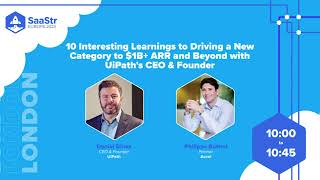
Please welcome UiPath's CEO and founder Daniel Danez and Excels partner Philippe Boteri.
Hi everyone. So it's really a pleasure to be here with Daniel today. So if you have seen on, on the video, I mean uipath has been phenom in enterprise software. This is the leading business automation platform and it was actually the largest Cloud IPO of 2021, which is, you know, huge milestone for Europe because 10 years ago who would have thought that Europe would generate the leading IPO software IPO.
Globally, you know, in a given year.
So I'm super happy to have Daniel here today. I'm Philippe Boteri, I'm a partner with Accel and we had the privilege to.
Lay the series in the company back in 2017.
So some time ago, but UiPath was.
Founded way before that.
You founded the company in 2000, 2005. That's been a long time, a lot of key learnings and today we'll dive into some of the key things that you have learned along the way. But maybe just to start with Daniel, so when you know, can you tell us why, like kind of the founding story of UiPath and kind of how did you zoom in on RPA?
I think I was always, always an entrepreneur at heart. Because of some unfortunate circumstances, I had to make a living for myself since I was 19. So I did a lot of gigs in post communist Romania, including like currency arbitrage. I have started my first company which was kind of a recruitment company when I was 21, barely 20, turning 21 and then I discover software and I thought, wow, this is an easier way to make a living. So I've become a software engineer. Then I got employed by Microsoft. So I spent five years in Seattle, which was a good experience for my engineering expertise. But it was kind of terrible for my life. I left a very colorful like Eastern Europe Bucharest to go into the cold Seattle. So I knew that I had to go back and. But after I got my understood really how, you know, company like Microsoft is working and which is interesting about Microsoft was that they offer some kind of tribe like experience. So you, in a way you feel safe there or at least in my times it was. And I met some of the smartest people in the world because between 2000, 2005 they were really at the top of the game. So going back to Romania Offer me no chance that but to start my own company. And look, I did, you know what I know best to survive. So I did a lot of software consulting, outsourcing, but always the dream was to build a product. And the genesis of UiPath was a very little consumer tool that offers some kind of one click dictionary for desktop. So you can, you can click on every word on Windows desktop and then we can extract the word and then show a pop up like search or you know, find the definition. It was an early form of computer vision because understanding every word in the computer application where it's positioned, it's a much harder job that you can imagine right now. You cannot just copy paste every so. So it was an engineering gig. We went very deeply hooking the internal systems of Windows. It was an interesting stuff, but obviously it was a flop from a marketing perspective. But, but we kept going and eventually from this little thing we evolved into building really our entire computer vision stack. And then we understood that you will need the local no code system in order to facilitate using the power of this computer vision thing that interactive screens and then we discover the market. We started in the business process, outsourcing market and then we got into really large enterprises and then we spread across the world and then we did the IPO and now we are here. But I can trace back to the first line of code which was really that one for this little application.
And along the way, how much did you learn from your customers? Like when you were, you started as an outsourcing business and trying to find your way into a product, how important was it for you to kind of listen to your customers and try to infer should be versus you having your own vision of what the product should be?
I think that was kind of my biggest transformation in how I think about building product. So I started as a software engineer working for a really large corporation. I was completely shielded from customers. I never met a customer in my life in Microsoft. So I came with kind of the same approach in building this business. And I persisted in that approach. I am right and they are wrong. If I bring these new features, they will finally be enlightened. But it's a transformation and I can give you some pointers. So first we, from this little consumer program we got to a small ISV from us and they, they were doing something, some kind of banking software. And what they did was to read the screens of a teller machine. You know, you used to go to the bank and cash, you know, get some money or cash a check. And these screens These machines were not connected to the banking system. So they were reading the screens and then populate the banking software. So it was a very early form of rpa and they came to us and tell us, guys, you have this little thing that works very well with the screen and it was the best in the world. Really. Yeah, we just need this one, not the entire application that you built and you are so proud of. And it was funny because I, and I asked, so he asked for a license and, and I thought how much can I ask this guy? So I thought I had, you know, just out of Nowhere I said $10,000, so you have an unlimited. Next day they wired the money. Honestly, the entire revenue from that other application was maybe $100 at the time. And that convinced me we have to pivot into this. So let's build, maybe this is easier for us. Let's build like software components for other software developers. It's easier to understand this market. And then we started to build this library and then next we, we were having some few interesting customers that were telling us, guys, it's very difficult for us to use co code, to use like C Sharp or JavaScript or whatever to build process automation. We need something simple. And this is how we turn into low code, no code. So we build the low code, no code platform. And then we got another. It was a lucky strike, honestly. Out of nowhere we got a really big customer in BPO industry when I had no idea what even BPO is, really zero idea. And they, they wanted to use our software in this nascent RPA industry. And before us they were using one of our competitor, but they were really kind of stiff in their mind. They were not flexible to, to the customer demand and they were searching really via the Internet like a software that it's easy to use and create some process automation. And they call us in Romania and we went to India for like two, three months to do a prototype. And it was the aha moment when I really understood, wow, this is the market we hope for. We were just kids so far, we were in a playground. But this is a serious thing and we understood that what does it need to scale a business? As a software engineer, maybe this is also interesting. I never understood the idea of scale. In an enterprise, at least you can make, you can make easy prototypes or even little products that can help a small group of people or individuals, but scaling across an enterprise, it's a freaking different thing. So this is what we started to learn with these guys. So we've built our orchestration Software that can deliver hundreds and thousands of automation at scale and you can monitor them, you can do all sorts things. But that was instrumental. I didn't envision this. And then everything it's. You are in a very lucky position if you don't have to invent and reinvent yourself every year and you just listen to the customers and your job is just to prioritize, understand what are your best customers, what are the best segments prioritize to their needs. And this is what we did. It was simple and you still do it today.
Like what percent of your time today do you spend with customers?
I still spend significant percentage. I during, you know, all these years I built amazing relationship with some of our biggest customers. We, I call them friends, we go to dinners, we had amazing experiences and it's a trusted relationship between us and they are not afraid to call me bullshit. So for instance, last week I had a call with one of our first customer a huge advertising agency and this guy and we are really good friends, we play tennis together. So told me, Daniel, I'm disappointed in what you guys are doing. You lost touch with us. You just go only for revenue. You go to different business units. You don't help me consolidate what we have. You try to overcome, go to sea level and look to me it was a powerful moment when you realize you are on the wrong track. So you are always customers always help you go back to your core roots and building something that matters.
That makes a lot of sense.
I think that is one of the.
Most important learning probably of the journey.
Well, one other fascinating aspect about the story of UiPath it's the speed at.
Which the RPA category was created.
I mean if you look back like six years ago, no one knew about rpa. I mean I still remember when we did the diligence on the series A, I spoke to the cop dev person of the very large software company and I was starting to talk about robotic process of and the person said, told me well, we don't invest in robots in robotics. Like what is this about? So that was basically the state of RPA six years ago. Today it's top of mind for all.
The Fortune 500 CIOs.
So could you tell us more like how this category came together and kind of what were the ingredients that made it happen and what are the learnings that you would and the advice you would give founders in this room who are aspiring to create their own category as well?
Well, let me start with the last question because I don't think that the desire to make a category. It's the right approach to build software. I think it's a sign of arrogance. I want to build a new category. I think it's gonna clutter your mind. If you feel, you feel it's. You feel too much, you put too much pressure on you. If you play tennis and you are a young guy and say I have to win winbletto, you are not gonna win winble. You just have to go and play for the moment, for, for the joy of doing things. So even the mere idea of I want to build a category is going to prevent you from building a category. You build categories because it's the right timing, there is the right moment in life and you are somehow chosen to be in that place. That's the way people build categories. And we can look to numerous examples. What happened in rpa. It was a moment when the business process outsourcing industry matured enough so they were at the point where they couldn't reap more benefits for their clients. One of their core proposition is that every year they will deliver savings for their clients like 5 to 7%. So they were in a position where it was very hard to do all sorts of process engineering thing, human process engineering to optimize and deliver. So they were desperate to get into automation. So they were willing to take bets on very small companies. So this is. That was one of the, that was why the market was ripe at that point. But it was also a technology condition that, that was very interesting that happened at that time. It was the, the big advent of AI that happened. One of the big moment was 2011, 2012, when I think the image recognition, you know, take a giant leap because of the cloud and mobile phones and all these new pictures that were uploaded. People built software to recognize images. We took this type of piece of software and we applied it to desktop and we were capable of recognizing all the objects on the desktop. And that was instrumental for BPO industry because they were using kind of Citrix to access their client system. So in order to automate something over C Trix or any remote desktop on a virtual environment, you have to do only computer vision, basically like a human user. So we had this really good technology at that point and the market was arrived. So that was it always I think there should be like gold, there should be more conditions in order to build a category. And it was a few companies that was there. So it was good, it was good timing. It was really, for us it was only about good timing.
And did you feel like you had to Evangelize your vision to the analysts at gartner and Forrester, etc. Or do you feel that actually they came to you? What was kind of this push pull process in the naming the quadrants, et cetera?
I think the name of category was Great Robotic Process Automation. It attracted the attention of people. I think it helped in a way. We had a lot of detractors. People say this is not real automation. You just go via user interface, you should go only via APIs. It's all this and it's interesting because customers don't care about purity. This is also another lesson guys. If you aim to purity, it's the wrong way to do. It's you need to aim for kind of something that is the meaning is like life. Purity in a way burns everything around it and you don't see you cannot do real use cases. You need to do a right balance. Even today I hear this shit. It's only have to be only API driven. And then generative AI came that fucking emulates people. It's not API driven, It's different and it's so powerful when you think about it. So I think it's really important to go over your biases and create a tool that works for the job at hand.
Yeah, that makes sense. So let's shift gear a bit and talk about hiring and culture. So as you mentioned, your experience was as an engineer, but at some point you needed to hire people outside of your field of knowledge, you know, in sales, marketing, etc. And this is something that usually technical founder wrestle with like how do you. How do you hire that first VP.
Sales or VP marketing.
So I'm to trying curious to understand like how do you think about it and what did you learn along the way?
Well, so I'll start with the biggest learning and then I'll try to explain why with some examples to me. And I strongly advise you guys on this. My biggest learning in hiring. You should go for chemistry versus expertise. I was always under impression that if you can assemble a team of a players highly experts in their domain, this is going to work. It is far away from working. This is a recipe for disaster. Honestly you have this is why sometimes I'm curious if this is go they take three founders that barely met each other, but they are experts and they expect this company is going to work. No, they will gonna argue to death and it's a recipe for disaster. Chemistry. A team with people that trust each other and that have chemistry and they like to work each other. It's the best you can hope for and life in software, in product, in everything. This is so initially our culture helped us. So I know we'll get to culture so I'll serve it for later. But then I started to. So I hired initially really nice crazy people. Sometimes their first job were people that were in their own onwards like corporate fugitives. So they want a different experience. And it worked. It was magical. We had moments. So for us at 10pm it was full. You can see, you know, hundreds of people working, drinking wine and being immersed into that. It was one of the most beautiful experience and it's possible only by chemistry. But then at that point I didn't understand that this is the recipe. It came to me just by luck. And then I started to hire the experts and it's not working. They might lay a good foundation, but always the way they. People cannot change in life. This is also another big lesson. People's personality will never change. So you see two people that don't get along, they will never get along. This is always happening. So you hire someone with the personality that's a little bit different. It's not crazy different. I'm not talking about psychopaths, I'm talking people, different personalities. But they change. They, they create. It's like you bring a different ingredient to a recipe, it can change it. Sometimes we're good, but most of the time you destroy it. So I, and we've been through lots of lots maybe too much. We shoot ourselves in the foot. With so many changes in the go to market I now I consider more stability and building, going for the chemistry. It's a better, longer term, you know, way to success. And so I don't know if I have to go to examples because many people you know, are known but it's, it's literally the, the way to go. So don't, don't guys, don't ever compromise on this. And this is very hard because sometimes I had to be like go to market leader, having the regional sales leaders under me directly. It's a freaking hard job to do this because you have to go in all the sales forecast in calls and it's a lot, you have to put pressure on them. So I wanted to get out of this. But if you get out of this and you don't have the right person, you lose touch with customers, you lose touch with the teams, you create a lot of unhappiness. A lot of people come to you and they complain. And it's the culture, it's. You basically create a dissonance into you were into your company and so how.
You mentioned the culture. So it's based on four tenets today. So you have humble, bold, immersed and fast. So how did you come up and when did you come up with these four tenets? As they evolved over time. And how important is that focus on culture for the success of the company?
So when we have started to see scale in the company, we were looking. So I and my early co founders, we were big fans of like Netflix culture and their Netflix lives. So we understood the power of culture in the company and we tried to define our own culture. People come with many words, you know, like candor, honesty, we are open, flexible, whatever. So we were having long debates and we can come up with long list of things that we define. But again, I had an inspiration at some point and I said to myself, let's reset this exercise and let's start just with one thing. What's the most. If there is one word that describes us and our culture, what shall that word be? And I realized that we are there because some of our competitors were arrogant. It was one of the biggest reasons they let a small company out of nowhere to steal their lunch, because they were arrogant. So I said the opposite of arrogance. It's probably what works the best. And then I said, let's be humble. This is humble should define. We should always stay humble. It's such a powerful concept. It doesn't mean that we are humble because nobody is truly humble. But to me, culture is more like framework of operating. You aspire to be something, you are not something, but all. You filter all your decisions or your interactions by your values. So humble is very powerful because first of all makes you listen to others, which again, if you are not really that of a genius and you don't suck all the air in the room, you have to listen to the others. Collective intelligence, it's most of the time better than your own. So this is. This is always my style. I very rarely make decisions that I enforce on people. Most of the time they change my mind. So the power. Being humble gives you the power to change your mind. Mind. I make decisions against the group of people that I trust. Very rarely, only when I am 100% convicted. This is the right way. When I have the gut feeling when I tell them, guys, this is against my heart. I will die. I will reap my heart if you don't do this. And they will do this. And so humble. It's extremely powerful. And also, you need to be bold in life because if you aspire for Little things, you will achieve little things. So you have to be bold and you have to go, you have to be fast because you know the fastest company will always create the biggest impact. And the way to operate always is to be immersed. This is what I liked in life. I don't like balance, work, life, balance. This is a stupid thing for every. You have to be immersed and you stay immersed in your life or in your work as much as it's working. But at some point you are exhausted and you go back to the other thing and you immersed in the other thing. But this is how I see in general. I see a good way to conduct your life.
And so one point that you mentioned was, I think very particularly important and striking to me was when you say bold and the need to kind of set this very bold, very audacious target. And I remember when we invested in the company, this is one of the fastest growing software company of its generation. I mean, you went from 1,005,445,000,000 to 175,000,000 in revenue, which is kind of an amazing ride. And you always had like these very ambitious goals, which I mean, I would say like initially when you say, well, we're going to grow from 5 to 50 million, I would say like we've never seen that. Like, you know what if you do 20 or 25, that's already great. We say, no, like we're going to do 50. And you ended up being very close to that goal. So how do you, you set this goal for yourself in a way that is a stretch, but not. But still achievable. Right? And what advice would you give founder in this room in terms of thinking about the goal and knowing what is an ambitious goal that's going to motivate the team? And even if you fell short, a bit short, it's still okay, versus something that is totally out of reach and therefore it's going to discourage everyone one because you're going to miss it by a wide margin. Like, this is a very fine balance. And just I'm curious to see how you think about it.
I think this is clearly the, the black magic of, of running a company that grows fast because it's, it's easy to be crazy. You know, when I heard Masayoshi Son saying, you are not crazy, crazy enough. That's. Guys, I am crazy and I can be crazy enough, but I am going to burn billions of dollars. I will overrun the market with reps and then they will step each other's toes and they will be unhappy. We will burn hundreds of millions of dollars. The culture will sink and we will go busted. Right? So. So craziness doesn't work or super craziness. You said it very well. The fine balance works. But I wish it's a thing that can work. I can give you an example how I have chosen. You know like in 2017 we were number, we're on the number three in the market. We have two bigger companies ahead of us. So we were like finishing the year 17 with like $45 million. And the other guys were maybe 70, 50, something like this. And I knew they are growing maybe 50% so they get to 100. And then I said to myself this is shaping as a big category. It's. I felt it, it's huge. So it can absorb, we can absorb. We can take a much bigger risk. At that point we were almost cash flow neutral. We've been cash flow neutral for a lot of our existence until that moment when I said this is it, that's the market is ready. The biggest company will get the lion's share and of the market it's worth, you know, pressing the pedal. And then I came to the board, maybe you remember and you guys said again if you do, if you deliver $70 million that would be a great achievement. Starting from 45 we talk about ARR to 70. And I said no guys, 70 will still be the third in the market. We will deliver to hundred. And then everybody thought I am crazy. But I went to the sales leaders at that point I was still running all the sales, the GEO leaders myself and I gave them this huge number and to my delight they were not shocked. They thought I'm crazy but they were not shocked. And they said give, give me a little bit of time and I'll come with the number. And then they committed. So we had this concept neck on the line in terms of commitments and they collectively committed to $150 million. And then I knew this is it. We can capacitate to $200 million the entire sales team because we will achieve 150. Well we, we have achieved 175 and we burned $80 million that year but it was nothing really get to number one position getting Gartner in everywhere. We won the market and they competition never caught us after the gap only increased. It was a very well timed investment. But next year when I trying to do the same it was a freaking disaster. So this is why we need to be very cautious. I wanted from 175 to go to 600. Look at the capacity. And I said to myself, we can get a minimum to 450. Okay, we can burn $150 million. That's nothing. We had half a billion in the bank at that point. We raised a big series D and. But the problem was that we didn't have the right controls in place in that year. And we grew significantly to like 370 or something like amazing growth. But we burned $400 million and that was not fun because you all and we over hired. So that was really the moment when we've been into diminishing returns and it could have been very costly for us because in 2019 we were one of the rare companies that has done the round of layoffs. And it's such a big blow to the culture, especially when you are alone in the market, like Nobody was there. UiPath was firing 10% of their people. It was a six month terrible blow. And then Covid hit. But again we were lucky because we've done this restructuring. So we are well, better preparing. Covid, our main competitor at that time, were trying to catch us especially with softbank money. So they were pouring a lot of money into the, into everything. Sales, marketing, build a bloated company. And Covid hit and they are fucked. And we are in a much better position. We were nimble already. I learned my lessons. And then 2020 was an amazing year and where we still grew like 80% we kept the cost under control. We turned guys from 400 million burn to cash flow neutral in just one year. It's almost unheard of while growing 80%.
Well, UiPath has broken many rules, et cetera.
So now I don't have any benchmarks.
Anymore of what's, what's possible. Just trust your, your founders. So I mean as you think about this journey between, you know, kind of being break even, burning a lot of money, then being, you know, cash flow positive again and rule of 40 company like how do you, how would you advise founders to kind of manage and think about the cash burn? And is the rule of 40:40 something that only applies for large public companies? It's something that is relevant when you're a young company. Like how do you think about it?
I think it depends on the stage for me. So I bootstrapped the company for almost 10 years. 10 years actually. We raised our first round of investment in July 2015. I started the company in 2005. Bootstrap. When you bootstrap a company you need to understand cash flow because otherwise you die. So I was very much cash flow Attentive and it's part of my DNA. I always, I feel it's a little bit against my nature to just go board huge amounts of money. But you need to understand again the right moment when you have to board. There is this. You know a guy that I admire is Frank Slootman, CEO of Snowflake and he has a great book called Amp it up or something. I think it's almost like a recipe for building a star. Because this guy, he's an operator. I'm not an operator. It's a different beasts we are talking. But as an operator, he describes very well when you have to push the pedal, when you have to increase the reps, how to think about it. He's an awesome guy and even in person, let me tell you an interesting story with him to see how you know, truly operator thing. So I and Brendan, which was at that time my chief of staff, really good friends, we are very close. We went to meet him, it was before his Snowflake gig. It was between ServiceNow and Snowflake and Brendan introduced himself and he said, I'm Brandon dear, you know, Daniel's chief of staff. And this guy said, Frank said I would fire you next day. It was fun. Yes. What's this draw? It's a fluffy job. What Chief of staff, it doesn't exist. He thinks also customer success. It's a fluffy job and it doesn't exist. And to certain extent I agree with this, but it's a very hardcore thinking. It's kind of interesting to see. It's not me, but it's an interesting to watch and learn what you can apply to. To your own thing. Where we were. I got lost in my mind.
Well, good news is Brandon is still with the company.
Brandon is still with the company.
Okay, well, great.
Well, thank you. That was amazing, Daniel. So I was just trying, if I try to summarize the key takeaway, they should appear here. So along this journey, I think as you mentioned, listen and learn from your customers.
Super important role. Really be thoughtful about when and how.
To use your cash. So I think this rule of 40 is good to have in mind, but you need to know when is the right time to really involve your resources and really commit to the growth. Evolve your leadership style as we just discussed, focus on culture and be bold but not too crazy.
I think that's.
That's the learning. Thank you. I don't think we have time for questions unfortunately, but thank you very much. Thank you. Daniel, this was an amazing discussion.
It was great. Thank you guys.
Thanks.
There's no founder community like this. Eight annuals and three Europas. This is the best of the best in SaaS. CEOs who may even compete with the next generation, all want to share and help. We all need mentors. And the whole point of Saster, thousands of pieces of content, years of events, is to be your virtual mentor. And that's what I needed. Saster isn't a conference, it's a community. It is a work of passion at this point. Over invest in customer success. Make your frigging customers happy. Job number one, two and three is to add value to your community each year. The kind of value for everyone to feel like some part of Saster they have to be a part of. If saster grows about 70% bigger, then we kind of enter the stratosphere. The world of Cloud will be here. That's a great vision. Please welcome Saster CEO and founder, Jason Lemkin. Where's the clicker? Hey, everybody, can you hear me? Okay, thanks for coming.
Wow.
The session with Daniel was pretty good from UiPath, wasn't it? I had, we'd wanted him for a while, had not really heard the story, but pretty crazy to go 10 years to the first million in revenue, bootstrapped, and then after that, fastest growing to a billion. I mean, pretty good one. I learned a lot. So anyhow, thanks everyone for coming. This is gonna be fairly informal if you've been before. I just wanna spend a few minutes, if it's helpful, to kind of set the tone for where I see things in SAS today, where we're at, and then later we can pick it up, like for the very last session tomorrow, and we'll do a Q and A at the very end during happy hour, until I pass out or until you don't have any more questions. But for what it's worth, I'll share my thoughts about where we are. And it's funny how many folks were in Barcelona last year at Sasta Europa. Okay, a lot. I did these slides and I'll tie it to this. And basically my message last year in Barcelona is, stop whining. And it was, look, obviously last year things were easier for most folks in 2021, when buyers would buy anything, when in some cases there was a lack of discipline in the markets, which was fun, it was good. But last year there was still so much budget going to SaaS and Cloud that I challenged everyone, work harder. Stop. Stop pining. For 2021 and the late half of 2020. Those days aren't coming back. They were Crazy times are still pretty good. Go out there and friggin sell something. And I still think that's the right advice today. But I want to talk about how things are different this year than a year ago. Last year was challenging, but I thought a lot about this and I didn't figure this out until a couple weeks ago. Like why are things so different in 2023 than 2022? They're obviously very different than 2021. I think for most of us during the crazy lockdown era, it was just nutso. And this is what I. I know this sounds obvious, but. Or maybe it doesn't. This is what someone who's been doing SaaS since 2005, this is the first time in the last 10 years that SaaS has gotten harder. Okay, it has gotten harder. And let me just talk through it for a minute because it took me a while to really understand this and there were some bumps and this is just. I took from the BVP cloud index just the overall growth of the markets and the top one, I know I'm colorblind, is a blue or black or someone tell me the top one anyhow is all the public cloud stocks and their stock prices. And what you can see is that, look, there were a few bumps and if you squint, I know there's a little line. There have been some downturns at the Sasser annual in 2016, most people don't even know this or remember there was a flash crash in 2016, there was a flash crash and it was worse than anything other than 2008, 2009. For about four months, people stopped buying anything in Sasa. It's nothing like today. Literally every CIO stopped buying it. It was so crazy that LinkedIn, even though they were profitable in public, panicked and sold to Microsoft. Like, why? The markets panicked, okay? And the markets also sort of panicked, as we'll remember, around March of 2020. But what happened then is they were short, right? The nuttiness of the lockdown didn't last, right? Three months later, zoom exploded. Slack exploded. We had a tear in SaaS purchasing like we'd never seen. So even though it was a rough four weeks or eight weeks or 12 weeks, it was so short and even that you can almost squint and see that downturn. Even though that 2016 downturn was rough, it only didn't last a year. It lasted six months or seven months. The weird thing is now we're in year two of a tougher cycle, year two. And I put this up 2011 to 2016. Outside of that bump, SaaS went from really hard. Like no one would buy your product unless it changed the world and no one would pay anything. But each year got a little bit easier. People knew a little bit more about SaaS. And then Box went public in 2015, one week before the SAS test. People still didn't understand SaaS, but at least they would buy a bit little. And if you were lucky enough to get to 100 million in revenue back then, like HubSpot or Box, you could IPO, right? Things were smaller. And then between about 2016, 2018, after that, that little crash came back, everything got easier. It wasn't easy. It was always hard, but it just got easier. Deal sizes went up. Folks that used to know how to sell a product for 3k could figure out how to sell it to 10k to more stakeholders. And more budget opened up. And SaaS went from weird to mainstream over these years. Then right before lockdown, it got pretty good. Okay, 2018 and 29 were like, wow, there's unicorns now. When HubSpot IPO'd, it was worth 800 million. When Box IPO'd, it was worth 900 million. Public companies weren't even unicorns. Okay, Back then, all of a sudden, startups could be unicorns. And so it started to get easy. It started to get easy. We started to hire, started in some cases to lower the bar on hiring. And more importantly, it all became kind of mainstream. Normal people went into SaaS. It wasn't quirky people that did startups. It wasn't crazy people that did this. It was ordinary, regular old people. And it just changed the surface area of who we hired. And it just got easier. And then 20, 20 and 20 got almost too easy. Not necessarily for us as founders, but I'll tell you a story. Sometime around June or something of 2020, someone I knew called me and he said, hey, my daughter went into SaaS sales. I'm like, great. She just graduated from college. She went to DocuSign, who I knew I used to compete with. I'm like, great. How did it go? She closed five deals her first day. She's great at sales. Okay, she's great at sales. This is her first job ever. But she's so good at sales intuitively that she closed five deals her first day. Okay, that was a moment in time that we all thought crazily might last forever. But think about it. Tell you it makes no sense, right? That was. Everyone needed a call center, they needed E signatures, they needed. They needed to collaborate. And it was crazy. And so be it. We know that that was a unique moment in time, but I think our culture has changed and it, and I don't mean to sound like someone that's been doing this while they're almost a fuddy duddy, but folks on your team and founders that have only raised capital, for example, over the last couple years, folks don't even know know what it used to be like. And so what happened was then we got to 2022, and 2022 in some ways was terrible because it was a huge overhang. The markets actually really peaked just at the end of 2021. And I remember one of my first group of investments from 2013 to 2015 was sales loft. And I had invested in Salesloft almost pre, pre revenue. And it was the last big acquisition that happened. They got bought for almost 2.5 billion in cash and it closed December 31, 2021. Okay, pretty good number. And they just crossed a little over 100 million in revenue. So at the time when deals were being done at really high multiples, it was like 20x, which seemed like a lot today, but then it actually was a decent deal for a PE workout. But it was interesting because that deal almost fell apart in December. By the time the deal got signed, it was exciting. But by the end, investors were starting to panic. There was questions, could we get out of the term sheet? It wasn't quite said, but panic had already sort of set in. And that's when I saw it coming down. And then it just. The markets just plummeted, as we know. Right. And so 2022 was crazy, but we were in kind of a free fall in the public markets. No one knew what happened. Right. And we didn't know would we bounce off the floor and fly back up to the top, what would happen? And so it was a weird year where at the start, beginning at that, those, those, those two and a half billion dollar deals stopped happening. So the series F and G and H and I G investors started to slow down, but the D and the C and the B investors were still there. And then by about the end of Q1 of 2022, the D and the Cs were gone, but the Bs and the A's were still in the market. And then the Bs started to fade away over the summer as the valuations plummeted. I mean, it kept going. And I would say probably by the end of last year, A's disappeared. Okay. And I actually don't think very many SaaS series As are happening, which we can tattle a little bit more later. But it took a while. But it was a weird year, right? Because everything was changing before our eyes and we didn't know. And I wrote a long post of like, it's gonna bounce back, but what is the angle of bounce gonna be, right? Is it gonna be like flat to this up or to the right? I personally never thought we would have two years of a public company sort of downturn or what we are. But what are we at now? Now we're in what looks like a flat turn. Okay, this was up and down, but now. And I could extend out a little bit more like actually the public markets are sort of flat this year. Some of them are up a bit. The snowflakes and cloud players and others have actually come back from the bottom. A few others are down, but we're in a world where it's flat. And multiples. What public companies are valued at as a multiple of revenue are pretty crummy. There's a handful that are more than 10x the snowflakes and cloudflares up spots. But the average, I think we'll see it on the next slide. I think it's about 5 or 6x. So the average SaaS company, really good ones, public ones, are worth 5 to 6 times the revenue. And they have been. Now we're getting into two years of this, two years of this, and this is just what it is. And it's so I actually some of you will say, oh my God, it's so hard out there. Revenue's down. I don't think it's so hard. I just think it got hard again. It basically got as hard as it used to be, it got as hard as it should be. There is not unlimited budget CIOs. Small businesses do not have unlimited money. There's a fixed amount. And if you disrupt something, if you do something better than Salesforce or Zoom or HubSpot or Slack or even UiPath, if you do something that is 10 times better, you will get money. But it's because you're disrupting that budget. You're stealing budget from one vendor to a new vendor that will always exist even in the tougher times.
But we're back.
So it's a weird thing. And I think I'm still struggling with this at some level with founders I work with and even on our tiny little team at sastr. And I think folks are is like there's a lot of DNA that changed during this peak in this last year. And there's a lot of bad practices. There's a lot of folks who complain. They think sales is hard because you know what? Now they have to close 4 to 5 times their OT when really it was like 2x when the market peaked.
Right.
Or marketers really have to develop pipeline and other things happen. And so it's just harder. And so I don't. We're gonna.
It's.
By the end of this year, either multiples may rebound or I think we will have churned through a whole generation of folks who close five deals the first day on the job. So anyhow, that's my tone of I still challenge you and we'll go through this. Things are not that bad. Like things are down overall about 30%. I wrote it up on Saster. We had data from Altimeter, we had data from Chart Mogul, we had data from Andreessen all over the last two weeks. Things are about a third harder. Growth is down by about a third. But growth is not down 100%. It is down by about a third from when it's easier. So everything's 33 to 50% harder. That maybe that's the way it should be. So that's how I think about it. And. But the craziest thing isn't really the growth. The craziest thing. If you don't study this in one year. And Daniel kind of talked about it actually before how UiPath did. I know if you just heard him. UiPath went from losing 400 million in a year to being almost break even the next year. That was unprecedented. Now it's precedented because every public company has done this and people have been wondering for 10 years, can SaaS be profitable at scale? And no one knew. Now everyone is efficient, right? And I'll show you just a couple of examples. Here's HubSpot. And HubSpot, obviously a hero company for all of us, right? A lot of us love the founders and Yamini and it's a lot like our companies. They just crossed 2 billion in revenue. Okay. And all the way up to 2 billion. HubSpot selling to SMBs at a 10k price point. They thread a needle. Like they didn't. They didn't go. They wanted to invest in the business. They wanted to invest in sales and marketing and engineering and product. And so their net margins were pretty low, as you can see on the left. Like they were positive back to 2017, but they weren't much. Right. They were investing almost everything back in the business. And then look what happened over the last year, radically more profit from Almost nothing to 13.5% margin. Now, I think this is non GAAP. We don't have to talk about. We can let the CFOs and others, we can talk about the differences. But HubSpot is radically more profitable than it was a year ago. And we're seeing this everywhere. And like, here's another fascinating one. Monday.com. i mean, Monday.com is crazy. It's growing. I just wrote up. I forget. I think it's growing 50% at 640 million in ARR. Pretty good, right? Pretty good. But look what they did on the left. Here's Monday's headcount.
Grow, grow, grow.
And then what did they do for a year flat, right? So they held the headcount flat. They've just restarted some hiring, but mostly for engineering. But they grew 50%. So if headcount's flat and you grow 50%, what happens to the bottom line? It gets a lot better. So look at this radical change from Monday. Radical change. Investing in growth. Investing in growth all through Q2 of 2022 as the world changed, right? Negative, negative margin. That was okay. They had tons of money, they went public. That's what the cash is for, right? To grow quickly, like Daniel talked about. But then the world changed and Monday become radically different from minus 16% margins to 24% in one year. 24% is really hard to do. Now again, this is non gaap. I'm not going to get into this in a short session, but 20% is pretty darn hard to do. 30% is what Salesforce is trying to do. Very mature. So look at that rate of change. Like we've never, never seen this rate of change in our lives in SaaS of companies going from everyone being okay about being inefficient as long as it's growth, to radically efficient. And almost. There are a handful of folks that are public that haven't done this. But almost everyone else that you analyze has gone through this radical efficiency change. And this may be the most we'll see. It may not stick. Okay. It may be that multiples reflate and good times are back and capital flows and we get back to the, to the, to the slightly drunk levels of the past. Maybe, I don't know, or maybe for the first time ever in SaaS, ever in our working lifetimes, efficiency actually matters. That it actually matters. It hasn't really mattered. People complained about SAS during the early IPOs box of the next generation and on Salesforce of the prior generation. They complained why they weren't profitable enough, but the market still tolerated it. People tolerated that. SaaS was always kind of investing in the future like the Amazon model. Jeff Bezos was always be patient. And in a way Marc Benioff and others were like that. But maybe we're done, maybe we're done with inefficiency. And at the end of the day, software used to be incredibly profitable. Adobe Today almost 50 cents of every dollar goes to pure profit. It's 40 something percent of every day. That's the way software used to work. A bunch of folks would write some code, you'd burn it on a DVD ROM that cost like 50 cents and you'd sell it for 50 bucks. Okay, so yeah, it was kind of expensive to get the engineers but the old classic software companies were so profitable like your eyes would cry. And SaaS never got there. But SaaS can be, SaaS can be. Maybe we can't spend as much on sales and marketing and GNA and maybe even product engines. We used to. Maybe we just all have to spend 33% less forever and it's doable. Like Monday did it in one year. HubSpot did it in one year. A lot of you did it in one year. But most startups are just thinking about this as a temporary thing. The board said get more efficient. Like we're not sure we can raise another round. So we're going to pause, we're going to slow down. That's very different than fundamentally changing all of the metrics and numbers we've looked at for 10 or 15 years that everything's going to have to change. Everything's going to get 33% more efficient and maybe 33% harder. Quotas will have to be actually be met. Everything will have to be more disciplined. So will this stick? I don't know. But again we're coming into 18 months into this change time. Maybe it's not a downturn, but it's a side turn, it's a re flattening. And if we end up 24 months into this and multiples are sort of the same, I think we are in a new efficient world. For the first time in SaaS, we will not, we will not go back. People now know like you can't say hey, well we're always invest that we can't be profitable. Monday doesn't want to be profitable. HubSpot doesn't need to be profitable. You can't. Now we've proven they can be the exact same companies with the exact same products and the Exact same management were able to become radically more efficient in a year. And you know, net net, it's doing more with not that many more people. That's the change, right? Not. Not the flood of people. Yeah, that's. That's the. That's the new world. So a couple related points. Two different ways to look at this data. I like this one chart mogul just put this together the other day. I put it up on Saster and I thought it summarized a lot of things briefly. And they looked. I don't know how many customers they have, but maybe 1000 something. I wrote it up on Sastr, but this was super interesting. They tracked the overall growth of their companies from 1 to 30. And anyone that's tracking direct metrics, it's super interesting. And so what do they see? Their top quartile. Now everyone may have different top quartiles and medians, but it's still very interesting because it's probably consistent. Their top quartile in 2021 hit 100% annual growth from 1 to 300. Obviously there are outliers, there are ripplings that'll be here later and uipaths and looms that are all speaking today that grew faster than 100. This isn't top 1%, but this is top quartile that they could double in 2021. And this is interesting because if you double at this rate, it also means roughly you can raise venture capital roughly at this rate, triple, triple, double, double. If you're doubling, you can raise venture capital. If you're growing 65%, that's still pretty good growth. You can't raise money. So one, all these companies became unfundable over the course of this year. And two, what really happened is the best ones still grew, but they grew 33% less than they did at the peak. And I think this, remember, and less than 2020. So similar things happened with the median startup, but this is where we're at. And so there's a bunch of lessons from this, but one of this is it's not like the top quartile is growing zero is growing zero. And I don't mean to be direct, but with a few exceptions, I don't have any empathy for startups that had decent growth during 2021 and have slowed to zero.
Okay.
I don't have any empathy. Do you really have no customers? Really none? No. What it really means is your product wasn't valuable enough. It means you no longer have product market fit. It means you fell out of product market fit. It means in 2021 when a director of sales had budget and can buy your product. But now the VP of sales or CFO doesn't see value. That's on you, right? That's not the market. You didn't build a valuable enough company. Go change your product, go tilt, go iterate so that there's enough value if your growth is slowed. 33% since the peak. I got a lot of empathy. If this is you, I have a lot of empathy. You're not alone because these are the top quartile. There are macro impacts. Not for everybody. I would say 20 to 30, 20% or so. And we'll see some other data in a minute. 20% or so of SaaS companies are not impacted at all. They have no macro impacts for a lot of reasons. But on average you're down to third. So here's where I have empathy and below that it's cry me a river. Like this isn't meant to be easy. Okay? Everyone already has bought 200 SaaS products. No one needs yours too. Okay? Most businesses out there work just fine. Do we need the 11,000th prospecting tool or the 58,000 payroll system? We do not. The tools are okay, that we have today. Build something disruptive, build something amazing that will get someone to switch and you'll unlock the budget. So anyhow, I thought this was super interesting to see. And here's another variant that Jamon Ball from Altimeter put up. He's got a great blog on Substack. He looked at all the public companies and there's a lot of data in here. But if you look at the left in red, the medium public company growth is down 35%. So essentially that sort of ties to the chart mogul data. It's not like any public companies have no revenue, right? But overall it's down. It's down about 35%. Monday is growing 50% at 640 million, which is stunning, but I think at 400 million it was growing like 80%. Okay. And so new bookings are down a third, but the new bookings are still coming in. And if you look at the left, I said about 20% of SaaS startups are unimpacted. You can kind of see that on the left. Those are folks that are growing faster than they were before in ServiceNow and a few others, HubSpot, Dynatrace, you can see these are the ones that are having no macro impacts for different reasons. So it's harder, but it ain't so hard that either the Startups or the public companies can still get there, but they are now radically more efficient than they were. So this is kind of. I wanted to synthesize everything that I'm seeing. It should be a third harder for most of us, not all of us, but go sell something and then to tie it together. I know you folks have seen this and maybe the point I made before is merchant and we'll talk about this will get threaded through tomorrow where we have a ton of VC content, VC type content. And I can talk more about it if people want to. I know people have seen different charts of Vertas, but I like this version from Carta that showed through Q1. You know, you can just see the peak of venture and that it's just plummeted, right? It's just plummeted. Capital fell 80%. And I know everyone knows this, but if I had to give you one takeaway, it ties back to the price. I'd hear a lot of founders are like, okay, I want to raise, I want to raise an A round or a late seed round or something. And I'm like, how are you doing? I'm like, well, we're at 2 million ARR. We're going 40%. But last year we were growing much more quickly. It's just harder today. I'm like, I get it, but you're not going to get funded. And if I had to give you one, we can talk more about this tomorrow. If I had to give you one takeaway is if you are, if you're, if your revenue, if it's 33% harder than it was last year, you're not alone, right? But it doesn't change the math of fundraising. You're not going to get a pass from new investors. Now your existing investors may give you extra money, may give you a bridge or an extension because they understand the 33% impact, right? If you were doubling last year and you're great founders and the growth is a little bit down this year, they may give you another million dollars or half million or five million dollars because they know, because they're already on your cap table, they're already invested and they will cut you some slack for that 33%. But new investors, they can't. And this is why there's so much stress across venture today, because you need to get to 100 or 200 million in ARR in 7 to 10 years for venture to work. And if you're not growing at a rate that can, can compound to 100 million in that journey, you simply can't make VCs enough money for them to make money. Founders don't get it right. And so there's this old math that Niraj from Battery put together a while ago. Triple, triple, double, double. You know, you gotta triple after 1 million, 1 to 3, triple again, 3 to 9, then 9 to 18, 18 to 36. Not everyone quite does triple, triple, double, double. But the reason it's such a useful heuristic is that gets you to 100 million in seven to eight to nine to 10 years. That's what it takes. And if you fall below that line, it doesn't mean you're a bad human or a bad startup or your customers don't love you. It just means venture capitalists can't make enough money to invest in you. Right? So a deeper topic, but just realize your existing investors may cut you slack if growth is slowed, but new investors are just going to pass, right? They're just going to pass. And this is why the markets have frozen. And I will tell you simple. I've talked to so many folks and I met with one of the best SaaS. VCs. Growth multi stage. 10 billion, 20 billion under management. Done so many of the great SaaS companies through IPO. And I met with him last week before I came out here, like, how are you guys thinking? And like, well, you know, first of all, our investment pace is down 80% from where it was at the peak, which is kind of like this data. And said, but what do you think? What if I gave you a triple, triple, double, double company? He's like, even that, we don't even know if we want. Unless it's AI. We're not even sure we want to invest today. Okay. The markets are just sort of paralyzed and frozen and again, you're not going to get cut any slack. And I've already had this conversation like six times this morning. Can I. I want a raise and my growth is down. Well, you know, it's. Cry me a river. The math has to work out. Anyhow, I wrote this tweet the other day. There's essentially zero interest in abc sas, feces or anything. Is in AI. That a version of the story I just told? Zero interest, but pretty darn close. We'll talk about that. But you know, this is Dan Schiman, one of the most successful angels. You know, top angel and board member for Zoom. He owns, owns like one point something percent of Zoom. Personally Sentinel one, so many other. I mean, probably the best angel track record. But just a reminder, the pendulum will swing. Back, which will be kind of the last point we talk about. And I'll have to go through this a little bit quickly because the prior session went long, but I want to hit a couple other points. And I write up the Gartner data a lot on Saster. I used to be a skeptic of Gartner when I was a CEO years ago, because it always seemed like you kind of paid them to get the research and it was pay to play and there was a lot of stuff. So be it in terms of the research. But the great thing about Gartner is there's no one that talks to as many in the enterprise CIOs and buyers as they do. Okay. They're constantly surveying hundreds and hundreds and hundreds of buyers. So even when their numbers change a little bit, I generally find it's always some of the most directionally correct data that we can access as founders and executives. So what does Gartner say? Well, you know, SaaS is still going to grow 18% in spend this year and another 18% next year. People are still going to spend almost $200 million in the US alone on SaaS, just in the enterprise. 200 billion and 230 billion next year. Now, a lot of that's going to go to incumbents. A lot of it's going to go to price raises and inflation. Okay. But it sure ain't going down. So change the world and you can access some of that incremental $30 billion. Just an incremental 30 billion that next year is still going. And this is only enterprise. This isn't even SMB. That's still going in this year. So overall, things are trending Good for SaaS. People are buying more and more of our products. They're just buying different with more scrutiny than they did 18 months ago, as we all kind of know. And I thought this was a good summary with Twilio. This is. This is one of their classic billboards in the Bay Area. And it just shows how buying has changed, right? So for like 10 years, basically, Twilio had versions of the same one on the right. Ask your developer. Ask your developer. You need to add voice, you need to add sms.
How?
What do you do? Ask your developer. They'll make the decision. This was empowering the line to buy, which benefited so many of us in the peak. Now it's reducing costs by 65%. Now this is something you can go show your CFO on your phone. Hey, if we use Twilio, our costs are going down 65% so for all of Twilio's first decade or so, ask to your developer, ask your developer, ask your developer. Now this is the theme of the day. PagerDuty had a very similar one and I thought it was just. And so net Net. My last point is, and so many, I think founders have adjusted to this, but it took folks a while. Folks are complaining, oh my God. Now the CFO has to approve my deal. Now I have more stakeholders. Now I have to go through scrutiny. Now I have to go through an extra layer of procurement. And I'm like, cry me a river. This is the way it used to be until 2020. It used to be everything had to be approved by the cfo. It used to be you had to do seven things and you had to do a pilot and you had to resell it after the pilot and you had to do all of it and you had to go through all of it. And then all this budget, everything became about investing in growth through SaaS and it all got lost in 20 and 2021 and people went to VPs and directors and gave them a reasonable amount of budget to just go spend, just go buy the apps you need to grow even faster. And that's gone. They no longer have those budgets. Their bosses have those budgets. As you can see from the Gartner data, it's not like the budgets disappeared, but those folks that could just buy your app without the CFO's approval, that's just been, that's just gone in most businesses. But it's just like it used to be. It used to be this way until about 2018. So we're just kind of back to the future or something like that. So if I, I think this is my last slide. Let me go back or close to it, this is my last point and I'll try to wrap up in two minutes because I lost a little bit of time. But for founders and others, the biggest challenge through the rest of the year and into next year is really just multiples. It's just multiples, revenue multiples. And I as a founder, I never really thought about what multiples were. I never really looked them up. Even when I started investing, I didn't really care. What are you going to do as a seed investor? You going to worry about the multiples? Just invest in the company, an early stage company, hope it gets big. You don't worry about it, but because it's so much impacts buying, it's so much impacts every round from a on you, everyone needs to be an expert on Multiples on multiples. Right. And this is sort of low growth, mid growth, high growth again from Altimeter. You know there has been a bit of, it's probably that this, I think this is last week. There has been a bit of a bounce at the end. But some folks in the stock market, I'm not sure I love this term, they call it a day dead cat bounce. I don't know if you hear the term. It's like even when the market drops a lot, it may bounce off the bottom but it doesn't mean that it's really anything real. It's not such a big bounce. So some people think it's back a little bit. But again until we're above to simplify this for folks, until the average good public SaaS company, and maybe this is mid growth is above 10x, there's stress, there's stress. It's almost impossible for late stage investors to make money, right? If the average public company is doing 300 million and trading at a billion something in revenue, who's going to do a unicorn? There's no room to make money. You've got to triple your money at least as a late stage investor. How can you invest in a billion if the company, after all this hard work, IPOs at 2 billion and there's more dilution. So it's just broken. If we stay here and we've been here, as you can see, since, since we came off this peak. We've been here for a while. We've been in this 6x7x world for a while. And depending on how you look at it, it may be the lowest multiple since 2017, 2018, maybe longer, depending on how you cut the data. But will we stay in this world? It's a world we've been in before. It's a world where you can be efficient and profitable, but it's not, it's hard, it's hard to raise capital, it's hard to get anywhere. Or will we reflate even just 20 or 30% that's like we need to study this as founders and everything will change if it gets just a little bit easier. But we've been here for a while, guys, and it's, there's no evidence we got to live in the real world as founders and leaders and right now there's no evidence that it's going to get any easier. There's no evidence it's going to get any harder. Like enterprise buying still up 18%. These, these, they're still good companies, but multiples are rough and that's also why almost every unicorn of the last couple years isn't worth what they were worth then. The multiples didn't support it when they're up at the top. It was great, right? When Companies were worth 40x, the top companies when they're public. Snowflake was worth 80x. It was easy. Now it's just. It just the math doesn't fit. So that was my last point here. Don't be waiting for a rebound, but just lastly to summarize then we can chat more tomorrow and later I thought we're 18 months into this reset again. I think that's a better term than a downturn. We're resetting to. At least right now it's. We're resetting to where we were before this big run. We're 18 months into it. And so what I said to you before is let's hope for better. I do think as an optimist multiples will be higher. I do think buyers are still there, but we gotta plan for more of the same. I think as founders you have to plan that 18 months is a long time. 18 months is not the flash crash of 2016 or the weirdness of 2020. 18 months is a long time. It's not terrible, it's still growing, but we can't plan for it to get any easier. So I sort of summarized it in five points. 1. And I know a lot of folks are still grappling with this. A lot of folks in sales, AES and SEOs are still freaking grouchy in 2023. They're grouchy because they're all making less money than last year and less money than the year before. And maybe they entered the markets in 2020 and 21 and they think this is way too hard. Like I actually, like Sam said at the beginning, I have to do outbound. I have to set my own calendar. I actually have to generate pipeline. Like a lot of AES I know are complaining. They're still complaining. But the math has to work again. There's not so much venture capital to lubricate the system that sales reps at the end of the day can get away with closing 2x or even 1 time multiples. We're back to 3 to 5x OTE. So if a rep wants to make 150 grand a year us, great. But if you're enterprise you better close 5 times that mid market. 4 times s be 3 times. Otherwise they're not efficient enough. And we talked about efficiency. So sales has got to get back to Real world numbers that have made sense since the dawn of time. 2. I know everyone sort of gets this, but founders still are too optimistic about venture capital. In my experience, almost every founder knows it's harder, but they still don't realize how hard it is. And maybe we'll chat about it a little bit tomorrow, if nothing else, like the old days, until about 2019, assume every round is hard.
Harder.
Assuming the next round won't come. As people are saying, I've written this up many times, it got harder. And we went through this weird perversion or inversion of this from 2019 to late 2021, where each round, if you were a great company, if you were great, not for everyone. Venture capital has always been for the privileged few. But if you were in the zone, it actually got easier. Each round got easier. And you would look around, you'd be like, oh my God, weren't they were worth 300 million last month and now they're doing another round of 600 and then another round at 1.2. And not only was it crazy, the numbers, but what was crazier is each round got easier. There was so much momentum in the market, so much fomo, that it was crazy that each round got. It's never happened in my lifetime since my first job and it may never happen again. That each round got easier. It's supposed to get harder. It's supposed to get harder. As you approach the value of a public company, it's very hard for investors to make three to five times their money, right? It's very hard. It should be if you think about it now, VCs need to make at least three times late stage VCs. Early stage VCs want to make 100x series B want to make 10x and late stage want to make 3-4x. If you're only air quotes, only going to be worth 2 billion. How even no matter where you are, how can anyone afford to invest at a higher than a $500 million valuation? Think about it. Just to make 4x, even 3x with some dilution and risk, that's going to be about the ceiling, right? And you don't really see any growth rounds, but being done much more than 500 million today for that reason, they really just don't. One of the best companies I've invested in, it's coming up on 50 million. The growth's pretty good. It's almost profitable. Not much to complain about. And one of the leading growth investors really, really wanted to invest and they're just like. But Our ceilings. This is just like two weeks ago. Their ceiling's 500 million. It doesn't really matter beyond that. They have $10 billion. We just don't. Unless you're really going to be worth 20 billion. We just, that's our lines for the, this math. Like we don't think we can make more than 3x our money. So no matter what it is, we're, we're just stopping at 500 million. This is for a late stage investment. So it was it kind of tied to this point, the third point which we chatted about. But. And you can't just cut. And public companies know this. Like, I mean layoffs were brutal for public companies, but they kind of did the good ones did this, did this, did this thing of precision. HubSpot did some layoffs, but it wasn't that much. And it let them become radically more efficient here I think they did 10%. Look, I know it's not easy to do layoffs, but they went from somewhat efficient to radically inefficient here. It was a tweak, right? It was a tweak Monday. I don't know if they did layoffs, but they did basically a hiring freeze. It worked, right? And it made them radically more efficient. That works like growing your revenue faster than your expenses always works. But just cutting solves no long term problem, right? And so you've got to still do marketing. And I think there will be a rebound in marketing by the end of this year. Everyone that cut marketing to zero in the beginning of this year is gonna have no pipeline at the end of this year. That is the looming cliff for so many. Everyone below the public company stage is not gonna have enough pipeline at the end of the year. They're have to deal with this. Everyone thought the marketing was dumb. Everyone thought field events were dumb or webinars were dumb or podcast ads were, were dumb. And basically everything in marketing, for many folks, everything in marketing for the last six, nine months has got. You need an ROI measured in like three months or less if you can spend the money. But I need that, I need to deliver that into revenue this quarter. It doesn't work that way in marketing. So you can't just cut your way to growth. And we're all going to see this price at the end of the year. But to be efficient, this is like old school math that I did when I was a founder in HubSpot. Maybe for every dollar in new revenue you bring in, I guess that really should be arranged. Spend 75% instead of spending two times what you bring in. Spend 75% of it. You'll never fail if you spend most, but not all of your new bookings. And then my last couple points, not to read from a slide, but I think they're useful. Going to the prior point, all of this may be out the window if we see even a modest rebound of multiples, right? If the average public company reflates to 10x, VCs are going to be able to make more money. That means startups will get more money. That means everyone will spend more money. That means you can, you can, you can overpay people on your teams, you can do whatever, you can over hire, you can make all these. It'll be okay. I mean, it'll get a lot easier if we see a rebound in multiples. But again, it's been 18 months and we haven't seen it and we haven't even seen the decline. We could all kind of intellectually say we're just in this crazy free fall period, but now that it's been flat for six months, there's just no evidence they will come out. But maybe interest rates will come down if everything in multiple is really just an inverted version of, of, of the Fed. Maybe when the Fed starts to cut, multiples will reflate, but there's no evidence of it yet. And then just kind of two final points on the state of everything for folks that I don't know what it's exactly like in London. I've only been here four days, but to say that no matter to say, you know, on Twitter, you see, everyone's talking about AI in the Bay Area. In sas, they understate it. Understated. The only thing anyone is interested in the Bay Area is AI. Nothing, everything. They want AI, they don't want fake AI. They don't want the fact that you did some crappy Chatbots integration last week. What they really want are companies that can grow at insane rates because they displace human beings. That's what VCs want. They want companies that can go 1 to 10 to 100, like in two years that will just replace hundreds of jobs. That radical efficiency, and that's what every VC in the Bay Area is hunting. And they will throw crazy amounts of money at startups that might be that. But as crazy as there's a mission here, they're looking for folks that can get to 100 million in a radically short amount of time by frankly displacing a huge amount of jobs. Right? And so that's what we're looking for, but there's too many of them. These $10 million, $20 million rounds in the Bay Area, they can't last, right? Not enough of these companies are going to go from 1 to 100 in two years. And so we'll see what happens in SaaS. And then the final point, just to note, and you know, this year was the slowest year so far for SaaS IPOs. Last year was the second slowest ever. And then 2021 was an IPO day. It was an IPO day to nonce. It's nonce right now. It's frozen. But there are so many SaaS companies at 200 million and above waiting to go to IPO. I've invested in four and a half that are at 200 million from like 2013 to 2015 batch. They're all waiting at 200 million. No one wants to IPO at $800 million valuation or 1 billion. Especially if the last run was higher and the markets are frozen anyway. But I don't know where to predict this all is except when things do open, when if multiples do reflate a little bit, we will see this spring of public SaaS companies like we've never seen, right? There's a whole new wave. There are only a handful in the beginning and then they seem to flower. But overall the buying is so big, there's just so many at 200 plus million ARR. And then you know, Canva announced this week that they crossed 1.5 billion in ARR profitable for 5 years. I mean just sitting, waiting to go public at 1.5 billion. Right? I mean HubSpot is such a great company and it just hit 2 canvas quietly off in the corner profitable with its PLG plus sales team thing coming up on 2 billion quietly waiting for the markets to reopen. Now it does sit on a $40 billion valuation, which is a little stressful, which is where some of the press came out. But pretty crazy the amount of high quality companies that are just waiting for the markets to reopen. So we can chat more about this tomorrow. Hopefully this is helpful. It's just what I see in the markets. But thank you everyone for coming. I'll miss some of this, but just a few couple quick notes and then I think we're out of time. If you haven't brain dates are core to what we've done for the last couple years. Over on the other side of the venue there are tons of brain dates for mentoring sessions and meeting people. We have a one on one room, we have one on four for small groups. And then we have these slightly bigger super brain dates. If you haven't started, it's cool. You can sign up on the mobile app or you literally can go to the brain date, stand there and sign up to join any that you you want. They're pretty cool. And then maybe just the last thing in the middle because we're out of time. There's a whole bunch of informal parties or off site parties. Maybe you've been invited to some. I listed a bunch on saster.com you can find. But our own party, which you don't have to go to. You can go to anyone you want or you can go to 10 parties. It's all good. But there's one way up on the roof. It's a super cool venue. You can see all of London. It's got all different sort of sports. I think there's like a putting green, there's different bars. The view's fabulous. This is it up here. But not everyone can go at the exact same time. So I think when we hit five, we have a huge happy hour there. And I think people got a ticket and it says when you can go up. You may be able to go up other times but I think it gives you a cue because there's only so much weight you can have on the roof. Just to know. But it'll be pretty cool for tonight. But just look at your. You can try to go and they'll be happier but you may not be able to get in at the exact moment if it doesn't tie to the hour at your card. So thanks everyone for coming and we'll chat more during the two days.
Sam.
Foreign.
Hello, everyone.
We are about to kick off in stage A.
With Braze.
It can be hard to find the courage to light a spark and start something new. Most of the market before us actually built for a single channel to constrain the thinking. Braze is a customer engagement platform. We were trying to solve a higher level problem.
Yeah.
How do you build good relationships with people? We were just operating in a totally different universe and we didn't even realize that. That we were. What makes great relationships between brands and their customers, it's the human factor. It's happening in real time. We've moved from staring at the glass to looking through it. The evolving context that's around you needs to be taken into consideration. Modern customer engagement is an interdisciplinary sport. The magic that happens at the intersection of complementary skill sets and passion. We sell to job titles that didn't exist when we started the company. Braze is now so much more than the sum of its parts. That level of like, how do I anticipate their needs? That's something that brands still strive to do. We want Braze to be different because you're a part of it. We want it to be a tapestry of amazing individuals. We're going to build a generational company. We need to make sure we're continuing to think for the long term. And everyone that was a part of it didn't think of the IPO as the finish line.
Please welcome Braze's co founder and CEO Bill Magnuson.
That's the first time I've ever seen that video. Wow. Welcome everyone. Thank you for choosing to delay your lunch a little bit more to be with me here today. I hope we'll make it one worth your while. My name is Bill Magnuson. I am the co founder and CEO at Braze. We were founded in 2011 and actually I was the CTO until 2017 and so have a lot to kind of talk about in our history today. It's obviously an important moment in time across the whole markets. We heard from Jason earlier a lot of the pressures that, you know, a lot that this entire community is under from a venture perspective, from an overall market perspective. But what I want to really focus on today is that when change is happening, even if surface level we look at it, it feels like negative change. There's always opportunity in that. But parsing through the opportunity, trying to find the parts of it that are enduring, finding the parts that are not the kind of surface level vanity metrics that a lot of the hype tends to focus on. But the things that are actually going to have staying power, which often take a while to percolate and mature and really settle in, those are the places where you can really build enduring differentiation and build enduring businesses. And so I'm going to talk through the story of Braze and how we really process that from a market perspective. Introduce a few mental models for people to use and I hope you find this helpful along the way. So of course always start this out with the from humble beginnings photo. This is actually me and my co founder John hyman back in 2011. This is at the third ever WeWork in the meatpacking district in New York. And if you look on the ground there, fun fact, WeWork has run out of money more than once. The first time was actually when they were outfitting that office space and they left us with bare concrete floors in this nice little oven box up on the top floor. And we started off July 2011. We had a huge amount of conviction in mobile. As I mentioned, I was cto. John Hyman is today's cto. So we had two technical co founders to start out with, which is a great privilege as you're starting to build a new product. And actually Braze, which is well known for selling to marketers today, actually sold to developers back then because mobile apps at the time didn't have business models, they weren't making money. And when you don't have a business model, you usually don't have marketers. And so we were actually building for people that were building apps as developers. It was pretty nice because as a developer, being able to build something that is used by people that you understand was really amazing and an interesting fact. And we'll kind of dig into this a little bit later. Back in 2012 when we launched our beta, we had more developers sign up for the, we were called Appoy at the time for the AppBoy beta than we even have customers today, 12 years later, having gone public and now worth, you know, billions of dollars. And so, you know, take that away a little bit and really, you know, reflect on what that means as you're building your business and the metrics that you focus on. You know, we were so excited about that in the early days there was felt like there was a gold rush around mobile apps. And now here we are, more than a decade later, still have less customers than the number of developer signups we had for our beta. And of course the reason being that that wasn't the right metric to focus on. And what we've really built focus was the enduring change that happened in the market. So Braze today I mentioned, you know, founded 2011, we're coming up on our 12 year anniversary this summer. We were headquartered in New York City to start with, but London was also our first international office and today is our second largest office globally. I like to say that the center of gravity for Braze exists somewhere over the North Atlantic. It is not somewhere over the United States. And you know, we're proudly a very global company to today, about 43% of our revenue comes from outside of the United States. And an interesting kind of fact about that is that I get questions from public market investors about why such a huge mix of our revenue as a relatively young company comes from outside of the US But I always have to laugh at that because I got the same question. We raced our Series B back in 2014, 2015. The answer of course was that the app stores were global. You know, when we were, when we first opened our London office, three of our four largest customers were based out of Oslo, Armenia and Berlin. Even though we had no humans on the ground outside of the United States, the opportunity that was presented by these increasingly interconnected markets didn't respect borders and it created huge amounts of opportunity, led to a lot of change. And you know, we, we therefore have then grown globally in order to service a global customer base. Today that customer base, the combined user bases of all of our customers, are almost 5 billion monthly active users. We sent over 2 trillion messages last year. We processed over 11 trillion data points in order to understand when to send those messages, where to deliver them, what to say. And we help all of these brands that we work with manage their customer relationships, really work through the foundation of what creates an enduring and durable business in investing in long term connection retention and doing it through high quality engagement. And so of course what we want to talk about today is finding opportunities through change. And there's a few different ways to think about change. There's the pace of change, there's different cross currents in it. We kind of move through change in sequences. And I think another really important part of change is that we also need to look at the fact that even change we might perceive as negative still creates opportunities. In fact, when I was checking in here earlier today, the person at the check in counter asked me, what's your talk about? And I gave a brief abstract to it and she said, so what's the answer? Do you just wait it out? And of course not. Right. The companies that are going to win are the ones that are going to actually predict what the change is leading to and start building for that tomorrow, right now. So that when it gets there, you actually have a head start on all the competition and the market arrives and it's waiting for you, or when the market arrives, you've been waiting for it. In fact, when I look at the purpose of venture capital, it's not to burn $1.05 in order to, to grow a dollar of revenue. It's to give you that opportunity to already be building for the market while it is still developing. When we were building AppBoy, we actually had an interesting vertical focus in the sense that from 2011 to 2015, the only part of the mobile market that was making money was in mobile gaming. But what we saw in mobile games at the time were a bunch of apps that were tricking children into buying fish food by clicking, clicking on the in app purchase button. A bunch of times, or just like milking their whales and trying to move them from one title to the next. These weren't sustainable businesses, but we believed that actually people would move their lives, the products and services that they were consuming, the habits that they had into mobile. And so AppBoy in the early days kind of went after the Nash equilibrium in the market. We were like, hey, why don't we chase after all the other verticals? Well, all of our, all of our future competitors are focused on gaming. And then as that market grows up, which we believed would eventually be much larger than just gaming was, we'd be ready for it and we would have a platform that was already built to be more versatile and to be more vertically diversified. And of course that took more time, but it's exactly what happened. And so when you look at Braze today, we are a super diversified, diversified customer base. Our largest vertical contributes kind of low 20% of our revenue. It's E Comm, which is pretty common for a marketing company. But if you look right down the list, you've got media and streaming, you've got financial services, you've got health and wellness, you've got QSR and delivery and on demand, a really diversified customer base. And it's because in the early days, we didn't chase after the same ball everyone else was. We took a step back and we said, what's really changing in the market and how is that going to create a more broad opportunity? Now, when we talk about acceleration, we can't also ignore the fact that these cycles are moving faster than they ever have. Now, this is a chart originally from the Economist, but augmented a little bit. The time until 25% of Americans have adopted these subsequent technologies. And the headline here is that things are speeding up. Obviously, the amount of time it took for the television, 26 years, smartphones only three years. But there's another layer of change here, which is like this was the time until a quarter of Americans picked these things up. How long until they affected an election? How long until someone wrote a PhD thesis on these? How long until a new job title was created in order to work on these? How long until there was mass adoption, until it went global? When we look at smartphones, interestingly enough, it's the most widely deployed technology ever, even more so than clean water and electricity before it. That level of penetration had never been seen before. And that's why these markets that are addressable through mobile are so large, they're so global, they allow such rapid adoption. But of course, the flip side is that we still get things in the post that we need to read and reply to. The BBC is still broadcasting shortwave radio all these years, years later, right. There are things that are enduring. Just a couple weeks ago in the United States, the first NBA team tried to cut the cord, if you will, and their regional sports broadcaster went bankrupt and they tried to go direct to consumer over streaming. And that company in bankruptcy sued them and enforced their contract and disallowed them from being able to go straight to streaming. So they're still on the local cable broadcast. Right. There are aspects of change that actually hold us back, that are enduring where skill sets need to evolve, where regulatory systems need to evolve. And there are other places where this speed's up. Right? Microsoft bought and divested Nokia in just three years. The time from Uber launching to the New York City taxi medallion prices crashing was substantially faster than the multiple decades that it took for Kodak to slowly die. Right. There's a lot of different kind of forces that are entrenched that can slow down this change over time. But of course, the other side of that is that when you look at how things like job titles, skill sets, industry structures, budgets, org charts, regulatory regimes, these things that are kind of tied to the structures that we as humans create when they evolve, that creates enduring change and enduring advantage. And so as an entrepreneur, I think we need to keep both of of these things in our minds. One is that yes, things are changing very quickly, but two, they interact with a lot of things that change more slowly. And so the things that move fast create these new opportunities, these new toeholds in the market, these new technologies to leverage these new ways of working. But we need to make sure that we're pacing ourselves correctly and that if we're trying to build a generational business, that we know what's still going to be true in five years and 10 years, and that we're really building to have advantage as those things develop. Now, of course, the other consequence of these really huge global markets is that the pace at which consumer technologies are being adopted is rapidly advancing as well. And here we can see the time to 100 million users and you've got ChatGPT down there in the bottom right really crushing it recently. And this means that user attention can move really quickly. This is another testament to just the size and scale of these global markets. But again, we need to look at these and say, what change are these going to drive for humans? When we look at the last five years, there's been a lot of places where Change has accelerated. We looked at Covid, a lot of people's ways of working change. A lot of the ways that we organize our society, that we transact in commerce changed rapidly. But a lot of stuff have also kind of returned back to those, to the prior growth line. E Comm pulled forward tremendously and now it's revisited its prior growth path almost exactly. When we look at a lot of the patterns of behavior that people have had, it turns out that humans still like each other, we still like socializing. It turns out that a lot of the companies that said they were never coming back into the office are now mandating that people do. And I kind of look at a lot of those things in the early days of I actually went back and read a lot about the 1918 epidemic which impacted global society in a very similar way. And the interesting thing about it is that there wasn't actually a lot to read about. There's no art, there's no theater, there's no movies that were made about it. You don't really learn about it in school. And the reason for that was that people kind of moved on afterward. They actually, even though it was highly disruptive to the entire economy, humans got back to being humans pretty quickly after they forgot about it. And of course we're seeing that now too. And so I think it's really, you know, important to keep both of these things in our heads at the same time. Massive opportunity because of the size of these markets and how fast they can move. But at the end of the day, you know, there's these enduring facts about humans that if we lose sight of those, we lose the ability to build businesses that are enduring. So, you know, big takeaway here as we're thinking about growing a business. And now especially when we're so focused, we need to be so focused on prioritization because of access to capital. You need to reserve your conviction and your focus for change that's going to endure. If you're just chasing shiny things around, you know, a new one pops up every six months and you're going to run out of energy, you're going to run out of financing, you're going to, you know, you're going to exhaust the startup. And when you get there, of course everyone else is chasing the same ball around. It's like a bunch of 8 year olds out on the football pitch who are just running after the ball as opposed to actually playing a strategy. Don't be that version of a startup. So going back to our story, what was the change that we thought would endure. Well, we had this in two stages. The first one, that new brands would be born and built to be mobile. First in 2011, obviously people were excited about the iPhone, but the biggest apps in the app store were a flashlight app and a compass app and a game where you could feed fish food to an animated fish. These were fun and they were exciting, but they weren't building sustainable business models yet. We believe this to be true in 2011, but we didn't really start to get product market fit around real at search scale mobile businesses until around 2014 or 2015. It actually took three or four years of quiet building. Through that time period, we raised our seed round or series A or series B. In each one of those rounds we only got one term sheet and we actually ran out of money twice and had to float a small loan in order to make payroll. We were building for a future that we knew was coming and that we had conviction was coming, but it really wasn't there yet. And now the second part was that the enterprise would be transformed by mobile in that same time period, 2014, 2015, when we started to see this first leg of the stool for product market fit happen with these digital first companies, the mobile natives, we called them the mobile titans at the time because they were high scale companies, even though many of them were young and had a small number of people. The enterprise, in the early days, they would build mobile apps and we would chase them and we even signed a few exciting enterprise contracts. But they were all in these little innovation teams and many of them had not really rethought their own business models. They were succumbing to the same problem that I just warned everyone about, which is that the enterprises saw mobile and they saw the excitement and the opportunity, but they didn't really think about what is the enduring change going to be? How is my consumer going to behave a couple years from now once they've integrated mobile mobile into their lives? How do I need to change the delivery mechanism of my whole company? And there's a lot of talk about do you burn the boats or not? How do you do that? The enterprise was so far from burning the boats when it came to Mobile in 2015, but we knew that they were an important part of our future. And so as we built our business, we kept these two stages in mind. We knew that the mobile first companies were going to drive our early growth and that the enterprise would be where we would cement our future. But we had to be patient. We had to wait for things like Org charts to change. We had to wait for budgets to show up. We had to wait for enterprise thinking to kind of lose its momentum and not be so entrenched. We had to wait for the competitive landscape and a lot of the technology architectures that a lot of these enterprises deploy to really shake itself out. But today, I mentioned earlier that the number of customers Braze has today is less than the number of developer signups we had for our first beta. A big reason is because we were focused on actually looking at both sides of this business. We knew that the enterprise was in our future, and so we were building for that even in the early days. And another aspect of that early conviction and really deciding where we were going to exist in the market is that we believe that because of changing consumer sentiment and because of the way that we would adopt mobile technology, that increasing levels of sophistication would continue to be rewarded in customer engagement. Which meant that if you were still just kind of blasting out emails to everyone, as people had been doing with the likes of what is now called Salesforce Marketing Cloud, that would eventually just stop working. That if you were going to actually engage people through digital messaging, through these mediums, that you were going to have to invest in building up what today we call first party data so that you could have a stronger understanding of the customer, that you'd have to integrate into the product experience and not just be kind of coming in over the top, as many people's email strategies did, that you'd need to be able to coordinate across different channels, you'd have to personalize the content to be more relevant. You'd want to analyze the results as they come in in collaboration with the data team. Now, when we started the company and you heard it kind of in that early video reel, the job titles that we sell to today and the teams that we sell to today actually didn't exist. And a big part of that is because the kind of practice of customer engagement that we see today, where it's data driven, it's agile, it brings together marketing teams with product teams and data teams. That model of working didn't exist. And, you know, the marketer today versus 10 years ago has become much more data savvy, they've become much more technical. You can count on them to know basic scripting. Many of them are, many of them are comfortable in HTML and other things. None of those things were the case 10 years ago. And so we had these evolving skill sets amongst the marketer, but more importantly, we also had evolving collaborative models. The marketer started working with the engine, started working with data scientists, they started integrating into broader technical architectures. And those were the changes that actually ended up enduring over time. And so one of the major takeaways here is that when you're trying to figure out what change is going to endure through a market, go back to the humans. Who are the humans that you're selling to? How is their job evolving? What skill sets are they investing in? What does it take for them to get promoted? You know, how do you turn your early champions into people that become the future business leaders of tomorrow so that they can spread your technology, that your champions gain these positions of authority, that they move from place to place and bring your software with them to other companies? The teams and the budgets and the org charts and the skill sets that people invest in and the way that they develop their career paths and they build their careers around your technology are one of the most enduring aspects of really building any generational software company. And so when you're looking at change, make sure that you're looking at these things that people invest in that move a little bit more slowly, because those are exactly the things that are sticky. And so Jason talked earlier about the triple, triple, double, double, double, and actually mentioned Neeraj Agarwal as a person who, you know, kind of famous for coining that fun fact. Neerage actually invested in braze right in the middle of this chart. And so that 8x in two years is almost that triple, triple. And we actually went through and on some framing here, we're triple, triple, double, double, double. With Neeraj's help, actually. And this was obviously a super exciting period. And right after that, we went from 20 to 207xing in four years. But I like to kind of look at these graphs and then also look at what a lot of people were including in their VC decks at the same time. So here were global smartphone sales. So 2011 were founded. It's a little bit to the left there. And obviously this looks like exponential growth, right? It looks like a hockey stick, 2 million to 20 million. So, you know, we go out and we raise that financing round with Neerage. And you look at this chart and you're like, ah, it's slowing a little bit. That's, it's not great. And then 20 to 200 million, not only does it slow, but it actually flattens out and declines. Right. This was a vanity metric for our industry. The smartphone sales were obviously that created all this excitement in the early days. But what mattered was actually that the install base was growing. Right. We didn't need people to be buying a new phone every single year or all these new people. What happened here is that we interconnected the entire world. So even though you look at a chart like this and you're like, ooh, shit, that looks like flatlining and declining growth, Right. The important aspect of this chart was what it was doing to the install base. Let's look at another one. I remember this being in all of our fundraising decks as well. In the early days, these were the number of apps and games in the App Store growing meteorically in those early days, just blasted right up again, flatlined, went down. But these numbers are in the millions. 2 million apps and games in the App Store. We have less than 2,000 customers even today. Right. So this was exciting, but it didn't really matter. The fact that there were millions of apps in the App Store, like, pretty irrelevant for a SaaS business that, you know, like I said, even today only has 2,000 customers. So what did matter? Well, this is the revenue that they were generating. The revenue of mobile apps worldwide was growing that whole time. It took time for customers to trust enough to put their credit card into a smartphone and for the cell networks to get faster and for the install base to get there, and for these mobile apps to actually have business models and be focused on building enduring relationships and recurring revenue. And when that happened, that was what really enabled our growth and our ability to go to scale. So the tale of this is that, you know, there's the numbers and there's the surface level change, and then there's the enduring change, Right? And what this meant here is that people were actually building durable businesses in mobile, and that was actually what we were tied to in terms of our growth. And so I'll end this section with this, I think a quote which gets more mutated almost every time it gets repeated. I tried to go back to the original source as far back as I could, all the way back and 1981. But I think the interesting takeaway with this is that both of these things are true for the same reason, which is that the real enduring change has to interact with systems and humans and budgets and governance and governments and the enterprise and all these things that, yes, they move faster today than they used to, but they're still tied to these truths about humans and organizations and structures and everything else. And so the surface level change shows up and it moves super rapidly, and it builds a ton of excitement, and it's a really awesome thing. But the change that endures actually Also creates substantially more impact. And so that's actually good news in a couple ways. But what it requires from each one of you as an entrepreneur is to really be able to take a step back from that hype and make sure that you really understand what plan part of this change is going to endure. If you build for that, that's how you build a generational company. All right, so from there, how do we then decide how fast we want to grow? And this is particularly important in the current venture environment, as Jason just detailed. A lot of now, my job right before we started braze, back in 2011, I worked at a hedge fund, Bridgewater Associates in Connecticut. And during your onboarding, you know, there's a session that you do with one of the chief investment officers and he goes up on the whiteboard and draws out these three investments here. And the question is posed, you know, as an investor, which of these would you rather invest in? And, you know, a lot of people look at this and it looks on its face like a question of, like, how much volatility can you stomach? How patient are you as an investor? But it's actually a trick question because the only one of these that actually exists as a hedge fund is letter A, letter B took too long to get off the ground and it never actually attracted early investment. And so that fund actually shut down before it even got to its inflection point. And letter C, they overheated early on. They raised a down round on the way down there. In the hedge fund world, they would have shut down in order to capture their performance fee. And they went and started a new hedge fund under a different name so they could establish a new high water mark. Right. Whatever the function is, they don't actually get out of that trough and never get the opportunity to come back up. And so in this case, this is the hedge fund world, but I think it applies just as much to startups, which is that making sure that you're growing at the right speed along the way, super important, because it's what gets that flywheel running. It's what builds the momentum so systematically over time with your teams and the conviction in the markets and your partners and your investors and being able to raise that fundraising. So, okay, great. How do we really think about this, though? So I like this idea of. So I kind of worked this out. And actually, interestingly enough, this is an adapted slide from a presentation that I gave to my company all the way back in 2014 when we were really struggling to see that early product market fit. I mentioned that waiting for mobile first companies to really come to scale took a long time and that's a little nerve wracking. I had conviction that it was going to come. I had the patience. But that doesn't mean that everyone shares in your patience at your company. It's really stressful building a startup in the early days, especially when you're, you know, when you're waiting for product market fit to show up. For us, we felt conviction that we had the product and the market was still developing and it took time and so, and then we also had competitors at the time that had raised way more money than us. They were spending way more money than us. They were out in the market buying billboards and doing sponsored speaking slots and they thought it was a giant land grab where they were just trying to sign up every logo they could. They didn't have any discipline in their sales process. They were giving things away for free, you know, all these things. And you know, we were trucking along being patient. And one of the ways that I tried to capture this is these supply curves are an idea where if you want to capture a certain amount of business in any given year in your market, that curve is relatively static. And so yeah, you can spend huge sums of money in order to, you know, move the amount of revenue you're going to get in a given year. There's that orange dot on the supply curves. And so when your supply curve is relatively inelastic, when the market is still immature, when you're selling to growth teams or to data driven marketers, but data driven marketers don't exist yet. When you're selling to growth teams and they don't have budgets yet, those supply curves are pretty hard to access because you're trying to push into change that's coming, but it's not here yet. And so yeah, you can spend tons of money in order to access a more marginally higher market. But if you're patient and you kind of find that part of the curve that's efficient, where you're spending enough but not too much, and then over time the supply curve is going to swing out. If you're attached to the right level of change, those mobile apps are going to start to generate more revenues, they're going to have budgets. The teams that you're selling to are going to start to reform into new org charts because the successful ones are going to get modeled, they're going to get written about in TechCrunch or in Saster or what have you and other people are going to start to build out similar teams. CFOs are going to start to assign budgets to those groups. People are going to invest in the early skill sets, they're going to join things. For us, it was their mobile growth communities or it was going through programs like Reforge in order to educate themselves on how to be an agile marketer. These were all the systems that were in place, that were kind of processing, they were building the market for us. They were starting to, you know, build that opportunity in a more enduring way. And so over the years, the supply curve swings out. And you know, this is another way of thinking about product market fit as well, is that the better product market fit you have, the flatter this curve is going to be for you, the more kind of efficiently you can spend more money in order to, in order to access more market. And if you spend too much money in the early days, when you don't really have that product market fit, you're effectively pushing a rope. You can torch a lot of money in the early days trying to push your way up an inelastic supply curve. And when you do that, then you end up like letter C here. You spend a lot in order to push up in the early days, but if the market's not there for you yet, you're going to burn out. And so keeping this in mind and really understanding what role do I have to play in the supply curve, I think when you're a very large company, you can actually go and you can impact these supply curves, right? You can go and you can give Photoshop away to every high schooler in the nation and you can do all sorts of stuff where you're going to play the long game, you're going to develop the market over the course of 10 years, you're going to invest in influencing university education and all those kinds of things. And there's a lot of amazing ways to actually impact this over time. But when you're a small startup and you have limited resources, a lot of times you have to take things like this as a given and you can go and you can speak at conferences and you can push your message and you should do all those things for sure. But know that you know, when you're selling into teams and people and you know, these other things that take time to change, sometimes you do need to wait. And so just make sure you know what's impacting your supply curve and how you can land in the right place on it. So of course I said, you know, there's a, the product market Fit corollary to this. And you need to focus to where your product market fit is strongest. Right. Try to be in that little, try to be right at that inflection point on these supply curves, but don't get stuck. You need the supply curve to swing out over time if you're going to build a business that's larger and larger. And so when we look at this from the braze days, we obviously had these early adopters, we had the early mobile startups that we were working with, but the area under the curve matters a lot as well. Well, when we look at the pragmatics, the conservatives, that early and late majority, that's fully two thirds of the overall market in this model. And I think this is a pretty accurate one as well. A lot of the analysis of this is actually focused on crossing over the chasm. And that is an important topic, not for today. What I'm trying to stress here is to really think about how do you transition through those different supply curves? How do you look at the change that's enduring? Because the reason that that part of the market is so much bigger, the reason there's so much under the curve in the early and late majority is because the early and late majority are tied to all those change processes that take longer but also endure more. And so you need to build for the early part of the market. That's how you survive, it's how you grow in the early days. But don't let it distract you from what the unique needs are of the market. That kind of weights beyond that. And one example we had actually on this in our early days, I mentioned earlier that the marketers of today are more likely to know basic scripting and to be able to maybe write SQL or write HTML or what have you. And we actually had a product that in the early days assumed that there was strong collaboration with an engineering team, because in most mobile startups, the marketing team sat right next to to the product team and the engineering team and they were integrated together. You look at a lot of the enterprise businesses we sell to today, people that are coming from like a brick and mortar legacy. You look at an energy company, you know, utilities, et cetera, they don't even have product teams. Right? That idea, that concept doesn't exist. And when their marketing teams want to build things, they've always gone to the systems integrators, Accenture, Deloitte or the, you know, wpp, Merkle, the big agencies. And that means that their team structures and the skill sets that they can lay Their hands on easily are completely different. And so we were building for this more and more sophisticated, more technical, faster moving startup, and losing sight of the fact that actually there were other features that we needed to build that assumed that there was no access to technical resources. Right. And that was actually how we then moved into the early and then eventually the late majority to be able to grab much more of the area under the curve. But we had to understand like what else was going on in the market and make sure we didn't get caught in that early stage. And then the last thing that I want to walk through as it relates to product strategy as well, because of course, when we're prioritizing, we're usually building our product in an ecosystem and that ecosystem has a lot of other technical players. And it's got, you know, there's inputs, there's outputs, there's places in the value chain where we want to establish our pricing and capture value at point some. And I always go back to this quote from Joel Swosky a long time ago, and he's talking about this idea of commoditizing your inputs. So when you look at your whole value chain, what are the complements to your product? So for Braze data, first party data is one of the strongest examples of this. And so for us, in order for us to be able to make rapid decisions, I mentioned that we processed 11 trillion data points last year to send over 2 trillion messages. That data is absolutely something where we want the price of the complement. So the price of getting data into braze, we want it to decrease over time. Price has a lot of different meanings. And commoditizing also has different meanings. We look at it from a technical perspective, commoditizing something means making the nth thing exactly like the N plus one month, right? Making it so that you've essentially abstracted away the differences between these. So a way to, you know, a lot of times you think about this in terms of dollars and cents, but another way of thinking about this as well is in terms of like technical complexity. So if you build a good abstraction layer, a good set of APIs, you build a good way for partners to plug in as easily as your customers, as easily as your own software, which is what we've done in our data layer. You're effectively commoditizing your inputs of commoditizing those data inputs, and you're enabling there to be competition above that abstraction layer. And so making this a little bit more concrete, when we look at Braze, we're a customer Engagement platform. So we want to ingest data in order to understand more about customers and then use that understanding in order to determine the most appropriate and valuable actions to take. And so this is how I think about the value chain in our market. We ingest data in the top, we then move it through classification, orchestration and personalization, which is where we work to understand things. And then with that understanding, where we take together the user context and the strategies that the business has and the user preferences and behaviors, we then take action. We deliver push notifications, emails, sms, we change the product experience, we deliver a message in an inbox for the next time they log in, et cetera, et cetera. All those things kind of come together, they're consolidated and coordinated. But we always, you know, inherent in this is that we've made this decision to vertically integrate everything in the middle. As soon as the data shows up down to us talking to people, we've made sure that our software encapsulates all of that and that we do so in a way that's tightly vertically integrated so we can deliver a differentiated product experience through performance and scalability and raw capability that we can invest in usability so that, so that marketers can sit on top of the stack and be able to use. We have a visual programming language tool called Canvas that lets them actually design the orchestration of all these things. But we've also made sure that we have a really strong abstraction layer over the message channels and we have a really strong abstraction layer over the data so that data can come in from anywhere, it could come in flexibly from our partners, from data warehouses, from direct integrations into their products and services that those complements to our product, that more, more data comes into us. The better use cases we can run, the more visibility we have into performance, the faster that that data gets to us, the more we can use it to make real time decisions that we can optimize experiments in real time. We should not be in any way trying to gate the data that comes in, monetize that. What we want to be able to monetize is in the middle of our value chain. We price primarily based off of the number of monthly active users because we want to charge a company for what they care about, which is building a customer relationship. That's where we're able to value, sell the best, because we enhance the value of a customer relationship. And so we're not trying to sell them a commodity, we're trying to sell them a more valuable customer relationship. And in doing so we want to look at what are the things that we can put an abstraction layer over data and messaging so that we can capture that value in the middle. And then we enable competition in both of the abstraction layers. And so when you're thinking through kind of, where do I focus, what do I build? Right? We along the way could have gone and chased down and tried to build all the stuff in the data world. We could have built our own data warehouses, built our own cdp, built this other stuff, and a bunch of our competitors did that. Right? We also could have gone and tried to build every channel under the sun and, you know, we built a small set of them in house, but we were happy to partner for a bunch of other ones. You know, we even. I mentioned the post earlier. We even can orchestrate direct mail to. To people, but I'm certainly not going to buy any heavy machinery to actually be printing mail. Right. We're happy to partner with people on that, but we've abstracted away the details of how that messaging gets plugged in so that we could choose where to focus. And we put the vast majority of our R and D in the middle of this value chain. And that's exactly where our pricing is. And so you align the pricing, the teams that are working with your product and your vertical integration and your value chain together, and then you get this R and D focus that creates, that kind of creates and compounds that value, and then let the rest of it, let the rest of your complements commoditize themselves and you'll be in a much stronger position. All right, so that wraps it up. Quick summary. Before we go into Q and A, the first thing up top, obviously, change creates opportunity. But remember that change, both positive and negative, creates that opportunity. So even if the change looks negative on its face, like we're experiencing a lot of in today's macro, that's still change. That can create a window for you to go in and build value for your company. The next one is that huge businesses are built on change that endures, not change that is this chasing a shiny thing around or trying to track ourselves to vanity metrics. Third one, be cognizant of that supply curve. Don't exhaust yourself trying to push a rope when all you need to do is wait for the market to evolve. Make sure that you're growing at the right speed and that you know what the drivers are that are going to enable your growth and at what pace as you move ahead. Fourth one, satisfy the demands of today, obviously, but don't lose sight on that bigger Tomorrow, make sure you know how your customer Persona is going to change over time, how the market is going to change over time, and that you're building for that future opportunity. Opportunity, because it's much larger. And then finally, make sure that you're prioritizing by leveraging your value chain that again, you are aware of what the inputs and the outputs are, that you know where the vertical integration is the most important and that you're actually focusing your R and D and your market development in the same place that you're generating value for your customers. And in a perfect world, it's also tied exactly back to that change, as I mentioned, with the evolution of marketing teams over time. All right, so that does it. I think we have a few minutes for Q and A, although I also know that the schedule was running behind and we're trying to get to lunch, so I don't know what our overseers are planning. Okay, we're going to wrap it up. Thank you, everybody.
Cheers.
Sa.
It.
You.
Sam.
La. Sa. Sa.
Who?
Sa.
Sa.
Sa. Sa.
Save that it.
Sam.
La.
Sam.
Sa.
Sa.
Sam.
All right, welcome everyone. I'm going to quickly introduce Parker and then make way for him to come up on of top stage and take over for a bit of a presentation and join him back up here momentarily for a bit of a fireside chat. I am fortunate enough to have worked with Parker at a company called Zenefits where he was the CEO for a number of years. I was the VP of sales and reported directly to Parker. One of my favorite Parker stories is I joined in late 2013. So my first full year was 2014. And about a couple quarter in, we were shooting for a revenue target of $10 million by the end of the year. We started at something like half a million dollars of ARR. We were going for 10 million and 1/4 in. Parker sat down myself and the head of marketing at the time. So the go to market team, he was like, all right, nobody panic, but I just want to do a quick thought exercise of what it would look like if we switched the goal to 20 million in ARR this year. So we're going to double it, but just like throw stuff up against the wall, see what sticks. And so we went through this, what started as a thought exercise and I think within 24 or 48 hours, we changed the revenue target to 20 million in ARR. And so one thing that was just super motivating for me, having Parker as a leader was that type of push and motivation. And I know that was happening within The Go to Market organization, alongside all of the different departments that reported into Parker. This just sort of like, how can we be better? How can we move faster? How can we deliver more? With that, Parker's going to be talking about the first rule you know, about building software is wrong. His theory around the compound startup. Parker's probably the best person in the world to deliver this talk now, being the founder of two compound startups, each valued at several billion dollars. So, Parker, come on up and I'll join you momentarily for the fireside chat.
Thanks. All right, so if there's one rule that almost everyone universally agrees with about building software, it's that focus is really important. So two of my favorite Silicon Valley characters here are Bill Gurley and David. I was only CEO of that company for a very brief period of time. Sachs both agree that focus is really, really critical and even sort of way beyond that. This is sort of a consistent truism, very strong conventional wisdom, that focus is really important and you want to narrow what you're doing so that you can go really deep. And I think that this conventional wisdom is wrong or at least extremely limiting. And they're exactly a set of companies that could be built, that are often not built, that break this rule. And so there are a few things that are problematic with this. One is that it sort of limits you to problems that are contained within one sort of vertical or one sort of type of business system. And a lot of the deepest problems that we face as companies are problems about collaboration across the business, how different systems interface with one another. That that sort of strategy of narrowing what you do doesn't really lend itself to solving those kinds of problems. It's also been picked over. Like at this point 15 years ago, you could start a SaaS company in any vertical and you'd be the first one, and it would probably be pretty successful. But now every space has got two or three things in it. And so the focus, narrow point, solution, approach, there's not a lot of opportunity left. And then you get to this issue where, like, how do you. How do you go to product number two if everything about your company is oriented around just having one product in it? So the alternative here is something that I call a compound startup, which is a company that is building multiple products in parallel that are deeply integrated and seamlessly interoperable with one another? And I think there are a few advantages of this. One is that the area is relatively unexplored. There are a lot of places where, because the conventional wisdom is so strong in the idea that you shouldn't do this, there are these undiscovered islands of product, market, market fit that are sort of just beyond the horizon line, that if you can sail out and sort of make it there, everything else about your company will work. There are some critical advantages from a product perspective of building a compound startup. I think it's obvious and very well understood what the product advantages are of building a really focused, narrow point solution. The product advantage advantages of building a compound startup there are really, really five. The first is that most compound startups, the products are much more deeply integrated with one another. The second is they're usually really deeply integrated with some underlying system of record. So in Rippling's case, that would be employee data. There are a bunch of ways in our product that employee data allows for many new product capabilities. There's a lot of functionality that's unlocked because all of our products are deeply integrated with employee data. You get to abstract out a lot of stuff. You can find elements of your product or elements of these products that end up being repeated. You can build them once and then build them really well, go really deep on these concepts. So at Rippling, these are things like reports, reports and analytics. We workflow automations, role based permissions, custom policies, there are a few others. And like on those things, on these critical pieces that end up being used across every single product that we build, what we can do is we can go 100 times deeper on those capabilities than any of our competitors can afford to go. And so whenever we're going up against a point solution competitor that only builds in one area, we know that we're gonna win in those areas, we're gonna have better permissions, we're gonna have more sophisticated analytics capabilities, et cetera, et cetera. You also, for clients, you get a shared ux, which means that your clients already know how to use your product. So when they buy the next thing, if they buy it from you, they already have superpowers in your system that don't exist for them if they buy the standalone system. So one great example of this that you see is with Salesforce. You know, anyone that's in sales operations, the next product that they build that they buy, whether it's like CPQ or you know, any of the other SKUs that Salesforce sells, people in sales ops who use Salesforce are going to want to buy that next product from Salesforce because they're going to already going to know how to use it. And then lastly lastly you have this pricing advantage which is that Compound products can optimize pricing over the entire bundle of SKUs and they don't have to make it all back on one specific product. And that allows you to run circles around competitors from a pricing perspective. In a lot of cases, you see this like Microsoft is the classic example of a competitor that uses this to great effect. That's why Slack is owned by Salesforce now, because like Teams is free in the Microsoft bundle. And the knock on this is always, well, how do you. If you build a lot of things, how can you be good at any one of them? Aren't you gonna end up building superficial versions of each of these products? And the answer is like, that doesn't work. And so the challenge is of a compound startup is that you need to be good at parallel execution across all of these different products because you're never. You're only as strong as your weakest link. And so if you have one crappy product and a customer is buying seven things from you and six of them were great and one of them they're dissatisfied with, they're going to churn. And so you can't afford to build something bad. And that's hard for sure. That makes execution very challenging. So I want to talk a little bit of an example. Rippling is launching this week into the UK market. So we're now offering our full system, you know, payroll, H R S, all of our different products in the UK to UK companies. And the UK market is actually a really great example in my view, of what happens when competitors and companies get too focused, which is that if you look at the way companies run payroll in the uk, there are. Payroll ends up being sort of like a hash function of all of the changes in your company since the last time you ran payroll. Like almost anything happens in the company and like you, then it has some implication for payroll. And so when companies are managing all these of, of this in all these different systems, it ends up getting really difficult to do this. And so companies today in the uk some will have an HRIS system, but sometimes we're doing stuff out of spreadsheets and sometimes they'll usually have a payroll system. But then pensions and hours and annual leave is all managed, often in separate systems. And then you got to sort of upload a file to your bank at the end and get your employees paid. And anything can go wrong at any point between any of these systems, which makes it a tremendous amount of work. And so what does that look like? Well, you know, there are a bunch of disadvantages to managing this Stuff in spreadsheets, obviously. But then once you get stuff over into payroll, you know, you've got to deal with all of the change management in the payroll system as well as an HRIs. All kinds of stuff can go wrong. My, my favorite example of this is with annual leave. When people go on annual leave, you've got to pay them out at an hourly rate that's based on the historical average rate that they've had over the last year based on net of overtime and things like net of overtime and things like that. Which means that whatever system you're using to track leave has got to be aware of overtime and what you paid out over the last year and then that's got to flow into payroll and then you've got to deal with this bank file. And there's a whole bunch of challenges with that. And the alternative to this is you have one system that just kind of does all of this together and that's effectively what Rippling is and what we do. And by the way, one really interesting proof point on this is rippling is a 2,000 person company. I am the only admin for our system in Rippling. So I personally run payroll for our 2000 person company across about a dozen different countries around the world natively in Ripplane. And I do that, you know, as a part time job and in the UK market. We did a sort of a quick study recently and found that a lot of even like SMB companies in the UK, someone spends five or six days a month just dealing with payroll. And so it's an enormous amount of work that can be just dramatically compressed when you take this sort of compound all in one approach to the problem. And it also helps you really see this in stark relief with new joiners, when you have new joiners in your company. Because everything's managed in one place, everything happens in one place. You click this button, says you want to hire someone. We send out employment agreements, we collect all of their details, we get them enrolled in all the right systems and it takes you 90 seconds and then they're ready to go. And a lot of you will see if you don't see the pain viscerally of managing all these different systems in separate places. You probably see it when you hire someone because that's when you see all of this all at once and actually Rippling. Interestingly, our broader product is much more than just what you think of as traditional HR and payroll software. And so this idea of a compound startup and focusing on employee data and everywhere that employee data lives within your company has ended up bringing us into a bunch of other areas. And so right now, Rippling has actually three separate clouds. We have our HR cloud, our IT cloud and our finance cloud. And so when you click that button to hire someone, we don't just manage everything related to HR and payroll. We also set them up in all of your different apps, you know, Slack, Dropbox, GitHub, email, Salesforce and so on. And you know, get them their new computer and ship that out and manage it for you going forward. And then we also separately have our finance cloud where we manage expense, reimbursements, bill pay, corporate cards, things like that, and everything sort of then, you know, operates seamlessly. And then beyond that, companies end up. This problem gets multiplied by country. So most businesses are a lot more remote or a lot more distributed than they used to be. And I'm sure many of your companies are hiring people outside of just the uk. And so you end up replicating like separate stacks of software to do this in the uk, where maybe you're using Sage, and then in France, where maybe you're using Sile, and in Germany, where you might have a system like Dateville and a whole bunch of other associated systems around it. And the nice thing about Ripplane is we've actually built sort of global payroll, global HRIs, all of these capabilities into one sort of native system so that you sort of combine all that into one. So to sort of summarize here, if you're thinking about building a compound startup, the most important thing to start with is like the, that the integration is the product you want to build in a space where there are problems because of disconnected systems or business process, and that you have these advantages where if you combine everything, you can unlock a lot of new product capabilities, really simplify things for the user, and find areas where you can pull out functionality that you build once. Because you end up like so many companies end up. How many? You know, probably a zillion companies in the audience here have all had to build some version of reports and analytics for customers of different permissions or workflow automations or things like that. So if you can find those things that you can pull out, you get these incredible efficiencies for product development. You want to try and find ways to help customers save money where you can charge more overall, but per product they're saving money because they're sourcing multiple SKUs through you. And then there are a lot of organizational challenges where you've got to often organize the company into business units with sort of strong entrepreneurial leads that can run individual products relatively independently to sort of paralyze execution. So thank you. I'm going to. Sam's going to step up and join me now. Sam and I actually were on stage for the very first Saster with Jason, I think like 10 years ago now. It was really cool. I have very fond memories and so it's good to be back. Good to be back here.
Round two.
Yeah, round two.
Awesome job.
Thank you.
So I'll probably comment this from the go to market lens given my background. So lots of questions sort of stemming from potential customer, growing revenue, those sorts of things from the customer standpoint. Two slides ago you talked about international payroll, which is just one of the SKUs that you offer if I'm a customer and there are big companies that have been built in that specific category and probably multiple categories where you are offering SKUs. And so if I'm a customer, I need international payroll, what are the advantages? Or why would I go with a company like rippling where I'm one of 22 SKUs that you're focused on versus a point solution that's potentially a big company, a deal or remote, something like that. That is more of a point solution that already exists in this space.
It's a good question. I think it's actually because of the ways that we can simplify the problem for you by being a compound company. And in fact, many of the problems with the those systems relate to this central original sin that they have, which is that companies like Deal and like Remote actually have not built underlying global payroll or payroll really of any kind. And so those companies are sort of secretly running on other payroll systems country by country. You know, I think, you know, Deal Use uses CLA in France and probably Sage in the UK and Humi at one point in Canada. Deal was actually until very recently a rippling customer in the United States they ran in fact their global HR on Rippling because they didn't have all of these other systems in place. And so the problems that you have as a company if you're using one of them is first that it's a very poor foundation to build, build on from a product perspective. Because what they're doing is every time you submit payments in Deal or Remote or one of those systems, there's this army of ops people that are loading it into all of these other systems around the world and then running payroll and then getting the data back to you. And that's why you have to run payroll 15 days in advance or 30 days in advance or however long it is right now. And of course that comes with a of lot, lot of problems. You know, stuff goes wrong, it's a pain in the butt. And you also, like, you don't have the depth of systems that you need to run your business in those countries. Like, you don't have full HRAs, full compliance, full time off tracking, you know, all of these other things that sort of surround payroll. And so if you want to run a report and be like, well, how much did I spend on engineering last month? There's no place to do that because you've got, got one place for your employees in this country and another system for your employees in that country. Or maybe you overlay it with a completely separate HR system that actually is never up to date because actually it's not connected up to the system you're using to pay your employees. And so you run into the problem of having disconnected systems when you use these focus point solutions. And that causes an enormous amount of administrative pain within your company.
That makes sense. This, this has been a bit of, a, bit of an evolution for you, I think. You know, many years ago you were co founder at Sig Fig, which was probably a point solution. And then you were founder and CEO at Zenefits, which was, was more compound startup. And now you're rippling, which is sort of like the ultimate compound startup. So you've probably learned a lot as it pertains to point solution compared to compound startup throughout this evolution. What are some things that you've learned, just generally speaking, maybe that you wish you had known back in the days of Sig Fig, back in the days of Zenefits, that, you know, now, you.
Know, the biggest thing is I think even, even when I started rippling the, you know, I hadn't, I hadn't started using this word compound startup, but we were, we were always kind of a little bit apologetic about sort of how much we were doing. There was this deep conviction that this was what needed to happen, that the market, this is what the market needed. And customers didn't just want all in one, they wanted the all est and one est. And that was the way to win. But when we would talk with investors, one of the questions you, you get from investors is always like, if this doesn't work, why does it, why won't it work? Or what's the, you know, if you, you know, if it, you know, why are you going to lose? And for us it was always like, well, you know, it's this thing like the knock on Us is that, you know, maybe we're, we're doing too much. And like, we've got to overcome the fact that our strategy is very specifically and purposefully taking on all of these things in parallel. And actually like, what I realized is over the course of doing Ripplane is that like everything that's great about the company, like all of the company's biggest strengths come from this. Like it ended up, ended up being like the source of our greatest enduring advantage. It's why the company has really unusual growth persistence. You know, like highly anomalous in terms of how much our growth rates have persisted year over year. Really high. Ndrs, we have like a lot of companies this year we went from our customers hiring tons of people and getting tons of free seats because they just are constantly adding new employees in the system to a 10% drop in our, you know, annual NDR cohorts from a seat basis. But our NDR stayed at like 130%. And the reason is, is because, you know, those cohorts buy some many new products because of the cross sell motion that we have that, you know, our NDR stays extremely high. And again, that's all, all a function of like our whole compound approach and the different products that we have. You know, the, the cross sell business at Rippling is, you know, now over $5 million in net new a month, you know, even before you get to like new logo sales. And so like really all of like the things that you that make our business really incredible come from this thing that started out as something that we were kind of like, I know this is not what companies are supposed to do, sorry, but. And that was sort of a confidence that developed over time.
And you were, when you said you didn't, I think you said I didn't know the term compound startup when I started Rippling or you use that term. But I think you knew that you wanted to be not a point solution. You wanted to be all in one conviction.
That was the thing that I walked away from Zenefits with, was like that, you know, when, you know, when Zenefits was really working, it was that you had, you could click this button to hire an employee and they would show up automatically across all of your HR systems in Zenefits case. And we just had like this strong belief that people wanted that button, but they wanted it to work for everything across their business.
And I talk to companies regularly from sort of the investor seat that they are starting as a point solution with aspirations to evolve into what we're talking about as a compound startup but they may just call it like a multi product offering. This happens pretty regularly in the revenue stack where I get pitched and it's like we're gonna start with let's just take like a gong like version. It's a bit of a point solution and then they want to transcend and become, you know, take over Salesforce, take over a lot of the other revstack solutions for like knowing what you know now and maybe for folks in the audience that are founders of a company that is as a point solution. How would you think about like adapting from being a point solution into a compound startup? Is it possible to do that after day one? Just what comes to mind.
It's really hard. I mean there are sort of two sets of problems. One is there are so and the answer is like I'm not sure that you really can. I think you kind of have to almost like re found the company or sort of like rewind and reverse and start over and go in this different direction Tactically. The reason that big businesses, it's really so hard for them to launch like a second product is there's so many built in assumptions that they have around there being a single product. You have everything from just like the way your Salesforce instance is set up to the way your sales team is compensating to all of your, the way all your training works to you know, how your product marketing and your product teams are aligned. It's very hard to just suddenly have like two things where there was one before. But the bigger thing is like almost by definition compound startups are solving like different problems than point solution products. Like if you, if you take the example with gong, I mean I don't know the company super well and I'm speaking you know, off the top of my head but you know, if you, you start with this thing that you're, you're solving this problem around call recording transcription, you know, and sort of like insights about, you know, for management about how reps are doing. And now you want to take take on Salesforce, you've, you've kind of got to step back and be like well what we're now solving is the, this problem, this like business process problem on like how do you put your customer facing teams on rails to sort of deliver a consistent experience to customers and like one part of that may be like the call recording experience and it might be that a company that actually started out that was like hey, we're going to do the compound startup for this sales stack and Do, I don't know, something like CRM, but also call recording and lead routing and you know, calendaring, like Chili Piper and Calendly and like a whole, you know, and did that all together. Like, like maybe. Yeah, I can see how that would be way simpler for a lot of go to market teams to not have to deal with all this crap in different systems because for whatever reason, Salesforce has never gotten around to sort of rolling up their ecosystem. But you kind of have to start from that. I think it's very hard to like, you know, pivot from one of those things into like the full suite.
Let's talk about product launches. There were, there were a couple of questions earlier in my session about launching new products. From your perspective, I think you've done this. How many SKUs do you have?
It's like probably about two dozen now.
Okay, so. So 24 different products that you've launched, you've probably launched them with. With varying degrees of success and fanfare. Any takeaways in terms of things that have gone well with launching a product versus lessons. On the flip side, I mean, I.
Generally think that product launches are something that we're like not very good at. We're generally not great at PR and tend to sort of not be sort of like really, really seeking the limelight. From a press perspective, what I think has gone well for us with launches is focusing on what comes after the launch and just sort of getting through the launch. Because the launches you get this thing where you get a lot of attention for 48 hours. Sometimes it lasts for two or three weeks and then it's kind of crickets. And so what we've done, I think reasonably well is building out everything that happens after the launch. And so for us that means building out a cross sell motion for a product. And the cross sell motion is both about having an account management organization. I mean, there are actually a couple elements to it for us. One is an account management organization that is focused on selling, you know, new SKUs to existing customers. They obviously do a lot with customer success, but unlike a lot of customer success organizations, I mean, they're a real sales organization that's quoted and that is able to make customers successful and solve their problems by bringing them like rippling solutions. Another piece of it that I think is actually really interesting is what we found is that in a lot of cases, this is about building standalone sales organizations. So a lot of our products, like our global team, has a standalone sales organization. Our finance cloud has a standalone sales organization. Some of our Upcoming product launches. You know, like our ATS product that's coming soon is going to have a standalone sales organization. And then the third that's really interesting is we have an internal, effectively like an in house system that is, that is effectively like an ad system that we use internally that basically individual product teams can place like ads and promotions inside of our product. And we have a lot of. I hate myself for using the term AI or machine learning because your valuation just went up. But we have some AI and some, there's like sort of assessing like for this specific customer and this specific contact at that particular customer at this moment in time which, you know, all of the sort of individual creatives are competing with each other. And the sort of machine learning system is making a decision about sort of what to optimize for and what to show the customer and what are they most likely to convert on. And that's what then drives a lot of like leads across to the account management team. And so getting those pieces is right, like the sort of internal cross sell advertising. The sales organization for the product, the account management organization, that's what makes it, you know, like it doesn't do anything for you in the first like three weeks but it gives you like a consistent cross sell motion in the period after launch. And that's what we tend to focus on.
And one of the questions that was asked to me this morning was around determining when to specialize salespeople on specific, specific product lines versus allowing the existing team to sell. And I think you do a bit of both. I don't think you have 22 dozen. I don't think you have 24 dedicated or specialized sales reps that are selling each individual sku. So some of those are sold as part of maybe a bundle or a sales rep can sell multiple products at once. How do you decide which products are specialized versus which don't have dedicated salespeople?
It's hard. So I would say that, I mean first of all there's actually this is, there's a tremendous amount of disagreement internally at Ripplane about how to do this. I am like personally on team. Every product should have its own independent sales org. And a lot of other people are on the other side of this question. I think what you get. The issue with having one sales team is eventually you run out of training capacity. The team cannot learn yet another product and they get really frustrated with being yanked into training sessions for each product launch. At Rippling, we aim to launch five new SKUs a year. So five new products every single year and it's just too much for one set of people to absorb and still be effective at all the others. And so it's kind of driven us to sort of need independent sales organizations and we're increasingly doing more and more of that over time. But the other benefit that you get is that the individual sales orgs can just go way deeper on that individual product. Like you get some of the advantages of being a focused point solution company when you have, you know, when each of your individual product sales organizations, organizations can have a VP of sales and that VP of sales is going to think about, you know, that product and their point solution competitors all day long and they're going to figure out like how to beat them and how to attack the market in the right way versus like you know, if you have a VP of sales that's got, you know, 25 SKUs that they're selling, they're going to pick like the three or four that are the easiest to sort of help them get to quota. And, and inevitably you get products that are just not going to be as material an input to your sales number that year, but still like could be like really successful that just get ignored if you don't sort of break it up and have individual people that are responsible just for those things. And so I'm a big fan of, of separate sales organizations for this. I think it, it kind of bounces back and forth. And so like the knock on this is like, I think like Salesforce internally like struggles a bit with having sort of, you know, the sales experience for customers, having multiple sales teams going after customers and not having like a coherent and cohesive experience for customers on this. And so like a lot of things, I don't think there's one right answer. And I think what happens is like your company will probably go back and forth, you know, every five to seven years or so between these two extremes of one sales team versus you know, individual sales orgs per product based on like what you're bad at as a company at that moment in time and sort of reorganizing will probably help you get better at the other thing. And then over time you'll sort of one of these muscles will start to weaken and you'll need to sort of go back the other direction.
Makes sense. The way that I framed it earlier today when somebody asked the question was a bit of solving for the outcome. If the goal is to generate the most revenue for the company, try and construct the team with the construct that you believe delivers that ultimate outcome. If it's like usage based on a certain product. Try and design the team that solves for that outcome. And again, it's a bit subjective, but if you start from the outcome and then work your way back from there, maybe a way to make the decision or framework to use. When you were talking Parker about, you know, it's hard for a sales rep to understand and learn and go very deep on 20 different products, where my mind went was the same thing is probably true for the market. And so if you are offering 25 different products and rippling is known as sort of like all in one hr and it, how do you, you handle that from a brand standpoint? Like how do you, when you're a point solution, it's like very obvious.
And finance. Mr. I went to Brex.
Well, sure, let's forget about the last one. But how do you, like, how do you establish a brand so that when people are looking for One of these 25 products, they know to come to you and not sort of like muddy the water with all the different campaigns that you're doing, whether it's payroll, IT provisioning, international pay. Again, 25 of these things, I think.
It'S probably the thing that we have found to be the most challenging about our business is the sort of brand question of what is Ripplane and how do we describe it? Because there isn't another analogous thing like this. And so what happens in practice is as customers tend to come to us, nobody's like really looking for a rippling, they're looking for a subset of what we do. Maybe there are companies in the audience that are like, oh man, yeah, I hate dealing with sage and process. There is super broken and so we want to talk to rippling about that. And maybe there's a separate company that's like, I would never switch payroll but I'm interested. Like, man, it's a lot of work. You know, when I have new joiners in my company that need to, they need to get up and running with, you know, all these different apps and systems and computers. And I heard that you guys solved that problem but not interested in switching payroll. And so what we see in the US is people tend to come to us with one of those problems and what we do in sales. And by the way, customers very like almost no. People almost never buy just one rippling product and they almost never buy all of them upfront. And so usually customers are buying like call it seven skus. And so there's this opportunity to sort of cross sell them things after the fact. Which is where that cross sell motion comes from. But usually our job in the sales process is to convince customers like, hey, look, you think that you're coming to us with this one problem, which is like setting up new joiners in Slack and email and Salesforce and GitHub and solving the administrative pain around that. But actually the problem that you have is the fragmentation of employee data across all the business systems in your company. And like, let me try and convince you that the problem that you're seeing here is a symptom of this deeper underlying disease. And I can point to like 20 other problems that you have in these other areas. You know, maybe it's like in payroll and HRS for example, that are stem from the same underlying condition. And if you, if you are willing to solve this problem at a slightly more fundamental level, rippling can actually solve all of that for you. And so a lot of times we get customers in who come in with a very opinionated view of what it is that they're shopping for that end up buying a much larger, larger suite. And sometimes they end up somewhere in between. And that's fine. And over time there are opportunities for them as they grow more confident with the product to add things down the line.
You have built 24 products. You also integrate with what? Thousands, hundreds maybe? So you aren't building every single point solution that exists in the possible stack of products that you could build. What's the decision framework that you approach build versus partner with?
So the real thing that I think about is there are these five advantages. There are many disadvantages, many hard things about building a compound startup, but there are these five advantages that you have. And generally speaking, you want to build products where those five advantages are maximized. And so, you know, the first one was like integration. So you want to build products where the integration with the other products that you've already built matters. Integration with employee data. We look for products where employee data matters. And that's not necessarily to say that we build HR products, because the thesis of the company is that actually employee data matters in a lot of other areas outside of hr. Like one of those examples being things, things like finance products like, you know, expense management, bill pay, corporate cards, or actually an understanding of who your employees are and you know, who should be on what policies and who needs to approve for who else. And like that actually matters tremendously in those areas. You want to build products where the middle. We talk a lot about middleware at Ripplane, which are the sort of platform components, the elements that we Try and build once and then reuse across our products, things like reports and workflow automations and permissions and approvals. You want to find products where the middleware capabilities, the platform components you've already invested a lot in matter a lot for those new products. So for us it's like, what are the new products where, yeah, analytics, workflow, automations, approvals, permissions, like those matter a lot lot for that new product. You want to build a product where we're. Generally speaking, you have a buyer in common. So this advantage of having a buyer that's already bought into, like, I know how to do stuff in Rippling, I don't want to buy some other thing, you know, that only works if you have a buyer in common and all else being equal, you want to look for areas where there are things that you could do with pricing that allow you to sort of run circles around competitors from a pricing perspective. And that's sort of roughly how we prioritize things.
Makes sense. We have about five minutes left. I don't want to monopolize all of the time and questions for Parker. If anybody has a question, please just come up to the mic and go ahead and ask. It looks like somebody's maybe already over there.
Oh, just a quick question for you.
The compound idea of startups, do you.
Think that it's suitable also for the.
Bootstrap ones or only for VC baked ones?
So you said uizid for bootstrapped companies. Yes, yes, it's possible. It's hard because it was definitely true that earlier on we were more capital intensive than we otherwise would have been. Rippling has always had an unusual R and D expense footprint. So most SaaS companies, you know, like sort of above, call it 200 million in ARR spend about 20% of their revenue on R and D. Rippling spends and the standard deviation around that is about 7 or 8 percentage points. Rippling spends about 70% of our revenue on R and D. And so it's many standard deviations away from the mean and highly anomalous. And so that has made us like, we don't like our. The counterpoint to this is that our sales and marketing efficiency is very, very high in comparison to most other SaaS companies. But the R and D expense has always been anomalous, which is as I want it to be like I want. And I think it's, you know, as you as prospective customers, that's also what you should want. We're putting money into the right things, which is building really good products for you. But it does make the business capital intensive in the early days. So you probably got to raise money. Sometimes people think, well, you can only do that as like a second time founder. I actually don't think that's true. I think if you can pitch investors on a more ambitious surface area, there are people who will fund that and will write a big check for you. Like even relatively early on.
I founded a company called Berg, which.
Is a talent on demand platform. But my previous company are very happy.
Users of Rippling and it's awesome. Oh, sweet.
You obviously have a fantastic compound business.
But I assume that you obviously have to start somewhere.
That is, you probably start with an on point solution and broaden into compound. Where do you begin that journey or how do you think about that?
So I actually kind of disagree with that because I think what happens is the companies that start with one thing with this plan. Yeah, yeah, but someday we're going to build the next thing. They very rarely get to the next thing. The first thing just sucks up more and more time and energy and effort and you go deeper and deeper and it's never really done. So we actually started very purposefully at Ripplane with three things. So so on day one, we had literally two or three people working on building payroll and HRIs, two or three people working on device management. So mobile device management and computers and the ability to order computers from us and have them ship out and then manage security on the devices. And the third was what would be called identity apps and identity. So setting people up in apps and single sign on and that sort of stuff. And so even like before we launched, like our launch set included like all three of those things. And we thought it was really important for the story to be able to tell customers like, you know, that we're not. It's not just like payroll and hr, it's this broader sort of thing that includes all of these different products that all are in their own ways, resolution of information about employees within your organization.
Why those three, not the next three? Sorry, that's the last question.
Yeah, so we started with all those three and obviously stuff started to come later. So we started expanding the product set a lot later on. But we started with those three because they seemed they were the deepest reservoirs of employee data that we could find within the company. Like the payroll and HR side for obvious reasons. But actually the market that people call identity right now is actually fundamentally about employee data as well. It's just employee data in the IT department instead of the HR department. And so that's why we sort of built that as well because we thought, look, you shouldn't have separate systems for employee information because the user happens to to be an IT user versus an HR user. Like you should have one underlying thing. And that's what's actually going to dramatically simplify this because like when you hire someone in the HR system, they get provisioned all the IT stuff. But conversely, when you're doing things in the IT world, you have full observability into all of the HR data. So, you know, like their department and their teams and their start date and you know who their manager is. And that actually ends up being really important. Important for a lot of IT systems as well.
All right, with that we are at time. I apologize we didn't get to the last question. Thank you so much.
Parker.
Thank you so much for everyone that attended. Take care.
Thank you.
Baby. You.
It.
Sam savior ram. Sam la. Sa. Sa.
Sa. Sam. Please welcome connect ventures managing partner petro bieza, index ventures partner georgia stevenson, rspace co founder and cmo stephanie boyker and purple dots CEO and co founder madeline para.
Hello. This is lovely. Good afternoon everyone. Thank you for being here. The siesta time. I guess I've been told by the SAS organizer that this session have had a lot of registration and interest. I suspect because of the topic we are discussing today as product led growth and product what is more paramount? Who is king and who is King Kong. But I'm sure also because of the three guests and panelists, I am the fortune to share the panel today. So Madeleine, Stephanie and Georgia, thank you for for being here. Why don't we kick off with brief intro each of you and just as a tagline, what is your Most favorite product SaaS and why we can. Yeah Martin, if you can. Abdigo.
Yeah. Hi, I'm Madeline, I'm a two time founder. So my first startup was a startup called Twazoo. We did social reviews and user generated content based on what people are saying on Twitter and Instagram. We exited to Skyscanner and I am now on my second startup called PurpleDot. We power pre orders for top e commerce and retail brands like Mattel, French Connection, Tala, if there's any Gen Z in the audience. And both of these startups are B2B2C so for the last 10 years I've been pretty obsessed with the B2B2C space and I think it has a lot of interesting usage of the product led growth trifecta that we'll be talking about today. So I'm excited to Share some of our experiences and do's and don'ts in that space. My favorite Sid's, my favorite SaaS tool that leverages PLG. I've recently come across a tool called Crossbeam. I don't know if you've heard of it, but what Crossbeam does is it makes it really easy to understand whether a partnership opportunity makes sense between your company and another company. I think it's brilliant because you basically both upload your CRM, you understand which audience, which segments you want to share and it spits out what they think the shared revenue opportunity could be or the shared referral opportunity could be. And this is something that with our first startup to zoo, I would have loved to have because sometimes it's hard to understand if a partnership's gonna be worth it or not. So that is my favorite SaaS tool is Crossbeam right now.
Thank you Stephanie.
Cool, thanks. I'll check it out. Hi, I'm Stephanie Bunker. I'm one of the three co founders of rspace and what we're doing in our space is we're building a collaborative workforce planning to help everyone in the company navigate who works on what in every shape that teams are formed. But before our space I worked across product marketing and growth from pre seed to public companies, most recently being at Spendesk, the spend management platform here in Europe where I built and scaled the marketing team from 1 to 50 million. We started in the context of sales, led, moved over to product led, mostly really enabled by our efforts around the community as we really invested a lot in building CFO Connect which was our active community of 10,000 financial leaders. And I'm really happy to be part of the Connect portfolio and talking about PLG today as I do believe it's just something that every company has to implement whether or not it's not how but when and favorite SaaS tool. So I think my newest favorite SaaS tool is pitch. As someone who just really values storytelling communication, I think it's really enabled everyone to be good at slides instead of just relying on marketing to be good at slides. And so I think it's in addition to being a really great easy use tool, I think they've implemented really great product led growth motions from their easy adoption and I think they have just a really fantastic way for monetization as well. It feels very simple and you don't really feel like you're being charged but you're just getting value as you go. So I love pitch.
Thank you Georgia.
Thanks Pietro. Sorry I can't help it feels like we're on the Apprentice here behind the desk.
I'm competing.
I love it. I'm loving it.
A little bit nervous but nice to meet everyone. I'm Georgia, I'm a partner. Index Ventures Index is very much a multi stage investor. So we invest in everything from seed venture and growth and beyond that. We're a fund that was born out of Europe about 25 years ago and a dual headquartered in US and Europe and are lucky to have a lot of, I would say product led growth companies within our portfolio. So pitch is one of them as well as things like notion, like Figma, like Discord and a bunch of others. In terms of my favorite product led growth company, I'm biased because I work super closely with them but linktree definitely comes to mind. So linktree is a platform that enables creators to essentially link everything they are across the Internet. So the more that we express ourselves on different channels, different types of content, different social networks, linktree is a way for creators to bring their different identities and profiles all together and enable their audience to kind of cross convert and cross engage.
So that's a. I love it and is in my email signature. There we go. What else qualify me actually to be the behind the desk is like product, let's grow trifecta. I guess the answer is like so my background is a marketer and I've been a founder of a product led company and now with Connect Ventures we are a seed vc. We invest in very product led companies and of course behind our product led there is also product company. There's also a product led engine for growth is where the great things happen. So the big debate I'm starting opening the conversation with you and afterward with the audience is the dichotomy, classic conversation between what is biggest, what actually drives the most value creation in venture is product or actually is distribution and in this case is product led growth distribution. So I would like to kick off just very high level like again product distribution or product go to market. What is king and what is King Kong in your experience and then we can deep dive into the product growth drive factor. Maybe we change the order we go from Stephanie now.
Yeah, sure. Well I guess in this first analogy I hope product led growth is not King Kong because he dies.
There we go.
I'm hoping, yeah, I believe product led will keep going but in the the trifecta I think that, that you've explained, we have the adoption, we have onboarding or adoption distribution, adoption and expansion. I mean I, I strongly believe that adoption is the one that is just undisputable, that companies have to implement. I think distribution, it really depends on the industry, the product, the market. And I don't believe that every product is capable of going bottoms up, even though I know a lot of investors push for it early on. I know it's something we talked about and I don't believe that's the one that everyone should invest in early on. So yeah, so I'd say I believe that the adoption is really the most unavoidable and the most productizable part of the product led growth motion.
Giorgio, you take the question. I think before deep diving into the three elements that Stephanie introduced, I like to stay more on the more high level. What it takes to create a great Sasso lie. Of course, both having a product that people love is the first things, but also lot of great things happen with. You also have an opinionated product led growth strategy. So what do you think is if you have to pick one, what is the biggest levers or driver of force? Yeah, you start.
Yeah. So I think it's interesting. So we definitely love working with teams and with founders who are opinionated about product. I think when it comes to product led growth, in some ways it can be distracting or detrimental to a business being built. So maybe to put that into example, I think one of the challenges with product led growth is ultimately you are acquiring any customer that wants to use your product, which is a great thing and it shows virality and it shows product love. But what it means is that once you have acquired them, they are there for a customer and you are serving them as a customer when it comes to your roadmap, when it comes to your customer service, when it comes to the community that you're building. And I think probably everyone in this room would agree that not all customers are created equal and they have different types of value at different times for a business. So taking the example of linktree, this was a product that was global from day one and very much cross industry from day one. We had everything from celebrities, artists using the product, but also things like churches, like restaurants, like a whole bunch of diverse use cases. And obviously that's amazing and that's magical and definitely that's, you know, it's a clear indicator of product market fit. But the challenge with that is when you are prioritizing what features to launch, when you are prioritizing what markets to start doing paid marketing in alongside this organic growth, you end up trying to cater for maybe, you know, 100 different types of customers. Right. And Often I think that's sometimes the the trap or for want of a better word that sometimes product led can drive product led growth can drive to where you end up taking on customers that actually you are not best suited to serve. So maybe as a counter because I feel like always it's better to disagree but actually sometimes I think it can have a a detrimental effect versus always being something that, that investors look for.
And want to see Disclosure we agree to disagree on everything about probably growth. And yes I agree with you Georgia in Typhoon which has been kind of like defining vest and for me I've been for with them for seven years and it's a great example of product led growth company that also have a fantastic product. The uncontrollable results of the virality is actually you might end up onboarding customers and users that actually are not the one which actually as a business you want to have modeling like you are a product person first. Now with papadot you also drive the go to market effort.
Yes.
So how do you think about the dichotomy about product and product led growth?
Yeah, I mean I think ideally obviously you always have both but I would and I know I'm biased on this but I would always fundamentally start with the product strategy and the problems to be solved for your core customer and then it's kind of once I build that it's not the build and they will come. So how do you embed within your product features that are both good for the customer and good for your growth? It can't be separate in my opinion. But for me I think if you have a product led growth strategy before you have a product that you know solves a problem for your customers, you are at risk of what Georgia just said, which is not knowing who your customer is attracting a lot of them and actually you're not, it's not the problem you're trying to solve for them, et cetera, et cetera. So for me I would always start with product strategy first. What problems are you solving for your customers? And then say okay, well I've built it but they're not just going to come and onboard themselves and all these types of things. But what features can I add to my product that naturally let it grow? Whether that's distribution, whether that's adoption, whether that's expansion. But yeah, for me as a product person I'm very strong on always start with a product the problems you're solving first and then figure out how you can embed growth tactics within that that are also good for your customer. So yeah that's my thoughts on it.
Excellent. And that things bridges well to I think the second topic which is what is the definition of product growth which I think all agree here is a very buzzy word is a catch all phrases one and for sure it's not a silver bullet. Why as per Georgia points, it's not just once you have it or your business results are done. I think we can all agree about the definition which is the ability for a business to grow purely as a result of the product being used. But I think the effort that we have done as a team and also with a bit of thinking myself before is actually product led growth has to be unpacked in three different components. Otherwise we all talk about product growth in balls in strategy session in conferences, but eventually it's easy to create confusion unless we really unpack and break down the product growth engines in three different components. The first is a product LED distribution which is when the product markets itself it creates a forced consumption. I use link tree on my email. People want to know where my social presence is. By clicking it, it forces to consume the link tree. If I send a calendar to plan schedule a meeting with me, the recipient is forced to use a calendar without being forced to become a customer. But for sure starting using experience the product that is the first component. The second one is is product led adoption which is probably what the doctrine mostly accumulates product led growth with which is the bottom up self serve motion of freemium product in B2B SaaS. The third one is what we call product led expansion and is where the product can expand itself within organization again without the need of account energet to sign a new contract for 10 seats or for higher usage of the product. Right. So of course when all these three elements are combined together and works, we reach the PLG trifecta which is the SaaS heaven. And so I like to again drive back to our panelists. How do you have experienced different these three components? I'd like to start with Stephanie. No, I guess we should start with modeling which I know you are a fan and have a good story about the product LED distribution.
Yep. Yeah. So product LED distribution is definitely my favorite. I know Stephanie's favorite is adoption. I love product LED distribution. Why? Because it's basically giving you free marketing and free awareness if used right. And then in the early days if you can get that right, that can eliminate or at least significantly reduce your need to do paid marketing. And so I'll give an example again in the B2 B2C space, because that's my favorite. And so we're all on the same page of B2B2C. What I mean by B2B2C is when you're selling a product to a business that's ended up being consumed by their customers. Right. So let's take a look at mailchimp or if anybody listened to Serial mailcrimp, which is a fun company. Mailchimp I think has done a really good job at a B2B2C PLG distribution strategy because they've always had a tier where at the bottom of their emails it says the email is powered by mailchimp. And so what does that mean? It means that when businesses use mailchimp, their end consumers get the email, hopefully experience a nicely laid out email. It's very crisp, clear, good graphics, etc. At the bottom they say oh, Mailchimp, this is Mailchimp. So that when they're thinking about an email provider for their own business or their own companies, mailchimp is top of mind. Now to do the counter argument on that. Mailchimp do have tiers where you basically pay to remove that branding. I don't think that's ideal because ideally your PLG distribution is so core to the value delivering customers and we can talk a little bit about those differences in a bit. But yeah, I think it's a good example of PLG distribution and kind of that B2B2C space. How do you raise that awareness in a natural way? And I bet in the early days that really helped mailchimp scale that brand awareness when traditionally you don't have to pay a lot on paid marketing.
Good, I like it. Next is product led adoption and is Georgia which you have linktree or you play something else here.
Yeah, well I think this is. So I think what's interesting and kind of back to the point I was making previously is around kind of who is adopting it and why. Right. And I think what we have seen is that suddenly when you have a lot of customers, it's who do you listen to and how do you identify the ones to listen to. So I can't help but plug another company in our portfolio that everyone should check out. Common Room C O M M O N Room and a lot of our product led growth companies work with Common Room. Our customers are Common Room. So the figmas, the notions, the dropboxes of this world and what Common Room enable companies to do is understand across the different channels and community platforms who are the sort of right customers and right Ambassadors for the product. So who of the customers that have adopted this product are the right ones to listen to? Because I think what some companies can find is that it ends up being sort of the tyranny of the minority. Right. With some of these adoption curves that you end up listening to not so valuable customers and therefore building features or building pricing for them. So in terms of understanding who's adopting, why they're adopting, we've seen common room be meaningfully good for the companies who are going through that.
Nice, nice. Let's get an example from Stephanie about how the product can then once it's land, how can expand.
Yeah, absolutely. And I do love distribution. I will mention that I just think distribution is the one that we focus on so much because it's what people always think of in the product. Live Motion and expansion is near and dear to my heart because I think it's one of the main reasons that Spendesk was actually quite successful. So 40% of the revenue at Spendesk came from spend through the platform. So this meant number of transactions and volume of transactions to the platform. So it was hugely important that it wasn't once the deal was made that you had to continuously invest into that relationship to really get the full value out of the customer and also for the customer to see the full value out of the platform. And so this is where we invested really heavily in our product led motion in terms of both lifecycle email marketing, but also really building within the product a spending insights dashboard that essentially educated customers on how to optimize their spend. So as you're, as you're pointing out, I think a huge component of product growth is making it a feature that is if you ripped it out completely, takes value out of the product. And this was, was one of the core value features that not only increased usage through the product, increased spend through the product, but allowed users to really just use it without ever having to talk to anyone. Where we know that's really a huge blocker. Right. When you have to, you know, you want to use more of the platform, but you have to wait to be able to talk to someone. So that was one of the huge investments we made from an expansion perspective.
That's great. It's great. Both three of you have mentioned if you like opinionated intentional strategy both at product level and a product led growth level to maximize the effect. Right. So can you walk us through a few ones that have you seen or have you done directly to really boost intentionally with active changes in the product strategy or as how the team works together. How do you configure the growth team, et cetera. Who wants to start probably on both at distribution, adoption or expansion. How can you. Good tips, good hints, practical for the audience, for the founders here in the audience. How can really can tweak and make things happen and change dramatically the adoption and the results?
Yeah, I can start. So I think that first of all, I think PLG right now is particularly trendy and buzzy and so I mentor a lot of startup founders and they almost always have some kind of PLG buzzwords in their go to market slide, usually to satisfy VCs that it's like a tick box activity. Yes, we are doing product led growth. Why? Because it reduces cost and you can scale cost efficiently. But I think a tip that I always use in my head when thinking about whether we should build a feature that will help with product LED growth is back to the question of if I removed this feature, would my customers care? And if the answer is yes, they would care, then do it. If the answer is no, they wouldn't care. I would argue that is a growth hack. It's not product led growth. And growth hacks are great. Right. So I think that growth hacking is a discipline in its own right and it could be a whole panel about growth hacks, but I think they have a very limited time set that they'll be effective and you just have to approach it as such. So something that we do in our team a lot is when we're thinking about a feature that we think will help with growth that is part of product led growth, we asked ourselves, do our customers actually want to use this feature? Will it help them? Is there a job to be done? Is there a problem to be solved with this feature being delivered? And if it's yes, it's an obvious let's do that. If it's no, I would always reconsider it from a product strategy person first. Right. And so yeah, I think that that's a question in my mind a lot when we're prioritizing a roadmap and things that we think will help with growth is always put the customer first, always put the problem to be solved first. And then usually, at worst, at least you've delighted your customers. Right. And at best, it also helps with growth.
Love it. Love it. So if it's not organically embedded in the product experience, you have to think twice before pushing through.
If it's not, yeah. If it's not solving, I would argue if it's not solving a problem for Your customers either making their own onboarding experience better or making the discovery or product easier or you know, all these types of things and be true to yourself. Look at yourself in the mirror and like ask if you're bullshitting yourself on this. It's a growth hack, it's not product led growth.
Okay, so George, as we see now we need to have the boxing tick, PLG or grohack. So yeah, more harness.
Growth hacks are great, but it's not to me it's not strategic to the product and so therefore it's going to have a limited life cycle of effectiveness.
George, have you any great examples where some team you have worked with implemented a change that's dramatically changed the growth trajectory of the company?
Yeah.
So firstly, I totally agree. I think that typically growth hacks can be unsustainable and it kind of veils the underlying either sort of issue with the product or something that it's not nailing. I actually think petro, you use the word kind of what tweaks. I almost feel like if I think about businesses across our portfolio only really the sort of, you know, you have to get to a certain scale and a certain user base to really have the luxury of tweaking. Right. If you're, if you're tweaking at such an early stage, arguably you're kind of kind of going down a rabbit hole for want of a better word. Right. You either have product market fit or you or you don't. And if you don't have product market fit, it's almost like let's focus on that versus sort of micro tweaking some of these things to drive as Madman said, you know, unsustainable growth hack. So I think a lot of our businesses that we're working with are not in a place where they have the luxury, luxury of tweaking and then they get to a certain scale. And of course you can do all these clever things around either the logo being on things or pop ups or banners. But yeah, it's almost very. I guess my comment is it's very contingent on the stage that the business is at and the strategy that they deploy.
Yeah, okay, maybe Zimo in the domain on the growth hack but I saw a couple of time like really a small change in the user flow where again after being a force consumer of the product, the call to action at the end like when you receive a typhoon, the call to action that they a b tested on. Okay, how you then can try to turn a consumer in as user once you find the right Formula that has been dramatic, a dramatic and material change in the growth of the company. Because if 80 or 60% of your natural growth is organic and you find the right loop that is meaningful not at the decrement of the product value. But I think this growth hack and product thinking and product execution growth and go to market growth hack. Another big always puzzle I guess unresolved to date is the organization inside the company. Like where to put the growhack team inside the product, inside the marketing. Everyone is very opinionated about that. Stephanie, I know you're also very opinionated on org structure and team design because also our space is your domain. Tell us how you thought about.
What.
Works best in your experience.
Yeah, no, I'm glad you asked this question. So I love team design. So I mean look, I think the initial examples of growth coming out, you know Slack obviously is one of the best examples and who had a dedicated growth squad when they're around you know, 300 because they wanted to create a space for experimentation. And I think in the early days it made sense to create a siloed organization. But I'll say from my personal experience at both Gusto and at Spendesk where we both tried to create initially a separate growth organization, I really think it didn't work because it both siloed kind of the great best practices of experimentation but also it created a really confusing end to end user experience because even though we're talking about the trifectas as different parts, the user experiences them as one full journey. And so I would say the advice and my recommendation is to have yes, dedicated engineering because I think think that's the difference when we're talking about the growth hack versus having it built into the product strategy. But I really think having distributed growth managers is the right move. And whether or not you have a separate growth leader that's out of marketing or product, I think it depends on the leadership team and skills that you have. But you even see I think amplitude who also is one of the best examples. They had a dedicated interim head of growth but now it's been absorbed and it's spread across to the two teams again. So I guess my takeaway is dedicated engineers but I really think distributed growth managers so that it really is created as a full end to end experience.
I know Any stronger view in agreement or disagreement on the structure?
Structure? I think well having most of my working life has been in my own startups but I have worked at larger companies before at Skyscanner and also in Pharma and I Think the main thing is and it's easier said than done is making sure that product and marketing are completely aligned. Or again you get divergent on marketing's doing growth hacks. Why? Because they don't have engineers. They try to do quick and dirty things to get the growth that they need and sometimes product. Unfortunately this is a whole other discussion can get quite far removed from the business outcomes that actually matter. And so I think that product led growth definitely needs to be its own squad with different product strategies to help boost it up. But yeah, I wouldn't do them divergent. I think that's when you see product led growth really get missed opportunity because you're in your own little silos of products which can be removed from the business outcome and marketing which is trying to do things as scrappy as possible to get the numbers that they want.
Okay, okay. In the spirit of time I want to drop. I know you're not really prep on this but by design, it's by design. So there are actually so plg, yes is new, is always a fashion world but actually good teams and has been on the playbook of everyone's for many many years to say new things are happening in our industry and are very top of mind for any of us. One is businesses have less money for software to date, right? This is across the spectrum, across the verticals.
So.
So selling to customers is getting harder and harder. And so we just showed this. One of you picked up this TechCrunch article last week that was about oh PLG now is dead. Right. And I think the too long didn't read was because now there's much much more control at customer level on how to team spend money. The dream where a single contributor in a company can take the credit card, buy a software in the pure product led adoption motion without any approval and then it expands magically by individual to a team to a team to the entire company is less credible. So the first question is how do you guys have you seen this happening? Your experience, your portfolio like less ability for a product to sell itself and more the need to get approval. So you need a sales team, et cetera, et cetera.
Yeah, well I can start because I mean you know the use case I think it's so our space again like what we're building is we're creating a platform really for any team to really model out the different scenarios for the their team structures but also everyone else in the company to have a source of truth to know who works on what because we know that's typically distributed and amassed across many different sources. And so we originally when we started building the product fell into a very similar ego to build a product led growth first motion. And so we wanted to really build it in a place that any team could adopt it in isolation. So engineering manager, a head of design, director of product could really adopt it and then start to spread across. But we've seen definitely with the current economic situation that we're all in, budgets are centralized, therefore decisions are centralized which means operational folks I think have much more weigh in than they did before in being able to use these tools. So we've, we've definitely made a huge pivot in the last two quarters to really focus on serving HR and operations leaders. Because yeah right now for us and that's why I mentioned like not every part of the PLG needs to be implemented at the same time as you said. And, and we've really shifted to have now a sales led acquisition motion although our product is still product led from adoption and expansion. But because exactly what you said with the current situation it's a top down decision where before there was an ability to do more of a bottom step.
Yeah, Georgia yeah.
So I think, yeah, index we're definitely thinking a lot about this both in terms of the businesses that we are looking to invest in but also how it's going to impact a lot of our portfolio companies. I think in general we sort of break AI down into to three parts. So it's obviously underlying models, kind of picks and shovels infrastructure and then application. If I think about application which is obviously the sort of almost last to feel the effects. One of the earliest places where we're seeing the application drive meaningful change is actually within customer service teams. So the idea that suddenly when you can kind of multiply agents and what within products, what that looks like on a. When you're trying to charge per seat.
Right.
So suddenly some of these pricing strategies that have been used a long time, for a long time by product led growth companies are being being sort of called into question in terms of how, how sustainable they are. On the other hand, I think what everything we're seeing is that ultimately you know, data is the most valuable moat. Right. So as long as you are building a mo within the organizations you're, you're servicing and you have valuable data that means that they want to continue to work with you and see the value in that because from that data you can build you know, new products or new services then ultimately that becomes the moat and the way to still drive Value and to drive you know get budget in a new way.
Yeah, I think that is we're entering the domain of produce LED sales which would deserve an entire an entire session but we entering. Thank you. Now I want you to answer the question from the audience we got 10 minutes. Who's there's any urgent question please Because I have only a couple of reserved.
So.
No question whatsoever clarification examples to bring in. Okay. Why are you thinking And I know there's John aware somewhere in the audience so please think a question. So my bonus question is on the other thing that is top of mind today and in a way is change has changed and is going to change a lot in the how software is built, how software is designed and how software is sold to companies which is guess what? Generative AI. Right. So the question I think to think about is given the product LED growth motion how generative AI can impact does it change things, accelerate some one of the three forces or is actually neutral. Well think about that. My high level $0.02 at the moment is that generative AI will be quite neutral in the variable loop like in the product LED distribution. I don't see. I can't imagine any good examples. It will be actually a net positive on the adoption because of the ability of speed and improve the onboarding through a conversational UI and because of the ability to port data from one system of record out. So we saw before the great speech before the example in HR all the data are stuck into cipstone record and so owning the entire suite is a complete advantage for rippling. But what if now it's very easy to extract in a structured way data and so the new product basically has not the barrier to enter the user before. So that is my two cents. And finally for what is in regards to the product LED expansion I think think it will be a net negative because there will be less people using software, less developer, less seats because of the automation they will bring in. This is my thinking, my mental models. If anyone have a strong opinion please.
I mean I push back on you slightly on expansion. I actually think that AI and generative AI can do a lot of net positive for SaaS for expansion. Why I've seen a lot and even us at Purple Dot, you're always thinking about what is that expansion opportunity like what different features can I gate to then upsell a client on or how can I figure out the right number of seats to include in this package, et cetera, et cetera. And it's kind of right now for most companies it's almost like a one size fits all. Like this is the package that you have for the premium package and for the enterprise package and all these types of things. But I think with generative AI, SaaS will be able to get a lot smarter about slicing and dicing those packages based on the feature set that makes sense for that client today. That would be really tricky, right? To slice and dice a different premium package for hundreds of different clients. But I think with AI you'll see a lot more of this happen with expansion. Especially as customers like you said, are getting tighter with their budgets. Right. They're doing these reviews and like, oh, we're paying for this premium package, but we only use this feature, this feature, this feature. So yeah, I think there is a space for generative AI to play in terms of, for SaaS companies be able to adopt it and understand what their expansion opportunities are and even personalize those expansion opportunities. So, so that's more of like a usage based packaging than opposed to just seat based or a one size fits all that will make AI, will make a lot easier not only to execute it, but to make those recommendations in a way where you're not having so much budget pushback on that expansion.
Nice, nice. So that's my nice on pricing, nice pricing and packaging. Nice. Georgia, what are you thinking?
Yeah, so I mean, so I talked a little bit about example of one sort of application where we're seeing, I think in a lot of our products, in a lot of our portfolio, we're already seeing them implemented with our product like you know, notion sort of pre populated templates, link tree, pre populated bios and we continue to see more of that. I think maybe kind of taking a step back though it feels like, you know, much like PLG isn't the magic solve all, neither is generative AI. Right. And, and still behind both of those things, one, you still need a fantastic engaging product and letting kind of I dictate that strategy doesn't necessarily make sense. Like the product in itself self still needs to drive engagement. But be it, it goes alongside a lot of different sort of motions and different types of things like how you think about pricing or even in you know, PLG or.
Right.
It's like if you look at a lot of these successful PLG businesses, the notions, the figures of this world, you know, they would not be at the scale that they are at without having full kind of enterprise sales teams and having a multiple channel LED go to market. Whereas if you look at the counter with maybe something like Dropbox that didn't get to that scale, you know, that they were more reliant on solely the product led growth. So I think maybe the message is, you know, let's not kind of assume that just like PLG doesn't solve everything, neither does AI and to, and to think about it kind of in context with the rest of the levers that we can pull.
Of course, of course there is no such a thing as civil ballot in sas. I agree. Stephanie, do you have a. Some comments about.
Yeah, I mean I think I would again put AI and PLG in the same bucket where. It's something that you have to consider though because I think companies who don't consider it like, like companies that don't implement product led growth tactics, again, not at every single stage, I think are the ones that are unrooted. So I think it's going to be the same for AI and I think particularly I think what AI is going to really allow is to allow you to test and experiment ways to bring value much faster to your customers and before completely building it. I know that's something that we're playing with a lot right now at our space and so again I would push back a little bit. I think expansion is definitely one that I see as being a huge play in that because typically that's really where you rely a lot of the personalization on an individual. And I think the ability for AI to much more quickly actually data model your behaviors and create really tailored messaging is going to be I think critical. So I don't have all the answers and I don't think many of us do, but I think it's, it can't be ignored.
Okay. Okay. Personally I. Next year I will change the title. It will be PLG is King and Proud is King Kong. Which actually I what I believe, of course I'm always proud first and, and I come up with something about the generation. Some another beast or something starts with key. I don't know. We need to find, we need to find the answer. I think we have time for one question, but otherwise I think we can give it. Applause to the three panelists. Thank you very much. Oh, there is one question. There we go.
Is this thing on?
Yeah, it's up.
Wonderful.
We've had a lot of some really interesting diverse opinions on how a product can drive growth and accept my question is I'm wondering if the difference of perspective is also a difference of interpretation of what a product team does day to day. So maybe I could ask the panel if they can give their opinion about What a product team is responsible for.
What they're not responsible for.
If there is some diverse opinion on that as well. Is that a clear question?
I think it's about.
Where the product team ownership ends and the growth starts. Right. So I candidate Stephanie for a quick answer on that.
Yeah, I think Madeline, this will be a good, I think a hot topic one because I think that the teams that probably have the most convergence rate is between product, product marketing growth and then product. And so like I know this is a super, super simplified example, but I think the marketing team is responsible for selling the product. The product team is responsible for building the product. But I think the agreement between each one of those is while doing that is creating the correct experience delivered to the customer and then hitting the business goals that we're all accountable for. And so I think the, I mean the business schools are very dependent on the business but overall they're the same types of metrics and I think the product team are great. Product teams have, I would say metric and customer goal oriented objectives versus just build objectives. I'm sure maybe you can agree with that.
But yeah, yeah, just one sentence. I get this question a lot like what is product? What is a product team? Product team is solving customer problems aligned to the business outcomes. It's that simple. If you're building stuff that's not aligned to the outcomes, bad. If you're just doing business outcomes, also bad. Customer problem solved. Business outcomes achieved. That's product to me.
Excellent. Thank you very much again for your time.
Thank you.
Sa.
La.
Sam.
Sa. Sa.
It.
Sam. Good baby.
Wait. It. Ra.
You.
That.
The world of work is changing. This is a missing mode of communication at work. You can and should be able to work from anywhere, anytime. A missing key has been asynchronous video. Video messaging for work. It's more expressive and it's more efficient. What we call Looms. What's beautiful about Loom is the intelligence, inherent virality of it. We've had organizations go from 200 videos. Now they have 250,000 videos. You become an institutional store of knowledge. When you can record something actually faster than it is to type up a message, that's when you start to use loom as second nature. Video is growing exponentially. We're going to go for the horizontal opportunity. We're really just scratching the surface with video messaging and how far Loom can take it for the world. Even if you're engaging. From Sydney to San Francisco, London to India, Asynchronous enables effective communication wherever, whenever.
Please welcome Loom's co founder and CEO Joe Thomas.
All right, I think that that video handled pretty much everything that I wanted to say. So any questions? Thank you everyone for being here. I am really excited to actually do this talk specifically because, you know, get a chance to talk about the company and what value that we offer to the world, but don't have as much time to talk about some of the hard earned lessons that we've had along the way and felt like this was a great audience to kind of share some of those back with you all. So the name of the talk is, is from two weeks of Runway, which is a true story to 1.5 billion valuation and some of the things that we learned. So this picture, these couple pictures that you see are actually from the first couple weeks that we are starting. Gloom smiles on our faces, having a really great time thinking that we're going to take on the world. And then you fast Forward forward about eight months later and this is 3am Was the actual timestamp on the photo. That is a twin mattress on the floor of my co founder's bedroom. We were truly a few weeks away, not just in terms of the $25,000 that we had raised in angel money, but all of our personal savings as well. We had done a couple of massive pivots at that point. Neither of them had quite worked out and this was kind of our last shot on goal that we were going to get. So we were putting everything into it and we're missing our third co founder who had essentially locked himself in his own bedroom for a week to rebuild a new part of technology that we hadn't had yet. So here we go, getting into the actual lessons that we learned. And I think that this is arguably one of the most important, important things that you can think about when you are starting a company and a product is exponential growth in market. Now I wish I could say that we understood that importance as first time founders going into starting Loom, but that was certainly not the case. This is more of a connecting the dots looking backwards than it is forwards. But when we did actually pivot to the products that we are working on today and also the products that we were building before this, we had shown up to Whiteboard one day, the three co founders and we all had to bring three ideas to the table. And the one that we chose was to bring video to the workplace, although had very, very different applications. And the reason for that is that we had seen and it was good, I would say principled thinking, but it wasn't truly quantitative in nature. We had been using consumer apps like Snapchat and YouTube and we felt like video was everywhere in the consumer landscape. But when we showed up at work, we were still using Outlook for email. And then it was slack in the last kind of like six to 12 months before we started loom. But video was truly nowhere to be found. And so Mary Meeker, she puts out an annual Internet trends report and that's the image that you see on the left. And video was actually the fastest growing sector of Internet traffic, which was at 57% in 2012 and that it had gotten up to 64% by 2014. So not only was it a majority of Internet traffic, but it was also the fastest growing. So we had launched in June of 2016. That was the 2014 report. Fast forward four years later. The two fastest consumption consumer platforms on the chart you see are YouTube and Instagram. And in that window of time, about 2017, 2018, Instagram had added stories, which is a more video oriented product. And they ended up being the fastest growing. And the crazy part is on that middle image, what you don't see is TikTok because it really took over the world starting in late 2020, throughout 2021 and TikTok by the end of 2022 was the number one most trafficked site in the world. And it's the first video only consumer platform. So this is just to convey how important consumer behavior is. And we wanted to bring some of that behavior to the workplace. And we thought that when we were thinking about how day to day communication and collaboration gets done at work is that you could see that there was a missing gap in the top right hand. So really what I'm trying to convey here is that if you're starting a company or you're still in the early stages of building a company, you should really think hard about is there exponential growth in the market that I'm going after? Because it's much easier to ride a wave than it is to create one yourself. The second hard lesson that we had to learn is that you really need to make a product that's so good people tell their friends about it. And this is much, much easier said than done. To be clear, we had about nine months of pain and trial and tribulation to show for that, but it is so worth it. And if you are trying to build truly a venture backed company, this is absolutely critical to being able to do so. So the first products when I was talking about building video at work is that we built a company called Open Test or a product called Open Test. And the thinking was that it was going to be this two sided marketplace. We were going to get product experts like you all in this room, or a designer from Google, a product manager from Facebook, basically anybody from Fang. And then we were going to pair them up with companies on the other side. Whether it's a design file or it's a code reverse, or it's a product requirement Doc. And we're going to create this two sided marketplace for microtransactions to pay experts for their time. And what we did was we ended up building this video layer in the middle, so that way it made it really easy to record that feedback and then deliver it to the people on the other side. What you can see, and this isn't actually the chart on the right, I couldn't go back that far into in time to see what our analytics dashboard said. But this was essentially what happened when we launched on Product Hunt. You know, it went straight vertical for about 12 hours and then right back to zero after that. And even though we were getting friends and family that were telling us, oh, this is actually really interesting in reality, when you put it out to strangers in the world, they were not telling other folks about it. So we went right back to zero. But we did by putting ourselves out there, by putting a product in market, it makes a rich ecosystem to receive feedback from folks. And there might be golden nuggets of feedback that you want to keep pulling the string on. And so what did we actually learn? I talked about two major pivots. I'm going to kind of like skip to the last one that we got to, which is what Loom is today. But we had built this video recording layer in the middle, which was essentially allowing people to record a screen, have a superimposed camera bubble. And they wanted that dissociated from the two sided marketplace. They just wanted a really nice screen recorder. And when we went to Vinay and we said, hey man, by the way, second pivot, like, can we build this technology? Vinay or Shahid and I will sit over here and wait for you to be done, he's like, yeah, I can do this. This is the easiest thing that you've asked me to do is just break out the video recorder from the actual platform that we had built. And when we did that, we ended up launching again on Product Hunt, call it about two months later. And that was in June of 2016. And the GIF that you see on the right is the fact that that same Day, a bunch of people were tweeting about what was called OpenVid at the time. Arguably my worst branding mistake ever. People, people were so confused between Open Test and OpenVid, but we did know that we had something interesting and special because we were number one product Hunt of the day. But the real story here is that I had gone to one of my childhood friends weddings that weekend. I felt so bad because we were running out of money and I was one of the best men in the wedding, and so I couldn't say no. I knew that I was going to regret it for the rest of my life if I didn't. So I went to this wedding and we had launched that night, and I woke up on Saturday and I turned to my girlfriend, now wife at the time, and I looked at our analytics dashboards and we were having more videos recorded the next day than the day that we had launched on Product Hunt. I was like, we did it. I don't know what we did, but we did it. And so that was essentially what I think the principle is now, that a product so good that people tell their friends about it is essentially what was happening on Twitter with coworkers. And so once you have that, it really does end up compounding on top of itself over the course of time. This is still the core growth engine of Loom today, which is that people record videos, they send them to others, and they get so much value out of it that they talk to one another about how they end up using Loom. And that's the core engine of Loom's growth today. So if you can think really, really hard and try and hit that bar, that's incredibly hard to hit. It will end up compounding on itself over the course of time. All right, so it was initially kind of like a massive market, then it was a product so good that people tell their friends about it. Then you need to actually, when I was talking about the fact that we did it, but I don't know what exactly we did, well, then you kind of have to figure out what it is that you want to go after. What is the kernel of truth that you have found? What is the earned secret? And then how do you build an ambitious vision around it, a definitive view of the future, and that it can be huge if it ends up working. So when we were looking at the video landscape in terms of day to day communication via video messages at work, Loom was not the first entrance, not by a long shot. I mean, QuickTime had been around as a default software application where you could record your screen for literally two decades before Loom had launched. And when we started looking at the broader landscape, we knew that if we wanted to unlock the potential of video messages at work, it's a relatively complex undertaking. You needed to own every single step of the recording, sharing, editing, collaboration, storage journey. Because we knew that we weren't cool enough to build a consumer product, we knew that we wanted to build for work. And so by having to build for work, you needed to not only provide a communication tool, but you needed enterprise security and readiness. And when we looked at the broader landscape, there was nobody that was going after the holistic end to end opportunity. And when we started to actually pitch this version of the vision to investors, we had gotten essentially like a million no's for a very long time. But when we talked about going after this bigger ambitious vision, it was really valuable from an investor perspective. And so we actually started getting checks beyond $25,000. But I also think that it's really valuable from a recruiting and employment perspective because we also had a tough time recruiting folks as well. So you have to have a clear fear ambitious vision once you end up knowing the kernel of truth that you're going to keep building against. And so you had seen this chart before, we have now just filled it in with the Loom logo. In terms of going after Async Video, we believed would be as important as video conferencing over the course of time. We also believe it'll be as big and important as synchronous texts like Slack or, or asynchronous text like docs and sheets and slides. And we truly believe that, we think that over the next decade that Async video will be as big as it is in the consumer landscape at work. And one of the things that I actually feel like we didn't do a great job of in the first three or four years. We actually did what I think a lot of founders and CEOs end up doing, which is the fact that when you're talking about the Tamil, the total addressable market for your product and offering, you end up going to these websites that have white papers and you're like, what is the compounding annual growth rate cagr? And then you say what percentage are we going to own? And it kind of feels like fluff because it is, because a lot of times you're going to be building within a space in a sector that doesn't really have existing market. Async video at work wasn't really a thing before Loom came along. And so I feel like four years on, we did a much better job of conveying what is the total addressable market for something like video messages. And we finally anchored on the fact that we are video, but we are also messaging. And the biggest, most ubiquitous messaging platform is email. So what if we took something that was like the amount of daily emails that are sent and then you kind of shrink that bubble down to how many are long form emails that are sent? Because looms tend to be about two to three minutes in length on average. So it's a long form message, it's not a five second message that you're sending to others. And then what if we only captured 1% of that long form messaging opportunity? Well, then you end up with 3 billion daily looms and 40 million daily creators. And so when it came to anchoring the total addressable market for loom, when we finally made it a little bit more real, you know, a little bit more tangible, that you could feel it, I feel like that to me was much more valuable than looking at these white papers and looking at the cagr of something like telecommunications and saying loom is going to take 0.5% of that and that's $100 billion market. You know, like this feels a little bit more grounded and real and so could be huge if it works. I think messaging and storytelling that you do around a business is what helps you achieve its fullest potential, and that's what you try and do with total addressable market framing. The fourth lesson that I think is more of one that we learned in the first two products that we had started that did not work out, is that beyond our product hunt launch, we didn't really know how we were to going to grow. You know, we were just kind of like throwing them over the fence and hoping that something would stick and work. But when it came to Loom, the product that we're working on now, we had to get a little bit more principles around how we thought about our distribution strategy and how we are going to grow. And I actually got a chance to do a session with Saster in mid-2021 around a flywheel concept, which is like what Amazon used in order to talk about and think about their overall growth opportunity. What are the key steps in the flywheel and how do you end up unlocking it and accelerating it to the best of your ability? And we ended up dragging and dropping that sort of framework to Loom in the early days just to know what were the key steps of growth. So if you want A more detailed talk on Flywheel. You can just search Saster Flywheel and it'll go in depth there. But the core concept here is that we ended up mapping out what were the key steps for Loom because we knew that we had an inherently viral product. Again, people would record and they would share with others. And so our job, and still to this day our job, is how do we enable more people to record and share with one another? Because growth will generally take care of itself. So you map those key steps, you say what percentage of resources are going to against there. You have theories and thesis as to what is actually the meaningful friction points and blockers and then you remove those as much as you can over the course of time. And so our distribution strategy is just leaning into the viral nature of Loom. Now you end up adding on channels over the course of time. But when you are an early stage founder and CEO, you truly only have time for one, right? And there should be one that says directly aligned with your company as possible and just go after that one as diligently and framework oriented as possible. So that way you can accelerate your growth to the best of your ability. But just be honest with yourself. I think that we tried to do way too many things in the early days around, oh, we're going to go after SEO. Oh, we're going to go after integrations. And really time and time again we've just learned the lesson that the more that we can make our beer taste better as, as Bezos says, the more that we can lean into this core Flywheel. That's the thing that unlocks the most growth for Loom. And then the last lesson that I'd say is why do startups win? Is ultimately team mindset and momentum. Those two different opposing pictures that I had shown to start with of like smiles and happiness and joy and then like hard work grinding like 11th hour sort of, we just got to keep going. Is really at the core of us three co founders was that we were like all in from the very beginning. We're going to do whatever it takes. And then what's really hard is building out a team that ends up adopting that same mentality and mindset. And it's really important that you think about as you're starting to make your first hires, how you can make sure that that culture continues to grow with you as you all grow. But I think that the first thing that I'd start with in terms of why startups win, I think is really, I don't know if anybody out there in the crowd right now is like in it right now. And you don't know if it's going to work. And you might throw in the towel is that. I think that this is from Sam Altman, where it's like one no versus versus one yes. And this is where for us, like, why did we start a company? Honestly, we talked about the fact that we were bad employees. We always kind of wanted to do our own thing while we were at the company and we felt like as a company and as an organization, you want to be as aligned as possible. And we always wanted to do our own thing. So not that we were unemployable, we were just bad employees. And we got told too many. We got told no too many times at our corporate jobs. So what we did was we decided to build on our own, but we got way, way more nos when we were starting loom. Like I said, nine months was not just building products and being told essentially no by customers, but we had done about 100 investor pitches and again only had gotten 25k from two people. So that's a 2% hit rate. 98% were just straight up no's, including from friends and family, by the way, which is like the hardest ones is like you go and talk to your aunt and uncle and you sit them down at Thanksgiving and you're like, I promise it's a real thing. And they're like, good luck. But anyways, I feel like it was nine months of really hard work and we just kept pulling on strings that we felt like were worth pulling on and we just got the one yes. And that was everything that was what enabled us to continue to build. And I think that that's where why startups win is that corporations end up saying no a lot to really good ideas. You actually have to probably get yeses all the way up the chain. Whereas startups only need one yes 1% of the time over the course of a year in order to build something of significance. So that's the first reason why startups end up winning. I think the other thing is that team mindset and cultural values end up being unbelievably important. And so we've had iterations on our values over the course of time. Of course we have, like, as the team grows and evolves, as you bring on more diverse mindsets, you bring on more leadership who have seen things that work and don't work like you want to be able to, to potentially evolve these over the course of time. But what I would say is that the Core of them have ultimately stayed the same. And so we turned it into a phrase at Loom. Like a Loomate is an optimistic owner who acts with Velocity, keeping it real and human. And four out of five of these are actually the same as they have been when we went to Mexico as a seven person team and we came up with our cultural values and they stay true to this day. And so I feel like as a startup employee generally you have to be an optimist a little bit. What I lovingly say is like a little bit of a screw loose because you are taking something that's a little bit harder in nature, a little bit more variable. But as long as you're in the mindset of together we can very powerful when it comes to ownership at startups. It's actually literally true that you tend to be owners at the company because you own shares in the company. So you are an owner and that everybody should act like one. Is like, I was in the New York office last week, there was a bunch of dishes in the sink. I just like rolled up my sleeves and I put them all in the dishwasher. It's like anything that needs to be done is that it's my responsibility is like the default answer. Velocity is the most important. Vinay, my co founder and ourselves cto, he's like, this is my ultimate, ultimate, ultimate value. He's all about Velocity. And it's a bias for action. Is so important is that you don't actually want people who go around and build a bunch of conviction from their peers and from executives of their team. You just want people who will get shit done. And the other part of it that I was talking about, where we were a little bit not so great employees, was that we wanted to get stuff done at our previous employers as co founders of Loom, but we were doing it in our own ways versus aligned. And so that last part with purpose is almost as much for us as founders as it is for employees, is that we need a bias for action, but we need to be as aligned as possible. The real part is saying the hard thing always. I don't know how many of you in the audience actually are conflict averse. It's what my executive coach that I've been working with for four years told me in our second session is that, you know, your greatest superpower also tends to be your greatest weakness. I'm a deeply empathetic person, but that means I don't actually do the hard thing or say the hard thing to the person that needs to Hear it. So again, in terms of a value that I need to like, read on a daily basis to be the best CEO that I can, is that you're not always going to make people feel warm and fuzzy. Actually, that's not your job as a co worker, a peer, as a leader, certainly not as CEO. And so say the hard thing always, it's like the thing that I have to constantly be working on. And then the last thing is like, you can do real, you can do velocity, you can be somebody who is an owner and is constantly driving while also being a human, is that you can do all of that with respect and compassion. And we always wanted to have one value that was mixed in, in terms of directly aligned with our product offering, which video messaging at work is that it's more human in nature. And so we wanted to make sure that that product offering was represented. But you can do all of those things with respect and compassion. And when you have cultural values that end up being aligned with, what it is that you're setting out to do with the worlds is that you win on big platform shifts. And for us, this is a roadmap of all the things that we've done over the course of time, that it ended up being more ambitious, that we had more individuals to take on additional things, and that we needed to just keep driving against it. And it really is about those cultural values that end up keeping you accelerating even as you add more people over the course of time. So bringing it all together is that, you know, I wanted to say actually that this framework about what is most important as a startup. There is a talk by Sam Altman, like, I think that he obviously being the president of YC for about six years, they think really, really, really hard about what it means to have a successful company. And I just took that framework and I applied all of the loom stories to it. That made it a little bit more real, whereas the talk is a little bit more abstract. But if you wanted, I highly recommend that you end up going to watch this because it is something that's truly profound in terms of the simplicity, yet the realness in which the lessons are in terms of building a great company and a great product. So I'm not going to read them. We already went through all of these five lessons. And the one last thing actually before we go to Q and A is that there is a special announcement. You know, you got to take advantage of being up on stage sometimes. And obviously, of course, every company, every B2B SaaS is doing some sort of AI announcement, like we are no different. But as of today, we had the team hustling that by this talk that there should be AI features available to everybody on Loom who's on our starter, free or business tier. And it is just the beginning. It's going to be titles that are based off of transcript that we apply to every video and that every video will have an automatic summary. We've been using it internally for a couple months. It's been really, really powerful. But again, this is just the beginning. We had things like auto chapters, auto due dates, auto action items that we're working on, cam and voice avatars that you'll be able to edit via the transcript. So if you want to delete a sentence and retype it, you don't have to rerecord. Which is the number one pain point that we hear from users is that, damn, I nailed that five minute video, but I messed up that one sentence. So we got that coming out and available to all of you as of today. It's a free beta. So this will actually be something that will be in an AI add on at some point in the future. We're thinking end of August, early September. But Loom AI is available to everybody as of today. So. With that I think we'll go to questions which there's the two mics right there.
Okay.
Hi, I'm Michael from. Came all the way from Japan and.
Like, very interesting presentation, very insightful. And I have one question about.
So Loom could be used for like.
Shooting videos in many workplaces.
And have you ever thought about focusing.
On one category, for instance like sales.
Customer support, but you decided to replace.
It with all the use cases?
Yeah, it's a great question and one that we've wrestled with for like since we started Loom, which is that we are from our pre seed investors. They wanted us to verticalize specifically with the sales Persona because they're like, you need to build this set of features and then you do it over the course of the next couple years, you, you get to this ARR and you get acquired by Salesforce. Yay. Like, everybody wins. But we thought that based off of the initial survey that we ran, we had seen that it was a truly horizontal distribution of folks that were using Loom and theoretically product market fit. Although it was a free product offering at the time, they weren't paying, but it was like engineers and designers and product managers. It was sales success support. It was executives at the top of the company. It was like IC engineers at the bottom. And it was across a variety of industries and we thought that very rarely do you get the opportunity to go horizontal after something and that we were going to take a big bet on that. Now, that was like I was saying horizontal versus vertical was like the earliest, some of the earliest conversations that we were having. But I also had a meeting with Brett Taylor who's like co CEO of Salesforce and now he's building his own thing again. And he had built Quip, which was like a horizontal communication and collaboration platform. And he was saying where a lot of companies like Loom end up falling down or not reaching your fullest potential is you don't build the last mile product experiences because you end up building horizontal for everybody. And when you're building for everybody, the saying goes, is that you're building for nobody. And so for the first time, starting in H2, we're going to do three month sprints against certain ideal customer profiles, sales being the first one, because there's a short list of features that were missing for them that could make Loom disproportionately valuable relative to building more horizontal features. And so I think that we could have started going vertical sooner. I think we probably could have started doing that at year five or six versus year seven. But we're doing it now and I think that it really is. Most horizontal platforms miss those last mile product experiences. And we're hoping to fix that over the next couple years. Thank you. All set. Oh, there you go. Thank you for presentation. Very good presentation.
I have a question. If from the very beginning you were.
Conscious about the direction you were mentioning that there was a hole between video.
Asing you were conscious at the very.
Beginning of that, or do you think.
As a retrospective now you connected the.
Dots after that, or were you planning.
From the very beginning to.
To spot the point?
I'm sorry, can you ask the question again? You were talking about that there was a place in video where video was gaining more and more traffic and it was your plan from the very beginning.
To start to this point with video, to E commerce and so on.
Or this is more like, let's do something funny and we'll check what we'll achieve. No, I mean the conversation that we had, it was a Sunday whiteboarding session and we reflect on it all the time, which is that, like I said, we all brought three ideas to the table. I mean, one of the ideas I brought to the table, just how different was it is. I thought that there's a lot of food waste in the world and that we could build an intersection of software and delivery services to take leftover food at restaurants to food banks and they get a tax write off. That was one of the ideas I brought to the table. And the conversation that we had over the course of three hours when we were going through each of the ideas we. Like I said it was okay, principled thinking, but we got more principled on it over the course of time. More quantitative was that we were like video is truly everywhere. We were using Snapchat all day, every day. Not just with the three of us, but with all of our friends. It was much more visual oriented communication. And that when we were showing up to work, it was like we were sending plain text emails. It was something that felt a little bit more archaic, whereas one felt like the future. And so we felt like video was starting to take over in the consumer landscape and that we could bring futuristic communication collaboration offerings to work via video. And so that was the conversation that we had. And yeah, and I think it was good. Okay, principled thinking. But then we got the data over the course of time to back it up. Yep, no problem.
Hi Joe. Hey.
Just wondering what was the point at.
Which you sort of decided to have.
Like a freemium offering that you decided.
You need to shift the focus from acquisition of new customers to actually monetizing your existing customers? And what advice would you have for companies that are considering freemium versus free trials, etc.
Yeah, well, this is another part of the journey that I think maybe we didn't do a great job of because we had been building for about three years and, and we are still free at that point because video, and specifically video infrastructure is hard. And when you have a team of essentially 12 people before we raised a Series A and almost all of them were engineers. And I mean, Zoom is a great example of a supersaturated market. And they came along with a more performant video conferencing offering and that ended up taking over. That was one of our thesis for Loom is that we, we needed the fastest, simplest, most performant video infrastructure. But that took all of our resources. So we went to go raise our Series a as a B2B SaaS company. And it's not like we were below the revenue standards that you typically hit. We had no revenue at that point. And the Series A fundraise actually took a long time. It took about four months, five months in order to close it. And it was because we actually got a lot of no's up front when we got to the revenue slide of the pitch that we would go in and do in offices and we were like, we're at zero revenue. But here's all these surveys that we've ran that tells us we will make money in a little bit. They're like, no. So we actually, it was like 80% was a pre filter based off of zero revenue. So all that's to say is like, we monetized late. But I think that for us what was really helpful is I don't know if you're familiar with Reforge, they're like a growth academy. They have a really, really good program on how to go 0 to 1 on the monetization front. And so some of the data that we were bringing to these investor pitches were like Van Wessendorf price point analysis and max diff surveys. And it was broken out by size of company and it was broken out by ICPs like Persona types. And here's the features that would be most valuable to engineers, here's the features that would be most valuable to salespeople. Here's their willingness to pay. And so as structured of a data as we could get, we're bringing them to investor pitches. And I think by going through that in a more rigorous way we were able to understand pretty quickly is like it's time to monetize. Right. Like there's a short list of features that people are willing to pay for. But it was really a forcing function for us is that we needed to keep the lights on from like a video infrastructure perspective. And we needed more money in order to hire more people in order to build the monetization oriented offering. So that's why we went out for our Series A. But we had gone through that program and that gave us the aha moment. It was time to like build for monetization versus focus on freemium acquisition, performance and infrastructure.
Thank you.
Yep. Hey man. I'm Mike from Waybook. Always been a massive loom fan and it always has felt so well put together. So it's really interesting to hear some of the bumps in your position. Now as CEO, what would you say are the biggest challenges? That first you spend most of your time and that kind of keep you up at night. I think that the CEO journey is a unique one in the sense that every quarter it feels like something radically different is at the top of the list. You know, like whether you're hiring for a certain age executive in that 90 day window, it could be marketing one quarter and the next one is VP of engineering. And it's like they're kind of a world apart. And so I feel like I'm constantly getting a crash course on what is the next thing that I need to learn at a surface level just to be enough dangerous to enable experts. And so right now I would say that for me, over the past year, the existential sort of crisis was the macro environment is changing. It was going from growth, growth, growth to growth burn margins. We actually started talking about corporate efficiency metrics like burn multiple and rule of 40 for the first time in like a couple years. And that was a really kind of abrupt pivot for the company more broadly. But now that we're a year on and we've gotten that foundation set, you know, the last board meeting that we had and like we're going through H2 planning right now is okay, how do we take a lot of the hard work that we've done to set this strong foundation and get back to innovation a little bit more. And that's both from like a cultural perspective in terms of having trust that we can allocate 15 to 20% of our resources on bigger bets. And that's what you should likely always do as a startup is like take the big swings and then from there. The other thing that's keeping me up at night is that when you're a PLG self sort of business, you at some point need to actually have sales led, especially after you're going after enterprise organizations, be approximately 50, 50 of your net new revenue that you're generating. And we are far from that ratio and we likely have to close that over the next couple years. And I'm a product oriented CEO, I'm not a sales oriented CEO. And so this is the thing that keeps me up at night in terms of how do I get myself to do this tomorrow? Because I don't want to.
No problem.
Hi.
Hi.
That was actually my question. So it's perfect you touched on it. How has that evolved over time in terms of thinking about your PLG motion versus your sales led motion? And what are your thoughts on it today?
Yeah, I mean we interestingly hired our first salesperson in January of 2020 because we were building our first loom for teams oriented offering with an enterprise SKU that had your basic enterprise readiness like SSO and skim. And we knew that that was going to come out in six months and so we hired somebody six months before that to start having conversations with customers to make sure that they'd be willing to purchase once this actually comes out. But then Covid hit in March of the 2020, you know, there is a lot of kind of call it panic purchasing which actually over the course of the next couple years based off of zero interest rate, like cheap capital became unprincipled purchasing processes, not just panicked purchasing processes. And so we had built our sales team and our organization around this like freewheeling sort of like go out close deals. Everybody was broadly hitting their numbers, but it was a lot of like bad behaviors and habits. Like was this a thing that could actually scale what happens if the market gets worse? Which it did, you know, and then things got tougher. And so how do I think about it now? I think that when you're a PLG company like Loom we ended up building out over the course of a couple years an Enterprise traditional sales led motion contact us like we'll tell you that it's $45 per unit user per month, but we'll negotiate over the course of four or five calls. And then the range is like $6 per user per month up to like people just take the 45 at face value. And then you got a bunch of reps that are potentially like oh, I'm actually going to delay closing the deal because I'm going to wait a couple weeks in order to see if I can get more seats at a higher price point. And that's not aligned with how to be most value aligned with your customers. Certainly not as a PLG customer company where it's mostly inside sales. So the big change that we made starting in October of last year is that we reset to high velocity sales model which is like standardized price card. Like this number of seats gets you this price per seat. It like removes the negotiation part. We can spend more time on value selling and making sure that we're not actually trying to sell more seats than you need today. We just want to know how many seats that you want and then we're going to trust that we're going to expect expand over the course of time and through that I think it sets up the foundation for the relationship much, much better than the first couple years. And so we started making this transition to high velocity sales. It seems to be working, but it's been a hard change.
Thank you.
No problem.
Hey.
Yeah, I'm a big fan of the product as well. I use it still on the free plan. I noticed, noticed that you said good, you get AI for free too. Amazing. Yeah, I noticed you, you kind of frame it that you guys replace email in some ways or you are an asynchronous communication tool. There's a lot of buzz that I'm hearing that the way email works is going to change.
You know, Gmail will now write full.
Emails for me, compose them, send them off, and then you kind of hearing this sort of dystopian idea that, you know, someone will then consume that email, read that email, and then reply without the human being ever being involved. You're a person who spends your life thinking about communication and the way humanity communicates. Do you have any insights into where.
Are we going with this and how.
Does Loom fit into all of that? Yeah, I think that one of the things that we've thought about a lot from the very beginning is that video is actually a really, really efficient way to encode knowledge. So we biologically evolved to just speak. We didn't biologically evolve to type or write. And so the problem with speaking is that it's relatively unstructured in nature, whereas writing is ruthlessly efficient from getting it down to the kernel of the idea that you want and then sharing that out where somebody can consume it in the most compressed way possible. And so we thought that video is very efficient from an experience coding perspective, but inefficient from a decoding perspective for the person receiving. And, and the reason why I set all of that up is because there's something interesting about AI and essentially like synthetic communication that I was at an event a week ago, Greg Brackman was talking about. He's the CTO of OpenAI. He's like, Every company will have an AI. They'll go out and they'll talk to each other, say like, Loom wants to purchase gong and like they'll just talk to, to each other. And then it'll come back being like, here's the proposal, right? Like this, this sort of synthetic communication that you're talking about, the individual level, will likely happen at the company level. And the interesting thing though, that a lot of AI researchers are talking about is like, well, if the Internet generally just becomes AI data, then we've essentially stopped in 2023 of creating net new knowledge for humanity. And then it just becomes this photocopy of a photocopy of a photocopy. And if, like, you've seen that and you like photocopy something multiple times, it becomes much grainier and just shittier is you could say. And so there is some concern with that. I think that what's interesting about video being a really efficient way of encoding is what percentage of knowledge and life experience do you feel like you have that's documented in some way, shape or form and can a more efficient encoding for human knowledge that's mainly captured still in our brains, it's not documented out in the world. Can we actually enable people to get more of that knowledge out of their heads and into the world? And so I don't know what happens like five to 10 years from now with AI. I don't think anybody does. But I think with Loom and video, it's like the encoding part is what we think about a lot. And I think that there's a lot more knowledge to be captured. In a way with Loom, how it works at the moment is if I'm getting emails from people, I don't know if a human wrote it or not. Whereas if I'm getting something on loom.
At least I know that it's a.
Human who spent a minute making that. Totally. And I think that the thing that I avoided a little bit is because there's plenty of companies out there that do the digital and voice avatar. Right. And so when it. It's not going to be Uncanny Valley, pretty soon you're going to get a video from someone and you're going to be like, is that real? And so I just want to say like text, yes, but video next. And so I don't know if that's always going to be true. And so I think that that's where we'll get into like an interesting world. I've been joking around with some folks that like crypto may actually have its like core use cases, like stamped authenticity of like, Yes, I recorded this video. Yes, it's me that's like on the blockchain ledger. And that is when crypto might actually have its really, really important consumer application. But we'll see. Amazing.
Thanks.
Hi there.
Thanks so much.
Just to add on to that a.
Bit, I wondered, we still take Looms.
And send them via email and I.
Wondered if you ever considered completely displacing email so that people were just doing loom to Loom.
Yes. But I think that for us for the first five years, one of our core product principles is nobody wants another inbox to check. Like, you already have slack, you have iMessages, you have email. When does Loom reach a threshold of being another inbox? And even if we could do it from a business purpose perspective, is it the right thing for users and customers? And so we actually avoided it for a very long time. The only reason why we ended up building comments along the video timeline, which essentially creates an inbox for you to check, is that people are telling us over and over and over again is like, I just want the most efficient way to leave a comment at a specific timestamp of a video. If it's a comment at the end of a video, I'll just go back to Slack and email and respond there. But it's, like, way more efficient than me having to type up the context of, like, here's where I'm at in the video. Can you explain a little bit more here? So that's the only reason why we built comments, which is essentially the first step into being another inbox. And then some of the other things that we talked about. Like, there's been plenty of consumer products out there over the course of time that allow for Async video conversations. Like, you record, then somebody records next, and the next person records. And none of those have reached mass adoption. And I think it's just because doing an Async video conversation is hard.
You.
You know, like, it's just, like, not very efficient. And when people pick up workplace communication tools because it makes them faster and better at their jobs, like, that's the two things that people pick up workplace communication tools. Trying to do an inbox that is based off of Async video messages back and forth, it just never hit the tipping point for us. And then the last thing I'd say is, like, the resources that wasn't building the inbox, we actually went really deep on integrations. So when you paste a loom link, there's 2,000 platforms in the world that expanded into loom video in line because we replicated the YouTube model, where it's like, you don't always want to click a YouTube link to go to YouTube to watch it. You just want to watch it right there in line. And so there was always something that was more valuable for our customers, which is like, we're an invisible window that sits on top of anything. We're a link that you can share anywhere. So we should build against integration way more than we should build against an inbox.
Thanks.
No problem. All right, I think we are all set. So thank you, everybody, for coming out.
Sam. Ram.
Sam. Sa.
Race.










