Mastering High-Volume, Low-CAC Marketing: Strategies from Gorgias, Vercel, and Hypergrowth
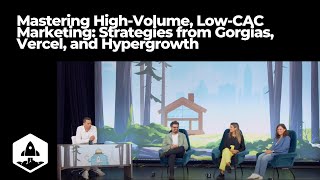
Guillaume Kevan hosts executives from Gorgias, Vercel, and Hypergrowth on scaling marketing cheaply. They cover automated outbound using behavioral signals, product-led growth to shift costs to users, and community tactics like open-source. AI personalization can boost outbound temporarily, but requires heavy upfront engineering investment.
Chapters
Hello everyone. Thanks for coming today. Thank you folks for coming. The intro on the speakers may be a bit short, so I'd like the panelists today to present themselves. We can maybe start with you Excel. You can tell us what's your role in company.
Yeah. Hello everyone. My name is Excel and I am a senior director of growth operations at Gorgias. Which means that my team handles all of the data collection, processing, process automation for all of the GTM team. So that's gonna be marketing partnerships, sales success, et cetera.
Hi everyone.
Morgan here.
I'm the VP of marketing at Vercel. We are a front end development cloud platform. In terms of what I do all day is just make sure that everybody knows about us and our brand. Help the company generate both self self serve and sales serve revenue.
I'm Martin Gontonikas but everybody calls me Gonto so call me Gonto. I'm his co founder on Hyperdos Partners. We help companies with marketing, growth and products. We do a deep advisory and try to help them grow with low CAC growth strategies. Before that I was the SVP of marketing and growth at oddsido which was a auth startup.
Okay. And I'm Guillaume Kevan, already calls me G. So we are the two GS and I used to run growth at a couple of companies including Segment Drift Gorgias where I worked with Excel and recently I'm an advisor at Ramp and I co run Hypergrowth Partners and I'm your host today. And so today's topic is going to be on scalable low CAC growth strategies. And that's a topic that you know, Gonto and I, we advise what north of 20 companies.
Yep.
Concurrently fairly late stage companies. And obviously you've been aware that this is like a clear shift in what the boards and founders are asking us. And it's no longer like growth at all cost. It's low CAC at all cost for better or worse. And then we got to come up with creative solutions. And so we want to share today some some examples and pulling from Vercel and Gorgias some great examples if you're kind enough to share a couple logos here. Obviously they're all companies that we have worked with and say in common. The reason why we have Morgan and Excel here in common. Those companies have one thing that's fairly unique and I wanted to pull from, from this deck here, from the keybanc capital deck before we kickstart this panel. And this is from like last year's survey but the best companies so the top companies have a significantly low lower CAC than the rest. Now that might sound obvious, but when you look at the data here at the bottom of this slide, you're seeing it is like $1.05 versus $1.80. And that is like probably one of the most profound differences. Like off the 120 slides, this is the one where you can see the biggest difference. And so it's obviously like, how do you achieve that? Okay, so let's dive into some couple examples and we can start I think with one example which is automated outbound. We have two interesting situations. We have one with Axel here, you're running at Gorgias with a team that has like fairly good experience on automated outbound for a couple of years. And Morgan, I think you have appetite to do that, a strong appetite. So maybe let's start there. Maybe Excel, you can tell us a bit about how it's running and like some of the performance there and what we can learn and copy.
Yeah, for sure. So as G said, we've been doing automated outbound at Gorgias for a while now and I'm going to try and give a quick overview of everything that's involved. So in Outbound we are going to consider three channels. There is the email actually dimension. You're going to have email outbound, you're going to have ads and then you're going to have also customer referral. And what we do at Gorgias is our dimension engine is fully automated and it is a multi channel approach to all the contacts that are and the companies of our tam. So the first thing that we do is obviously we use quite a bit of data vendors to first have a clear overview of what is our entire tam. And then from there that's when the strategy comes in. So we're going to be doing a lot of predictive analysis to categorize our tam. Right. And prioritize where we spend our resources. Because as we were saying before, making sure that you're making the most out of your resources, especially when those are quite tight, is paramount. So you want to make sure that you're using high quality data, that you audit it quite regularly and that from there you're making the best decisions possible. What we do with that, and that's something that we actually started with G when you were working with us at Gorgias, that was in 2019, I think, is we use a system of signals which are basically behavioral events that you can scrape the Internet for to understand what your TAM is doing. So a couple Examples, let's say a company is so gorgeous. Sorry, Circling back here, we're a help desk for E commerce stores. So our Persona are CX people. So imagine somebody in your TAM is hiring for a new CX lead. This is an event for us. Right. This is a signal that they need help to figure out their CX motion. So that's something for us that's interesting. If a company, the TAM say is starting to use another tool in the E comm SaaS world, that is also a signal for us, whether that be a competitor, direct competitor, Gorgias or just a highly compatible tool like Klaviyo, Yapo, et cetera.
If I recall from the numbers from back then, when you outbound a prospect with an intent signal, one of those versus not the dollars per contact were three times to four times higher, right?
Yeah.
So three to four times higher revenue per contact emailed when you have a predictive signal.
Yeah, and now we basically just do.
That's all you do?
Yeah, that's all we do now. And there's tons of signals out there. Our entire. Again, the engine is fully geared around that. And so it has a system of branches of depending on one the high fit of the company, the awareness stage that it's at with all of the different signals that we compute and aggregate from there they're going to fall into different branches of actions of. Okay, they're going to fall into first an email sequence and then at the third stage you're going to put in some ads in there and then ask for customer referral and try to have a network map of how you can associate prospects with your customer base or your partners. So putting all of that together using a ton of data and processing, that's intense.
I like it. Actually. Let me prompt that with one slide and let's switch to Morgan because Morgan, like you want to build that. Actually, I have some data for all of you which I pulled from ramp and so for obvious reasons, I had to obfuscate the actual numbers, but it did give you the lift here. What you have here is the difference between the average cost per contact email between the automated outbound team and the SDR team. So you have a 2 and a 2.4x difference and then the marginal cost, that's very important because as Excel was pointing out, there's a lot of infrastructure, there's a lot of effort, there's humans, lots of technology, lots of data vendors that you buying from. So there's a high upfront cost to get it running. But once it's running, the marginal cost to keep it running is extremely low. And so you can see here this 8x difference. Yeah, go ahead.
One thing to add is something that to me is interesting is that to get it running, what you need is engineering in marketing, which is not something very common. But to build it, you need to hire one or two engineers that are working on this. Because some of these integrations, some of the things you need to check, they need to be there. One example that I can give you that was pretty complex that we did with humanitech is they saw that companies were buying their product when they sell to engineers, and they saw that when the engineers, for example, when the company was going through an upgrade of Technology Stack, meaning changing programming language, that was a good time to contact. So we had to get an engineer to look into programming languages that developers were using in LinkedIn, look into programming languages that they were using in the hiding page, and check that every two days. If they were different, that meant that they were going through an upgrade of the tech stack because they were hiding for something different that wasn't there before. And then through that, using that information, then using an engineer to automate sending the emails and starting to build. All of that means that you're paying for an engineer, but you're starting to replace some of the SDRs that otherwise you're paying. So it's a bit of a switch of the cost as well, even though it increases in the beginning, but then it slows down.
How many emails do you send a month through your automated outbound program?
So I think in the past quarter.
We sent like about a million million emails. Yeah.
And how big is your tam? Like a couple hundred thousand core icp.
Couple hundred thousand.
So you're reaching out to every company in your TAM a couple times per quarter? More or less, yes.
Yes. But then again, through that, it's different people at different levels within those companies. And there's a whole strategy, too, of who to contact and when. Because I think also our outbound strategy as a whole has evolved quite a bit, even over the past couple of years, because our position in the market just wasn't the same, obviously. So at first you kind of want to reach out to everyone, get your name out there, make sure that you're known. And then there's a shift that comes in where you have to make sure that you protect your brand reputation. Even just for emailing capabilities, you get deliverability. Oh, for sure. So you need to work on that. And then it's about really mastering that balance between quantity and quality and then really working into the creative aspect to it. So there's big again, engineering upfront work. And I would say for us, we weren't even really engineering. So just learn on the job how to do some of that engineering like work. Today though, I feel like there are a lot of tools out there that can get you to that level of sophistication without being a proper engineer. There is a lot of no code or low code tools that can help you do that.
And Morgan, we talked earlier, just before this, that you had the yearning, the appetite to do this because right now you're fairly SDR heavy. Where are you on this journey and why this appetite?
Yeah.
So Vercel is still a relatively young company and when I joined about two years ago, every single salesperson was hitting their number or exceeding their target solely off of inbound. And when I joined I was like, wow, I would have loved to actually be a salesperson here instead of on marketing. But as we started to continue to grow and our targets remained highly aggressive, we needed to think about other ways we were going to hit our revenue targets without just relying on inbound. What we did at first is build a product advocates team instead of a traditional inbound SDR team. And so these were Vercel as a developer company selling to developers. So what we did is we hired people just out of boot camps that may have not gotten a job as an engineer at a company to take on this inbound SDR role. And we did that for two years and it worked out quite well for us because they could actually answer the questions that came in through inbound.
And.
But as we started to move up market, we needed to move away from just capturing demand from mid market and actually really start bringing demand to us from the enterprise and strategic segment. So we quickly hired 15 outbound SDRs in a period of six months. What we've noticed now is that we have a very heavy or very large SDR team that may not know actually how to go outbound to the developer audience. And so we're asking ourselves, would it be more effective if we actually pivoted to an automated outbound model so that we could be sending tens of thousands of emails a week and then passing anyone that's responding to those emails over to the SDR team and then are able to shrink the size of the team to be more effective and lower our acquisition costs?
Yeah, I think actually like I have, yeah, I have just here actually the payback period for multiple of my clients, which I Obviously normalized here. And this is like looking backwards and starting to shift. But there's something we talked about which is happening, which is the outbound channel both for email and calls were on a, I'd say downwards performance trend over the past 10 years. Mostly because everyone was being like just being commoditized. Everyone was being like desensitized to getting like personalized emails and calls. And with the arrival of AI in LLMs, the quality of the content is so much better that there is for now a return of this renewed performance. Actually like there's this tweet which I found fairly recently, a couple of weeks ago of somebody saying that the outbound they're getting from Reamp is the best emails ever. And those are automated, all right, Fully automated. There's no human involved in sending this. No human was harmed, at least on our side.
That's crafted spam effective.
But I have a point there which is generally I'm a happy camper if I provide value in the email. So here's the question I have, which is if you provide true value, if your email is truly helpful, does it matter if it was written by a human or not?
For the audience that I market to, it doesn't matter. And in fact sometimes if you let them know that it was generated through AI, it has higher click through rates. But that isn't the same for everybody. Not Everybody's Slanging Developer SaaS software, but.
There'S an honesty aspect to it for sure that people can relate to.
Yeah. So I think there is a shift in quality, there's a shift in expectations. I don't think it's going to last. I think there's going to be a return to median in a couple of quarters as people get desensitized again. But for now there are like these new tools both on the cold calling as well as on the email side and content creation side that you should go get those conversions and those low cacs. And if you're not, I think you're being left behind, like you're absolutely getting left behind.
And I think what's key now for all of that is understanding what are the right data vendors to use and if they're not right ones for you is what can you scrap, what can you get out of it? Like you were talking about using tools. But I'm a big believer that if you're using the same tools that all of the rest are using, it doesn't work because it's the same. You have to be unique. I'm a big Believer that it's better to be different than better. So if that's the case, it's how can I be more unique? How can I search something different? The rest is not searching. How can I in the email send you something that nobody expects? One example that you had that was pretty good was for example, sending GIFs. You create GIFs with injecting things based on how something would look like or you do a deep fake with something that is more custom now. And I think trying to be a bit more creative on some of those things and trying to actually use the engineer for build that will make a difference when you're trying to build these low CAC automated outbound strategies.
Yeah, absolutely. Okay, we're good on outbound. You want to shift to another low cac. Okay, so other low cac, far from ganto here, a product led sales Ganto.
Yeah, to talk a little bit about this is I think the example that Morgan shared before is fantastic. Most companies become product growth because they think it's going to be cheap and they think it's going to be just self service. But the reality is that most companies that do product led growth are not self service because in the end they need to get to enterprise because that's where the real money is. But if you only do enterprise and you forget about your user from the PLG perspective and it stops working. So to me, thinking about what's a good experience on product LED sales is what makes a difference. And I'll give you an example again. Selling to developers. One thing, for example that we're doing is we copied from Morgan the idea of using these product advocates, which are basically these junior, very junior developers that will act as SDRs. But one thing that we're doing, for example, is trying to understand if somebody got stuck trying to implement the product. How do we do that? We started with they click on one place in the dashboard, they click on another and then they come back. If they come back and they don't do anything, something weird is going on. If they click on a section and they stay there for 20, 30 seconds, maybe they are lost. But one thing we're trying to use now is AI to figure out if they are stuck. And then if they are stuck, the question is we want to contact them because we want to be useful, unstuck them and then sell them. But the other question is how creepy can we be? Can we tell them like, hey, you're stuck, we're going to help you, or they don't like it. So I'm A big believer in testing your creepiness level on how creepy you can be with your audience. What's interesting is that we developers, they love us to be creepy because they are like, oh, this is pretty cool. The engineering work to be creepy. I love it. So, so it worked. But when you work with other audiences, maybe it doesn't. But I think starting to think about how to build your product LED sales, maybe starting to use more AI, starting to automating and testing your creepiness level is a good way to think about PLs to create these enterprise level deals from a product growth perspective.
And if we take a step back, I think we've had this debate a couple times where we're getting asked from founders on the advisory fund all the time to help them build like product LED growth like all the freaking time. And we asked enc why, like why do they want to do PLG when they don't have like a PLG product? And the truth is if you think, if you actually deconstruct the why, it's because they want low CAC and they just mentally build the bridge that product LED growth means like free signups, Free signup is low cac.
That sounds great.
So let's just do this PLG thing. But they don't have the product that goes with it. There's no virality, there's almost sometimes no like way for the user to get to success on their own. And so there's no way to build like plg. And so there's actually a better way of like building product LED sign up motions with separate products to get people engaged and then push that into a sales motion. And that is a much easier transition than like shifting your entire product from an enterprise product down to a self serve like PLG product which no one really pulls off. But like Morgan, you have a true PLG product, don't you?
Yeah, we have both like a freemium plan and we have a free trial model. Like our freemium plan is bringing in 100,000 signups a month, which is a lot of people to be communicating with. And I always tell my team that like it's imagine filling at a football stadium and then trying to figure out of all the people in the football stadium who needs to talk to the sales team, which is quite hard. So I think if you're just starting off this model that we're talking about, product advocates is a really interesting one because it actually shifts the mindset of being proactive customer support. And if you're doing things in the best interest of your customers to make sure that they fully understand how to use the product, whether in a creepy way or an uncreepy way. You get really good outcomes and you let people start to self identify that they have the intent that they actually are maybe in the wrong place and they do want to be speaking to a salesperson because they know for sure they're going to get a discount or they're looking for certain security compliance features that are not available in the free plan. And then if you maybe don't have a real PLG business model, I do think thinking about free trials in terms of intent is another interesting way. One thing that we did at Vercel is we realized listen, some people, they don't even want to go try the free plan and they don't even want to take the effort to start a free trial and maybe they're not also ready to talk to a salesperson for an interactive demo. And so we built our own just like self serve demo that allows someone to look around in the product and see what it would look like with everything enabled. They don't have to do any implementation themselves.
You build yourself in house, no nevatic walnuts involved.
Yes.
Interesting.
Why?
Just because those are the people that have the lowest intent but still have intent and we're not asking them to do anything. I think PLG is great but the user is still on the hook to do something and they might not have the time of the day or it just sense makes might not be the right moment.
I actually I want to double click on that because I love that trail of thought there. Actually there's a connection between Outbound and PLG where they're both like very high scale, low conversion motions and if you just compare like you know, let's say sales led businesses there's like a complete opposition. Like in the sales led business the cost of doing the sales is fairly high. You have humans involved, you've got like SDRs and AES and there's dropouts at every point. And and so you're trying to be careful thus like all the qualification tools where you're trying to basically de risk and remove some of the costs that might come into your funnel. And PLG and Outbound is the opposite. There's no cost for you to get people on this like self hosted demo, self serve demo. Right. And so you're trying to push as many as possible and the people like will self select. Oh, Vercel is the right tool for me.
This is perfect.
I'm the right user and Those who get through are qualified. And so you have qualification like scenarios. The question is, who's doing the qualification? Who's bearing the cost? And then in the PLG outbound model, the user is bearing the cost. Right. And in the sales then model like you, the company is bearing the cost. Which is why we're all seeing this shift from the company to PLG and outbound. Because, yeah, we want to shift the cost to the users. That's what's going on.
Yeah, that interactive demo is completely ungated, so. So anyone can try it. We're not asking you for your email. And then at the very end we just say, are you interested in chatting with someone from the sales team or are you interested in starting a trial? And we let them just choose on their own. It does reduce the amount of leads that we're generating, but we don't want a large SDR team, so we found it to be more effective.
Can you give us some examples? I thought there was some cool examples of a community on plg. Ganto.
Yeah. Like the other thing that to me is interesting is if you think about community is also one or few too many things where you want to blow up or become a thought leader or become known in a specific community so that then people start coming to you. One thing that we've done with one of our customers that I think is very interesting is when everybody thinks about community, they think that they have to create their own community. But I think in most cases that's not a good idea. I think it makes sense to create your own community when you have something that is free for everybody or it's a big portion that is free, or if it's open source, if it's a developer product, but if it's not that, then you have a closed product. People need to pay. They don't want to be part of your community. Like why? So in those cases, to me it's more about how do I tap into existing communities. And existing communities are still relationship based. So one thing that we did, for example, was after interviewing a few ICs from our target market, we figured out who were the 20 people on Twitter and YouTube that we wanted to talk about us. So what we did is without them knowing, we followed them around the world, we looked into what conferences they were speaking and we spoke into all of those conferences. The people who spoke at those conferences were just two. They flew around and the idea was we went to those conferences. Not because of your following people around.
The world at conferences.
Yeah, creepiness.
Yeah.
I was going to say like this.
Factor is eking towards the edge.
And in that case, instead of caring about the attendees like you, we care about the speakers because you have a speaker dinner, you go drinking with them, you build a relationship with them and then because of that they started to share our content. So then what's our distribution talent? It's not Google, it's actually the community who are the influencers in this community that we have a relationship with that show our content. And then people are like, wow, everybody's talking about this company, this must be great. But even though the product in this case is great, that might not be the case. And it's more a relationship driven thing that is making it happen.
That makes sense.
Yeah. And for Vercel we had a different approach. We didn't necessarily tap into an existing community, although we are like a react based framework. And we did tap into that community, you could argue. But we ended up creating our own open source framework and essentially we're giving technology away for free and that's growing the community. That Next JS community is what actually fuels all of our growth. So if that number is going up and to the right of how many people are using Next js, we see the same correlation for how many people are actually signing up on our paid platform. And it was a very similar model from when I worked at GitHub.
What I love about that is that even though your product was not free or was not open source, you created something in parallel that is free and open source and people can use. And then once people are using it, you're like, oh, but they work so much better in my platform.
Yeah.
And I think that's a fantastic way to build your own community with something that's.
I want to say it works that way but not the other way around. Because when you have a successful business, then you open source part of it. But you already have the monetization framework that works great because then you're creating growth. Gaunter and I, we both have been involved in like open source businesses which try to like monetize on top of like completely open source like community. And that's been like one hell of a struggle because they have no monetization paths and people are like, hey, this free platform is open source, platform is great, why should I pay? And so the shift of the perceptions is not there. And that's been a real struggle. So I think like a couple of businesses like Vercel, I was in segment, it's the same.
Right.
Monetization comes first Open source for acquisition comes second. Other way around is like super hard. My opinion. Cool. Any other creative tactics you want to share? Go on to more creepiness ideas.
I have one more to share.
I was sure.
Which is a creepy. I'll say. But one of the things that we did, for example, with influencers as well, is we wanted influencers. We wanted people to think more of our brand and know us more. So one thing that we did was we looked into the known influencers in the space again. In this case, they were developers as well. And they had some open source frameworks and they had their own landing pages. And what we did was two things. One is we started to go and offer them for free to redesign their websites. So open source framework and the influencer page, we did it for free. Hey, we'll redesign it. We'll do everything of this for you. And of course they said yes because it's free. But why did we do it? Because this is the creepy part.
The thing is that I knew it.
Yeah, our redesign is exactly with the same branding, same color, same everything as the product brand. So now people don't see it, but when they go to every influencer page and to every framework page, they see the same type of logos, the same type of colors, and they think it's related, even though it's not. So with that, they feel a bit more related to this. And one last thing that we added on top of that is that we asked them that if in exchange of this free redesign, they could add a retargeting pixel on their website. So the idea of that is that now if anybody goes to any of these open source frameworks, we can target them with ads, even though we don't know who they are. But we know that if they're going to that page, it makes a lot of sense for us as a customer as well.
Basis of marketing, you're offering something of a perceived value which is much perceivedly higher but very low cost to you. And in exchange getting something very high value to you, but very low cost to them. So it's a good trade.
Exactly, Good trade.
I like it. Okay, a couple of like takeaways from today. So what you chat about. So a strong shift towards like low cac. Like absolutely. Like high volume, low CAC in very different businesses. Like you look at Excel at Gorgias and Morgan at Vercel, we're talking of two different industries and motions, but the yearning is the same. Right. And what Ganja and I are seeing in our talks with founders is founders obviously want to have the cake and eat it. Right? And so they want both, right? You both want like the low CAC of the outbound and you want the PLG motion and you want it now. And so that's what's going on. Honestly, you should start somewhere not on both sides is my opinion. And so PLG for sales led. PLG2, sales led is probably the new thing we're seeing right now. I think that's the major shift we're seeing right now with AI empowered outbound. Think of the two major shifts we're seeing.
I think it's that and also the combination of both of them together. Like you're doing PLG and you have ICs from something, individual contributors signing up. Then you automate, maybe showing ads to their bosses. So because of availability bias, when they bring it up, they'll remember it. And then you send them emails that are automated based on information from what the developer is doing and what others are doing and using AI. So I think also the combination of these two strategies is where things start to get fun, creepy. I don't know, something.
I think there's really a strong shift with the tools we have. Like both, like Excel talked about the low code tools, but also like the AI tools, like on the copywriting and automation part as well as on plg. Like, if you're not using this, you're going to be left behind. And I also don't think it's going to last super long. There's going to be a reversion to the mean in the next couple quarters as people become desensitized. And so there is a time window to do this. Right now there's a significant benefit if your competitors are not doing this, to do it yourself. But in three, four quarters, you'll have to do something else.
Cool.
Thank you. Thank you so much. We're out of time. Thank you so much for coming today. And I hope you can go talk to your founders, your CEOs and do at least one of those two campaigns. Thank you, folks.










